
**Astronomy Picture of the Day**
07 March 2025
**Planetary Nebula Abell 7**
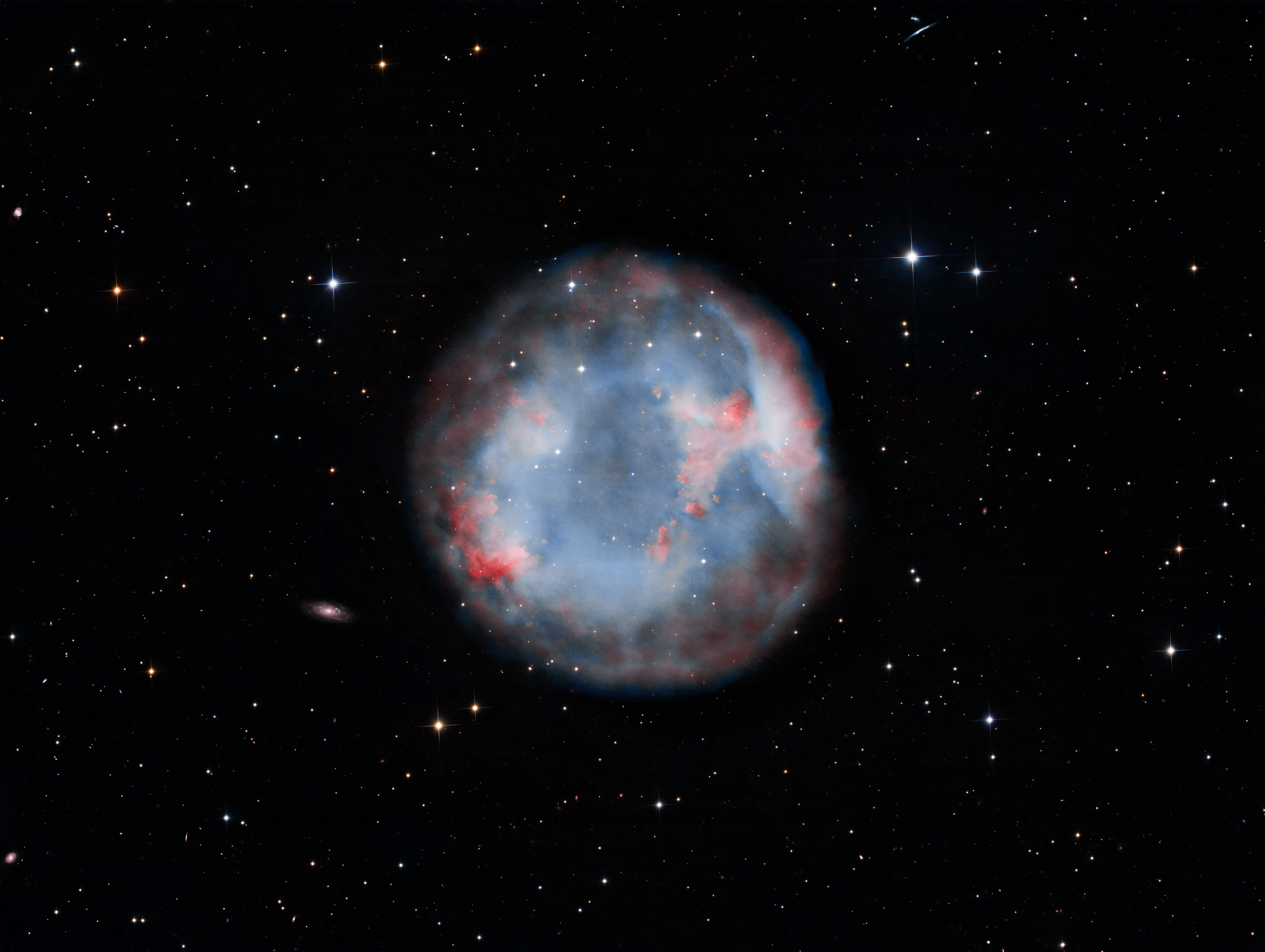
Image Credit & Copyright: Vikas Chander
Very faint planetary nebula Abell 7 is about 1,800 light-years distant. It lies just south of Orion in planet Earth's skies toward the constellation Lepus, The Hare. Surrounded by Milky Way stars and near the line-of-sight to distant background galaxies its generally simple spherical shape, about 8 light-years in diameter, is revealed in this deep telescopic image. Within the cosmic cloud are beautiful and complex structures though, enhanced by the use of long exposures and narrowband filters that capture emission from hydrogen, sulfur, and oxygen atoms. Otherwise Abell 7 would be much too faint to be appreciated by eye. A planetary nebula represents a very brief final phase in stellar evolution that our own Sun will experience 5 billion years hence, as the nebula's central, once sun-like star shrugs off its outer layers. Abell 7 itself is estimated to be 20,000 years old. But its central star, seen here as a fading white dwarf, is some 10 billion years old.
#APOD #AstronomyPhotography #Astrodata #Astrophoto #Space
**Astronomy Picture of the Day**
06 March 2025
**Starburst Galaxy Messier 94**

*Image creditor details unavailable via API. Visit linked page below for full info.*
Beautiful island universe Messier 94 lies a mere 15 million light-years distant in the northern constellation of the hunting dogs, Canes Venatici. A popular target for earth-based astronomers, the face-on spiral galaxy is about 30,000 light-years across, with spiral arms sweeping through the outskirts of its broad disk. But this Hubble Space Telescope field of view spans about 7,000 light-years or so across M94's central region. The sharp close-up examines the galaxy's compact, bright nucleus and prominent inner dust lanes, surrounded by a remarkable bluish ring of young, massive stars. The massive stars in the ring appear to be less than about 10 million years old, indicating the galaxy experienced a corresponding well-defined era of rapid star formation. As a result, while the small, bright nucleus is typical of the Seyfert class of active galaxies, M94 is also known as a starburst galaxy. Because M94 is relatively nearby, astronomers can explore in detail reasons for the galaxy's burst of star formation. Today's Coverage: Moon Landing
#APOD #RocketScience #NASA #Universe #SpaceExploration
**Astronomy Picture of the Day**
05 March 2025
**Seven Sisters versus California**

Image Credit & Copyright:
Todd Anderson
On the right, dressed in blue, is the Pleiades. Also known as the Seven Sisters and M45, the Pleiades is one of the brightest and most easily visible open clusters on the sky. The Pleiades contains over 3,000 stars, is about 400 light years away, and only 13 light years across. Surrounding the stars is a spectacular blue reflection nebula made of fine dust. A common legend is that one of the brighter stars faded since the cluster was named. On the left, shining in red, is the California Nebula. Named for its shape, the California Nebula is much dimmer and hence harder to see than the Pleiades. Also known as NGC 1499, this mass of red glowing hydrogen gas is about 1,500 light years away. Although about 25 full moons could fit between them, the featured wide angle, deep field image composite has captured them both. A careful inspection of the deep image will also reveal the star forming region IC 348 and the molecular cloud LBN 777 (the Baby Eagle Nebula). Jump Around the Universe: Random APOD Generator
#APOD #BlackHoles #Stellar #Astrogeek #Research
**Astronomy Picture of the Day**
04 March 2025
**A Quadruple Alignment over Italy**

Image Credit & Copyright:
Valerio Minato
Why does this Moon look so unusual? A key reason is its vivid red color. The color is caused by the deflection of blue light by Earth's atmosphere -- the same reason that the daytime sky appears blue. The Moon also appears unusually distorted. Its strange structuring is an optical effect arising from layers in the Earth's atmosphere that refract light differently due to sudden differences in temperature or pressure. A third reason the Moon looks so unusual is that there is, by chance, an airplane flying in front. The featured picturesque gibbous Moon was captured about two weeks ago above Turin, Italy. Our familiar hovering sky orb was part of an unusual quadruple alignment that included two historic ground structures: the Sacra di San Michele on the near hill and Basilica of Superga just beyond. Your Sky Surprise: What picture did APOD feature on your friend's birthday? (post 1995)
#APOD #Astrophysics #Astrobiology #SpaceMissions #AstronomyPhotography
**Astronomy Picture of the Day**
03 March 2025
**Blue Ghost on the Moon**
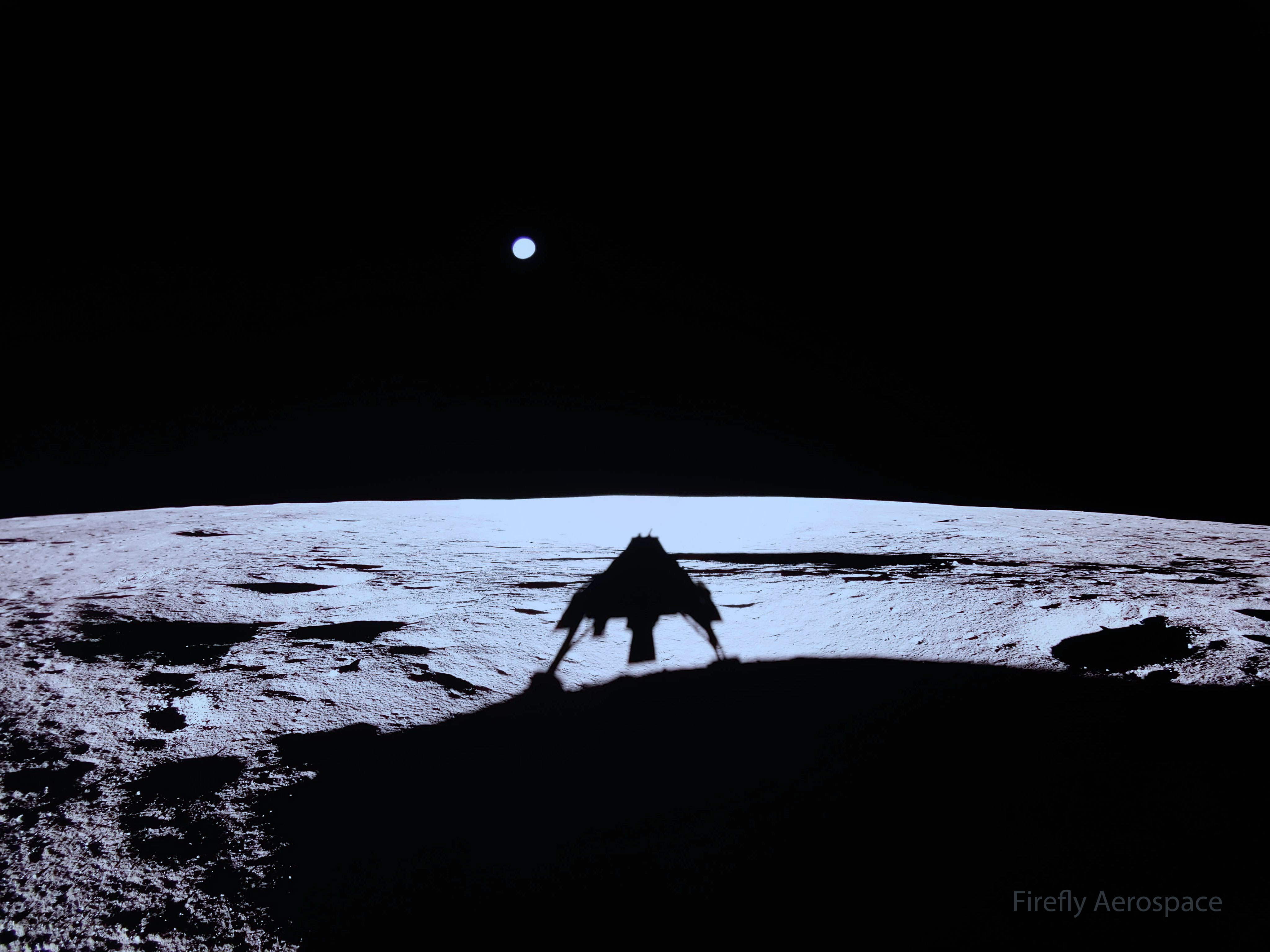
*Image creditor details unavailable via API. Visit linked page below for full info.*
There's a new lander on the Moon. Yesterday Firefly Aerospace's Blue Ghost executed the first-ever successful commercial lunar landing. During its planned 60-day mission, Blue Ghost will deploy several NASA-commissioned scientific instruments, including PlanetVac which captures lunar dust after creating a small whirlwind of gas. Blue Ghost will also host the telescope LEXI that captures X-ray images of the Earth's magnetosphere. LEXI data should enable a better understanding of how Earth's magnetic field protects the Earth from the Sun's wind and flares. Pictured, the shadow of the Blue Ghost lander is visible on the cratered lunar surface, while the glowing orb of the planet Earth hovers just over the horizon. Goals for future robotic Blue Ghost landers include supporting lunar astronauts in NASA's Artemis program, with Artemis III currently scheduled to land humans back on the Moon in 2027.
#APOD #Astrotheory #Research #Astronauts #Astrochemistry
**Astronomy Picture of the Day**
02 March 2025
**The Hubble Ultra Deep Field in Light and Sound**
https://apod.nasa.gov/apod/image/1803/AstroSoM/hudf.html
*Image creditor details unavailable via API. Visit linked page below for full info.*
Have you heard about the Hubble Ultra-Deep Field? Either way, you've likely not heard about it like this -- please run your cursor over the featured image and listen! The Hubble Ultra-Deep Field (HUDF) was created in 2003-2004 with the Hubble Space Telescope staring for a long time toward near-empty space so that distant, faint galaxies would become visible. One of the most famous images in astronomy, the HUDF is featured here in a vibrant way -- with sonified distances. Pointing to a galaxy will play a note that indicates its approximate redshift. Because redshifts shift light toward the red end of the spectrum of light, they are depicted here by a shift of tone toward the low end of the spectrum of sound. The further the galaxy, the greater its cosmological redshift (even if it appears blue), and the lower the tone that will be played. The average galaxy in the HUDF is about 10.6 billion light years away and sounds like an F#. What's the most distant galaxy you can find?
#APOD #Astrogeology #Planets #SpaceMission #SpaceIndustry
**Astronomy Picture of the Day**
01 March 2025
**Blue Ghost to the Moon**
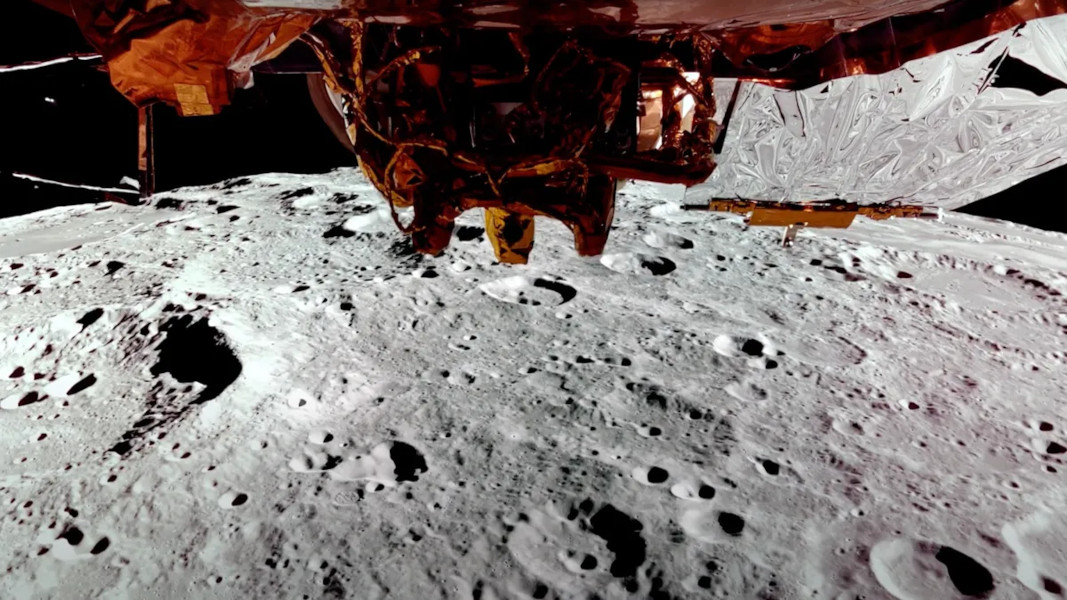
*Image creditor details unavailable via API. Visit linked page below for full info.*
With spacecraft thrusters at top center, the rugged surface of the Moon lies below the Blue Ghost lander in this space age video frame. The view of the lunar far side was captured by the Firefly Aerospace lunar lander on February 24, following a maneuver to circularize its orbit about 100 kilometers above the lunar surface. The robotic lunar lander is scheduled to touch down tomorrow, Sunday, March 2, at 3:34am Eastern Time in the Mare Crisium impact basin on the lunar near side. In support of the Artemis campaign, Blue Ghost is set to deliver science and technology experiments to the Moon, part of NASA's Commercial Lunar Payload Services program. Blue Ghost's mission on the surface is planned to operate during the lunar daylight hours at the landing site, about 14 Earth days.
#APOD #AstronomyFacts #Astroinformatics #AstronomyClub #Astrophysics
**Astronomy Picture of the Day**
28 February 2025
**Athena to the Moon**

*Image creditor details unavailable via API. Visit linked page below for full info.*
Planet Earth hangs in the background of this space age selfie. The snapshot was captured by the IM-2 Nova-C lander Athena, just after stage separation following its February 26 launch to the Moon. A tall robotic lander, Athena is scheduled to touch down on Thursday, March 6, in Mons Mouton, a plateau near the Moon’s South Pole. The intended landing site is in the central portion of one of the Artemis 3 potential landing regions. Athena carries rovers and experiments as part of NASA's Commercial Lunar Payload Services program, including a drill intended to explore beneath the lunar surface in a search for evidence of frozen water. It also carries a propulsive drone dubbed the Micro Nova Hopper. After release to the lunar surface, the autonomous drone is intended to hop into a nearby crater and send science data back to the lander.
#APOD #Cosmos #SpaceExploration #Astroengineer #StarFormation
**Astronomy Picture of the Day**
27 February 2025
**Open Star Clusters M35 and NGC 2158**

Image Credit & Copyright: Evan Tsai
Framed in this single, starry, telescopic field of view are two open star clusters, M35 and NGC 2158. Located within the boundaries of the constellation Gemini, they do appear to be side by side. Its stars concentrated toward the upper right, M35 is relatively nearby, though. M35 (also cataloged as NGC 2168) is a mere 2800 light-years distant, with 400 or so stars spread out over a volume about 30 light-years across. Bright blue stars frequently distinguish younger open clusters like M35, whose age is estimated at 150 million years. At lower left, NGC 2158 is about four times more distant than M35 and much more compact, shining with the more yellowish light of a population of stars over 10 times older. In general, open star clusters are found along the plane of our Milky Way Galaxy. Loosely gravitationally bound, their member stars tend to be dispersed over billions of years as the open star clusters orbit the galactic center.
#APOD #Astrophoto #CosmicWonders #Universe #Planets
**Astronomy Picture of the Day**
26 February 2025
**Einstein Ring Surrounds Nearby Galaxy Center**

Image Credit & Copyright:
ESA,
NASA,
Euclid Consortium;
Processing:
J.-C. Cuillandre,
G. Anselmi, T. Li
Do you see the ring? If you look very closely at the center of the featured galaxy NGC 6505, a ring becomes evident. It is the gravity of NGC 6505, the nearby (z = 0.042) elliptical galaxy that you can easily see, that is magnifying and distorting the image of a distant galaxy into a complete circle. To create a complete Einstein ring there must be perfect alignment of the nearby galaxy's center and part of the background galaxy. Analysis of this ring and the multiple images of the background galaxy help to determine the mass and fraction of dark matter in NGC 6505's center, as well as uncover previously unseen details in the distorted galaxy. The featured image was captured by ESA's Earth-orbiting Euclid telescope in 2023 and released earlier this month.
#APOD #StarCluster #Astrochemistry #Astrofans #SpaceExploration
**Astronomy Picture of the Day**
25 February 2025
**M41: The Little Beehive Star Cluster**
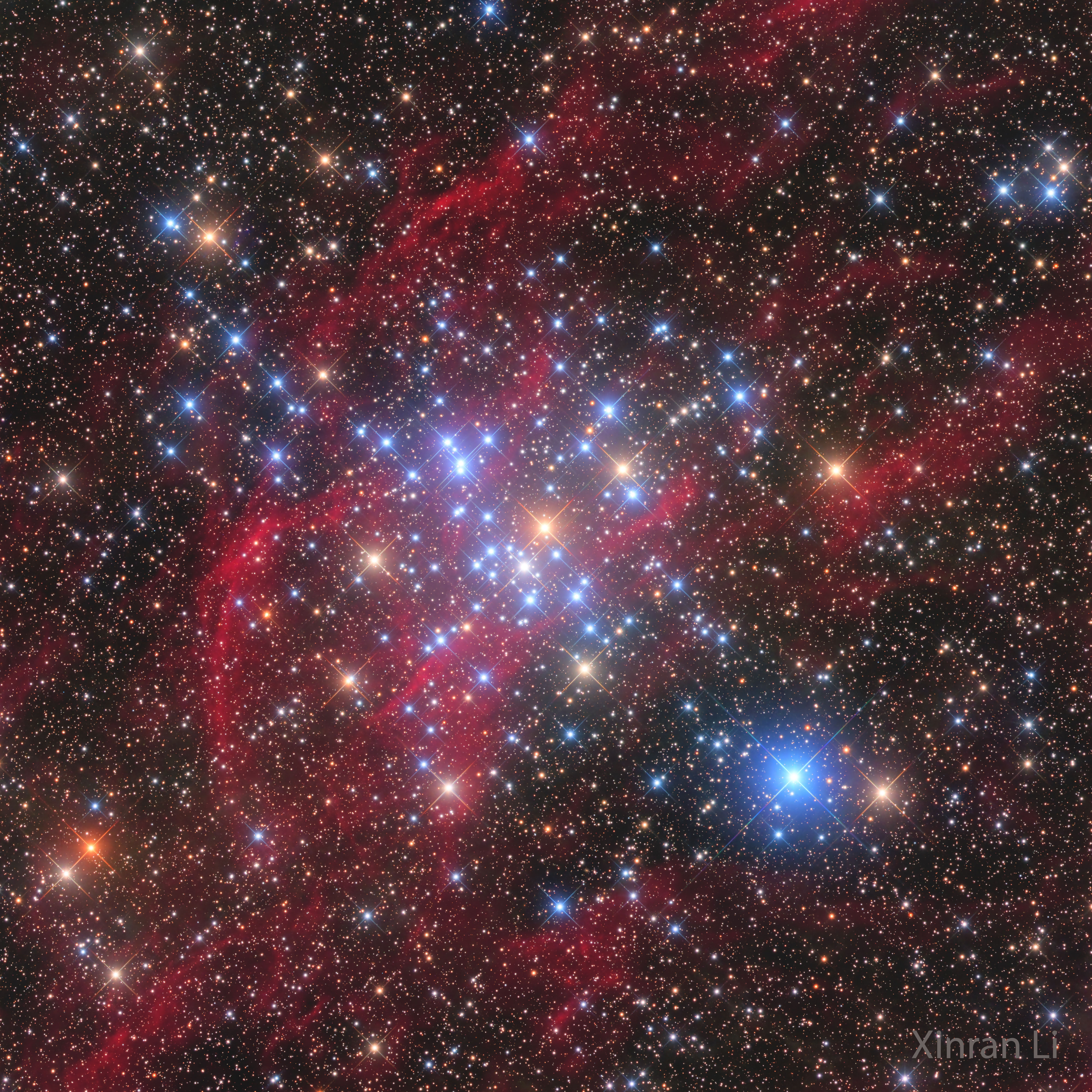
Image Credit & Copyright:
Xinran Li
Why are there so many bright blue stars? Stars are usually born in clusters, and the brightest and most massive of these stars typically glow blue. Less-bright, non-blue stars like our Sun surely also exist in this M41 star cluster but are harder to see. A few bright orange-appearing red giant stars are visible. The red-light filaments are emitted by diffuse hydrogen gas, a color that was specifically filtered and enhanced in this image. In a hundred million years or so, the bright blue stars will have exploded in supernovas and disappeared, while the slightly different trajectories of the fainter stars will cause this picturesque open cluster to disperse. Similarly, billions of years ago, our own Sun was likely born into a star cluster like M41, but it has long since drifted apart from its sister stars. The featured image was captured over four hours with Chilescope T2 in Chile.
#APOD #SpaceDiscovery #Galactic #NASAInspires #Astrogeology
**Astronomy Picture of the Day**
24 February 2025
**Light Pillar over Erupting Etna**

Image Credit & Copyright:
Davide Caliò
Can a lava flow extend into the sky? No, but light from the lava flow can. One effect is something quite unusual -- a volcanic light pillar. More typically, light pillars are caused by sunlight and so appear as a bright column that extends upward above a rising or setting Sun. Alternatively, other light pillars -- some quite colorful -- have been recorded above street and house lights. This light pillar, though, was illuminated by the red light emitted by the glowing magma of an erupting volcano. The volcano is Italy's Mount Etna, and the featured image was captured with a single shot during an early morning in mid-February. Freezing temperatures above the volcano's lava flow created ice-crystals either in the air above the volcano or in condensed water vapor expelled by Mount Etna. These ice crystals -- mostly flat toward the ground but fluttering -- then reflected away light from the volcano's caldera.
#APOD #GalacticAdventures #Astrophysics #BlackHoleDiscovery #Meteorology
**Astronomy Picture of the Day**
23 February 2025
**Saturn in Infrared from Cassini**

*Image creditor details unavailable via API. Visit linked page below for full info.*
Saturn looks slightly different in infrared light. Bands of clouds show great structure, including long stretching storms. Also quite striking in infrared is the unusual hexagonal cloud pattern surrounding Saturn's North Pole. Each side of the dark hexagon spans roughly the width of our Earth. The hexagon's existence was not predicted, and its origin and likely stability remain a topics of research. Saturn's famous rings circle the planet and cast shadows below the equator. The featured image was taken by the robotic Cassini spacecraft in 2014 in several infrared colors. In 2017 September, the Cassini mission was brought to a dramatic conclusion when the spacecraft was directed to dive into the ringed giant. Your Sky Surprise: What picture did APOD feature on your birthday? (post 1995)
#APOD #Astrophotography #Exploration #Universe #CosmosJourney
**Astronomy Picture of the Day**
22 February 2025
**Rima Hyginus**
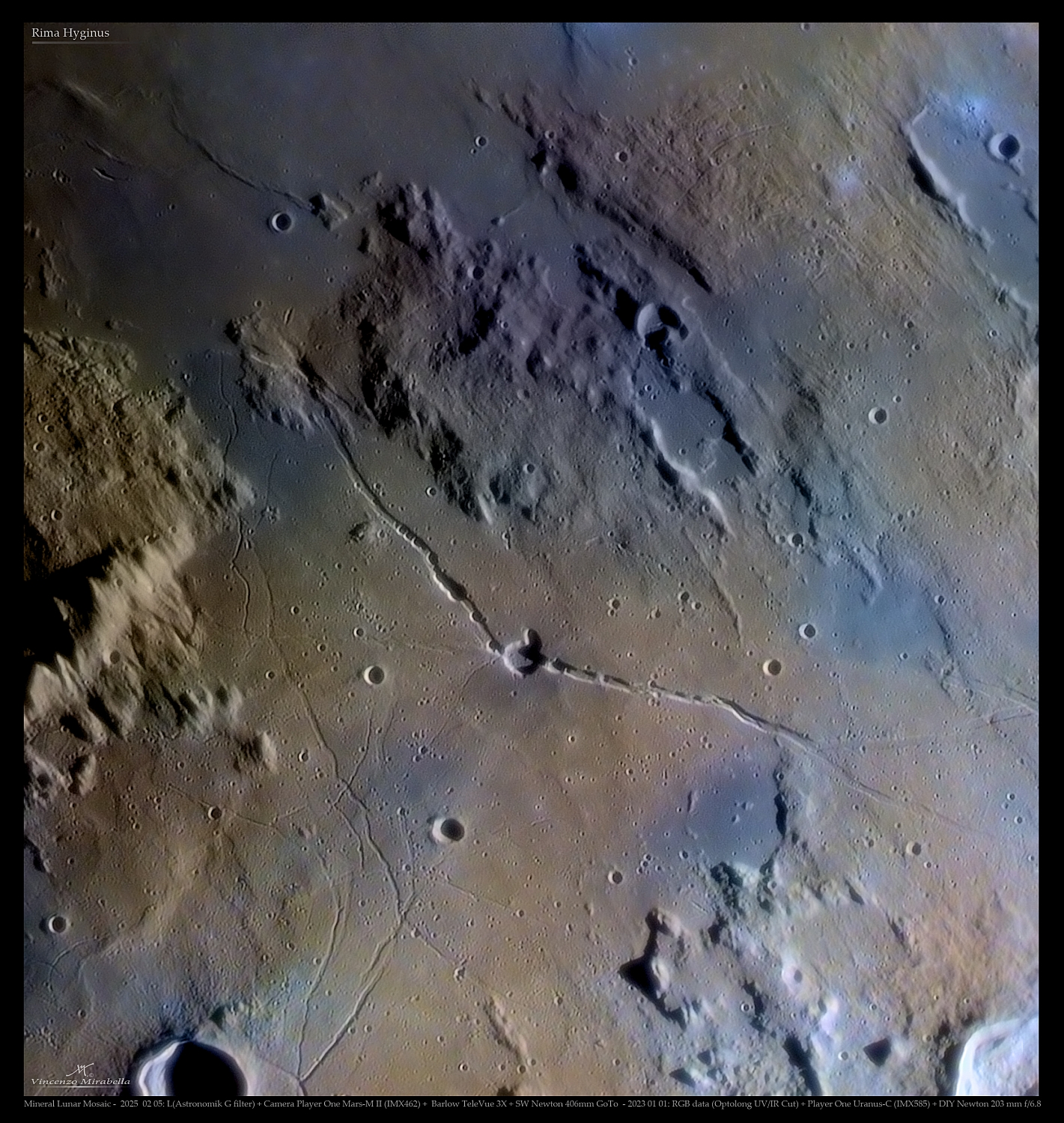
Image Credit & Copyright: Vincenzo Mirabella
Rima Hyginus is a spectacular fissure, some 220 kilometers long, found near the center of the lunar near side. Easy to spot in telescopic views of the Moon, it stretches top left to bottom right across this lunar closeup. The image was made with exaggerated colors that reflect the mineral composition of the lunar soil. Hyginus crater lies near the center of the narrow lunar surface groove. About 10 kilometers in diameter, the low-walled crater is a volcanic caldera, one of the larger non-impact craters on the lunar surface. Dotted with small pits formed by surface collapse, Hyginus rima itself was likely created by stresses due to internal magma upwelling and collapse along a long surface fault. The intriguing region was a candidate landing site for the canceled Apollo 19 mission.
#APOD #Universe #SpaceExploration #GalacticAdventures #Astrogeology
**Astronomy Picture of the Day**
21 February 2025
**Hubble's Andromeda Galaxy Mosaic**

*Image creditor details unavailable via API. Visit linked page below for full info.*
The largest photomosaic ever assembled from Hubble Space Telescope image data is a panoramic view of our neighboring spiral Andromeda Galaxy. With 600 overlapping frames assembled from observations made from July 2010 to December 2022, the full Hubble Andromeda Galaxy mosaic spans almost six full moons across planet Earth's sky. A cropped version shown above is nearly two full moons across and partially covers Andromeda's core and inner spiral arms. Also known as M31, the Andromeda Galaxy is 2.5 million light-years away. That makes it the closest large spiral galaxy to our own Milky Way. Our perspective on the spiral Milky Way is anchored to the view from the location of the Sun, a star found within the Milky Way's galactic disk. But Hubble's magnificent Andromeda mosaic offers an expansive view of a large spiral galaxy from the outside looking in. Hubble's comprehensive, detailed data set extending across the Andromeda Galaxy will allow astronomers to make an unprecedented holistic exploration of the mysteries of spiral galaxy structure and evolution.
#APOD #Universe #Research #PlanetaryScience #GalacticAdventures
**Astronomy Picture of the Day**
20 February 2025
**Messier 87**

*Image creditor details unavailable via API. Visit linked page below for full info.*
rmous elliptical galaxy Messier 87 is about 50 million light-years away. Also known as NGC 4486, the giant galaxy holds trillions of stars compared to the mere billions of stars in our large spiral Milky Way. M87 reigns as the large central elliptical galaxy in the Virgo galaxy cluster. An energetic jet from the giant galaxy's core is seen to stretch outward for about 5,000 light-years in this sharp optical and near-infrared view from the Hubble Space Telescope. In fact, the cosmic blow torch is seen across the electromagnetic spectrum from gamma-rays to radio wavelengths. Its ultimate power source is M87's central, supermassive black hole. An image of this monster in the middle of M87 has been captured by planet Earth's Event Horizon Telescope.
#APOD #Cosmological #Astrophysics #SpaceStation #Astrogeek
**Astronomy Picture of the Day**
19 February 2025
**HH 30: A Star System with Planets Now Forming**

*Image creditor details unavailable via API. Visit linked page below for full info.*
How do stars and planets form? New clues have been found in the protoplanetary system Herbig-Haro 30 by the James Webb Space Telescope in concert with Hubble and the Earth-bound ALMA. The observations show, among other things, that large dust grains are more concentrated into a central disk where they can form planets. The featured image from Webb shows many attributes of the active HH-30 system. Jets of particles are being expelled vertically, shown in red, while a dark dust-rich disk is seen across the center, blocking the light from the star or stars still forming there. Blue-reflecting dust is seen in a parabolic arc above and below the central disk, although why a tail appears on the lower left is currently unknown. Studying how planets form in HH 30 can help astronomers better understand how planets in our own Solar System once formed, including our Earth.
#APOD #Science #GalacticAdventures #NASAInspires #SpaceTech
**Astronomy Picture of the Day**
18 February 2025
**Thor's Helmet versus the Seagull**

Image Credit & Copyright:
Nicolas Martino, Adrien Soto, Louis Leroux &
Yann Sainty
Seen as a seagull and a duck, these nebulae are not the only cosmic clouds to evoke images of flight. But both are winging their way across this broad celestial landscape, spanning almost 7 degrees across planet Earth's night sky toward the constellation of the Big Dog (Canis Major). The expansive Seagull (top center) is itself composed of two major cataloged emission nebulas. Brighter NGC 2327 forms the head with the more diffuse IC 2177 as the wings and body. Impressively, the Seagull's wingspan would correspond to about 250 light-years at the nebula's estimated distance of 3,800 light-years. At the lower right, the Duck appears much more compact and would span only about 50 light-years given its 15,000 light-year distance estimate. Blown by energetic winds from an extremely massive, hot star near its center, the Duck nebula is cataloged as NGC 2359. Of course, the Duck's thick body and winged appendages also lend it the slightly more dramatic popular moniker, Thor's Helmet. Portal Universe: Random APOD Generator
#APOD #PlanetaryExploration #Astrochemistry #RocketLaunch #Astroknowledge
**Astronomy Picture of the Day**
17 February 2025
**SpaceX Rocket Launch Plume over California**

Image Credit & Copyright:
Martin LaMontagne
What's happened to the sky? Last Monday, the photogenic launch plume from a SpaceX rocket launch created quite a spectacle over parts of southern California and Arizona. Looking at times like a giant space fish, the impressive rocket launch from Vandenberg Air Force Base near Lompoc, California, was so bright because it was backlit by the setting Sun. The Falcon 9 rocket successfully delivered to low Earth orbit 23 Starlink communications satellites. The plume from the first stage is seen on the right, while the soaring upper stage rocket is seen at the apex of the plume toward the left. Venus appears at the top of the frame, while a bright streetlight shines on the far right. The featured image was captured toward the west after sunset from near Phoenix, Arizona.
#APOD #SpaceTech #SpaceDiscovery #Astroeducation #Astroenthusiast
**Astronomy Picture of the Day**
16 February 2025
**Perijove 11: Passing Jupiter**
https://www.youtube.com/embed/OfM7VlonD5c?rel=0
*Image creditor details unavailable via API. Visit linked page below for full info.*
Here comes Jupiter. NASA's robotic spacecraft Juno is continuing on its highly elongated orbits around our Solar System's largest planet. The featured video is from perijove 11 in early 2018, the eleventh time Juno passed near Jupiter since it arrived in mid-2016. This time-lapse, color-enhanced movie covers about four hours and morphs between 36 JunoCam images. The video begins with Jupiter rising as Juno approaches from the north. As Juno reaches its closest view -- from about 3,500 kilometers over Jupiter's cloud tops -- the spacecraft captures the great planet in tremendous detail. Juno passes light zones and dark belts of clouds that circle the planet, as well as numerous swirling circular storms, many of which are larger than hurricanes on Earth. After the perijove, Jupiter recedes into the distance, then displaying the unusual clouds that appear over Jupiter's south. To get desired science data, Juno swoops so close to Jupiter that its instruments are exposed to very high levels of radiation.
#APOD #SpaceWeather #SpaceDiscovery #SpaceInnovation #Planets