
**Astronomy Picture of the Day**
28 March 2025
**Lunar Dust and Duct Tape**
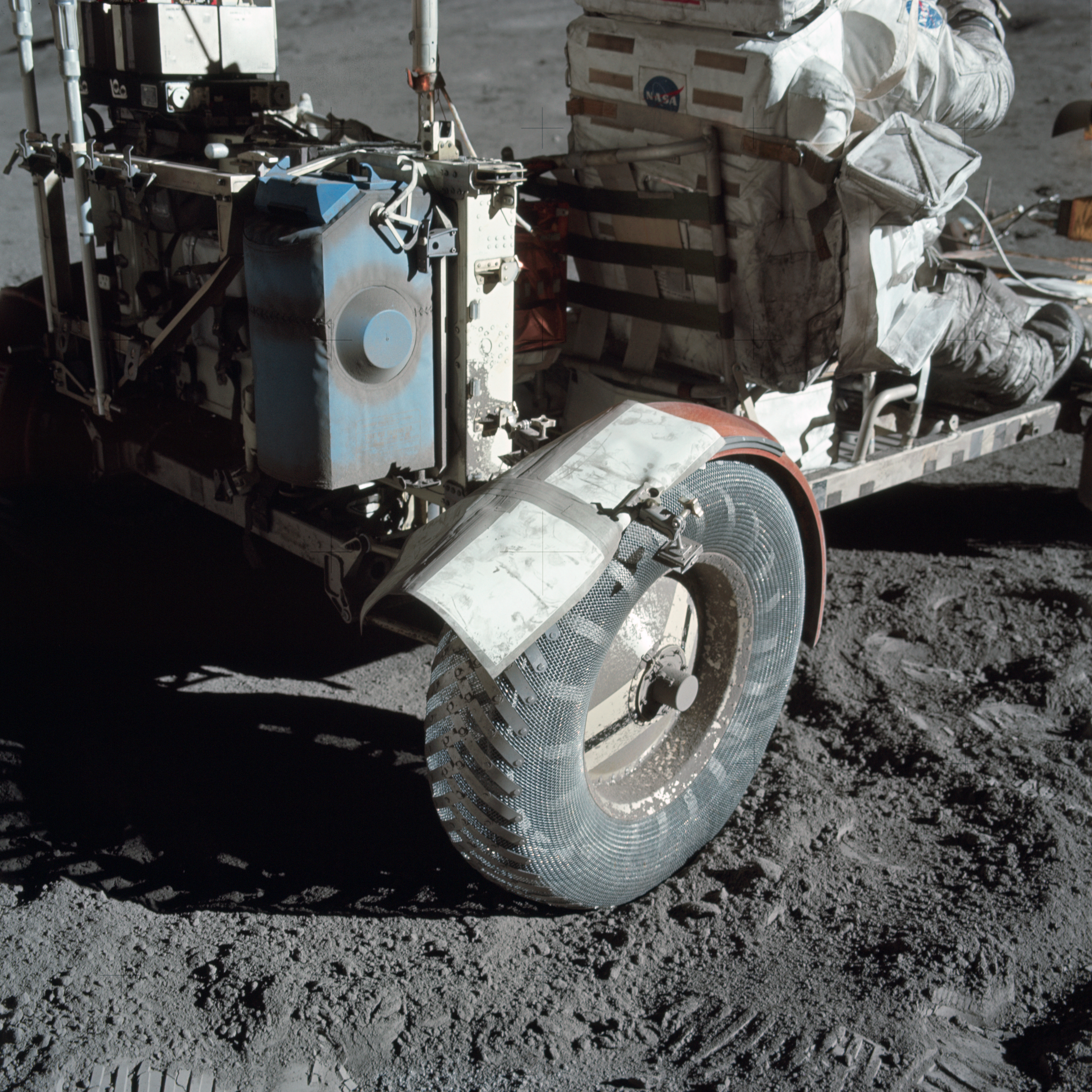
*Image creditor details unavailable via API. Visit linked page below for full info.*
Why is the Moon so dusty? On Earth, rocks are weathered by wind and water, creating soil and sand. On the Moon, eons of constant micrometeorite bombardment have blasted away at the rocky surface creating a layer of powdery lunar soil or regolith. For the Apollo astronauts and their equipment, the pervasive, fine, gritty dust was definitely a problem. On the lunar surface in December 1972, Apollo 17 astronauts Harrison Schmitt and Eugene Cernan needed to repair one of their rover's fenders in an effort to keep the rooster tails of dust away from themselves and their gear. This picture reveals the wheel and fender of their dust covered rover along with the ingenious application of spare maps, clamps, and a grey strip of "duct tape". Northern Hemisphere Alert : March 29 Partial Solar Eclipse
#APOD #Astroenthusiast #RocketScience #PlanetExploration #Astrophotography
**Astronomy Picture of the Day**
27 March 2025
**Messier 81**
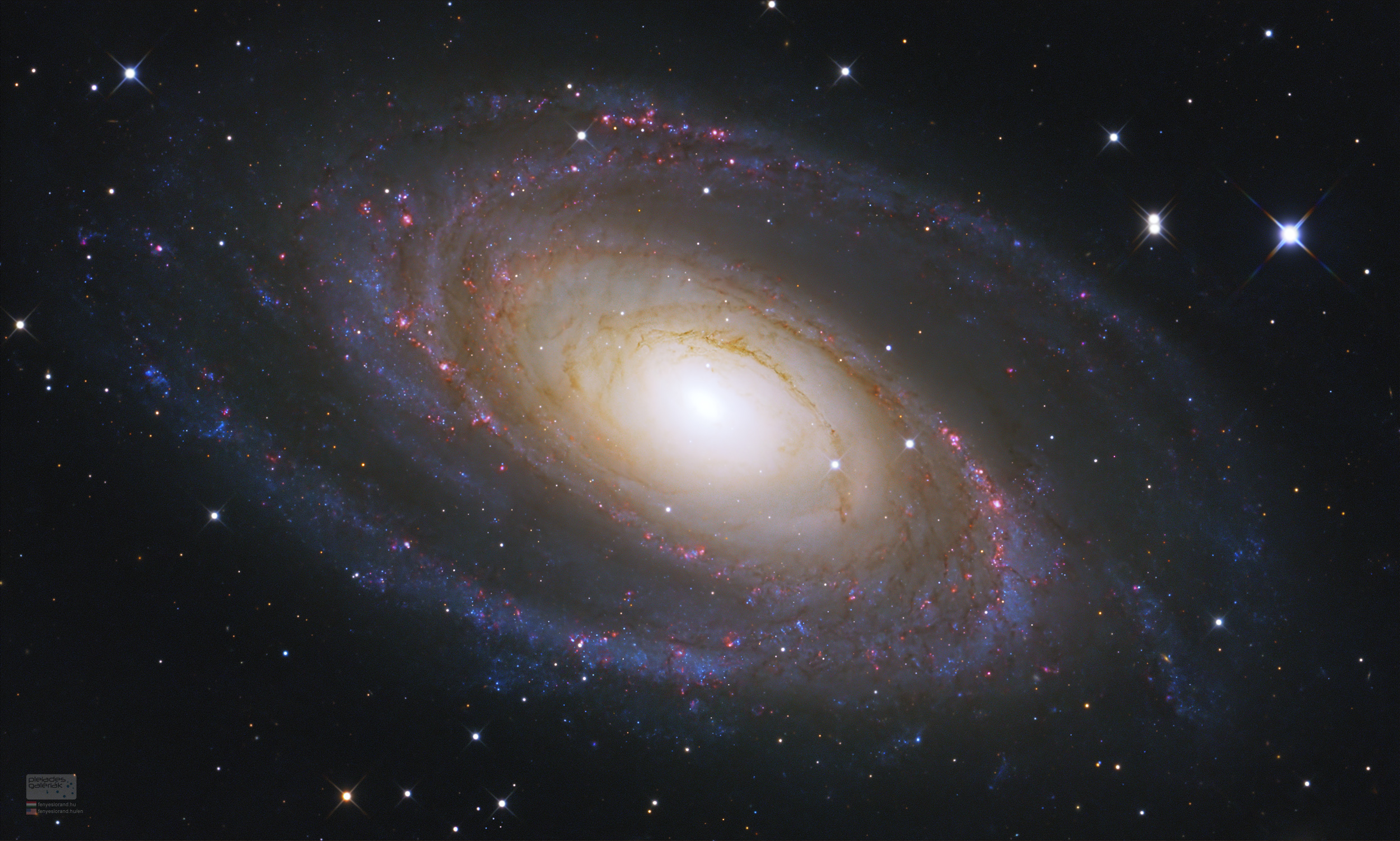
Image Credit & Copyright: Lorand Fenyes
One of the brightest galaxies in planet Earth's sky is similar in size to our Milky Way Galaxy: big, beautiful Messier 81. Also known as NGC 3031 or Bode's galaxy for its 18th century discoverer, this grand spiral can be found toward the northern constellation of Ursa Major, the Great Bear. The sharp, detailed telescopic view reveals M81's bright yellow nucleus, blue spiral arms, pinkish starforming regions, and sweeping cosmic dust lanes. But some dust lanes actually run through the galactic disk (left of center), contrary to other prominent spiral features. The errant dust lanes may be the lingering result of a close encounter between M81 and the nearby galaxy M82 lurking outside of this frame. Scrutiny of variable stars in M81 has yielded a well-determined distance for an external galaxy -- 11.8 million light-years.
#APOD #Planetarium #Astrobiology #Astrobiology #SpaceMissions
**Astronomy Picture of the Day**
26 March 2025
**Star Formation in the Pacman Nebula**
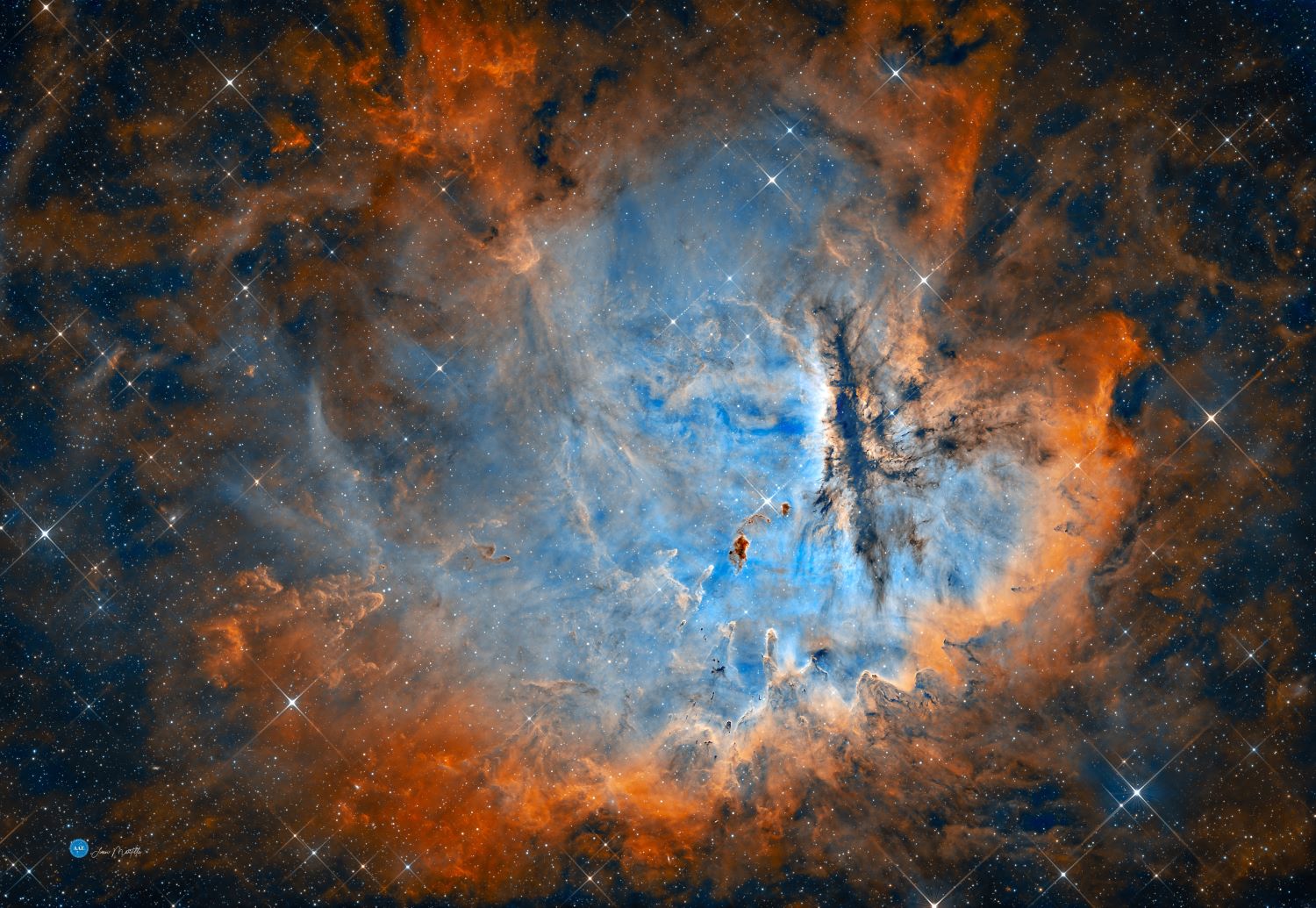
Image Credit & Copyright:
Juan Montilla
(AAE)
You'd think the Pacman Nebula would be eating stars, but actually it is forming them. Within the nebula, a cluster's young, massive stars are powering the pervasive nebular glow. The eye-catching shapes looming in the featured portrait of NGC 281 are sculpted dusty columns and dense Bok globules seen in silhouette, eroded by intense, energetic winds and radiation from the hot cluster stars. If they survive long enough, the dusty structures could also be sites of future star formation. Playfully called the Pacman Nebula because of its overall shape, NGC 281 is about 10,000 light-years away in the constellation Cassiopeia. This sharp composite image was made through narrow-band filters in Spain in mid 2024. It combines emissions from the nebula's hydrogen and oxygen atoms to synthesize red, green, and blue colors. The scene spans well over 80 light-years at the estimated distance of NGC 281.
#APOD #SpaceMissions #Astrodata #Astrozone #SpaceInnovation
**Astronomy Picture of the Day**
25 March 2025
**A Blue Banded Blood Moon**
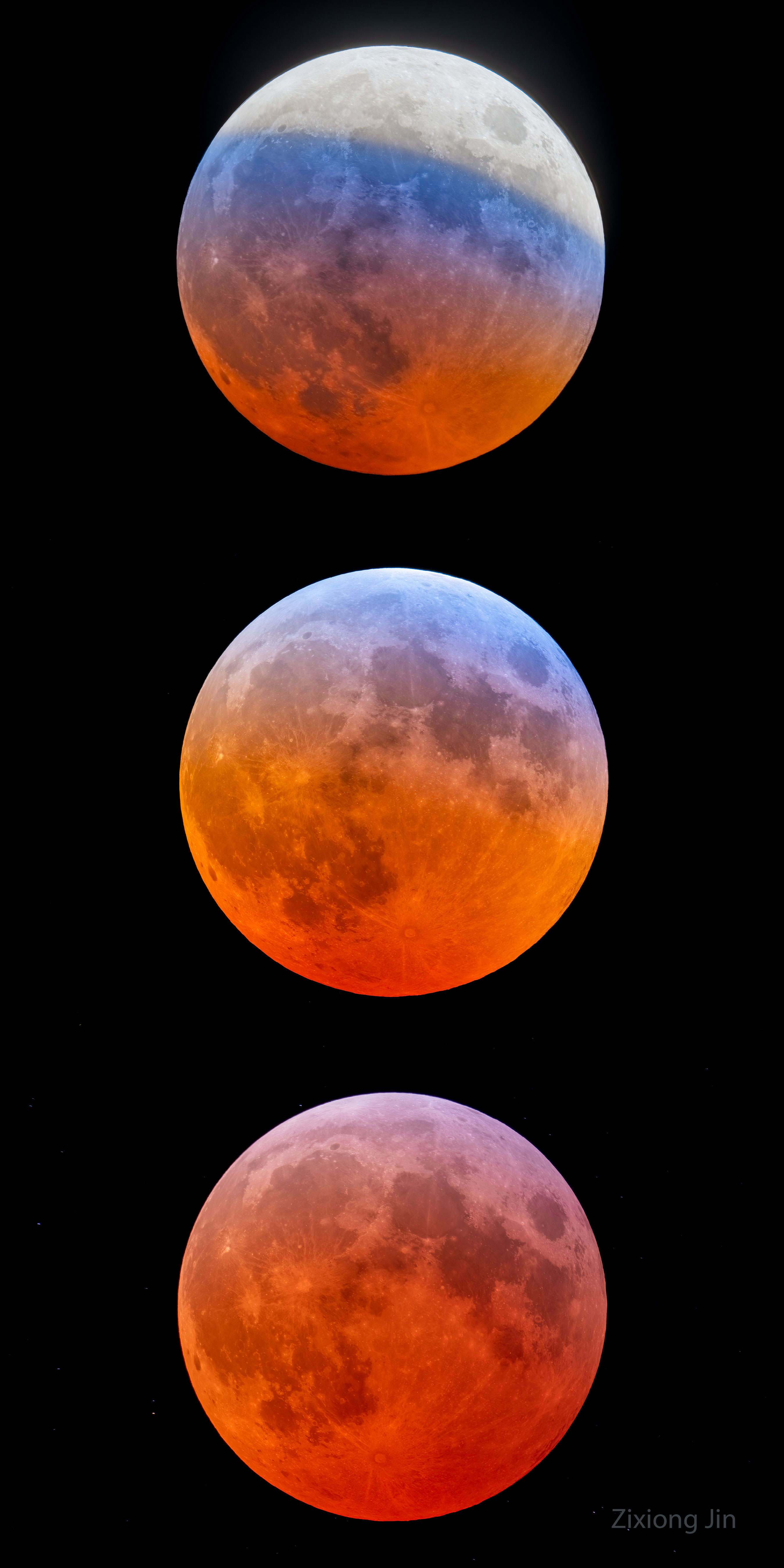
Image Credit & Copyright:
Zixiong Jin
What causes a blue band to cross the Moon during a lunar eclipse? The blue band is real but usually quite hard to see. The featured HDR image of last week's lunar eclipse, however -- taken from Norman, Oklahoma (USA) -- has been digitally processed to exaggerate the colors. The gray color on the upper right of the top lunar image is the Moon's natural color, directly illuminated by sunlight. The lower parts of the Moon on all three images are not directly lit by the Sun since it is being eclipsed -- it is in the Earth's shadow. It is faintly lit, though, by sunlight that has passed deep through Earth's atmosphere. This part of the Moon is red -- and called a blood Moon -- for the same reason that Earth's sunsets are red: because air scatters away more blue light than red. The unusual purple-blue band visible on the upper right of the top and middle images is different -- its color is augmented by sunlight that has passed high through Earth's atmosphere, where red light is better absorbed by ozone than blue. Celestial Surprise: What picture did APOD feature on your birthday? (post 1995)
#APOD #Exploration #SpaceFacts #SpaceTech #Astrochemistry
**Astronomy Picture of the Day**
23 March 2025
**Ancient Ogunquit Beach on Mars**
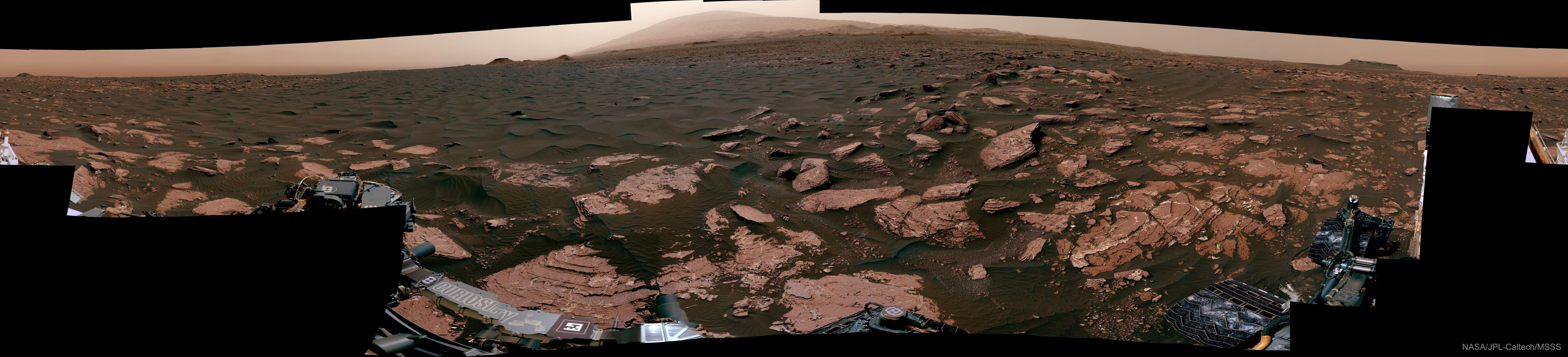
*Image creditor details unavailable via API. Visit linked page below for full info.*
This was once a beach -- on ancient Mars. The featured 360-degree panorama, horizontally compressed, was taken in 2017 by the robotic Curiosity rover that explored the red planet. Named Ogunquit Beach after its terrestrial counterpart, evidence shows that at times long ago the area was underwater, while at other times it was at the edge of an ancient lake. The light peak in the central background is the top of Mount Sharp, the central feature in Gale Crater where Curiosity explored. Portions of the dark sands in the foreground were scooped up for analysis. The light colored bedrock is composed of sediment that likely settled at the bottom of the now-dried lakebed. The featured panorama (interactive version here) was created from over 100 images and seemingly signed by the rover on the lower left.
#APOD #SpaceDiscovery #Astrospace #Astrophotography #SpaceDiscovery
**Astronomy Picture of the Day**
22 March 2025
**SuperCam Target on Ma'az**
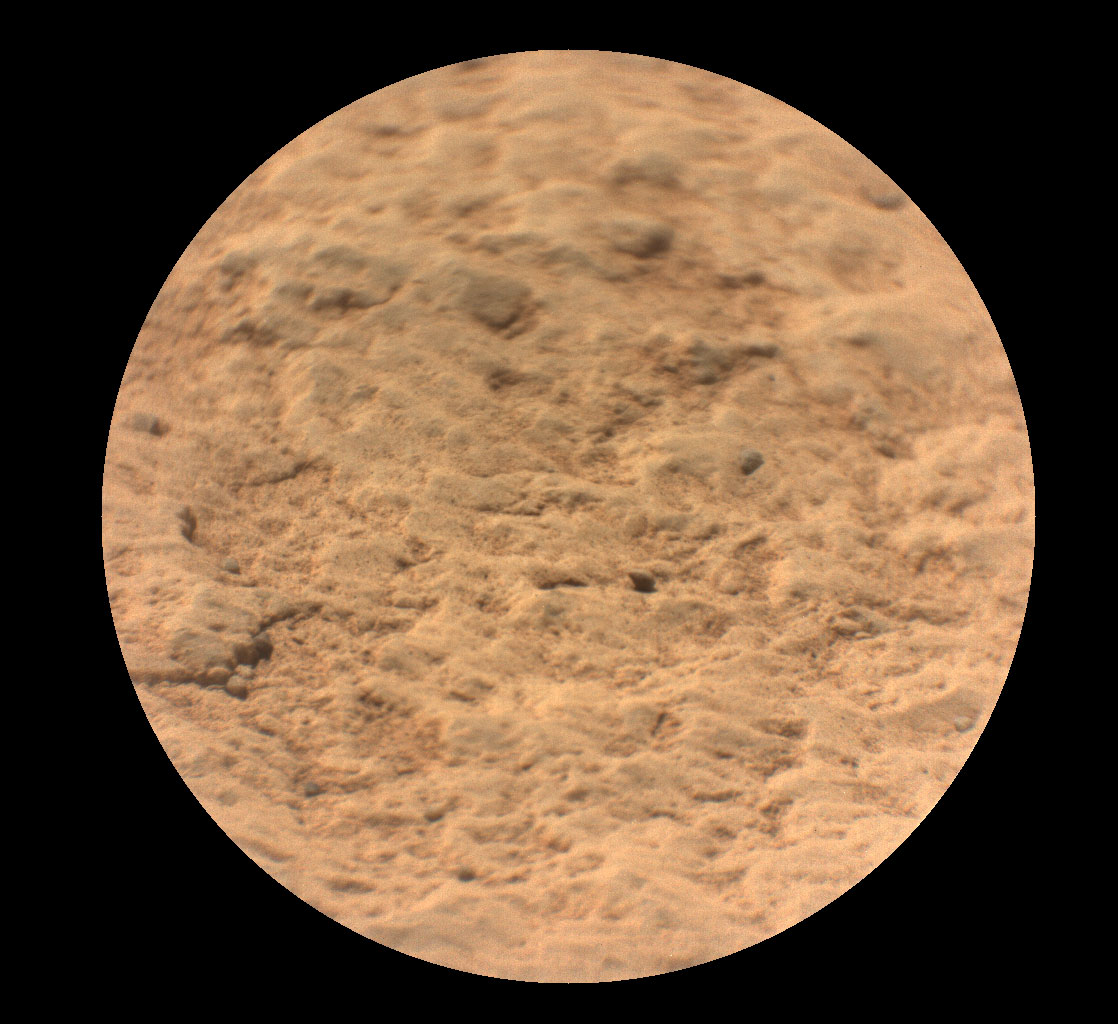
*Image creditor details unavailable via API. Visit linked page below for full info.*
What's the sound of one laser zapping? There's no need to consult a Zen master to find out, just listen to the first acoustic recording of laser shots on Mars. On Mars Rover Perseverance mission sol 12 (March 2, 2021) the SuperCam instrument atop the rover's mast zapped a rock dubbed Ma'az 30 times from a range of about 3.1 meters. Its microphone recorded the soft staccato popping sounds of the rapid series of SuperCam laser zaps. Shockwaves created in the thin Martian atmosphere as bits of rock are vaporized by the laser shots make the popping sounds, sounds that offer clues to the physical structure of the target. This SuperCam close-up of the Ma'az target region is 6 centimeters (2.3 inches) across. Ma'az means Mars in the Navajo language.
#APOD #Meteorology #Cosmology #Astrophysics #BlackHoles
**Astronomy Picture of the Day**
21 March 2025
**The Leo Trio**
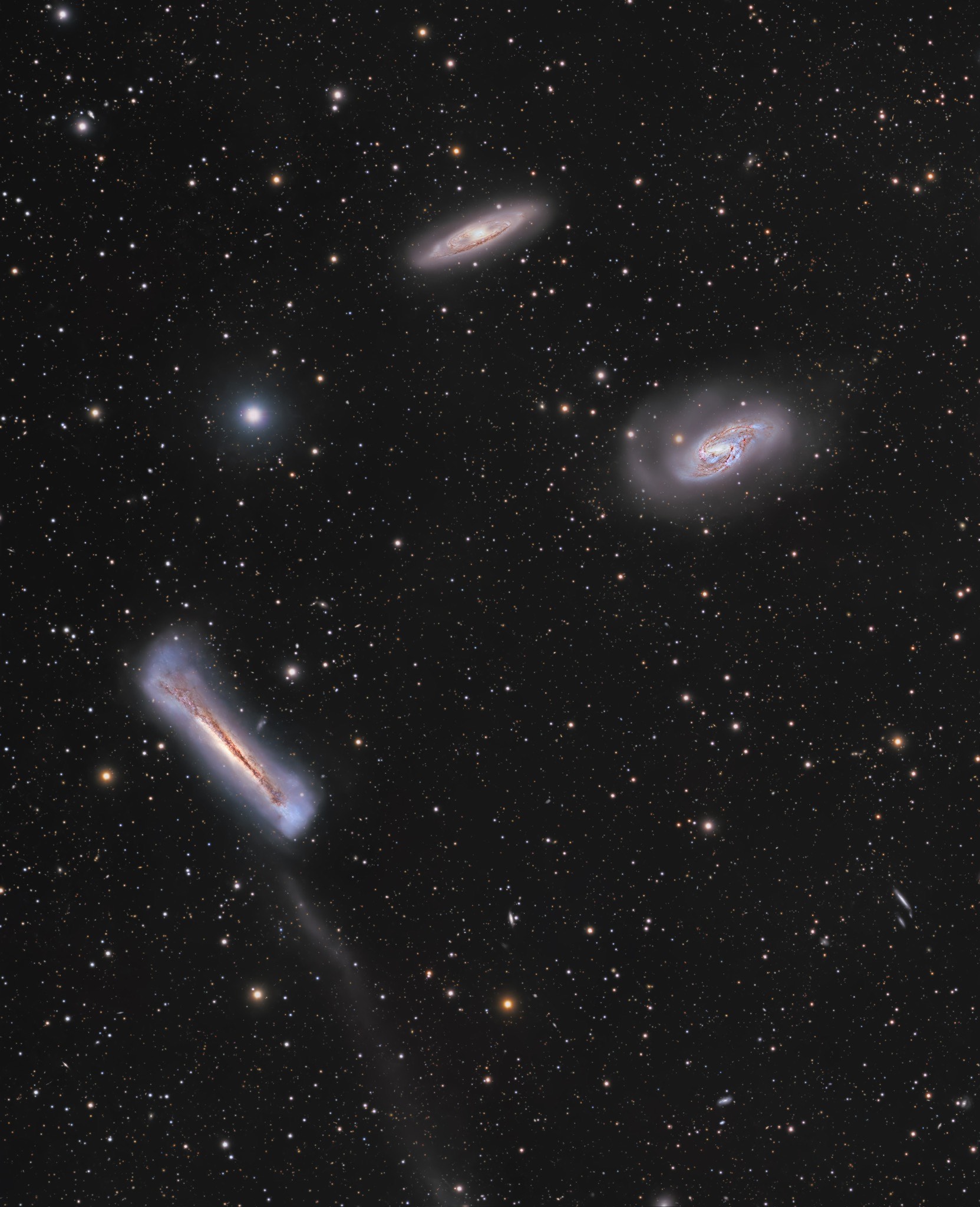
Image Credit & Copyright: Rabeea Alkuwari
This popular group leaps into the early evening sky around the March equinox and the northern hemisphere spring. Famous as the Leo Triplet, the three magnificent galaxies found in the prominent constellation Leo gather here in one astronomical field of view. Crowd pleasers when imaged with even modest telescopes, they can be introduced individually as NGC 3628 (bottom left), M66 (middle right), and M65 (top center). All three are large spiral galaxies but tend to look dissimilar, because their galactic disks are tilted at different angles to our line of sight. NGC 3628, also known as the Hamburger Galaxy, is temptingly seen edge-on, with obscuring dust lanes cutting across its puffy galactic plane. The disks of M66 and M65 are both inclined enough to show off their spiral structure. Gravitational interactions between galaxies in the group have left telltale signs, including the tidal tails and warped, inflated disk of NGC 3628 and the drawn out spiral arms of M66. This gorgeous view of the region spans over 1 degree (two full moons) on the sky. Captured with a telescope from Sawda Natheel, Qatar, planet Earth, the frame covers over half a million light-years at the Leo Trio's estimated 30 million light-year distance.
#APOD #SpaceTechnology #Astroengineering #Astrozone #GalacticAdventures
**Astronomy Picture of the Day**
20 March 2025
**The Solar Eclipse Analemma Project**
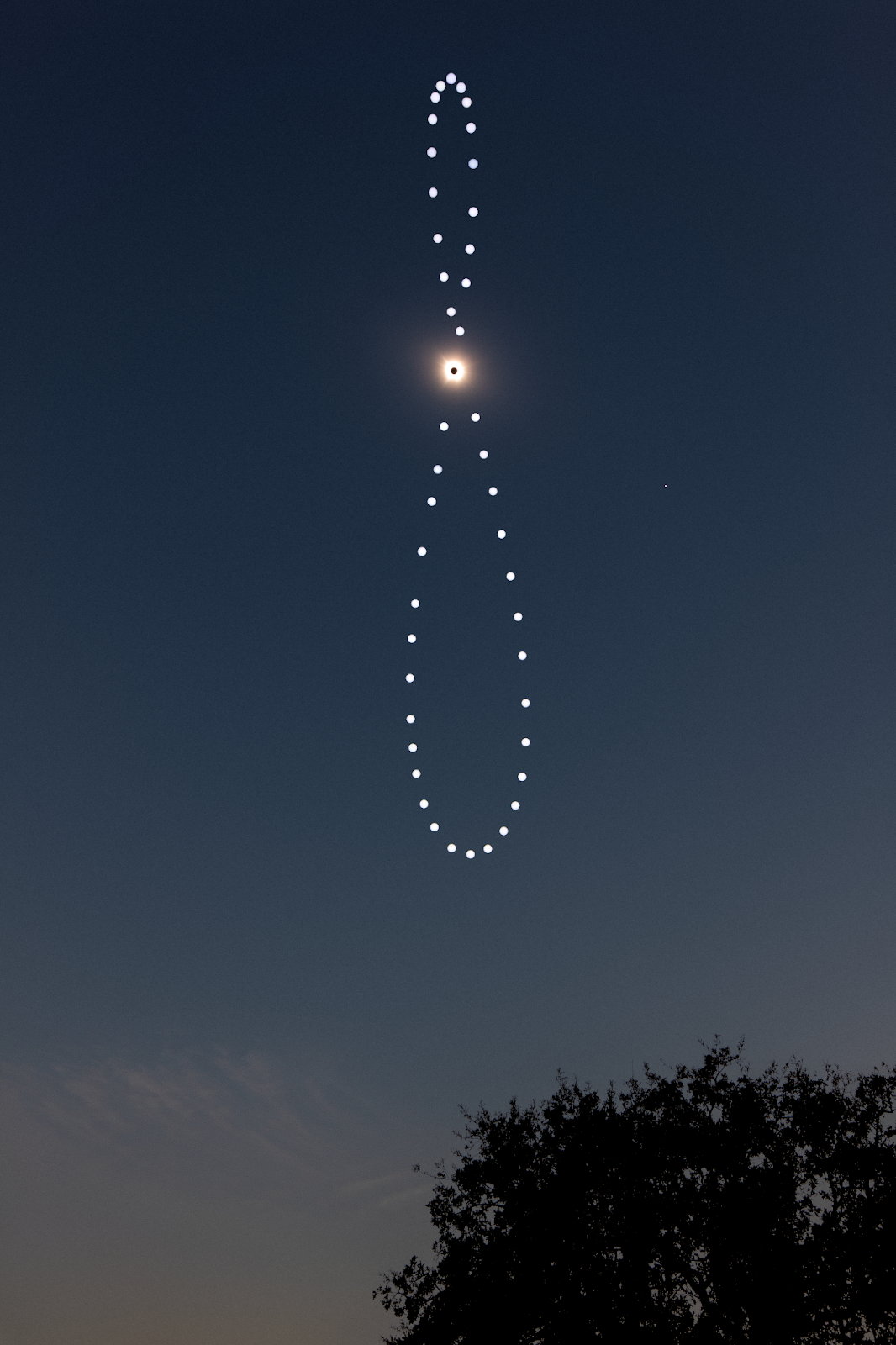
Image Credit & Copyright: Hunter Wells
Recorded from 2024 March 10, to 2025 March 1, this composited series of images reveals a pattern in the seasonal drift of the Sun's daily motion through planet Earth's sky. Known to some as an analemma, the figure-eight curve was captured in exposures taken on the indicated dates only at 18:38 UTC from the exact same location south of Stephenville, Texas. The Sun's position on the 2024 solstice dates of June 20 and December 21 would be at the top and bottom of the curve and correspond to the astronomical beginning of summer and winter in the north. Points that lie along the curve half-way between the solstices would mark the equinoxes. The 2024 equinox on September 22, and in 2025 the equinox on March 20 (today) are the start of northern fall and spring. And since one of the exposures was made on 2024 April 8 from the Stephenville location at 18:38:40 UTC, this analemma project also reveals the solar corona in planet Earth's sky during a total solar eclipse.
#APOD #RocketLaunch #Science #BlackHoles #RocketScience
**Astronomy Picture of the Day**
19 March 2025
**Blue Ghost's Diamond Ring**
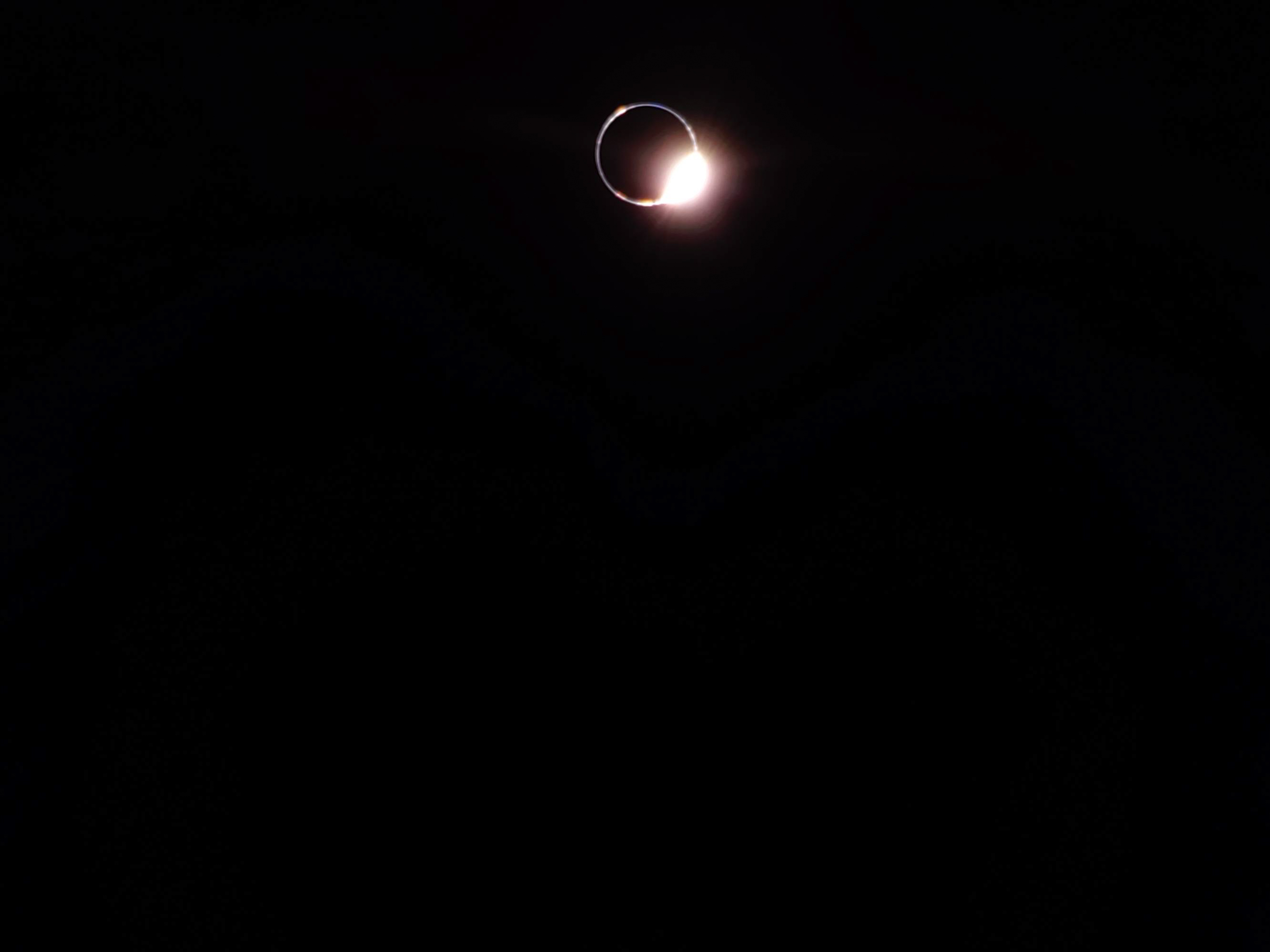
*Image creditor details unavailable via API. Visit linked page below for full info.*
On March 14 the Full Moon slid through Earth's dark umbral shadow and denizens of planet Earth were treated to a total lunar eclipse. Of course, from the Moon's near side that same astronomical syzygy was seen as a solar eclipse. Operating in the Mare Crisium on the lunar surface, the Blue Ghost lander captured this video frame of Earth in silhouette around 3:30am CDT, just as the Sun was emerging from behind the terrestrial disk. From Blue Ghost's lunar perspective the beautiful diamond ring effect, familiar to earthbound solar eclipse watchers, is striking. Since Earth appears about four times the apparent size of the Sun from the lunar surface the inner solar corona, the atmosphere of the Sun most easily seen from Earth during a total solar eclipse, is hidden from view. Still, scattering in Earth's dense atmosphere creates the glowing band of sunlight embracing our fair planet.
#APOD #Astroengineer #LunarExploration #Astrozone #Astrotheory
**Astronomy Picture of the Day**
18 March 2025
**LDN 1235: The Shark Nebula**
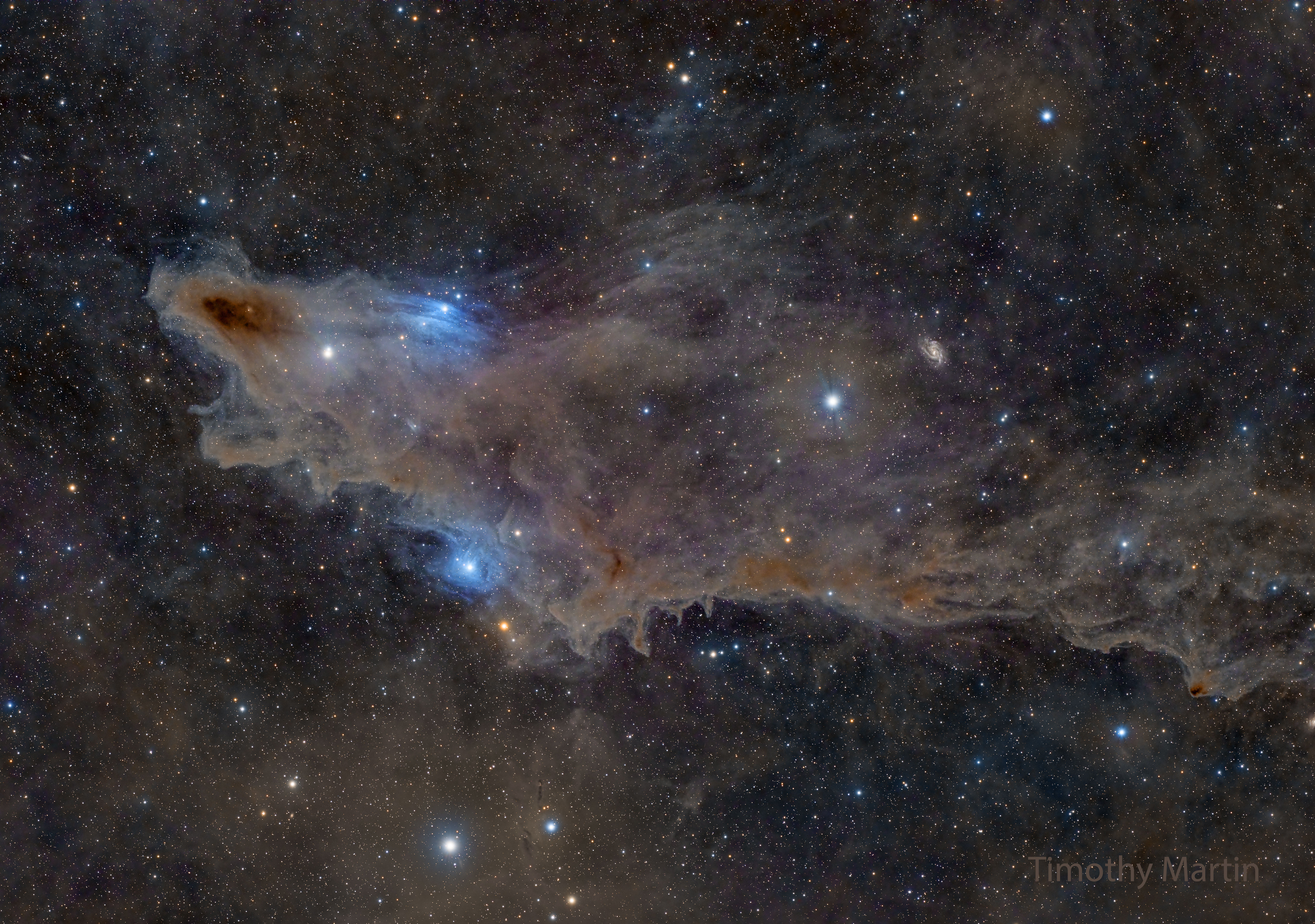
Image Credit & Copyright:
Timothy Martin
There is no sea on Earth large enough to contain the Shark nebula. This predator apparition poses us no danger as it is composed only of interstellar gas and dust. Dark dust like that featured here is somewhat like cigarette smoke and created in the cool atmospheres of giant stars. After expelling gas and gravitationally recondensing, massive stars may carve intricate structures into their birth cloud using their high energy light and fast stellar winds as sculpting tools. The heat they generate evaporates the murky molecular cloud as well as causing ambient hydrogen gas to disperse and glow red. During disintegration, we humans can enjoy imagining these great clouds as common icons, like we do for water clouds on Earth. Including smaller dust nebulae such as Van den Bergh 149 & 150, the Shark nebula, sometimes cataloged as LDN 1235, spans about 15 light years and lies about 650 light years away toward the constellation of the King of Aethiopia (Cepheus). Explore Your Universe: Random APOD Generator
#APOD #NASAInspires #NASA #Astrospace #Meteorology
**Astronomy Picture of the Day**
17 March 2025
**Thor's Helmet**

Image Credit & Copyright:
Brian Hopkins
(East Coast Astronomer)
Thor not only has his own day (Thursday), but a helmet in the heavens. Popularly called Thor's Helmet, NGC 2359 is a hat-shaped cosmic cloud with wing-like appendages. Heroically sized even for a Norse god, Thor's Helmet is about 30 light-years across. In fact, the cosmic head-covering is more like an interstellar bubble, blown by a fast wind from the bright, massive star near the bubble's center. Known as a Wolf-Rayet star, the central star is an extremely hot giant thought to be in a brief, pre-supernova stage of evolution. NGC 2359 is located about 15,000 light-years away toward the constellation of the Great Overdog. This sharp image is a mixed cocktail of data from narrowband filters, capturing not only natural looking stars but details of the nebula's filamentary structures. The star in the center of Thor's Helmet is expected to explode in a spectacular supernova sometime within the next few thousand years.
#APOD #AstronautLife #Astroinformatics #Astroenthusiast #SpaceExploration
**Astronomy Picture of the Day**
16 March 2025
**Venus and the Triply Ultraviolet Sun**

*Image creditor details unavailable via API. Visit linked page below for full info.*
This was a very unusual type of solar eclipse. Typically, it is the Earth's Moon that eclipses the Sun. In 2012, though, the planet Venus took a turn. Like a solar eclipse by the Moon, the phase of Venus became a continually thinner crescent as Venus became increasingly better aligned with the Sun. Eventually the alignment became perfect and the phase of Venus dropped to zero. The dark spot of Venus crossed our parent star. The situation could technically be labeled a Venusian annular eclipse with an extraordinarily large ring of fire. Pictured here during the occultation, the Sun was imaged in three colors of ultraviolet light by the Earth-orbiting Solar Dynamics Observatory, with the dark region toward the right corresponding to a coronal hole. Hours later, as Venus continued in its orbit, a slight crescent phase appeared again. The next Venusian transit across the Sun will occur in 2117.
#APOD #Celestial #SpaceTechnology #Astronauts #SpaceAdventures
**Astronomy Picture of the Day**
15 March 2025
**Tololo Totality**
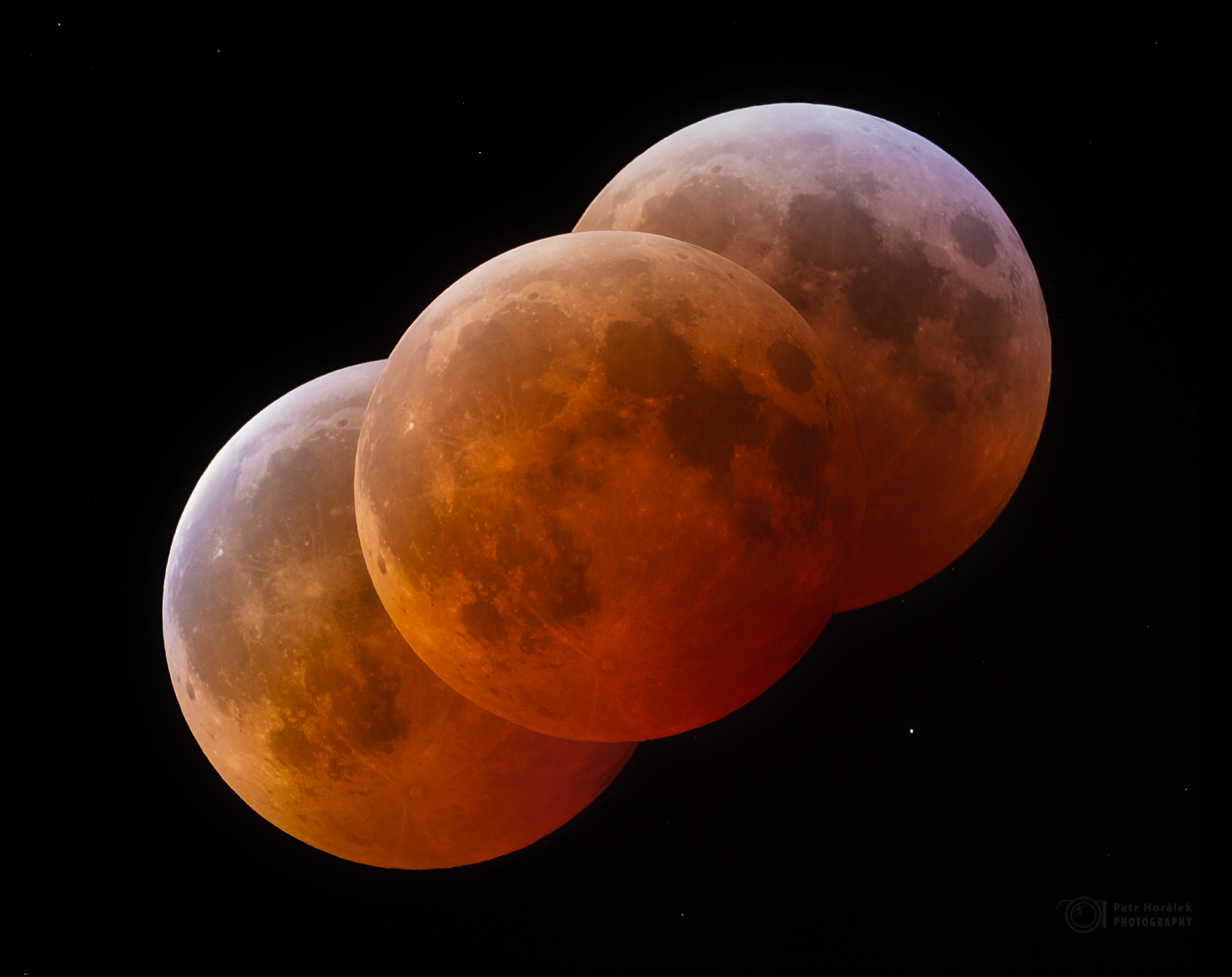
Image Credit & Copyright: Petr Horálek
On March 14 the Moon was Full. In an appropriate celebration of Pi day, that put the Moon 3.14 radians (180 degrees) in ecliptic longitude from the Sun in planet Earth's sky. As a bonus for fans of Pi and the night sky, on that date the Moon also passed directly through Earth's umbral shadow in a total lunar eclipse. In clear skies, the colors of an eclipsed Moon can be vivid. Reflecting the deeply reddened sunlight scattered into Earth's shadow, the darkened lunar disk was recorded in this time series composite image from Cerro Tololo Observatory, Chile. The lunar triptych captures the start, middle, and end of the total eclipse phase that lasted about an hour. A faint bluish tint seen just along the brighter lunar limb at the shadow's edge is due to sunlight filtered through Earth's stratospheric ozone layer. Growing Gallery: Total Lunar Eclipse of 2025 March
#APOD #Astrotheory #SpaceWeather #AstronomyLovers #Astrogeology
**Astronomy Picture of the Day**
14 March 2025
**Moon Pi and Mountain Shadow**
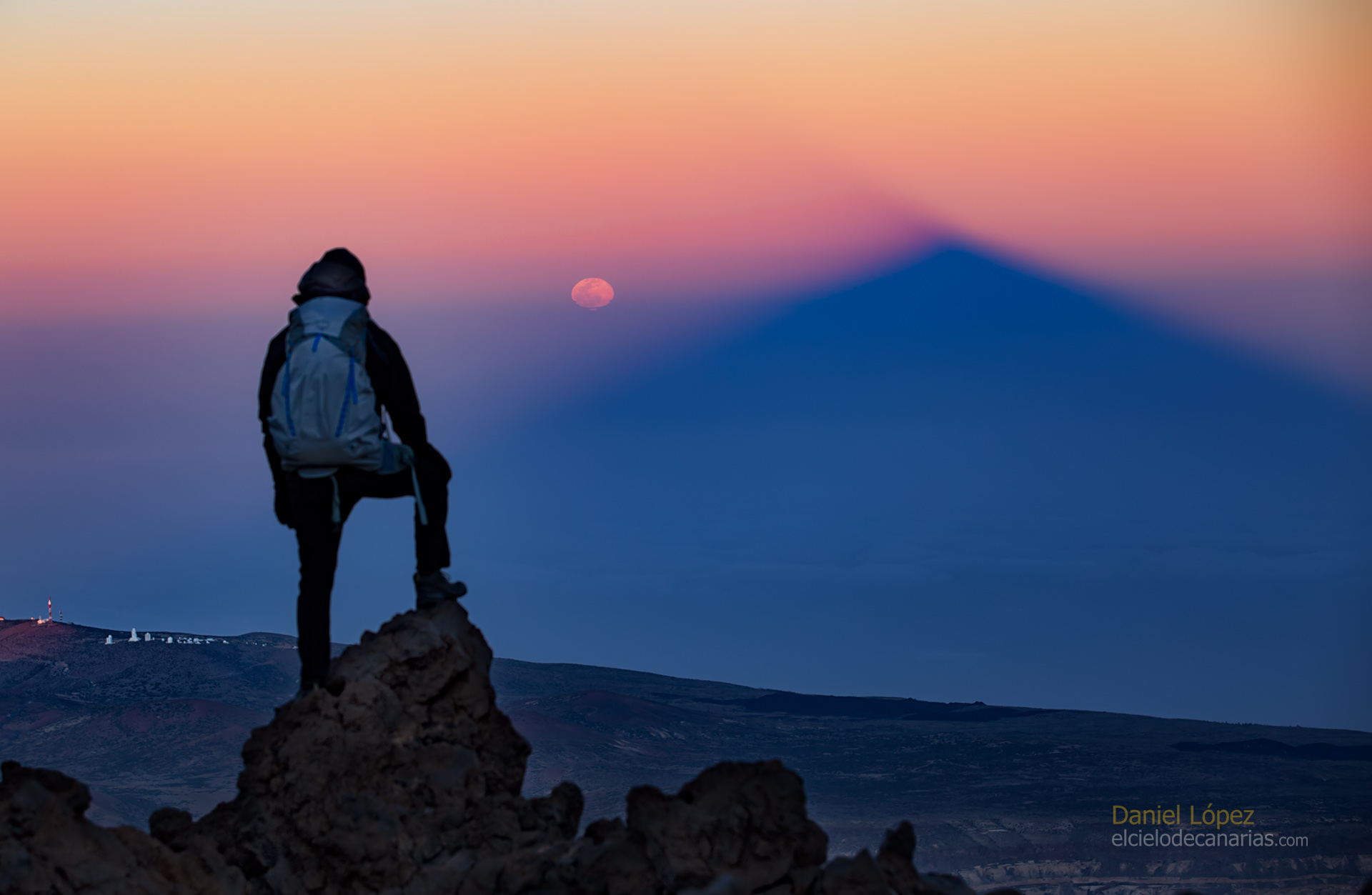
Image Credit & Copyright: El Cielo de Canarias
What phase of the Moon is 3.14 radians from the Sun? The Full Moon, of course. Even though the Moon might look full for several days, the Moon is truly at its full phase when it is Pi radians (aka 180 degrees) from the Sun in ecliptic longitude. That's opposite the Sun in planet Earth's sky. Rising as the Sun set on March 9, 2020, only an hour or so after the moment of its full phase, this orange tinted and slightly flattened Moon still looked full. It was photographed opposite the setting Sun from Teide National Park on the Canary Island of Tenerife. Also opposite the setting Sun, seen from near the Teide volcano peak about 3,500 meters above sea level, is the mountain's rising triangular shadow extending into Earth's dense atmosphere. Below the distant ridge line on the left are the white telescope domes of Teide Observatory. Today, March 14 2025, the moon is Pi radians from the Sun at exactly 06:55 UTC. That's about three minutes before the midpoint of the March Full Moon's total lunar eclipse.
#APOD #PlanetExploration #Astrocosmos #Exploration #Astrotheory
**Astronomy Picture of the Day**
13 March 2025
**The Protostars within Lynds 483**

*Image creditor details unavailable via API. Visit linked page below for full info.*
Two protostars are hidden in a single pixel near the center of a striking hourglass-shaped nebula in this near-infrared image from the James Webb Space Telescope. The actively forming star system lies in a dusty molecular cloud cataloged as Lynds 483, some 650 light-years distant toward the constellation Serpens Cauda. Responsible for the stunning bipolar outflows, the collapsing protostars have been blasting out collimated energetic jets of material over tens of thousands of years. Webb's high-resolution view shows the violence of star-formation in dramatic detail as twisting shock fronts expand and collide with slower, denser material. The premier close-up of the star-forming region spans less than 1/2 a light-year within dark nebula Lynds 483. March 13/14: Total Lunar Eclipse
#APOD #Astrodata #GalaxyExploration #PlanetaryScience #NASAInspires
**Astronomy Picture of the Day**
12 March 2025
**NGC 772: The Fiddlehead Galaxy**

Image Credit & Copyright:
Jean-François Bax & Serge Brunier,
OCA/C2PU;
Text:
Ogetay Kayali
(Michigan Tech U.)
Why does this galaxy look like a curly vegetable? The Fiddlehead spiral galaxy likely gets its distorted spiral appearance from a gravitational interaction with its close-by elliptical companion NGC 770, seen just below. Cataloged as NGC 772 and Arp 78, the Fiddlehead spans over 200,000 light years, is a nearby 100 million light years beyond the stars of our Milky Way galaxy, and is visible toward the constellation of the Ram (Aries). But in the featured image, the Fiddlehead appears to have another companion -- one with a long and fuzzy tail: Comet 43P/Wolf-Harrington. Though the comet appears to be aimed straight at the massive galaxy, it is actually much closer to us, residing only light minutes away -- well within our Solar System. The comet will never reach the distant spiral galaxy, nor is it physically related to it. By a fortunate trick of perspective, though, these two cosmic wonders briefly share the same frame taken late last year from Calern, France.
#APOD #GalacticAdventures #Astrozone #Astroinformatics #Astrochemistry
**Astronomy Picture of the Day**
11 March 2025
**NGC 1672: Barred Spiral Galaxy from Hubble**
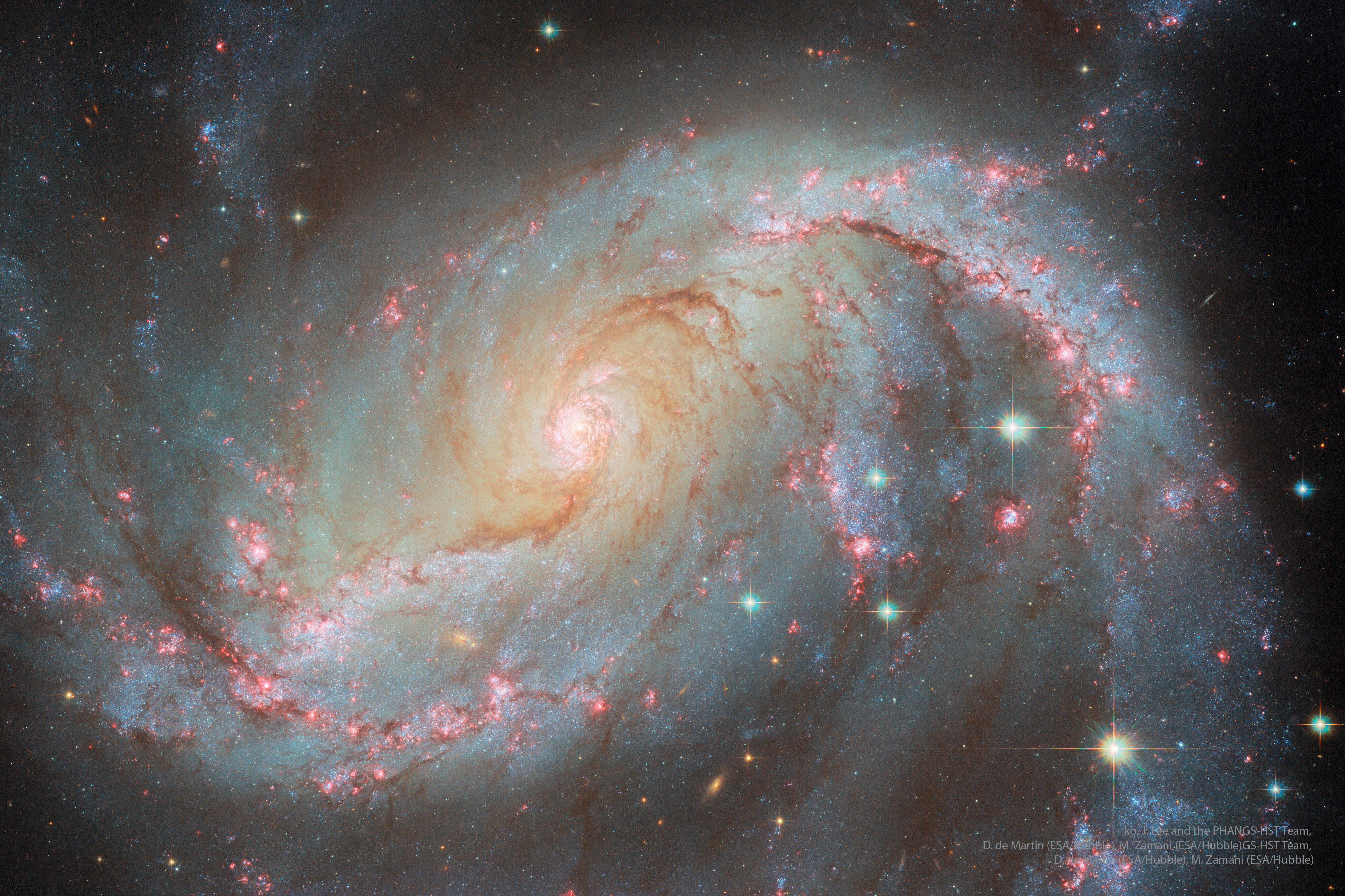
*Image creditor details unavailable via API. Visit linked page below for full info.*
Many spiral galaxies have bars across their centers. Even our own Milky Way Galaxy is thought to have a modest central bar. Prominently barred spiral galaxy NGC 1672, featured here, was captured in spectacular detail in an image taken by the orbiting Hubble Space Telescope. Visible are dark filamentary dust lanes, young clusters of bright blue stars, red emission nebulas of glowing hydrogen gas, a long bright bar of stars across the center, and a bright active nucleus that likely houses a supermassive black hole. Light takes about 60 million years to reach us from NGC 1672, which spans about 75,000 light years across. NGC 1672, which appears toward the constellation of the Dolphinfish (Dorado), has been studied to find out how a spiral bar contributes to star formation in a galaxy's central regions.
#APOD #RocketScience #Astrocosmos #SpaceExploration #NASA
**Astronomy Picture of the Day**
10 March 2025
**NGC 1499: The California Nebula**

Image Credit & Copyright:
Toni Fabiani Mendez
Could Queen Calafia's mythical island exist in space? Perhaps not, but by chance the outline of this molecular space cloud echoes the outline of the state of California, USA. Our Sun has its home within the Milky Way's Orion Arm, only about 1,000 light-years from the California Nebula. Also known as NGC 1499, the classic emission nebula is around 100 light-years long. On the featured image, the most prominent glow of the California Nebula is the red light characteristic of hydrogen atoms recombining with long lost electrons, stripped away (ionized) by energetic starlight. The star most likely providing the energetic starlight that ionizes much of the nebular gas is the bright, hot, bluish Xi Persei just to the right of the nebula. A regular target for astrophotographers, the California Nebula can be spotted with a wide-field telescope under a dark sky toward the constellation of Perseus, not far from the Pleiades. Explore Your Universe: Random APOD Generator
#APOD #Meteorology #LunarMission #Astroinformatics #SpaceWeather
**Astronomy Picture of the Day**
09 March 2025
**Cyclones at Jupiter's North Pole**

*Image creditor details unavailable via API. Visit linked page below for full info.*
Why are there so many cyclones around the north pole of Jupiter? The topic is still being researched. NASA's robotic Juno mission orbiting Jupiter took data in 2018 that was used to construct this stunning view of the curious cyclones at Jupiter's north pole. Measuring the thermal emission from Jovian cloud tops, the infrared observations are not restricted to the hemisphere illuminated by sunlight. They reveal eight cyclonic features that surround a cyclone about 4,000 kilometers in diameter, just offset from the giant planet's geographic north pole. Similar data show a cyclone at the Jovian south pole with five circumpolar cyclones. The south pole cyclones are slightly larger than their northern cousins. Oddly, data from the once Saturn-orbiting Cassini mission has shown that Saturn's north and south poles each have only a single cyclonic storm system.
#APOD #SpaceAdventures #NASA #MeteorShowers #Universe
**Astronomy Picture of the Day**
08 March 2025
**Galaxies in Space**
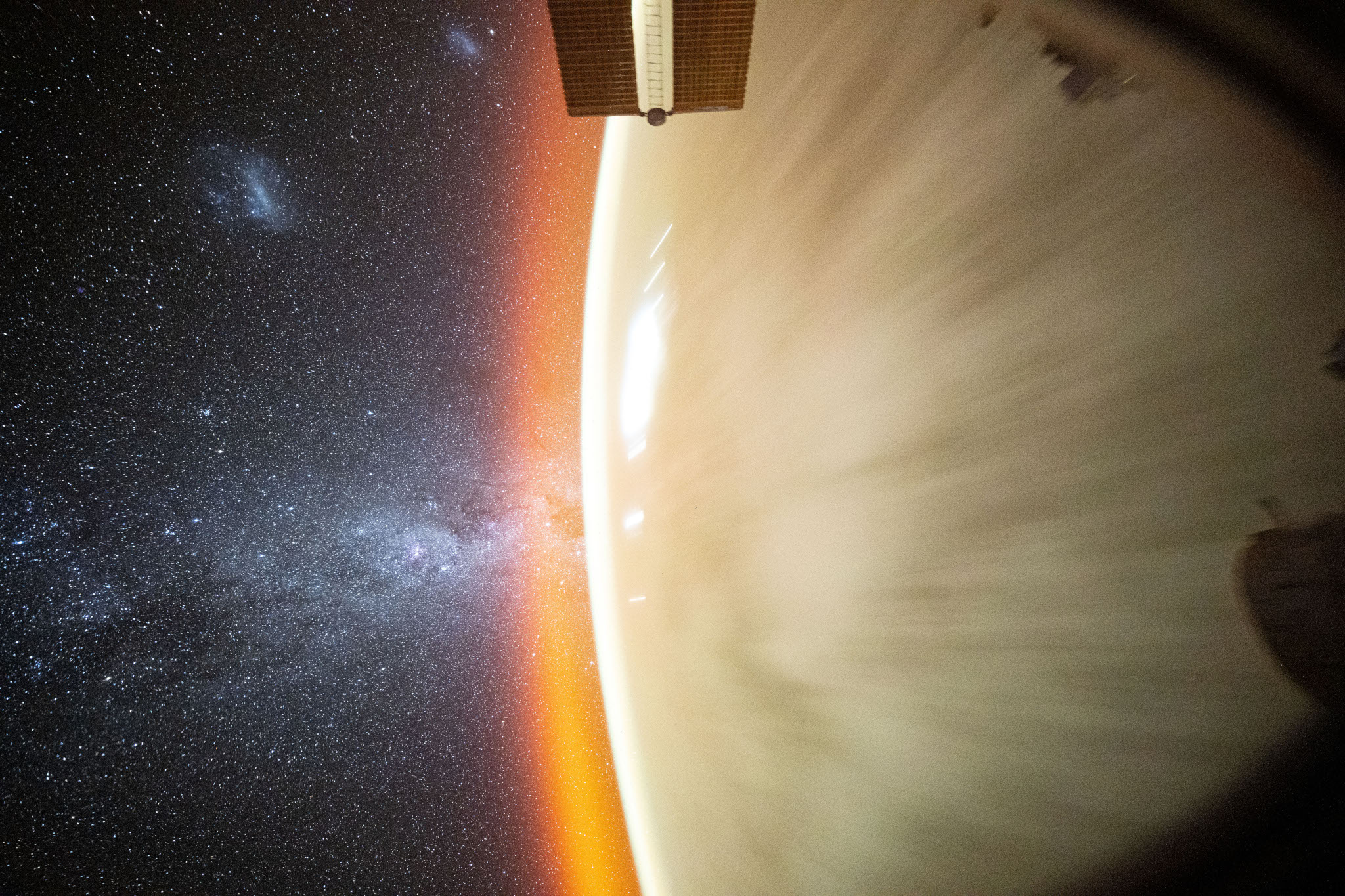
*Image creditor details unavailable via API. Visit linked page below for full info.*
The plane of our Milky Way galaxy extends beyond the limb of planet Earth in this space age exposure captured by astronaut Don Pettit. His camera, with low light and long duration settings, was pointed out the window of a Dragon crew spacecraft docked with the International Space Station on January 29. The orbital outpost was at an altitude of about 400 kilometers above the Pacific Ocean at the time. Motion blurs the Earth below, while the gorgeous view from low Earth orbit includes the Milky Way's prominent satellite galaxies, known as the Large and Small Magellanic Clouds, near the upper left in the frame. Fans of southern skies can also spot the Southern Cross. The four brightest stars of the famous southern constellation Crux are near picture center, just beyond the edge of the bright horizon and shining through Earth's orange tinted atmospheric glow.
#APOD #LunarExploration #Astrotheory #PlanetaryScience #Astrofans