
ADP Reports Biggest Disappointment In Job Gains In 2 Years In February
ADP Reports Biggest Disappointment In Job Gains In 2 Years In February
According to the latest data from ADP, hiring slowed to the smallest level of gains since July, with trade and transportation, health care and education, and information showing job losses. Small business employment also fell.
 ?itok=5JqWWyS9
That was the biggest miss for ADP headline data since March 2023...
 ?itok=N5Fep-Sk
According to Nela Richardson, Chief Economist at ADP, "policy uncertainty and a slowdown in consumer spending might have led to layoffs or a slowdown in hiring last month. Our data, combined with other recent indicators, suggests a hiring hesitancy among employers as they assess the economic climate ahead."
Oddly, as we noted above, job losses were concentrated in Small Businesses... (we say oddly because we have seen Small Business Optimism explode higher since Trump was elected...)?
 ?itok=U8gSqY1W
Perhaps more odd still is the fact that goods-producing firms saw a huge jump in job additions (Trump driving confidence in manufacturing with the biggest addition since Oct 2022) while Services was job additions tumble...
 ?itok=RRoMJvlR
On the potentially positive side of the ledger - wage growth slowed for job-changers (and was flat for job-stayers)...
 ?itok=wNC0_rVe
But given the levels of wage inflation (and labor weakness), it still has the stench of stagflation.
So, to sum things up:
Small biz optimism is thru the roof... but small biz see the most layoffs.
...and policy uncertainty is cited as the reason for weakness BUT manufacturers (which is where all the uncertainty is) added the most jobs since Oct 2022...
Is someone trying to force a confidence collapse narrative?
https://cms.zerohedge.com/users/tyler-durden
Wed, 03/05/2025 - 08:27
Futures Rise On Hope For Trade War Relief, Europe Soars, Bunds Crash On "Whatever It Takes" Stimulus
Futures Rise On Hope For Trade War Relief, Europe Soars, Bunds Crash On "Whatever It Takes" Stimulus
US equity futures are higher following comments from Commerce Secretary Howard Lutnick who seemed to suggest that a compromise on Canadia/Mexican tariffs could be announced today; and while Trump’s speech last night doubled-down on tariffs he but did not refute Lutnick’s comments; at the same time the US/Ukraine mineral deal also appears to be moving forward providing further de-escalatory relief for markets. As such, as of 8:00am, S&P 500 futures are up 0.3% while Nasdaq 100 contracts add 0.6% (both well off session highs) with all 7 of the Mag 7 higher and Semis are bid into MRVL earnings. Chinese stocks led a rally in Asia after Beijing set an ambitious economic growth target that boosted expectations of further stimulus.Finally, European stocks are surging (Dax +3%) after Germany unveiled plans to unlock hundreds of billions of euros for defense and infrastructure investments in a dramatic policy shift which has sent German bonds plunging by a near record 22bps. US Treasury yields are flat around 4.24% while the USD is weaker and commodities are mixed. Energy is lower, Ags higher, and precious over base. Today’s macro data focus is on ISM-Srvcs, Factory Orders, Mortgage Applications (up 20.4%), and ADP.
 ?itok=o_TV4Ejx
In premarket trading, Goldman and Citigroup rose more than 1%, while Tesla was poised to recover from a four-month low, and led gains among the Magnificent Seven stocks, putting the electric-vehicle maker’s stock on track to rebound after two sessions of losses (TSLA 1.6%, NVDA +1.5%, AMZN +0.8%, META +0.5%, GOOGL +0.6%, AAPL +0.3% and MSFT +0.3%). AeroVironment (AVAV US) shares are down 20% in premarket trading after the small unmanned aircraft maker slashed its FY forecasts. It also reported third-quarter results that missed expectations. Here are some other notable movers:
AppLovin Corp. (APP US) is downgraded to sell from neutral at Arete, which cites concerns over the firm’s e-commerce business
Carrier Global (CARR US)shares rise as much as 2.9% in US premarket trading after JPMorgan upgrades the heating and air conditioning equipment maker to overweight from neutral, seeing the stock as cheap enough
Moderna (MRNA US) shares rally 8.6% in premarket trading after Chief Executive Officer Stephane Bancel and Board Director Paul Sagan said they bought $6 million of stock, according to SEC filings
Palantir Technologies Inc. (PLTR US) shares are up 2.6% in premarket trading, after William Blair upgraded the AI software company to market perform from underperform
Shares of automakers, banks and chip firms jumped in premarket trading on Wednesday after Lutnick said the Trump administration may announce a pathway for tariff relief on goods from Canada and Mexico covered by a North American free trade agreement
US stocks capped their worst two-day slump since December on Tuesday, before the comments from Lutnick, who told Fox Business that Trump may offer a path to alleviate some tariff pressure. Traders will be watching data due later today for a snapshot of the state of the economy.
“The market doesn’t like uncertainty and tariffs will most likely continue to be an overhang risk,” Nataliia Lipikhina, EMEA equity strategy head at JPMorgan Private Bank, said on Bloomberg TV. “But if we are looking at earnings growth in the US, we actually see double-digit growth in 2025 and 2026. We are buyers of the dip at this point.”
In an address to Congress, Trump acknowledged that there may be an “adjustment period” to tariffs as he defended his policies to remake the US economy. Ten-year Treasury yields traded steady at 4.24%, while the dollar sank 0.4%.
On the corporate front, Blackrock Inc., the world’s biggest asset manager, led a consortium that will buy a controlling stake in Panama ports and a larger unit that has operations across 23 countries. It’s one of the biggest acquisitions of the year that marks a win for Trump, who had raised concerns over control of key ports near the Panama Canal.
European stocks are sharply higher on German military spending/debt brake removal, unlocking hundreds of billion of euros in defense and infrastructure spending. Shares in the region have also received a boost on hopes that the Trump administration may walk back some tariff measures and also on the increasing probability of a US/Ukraine mineral deal which is boosting the odds of a ceasefire. Construction and industrial sectors are leading the gains. Stoxx 600 rises 1.7% to 560.62 with 473 members up, 121 down and 6 unchanged. The DAX is up over 3% and set for its best day in over two years, the euro rises 0.6% and now trades above $1.07 for the first time since November. Here are some of the biggest European movers on Wednesday:
Germany’s defense, industrial and domestic stocks rise after chancellor-in-waiting Friedrich Merz said the country would unlock hundreds of billions of euros for defense and infrastructure investments.
European mining stocks and steelmakers are outperforming on Wednesday after commodity-hungry China set a bullish economic growth goal for 2025 and said it will cut output of steel in an attempt to ease a massive glut and restore profitability at mills.
Bayer shares gain as much as 6.5% after the German company reported sales and earnings for the fourth quarter that were ahead of expectations.
Campari shares rise as much as 6.3% as analysts point to the Italian spirits maker’s fourth-quarter sales beat and strength in its EMEA business and aperitifs.
Breedon Group shares jump as much as 15% after the building materials company delivered results just ahead of expectations.
Evonik shares jump as much as 11% after the specialty chemicals company said it expects earnings to grow in the current quarter.
Sandoz shares gain as much as 7% as biosimilars sales of the Swiss generic drugs maker came in slightly higher than anticipated and the company reaffirmed its mid-term outlook.
Games Workshop shares rise as much as 8.5% to hit a new record high after the Warhammer figurine maker said trading was better than expected in the first two months of 2025, which is set to see annual profit come in ahead of expectations.
Richter shares gain as much as 3.6% after the Hungarian pharmaceutical company said it plans to pay out 30%-50% of its adjusted net income in 2025-2030, providing “significant upside” to the dividend, as it focuses strategy on managing the patent cliff for its blockbuster Cariprazine drug.
Flutter shares rise as much as 3.4% in London after the FanDuel owner reported final results for 2024 in line with consensus and confident 2025 outlook.
Adidas shares fall as much as 3.9% after the sportswear company forecast FY25 operating profit that missed analyst estimates.
Lindt & Spruengli shares drop as much as 5.4% after Vontobel cut its recommendation on the chocolatier to hold from buy, citing a volatile market amid low US consumer confidence data and the strong run in the stock before results released this week.
Earlier in the session, Asian stocks rallied as China’s ambitious growth target raised prospects of more stimulus and the Trump administration indicated it may roll back some tariffs on its allies. The MSCI Asia Pacific Index rose as much as 1.1%, the most in three weeks, with Chinese technology stocks like Tencent and Meituan among the biggest boosts. Chinese stocks in Hong Kong rallied more than 3% after the National People’s Congress in Beijing set an economic growth target of about 5% for 2025, the third straight year it has maintained that goal. Stock benchmarks also rallied in Japan, Korea and Taiwan. Donald Trump’s administration showed willingness to walk back on the 25% tariff imposed on Canada and Mexico, two of its biggest trading partners. Hong Kong and China’s “major indexes do not look expensive, trading around historical means,” Citi strategists including Pierre Lau wrote in a note. “Valuations of China’s alternatives to the US’s magnificent-seven stocks look inexpensive, in our view,” he said. Elsewhere, India’s NSE Nifty 50 Index climbed, snapping a record-setting 10-day losing streak, while stocks fell in Australia.
While German and European stocks are surging, German bunds lead a near-record plunge in European government bonds after Germany unveiled plans to unlock hundreds of billions of euros for defense and infrastructure investments in a dramatic policy shift. German 10-year yields soar more than 22 bps to 2.72%, the biggest one day move since the failed bund auction in Nov 2011.
 ?itok=Xy5PyIYy
“Huge quantities of debt in the coming years is going to be quite disruptive for European bond markets, particularly the long end of the curve,” said Peter Kinsella, global head of FX strategy at Union Bancaire Privee Ubp SA in London. “We’ve not seen this type of issuance pretty much since the early 1990s when Germany was paying for reunification.
In the US, treasuries are steady as US trading gets under way with the curve steeper, as front-end yields are more than 3bps richer on the day with long end little changed. Treasury yield shift leaves 2s10s, 5s30s spreads steeper by 3bp-4bp; US 10-year yield around 4.23% is ~2bp lower on the day while Germany’s is higher by 22bp, after German policy shift to a massive debt-financed defense spending plan. US session includes February ADP employment and ISM services gauge, and possibility of Mars Inc. corporate bond sale exceeding $25 billion.
In FX, the Bloomberg Dollar Spot Index fell 0.6%, hitting its lowest since Dec. 9, led by falls versus the euro; EUR/USD jumped 0.9% to 1.0722, a level last seen on Nov. 11 after Germany pledged to unlock hundreds of billions of euros for defense and infrastructure spending; the Swedish krona takes top spot among G-10 FX, rising 1% against the greenback.
“The US economy could slow down further and force the Fed to resume its easing cycle in the second half of the year,” said Valentin Marinov, head of global FX strategy at Credit Agricole CIB. “The Fed may also have to put an end to its quantitative tightening programme to accommodate US President Donald Trump’s fiscal spending plans. This could erode the USD exceptionalism.”
In commodities, WTI falls 1.5% to $67.20 a barrel. Bitcoin rises 3% and above $90,000.
The US economic data calendar includes mortgage applications which soared by 20.4%, after dropping 6.4% last week; February ADP employment change (8:15am), S&P Global US services PMI (9:45am), January factory orders and February ISM services index (10am). Fed releases Beige book at 2pm. Fed speaker slate empty for the session
Market Snapshot
S&P 500 futures up 0.8% to 5,838.00
MXAP up 1.1% to 186.59
MXAPJ up 1.9% to 586.12
Nikkei up 0.2% to 37,418.24
Topix up 0.3% to 2,718.21
Hang Seng Index up 2.8% to 23,594.21
Shanghai Composite up 0.5% to 3,341.97
Sensex up 1.0% to 73,718.18
Australia S&P/ASX 200 down 0.7% to 8,141.11
Kospi up 1.2% to 2,558.13
STOXX Europe 600 up 1.5% to 559.12
German 10Y yield little changed at 2.68%
Euro up 0.9% to $1.0718
Brent Futures down 0.6% to $70.63/bbl
Gold spot down 0.1% to $2,915.13
US Dollar Index down 0.82% to 104.88
Top Overnight News
US President Trump said in his Address to the Joint Session of Congress that America is back and they have taken swift and relentless action and are just getting started. Trump announced he will create a new office of shipbuilding in the White House and will offer new tax incentives for shipbuilding, while he is fighting every day to make America affordable again and reiterated his call to drill for more oil. Furthermore, Trump said they will eliminate inflation by reducing all fraud, waste and theft of public money and stated that reciprocal tariffs will kick in on April 2nd.
President Donald Trump's administration is considering granting relief from his 25% tariffs on Canadian and Mexican imports to products that comply with the trade pact he negotiated with the two U.S. neighbors during his first term, Commerce Secretary Howard Lutnick said on Tuesday. RTRS
Trump called for ending the bipartisan $52 billion chip subsidy program, saying it’s a “horrible, horrible thing.” An end to subsidies will end up benefiting the Chinese AI and semiconductor sector. BBG
Border crossings along the US-Mexico border plummeted to the lowest level in decades during Feb, giving Trump a major victory. Axios
German borrowing costs surged by the most in 17 years as investors bet on a big boost to the country’s ailing economy from a historic deal to fund investment in the military and infrastructure. The yield on the 10-year Bund surged 21 bps to 2.69%, its biggest one day move since 2008. FT
Google is urging DOJ officials to back away from a push to break up the company, citing national security concerns, people familiar said. The Biden administration called for changes including the sale of its Chrome web browser, with hearings scheduled for next month. BBG
China’s NPC numbers are largely consistent w/recent media reports, including a GDP growth objective of around 5%, inflation around 2%, and a fiscal deficit target of 4%, while officials pledged to boost domestic consumption. WSJ
China’s Caixin services PMI comes in ahead of expectations for Feb at 51.4 (up from 51 in Jan and above the Street’s 50.7 forecast). BBG
BOJs Uchida said the BOJ can raise interest rates at a pace in line with dominant views among financial markets and economists, keeping alive expectations that there is a chance of a near term increase in borrowing costs despite Trump tariff risks. RTRS
A more detailed look at global markets courtesy of Newsquawk
APAC stocks traded mixed following the whipsawing stateside on Trump's tariffs, subsequent retaliation and Commerce Secretary Lutnick's suggestion of a potential rollback, while the region also digested a slew of commentary from China’s Official Work Report and President Trump’s Address to the Joint Session of Congress. ASX 200 was dragged lower by underperformance in the consumer and energy sectors, while better-than-expected Australian GDP data failed to inspire a recovery. Nikkei 225 price action was initially choppy but gradually edged higher amid a weaker currency. Hang Seng and Shanghai Comp were positive after better-than-expected Chinese Caixin Services PMI data and with the attention on the NPC and the Official Work Report in which China maintained its annual growth target of around 5% and pledged measures including a boost in spending, while there was notable outperformance in Hong Kong where CK Hutchison surged by more than 20% after agreeing to sell its Panama Canal Ports stake to BlackRock.
Top Asian News
Foxconn (2317 TT) February revenue rose at a rate of +56.43% Y/Y (vs +3.2% Y/Y in January).
China targets 2025 GDP growth of around 5% and CPI at around 2%, while it sees the 2025 budget deficit at 4% of GDP and said it will adopt more proactive fiscal policy. China will re-capitalise major state banks with CNY 500bln from special treasury bonds and will issue CNY 1.3tln in ultra-long-term special treasury bonds in 2025 vs CNY 1tln in 2024, while it set the 2025 quota on local government special bonds at CNY 4.4tln vs. CNY 3.9tln in 2024, according to the Official Work Report.
China's NDRC said it will boost domestic demand and will promote integrated advancements in technological and industrial innovation and will use monetary policy instruments to adjust both the monetary aggregate and structure, while it added that China will lower banks' reserve requirement ratios and interest rates at the right timing. NDRC said China will support the fundraising of micro and small businesses, well accelerate efforts to foster a complete system of domestic demand and make domestic demand the main engine and anchor of economic growth.
China's financial regulator head said will support the property market, lengthen the white list, and ensure delivery of housing, while China will increase the supply of credit to more private enterprises and will reduce comprehensive financing costs of private enterprises. Furthermore, China approved an additional CNY 60bln of insurance funds for long-term investment in capital markets.
China Cabinet Research Office head said fully confident in achieving the 2025 economic growth target and that China’s economy has shown steady improvement over 2025 so far, while the official added that macro policy measures will provide strong support to the economy.
RBNZ Governor Orr resigned and Deputy Governor Hawkesby will be Acting Governor until March 31st, while RBNZ Chair Quigley said Governor Orr resigned for personal reasons and feels like 'he's done the job'.
European bourses (STOXX 600 +1.5%) are entirely in the green, with sentiment boosted by several factors, which include; a) Lutnick suggesting Trump will scale back Canada/Mexico tariffs, b) Germany agreeing to debt brake reform, c) China’s Official Work Report which maintained its annual growth target and pledged measures including a boost in spending. Price action today has really only been one way, and that’s upward; as it stands, indices generally reside at session highs. European sectors hold a positive bias, with the key movers today attributed to the aforementioned German debt brake reform agreement. Construction & Materials tops the pile, joined closely by Industrial Goods and Services, Autos and then Tech; the latter two, buoyed by the risk-tone given the optimism surrounding a rolling back of US tariffs on Canada/Mexico.
Top European News
UK Treasury has earmarked several billion pounds of draft spending cuts to welfare and other departments, via BBC citing sources; Treasury will inform the OBR of its "major measures" on Wednesday.
UK Chancellor Reeves is set to submit plans this week to the OBR detailing billions of GBP of spending reductions, according to the FT.
German new passenger car registrations (Feb) -6.4% to 203,434, according to KBA
FX
DXY is extending its downside for a third consecutive session as gains in the EUR act as a drag on the index. DXY has fallen from the 107.56 level seen at the start of the week to a current session trough at 104.85, taking out its 200DMA at 105.00 in the process. Headwinds for the DXY aren't just a case of EUR strength, it is also in the context of domestic weakness following a recent run of soft data prints. And on the trade front, US Commerce Secretary Lutnick suggested Trump could potentially reduce tariffs on Canada and Mexico, perhaps as soon as Wednesday. Today's data slate sees US ADP and ISM services PMI with the former taking place in the context of Friday's NFP print.
EUR is the clear outperformer across the majors with the obvious catalyst for recent price action being the latest updates out of Germany. To recap, the measures announced by Merz and others include a special EUR 500bln 10yr fund for infrastructure investments, changes to the debt brake to exempt defence spending of more than 1% of GDP, a loosening of the regional balanced budget requirement and a new instrument to provide EUR 150bln of loans. Subsequently, EUR/USD has surged from the circa 1.0388 level seen at the start of the week to a multi-month peak at 1.0722, brining it in touching distance of its 200DMA at 1.0725.
JPY is firmer vs. the broadly weaker USD. On the domestic front, BoJ Governor Ueda noted that diverging monetary policy stance among countries could potentially increase volatility, have destabilising effects on exchange-rate dynamics. Elsewhere, BoJ Deputy Governor Uchida said he does not have a preset idea in mind on the pace of future rate hikes and does not think it is good communication for the BoJ to judge whether market pricing of future moves are appropriate or not. USD/JPY has delved as low as 149.11 but stayed clear of yesterday's 148.08 YTD trough.
Cable is up for a third session in a row, clearing the 1.28 mark and its 200DMA at 1.2803, printing a fresh YTD peak at 1.2854. Newsflow for the UK remains on the light side asides from reporting via the BBC that the Treasury will inform the OBR of its "major measures" on Wednesday aimed at reducing spending by billions pounds.
Antipodeans both faded some of their recent gains as the greenback recouped lost ground and amid the mixed risk sentiment in Asia, while there was little reaction seen following better-than-expected Australian GDP data or from the announcement that RBNZ Governor Orr resigned.
Hotter-than-expected Swiss inflation metrics from Switzerland triggered a knee-jerk lower in EUR/CHF from 0.9470 to 0.9453 before paring almost all of the move. The release exceeded expectations but fell in-line with the SNB's Q1 projection of 0.3%.
PBoC set USD/CNY mid-point at 7.1714 vs exp. 7.2575 (prev. 7.1739).
Fixed Income
Bunds are under marked pressure following the CDU, CSU and SPD leaders announcing an agreement on the first phase of debt break reform which they hope to pass in the next week as such get through under the current Bundestag configuration where a two-thirds majority for constitutional reform can be attained. At most, the planned reform has weighed on Bunds by over 250 ticks to a 129.66 trough vs Tuesday’s 132.24 close. Since, Bunds have made their way off the 129.66 base and are back above 130.00 with support coming via downward revisions to some Final PMIs this morning, as the equity rally took a slight breather and on profit taking from the marked bearish action.
USTs are under modest pressure, following the lead from Bunds, but to a much lesser degree. Due to the German measures not having any direct fiscal implications for the US and as the region remains more focused on growth concerns; ISM Services & Factory Orders are the next points to watch on this alongside ADP ahead of Friday’s Payrolls. USTs have been down to a 110-27 base but have spent much of the European morning and APAC session holding at the 111-00 mark.
US yields are bid across the curve with the belly leading, as has been the case in recent sessions. On the trade front, US Commerce Secretary Lutnick suggested Trump could scale back the Mexican/Canada tariffs, and could be announced on Wednesday.
Gilts are softer following the lead from Bunds. Trading much closer to Bunds than USTs in terms of magnitudes with Gilts down to a 92.11 low at worst vs the 93.50 close on Tuesday. Pressure which comes as Gilts play catchup to the Merz announcement, with USTs having already reacted in Tuesday’s session, and as the focus returns to the UK’s own fiscal fortunes. On this, multiple outlets have reported that Chancellor Reeves is to present the OBR with her latest potential fiscal adjustments which the BBC, citing sources, reports include several billion pounds of draft spending cuts to welfare & other departments. Most recently, no move to a strong UK auction which saw a b/c in excess of 3x.
UK sells GBP 4.25bln 4.375% 2030 Gilt: b/c 3.39x (prev. 3.05x), average yield 4.311% (prev. 4.276%) & tail 0.3bps (prev. 0.5bps)
Commodities
Crude is on the backfoot, continuing the pressure seen in overnight trade which failed to materially benefit from the latest private sector inventory data which showed a surprise draw in headline crude. A softer Dollar, positive risk tone and China pledging to boost spending has failed to lift sentiment in the complex; focus may be on Ukrainian President Zelensky who said that Ukraine is ready to come back to the table to sign a minerals deal - tariff uncertainty and recent OPEC+ action also factor. Brent and WTI trading at USD 67.47/bbl and USD 70.55/bbl respectively.
Precious metals are mixed, with gold flat whilst Silver gains; the softer Dollar and China's Official Growth Report manages to keep the yellow-metal afloat, despite the risk-on mood. Gold trades indecisively but towards its USD 2,922/oz high, after remaining above the USD 2,900/oz mark for most of Monday’s session.
Base metals are entirely in the green, with the complex boosted after China's Official Growth Report which maintained a growth target of around 5% and pledged measures to boost spending. 3M LME Copper above the USD 9.5k mark compared to Tuesday’s USD 9.34k close.
Private inventory data (bbls): Crude -1.5mln (exp. +0.3mln), Distillate +1.1mln (exp. +0.2mln), Gasoline -1.2mln (exp. -0.4mln), Cushing +1.6mln.
5.6 magnitude earthquake in Oaxaca, Mexico, via GFZ.
Geopolitics: Middle East
White House said the Gaza reconstruction plan adopted by Arab states does not address the reality that Gaza is 'currently uninhabitable' and that President Trump stands by his proposal to rebuild Gaza 'free from Hamas'.
Russian President Putin agreed to act as a mediator between Iran and the US, according to Zvezda citing the Kremlin. It was also reported that a Kremlin aide said Iran was discussed at Russia-US talks in Riyadh and that Russia and the US agreed to hold separate talks on Iran, according to Interfax.
Geopolitics: Ukraine
US President Trump said in his Congress address that he received an important letter from Ukrainian President Zelensky who said he is ready to come back to the table and Ukraine is ready to sign a minerals deal.
US and Ukraine plan to sign minerals deal and President Trump has told advisers he wanted to announce the Ukraine minerals deal during Tuesday's speech to Congress, according to sources cited by Reuters although they cautioned that the deal had yet to be signed and the situation could change.
Geopolitics: Other
China's Coast Guard said the Philippines sent a civilian boat to deliver supplies to its 'illegally grounded' warship at Second Thomas Shoal, while China urged the Philippines to honour its commitments and work with China to manage the maritime situation.
US Event Calendar
07:00: Feb. MBA Mortgage Applications, prior -1.2%
08:15: Feb. ADP Employment Change 77,000, est. 140,000, prior 183,000
09:45: Feb. S&P Global US Composite PMI, est. 50.4, prior 50.4
Feb. S&P Global US Services PMI, est. 49.7, prior 49.7
10:00: Jan. Factory Orders, est. 1.7%, prior -0.9%
Jan. Factory Orders Ex Trans, est. 0.2%, prior 0.3%
10:00: Jan. Durable Goods Orders, est. 3.1%, prior 3.1%
10:00: Jan. Durables-Less Transportation, est. 0%, prior 0%
10:00: Jan. Cap Goods Ship Nondef Ex Air, est. -0.3%, prior -0.3%
Jan. Cap Goods Orders Nondef Ex Air, est. 0.8%, prior 0.8%
10:00: Feb. ISM Services Index, est. 52.5, prior 52.8
14:00: Federal Reserve Releases Beige Book
DB's Jim Reid concludes the overnight wrap
We've used the tagline that these are "days where decades are happening" in recent weeks and although that perhaps seems like an exaggeration, yesterday I truly believe it wasn't as last night Germany announced plans for one of the largest fiscal regime shifts in post-war history, perhaps with reunification 35 years ago being the only rival. Everything you thought you knew about Germany's economic prospects 3 months ago, or even 3 weeks ago, should be ripped up and you should start your analysis from fresh. This is game changing if it goes through.
As Merz himself said last night, "whatever it takes". More on this later but even before this it was a crazy day of volatility after the 25% Mexican and Canadian tariffs went through. The S&P 500 traded as low as -2.00% early in the session but was then +0.26% higher with 35 minutes of trading left before slumping again and closing -1.22% lower, wiping out its post election gains. Meanwhile the DAX (-3.54%) posted its worst day since 2022, having just experienced its strongest session since late-2022 (+2.64%) the previous day. DAX futures are back up +2.04% as I type this morning.
Meanwhile S&P 500 futures are trading +0.67% as I type, on the back Commerce Secretary Lutnick’s comments shortly after the US close yesterday that Trump might announce a pathway for some tariff relief on Mexico and Canada as soon as today. Lutnick said that with both Mexico and Canada “trying to show that they’ll do better”, Trump could decide to “meet in the middle some way and we’re going to probably announce that tomorrow “. That said, he appeared to rule out a full rollback or pause to the tariffs.
There was little softening in the tone on tariffs in Trump’s eagerly anticipated speech to Congress overnight. Trump said that "we need Mexico and Canada to do much more than they have done" on fentanyl, while also focusing on the April 2 date for reciprocal tariffs. When it comes to potential disruptions, Trump said “There’ll be a little disturbance, but we’re okay with that”. In other economic matters, Trump called for end to subsidies under the CHIPS Act, touted new energy and minerals projects and mentioned the goal of a balanced budget. But overall there were few striking announcements with Trump’s comments ranging from immigration to a new missile defence shield to suggesting that the US will get Greenland “one way or another”. On Ukraine, Trump acknowledged Zelenskiy’s comments earlier on Tuesday that Ukraine was ready to come to the negotiating table. However, Trump did not confirm if the minerals resource agreement would be revived, which reporting earlier in the day suggested he might do.
Turning back to the seismic fiscal news out of Germany last night. The leaders of the CSU/CSU and SPD announced an agreement to approve three material changes to the debt brake before the end of the outgoing parliament in which the centrist parties still hold a constitutional majority. Specifically , this includes a EUR 500bn SPV for infrastructure investment, an exemption from the debt brake for defense spending above 1% of GDP and a rise in the net borrowing cap for federal states from 0% to 0.35% of GDP. While recent reporting pointed to increased prospects of a change, the magnitude of the proposal, including the open-ended borrowing room for defence, is well beyond expectations. With party leaders explicitly referring to a "whatever it takes" moment and a determination to "rearm completely", our Germany economists think German defence spending could rise to at least 3% of GDP perhaps as early as next year. See their reaction here for more. One potential catch is that the Greens, whose support is needed for the constitutional majority, have not yet confirmed if they will support these changes. But our team strongly assumes that this will be the case, not least given the large infrastructure fund proposal.
Earlier in the day we also had an EU announcement on a new defence package ahead of the EU leaders summit tomorrow. The proposals would allow member states to significantly increase defence spending without triggering the EU’s deficit rules, and they also proposed a new instrument that would provide €150bn of loans for defence investment. While much less dramatic than the German news later in the day, this added to the sense of a developing paradigm shift in European defence. You can see our European economists’ take on the announcement here.
In terms of market implications, the German fiscal announcement has led our FX strategists to take an outright bullish view on the euro, targeting a 1.10 level against the dollar (link here), while our rates strategists see the much looser fiscal policy as favouring a short Bund view (link here) with a 10yr target of 3.0%. Meanwhile, our equity strategists (link here) see the events as confirming their case for an ongoing overweight of European equities, despite these having already posted the strongest outperformance versus the US at the start of a year since 2000. These moves have began to emerge in markets, with the euro ending yesterday’s session above 1.06 against the dollar for the first time since November, STOXX 50 futures trading +1.76% higher overnight and yields on bund futures around +10bps higher.
Moving on to review the different market moves yesterday that are now slightly out of date. Equities took a big hit as markets started to price in more aggressive tariff policies around the world. That included another slump for the S&P 500 (-1.22%), building on its -1.76% move the previous day. And in turn, the VIX index of volatility rose another +0.73pts to 23.51pts, its highest level of 2025 so far. The selloff was broad-based with the equal weighted S&P 500 (-1.63%) seeing its worst day of 2025 so far. Cyclical sectors underperformed, and banks took a particularly large hit, with the KBW Bank Index (-4.56%) posting its biggest daily decline since the regional bank turmoil of March 2023. The Magnificent-7 (-0.64%) and the small-cap Russell 2000 (-1.08%) saw more modest declines, though this still leaves the Mag-7 a full -15% beneath its post-election high.
Volatility was also visible in rate markets. A strong initial rally on the back of tariff news reversed over the course of the day, helped along by the German fiscal news and Lutnick’s comments. The amount of Fed rate cuts priced by year-end had spiked by more than 13bps to 85bps intra-day but reversed later on, with pricing down to 74bps as I type. Treasury yields saw a similar roundtrip , with 2yr yields down -11bps intra-day early in the US session but +4.1bps to 3.99% by the close, while 10yr yields closed +8.9bps higher at 4.245%. Earlier on in Europe, yields had been more steady, with those on 10yr bunds (+0.4bps) broadly flat, whilst those on 10yr OATs (+1.4bps) and BTPs (+2.4bps) moved higher.
European equities had seen a major slump yesterday, which saw the STOXX 600 (-2.14%) post its worst daily performance since early August. Most tariff-sensitive sectors saw a huge slump, with the STOXX Automobiles and Parts Index (-5.39%) suffering its worst daily performance since March 2022, just after Russia had launched their full-scale invasion of Ukraine. Obviously there are lots of moving part but German assets are likely to rebound strongly today.
Much of Asia is also bouncing with the Hang Seng (+1.72%) leading gains, rebounding strongly from the previous session losses after the National People’s Congress in Beijing set a 5% economic growth target for 2025, maintaining the target for a third consecutive year while laying out stimulus measures to boost its economy amid escalating trade tensions with the US (more below). Meanwhile, the KOSPI (+1.20%) is also strong but the Nikkei (+0.10%) and the Shanghai Composite (+0.10%) are only just higher. The S&P/ASX 200 (-0.69%) is bucking the regional positive trend despite economy picking up pace in the final three months of the year.
Coming back to China, Premier Li Qiang in a speech at the at the opening session of the National People’s Congress (NPC), acknowledged challenges posed by trade tensions as well as problems facing the Chinese economy. Meanwhile, the government report outlined plans to issue 1.3 trillion yuan ($179 billion) in ultra-long-term special treasury bonds in 2025 and another 500 billion yuan worth of special treasury bonds will be issued this year to support large state-owned commercial banks in replenishing capital. At the same time, Beijing raised its budget deficit target to 4% of GDP, from 3% last year, in line with our expectations. Additionally, Beijing revised down its annual consumer price inflation target to “around 2%” this year — the lowest in more than two decades — from 3% or higher in prior years.
Elsewhere, Australia’s GDP rose +0.6% q/q in the fourth quarter, in-line with market expectations while picking up from the +0.3% growth seen in the prior quarter, aided by robust public and private spending, along with a rebound in export demand. This strength in the Australian economy gives the RBA more headroom to keep rates high, given that inflation still remained sticky in the fourth quarter.
To the day ahead now, and data releases from the US include the ISM services index for February, the ADP’s report of private payrolls for February, and factory orders for January. Otherwise, we’ll get the final services and composite PMIs for February from around the world. From central banks, we’ll hear from BoE Governor Bailey, along with the BoE’s Pill, Greene and Taylor. And we’ll also get the latest Beige Book from the Federal Reserve.
https://cms.zerohedge.com/users/tyler-durden
Wed, 03/05/2025 - 08:20
Bond Vigilantes Blow Up German Bond Market After "Whatever It Takes" Fiscal Package
Bond Vigilantes Blow Up German Bond Market After "Whatever It Takes" Fiscal Package
last night saw Germany announce plans for one of its largest fiscal regime shifts in post-war history.
The leaders of CDU/CSU and SPD this evening https://www.faz.net/aktuell/politik/inland/sondierungen-union-und-spd-wollen-finanzpaket-in-milliardenhoehe-110335851.html
an agreement on an even more significant fiscal expansion than what anyone had expected at the beginning of the week. The plan is to make three material changes to the debt brake in the very near term, convening the outgoing parliament in which the centrist parties still hold a constitutional majority:
A EUR 500bn (11.6% of GDP in 2024) special purpose off-budget vehicle for infrastructure investment, that is planned to be disbursed over the next 10 years, and which amounts to roughly 1% of GDP in annual infrastructure spending (of which EUR 100bn will be allocated to the federal states).
A reform of the debt brake to exempt any defense spending in the main budget’s "Einzelplan 14", the budget of the Ministry of Defence, over and above 1% of GDP, effectively permitting open-ended borrowing for defense. Currently the Einzelplan 14 amounts to EUR 53.25bn (1.25% of nominal GDP in 2024). The current off-budget fund adds another EUR 25bn of defence funding but this would not be relevant for this part of the proposal. Thus apart from removing any constitutional limit on additional defence spending, 0.25% of GDP (EUR 11bn) of spending in Einzelplan 14 that surpasses the 1% threshold is freed up to fund other measures, for example tax reductions.
An increase in the structural deficit allowed for the states (Länder) from the current level of 0.0% of GDP to 0.35%, the same proportion as the federal level. Furthermore the proposal includes the formation of an expert commission tasked with creating a long-term reform proposal to structurally reform the debt brake by the end of 2025. This would have to be passed by the newly elected 21st Bundestag. It remains unclear if this reform proposal would supersede the announced measures to be passed in the 20th Bundestag or would add to them.
All elements require a two-thirds constitutional supermajority. The parties want to pass the agreed measures with the old 20th Bundestag parliament, before the newly elected 21st Bundestag (where the AfD has a potential blocking minority) is convened on March 25.
In keeping with recycled European aphorisms, party leaders, especially the Conservatives, explicitly referred to this decision as a "whatever it takes" moment and a determination to "rearm completely". According to DB's reading, tonight's robust rhetoric implies that the open-ended borrowing room for defense will be used at a pace that could bring German defence spending to at least 3% perhaps as early as next year (although the exact target may only be defined after the NATO summit in June).
Assuming it goes through, Deutsche Bank's Jim Reid warns that everything you thought you knew about Germany's economic prospects 3 months ago, or even 3 weeks ago, should be ripped up and you should start your analysis from fresh.
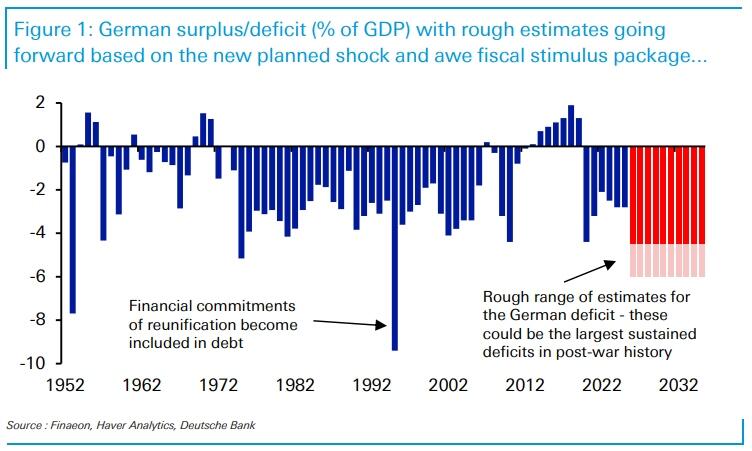
Today’s CoTD simply looks at Germany’s fiscal deficit through time and assumes an extra 3% deficit phased in over the next decade from current levels.
This is incredibly back of the envelope, but puts the planned move in some historical perspective.
Of course, if growth rebounds then this may reduce the deficit so there are a lot of moving parts. However, this could easily be a sustained fiscal stimulus unparalleled in Germany’s history. Germany will still likely have the lowest debt/GDP in the G7 as far as the eye can see.
 ?itok=ACeQkPE2
We estimated that Germany could spend around $1.6tn before its debt/GDP equalled the second lowest (the US) in the G7.
This package has the potential to be in the magnitude of around $1tn over time and the US won’t stand still in terms of its debt over this period.
If you want a bit of fun, Germany could spend $8.5tn before its debt/GDP equalled Japan’s!
So don’t underestimate how important this news is. Your portfolio over time will thank you for it.
Indeed it will, if you were long bunds as zee bond vigilantes just sent Bund yields higher by over 24bps...
 ?itok=RwNIF0nE
...the biggest yield jump in history for the German bond market...
 ?itok=tF-94mlp
that investors said the bond sell-off did not reflect concerns about the sustainability of Berlin’s debt, which at around 63 per cent of GDP is far lower than the level in other big western economies such as France, the UK and the US.
In contrast with recent rises in borrowing costs in countries such as the UK, which have threatened their fiscal plans, markets were pricing in a better growth trajectory that was boosting risky assets such as stocks at the expense of ultra-safe government debt.
“Yields are rising because of the perception that Germany is turning on the growth tap. It is very risk-positive,” said Karen Ward, a strategist at JPMorgan Asset Management.
We are not sure we're buying what these analysts are selling on this one - especially as we noted overnight that https://cms.zerohedge.com/markets/germany-unveils-historic-whatever-it-takes-fiscal-package-sending-swap-spreads-crashing
And remember, Europe is well-known for suffering sovereign debt crises at the worst possible time, and should inflation remain stubbornly sticky, the yield on new German debt may soon become unmanageable... which means the ECB will have to step in and monetize German deficit spending, as it did for much of the past decade. The only problem: it will first need a market and/or deflationary shock to greenlight such an intervention. Although in light of events in the past 5 years, we doubt very much that the Frankfurt-based central bank will have any problems coming up with yet another fake crisis to capitalize on.
This sudden (and urgent) surge in borrowing comes after Zelensky publicly snubbed Trump's deal in The Oval Office - prompting VP Vance to explain that this was a done deal... "someone got to him... likely it was our European allies"...
Yes! Lost in the temper tantrum thrown by pissy pants Zelensky is that this was a DONE DEAL. The signing was pro forma. Someone got to him. Likely it was our “European allies.”https://t.co/FwJujQHchA
— Cernovich (@Cernovich) https://twitter.com/Cernovich/status/1896751830379733394?ref_src=twsrc%5Etfw
Are we giving zee Germans too much credit for a 4D-Chess move? Did our "allies" force Zelensky to tank the deal with Trump at the last minute, to prompt a new 'crisis' (it worked with COVID, remember), enabling them to bypass the debt brake in the name of security, freedom, and whatever patriotic, democracy-saving narrative they choose next? Perhaps, but if the shoe fits (mixing analogies unapologetically) as the deadline for government change in Germany (March 24th) looms and the AfD's ability block this massive debt plan looms even larger indeed.
https://cms.zerohedge.com/users/tyler-durden
Wed, 03/05/2025 - 08:15
High-Frequency Data Signals Further Decline In Small Business Optimism
High-Frequency Data Signals Further Decline In Small Business Optimism
After US small-business optimism saw its https://www.zerohedge.com/markets/trump-victory-sends-small-business-optimism-soaring-most-44-years
amid rising macroeconomic uncertainty. With mounting trade tensions and consumer concerns, optimism among mom-and-pop shops may decline further.
Goldman's Will Nance, Rajul Bothra, and others cited new data from the Fiserv Small Business Index, a monthly indicator measuring small business performance across the US at national, state, and industry levels. Unlike traditional surveys, the index aggregates point-of-sale transaction data—including card, cash, and check transactions—from 2 million small businesses, offering some of the most real-time insights into consumer spending trends.
Fiserv's updated Small Business Index for February showed a further slowdown in consumer spending growth compared to January. NSA spending growth was just .2% (vs. 6.2% in January), while SA growth came in at 2.1% (vs. 4.9% prior). Adjusting for the leap year headwinds, NSA growth was a more modest 3.2%, while SA growth remained stable at 5.1%. Transaction growth also slowed to 1.2% NSA. Restaurants continued to show weakness.
 ?itok=hABZg895
Here's more color from the analysts:
Bottom Line:
Fiserv recently updated the Fiserv Small Business Index for the month of February. Spending growth saw a step down compared to January with 0.2% growth NSA (vs 6.2% growth in January) and 2.1% SA growth (vs 4.9% January). Adjusting for leap year headwinds, the step down was more modest at 3.2% NSA growth and stable when looking at 5.1% SA growth compared to the prior month. Transaction growth stepped down to 1.2% growth NSA. In terms of notable subsector trends, Restaurants continued to see weakness in spending and Retail sales saw a step down from January (adjusted for leap year). FI flagged that February is the first month since January 2023 in which retail average ticket sizes have increased year over year. This trend could point to either increasing prices on regularly purchased goods or the mix in goods purchased. In addition, FI noted service-oriented spending saw a modest decline, including Professional Services and Accommodation (Hotel spending) driven in part by cyclical performance. Overall, we see believe February looks stable on a seasonally adjusted basis, while the decline in NSA growth could be a negative for near term spending updates
February Results:
For the month of February, the Fiserv Small Business Index saw mixed trends in consumer spending with total SMB sales +0.2% yoy (3.2% adjusted for leap year, up +5.1% on a SA basis adjusted for leap year) vs 6.2% yoy in January. At the sector level, SMB retail sales remained relatively resilient but stepped down from January levels (2.2% in February adjusted for leap year vs 4.5% in January). Restaurant Spending (Food Services and Drinking Places) continued to see weakness in February at -4.8% (adj for leap year) vs to -1.8% in January.
From late 2024 into late February, bars, restaurants, arts, entertainment, and recreation small businesses recorded a noticeable spending slowdown. This trend suggests that despite a boost in small-business optimism following Trump's victory, consumers have abruptly cut back on discretionary spending—because the inflation storm triggered by Biden-Harris has not yet subsided.
 ?itok=aq5InwZj
 ?itok=0lASET0k
Fiserv's mixed consumer data comes ahead of the next NFIB Small Business Optimism Index release, scheduled for next Tuesday. This may reflect ongoing uncertainty weighing on sentiment.
 ?itok=7qXMi_KJ
A https://www.zerohedge.com/markets/trade-wars-begin-all-you-need-know
" hangover appear to be what the Trump administration needs to slow inflation while simultaneously bringing borrowing costs down to cushion the landing.
BESSENT: WE'RE SET ON BRINGING INTEREST RATES DOWN-FOX NEWS INTERVIEW https://t.co/myf6n3tgMX
— zerohedge (@zerohedge) https://twitter.com/zerohedge/status/1896905555731796028?ref_src=twsrc%5Etfw
Maybe...
If you didn’t already understand the current White House’s approach from their budget, Bessent is telling you 🔊 loud & clear, if you care to listen👂.
This is what he is saying in plain English:
- They want to slow demand in the real economy & hence slow inflation, by… https://t.co/6GKUIekITj
— Cem Karsan 🥐 (@jam_croissant) https://twitter.com/jam_croissant/status/1896424533319426233?ref_src=twsrc%5Etfw
. . .
https://cms.zerohedge.com/users/tyler-durden
Wed, 03/05/2025 - 07:45
If We Set Aside Ideology, Is There Anything We Can Agree On?
If We Set Aside Ideology, Is There Anything We Can Agree On?
https://charleshughsmith.blogspot.com/2025/03/if-we-set-aside-ideology-is-there.html
Just the experiment of setting aside ideological certainties for a moment would be instructive.
Humans are hard-wired to prefer simplicity over complexity, and this is the foundation of ideology, which like mythology takes a complex world and radically simplifies it to an easily digestible construct. (I tease all this apart in my book https://amzn.to/3zM05T4
.)
Being social animals, humans are also hard-wired to quickly form loyalties to groups and gravitate to one camp. Very few football fans (if any) have zero loyalty to any team and have zero emotional stake (i.e. there's no team they hope loses and none they hope will win).
Uncertainty generates anxiety, and so we settle the real world's many uncertainties with internal certainty: an ideology is a simple sketch of how the world works, and we will defend this emotionally powerful construct even as evidence piles up that it doesn't accurately map all of the world's complexities. We will deny, rationalize and cherry-pick examples to "prove" our ideological certainties map the real world.
The problem with radically simplified constructs like mythologies and ideologies is they cannot possibly map the world accurately as complex, interactive systems don't reduce down to a simplified construct. So every ideological construct ends up denying, rationalizing and cherry-picking examples to cover the inherent weaknesses of simplifying the world into bite-sized constructs.
Our intense drive to establish and nurture loyalties leads to emotionally satisfying but often counter-productive convolutions, such as any enemy of my enemy is my friend and any friend of my enemy is my enemy.
The problems with ideological constructs are magnified in tumultuous times as ideologies map a rapidly shrinking share of the real world. The internally coherent ideology drifts further into incoherence, and our natural defense is not to become more open-minded (i.e. actively embrace uncertainty and entertain new ideas) but to cling even harder to the simplified certainties that generate our internal sense of self and certainty.
Since the faithful of competing ideologies are pursuing the same strategy to reduce anxiety, our loyalties clash with increasing intensity. That possibility that all the ideologies claiming to map the real world are increasingly detached from real-world dynamics doesn't occur to any true believer in any camp, for each believer remains confident (and when pushed, becomes ever more adamant) that their ideology is the one true construct that faithfully maps all of the real world's immense complexity.
Such is the power of these internally coherent constructs that we don't see them as belief structures, we see them as the bedrock of truth. We don't recognize our ideological beliefs as beliefs open to question, and so when challenged, we respond defensively: Ideology? What ideology? What I'm saying is the truth. Yes, true to us, but an accurate account / map of all the world's complexity? No.
To each believer in an ideology, the problem isn't that their ideology is not mapping the real world with sufficient accuracy to successfully navigate increasingly stormy seas. The problem is the other ideologies are obstructing our solutions, which are guaranteed to work if pursued with absolute purity. Compromises introduce fatal impurities and so of course they fail to fix what's broken.
If only all those misguided souls abandoned their wrong-headed beliefs and joined our temple, then we'd clear up all the real-world problems in no time. But alas, the fools insist on clinging to their completely misguided faith in false gods.
In this increasingly bitter environment, up becomes down and vice versa. Common sense--by definition, an attempt to map real world complexities based on practicalities rather than internally coherent constructs and loyalties--is tossed aside in favor of doubling down on the simplified precepts of the ideology.
We end up arguing about internally coherent simplifications, none of which do a productive job of mapping the real world, and accusations and raw emotions replace rationality. We are raging, spittle flying, demanding everyone agree with us that 100 angels can dance on the head of pin, not 10 and not 1,000.
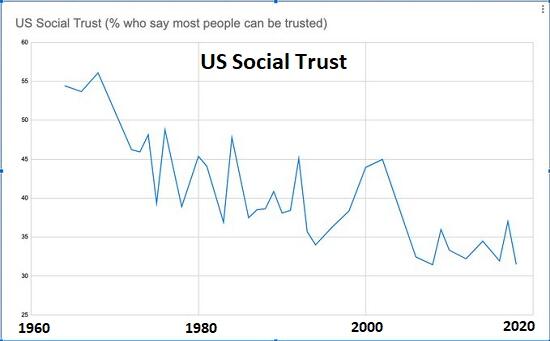
How can we trust anyone who so adamantly clings to such wrong-headed ideas? We can't, so social trust plummets accordingly.
 ?itok=rHzkpz9w
Those without any ideological faith watch the emotional fireworks with stunned amazement. So you think Dallas should be nuked because you hate the Cowboys? Um, okay.... But does nuking the Cowboys really clear your team's path to the Super Bowl?
The more the real world unravels into complex uncertainties, the greater our need to cling to certainties as the source of our internal security and hope. Rather than see the failure of all internally coherent but increasingly incoherent constructs to map the real world as the core problem, we see those with different ideological beliefs as the problem.
If we managed to set all ideological beliefs and constructs aside for a brief moment, is there anything we might agree on? As a thought experiment, imagine an AI project tasked with providing solutions to the core threats to our future stability and security. Is there anything the program might suggest that we could agree on?
How about accountability and transparency? Can we agree on the practical value of making those wielding power accountable for their actions and decisions? Can anyone contest the practicality of demanding an honest, transparent, accurate accounting of public funds and publicly traded private-sector enterprises? Can anyone contest that transparency is the foundation of sound decision-making?
Just the experiment of setting aside ideological certainties for a moment would be instructive. The irony here is the more the real world changes in ways that don't map simplistic ideologies, the greater our urgency to cling even harder to the simplicities we've invested with our identity and loyalty, and the stronger our instinct to lash out at anyone who disagrees with us, as if their disagreement is the problem, rather than the real-world complexities that no simple construct can map with any functional utility.
Rather than nuking Dallas, maybe finding some sort of practical, common-sense middle ground might be the wiser course, even though it goes against every fiber of our hard-wired instincts to circle the wagons to defend the one true construct and declare those who disagree as the problem.
* * *
https://www.patreon.com/charleshughsmith
.
https://charleshughsmith.substack.com/
https://cms.zerohedge.com/users/tyler-durden
Wed, 03/05/2025 - 07:20
https://www.zerohedge.com/political/if-we-set-aside-ideology-there-anything-we-can-agree
"America Is Back" - 12 Takeaways From Trump 47's First Major Policy Speech To Congress
"America Is Back" - 12 Takeaways From Trump 47's First Major Policy Speech To Congress
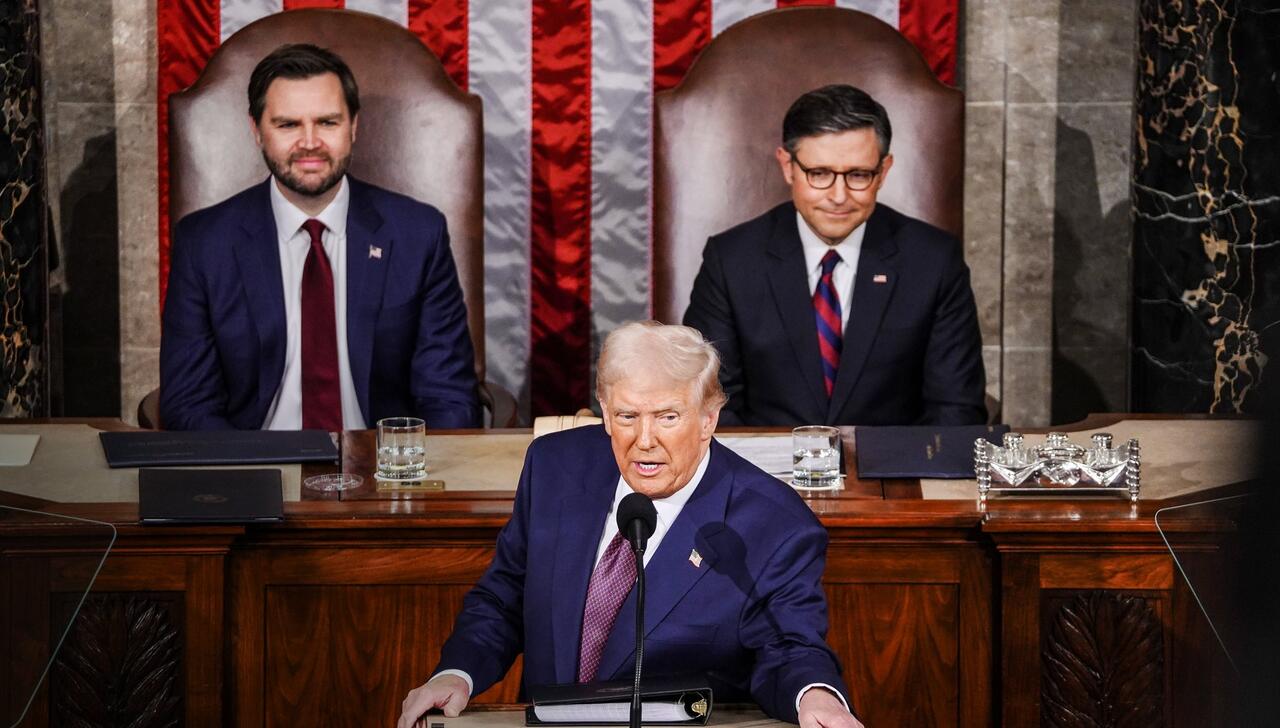
President Donald Trump capped off his first six weeks in office with a 100-minute speech to a joint session of Congress
The March 4 address followed a blitz of more than 100 executive actions that impacted nearly every aspect of government and U.S. relationships with other nations.
 ?itok=NrfZTHZv
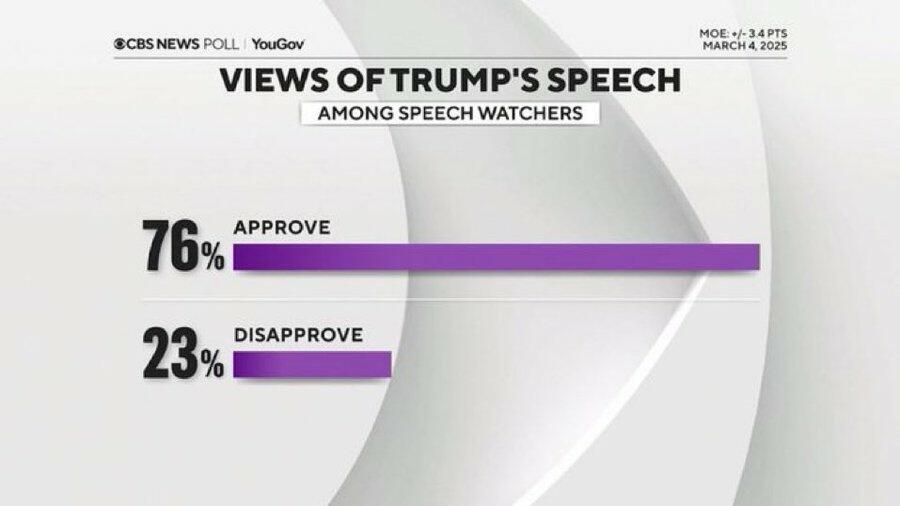
Americans largely approved of Trump's speech to a joint session of Congress.
 ?itok=6n0NrlE4
are the highlights of the speech, which began with the statement “America is back” and ended with a call to “renew the unlimited promise of the American dream.”
1. Tax Cuts Promised for All Americans
Trump pledged across-the-board tax cuts, including personal income, corporate, and industry cuts.
After Republicans’ 2017 tax bill failed to make personal income tax cuts permanent, Trump says he is pushing lawmakers to ensure that this Congress does so.
Trump reiterated his campaign proposals to end taxes on tips, overtime pay, and Social Security benefits, and proposed zero interest on loans for American-made vehicles.
Trump encouraged Democrats to join Republicans in backing the legislation, suggesting they would face political consequences otherwise.
“I’m sure you’re going to vote for those tax cuts because, otherwise, I don’t believe the people will ever vote you into office,” he said.
Trump added that these tax cuts—which would total $4.5 trillion over a decade under the current House GOP plan—would be retroactive to Jan. 20, 2025.
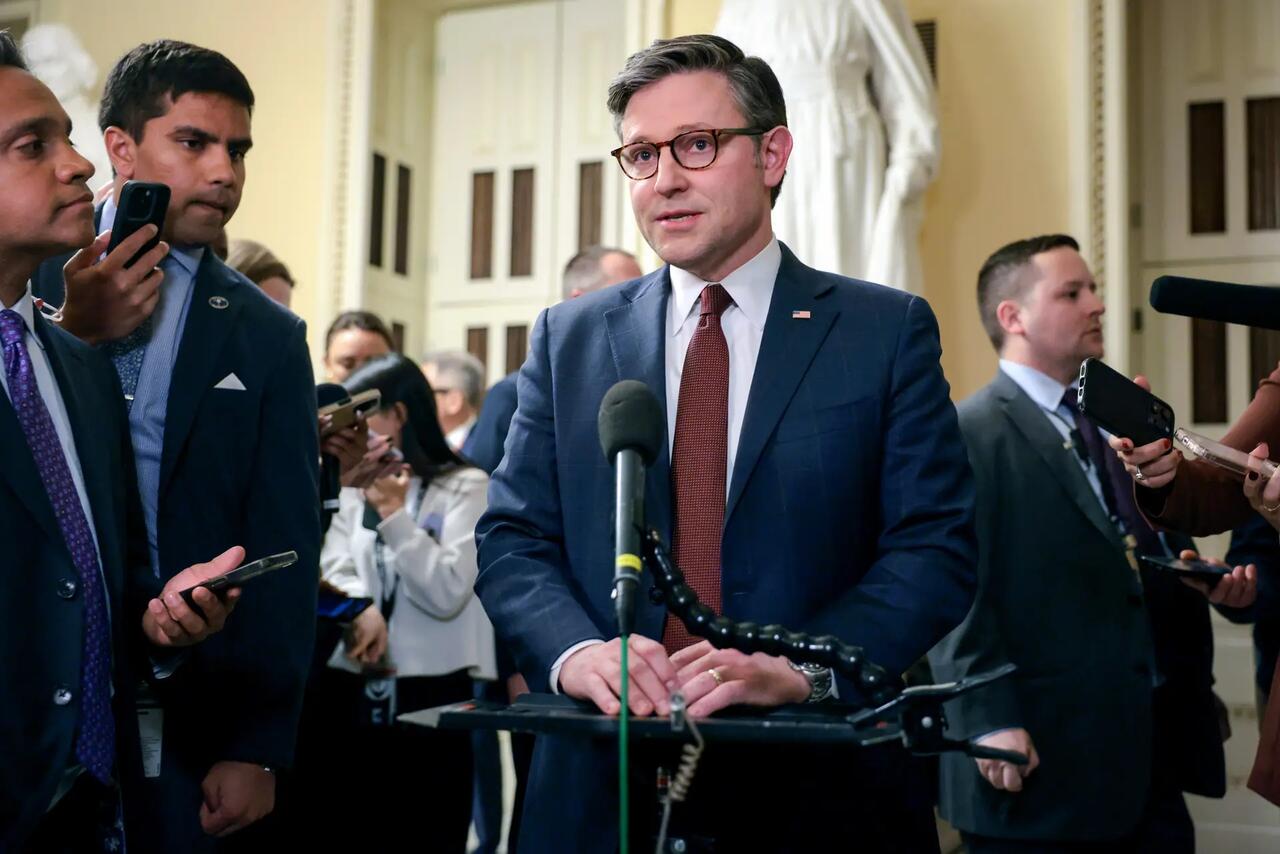 ?itok=ZXw-DD4c
Speaker of the House Mike Johnson (R-La.) delivers remarks after the House passed the Republican's budget resolution on the spending bill at the U.S. Capitol on Feb. 25, 2025. Kayla Bartkowski/Getty Images
2. Border Closed, Deportations Underway
Trump touted his administration’s efforts to secure the border, having signed 10 executive orders related to halting the flow of illegal immigrants and initiating mass deportation efforts nationwide to remove violent criminals from the country.
“Within hours of taking the oath of office, I declared a national emergency on our southern border, and I deployed the U.S. military and border patrol to repel the invasion of our country, and what a job they’ve done,” Trump said. “As a result, illegal border crossings last month were by far the lowest ever recorded.”
Trump said his rhetoric also helped encourage would-be illegal immigrants to reconsider their plans.
“They heard my words, and they chose not to come,” he said.
The president also highlighted his order designating cartels and transnational gangs as foreign terrorist organizations.
 ?itok=HBhpPg4l
President Donald Trump holds a copy of an executive order honoring Jocelyn Nungaray, a 12-year-old girl who was killed by illegal immigrants, as he addresses a joint session of Congress at the U.S. Capitol on March 4, 2025. Win McNamee/Getty Images
3. Trump Touts ‘Common Sense Revolution’
Trump also announced a “common sense revolution,” including primarily through rooting out “woke” ideas from the government and federally-funded programs.
He referenced an https://www.theepochtimes.com/us/what-to-know-about-trumps-executive-order-on-gender-5797074
signed early in his second term declaring that the federal government recognizes only two sexes, based on biological sex at conception and not “gender ideology.”
Trump highlighted his executive order stripping federal funding for schools that allow males to compete in female sports. One order declared that it is the official policy of the United States that Title IX applies to women and not men who identify as transgender females.
The first gallery guest introduced by Trump was Payton McNabb, a female athlete who suffered injuries while playing volleyball against a male player.
Trump also referenced merit-based hiring—rather than hiring to meet diversity quotas—as part of his “common sense revolution” agenda.
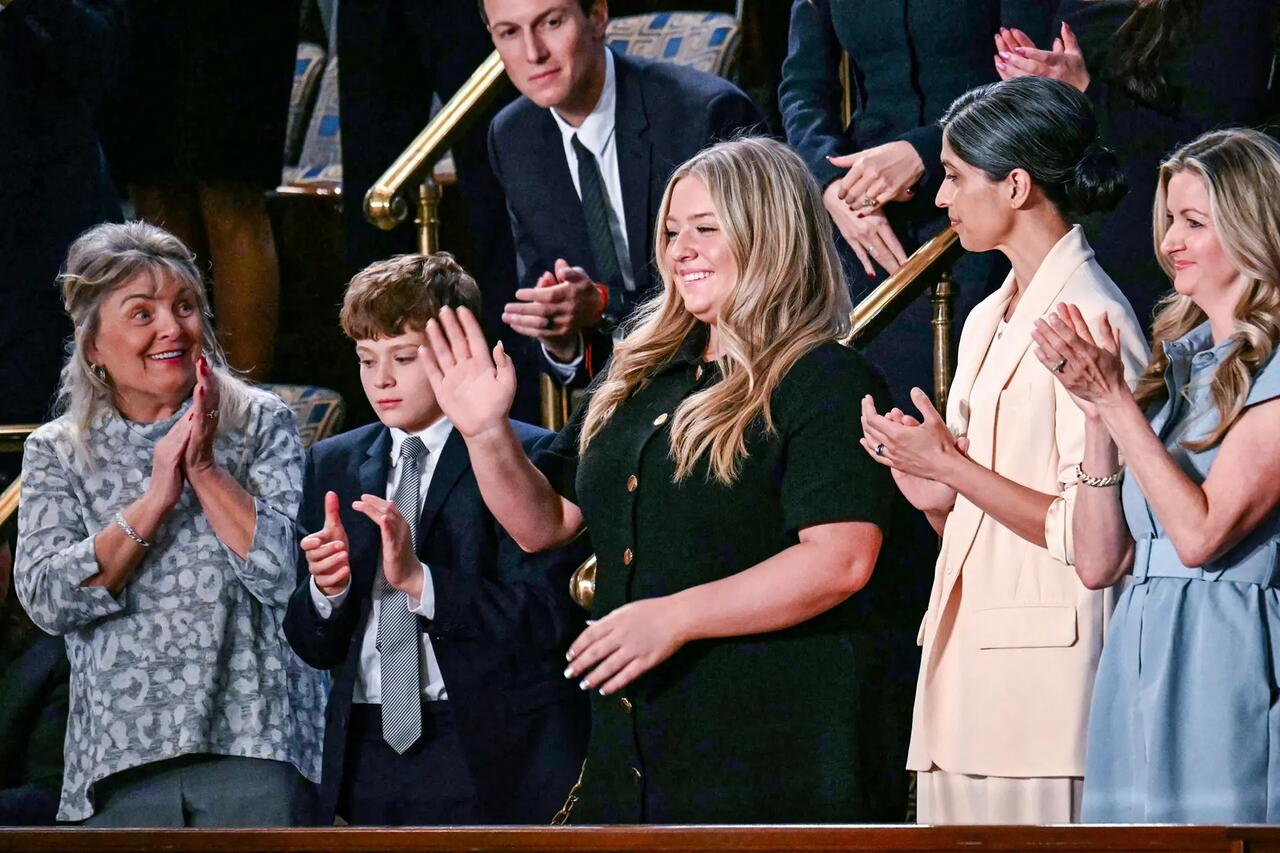 ?itok=YzE0zArT
Payton McNabb (C), former high school athlete who was injured by a volleyball spike from an opposing male player who identified as a transgender woman, is recognized by President Donald Trump as he speaks during an address to a joint session of Congress at the U.S. Capitol on March 4, 2025. Jim Watson/AFP via Getty Images
4. Tariffs Explained, ‘A Little Disturbance’
Trump said his trade policies will remain centered around tariffs that are designed to boost foreign investment in the United States and balance multi-billion-dollar trade deficits. The goal is to bring trillions of dollars into the president’s new “external revenue service.”
“If you don’t make your product in America,” Trump said, “you will pay a tariff, and in some cases, a rather large one.”
A series of tariffs—including 25 percent fees on goods from Canada and Mexico and 20 percent in addition to those already imposed on China—took effect on March 4, and across-the-board reciprocal tariffs are set to take effect on April 2.
“Other countries have used tariffs against us for decades, and now it’s our turn to start using them against those other countries,” Trump said.
While critics have suggested the tariffs could cause inflation, the president rejected the notion and said any impact would be temporary.
“There'll be a little disturbance, like we’re okay with that,” Trump said. “It won’t be much.”
5. DOGE Findings Highlighted
Trump praised the work of Elon Musk in leading the Department of Government Efficiency, which has announced savings of over $105 billion through contract cancellations, staff reductions, and identifying fraud and waste.
Trump listed a number of multi-million dollar projects related to diversity, equity, and inclusion (DEI) that had been terminated, and a $22 billion plan to provide housing and automobiles for illegal immigrants.
“We found hundreds of billions of dollars of fraud,” Trump said, noting that the Government Accounting Office has estimated that up to $500 billion in fraudulent payments are made annually.
“By slashing all of the fraud, waste, and theft we can find, we will defeat inflation, bring down mortgage rates, lower car payments and grocery prices, protect our seniors, and put more money in the pockets of American families,” Trump said.
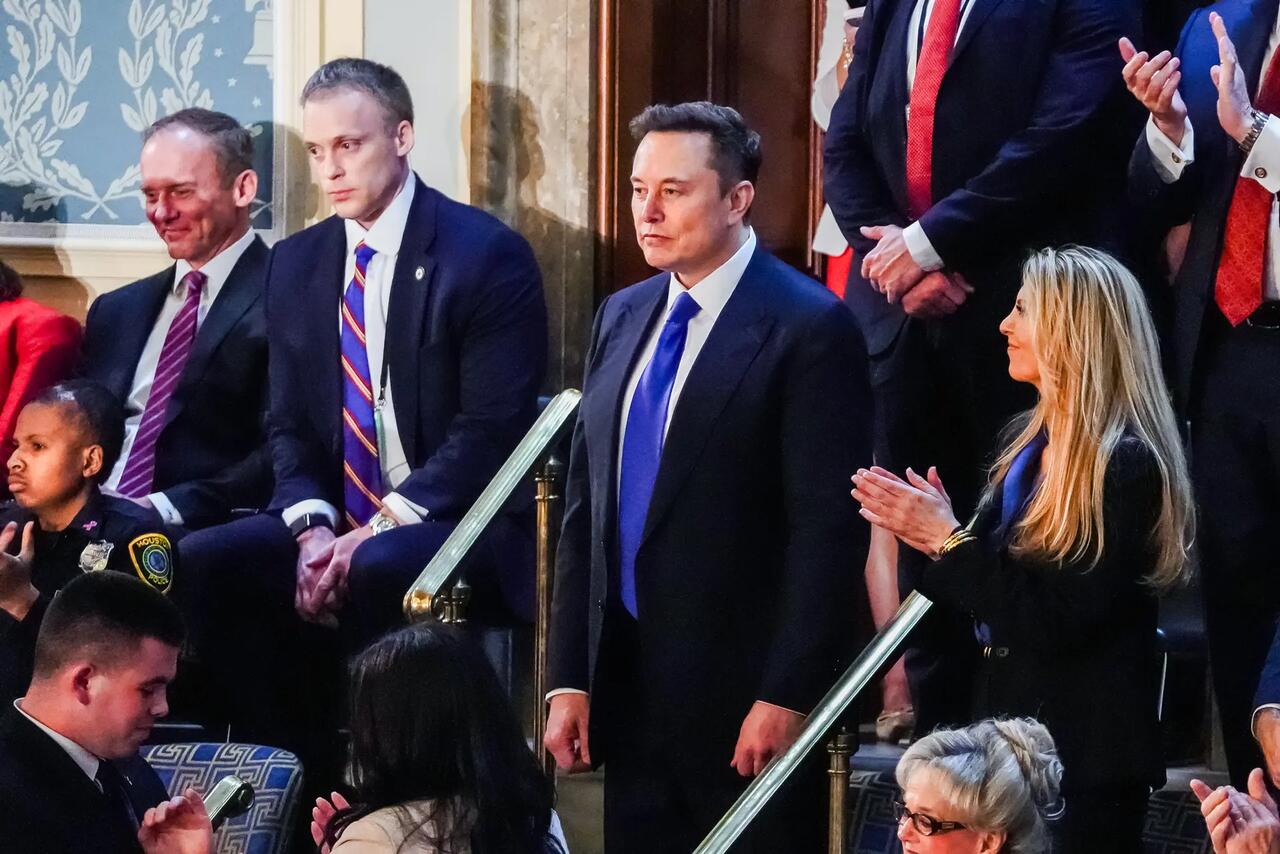 ?itok=zd6dDdOh
White House senior advisor to the president Elon Musk attends President Donald Trump's address to a joint session of Congress at the U.S. Capitol on March 4, 2025. Madalina Vasiliu/The Epoch Times
6. Promises Balanced Budget
Trump also formalized plans to balance the federal budget during his second term.
“I want to do what has not been done in almost 24 years: Balance the budget,” Trump said. “We are going to balance the federal budget.”
A balanced federal budget is a longtime goal of many Republicans but it is not an issue Trump has historically addressed directly.
On Feb. 7, he first indicated interest in such a plan, writing “Balanced budget!” in all caps in a post on Truth Social.
Balancing the budget would require either substantial spending cuts or substantial increases in government revenues, whether from internal or external sources.
He said part of achieving this would be a “gold card” program under which foreigners or their employers could pay $5 million for a path to citizenship.
7. Victims Spotlighted
Trump also recognized several victims of illegal immigrant crime during his address.
The first was Laken Riley, a 22-year-old nursing student at the University of Georgia who was murdered by a Tren de Aragua gang member in February 2024.
Describing Riley as “brilliant” and “the best in her class,” Trump touted his signing of the Laken Riley Act—the first signature of his second term—which requires federal detention of illegal immigrants accused of certain crimes.
Trump then announced that a 34,000-acre national wildlife refuge near Houston will be renamed after 12-year-old Jocelyn Nungaray, also allegedly killed by Tren de Aragua gang members.
“The death of this beautiful 12-year-old girl and the agony of her mother and family touched our entire nation greatly,” Trump said.
Family members of both victims were in attendance at the speech.
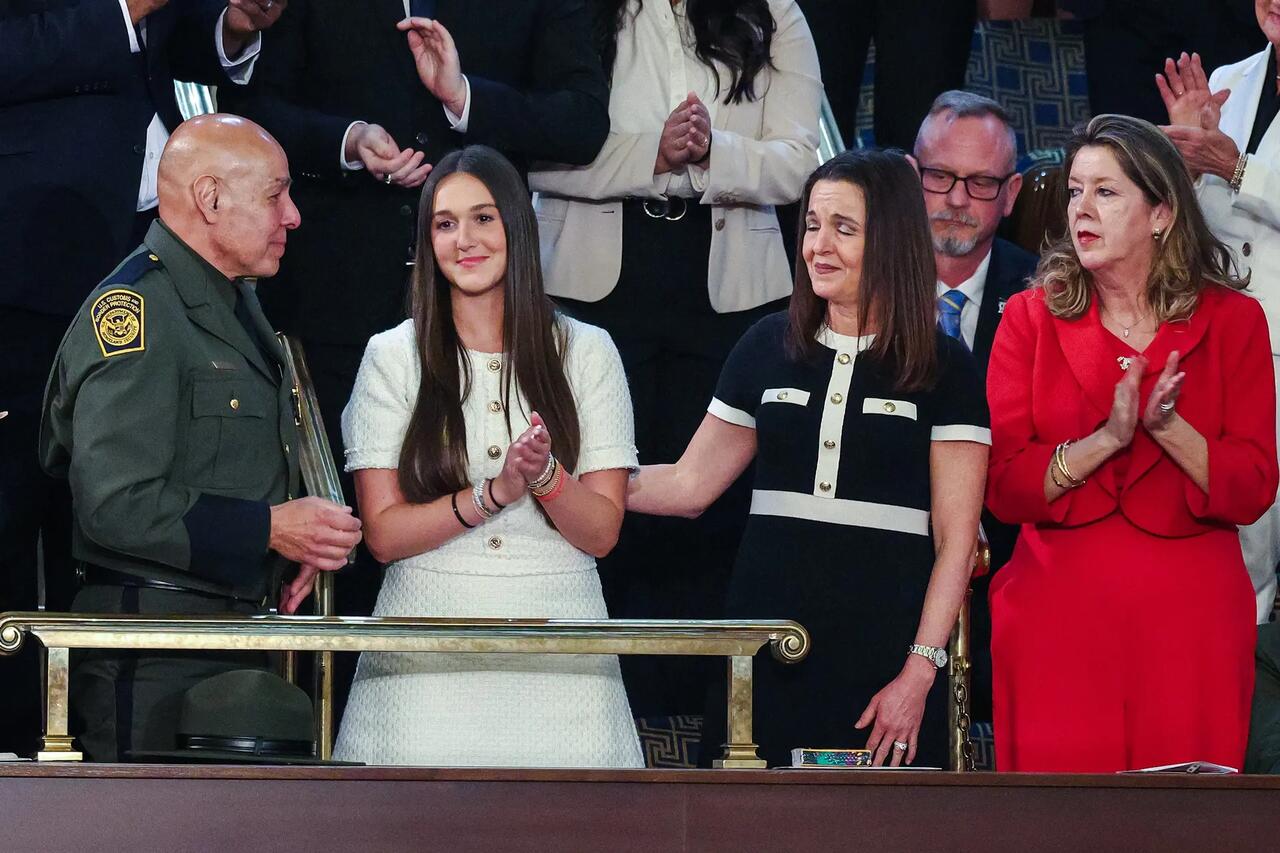 ?itok=J9rXbHki
Allyson and Lauren Phillips, the mother and sister of Laken Riley, listen as President Donald Trump addresses a joint session of Congress at the U.S. Capitol on March 4, 2025. Kayla Bartkowski/Getty Images
8. Direct Appeal to Greenlanders
Trump directly appealed to the people of Greenland to join the United States, which he said would benefit them and improve the security of the United States and the world.
“We strongly support your right to determine your own future,” Trump said. “And if you choose, we welcome you into the United States of America.”
Trump previously offered to buy Greenland from Denmark, which oversees it as an autonomous territory. The offer was snubbed by the Danes.
“We will keep you safe, we will make you rich, and together, we will take Greenland to heights,” Trump said.
The president said the island is important to national security.
“We’re working with everybody involved to try and get it, but we need it really for international world security,” Trump said. “And I think we’re going to get it one way or the other.”
9. Letter From Zelenskyy
The president described a letter he received from Ukrainian President Volodymyr Zelenskyy earlier in the day, suggesting the note could indicate the nations are closer to reaching a mineral deal.
Zelenskyy’s letter said that “Ukraine is ready to come to the negotiating table as soon as possible to bring lasting peace closer,” according to Trump.
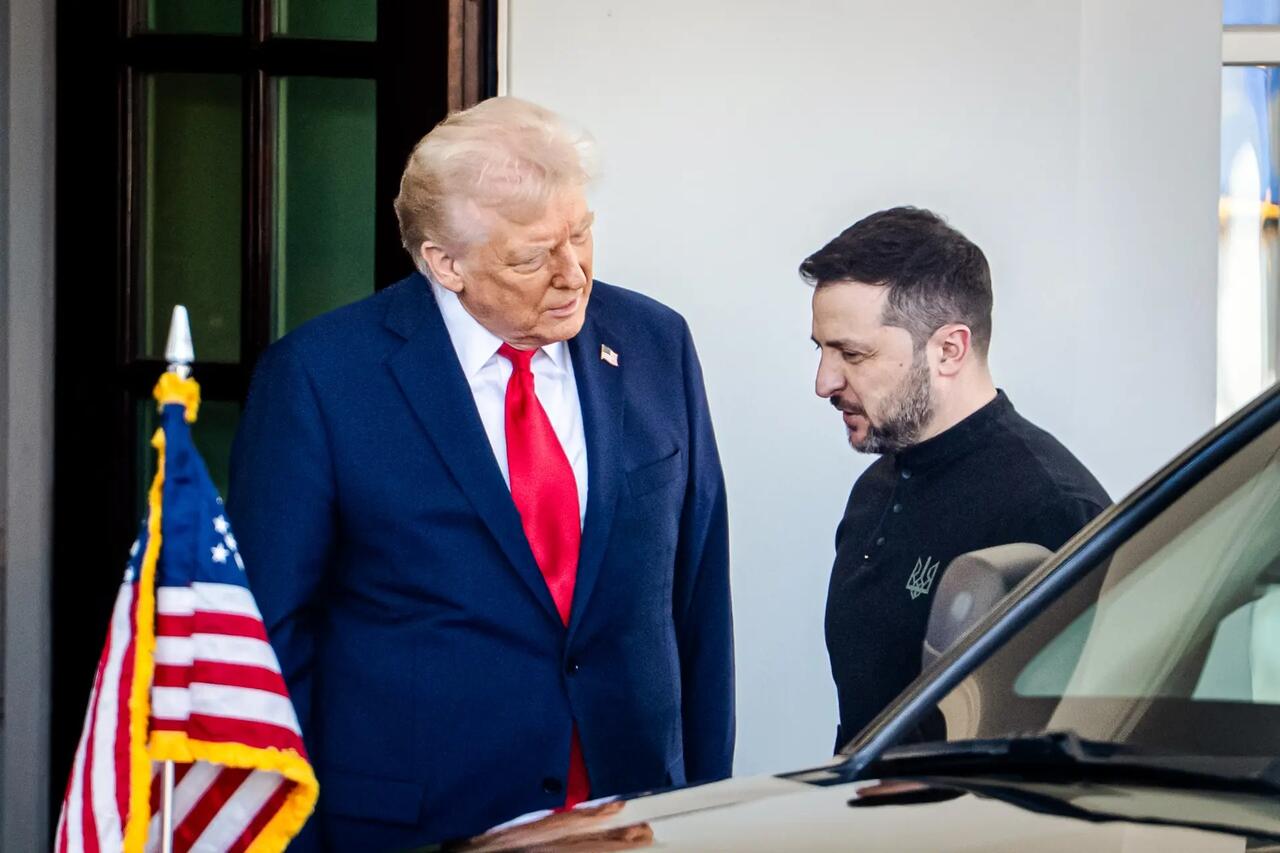
The U.S.–Ukraine minerals deal fell apart after a tense exchange between Trump and Zelenskyy in the Oval Office on Feb. 28. Trump also paused all U.S. aid to Ukraine on March 3.
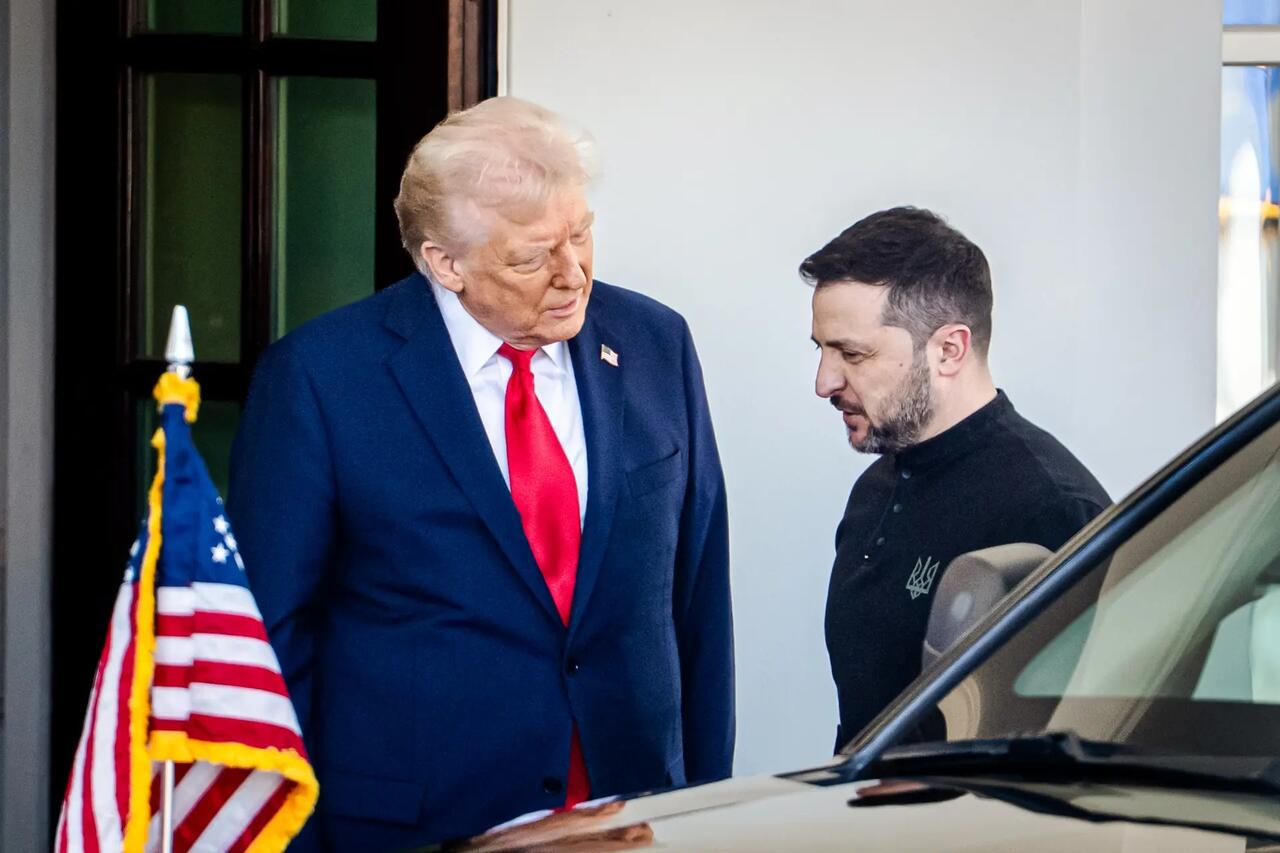 ?itok=Z06rayUy
President Donald Trump greets Ukrainian President Volodymyr Zelenskyy at the White House in Washington on Feb. 28, 2025. Madalina Vasiliu/The Epoch Times
The note informed U.S. leaders that Ukraine is prepared to agree to a minerals deal that would see 50 percent of some natural resource revenues go to repay America for the approximately $175 billion appropriated to support Ukrainian defense efforts.
Trump has repeatedly called for an end to the conflict between Ukraine and Russia.
“I appreciate that he sent this letter,” Trump said. “Simultaneously, we’ve had serious discussions with Russia and have received strong signals that they are ready for peace. Wouldn’t that be beautiful?”
10. New Shipbuilding Office
Trump said a new White House Office of Shipbuilding is meant to counter China’s strides in the shipbuilding sector.
“We used to make so many ships. We don’t make them anymore very much, but we’re going to make them very fast, very soon,” Trump said. “It will have a huge impact.”
Historically a leader in the shipbuilding industry, the United States has seen its dominance wane in recent years, and China now accounts for more than 50 percent of global orders, according to U.N. Conference on Trade and Development data.
The president said tax incentives will help “resurrect” the industry and are meant to revitalize commercial and military ship production and bolster national security efforts.
11. Arrest of Top Terrorist Responsible for Abbey Gate
Trump made a surprise announcement that the top terrorist responsible for killing 13 U.S. service members during the bombing at Abbey Gate during the withdrawal from Afghanistan in 2021 is now in custody.
 ?itok=0tD3uph_
A sign with photos and names of the 13 service members killed in a terrorist attack at Abbey Gate is displayed during a news conference at the U.S. Capitol on Sept. 9, 2024. Kent Nishimura/Getty Images
“America is once again standing strong against the forces of radical Islamic terrorism,” Trump said. “Tonight, I am pleased to announce that we have just apprehended the top terrorist responsible for that atrocity, and he is, right now, on his way here to face the swift sword of American justice.”
The Abbey Gate bombing was allegedly carried out by a suicide bomber, affiliated with ISIS, who detonated an explosive vest at the Hamid Karzai International Airport in Kabul.
U.S. officials have identified the senior member of the ISIS terror group based in Afghanistan as Muhammad Sharifullah.
Sharifullah was turned over to U.S. authorities by Pakistan and was being brought to the United States for prosecution, Trump said.
12. Democrats Respond
Congressional Democrats criticized Trump from both within and outside of the House chamber where he spoke. Rep. Al Green (D-Texas) was escorted out of the chamber after standing up and yelling during Trump’s speech.
Green rose to speak and shook his cane toward the president about four minutes into the speech, but his words were quickly drowned out by chants of “USA! USA!” from Republican lawmakers.
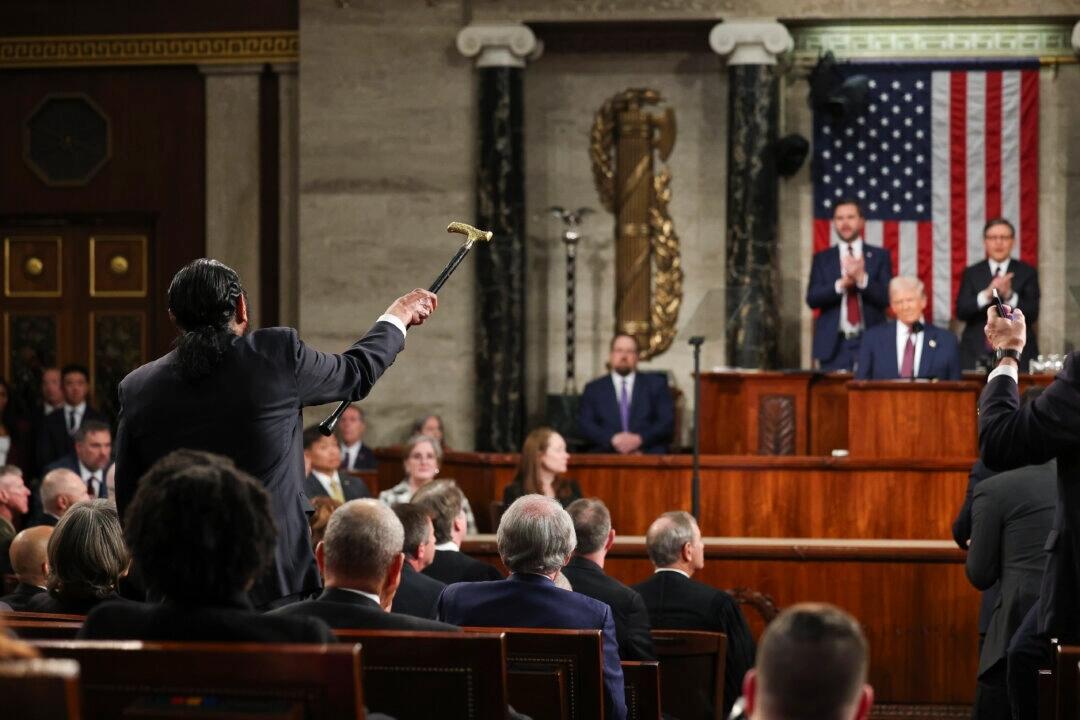 ?itok=a4ms28pi
He later said that he was “making it clear to the president that he had no mandate to cut Medicaid.”
Trump has said he won’t touch Medicaid.
Other Democrats protested with signs that read “Save Medicaid” and “Musk Steals.” Some congresswomen wore pink jackets as a statement about the purportedly harmful impact of Trump’s policies on women.
Following Trump’s speech, Sen. Elissa Slotkin (D-Mich.) gave a speech from her home state criticizing the president’s actions. “President Trump is trying to deliver an unprecedented giveaway to his billionaire friends,” she said.
Rep. Herb Conaway (D-N.J.) on NTD, The Epoch Times’ sister media outlet, pushed back on the idea of a golden age for America, stating that https://www.theepochtimes.com/business/us-annual-inflation-rate-jumps-to-3-percent-for-1st-time-since-june-5808158
of eggs and coffee. He also took aim at Trump’s tariffs, which he called “nothing but a tax on the American people.”
https://cms.zerohedge.com/users/tyler-durden
Wed, 03/05/2025 - 06:55
Ukraine: Is This Genuine Jingoism?
Ukraine: Is This Genuine Jingoism?
https://off-guardian.org/2025/03/03/ukraine-is-this-genuine-jingoism/
There was a https://www.bbc.co.uk/news/articles/c2019j0w9glo
!
Former actor and comedian President Zelensky and former reality television presenter Donald Trump went at it.
Trump made fun of his clothes, Zelensky warned that war would come to the US if Ukraine fell and called Vice-President JD Vance “bitch”.
Zelensky disrespected the office of the President or was bullied by big meanies depending on which color you voted for.
 ?itok=CAU4VC9_
It’s all very serious, real stuff.
As serious and real as the traumatised faces Zelenksy and his First Lady were making during https://www.vogue.co.uk/news/article/olena-zelenska
.
The track-suited former “peace candidate” then either left the White House voluntarily or was told to leave, again depending who you voted for.
He then immediately flew to England for an “emergency last minute” meeting with Prime Minister Sir Keir Starmer and a totally off-the-cuffhttps://www.bbc.co.uk/news/articles/ce98v8mnxm3o
.
Then all the leaders of Western Europe – plus Justin Trudeau, who is still in office despite resigning weeks ago – had a big old struggle session with the new “leader of the free world”, and decided they don’t want to be friends with America anymore!
All this was impromptu and extempore.
posted to the official Twitter accounts of multiple European political leaders later that day at almost the exact same time.
The leaders of Europe are shocked – shocked! – that Trump would treat a “hero” like Zelensky so shabbily and will gladly pay to guarantee Ukraine’s security.
Starmer has even offered to put British boots on the ground and planes in the air to secure a ceasefire:
The jingoism is at a fever pitch, with the usual warmongers and reality-deniers salivating at the idea of young men who don’t know each other shooting each other for no reason.
This is what everybody wants you to think about.
It has flooded the news and social media world like nothing has since the early days of Covid.
And, not since those early Covid days, has the truth/coverage ratio been so low.
Even more so than most news, no reality makes it into the discourse, rather there is simply an endless exchanges of one set of myths banging against another. Two teams fighting with invisible swords.
Nobody is even mentioning nuclear war, except in stories about surviving it https://www.dailymail.co.uk/news/article-14346385/As-Putin-threatens-West-world-politics-spirals-control-expert-reveals-rebuild-civilisation-Nuclear-war.html
, which is weird.
But what do we think is really going on? Are we really headed to World War III?
Or is this the managed-decline of America is simply taking another step forward while the financial burden of the forever-war necessary to secure a dystopian global state is being shifted to the EU?
Whether that’s the only aim or not, it’s certainly what’s about to happen.
Predictably, all the “anti-billionaire”, “save the planet”, “eat the rich” pretend liberals are cheering it on.
Because they don’t really care about the billionaires who own Boeing or Lockheed Martin raking in their tax revenue, they don’t really care about the impact of war on the environment, and they don’t really care about the corrupt rich making bank on both sides of the supposed “conflict”.
They are just Pavlov’s Pundits, conditioned to disapprove of everything Donald Trump says he wants just because he says he wants it. Even peace.
Which isn’t to say Trump really wants peace. But you know what I mean.
Also, I wouldn’t rule out a “nuclear near miss” or a “limited nuclear engagement” to try and scare people into global cooperation or something. When the media gets this hysterical, everything is on the table.
https://cms.zerohedge.com/users/tyler-durden
Wed, 03/05/2025 - 06:30
https://www.zerohedge.com/geopolitical/ukraine-genuine-jingoism
BlackRock's Purchase Of Hong Kong-Owned Panama Ports Marks Victory For Trump's 'America First'
BlackRock's Purchase Of Hong Kong-Owned Panama Ports Marks Victory For Trump's 'America First'
President Trump may be handed a major geopolitical victory concerning the Panama Canal, as a new report indicates that a BlackRock-led consortium has agreed to purchase key ports near the canal currently operated by Hong Kong-based conglomerate CK Hutchison Holdings Ltd. The report follows Trump's repeated warnings about China's growing influence over the strategic waterway and comes one month after https://www.zerohedge.com/geopolitical/panama-mulls-port-deal-cancellation-china-after-rubios-sunday-rumble-canal
the Panamanian government for allowing Beijing to expand its influence in the region.
 ?itok=Wx7EPkxK
provided more color on BlackRock's deal to purchase the critical ports near the canal:
The agreement was reached alongside a deal in principle for BlackRock and its Global Infrastructure Partners unit, along with Mediterranean Shipping Co.'s ports division, to acquire units that hold 80% of the Hutchison Ports group, which operates 43 ports in 23 countries, the company said Tuesday in a statement.
The consortium will also acquire 90% of Panama Ports Co., which operates the two entryways in Balboa and Cristobal. CK Hutchison said it would receive cash proceeds of about $19 billion from the broader ports deal.
. . .
The deal includes the bulk of CK Hutchison's ports division, which produced 20% of the conglomerates earnings before interest and tax in the first half of last year and was the company's third-biggest business.
The port deal represents the largest infrastructure deal in BlackRock's history after it purchased Global Infrastructure Partners last year, marking a new move for the asset manager in critical infrastructure investing across developed and emerging markets.
Earlier, BlackRock CEO Larry Fink told the RBC Capital Markets conference audience that the port deal was a great opportunity and highlighted the company's "long relationship" with CK Hutchison.
Public forensics analysis of CK Hutchison shows several key risk factors, including forced labor concerns and high political exposure to Chinese state-owned enterprises.
 ?itok=5nJ3Qkl3
Here's the upstream ownership profile of CK Hutchison Holdings. Notice some familiar names? Yes, BlackRock, hence Fink's comment at the RBC conference...
 ?itok=YGedDuRt
Here is more color on those direct owners and shareholders of the HK-based holdings company.
 ?itok=33sBDYIb
Trump's concerns about Beijing's encroachment on the canal may soon be diminished after the BlackRock deal (https://www.zerohedge.com/geopolitical/decades-long-chinese-influence-panama-begins-unravel
). Trump has complained that China has jeopardized US national security interests in the region. Hutchison's potential link to the Chinese Communist Party is shown above.
Latin America Research Professor Evan Ellis with the US Army War College told Bloomberg, "Hutchison could see the writing on the wall, that strategically it was best for them as well for Panama to pursue its interests elsewhere."
Risa Grais-Targow, director for Latin America at Eurasia Group, said the BlackRock deal to purchase the HK-owned ports and "diminish Chinese footprint in Panama" is a massive positive.
BlackRock told Bloomberg that the acquisition of the ports would require government approval. This might not be difficult to secure given the Panamanian government's urgent need to ease tensions with Trump.
https://cms.zerohedge.com/users/tyler-durden
Wed, 03/05/2025 - 05:45
Trump Policy Will Embolden Developing World To Reject Climate Agenda
Trump Policy Will Embolden Developing World To Reject Climate Agenda
Authored by Vijay Jayaraj via https://realclearwire.com/articles/2025/02/20/trump_policy_will_embolden_developing_world_to_reject_climate_agenda_1092843.html
,
President Donald. J. Trump’s seismic shift in energy policy will be felt far beyond U.S. borders. His withdrawing from the Paris Agreement, expanding American oil and gas exports, terminating the Green New Deal and eliminating the prospect of carbon tariffs offers a lifeline to developing nations grappling with chronic energy poverty.
 ?itok=oZIq1_yP
When the United States pivots sharply, other nations reassess their positions. Nowhere will a change in the dynamics of energy policy be more welcome than in developing nations whose imperative to increase access to energy conflicts with pressures to submit to Western climate lords’ anti-growth, anti-humanistic, and dystopian Paris climate agreement.
Many developing nations have long expressed frustration with the climate agenda’s constraints on their economic growth. India and China, for instance, have consistently maintained that they need flexibility to determine their own domestic energy mix, emphasizing that access to affordable fossil fuels is crucial for lifting millions out of poverty.
Similarly, nations across Africa have argued that their development priorities must include utilizing their natural resources—including coal, oil and natural gas—to meet people’s basic needs.
Take Nigeria, for example. With its significant natural gas reserves, the country has been caught between international pressure to limit the use of hydrocarbons and the urgent need to provide electricity to its growing population. International financial markets friendlier to fossil fuels could accelerate Nigeria’s plans to monetize its natural gas resources and expand domestic power generation.
As Yemi Osinbajo, a former Nigerian vice president, said, “Africans need more than just lights at home. We want abundant energy at scale so as to create industrial and commercial jobs. To participate fully in the global economy, we will need reliable, low-cost power.”
Global Implications of US Energy Expansion
One of the most notable effects of Trump’s energy policy is an anticipated surge in exports of liquefied natural gas (LNG) from the U.S., which is to resume processing permit applications for new LNG projects interrupted by former President Biden.
For developing countries, this means reliable energy at competitive prices—a stark contrast to the intermittent power of solar and wind projects that have been favored by climate-compliant financial institutions.
Energy poverty remains a crippling obstacle in many parts of sub-Saharan Africa, South Asia and Latin America. According to the International Energy Agency (IEA), nearly 800 million people worldwide are without electricity, while 3 billion rely on smoky biomass for cooking.
By moving to increase the global supply of LNG, Trump offers an avenue for these nations to transition toward cleaner-burning natural gas. Benefits will include less deforestation, less indoor air pollution and a chance for more economic growth.
India has already invested in LNG terminals in the U.S. and will be increasing imports as demand grows from its population of 1.4 billion.
Moreover, an increased supply of LNG will stabilize global reserves and reduce the vulnerability of energy-importing nations to geopolitical disruptions. Energy abundance is a prerequisite for stability and prosperity—a reality that developing countries know all too well and the climate obsessed seemingly undervalue.
No Carbon Tariffs: A Boon for Developing Economies
While many pundits harp on Trump’s proposed tariffs on imports, they don’t recognize—or at least fail to acknowledge—that many in the developing world are likely to be happy that carbon tariffs of the climate agenda won’t be part of Trump’s tax regime.
Carbon tariffs, a darling of the climate crowd on both sides of the Atlantic, are designed to penalize the producers—and users—of carbon-intensive goods. In practice, however, they act as a regressive tax on developing nations, many of which lack the financial and technological means to ”decarbonize” their industries.
For countries like India, which Foreign Minister S. Jaishankar has argued must prioritize economic growth over rigid climate targets, the carbon tax-free future represents a much-needed reprieve. It levels the playing field, allowing developing economies to compete in global markets without bearing the disproportionate burden of forced emissions reductions. Yes, Trump has threatened other tariffs, but those can be resolved through diplomacy.
Fossil fuels still account for over 80 percent of the world’s primary energy consumption, with countries like China, India, and Indonesia expanding their infrastructures to produce, import and use hydrocarbons despite pledges to meet impossible climate goals.
With Trump’s bold move, these nations will no longer feel the need to hide behind the veneer of climate appeasement.
Trump’s rejection of climate orthodoxy matches the aspirations of developing nations striving to ensure energy security and overcome poverty. Expect these countries to be emboldened to more openly pursue their preferred energy strategies and leave the Paris agreement themselves.
https://cms.zerohedge.com/users/tyler-durden
Wed, 03/05/2025 - 05:00
Britain Outraged Over Vance's "Some Random Country" Comments
Britain Outraged Over Vance's "Some Random Country" Comments
US Vice President JD Vance has sparked a row among allies after commenting about a potential European/UK-led peacekeeping force in Ukraine. His initial words came in a Fox News interview Tuesday wherein he made the case that the only security guarantees from America would come in the form a Trump's minerals deal, which has been stalled in the wake of Zelensky's Friday Oval Office blow-up with President Trump.
Vance said: "The president knows that if you want real US security guarantees, if you want to actually ensure that Vladimir Putin does not invade Ukraine again, the very best security guarantee is to give Americans economic upside in the future of Ukraine."
And that's where the offending comments came: "That is a way better security guarantee than 20,000 troops from some random country that hasn't fought a war in 30 or 40 years," he laid out.
 ?itok=-Uz2kH1q
He is being accused by top British officials and UK media of "disrespecting" British forces who closely assisted the US regime change wars and occupations of Iraq and Afghanistan. One former UK veterans minister branded him a "clown" who needs to "check his privilege" - as quoted in Britain's https://news.sky.com/story/jd-vance-denies-insulting-british-troops-over-random-country-jibe-13321190
.
All of this came in response to the London summit involving some dozen European heads of state and top security officials hosted by Prime Minister Kier Starmer. No other countries pledged troops in that meeting except Britain, with the close support of France, which may sign on to this 'alternative' peace plan. Starmer talked up a permanent settlement, favoring Ukraine, backed by Western "boots and the ground and planes in the air." The Kremlin has of course firmly rejected such a scenario.
The New York Times highlighted the growing outrage among British political leaders in https://www.nytimes.com/2025/03/04/us/politics/jd-vance-uk-random-country.html
:
Mr. Vance later insisted that his comments, in an interview on Monday night with the Fox News host Sean Hannity, did not refer to Britain or France, though he did not name any alternative countries.
Few in Britain were buying it, even on the right. “JD Vance is wrong. Wrong, wrong, wrong,” said Nigel Farage, the leader of the anti-immigrant party, Reform U.K., and a longtime ally of President Trump. “We stood by America all through those 20 years putting in exactly the same contribution.”
When it comes to the 2003 Iraq invasion, the UK's Tony Blair was considered one of the 'architects' leading the charge in Bush's war which is now widely admitted to have been based on WMD and chemical weapons lies. Iraq then suffered a 20-year plus insurgency and Western/NATO occupation. Out of this also came the rise of ISIS and a pro-Shia regime which is still in power in Baghdad.
In a post on X, Vance responded to the controversy: "But let's be direct: there are many countries who are volunteering (privately or publicly) support who have neither the battlefield experience nor the military equipment to do anything meaningful."
He further called the charges coming out of London "absolutely dishonest"...
This is absurdly dishonest.
I don’t even mention the UK or France in the clip, both of whom have fought bravely alongside the US over the last 20 years, and beyond. https://t.co/hrkb5pTV8p
— JD Vance (@JDVance) https://twitter.com/JDVance/status/1896891416187703687?ref_src=twsrc%5Etfw
A fresh Tuesday statement from Starmer's office says "no one wanted peace more than Ukraine" amid accusations from Trump's team that the Europeans are sabotaging Trump's progress in direct engagement with Russia to reach a permanent ceasefire.
Conservative MP Ben Obese-Jecty, a former British Army officer who fought in Iraq and Afghanistan, said: "The disrespect shown by the new US vice-president to the sacrifices of our service personnel is unacceptable." --https://www.bbc.com/news/articles/czx7w7q7qzro
They are pointing to at least 150,000 British personnel having served in Afghanistan alone, over two decades, after which the broad pullout was accomplished in 2021 under the Biden administration's lead.
At least one prominent UK politician, Conservative leader Kemi Badenoch, is downplaying Vance's words, saying he did not call Britain a "random country". She https://www.bbc.com/news/articles/czx7w7q7qzro
: "A lot of people are getting carried away. They're saying loads of things and getting quite animated. Let's keep cool heads."
* * *
And now the typical 'everyone I don't like is a Russian asset!' rhetoric...
We have to consider the possibility that President Trump is a Russian asset.
If so, Trump's acquisition is the crowning achievement of Putin's FSB career - and Europe is on its own,
— Graham Stuart MP (@grahamstuart) https://twitter.com/grahamstuart/status/1896833223004696766?ref_src=twsrc%5Etfw
https://cms.zerohedge.com/users/tyler-durden
Wed, 03/05/2025 - 04:15
https://www.zerohedge.com/geopolitical/britain-outraged-over-vances-some-random-country-comments
Israel Preparing 'Hell Plan' For Gaza
Israel Preparing 'Hell Plan' For Gaza
The Israeli government https://www.theguardian.com/world/2025/mar/03/israel-prepares-gaza-hell-plan-to-pile-pressure-on-hamas-reports
, the Israeli broadcaster Kan has reported.
According to The Guardian, the Kan report said that the “hell plan” would also involve forcing Palestinians in northern Gaza to move to the south to prepare for a resumption of the bombing campaign. Other Israeli media reports say Israel is preparing for a full-scale resumption of what international organizations have condemned as a genocidal war https://www.timesofisrael.com/liveblog_entry/report-israeli-officials-expect-gaza-fighting-to-renew-in-some-10-days-if-no-deal-struck/
 ?itok=-o8-IMA4
Hamas is urging that Israel follow the initial deal, under which phase two of the ceasefire was supposed to start already and would have involved a full Israeli withdrawal from Gaza.
After refusing to engage in talks on the second phase, Israel is trying to get Hamas to agree to an extension of the first phase ceasefire for another 42 days and release more hostages without an Israeli withdrawal, a proposal Israel says was put forward by President Trump’s Middle East Envoy, Steve Witkoff.
Israel has received widespread condemnation for blocking all aid shipments into Gaza and collectively punishing the civilian population amid the Muslim holy month of Ramadan, but the US has expressed support for the war crime and https://news.antiwar.com/2025/03/02/rubio-expedites-shipment-of-4-billion-in-military-aid-for-israel/
billions in new military aid ahead of Netanyahu’s announcement.
On Monday, Netanyahu https://english.alarabiya.net/News/middle-east/2025/03/03/netanyahu-warns-hamas-of-consequences-it-cannot-imagine-if-gaza-hostages-not-freed
, threatening that if Hamas doesn’t release Israeli hostages, there would be consequences “that you cannot imagine.”
acknowledged that Hamas was unlikely to agree to release more hostages without a long-term peace plan since the captives are the group’s only leverage over Israel.
Israel has repeatedly violated the ceasefire since the truce went into effect on January 19, https://news.antiwar.com/2025/02/18/israel-has-violated-gaza-ceasefire-266-times-killing-132-palestinians/
since then.
Gaza is drowning in a sea of waste & apocalyptic destruction...
 ?itok=8WU_qAmG
Israel’s restrictions on aid before imposing the total siege and its refusal to engage in talks on phase two were also violations of the agreement. On Monday, at leasthttps://english.alarabiya.net/News/middle-east/2025/03/03/two-palestinians-killed-in-israeli-drone-fire-in-gaza-s-rafah-medics-and-hamas-media-say
by Israeli fire in the southern city of Rafah.
https://cms.zerohedge.com/users/tyler-durden
Wed, 03/05/2025 - 03:30
https://www.zerohedge.com/geopolitical/israel-preparing-hell-plan-gaza
Germany Unveils Historic "Whatever It Takes" Fiscal Package, Sending Swap Spreads Crashing Ahead Of Debt Avalanche
Germany Unveils Historic "Whatever It Takes" Fiscal Package, Sending Swap Spreads Crashing Ahead Of Debt Avalanche
The leaders of CDU/CSU and SPD this evening https://www.faz.net/aktuell/politik/inland/sondierungen-union-und-spd-wollen-finanzpaket-in-milliardenhoehe-110335851.html
an agreement on an even more significant fiscal expansion than what anyone had expected at the beginning of the week. The plan is to make three material changes to the debt brake in the very near term, convening the outgoing parliament in which the centrist parties still hold a constitutional majority:
A EUR 500bn (11.6% of GDP in 2024) special purpose off-budget vehicle for infrastructure investment, that is planned to be disbursed over the next 10 years, and which amounts to roughly 1% of GDP in annual infrastructure spending (of which EUR 100bn will be allocated to the federal states).
A reform of the debt brake to exempt any defense spending in the main budget’s "Einzelplan 14", the budget of the Ministry of Defence, over and above 1% of GDP, effectively permitting open-ended borrowing for defense. Currently the Einzelplan 14 amounts to EUR 53.25bn (1.25% of nominal GDP in 2024). The current off-budget fund adds another EUR 25bn of defence funding but this would not be relevant for this part of the proposal. Thus apart from removing any constitutional limit on additional defence spending, 0.25% of GDP (EUR 11bn) of spending in Einzelplan 14 that surpasses the 1% threshold is freed up to fund other measures, for example tax reductions.
An increase in the structural deficit allowed for the states (Länder) from the current level of 0.0% of GDP to 0.35%, the same proportion as the federal level. Furthermore the proposal includes the formation of an expert commission tasked with creating a long-term reform proposal to structurally reform the debt brake by the end of 2025. This would have to be passed by the newly elected 21st Bundestag. It remains unclear if this reform proposal would supersede the announced measures to be passed in the 20th Bundestag or would add to them.
All elements require a two-thirds constitutional supermajority. The parties want to pass the agreed measures with the old 20th Bundestag parliament, before the newly elected 21st Bundestag (where the AfD has a potential blocking minority) is convened on March 25.
In keeping with recycled European aphorisms, party leaders, especially the Conservatives, explicitly referred to this decision as a "whatever it takes" moment and a determination to "rearm completely". According to DB's reading, tonight's robust rhetoric implies that the open-ended borrowing room for defense will be used at a pace that could bring German defence spending to at least 3% perhaps as early as next year (although the exact target may only be defined after the NATO summit in June).
There is, however, a catch and in this case it is that it has not yet been confirmed whether the Greens will agree to these constitutional changes. Still, DB assumes that this will be the case, with the infrastructure fund likely to satisfy their demands. After all it's only (lots and lots of) debt. It is also unlikely that CDU/CSU and SPD would have made this announcement without green-lighting it with the Greens. Nonetheless, this is an important source of uncertainty at the time of writing.
According to DB's Winker, and pending more clarity on this issue while being mindful of some execution risk, the German bank's strategists believe "this is one of the most historic paradigm shifts in German postwar history." Both the speed at which this is happening and the magnitude of the prospective fiscal expansion is reminiscent of German reunification — though the underlying geopolitical shift driving today's developments is far less benign than 35 years ago.
As a result of this paradigm shift, DB says that it will soon update its growth forecasts for the German economy once there is more clarity in the coming days, although it clarifies that at the time of writing "there is now meaningful upside risk to our 1.0% growth forecast for 2026." That said, the outlook for 2025 will likely be dominated by global trade policy, where the risks remain skewed to the downside of DB's 0.5% forecast.
Goldman agrees, writing that the agreed measures imply significant upside risks to the bank's growth, deficit and debt forecasts, even under gradual implementation...
 ?itok=cuAEwn7H
... but while it is debatable how much of the "defense" spending will trickle down to growth at the Federal level, one thing is certain: German deficits and debt are about to explode.
Indeed, a closely-watched gauge of the attractiveness of German debt fell to the most negative on record as German policymakers unveiled their unprecedented "whatever it takes" fiscal package meant supposedly to fund "defense" spending, but really just using the recent Ukraine fiasco as a pretext to flood the economy with debt.
As shown below, the German 10-year bond yield hit a record six basis points above comparable swaps, the most in data going back to 2007. The difference between yields and swap rates, known as the the swap spread, is a key yardstick of future issuance because bonds tend to weaken relative to swaps as the market anticipates more sales.
 ?itok=EreBGW-J
While some bond investors say Germany’s relatively small debt pile means it has the capacity to borrow more, they want higher yields to compensate for increased bonds outstanding. The latest leg of the move comes at a time when as noted above, Germany appears to have locked-in a gargantuan spending package equal to more than 10% of GDP!
“The German election aftermath is made more interesting by the twist from Merz that the outgoing parliament could be used to create space for extra borrowing,” according to Citigroup Inc. analysts, including Jamie Searle. “This keeps the near-term spotlight on funding for defense, which looks set to weigh further on swap spreads.”
Ironically, the German plans benefited from the catastrophic meeting last Friday between Zelensky and Trump, when it appears that the last bridge between the US and Ukraine had been burned, and Germany was on its own to fund the further defense of Ukraine. Well, now that we are hearing speculation that the US may implicitly provide security guarantees to Kiev under the guise of a commercial mineral development deal, suddenly the German plans looks far less solid: will the German people, famous for shunning any massive and not so massive new debt incurrence, agree to what is sure to be surge in the country's sovereign debt load if Trump would end up footing the bill for Ukraine anyway and Zelensky agrees with Trump's terms. We will find out in the next three weeks: the collapsed coalition only has until March 24 to pass the package before the new legislature sits for the first time, with the AfD now benefitting from a blocking position.
Investors had already started to price in the prospect of Germany dialing back its tight fiscal rules following the election, with the 10-year spread with swaps flipping negative for the first time in November. The 30-year swap spread, the equivalent gauge for ultra-long bonds, moved to more-deeply negative territory at about minus 50 basis points, compared to minus 46 basis points at Friday’s close.
The moves also reflect the growing volume of bonds that private investors must absorb as the ECB, once a major price-insensitive buyer, shrinks its crisis-era bond portfolios.
There also remains skepticism that Merz will be able to implement the debt brake reform in the near-future given political fragmentation. As noted above, the Left is in favor of ditching the debt brake entirely and kickstarting investment in infrastructure, but also wants to lower the defense budget. So only the possibility of horse trading that saddles Germany with even more debt is the most likely outcome.
Bottom line: Europe is well-known for suffering sovereign debt crises at the worst possible time, and should inflation remain stubbornly sticky, the yield on new German debt may soon become unmanageable... which means the ECB will have to step in and monetize German deficit spending, as it did for much of the past decade. The only problem: it will first need a market and/or deflationary shock to greenlight such an intervention. Although in light of events in the past 5 years, we doubt very much that the Frankfurt-based central bank will have any problems coming up with yet another fake crisis to capitalize on.
More in the full notes from https://www.dropbox.com/scl/fi/kvhxk6s3f21ztqavuxrww/Germany_-CDU_CSU-and-SPD-Leaders-Agree-To-Unprecedented-Fiscal-Package.pdf?rlkey=bv0igc83fhc26t6rwyzz1ntsi&dl=0
available to pro subscribers.
https://cms.zerohedge.com/users/tyler-durden
Wed, 03/05/2025 - 02:45
Government Advisor Warns UK Is Heading For Civil War
Government Advisor Warns UK Is Heading For Civil War
https://modernity.news/2025/03/04/government-advisor-warns-uk-is-heading-for-civil-war
A top academic and government advisor warns that the UK will experience a civil war within the next five years caused by the “destruction of legitimacy” brought about by the government’s failure to secure the border.
 ?itok=4UTxKFbn
Professor David Betz made the comments during a podcast appearance with journalist and author Louise Perry.
Betz teaches at Kings College London and has advised or worked with the UK MOD and GCHQ as well as being a Senior Fellow of the Foreign Policy Research Institute.
The professor, who describes himself as a “classic member of the establishment,” told Perry that British society is now “explosively configured” to suffer mass unrest.
He said the fallout began with the fracture of the social contract after the political establishment in the UK tried to subvert the Brexit vote.
Subsequent years have brought about a “destruction of legitimacy” as a result of successive governments’ open border policy and their inability to protect children from grooming gangs, in addition to a two-tier justice system presided over by a highly-politicised judiciary.
“If you want to create domestic turmoil in a society, then what the British government has been doing is almost textbook exactly what you would do,” said the professor.
Betz said that the situation is now “too far gone” and that a national eruption which will outstrip last summer’s riots is likely to happen within half a decade.
Writing on his https://www.paulembery.com/p/is-britain-heading-for-civil-war
, Paul Embery outlined some of the other arguments Betz made during the podcast that led the professor to make his fateful prediction.
Betz contends that we now live in a deeply fractured nation and one that has much less connection to those aspects of its history which previously made it content and well governed. The nefarious activities of certain individuals and groups serve to exacerbate and magnify our divisions.
So, can a society in which such realities are playing out be said to be destined for civil war? Well, here comes the interesting bit. Betz explains that highly-heterogenous societies (those comprised of many different social, cultural and ethnic groups) in which there is no single dominant cohort are not especially prone to civil war. That is because no group has enough power or status to co-ordinate a widespread revolt. Similarly, highly-homogenous, or ‘unfactionated’, societies are not particularly vulnerable on account of the fact that it is generally easy to arrive at consensus positions. The danger area, Betz asserts, is in the middle – societies that are becoming more heterogenous and in which a previously dominant social majority fears that it is losing its place. In such societies, a nativist sentiment manifests in a narrative of what Betz calls ‘downgrading’ and ‘displacement’ – the most powerful causes of civil conflict. Throw in long-term structural economic decline and the apparent inability of the government to offer ‘bread and circuses’, and the sense of dispossession deepens.
He also addressed the phenomenon of ‘asymmetric multiculturalism’ in which ‘in-group preference, ethnic pride, and group solidarity – notably in voting – are acceptable for all groups except whites, for whom such things are considered to represent supremacist attitudes that are anathematic to social order’. This ‘provides an argument for revolt on the part of the white majority (or large minority) that is rooted in stirring language of justice’.
On the surface, the United Kingdom would seem like the least likely country to be susceptible to mass civil disorder, but thanks to years of societal malaise and mass immigration, it unfortunately feels like we’re on the brink of experiencing just that.
* * *
Your support is crucial in helping us defeat mass censorship. Please consider donating via https://pauljosephwatson.locals.com/support
.
https://cms.zerohedge.com/users/tyler-durden
Wed, 03/05/2025 - 02:00
https://www.zerohedge.com/geopolitical/government-advisor-warns-uk-heading-civil-war
Russia's Top UN Representative Exposed The West's Role In The Global Growth Of Terrorism
Russia's Top UN Representative Exposed The West's Role In The Global Growth Of Terrorism
https://korybko.substack.com/p/russias-top-un-representative-exposed
Russian Permanent UN Representative Vasily Nebenzia pulled no punches at the UNSC last month https://russiaun.ru/en/news/terrorism_100225
to the Secretary General’s latest report on terrorism.
 ?itok=8sYbi2fC
He called the West out for using such groups “to achieve their geopolitical goals, including the overthrow of inconvenient Governments and the creation and maintenance of hotbeds of regional instability.”
He also claimed that they’re “cultivating a terrorist hydra” to justify aggression against the afflicted countries and their occupation.
This led to Nebenzia discussing the growth of terrorism in West Africa, which he said isn’t due to Burkina Faso, Mali, and Niger fighting more robustly against this scourge like the Secretary General’s report claimed, but NATO’s war on Libya as well as recent https://korybko.substack.com/p/did-westerners-ukrainians-and-islamists
support for such groups.
On the topic of Ukraine, he mentioned how it “had previously been used as a staging ground for foreign terrorist fighters, and now it has morphed into a logistical hub”.
Nebenzia also tied this to https://revers.press/andrewkorybko-eng/tpost/hmt8szdk21-the-bulldozer-revolution-now-against-us
.
was the next place that he talked about in this context, reminding everyone of how “NATO troops abandoned vast quantities of weapons and equipment there, which then fell into the hands of ISIL inter alia.”
This explains the explosion of terrorism there over the past few years. He didn’t say as much, but it can be understood that this was part of a cunning plan to indirectly worsen security along Russia’s southern flank in Central Asia, all with the intent of distracting from its military focus on NATO.
Nebenzia then turned to West Asia for the final part of his speech where he talked about how Western countries don’t want to repatriate their foreign fighters nor their family members, unlike Russia which has already done so with more than 500 of them.
Keeping them in camps there creates “hotbeds of radicalization and are used by terrorists to recruit new fighters.”
This observation cynically suggests that the West will continue weaponizing terrorism in the region in pursuit of its political goals.
The importance of his speech is that it summarizes the West’s role in the global growth of terrorism, which that https://korybko.substack.com/p/towards-tri-multipolarity-the-golden
. Just like USAID was mostly just a cover for laundering funds to anti-government groups and infiltrating foreign agents into those countries, so too were the West’s “anti-terrorist” operations actually meant to create and maintain hotbeds of regional instability.
Neither aimed to achieve what they officially set out to do, which is improve living standards and fight terrorism respectively, with each really doing the opposite of what they claimed.
The combination of USAID and “anti-terrorist” operations is largely responsible for the chaos that’s spread across the world from 2011 onward beginning with the theater-wide https://syncreticstudies.com/2014/12/03/the-color-revolution-model-an-expose-of-the-core-mechanics/
known as the “Arab Spring”.
It’s only after acknowledging these facts that the world can finally work towards repairing the damage.
https://cms.zerohedge.com/users/tyler-durden
Tue, 03/04/2025 - 23:50
Wake Up Call? Polls Show Half Of Democrat Voters Are Tired Of Far-Left Politics
Wake Up Call? Polls Show Half Of Democrat Voters Are Tired Of Far-Left Politics
Can Democrats learn to admit when they're wrong? It might depend on the variety of Democrat. Woke activists have proven time after time that they will double down on every incorrect position because they don't care at all about being right; they only care about winning and destroying anyone who stands in their way. But this is psychopathic behavior that should be common only among the fringes of ideological debate.
Are all Democrats woke and crazy, or do a lot of them go along with the extremist mob because they're too afraid to speak against their own side? Or, perhaps a lot of people that lean to the left of the political spectrum have a habit of blindly following the lemmings in front of them, even if it means going off a cliff in the end.
Whether it was psychopathy, cowardice or trend chasing, millions of US voters thought it was a good idea to jump on the woke bandwagon and support authoritarianism, collectivism and moral relativism for at least a solid four years. No moderation was allowed. No nuance was discussed. No centrist ideals entertained. During the Biden Administration and the Kamala Harris campaign ESG, CRT, DEI, LGBT and Net Zero were the message and the madness. It was everywhere and there was no escape.
Not surprisingly, the zealotry of the political left created massive blowback that they just could not comprehend. Using billions in government funds from agencies like USAID to saturate the culture with race communism and trans cultism did not help them in the long run. In fact, most of the population became fed up and angry. The Democratic Party fully embraced the woke militants and ended up alienating half of their own voter base.
 ?itok=eb0-BbrI
After the Democratic Party's well-publicized setbacks during the November elections, a recent national poll indicates https://news.gallup.com/poll/656636/democrats-favor-party-moderation-past.aspx
want their party to go moderate and move away from the terminally woke. That's up 11 points from 2021.
Only https://www.foxnews.com/politics/trump-begins-second-term-stronger-position-than-first-poll
in a Quinnipiac University survey conducted last month had a favorable opinion of the Democratic Party, with 57% seeing the party in an unfavorable light.
Polls also show that Democrats in congress hit an https://www.msnbc.com/opinion/msnbc-opinion/democrats-polls-approval-trump-schumer-rcna193431
last month as the party is finding it increasingly difficult to counter Donald Trump's government accountability message. To oppose government audits suggests they have something to hide.
 ?itok=zzyVAMNT
Democrat politicians have https://www.newsweek.com/mark-warner-over-wokeism-valid-attack-maga-2031935
in recent weeks to admit that overt "wokeism" is ruining the party. Senator Mark Warner, a Virginia Democrat, asserts:
"I think the Democrats' brand is really bad, and I think this was an election based on culture. And the Democrats' failure to connect on a cultural basis with a wide swath of Americans is hugely problematic..."
"I think the majority of the party realizes that the ideological purity of some of the groups is a recipe for disaster and that, candidly, the attack on over-the-top wokeism was a valid attack."
In other words, Get Woke - Go Broke.
It took several years and a severe beat down in the elections to draw out even a modicum of awareness from leftists and it's unlikely that they will abandon identity politics in the near term. But, if the polls are correct then nearly half of Democrats are burnt out on the wacky Manson Family behavior of their activist counterparts. This means that without dramatic changes, the Dems will not be winning any elections anytime soon.
https://cms.zerohedge.com/users/tyler-durden
Tue, 03/04/2025 - 23:25
EU Spent More Money On Russian Energy Than Ukraine Aid Last Year: Report
EU Spent More Money On Russian Energy Than Ukraine Aid Last Year: Report
A new report reveals that the anti-Russia, pro-Ukraine EU - spent more money on Russian oil and gas in 2024 than they did on military aid to Ukraine.
Andrey Rudakov/Bloomberg/Getty Images
According to the https://energyandcleanair.org/publication/eu-imports-of-russian-fossil-fuels-in-third-year-of-invasion-surpass-financial-aid-sent-to-ukraine/
by the Centre for Research on Energy and Clean Air (CREA), the EU spent approximately $23 billion on Russian fossil fuels vs. $19.6 billion on military and financial aid to Ukraine.
Meanwhile, China purchased at least $82 billion of Russian energy, India spent $51 billion, and Turkey spent $36 billion.
In total, Russia raked in $254 billion on energy exports.
"Since the beginning of the war in Ukraine, Europe has made significant progress in terms of energy independence. Imports of Russian oil and gas have decreased substantially, with gas imports dropping from 45% in 2021 to 18% in 2024," said EU MP Thomas Pellerin-Carlin in response to the report.
"However, a quarter of Russia's fossil fuel export revenues still come from Europe," he continued.
And despite EU efforts to reduce Russian dependence, member nations spent 7 billion euros ($7.3 billion) on Russian natural gas in the third year of the Ukraine war - an increase of 9% vs. 2023.
According to CREA, increased sanctions on Russia could reduce the Kremlin's fossil fuel revenues by $51 billion euros ($53.3 billion).
"Due to insufficient sanctions and loopholes, Russia has earned over 825 billion euros ($862.9 billion) from fossil fuel exports since the start of their invasion of Ukraine," according to Isaac Levi, CREA's Europe-Russia Energy policy analyst.
' Eric Lendrum notes further,
Overall, Russia’s oil exports have decreased by just 8% since the start of the war in 2022, despite overwhelming condemnation and sanctions from most Western nations. Since the war began in February of 2022, Russia has made nearly $1 trillion in oil exports alone.
One major reason for Russian exports remaining strong is that, even after numerous sanctions, the average price of Russian oil is still cheaper than other sources such as the Middle East.
Another reason why Europe has remained dependent on Russian energy is the anti-energy policies of the previous Biden Administration. After the start of the war, many European countries prepared to abandon Russian energy in favor of American exports. However, Biden’s White House soon banned liquefied natural gas (LNG) exports in the name of combatting so-called “global warming,” thus forcing Europe back to the Russian energy market. President Donald Trump rescinded the LNG export bans with an executive order on his first day back in office.
https://cms.zerohedge.com/users/tyler-durden
Tue, 03/04/2025 - 22:45
https://www.zerohedge.com/energy/eu-spent-more-money-russian-energy-ukraine-aid-last-year-report
Texas Needs Equivalent Of 30 Nuclear Reactors By 2030 To Meet Data Center Power Demand
Texas Needs Equivalent Of 30 Nuclear Reactors By 2030 To Meet Data Center Power Demand
The AI infrastructure trade (aka the Power-Up America basket which we recommended https://www.zerohedge.com/markets/next-ai-trade
before it soared into the stratosphere), had taken a back seat in recent weeks, with some marquee names such as a Vertiv, Contellation, Oklo and others, tumbling from record highs amid growing speculation that China's DeepSeek - and other cheap LLM alternatives - will lead to far lower capex demands than what is currently projected.
 ?itok=Lgc4EJEW
But while the occasional hiccup is to be expected, the endgame for US infra/nuclear stocks looks (millions of degrees) bright. Consider Texas, where demand on the state power grid is expected to expand so immensely that it would take the equivalent of adding 30 nuclear plants’ worth of electricity by 2030 to meet the needs. That’s according to the Electric Reliability Council of Texas (ERCOT), which manages the grid.
The forecast is based on the addition of new data centers needed to power artificial intelligence. And it’s raising concerns about whether infrastructure in the state, which last week we said wants to be "https://www.zerohedge.com/commodities/texas-wants-be-king-nuclear-power-next-ai-trade-unfolds
- will be able to expand fast enough.... and at what cost.
Coming out of the pandemic, electricity demand on the Texas grid was already growing faster than anywhere else in the country, https://www.bloomberg.com/news/articles/2025-02-28/texas-needs-equivalent-of-30-reactors-to-meet-data-center-demand
. And now that’s being supercharged by AI, with the state vying to become the data-center hub of the country, if not the world.
Individual projects are already starting to request 1 gigawatt of power and they pose new risks to maintaining a stable grid, said Agee Springer, Ercot’s senior manager of grid interconnections. A gigawatt is typically enough to power 250,000 homes in Texas. The data centers “present a reliability risk to the Ercot system,” said Springer, who spoke on a panel at Infocast’s ERCOT Market Summit in Austin this week.
 ?itok=kZahDdEP
“We’ve never existed in a place where large industrial loads can really impact the reliability of the grid, and now we are stepping into that world.”
Ercot said it’s gotten requests equal to 99 gigawatts for new connections to the grid from big power users, including data centers, bitcoin miners and hydrogen producers, according to an internal grid presentation Thursday. That’s up from 40.8 gigawatts last March.
The state grid is projecting that peak power demand will jump by 75% by 2030 from the current record of 85.5 gigawatts. The outlook was recently revised up sharply to factor in data centers on top of strong demand from the electrification of the economy.
Only Texas is aware of the power demand tsunami that is coming. The US is woefully unprepared for the coming explosion in electricity demand https://t.co/9wfgBbS6D8
— zerohedge (@zerohedge) https://twitter.com/zerohedge/status/1867594964047212966?ref_src=twsrc%5Etfw
Ercot, lawmakers and regulators are trying to figure out how to bring online data centers without adding stress to the grid, which in extreme conditions increases the chance of blackouts, or if they can be throttled back when needed.
“There can’t be anymore demand than there is supply,” said Beth Garza, a senior fellow at think tank R Street Institute.
There’s a big question as to whether infrastructure can be built fast enough because of supply chain issues, resulting in long wait times for things like big turbines to produce electricity and other key equipment such as transformers. Another critical issues is who is going to pay for all of this build out.
Data centers make money until power prices reach about $2,000 a megawatt-hour, but the price cap from Ercot is $5,000, Resmi Surendran, vice president of regulatory policy at Shell Energy north America, said on a panel at the summit in Austin. It’s unclear whether data centers are willing to be flexible, but she noted that such ability to ramp and down in response to price signals – known as demand response – could help solve significant problems.
Flexibility from data centers and other big electricity consumers, though, creates another issue: shifting costs for transmission projects to households and smaller businesses. This is because of a program launched about two decades ago that allows the state’s chemical plants, refineries and even Bitcoin miners to reduce or eliminate millions of dollars of contributions for grid upgrades by throttling back their power usage during the highest demand periods of the summer months. Known as four coincident peaks, or 4CP, it was seen as a way to reduce stress on the grid during the hottest times of the year, when electricity is needed to run air conditioners.
But this methodology for socializing costs is “just not right” as reliability risks have shifted, Texas Senator Charles Schwertner said in an interview at the event. A current Texas Senate bill is proposing to reform this.
“We need to make sure the methodology respects all rate payers,” Schwertner said.
https://cms.zerohedge.com/users/tyler-durden
Tue, 03/04/2025 - 22:35
Is The US Last In The Lunch Line?
Is The US Last In The Lunch Line?
(emphasis ours),
A few decades ago, many U.S. school cafeterias prepared meals from scratch for hundreds of students each day. As years passed, some kitchen staff watched fresh ingredients like flour and eggs disappear, replaced by boxes of pre-packaged, processed foods.
 ?itok=aA3pJfvV
“We do have a lot of fresh diced cucumber, pineapple, cantaloupe, honeydew, kiwi, and the kids enjoy it. But most of our lunches are heat and serve. Very rarely do we have made-by-scratch foods,” Verna Wow-Wright, a California-based school nutrition assistant, told The Epoch Times. The shift, driven by cost, convenience, and food safety regulations, changed how millions of American children eat at school.
Meanwhile, countries like Japan, Sweden, and France continue to prioritize fresh, minimally processed meals—an approach that some experts say contributes to lower childhood obesity rates and better long-term health.
As diet-related illnesses among U.S. children rise, could a closer look at global school meal programs offer insights into improving nutrition for American students?
A Comparison of US School Lunches With Other Countries
While lunches in many U.S. schools rely on processed and pre-packaged foods, other nations prioritize fresh, whole food-based meals.
A 2021 JAMA Network Open https://jamanetwork.com/journals/jama/fullarticle/2782866
in the Journal of Nutrition Education and Behavior noted that many school lunches still include processed foods despite growing concerns about their impact on children’s health.
Schools updated meal standards in 2012 to match the Dietary Guidelines for Americans, but parents remained unconvinced. Processed foods like pizza and corn dogs still dominated menus—reformulated just enough to meet United States Department of Agriculture requirements. While these meals meet nutrient standards on paper, parents see past the label, calling for changes beyond the bare minimum.
Kraft Heinz recently announced it will stop offering Lunchables in the National School Lunch Program, citing low demand and nutritional concerns, including high sodium and toxic lead levels, according to Consumer Reports. This reflects a growing focus on the quality of processed foods in school meals. Meanwhile, countries like https://schoolmealscoalition.org/sites/default/files/2024-05/MEXT_MAAF_2023_School_Meals_Case_Study_Japan.pdf
, Sweden, and France serve fresh, minimally processed meals—and some of their children have lower rates of obesity and metabolic disease.
Health Influence on Children
The Centers for Disease Control and Prevention reports that U.S. childhood https://www.cdc.gov/obesity/childhood-obesity-facts/childhood-obesity-facts.html
rates have tripled since the 1970s, affecting nearly 20 percent of children and adolescents in 2020.
Scientific research highlights the connection between diet and health. A 2024 https://pmc.ncbi.nlm.nih.gov/articles/PMC10899807/
a correlation between diets high in processed foods and cognitive function in children, including memory, learning, and attention.
New York school nutrition director Deborah Mackey told The Epoch Times that when her school started incorporating more fresh foods into the lunch program, staff saw higher academic achievement, decreased behavioral problems, and fewer trips to the nurse’s station.
What Other Countries Are Doing Right
Japan
Japan’s school https://icdasustainability.org/case-study/national-school-lunch-program/
emphasizes fresh, whole ingredients such as rice, fish, vegetables, and soups. Meals are prepared daily, and children are taught the importance of balanced nutrition.
As a result, Japan has one of the lowest childhood obesity rates globally at just 3.9 percent, according to a 2023 JAMA Pediatrics https://jamanetwork.com/journals/jamapediatrics/fullarticle/2819322
from 2006 to 2015 found that a 10 percent increase in school lunch coverage led to a 0.37 percent drop in overweight and a 0.23 percent drop in obesity among junior high school boys.
Sweden
Swedish schools provide https://cepr.org/voxeu/columns/swedish-school-lunch-reform-nutrition-and-lifetime-income
by the Global Child Nutrition Foundation.
France
France’s school cafeterias ban ultra-processed foods and focus on high-quality, fresh ingredients. https://www.schoolmealscoalition.org/sites/default/files/2024-05/Avallone_etal_2023_School_Meals_Case_Study_France_.pdf
since 2005 to reduce exposure to sugary, processed snacks.
“At lunchtime, our kids will eat grilled chicken breasts and salads. At the high school, it is a self-serve with choices for a starter, a main course, and a dessert,” Sophie Fieuzet, a concerned mother from Toulouse, France, told The Epoch Times. She relays that many French high schools have a long lunch break—typically 1.5 to 2 hours—and students can either eat at the school cafeteria or leave campus to eat at home or elsewhere.
For French students, lunch is a time to pause, connect, and appreciate good food. The focus is on fresh, seasonal ingredients and mindful eating rather than just filling up quickly.
US Efforts
The United States struggles to provide fresh foods for various reasons, including the following:
Cost: https://www.mdpi.com/2072-6643/14/11/2278
often struggle with higher costs and limited access to fresh food.
Infrastructure: A 2024 https://pubmed.ncbi.nlm.nih.gov/39056195/
published in The Journal of School Nursing found that many U.S. schools lack the supply chain and staff to prepare fresh meals at scale. These challenges were especially evident during the pandemic.
Food Safety: Schools must comply with strict food safety regulations, which can make using fresh, minimally processed ingredients more difficult, including keeping foods cold, according to the 2024 Nutrients study.
A Call for Change
Despite these challenges, USDA programs like The Patrick Leahy https://www.fns.usda.gov/f2s/farm-to-school
are helping schools incorporate more locally grown foods into their meals.
“One of the biggest strengths of the U.S. school meal programs is the ongoing shift toward offering more scratch-made meals and incorporating locally sourced ingredients. School nutrition professionals are transforming the perception of school cafeteria food by enhancing meal quality and integrating nutrition and culinary education opportunities to promote healthy eating habits among students,” Ashley Robbins, Texas-based registered school dietitian, told The Epoch Times.
Change is already underway, with concerned groups and parents pushing for healthier school meals:
Some states and districts are experimenting with fresher meal options despite budget constraints. https://www.schools.nyc.gov/school-life/food/school-meals/plant-powered
has implemented Plant-Powered Fridays to introduce more whole foods and plant-based meals while reducing processed options. Many of these meals are made from scratch with fresh ingredients.
Parents are demanding higher-quality food for their children, pressuring schools to make changes. A grassroots movement called the Metabolic Revolution has a https://petition.qomon.org/healthy-futures-ban-ultra-processed-foods-from-school-lunches/
to urge policymakers to ban ultra-processed foods from school lunches and prioritize whole-food options. The recent petition has gained significant traction, reflecting parents’ growing concern over what their children eat at school.
Moms Across America, a concerned parent group, advocates for more transparency and better nutrition in school lunches. In 2022, the group conducted independent lab tests on U.S. school lunches and found concerning levels of pesticides, heavy metals, veterinary drugs, and harmful additives in the food. Their https://www.momsacrossamerica.com/national_school_lunch_testing_program
highlighted potential health risks for children, including exposure to toxins that could impact brain function, behavior, and overall well-being. The results fueled concerns about the quality of school meals and the need for cleaner, more nutritious options for students.
Christopher Palmer, author of Brain Energy, stresses the importance of paying attention to what kids are eating. The Harvard assistant professor of psychiatry testified at a https://www.youtube.com/watch?v=6KskcoSkmjI
in September of last year:
“The chronic disease epidemic is escalating at an alarming rate across Western societies, with our youth bearing a disproportionate burden. When these conditions begin in childhood, their impact is compounded, leading to lifelong health complications and disrupted social, emotional, and cognitive development.”
Serving Positivity—One Banana at a Time
Alongside her staff, Wow-Wright writes uplifting messages on fresh bananas for students. Words like “able” and “inspired” reflect her mission—shared by many school nutrition staff—to transform kids’ eating by introducing healthier, fresher foods.
Today, some school nutrition workers are being the change they wish to see. “We do more than 60 percent scratch cooking, but no matter how awesome the meals are, if you can’t get the buy-in from parents and kids—and you’re not feeding them – what good is all that? We need to get kids involved and interested,” New York school nutrition director Mackey said.
 ?itok=2aaBygxG
To get kids excited about fresh foods, Mackey involves youth in menu planning and has implemented a “flavor station” where kids can add herbs and spices to their foods. She also started an Iron Chef student competition where kids can show off their culinary creations.
With an appetite for change and a passion for better school meals, getting kids excited about healthy eating could make a nutritious lunch future closer than we think.
https://cms.zerohedge.com/users/tyler-durden
Tue, 03/04/2025 - 22:10
Demographic Doom: Japan's Birth Rate Falls To The Lowest In 125 Years
Demographic Doom: Japan's Birth Rate Falls To The Lowest In 125 Years
The number of babies born in Japan last year fell for a ninth straight year to the lowest level on record stretching back 125 years, according to health ministry data released Thursday.
The 720,998 babies born in Japan in 2024 was a drop of 37 thousand, or 5%, from the previous year, according to the Health and Welfare Ministry. It was the lowest number of births since Japan started taking the statistics in 1899.
The result, which includes babies of foreign nationality born in Japan, is 15 years ahead of the forecast for reaching that level. The birth rate for just Japanese nationals is expected to fall below 700,000 for the first time when it is published later this year. The faster-than-predicted decline suggests government measures have completely failed to address the country’s fast-aging and declining population.
At the same time, the number of deaths hit a record just above 1.6 million, pushing the ratio of deaths to births above a shocking 2x for the second straight year, virtually guaranteeing demographic doom for Japan.
 ?itok=t4R9cNaI
“We believe the declining births has not been effectively controlled,” Chief Cabinet Secretary Yoshimasa Hayashi told reporters, adding the government will steadily pursue expanded childcare programs and subsidies for childrearing households, while promoting salary increase and support for matchmaking effort.
Japan's dismal demographic data come just as South Korea reported that the number of babies born in that country rebounded for the first time in nine years in 2024, a result partly attributed to an increase in marriages among couples who delayed weddings during the COVID-19 pandemic.
The Japanese survey Thursday also noted that the number of marriages last year was 499,999, an increase of 2.2% on 2023 when a 90-year low was recorded.
Experts say improving outlook for the economy, jobs and gender equality is key to encourage young people to marry and have children. And even though the Japanese economy has allegedly been "improving", the fact that prices have soared the most in decades has likely snuffed out any marginal desire the youth may have had to procreate as it has not been more expensive to have kids this century.
Surveys show that many younger Japanese are reluctant to marry or have families, discouraged by bleak job prospects, the high cost of living that rises at a faster pace than salaries and corporate cultures that are not compatible with having both parents work.
Japan’s population is projected to fall by about 30%, to 87 million by 2070, when four out of every 10 people will be 65 or older.
 ?itok=QCVHVy0I
Commenting on the demographic death of Japan, and really every Western "developed" nation, One River's Eric Peters muses that "if we can simply stave off a war with China and Russia for a couple decades, their youth will be too busy changing adult diapers to pick up rifles.... in 10yrs, both China and Russia will suffer 5% population declines. In 25yrs China will shrink by 13%, Russia by 14%. In 50yrs, China will shrink by 28%, Russia by 30%."
https://cms.zerohedge.com/users/tyler-durden
Tue, 03/04/2025 - 21:45
https://www.zerohedge.com/political/demographic-doom-japans-birth-rate-falls-lowest-125-years
Sanctions Have To Go, Kremlin Tells Trump
Sanctions Have To Go, Kremlin Tells Trump
Russia has informed the Trump administration on Tuesday that any normalization of relations with the United States must be accompanied by the lifting of sanctions against Moscow.
Kremlin spokesman Dmitry Peskov responded to Monday reports saying Trump has ordered options be drawn up to potentially give Russia sanctions relief amid ongoing direct talks to prepare for peace negotiations to end the Ukraine war.
"It is probably too early to say anything. We have not heard any official statements, but in any case, our attitude towards sanctions is well known, we consider them illegal," Peskov https://www.reuters.com/world/russia-says-normalising-ties-with-us-will-require-lifting-sanctions-moscow-2025-03-04/
.
 ?itok=fjza9kEP
"And, of course, if we talk about normalizing bilateral relations, they need to be freed from this negative burden of so-called sanctions."
Several waves of sanctions have been slapped on Russia both by the prior Biden administration and the European Union, targeting especially banking, energy, and defense sectors - as well as many measures against Putin and his top officials, as well as Russian oligarchs.
Given the dramatic and rapid moves coming out of the White House, this moment could be the best opportunity for Russia to get its wish of sanctions relief, though this is less likely to come from the European side.
Monday saw the White House announce a pause in all US defense aid to Ukraine, amid ongoing pressure to ensure Zelensky signs Trump's controversial minerals deal.
Putin's office has of course responded favorable to this unexpected development, with Russian media reporting the following new words, per TASS:
If the United States has really decided to suspend military aid to Ukraine, it may coerce the Kiev regime to engage in a peace process, Kremlin Spokesman Dmitry Peskov said.
...The order came into effect in the early hours of Tuesday. A Pentagon official told TASS that the US Armed Forces had suspended supplies of military aid to Ukraine. According to him, the move concerns all US military equipment that has not yet reached Ukraine, including weapons transported by aircraft and vessels or waiting to be shipped from transit zones in Poland.
"Undoubtedly, we have yet to figure out the details but if it’s true, then this is a decision that really can push the Kiev regime towards a peace process," the Russian presidential spokesman noted.
That decision came the same day Reuters reported "The White House has asked the State and Treasury departments to draft a list of sanctions that could be eased for US officials to discuss with Russian representatives in the coming days as part of the administration's broad talks with Moscow on improving diplomatic and economic relations, the sources said."
'These are entirely different things' – Putin never offered American companies to extract rare earths in Russia, he spoke of potential for cooperation, Kremlin Spox Peskov
Sanctions have to go https://t.co/ehAQVfQXmc
— RT (@RT_com) https://twitter.com/RT_com/status/1896984385490203090?ref_src=twsrc%5Etfw
These developments will likely accelerate the US-Russia talks and process of bettering ties, which could lead to actual economic cooperation down the line. Washington has also likely perceived by now that its anti-Russian sanctions have by and large not worked, or backfired. In many ways they have only strengthened Moscow's relations and trade with leading BRICS nations like China and India, as well as Iran.
* * *
Meanwhile, the below archived clip is subject of a lot of commentary this week, given where things now stand...
Biden tells Russia in 1997 to turn to China and Iran for help is countering NATO expansion.
He believed that Russia looking east was an empty threat and no danger to US hegemony.
How times change. https://t.co/22v7tO2Txq
— Joshua Landis (@joshua_landis) https://twitter.com/joshua_landis/status/1896983309726704103?ref_src=twsrc%5Etfw
https://cms.zerohedge.com/users/tyler-durden
Tue, 03/04/2025 - 21:20