
The Destruction Of The Democrats' Main Grifting Engine Is A Sight To Behold
The Destruction Of The Democrats' Main Grifting Engine Is A Sight To Behold
https://www.kunstler.com/p/springs-frightful-awakening
“The notion that Europe is able to pose a military threat to Russia does not even qualify as trashy propaganda for sub-zero IQs.”
- Pepe Escobar
“The left became hideously, ostentatiously, unapologetically corrupt (as ruling parties tend to do). They sold out bigtime and got bigtime rich. You want to know why none of them want to cut waste anymore? because they’re the ones stealing it.”
- El Gato Malo on Substack
In my quiet backwater of the Hudson Valley, an early spring drives all creation violently. The peaceful sleep of winter ends in twitches and spasms. The ground breaks open like one big egg and all living things emerge: green shafts of the crocus, scuttling sowbugs, slithering snakes, sleek garlic shoots, ‘possums in the compost bucket, ticks are back on the cat’s face, the ice in the river cracks in frightening booms, hungry songbirds infest the bare roadside lilacs, tiny voices trill darkly in the woods, a lone early moth in its first rapture of flight meets the pitiless windshield.
You can feel it. The northern hemisphere of this planet shudders, rattles, and rolls into the most tumultuous spring in memory. Everything is in play, turning, turning, while forgotten consequence rises on vengeful wings like an aggrieved god of yore. Nothing will be as it was. A most wicked spell has been broken. What does it feel like to be able to think again?
Messrs Trump and Putin sincerely seek to end the age’s stupidest war in Europe’s dumbest country, while the European Union and its outlier Great Britain go ostentatiously more insane every week. They bethink themselves storybook conquerors out of some retrograde history written by gibbering globalists. Macron and Friedrich Merz propose a grand invasion of Russia, as if Napoleon and Hitler had never existed, and they aim to get it done on about three days’ worth of ammunition. You first, Emmanuel, Merz insists. Non, non, pas de tout, Macron demurs with a deep bow.
Keir Starmer, Knight Commander of the Order of the Bath, and PM of an empire in late-stage sclerosis, does jumping jacks with pom-poms across the channel to cheer on France and Germany in their quixotic quest to conquer of Russia. “Go get’um lads!” he cries. Think of Sir Keir as a Monty Python archbishop as written by George Orwell under the direction of Franz Kafka — there’s what’s left of your jolly old England!
 ?itok=gGJTMJ_c
Meanwhile Ursula von der Leyen rehearses her part as the wannabe Joan of Arc in this political psychodrama. Her sweet grandmother’s face will smile placidly as the flames tickle her penitent’s robe. She was born for this. A million deracinated Congolese perform the twerk mazurka around her flaming pyre while the muezzins sing out the call to prayer from every minaret around Brussels. Her Hanoverian ancestors weep for Ursula through the mists of the centuries. Was Satan himself behind the contract she signed with Pfizer for as much as 4.6 billion doses of Covid-19 vaccine at a cost of €71-billion? Where did the money come from and where exactly did it go, and what did Ursula finally have to show for it? The European Court of Auditors had a look at this tangled web and blew their lunches all over the rue Alcide De Gasperi in Luxembourg City. Snails, champignon, and shards of puff pastry on the ancient stone steps. A disgrace.
You are not compelled to understand all these occult machinations roiling Europe at the moment, except to see that the continent wants to turn itself into the world’s premiere slaughterhouse once again after a seventy-year hiatus from the exciting frolics of World War Two. Almost everyone who lived through that episode is dead now. The cultural memory has faded. Europe is sick of lollygagging in the café, nibbling effete palmier and tartelette. They apparently want to wade across the chilly Vistula River and race to the east, like berserkers, hacking off Slavic limbs and heads along the way.
No, it is not true that Donald Trump’s ancestors invented the trumpet, but shrill brassy notes resound all over America these days as his enemies ululate and rend their garments. Liz Warren is yelling from streetcorners like her head’s going to blow plumb off her shoulders. Randi Weingarten was keening on MSNBC like an oboe with a broken reed. The entire two month-long spectacle has been a musical extravaganza. The President and his sidekick, Elon, keep coming at the country’s resident blob-of-evil like pit-bulls on a pack of wild hogs. Shreds of bacon have been flying all over the Beltway. I could have told you years ago that the blob was mostly lard and little meat. Now you know. It’s a sight to behold for the ages.
Yet, strange things keep happening day by day.
 ?itok=v24uS4cX
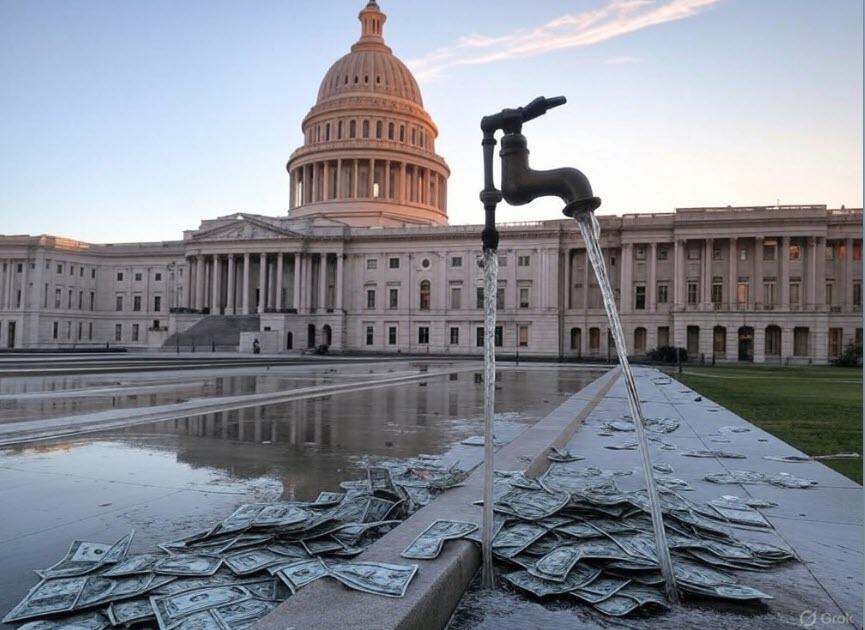
The Democratic Party’s main grifting engine, the USAID, was deconstructed weeks ago, yet we hear that just this week USAID workers were ordered to go back into their offices to shred all their documents. Did they have anything to hide, ya think?
Questions:
1) federal janitors pried the nameplate off the building back in February, and we must suppose that somebody also locked the joint up, or what?.
2.) How did these former USAID workers propose to get in the building and do their dirty-work?
3.) Why have we not heard that the FBI or the US Marshals Service was dispatched to prevent such a document shredding party?
I wouldn’t worry too much about those cheeky federal judges around the country declaring and ordering this-and-that on Mr. Trump’s campaign to fire federal workers and close down useless agencies. This is a last-gasp ultimate lawfare operation.
Let’s assume that Norm Eisen, Mary McCord, Marc Elias, and associates of theirs are the ringmasters in that circus. They will eventually be indicted for all manner of lawbreaking, possibly up to treason. And the SCOTUS will eventually put a sharp end to the judges’ monkeyshines.
Judges do not administer executive action out of the executive branch. And Guess what: lawfare is not law. It’s just dirty-fighting dressed up in abstruse ceremonial language.
https://cms.zerohedge.com/users/tyler-durden
Fri, 03/14/2025 - 16:20
https://www.zerohedge.com/political/destruction-democrats-main-grifting-engine-sight-behold
Harvard Prof Calls For Firing Of Any Faculty Not Supporting "Gender-Affirming" Policies
Harvard Prof Calls For Firing Of Any Faculty Not Supporting "Gender-Affirming" Policies
The anti-free speech movement in the United States was largely an outgrowth of higher education where viewpoint intolerance has taken hold of many schools. Indeed, intolerance and orthodoxy are often defended on the left in the name of tolerance and pluralism. https://www.hks.harvard.edu/faculty/timothy-patrick-mccarthy
that any faculty who do not support “gender-affirming care” should be stripped of their academic titles and fired.
 ?itok=ySXdA-eJ
Many academics and citizens oppose “gender-affirming” policies on religious or other grounds. Some believe that school-enforced policies inhibit debate over gender dysphoria and the basis for various treatments and protections on both sides. McCarthy believes that no such debate should be allowed among faculty, declaring that “there’s a particular place in hell for academics who use their academic expertise and power to distort and do violence to people in the world.” He was targeting two professors at NYU who are affiliated with groups critical of surgical and chemical interventions for gender dysphoria.
Professor McCarthy offered the usual nod to free speech and academic freedom before eviscerating both in his comments. He admitted that “a level of suspicion and inquiry into medical practices is healthy,” but then dismissed such views as harmful and mere efforts to “poison the waters.”
There was a time when such intolerance was directed against the left and groups ranging from feminists to those in the LGBT community. Now, it has become a badge of honor, the expected bona fides that show the correctness and firmness of one’s views.
The irony is crushing. Harvard’s Kennedy School https://www.hks.harvard.edu/faculty/timothy-patrick-mccarthy#:~:text=Timothy%20Patrick%20McCarthy%20is%20an,Leadership%2C%20and%20Higher%20Education%20Concentration.
states that McCarthy “was the first openly gay faculty member” at the public policy school “and still teaches the school’s only course on LGBTQ matters.” When I first went into teaching, I had friends who still remained in the closet out of fear that their sexual orientation would undermine their chances for tenure or advancement. Likewise, far-left academics associated with the critical legal studies (CLS) movement were viewed as “poisoning the waters” of higher education and rightfully blocked from teaching.
The left has now adopted the same intolerance and orthodoxy once used against it. Indeed, it has been far more successful in purging the faculty ranks of conservatives, libertarians, and dissenters. As we have previously discussed, Harvard is particularly notorious for this purging of both its faculty and student body.
This year, Harvard again found itself dead last among 251 universities and colleges in the Foundation for Individual Rights and Expression (FIRE) annual ranking.
The Harvard Crimson has documented how the school’s departments have virtually eliminated Republicans. In one study of multiple departments last year, they found that more than 75 percent of the faculty self-identified as “liberal” or “very liberal.”
Only 5 percent identified as “conservative,” and only 0.4% as “very conservative.”
According to Gallup, the U.S. population is roughly equally divided among conservatives (36%), moderates (35%), and liberals (26%).
So, Harvard has three times the number of liberals as the nation at large, and less than three percent identify as “conservative” rather than 35 percent nationally.
According to the last student survey, only 9 percent of the class identified as conservative or very conservative.
Notably, despite Harvard’s maintenance of an overwhelmingly liberal faculty and student body, even liberal students feel stifled at Harvard. Only 41 percent of liberal students reported being comfortable discussing controversial topics, and only 25 percent of moderates and 17 percent of conservatives felt comfortable in doing so.
Among law school faculty who donated more than $200 to a political party, 91 percent of the Harvard faculty gave to Democrats.
Professor McCarthy appears right at home in his public call for a further purging of faculty ranks.
This is an area that has deeply divided the country, as was evident in the last election. Higher education should play a critical role in that debate by allowing faculty and students to engage with each other in civil and substantive debate. Instead of spending so much time and effort trying to silence those with opposing views, the left could instead focus on refuting these claims. Instead, it is replicating that same pattern of cancellations, deplatformings and firings that marked the last decade. It is the same approach used against academics who questioned aspects of COVID policies including mask efficacy doubts, natural immunity theories, opposition to the closing of schools, opposition to the six-foot rule, and the lab theory on the virus’s origin. They were also removed from faculties and associations. Yet, many of these views have since been vindicated.
What was lost was not just free speech and academic freedom, but a rigorous debate that might have helped us avoid some of the costs of unsupported COVID policies. For example, some of our closest allies listened to skeptics on the need to close schools and opted to keep young children in school. They were able to avoid the massive educational and psychological costs that we incurred in this country. Much like Professor McCarthy, these skeptics were accused of “poisoning the waters” and spreading harmful ideas or disinformation.
There is no difference between the intolerance of figures like Professor McCarthy from those who once sought the same measures against liberals, homosexuals, or feminists. Now firmly in control of higher education, many on the left are using their power to win public debate through retribution, coercion, and attrition. In the process, they are destroying the very essense of higher education for not just our students but ourselves.
Jonathan Turley is the Shapiro professor of public interest law at George Washington University and the author of “https://www.amazon.com/exec/obidos/ASIN/1668047047?tag=simonsayscom
.”
https://cms.zerohedge.com/users/tyler-durden
Fri, 03/14/2025 - 15:00
DOGE, Elon Musk Must Hand Over Documents, Answer Written Questions, Says Judge
DOGE, Elon Musk Must Hand Over Documents, Answer Written Questions, Says Judge
(emphasis ours),
The Department of Government Efficiency (DOGE) and Elon Musk must give records to attorneys general that sued them, in addition to answering written questions, a federal judge ruled on March 12.
 ?itok=gVoU0k0o
The U.S. government must give New Mexico’s attorney general and 12 other state prosecutors who sued it numerous documents, including those that DOGE and Musk created or edited regarding the termination of federal workers, U.S. District Judge Tanya Chutkan https://www.documentcloud.org/documents/25560165-chutkan-order-on-doge/
.
Chutkan largely granted discovery requests from the attorneys general, who say that the actions by Musk as DOGE’s public face are unconstitutional in part because he was not confirmed by the U.S. Senate.
After the judge in February https://www.theepochtimes.com/us/judge-rejects-request-to-block-doge-from-government-data-5812309
Chutkan should grant expedited discovery so they could confirm that Musk and DOGE “are directing actions within federal agencies that have profoundly harmed the States and will continue to harm them” as they prepare a motion for a preliminary injunction.
Government lawyers opposed the motion. “The material the States seek is not relevant to their claims; nor should the Court require such discovery on an expedited timeframe before it has even had a chance to adjudicate the Government’s motion to dismiss,” the lawyers https://s3.documentcloud.org/documents/25560176/opposition-to-motion-in-doge-case.pdf
.
Chutkan https://s3.documentcloud.org/documents/25560164/chutkan-opinion-on-doge.pdf
she was granting expedited discovery because it was “reasonable and necessary to evaluate Plaintiffs’ request for injunctive relief.”
She turned aside government arguments that expediting discovery to support the forthcoming injunction motion was not a sufficient reason to speed up discovery.
“Courts in this jurisdiction ... have consistently found that preliminary injunction proceedings are exactly the kind of circumstance warranting expedited discovery,” Chutkan said.
The case centers on DOGE’s authority or purported lack thereof, and whether it has been working with or directing agencies to cut personnel and agreements.
In one filing in the case, a White House official https://www.theepochtimes.com/us/elon-musk-not-doge-employee-has-no-decision-making-authority-white-house-5811974
as its acting administrator.
DOGE has been assisting various agencies that have terminated tens of thousands of workers since Trump was sworn in on Jan. 20, according to Trump, Musk, and agency officials.
Under the new order, which does not apply to Trump, the government must https://s3.documentcloud.org/documents/25560177/proposed-discovery-in-doge-case.pdf
on obtaining access to and making changes to federal databases, lists, and summaries regarding the cancellation of federal agreements, as well as documents created or edited in relation to the termination of federal workers.
The deadline for discovery is 21 days.
DOGE must also identify every individual who has served as the administrator of DOGE, or the functional head of DOGE since Trump took office; every person who is part of DOGE; and all agencies for which DOGE or Musk canceled or directed the cancellation of grants and contracts or the termination of employees, the judge ruled.
Chutkan denied the plaintiffs’ request for two depositions, which the attorneys general said would be planned based on the government’s discovery production.
“[E]ven though Plaintiffs agree not to seek to depose President Trump or Musk, the court recognizes that depositions impose a heavier burden than written discovery,” the judge said. “If Defendants fail to adequately respond to Plaintiffs’ written discovery, Plaintiffs may renew their requests for depositions.”
This is the second order this week requiring DOGE to produce records. A different federal judge on March 10 https://www.theepochtimes.com/us/judge-says-doge-must-produce-records-on-operations-5823455
DOGE to comply with a Freedom of Information Act request, finding that it has been acting independently from the president.
A third U.S. judge in February https://www.theepochtimes.com/us/judge-orders-doge-employee-to-answer-questions-under-oath-5817505
a DOGE worker to sit for a deposition in a separate case that also seeks to block DOGE from accessing some government systems.
https://cms.zerohedge.com/users/tyler-durden
Fri, 03/14/2025 - 14:20
FBI Investigating "Alarming Rise In 'Swatting' Incidents" Targeting Conservative Influencers
FBI Investigating "Alarming Rise In 'Swatting' Incidents" Targeting Conservative Influencers
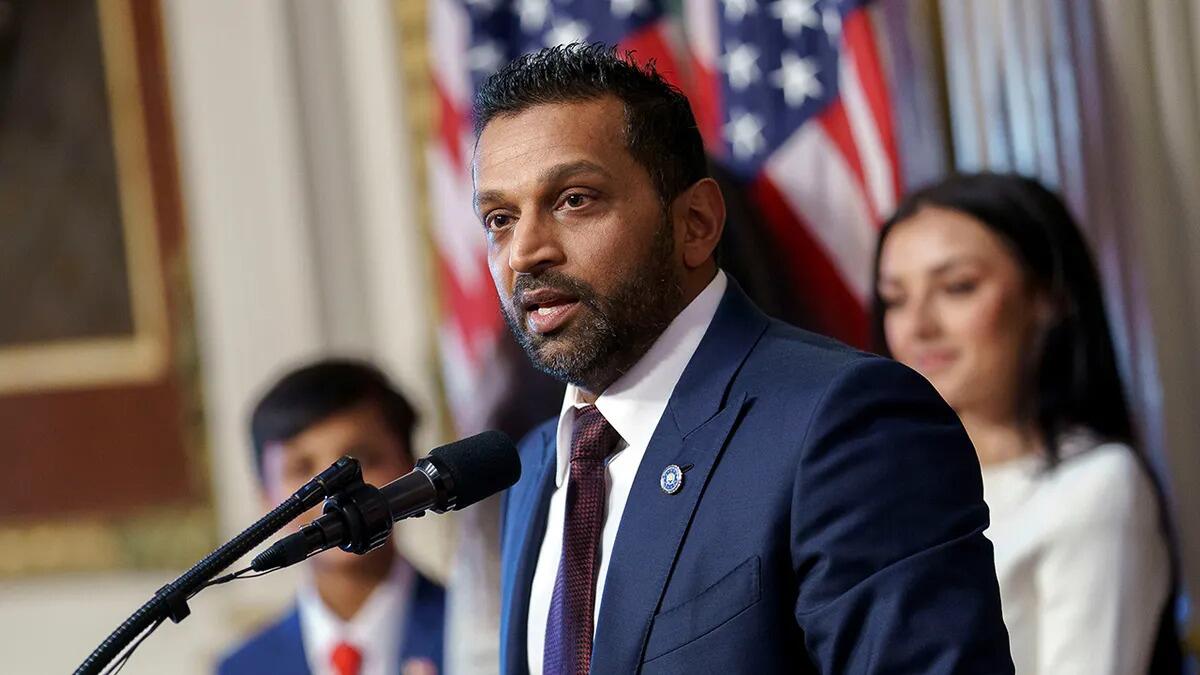
FBI Director Kash Patel on Friday responded to a string of 'swatting' incidents targeting conservative media figures in recent days, which came on the heels of the https://www.zerohedge.com/political/infowars-reporter-brutally-murdered-outside-austin-residence
of InfoWars reporter Jamie White.
 ?itok=cnXImmoM
Multiple conservative content creators, including InfoWars host Chase Geiser, Nick Sotor, Gunther Eagleman, 'Catturd,' and Trump impersonator Shawn Farash, have been targeted in swatting incidents, which typically entail fake or prank phone calls to emergency services that trigger an armed response from police officers to a particular address.
"I want to address the alarming rise in ‘swatting’ incidents targeting media figures. The FBI is aware of this dangerous trend, and my team and I are already taking action to investigate and hold those responsible accountable," Patel wrote on X Friday morning.
I want to address the alarming rise in ‘Swatting’ incidents targeting media figures. The FBI is aware of this dangerous trend, and my team and I are already taking action to investigate and hold those responsible accountable.
This isn’t about politics—weaponizing law enforcement…
— FBI Director Kash Patel (@FBIDirectorKash) https://twitter.com/FBIDirectorKash/status/1900536072871768094?ref_src=twsrc%5Etfw
On Wednesday, Geiser posted on X that he was "was just swatted again moments ago, just before 2AM," and that police officers "used a PA system to call me by name and order me to walk out of my house."
Geiser was swatted twice within a twelve hour period, the first time Tuesday afternoon and again early Wednesday morning just before 2AM. https://x.com/realchasegeiser/status/1899543983056990346
on the Alex Jones Show, noting that he and his family weren’t at home when the police showed up at his house. Geiser said when he met the police in his driveway, they were still receiving 311 messages about his property. “So there was a campaign of swatting my property,” he told Jones.
After the second incident, the Info Wars reporter https://x.com/realchasegeiser/status/1899722289446305907
that “6 to 8 police officers used a PA system to call me by name and order me to walk out of my house.”
I was handcuffed in the middle of the street, presumably at gunpoint though I couldn’t tell because of the light being shined on my face.
I was then led into the house where my wife was woken up and we were informed that they received a call from someone pretending to be me and threatening to kill my family. -https://amgreatness.com/2025/03/13/multiple-conservative-influencers-swatted-in-the-past-few-days/
"I was handcuffed in the middle of the street, presumably at gunpoint though I couldn’t tell because of the light being shined on my face. I was then led into the house where my wife was woken up and we were informed that they received a call from someone pretending to be me and threatening to kill my family."
Swatted for a second time in 12 hours. Here’s the video.
Long live InfoWars. https://t.co/H0nIt8NjcC
— Chase Geiser (@realchasegeiser) https://twitter.com/realchasegeiser/status/1899736616488308765?ref_src=twsrc%5Etfw
Nick Sortor, another conservative influencer with over 900,000 followers on X, wrote on Thursday that his family members were swatted.
"A dozen cops attempted to kick my dad’s door in at gunpoint,” he said Thursday, adding that “This is literal ... terrorism. And the FBI should treat it as such."
"In my dad’s case, the caller told police my dad was killing my entire family, requiring them to intervene with deadly force. This is nothing short of attempted murder. They wanted the police to kill my father."
Both my dad and my sister were swatted tonight.
A dozen cops attempted to kick my dad’s door in at gunpoint.
This is literal fucking terrorism. And the FBI should treat it as such.
Before calling in the swat, this dumbshit sent my sister an email calling me a Nazi, of course.… https://t.co/LVNgXZ16Im
— Nick Sortor (@nicksortor) https://twitter.com/nicksortor/status/1900063384927653947?ref_src=twsrc%5Etfw
Also Thursday, conservative influencer Gunther Eagleman wrote on X that "my house was just swatted," and that someone had "called in a fake hostage situation."
"Fortunately, I have good relations with law enforcement, and extra patrols will be added. I don’t tolerate threats and will find the culprit."
The gloves are off. First off, my family is safe.
My house was just swatted. Some ignorant fuck called in a fake hostage situation.
Fortunately, I have good relations with law enforcement, and extra patrols will be added. I don’t tolerate threats and will find the culprit.…
— Gunther Eagleman™ (@GuntherEagleman) https://twitter.com/GuntherEagleman/status/1900266427116110090?ref_src=twsrc%5Etfw
On Thursday night, Elon Musk favorite "Catturd" was swatted at his Texas residence, according to journalist Breanna Morello.
🚨BREAKING🚨https://twitter.com/catturd2?ref_src=twsrc%5Etfw
was swatted for a fourth time last night.
Many conservatives aren’t willing to go on the record when they’re swatted.
I can confirm about 6 incidents in the last 48 hours.
What’s the FBI doing about this?
Well I asked, but the FBI has not issued a…
— Breanna Morello (@BreannaMorello) https://twitter.com/BreannaMorello/status/1900512287343136985?ref_src=twsrc%5Etfw
Conservative radio host Joe Pags was also swatted.
Yes -- my family and I were swatted. This is how it went down. Including the video I saw on my front door camera at 2:35am. How would you have reacted? This has to stop https://t.co/uP5DeF6hSc
— Joe Pagliarulo Pag (@Joeshowtalk) https://twitter.com/Joeshowtalk/status/1900374449553023461?ref_src=twsrc%5Etfw
Farash thanked Patel, offering to provide any information that "can be helpful."
Thank you! We were swatted yesterday and are very happy to hear that this is a priority at the FBI. If there is anything that we can do or any info we can provide that can be helpful we'd be more than happy to share it
— Shawn Farash (@Shawn_Farash) https://twitter.com/Shawn_Farash/status/1900541096997921276?ref_src=twsrc%5Etfw
My wife and I were swatted tonight.
We are totally safe.
Thank you to everyone who checked in.
We are going to do whatever is necessary to find out who is behind these coordinated attacks and hold them accountable to the fullest extent.
Thank you all for the support! https://t.co/TRYsx0PF1d
— Shawn Farash (@Shawn_Farash) https://twitter.com/Shawn_Farash/status/1900355986390446449?ref_src=twsrc%5Etfw
In response to the swattings, Sen. Mike Lee (R-UT) called it "pure domestic terrorism."
Swatting = pure domestic terrorism https://t.co/S8p9B23oHy
— Mike Lee (@BasedMikeLee) https://twitter.com/BasedMikeLee/status/1900375328196861962?ref_src=twsrc%5Etfw
US Attorney for the District of Columbia Ed Martin released a statement Thursday night following the swattings.
"Swatting is a violent criminal act," he posted on X, adding "If any perpetrators are discovered in the District of Columbia or originate from here, you will be arrested, we will put you in jail and prosecute you to the fullest extent of the law."
Swatting is a violent criminal act.
If any perpetrators are discovered in the District of Columbia or originate from here,
you will be arrested,
we will put you in jail and prosecute you to the fullest extent of the law.https://twitter.com/hashtag/NoOneIsAboveLaw?src=hash&ref_src=twsrc%5Etfw
— U.S. Attorney Ed Martin (@USAEdMartin) https://twitter.com/USAEdMartin/status/1900346037589491998?ref_src=twsrc%5Etfw
https://cms.zerohedge.com/users/tyler-durden
Fri, 03/14/2025 - 14:00
Putin Calls For All Ukrainians In Kursk To Surrender, 'Sympathetic' To Trump's Request To Spare Lives
Putin Calls For All Ukrainians In Kursk To Surrender, 'Sympathetic' To Trump's Request To Spare Lives
Update(1358ET): The Kremlin has responded to President Donald Trump’s request that the lives of the Ukrainian troops encircled in Russia’s Kursk Region be spared, which was conveyed in a Friday Truth Social post by the president. Moscow says it is "sympathetic" to this request, and the pattern in the battle to retake Kursk has been to take POWs if weapons are laid down.
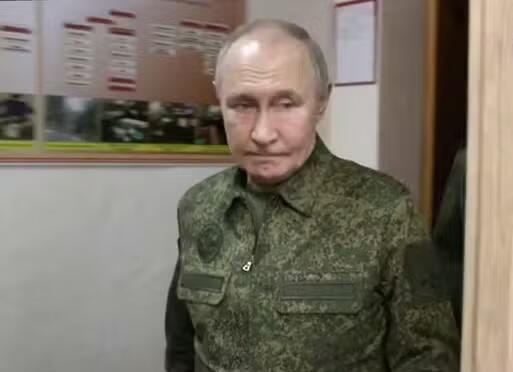
At the same time President Putin has called immediate surrender of all Ukrainian troops remaining on Russian soil. Trump had acknowledged that “thousands of Ukrainian troops" are "completely surrounded by the Russian military” in the southwest Kursk region.
Putin said during a National Security Council meeting on Friday that Russian forces guarantee their lives if they lay down their arms, according to https://www.rt.com/russia/614241-putin-urges-kiev-kursk/
translation:
Putin responded that he was aware of Trump’s request, adding that Russia was willing to consider it. “If they lay down their arms and surrender, [we] will guarantee them their lives and dignified treatment in accordance with international law and Russian legal norms,” the president said.
But Putin also emphasized the “numerous crimes against civilians” in the region, also has hundreds of thousands of citizens have fled over the last six months of the Kursk occupation on risky operation ordered by Zelensky.
The Ukrainian leader has meanwhile rejected that he will cede territory in Ukraine for the sake of peace, and is demanding a 'strong response' from the US. But clearly Trump's own words suggest he's not ready to order some kind of greater intervention on Kiev's behalf.
* * *
President Trump has revealed Friday that he has held the second phone call of his current administration with Russian President Vladimir Putin on the prospect of ending the Ukraine war. The call, held Thursday, included a plea by Trump for Russia to spare the lives of Ukrainian soldiers currently surrounded in the Kursk region. Such a direct appeal like this by Trump is unprecedented.
"We had very good and productive discussions with President Vladimir Putin of Russia yesterday" - Trump began a statement on Truth Social, before continuing, "and there is a very good chance that this horrible, bloody war can finally come to an end..."
 ?itok=I9Eva7os
That's when he stated in all caps, "But, at this very moment, thousands of Ukrainian troops are completely surrounded by the Russian military, and in a very bad and vulnerable position."
"I have strongly requested to President Putin that their lives be spared. This would be a horrible massacre, one not seen since World War II. God bless them all!!!" - Trump ended with.
Aside from the rare or even unprecedented nature of such a direct appeal from a sitting US President for Putin to spare the lives of Ukrainian soldiers, this a first top-level US acknowledgement that Ukraine is rapidly losing in its cross-border Kursk operation.
Already as of Wednesday there were widespread reports that https://www.zerohedge.com/geopolitical/ukraine-losing-its-trump-card-key-kursk-town-liberated-russian-troops
is underway, and it's been confirmed that the key town of Sudzha has been taken back by Russian forces, along with well over a dozen towns and settlements in rapid fashion.
The amount of Russian territory the Ukrainians still hold there has suddenly shrunk at least four-fold, and by many accounts Russian operatives continue closing in. Even the Financial Times has admitted that the writing is https://www.ft.com/content/f3b3d3f9-2c55-45f4-a11d-2e12feeb1018
:
Kyiv’s forces managed at one point to seize some 1,300 sq km of Russian territory. But over the first few weeks the area they were able to hold became a narrow wedge.
“It is no secret that the zone of our incursion, it should have been wider,” Kariakin said. “A wide area along the border would have been much more comfortable.” Instead, Russian troops surrounded Ukraine’s occupying forces on three sides. It was a precarious position and became increasingly difficult to hold.
War analysts consider it highly debatable and uncertain whether the risky cross-border gambit which started in August actually translated to any strategic advantage across the broader war theater:
For Andriy Zagorodnyuk, a former defense minister of Ukraine, the Kursk operation “served its purpose”: it diverted elite Russian forces and prevented them from opening up another front, he said. Others question whether the benefits outweighed costs to Ukraine’s defense effort on the eastern front.
The tragic 'cost' has been tens of thousands of Ukrainian troops lost to an operation which had little to no chance of success in the first place.
"High chance" of peace, Trump said...
❗️Trump stated that he spoke with Putin on Thursday
Trump asked Putin to SPARE the surrounded Ukrainian troops in the Kursk region.
Trump also noted that there are HIGH CHANCES of resolving the situation around Ukraine. https://t.co/bI2aTGBfYz
— Sputnik (@SputnikInt) https://twitter.com/SputnikInt/status/1900545081968333004?ref_src=twsrc%5Etfw
Sending masses of troops to invade and occupy Russian territory was essentially a suicide operation to begin with, for which Zelensky has come under intense internal and international criticism. Kiev has had to take more extreme measures to round up men to send to the front lines of late, and there have been reports of a lot of resistance and conscription officers roam the streets.
https://cms.zerohedge.com/users/tyler-durden
Fri, 03/14/2025 - 13:58
Futures, Yields, Gold All Jump After Schumer Caves To Keep Government Open
Futures, Yields, Gold All Jump After Schumer Caves To Keep Government Open
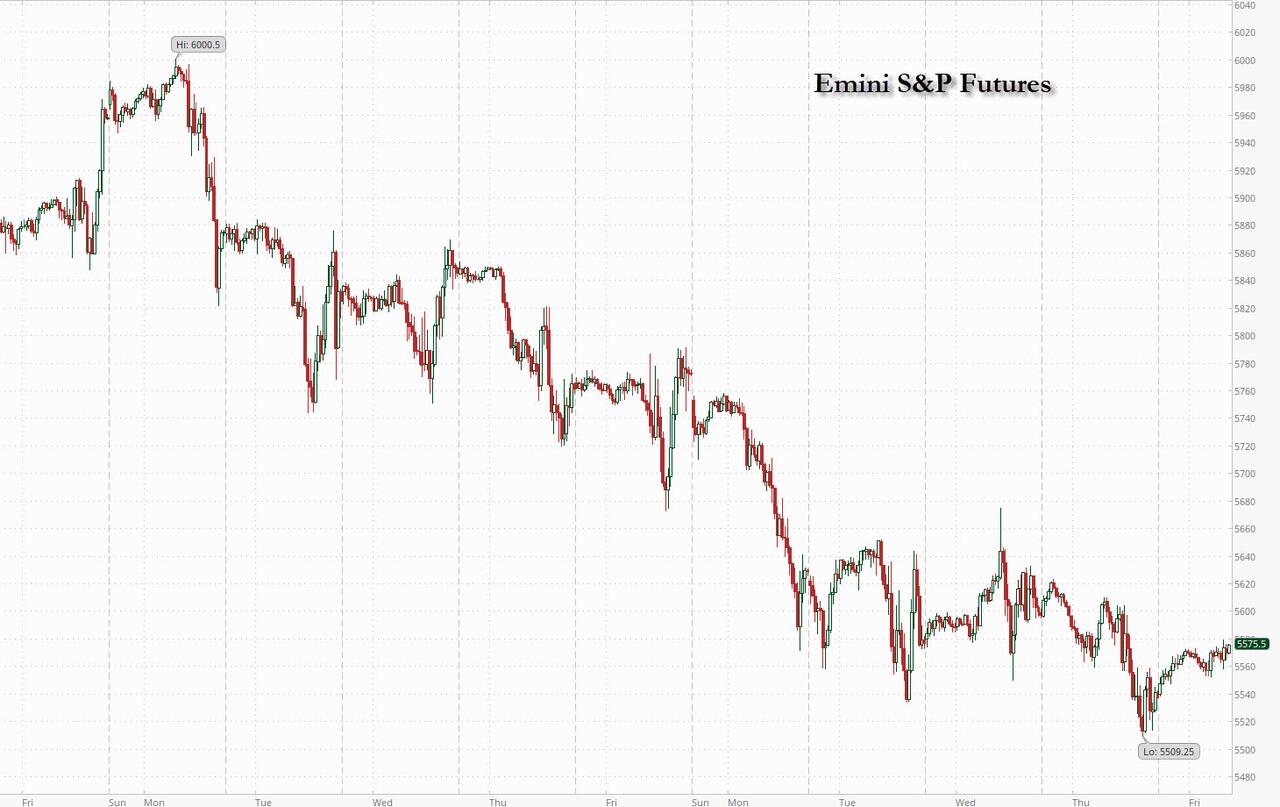
US equity futures and global stocks rose as the threat of a US government shutdown receded, removing at least one element of uncertainty confronting investors. Meanwhile, gold hit a record above $3,000 an ounce as the precious metal already anticipates the stimulus flood that is coming over the horizon.As of 8:00am S&P futures are higher by 0.9% as a stopgap funding bill is set to pass in Congress after top Senate Democrat Chuck Schumer caved and opted not to block the measure. That helped lift the mood after the benchmark index extended its three-week rout beyond a 10% correction on Thursday. Nasdaq 100 futures advanced 1.2% with Nvidia leading premarket gains among the Mag7. In Europe, the Stoxx 50 advances 1.3% with outperforming sectors including consumer staples and materials; Asian stocks were also higher. Bond yields are 1-3bp higher this morning; the USD fell as the EUR surged after politicians agreed to a deal to drown Germany in debt to fund "military spending." Commodities are higher led by Oil (WTO +1.0%) and Iron (+1.5%). Since yesterday’s close, there has been some positive developments on macro policies: meeting between Lutnick and Ontario’s Ford was viewed as positive; the US government managed to avoid the shutdown. Internationally, China will hold a press briefing next Monday to outline some additional measures boost consumer; Japan announced the largest pay hike in over three decades (+5.36% average pay gain and +3.84% base pay vs. 3.8% JPMe vs. 3.7% last year), a positive catalyst for consumption growth, yet not enough to push the yen higher. Today's calendar includes March preliminary University of Michigan sentiment at 10am where consensus expects a 63.0 print.
 ?itok=wtvmuP2-
In premarket trading, Nvidia is leading gains among the Magnificent Seven stocks as the group attempts to stage a rebound after the S&P 500 tumbled into its first 10% correction in almost two years. Alphabet +0.9%, Amazon +1.2%, Apple +0.5, Microsoft +0.7%, Meta +1.5%, Nvidia +2% and Tesla +1.7%. Applied Optoelectronics surges 55% after the maker of fiber-optic networking products entered a warrant agreement with Amazon. Ulta Beauty jumped 6% after reporting earnings per share for the fourth quarter that beat the average analyst estimate. Here are some other notable premarket movers:
Crown Castle rises 5% after agreeing to sell separate parts of its fiber business to an EQT AB fund and Zayo Group Holdings Inc. for a combined value of $8.5 billion.
DocuSign jumps 9% after the e-signature software company posted quarterly results that beat expectations and gave a billings outlook that’s seen as positive.
Gogo rises 13% after the in-flight broadband company forecast revenue for 2025 that beat the average analyst estimate.
Peloton Interactive gains 6% as Canaccord upgrades its rating and says the company is set to reap the benefits of being the “clear leader” in the connected fitness market.
Radius Recycling soars 110% after Toyota Tsusho’s US unit, Toyota Tsusho America, agreed to buy all shares in cash for $30 a share.
Rubrik surges 18% after the data security software company gave an outlook that is stronger than expected.
Semtech rises 12% after the semiconductor device company gave an outlook that’s seen as better than feared.
Xponential Fitness drops 31% after the franchiser of boutique fitness brands gave disappointing full-year forecasts.
Spot gold briefly rose above $3,000/oz for the first time while broader risk sentiment improved after Senate Democratic leader Chuck Schumer dropped his threat to block a Republican spending bill, thus lowering the chances of a US government shutdown on Saturday.
“It looks like the budget bill is still going through despite some opposition from Democrats and this has lifted sentiment in the US and probably there is also some spillover effect to Europe,” Julius Baer & Co. economist Sophie Altermatt said. “This might be just some reprieve, given we had so many uncertainties with erratic policy moves in the US,” she added.
Avoiding a government shutdown would remove a concern for traders, already fretting over threats to the world economy from President Donald Trump’s tariff war. Two months into Trump’s presidency, $5 trillion has been erased from US stocks. Those risks are spurring demand for haven assets, with investors the most bullish on Treasuries relative to stocks for at least three years, according to Bloomberg Markets Live Pulse survey. It’s also pushed gold to successive record highs, with the yellow metal now up more than 14% year-to-date.
“Gold is in a secular bull market,” said Peter Kinsella, head of foreign exchange strategy at Union Bancaire Privee UBp SA, who expects prices to reach $3,300 an ounce by year end. “For sure, that’s down to uncertainty caused by US trade policies but central bank demand is also a big factor.”
Some strategists reckon relief could be on the horizon for risk assets after the recent selloff. While the S&P 500 has plunged 10% off its February peak into correction territory, Bank of America’s Michael Hartnett said there’s unlikely to be a slide into a new bear market: “Fresh declines in stock prices will provoke flip in trade and monetary policy,” Hartnett wrote in a note, recommending buying the S&P 500 at 5,300 points, a 4% drop from current levels.
In Europe, German conservative leader Friedrich Merz reached a tentative agreement with the Green party on a debt-funded spending package for defense and infrastructure. The deal needs to be approved by party lawmakers and would release defense spending from debt restrictions and set up a €500 billion fund for infrastructure investment.
The Stoxx 600 climbs 0.4% as miners gained on expectations of economic support measures from China, even as benchmark indexes headed for a second straight week of declines. Carlsberg jumps on an upgrade from RBC, while Kering sinks after appointing a new artistic director to its key Gucci brand. Here are the biggest movers Friday:
Carlsberg gains as much as 4.1% after it and its peer Heineken were upgraded to outperform at RBC, noting the companies have been “prudent” in setting expectations in what is in an unusually “opaque” outlook
Adecco gains 3.6% and Hays gains 7% after BNP Paribas Exane upgraded Adecco to outperform, and double upgrades Hays to outperform, as staffing agencies are moved to the top of broker’s sub-sector preferences
Sectra gains as much as 12%, the most since December 2023, after the Swedish healthcare and cybersecurity firm reported 3Q earnings which beat expectations on most metrics, including revenues and profit
European sectors with heavy China exposure are getting a boost on Friday as the Chinese benchmark stock index rallied the most in two months on expectations of economic support from Beijing
Brunello Cucinelli shares rise as much as 3.7% as a broadly in-line set of earnings from the Italian luxury goods maker demonstrated its resilience against a tough backdrop for the broader sector
Kering falls as much as 10%, the biggest one-day drop in a year, after the luxury goods maker caught investors off-guard with its surprise appointment of Demna Gvasalia as Gucci’s new artistic director
Universal Music Group slumps as much as 11% after shareholder Pershing Square offloaded shares in the music company at a discount to yesterday’s close. Shares have fallen below the offer price
BMW falls as much as 4.5% after the German automotive firm reported disappointing guidance and missed expectations in its 4Q report, with analysts flagging the firm’s margin outlook as a particular disappointment
Swiss Life shares fall as much as 6.2%, the most in a year. The financial services company reported results that matched expectations, but were deemed insufficient by analysts
Bodycote slumps as much as 18%, the most in five years, after the heat-treatment specialist delivered its FY results, with analysts cite automotive and industrial weakness for likely mid-single-digit cuts
GN Store Nord shares are among the worst performers in the Stoxx 600 Health Care Index on Friday morning, after Bernstein re-initiated coverage of the stock with an underperform rating
El.En shares dropped as much as 8.5% in Milan trading, the most since May 16, after the Italian medical devices company reported FY earnings, indicating a “complex” outlook for 2025
Earlier in the session, Asian equities also advanced, propelled by a rally in Chinese shares as investor optimism for more policy support rose ahead of a press briefing on government efforts to boost consumption. The MSCI Asia Pacific Index rose as much as 0.9%, with Tencent and Alibaba among the biggest boosts. China’s onshore CSI 300 Index and Hong Kong’s Hang Seng China Enterprises Index each jumped more than 2%. China optimism rose on the announcement that officials from the finance ministry, commerce ministry, central bank and other government bodies are scheduled to hold a briefing on consumption Monday. The news provided traders further assurance that Beijing is determined to fix one of the weakest links in the economy. Word of the press conference “fanned expectations” for policy support, said Shen Meng, a director at Beijing-based investment bank Chanson & Co. “But if it falls short of providing details on increasing income, such optimism may weaken to some extent.” Stocks in Japan and Australia also rose, and US futures rebounded following the S&P 500’s drop into a technical correction Thursday. Rising prospects for a stopgap funding bill to avoid a US government shutdown provided some reassurance for markets amid continued concerns over economic growth and tariffs.
In FX, the Bloomberg Dollar Spot Index drops; The Japanese yen is the weakest of the G-10 currencies, falling 0.7% against the dollar even as Japan’s largest labor union group said its workers secured the highest pay deal in more than three decades. The pound falls 0.2%, extending its drop after data showed the UK economy unexpectedly shrank at the start of 2025. The Euro jumped above 1.09 after German conservative leader Friedrich Merz reached a tentative agreement with the Green party on a debt-funded spending package for defense and infrastructure. The deal needs to be approved by party lawmakers and would release defense spending from debt restrictions and set up a €500 billion fund for infrastructure investment.
In rates, treasury futures trend lower into the early US session. Treasury yields are cheaper by 1bp to 3bp across the curve with 10-year trading around 4.18%, cheaper by 3bp on the day with bunds lagging by 4bp in the sector and 10-year French bonds lagging 2bp. Bunds slid to lows of the day and French 30-year yields rose to the highest since 2011, after a report that German parties have reached an agreement with the Greens on a debt package. Advance in US stock futures adds to cheapening pressure on Treasury yields with University of Michigan sentiment data the focus for the US session.
In commodities, WTI rises 1% to ~$67 a barrel. The upbeat mood is evident elsewhere as Bitcoin climbs rises 3% toward $83,000. Gold traded briefly at a record price just above $3000 before modestly fading gains.
Looking at today's calendar, the US economic data calendar includes March preliminary University of Michigan sentiment at 10am. Fed officials are in external communications blackout ahead of March 19 policy announcement.
Market Snapshot
S&P 500 futures up 0.9% to 5,576
STOXX Europe 600 up 0.4% to 542.64
MXAP up 0.5% to 185.46
MXAPJ up 0.9% to 581.19
Nikkei up 0.7% to 37,053.10
Topix up 0.6% to 2,715.85
Hang Seng Index up 2.1% to 23,959.98
Shanghai Composite up 1.8% to 3,419.56
Sensex down 0.3% to 73,828.91
Australia S&P/ASX 200 up 0.5% to 7,789.68
Kospi down 0.3% to 2,566.36
German 10Y yield little changed at 2.88%
Euro little changed at $1.0854
Brent Futures up 0.9% to $70.51/bbl
Brent Futures up 0.9% to $70.51/bbl
Gold spot up 0.0% to $2,990.02
US Dollar Index little changed at 103.93
Top Overnight News
US equity futures are rallying after Senate Democratic leader Chuck Schumer dropped his threat to block a key spending bill, cutting the risk of a disruptive March 15 shutdown. BBG
US Senate Minority Leader Schumer said he will vote to keep the government open and not shut it down. It was separately reported that multiple US Democratic Senators and aides indicated sufficient Democratic support for cloture on the House-passed continuing resolution in Friday morning’s vote: Punchbowl.
US President Trump is to sign executive orders on Friday at 12:00EDT/16:00GMT.
US Vice President Vance said can never predict the future but thinks the economy is strong when asked if he could rule out a recession, according to a Fox News interview,
US Treasury Secretary Bessent said they hopefully won't get a recursive 'Biden-flation' and said they are very vigilant and it could happen again. Bessent added that before they can bring down inflation, they also want to help affordability and as they bring down inflation, they want to bring the absolute price level down through deregulation and bringing down interest rates for house payments and car payments.
Merz Said to Reach Tentative Deal With Greens on German Debt: BBG
Ontario Premier Doug Ford lauded his Thursday meeting with Commerce Secretary Howard Lutnick as “positive” and “productive” after their public rift over tariffs on imported goods. “We shared a tremendous amount of views back and forth, and I’m feeling very positive,” Ford told reporters outside the U.S. Department of Commerce building. The Hill
Chinese stocks jumped on Friday after Beijing promised new measures to help consumers, defying a Wall Street sell off and pushing the country’s main stock index into positive territory for the year. Chinese authorities announced late on Thursday that they would hold a press conference on “boosting consumption” on Monday. FT
China is increasingly concerned not just about US tariffs, but also the risk that Washington will direct other countries (like Mexico, Brazil, etc.) to ramp duties on Chinese imports as well. NYT
China may slash pay by 50% for fund managers who underperform their benchmarks, people familiar said, as part of a broader overhaul of the country’s mutual fund industry. BBG
Ukrainian drones attacked Moscow for the second day in a week, as US special envoy Steve Witkoff left the country, Russian news services reported. The attacks also triggered a massive fuel tank fire at one of Russia’s biggest oil refineries. BBG
The UK economy unexpectedly shrank 0.1% in January, hit by declines in manufacturing and construction. The pound slipped. BBG
Investors are the most bullish on Treasuries relative to stocks in at least three years, according to a MLIV survey. As tariff policies threaten US exceptionalism, some 77% see bonds giving a better volatility-adjusted return over the next month. BBG
Tariffs/Trade
Canada's Finance Minister LeBlanc said they agreed to continue discussions in the meeting with US Commerce Secretary Lutnick, while they have been clear that they will not reopen USMCA provisions on dairy and didn't discuss that with Lutnick.
Canada's Industry Minister Champagne said there was a mutual understanding that there is an impact on both sides of the border from tariffs and they talked about issues around economic security and national security with US Commerce Secretary Lutnick. Furthermore, they talked about Canadian aluminium steel and how they can help the US
Ontario's Premier Ford said they had a productive meeting with US Commerce Secretary Lutnick and will have another meeting next week, while he feels temperatures are decreasing and said it was the best meeting they had since tariff talks began.
ECB President Lagarde said US President Trump's policy decisions cause concern and warned trade conflict will damage the worldwide economy, according to an interview with BBC.
A more detailed look at global markets courtesy of Newsquawk
APAC stocks were mostly positive as risk sentiment gradually improved following the negative lead from Wall St where the S&P 500 slipped into a technical correction amid tariff concerns after President Trump threatened 200% tariffs on EU wine and champagne. ASX 200 gained as strength in mining, materials, resources and utilities atoned for the losses seen in the energy, financials and tech industries. Nikkei 225 staggered at the open with pressure from recent currency strength but then recovered soon after as the yen steadily pared its recent gains. Hang Seng and Shanghai Comp advanced with the Hang Seng resuming the outperformance which has helped the index notch gains of around 22% so far this year, while the PBoC reiterated support pledges and stated that it will lower rates and the RRR at a 'proper time', keep liquidity ample and guide social financing costs lower.
Top Asian News
China's financial regulator said financial institutions should boost financial support for consumption and will provide loan renewal support to eligible personal consumption loan borrowers.
DeepSeek is focusing on research over revenue and customers from sectors such as healthcare and finance bought API access to DeepSeek’s R1 and V3 models. Furthermore, DeepSeek's founder declined to entertain interest from China’s tech giants and venture and state-backed funds to invest in the group for the time being, while it may find limited access to NVIDIA's (NVDA) new generation of more advanced chips a potential bottleneck in the long run and could consider future partnerships that can help solve this issue, according to FT citing sources.
Rengo, Japan's largest labour union, says first-round data shows average wage hike of 5.46% in FY25 (demand of 6.09%); initial wage hike exceeds 5% for the second straight year.
Chinese regulators have issued a requirement for the labelling of AI generated content.
China Feb YTD Aggregate Financing (CNY) 9.29tln (exp. 9.757tln); M2 Money Supply 7% (exp. 7%); New Yuan Loans 6.14tln (exp. 6.38tln)
European bourses are mostly firmer, in what has been a choppy session thus far; initial weakness at the cash open has been entirely pared with indices generally towards the top end of the day's ranges. European sectors hold a slight positive bias; Basis Resources tops the pile, buoyed by strength in the metals complex, amid the risk sentiment and strong Chinese price action overnight. Media is found at the foot of the pile. Consumer Products is also higher today, benefiting from the strength in Chinese trade overnight; though Kering (-13%) slips after appointing Demna as Gucci's artistic director, a move JP Morgan brands as "controversial".
Top European News
Germany's CDU/CSU to hold special parliamentary faction meeting this afternoon, according to Reuters sources
Goldman Sachs cuts its UK 2025 GDP growth forecast to 0.9%, down from 1.0% previously.
DIW institute says the German economy is expected to stagnate in 2025, down from the previously expected growth of 0.2%; economy expected to grow by 1.1% in 2026, down from the previously expected 1.2%
BoE/Ipsos Inflation Attitudes Survey - February 2025. Median expectations of the rate of inflation over the coming year were 3.4%, up from 3% in November 2024.
UK PM Starmer reportedly suffered a cabinet uprising over planned welfare and public spending cuts, but insisted tough choices are needed and said he will not bend fiscal rules to allow more borrowing, according to FT.
EU Diplomatic Service proposes that member nations deliver military aid to Ukraine in 2025 worth at least EUR 20bln and potentially up to EUR 40bln, via Reuters citing a paper; aid to be provided in line with nations economic "weight".
ECB's Villeroy says will be inflation to 2% this year in Europe; EU has the resources to retaliate against the US admin tariffs on wine and liquor.
EU Envoys agree to remove three individuals from the sanctions list, agree to renew sanctions on more than 2400 individuals and entities.
FX
USD is flat after trading firmer for most of the European morning; now currently towards the lower end of a 103.79-104.09 range. Trade updates on Thursday included President Trump noting he will not change his mind on the April 2nd tariffs. As for US Government shutdown developments, things seem to be improving with US Senate Minority Leader Schumer suggesting he will vote to keep the government open and not shut it down. Focus ahead will be on the US UoM survey and then Trump executive orders thereafter.
EUR is firmer and trading towards the upper end of a 1.0831-1.0875 range. There has been little by way of trade updates, after Trump threatened the EU with 200% tariffs on alcoholic products on Thursday, if the EU do not remove their countermeasures on the US. Focus today will be on any potential updates on German spending plans, after the debate in the prior session - Reuters reported that Germany's CDU/CSU is to hold a special parliamentary faction meeting this afternoon - a report which may be attributed to the modest upside in the Single-Currency; elsewhere, focus will be on a Fitch credit review on France.
JPY is the clear underperformer today, with early morning losses facilitated by the risk-on mood; have peer CHF is also a touch softer. Further pressure was seen after Japan's largest labour union, Rengo, said the first-round data shows an average wage hike of 5.46% in FY25 (demand of 6.09%). There spurred some further pressure in the JPY, with USD/JPY lifting from 148.65 to briefly top 149.00.
GBP is subdued in reaction to the regions softer than expected GDP figures, which saw the UK unexpectedly contract in January; the downside was primarily driven by a slowdown in manufacturing. However, such an outturn was not entirely unexpected given the jump seen in December's release. Money market pricing incrementally moved dovishly, and is ultimately unlikely to have too much of an impact for the BoE as it remains focussed on inflation and other price points. Cable saw some modest downside on the release, and currently trades towards the lower end of a 1.2918-59 range.
Antipodeans are the best performing G10 currencies today, benefiting from the positive risk tone, which was lifted by remarks by a China's financial regulator who said financial institutions should boost financial support for consumption and will provide loan renewal support to eligible personal consumption loan borrowers.
Fixed Income
USTs hold a slight downward bias, in-fitting peers; currently sitting in a 110-24 to 110-31 range. Some of the bearish action stems from the positive risk tone, as well as a weaker-than-average 30yr auction on Thursday. Trade updates on Thursday included President Trump noting he will not change his mind on the April 2nd tariffs. As for US Government shutdown developments, things seem to be improving with US Senate Minority Leader Schumer suggesting he will vote to keep the government open and not shut it down. Focus ahead will be on the US UoM survey and then Trump executive orders thereafter.
Bunds are on the backfoot by around 12 ticks, and currently just off the day's trough at 127.15. As above, pressure stems from the risk tone and as markets digest the latest Trump threats on the EU (200% tariffs on alcohol, should the EU not remove their countermeasures). For Germany, Wholesale Prices jumped Y/Y whilst German inflation figures were revised a touch lower. And on German spending, updates have been light thus far CDU/CSU is to hold special parliamentary faction meeting this afternoon, according to Reuters sources, Scheduled EU-specific events are light for the remainder of the day, but focus will be on Fitch's credit review on France.
Gilts are flat but still outperforming today, with gains facilitated by the softer-than-expected UK GDP figures, which saw the UK surprisingly contract in January. A softer print than the market had been looking for, driven primarily by a slowdown in manufacturing. However, such an outturn was not entirely unexpected given the jump seen in December's release. Gilts are flat, but have held a downward bias in-fitting with peers; currently in a 91.67-92.03 range.
JGBs are modestly higher as Japanese paper reacted to the latest Rengo update, with initial data pointing towards 5.46% avg. wage hike vs demands of 6.09%. Initial hawkish reaction as it highlights the continued wage pressures in the region, but this proved short-lived as it was less than initial demands.
Commodities
Crude is on a firmer footing with WTI and Brent currently higher by around USD 0.74/bbl and USD 0.70/bbl respectively. Upside today stems from a paring of the prior day's losses and in tandem with the pick up in sentiment. On Russia/Ukraine, Russian President Putin supported the idea of a ceasefire but stressed that the ceasefire must lead to a final settlement of the conflict and solve the root causes of the conflict. More recently, Russia's Kremlin said it held late night talks with US Envoy Witkoff; Russia and the US will determine a timing of Russian President Putin/Trump call once Witkoff has briefed Trump. Brent'May currently in a USD 70.00-70.75/bbl range.
Spot gold is on a firmer footing, and has made a fresh ATH just above the USD 3k mark. ANZ sets its short-term price target of USD 3,050/oz.
Base metals are entirely in the green, with the complex boosted by the risk tone and support measure commentary from China overnight.
Russian Deputy Prime Minister Novak says global oil demand will rise during driving season and OPEC+ takes this into account; resumption of gas exports to Europe via Nord Stream pipelines is irrelevant for now. No talks about possible resumption of Russian oil exports to Germany via the Druzhba pipeline.
Qatar lowered the May term price for Al-Shaheen crude oil to USD 1.29/bbl above Dubai quotes.
Russian President Putin and Saudi Arabia's Crown Prince MBS discussed cooperation in OPEC+, as well as US-Russia ties and the Ukraine conflict.
US President Trump’s administration unlocked a USD 4.7bln loan for TotalEnergies (TTE FP)
Geopolitics: Middle East
Israel's Channel 12 quoted an Israeli source stating if there is no progress in negotiations within the next two days, the team will return to Israel, according to Al Jazeera.
US and Israel look to Africa for resettling Palestinians uprooted from Gaza, according to AP.
UN Security Council agreed to the Russia and US-drafted statement condemning widespread violence in Syria's Latakia and Tartus, while the statement called for Syria's interim authorities to protect all Syrians, regardless of ethnicity or religion and to hold the perpetrators of the mass killings accountable.
Geopolitics: Ukraine
Russia's Kremlin says it held late night talks with US Envoy Witkoff, conveyed signals to US President Trump via Witkoff, Russia and the US will determine a timing of Russian President Putin/Trump call once Witkoff has briefed Trump. There are grounds for cautious optimism. Both sides understand there is a need for such a call. Putin got information from US Envoy on US thinking on Ukraine. Putin is in solidarity with Trump's position but there is a lot of work to do
Ukraine Foreign Minister says the nation has begun forming a team to develop ways to control a possible ceasefire.
EU Foreign Policy chief Kallas said she is quite optimistic G7 can reach accord on a joint communique and if they cannot agree on G7 communique, it shows division between member countries. Kallas also said it is most likely that Russia will say yes to the US proposal for a ceasefire with Ukraine but with conditions and the US is telling G7 members they understand the Russians may want to extend the process by blurring the picture. Furthermore, she said the red line is Ukraine giving away territory and that territorial integrity is an important element, as well as noted that without the EU, any deal cannot be implemented because there are elements for which Europe has the card.
Saudi Crown Prince MBS and Russian President Putin spoke on the phone and the Saudi Crown Prince affirmed the kingdom's commitment to exerting all efforts to facilitate dialogue and achieve a political solution to the Ukraine crisis.
Geopolitics: Other
Senior officials from China, Iran and Russia hold talks in Beijing over Iran's nuclear issues, according to CCTV.
US Pentagon has been tasked with providing military options to ensure US access to the Panama Canal, according to CNN.
US President Trump said they are going to have to make a deal on Greenland and thinks the annexation will happen, while he added the US is going to order 48 icebreakers.
US Event Calendar
10:00: March U. of Mich. Sentiment, est. 63.0, prior 64.7
March U. of Mich. Current Conditions, est. 64.4, prior 65.7
March U. of Mich. Expectations, est. 63.0, prior 64.0
March U. of Mich. 1 Yr Inflation, est. 4.3%, prior 4.3%
March U. of Mich. 5-10 Yr Inflation, est. 3.4%, prior 3.5%
DB's Jim Reid concludes the overnight wrap
After my promise of an exciting special announcement, yesterday we announced the launch of the Deutsche Bank Research Institute (DBRI), a new offering designed to provide valuable insights for corporates, investors and policymakers navigating today’s complex and rapidly evolving global landscape. The Institute will connect the world to Europe and Europe to the world, across geopolitics, macroeconomics, technology, and the evolving corporate landscape. Going forward, we will be delivering more in-depth analysis through engaging and accessible formats, including videos, podcasts, webinars, events and reports, which will be available on our new public Institute website.
The inaugural paper for DBRI is called “What Germany’s economy needs now”, which lays out how the country’s economic prosperity has been under severe pressure from geopolitical and technological changes, which have exposed Germany’s structural weaknesses. It outlines a series of necessary reforms which will demand a historic effort from the next government. The challenges beyond the fiscal injections are enormous but the good news is that Germany has its future prosperity and security in its own hands. You can read the English version here and the German version here. Stand by for more papers over the coming weeks and months from our new Deutsche Bank Research Institute.
The market sell-off resumed in earnest yesterday, with the S&P 500 (-1.39%) down to another 6-month low and into technical correction territory, with the index down -10.13% from its peak as recently as February 19. This is the first correction since October 2023, and Bloomberg reported that this was the seventh-fastest correction in data back to 1929, taking just 16 sessions for it to happen. Other asset classes also continued to struggle, with US HY spreads (+22bps) reaching their widest level since August, at 335bps. And as investors poured into perceived safe havens, gold prices (+1.85%) hit a record high of $2,989.
Once again, the main driver was a fresh volley of tariff threats from President Trump, who made several posts criticising the EU yesterday. In terms of the latest, President Trump said that if the EU continued with its 50% tariff on American whisky, then the US would respond with a 200% tariff on EU wines, champagnes and alcoholic products. That immediately caused issues for several European beverage companies, with Pernod Ricard (-3.97%) posting the worst performance in France’s CAC 40 yesterday, and Remy Cointreau (which produces cognac) fell -4.67%. More broadly though, President Trump’s comments reignited fears that the EU could soon face a much more serious trade escalation, particularly with reciprocal tariffs set for April 2. Indeed, earlier in his post on the 200% tariff, he described the EU as “one of the most hostile and abusive taxing and tariffing authorities in the World, which was formed for the sole purpose of taking advantage of the United States”. Bear in mind that President Trump has said he considers VAT to be like a tariff, so that could cause considerable issues for EU member states.
Matters weren’t helped yesterday by the potential threat of a US government shutdown, with funding set to run out at midnight tonight. However, after the US close, the Democratic Senate Minority Leader Chuck Schumer said that he would vote to advance the Republican bill rather than see a shutdown. So that’s helped futures to recover a decent amount of ground this morning, with those on the S&P 500 up +0.76%. The Republicans do have a majority in both chambers of Congress, but in the Senate they only have a 53-47 margin, and require 60 votes to prevent a filibuster happening, so they had to get at least some Democratic support to pass their funding bill.
Nevertheless, that news came too late to prevent US markets taking a fresh hit yesterday, with the S&P 500 (-1.39%) now down -10.13% from its record high, and surpassing the 10% threshold that makes it a technical correction. Moreover, the decline for this week alone now stands at -4.31%, which if realised would be the worst weekly performance since the week of SVB’s collapse two years ago. As in recent days, the Magnificent 7 (-2.49%) led the declines, moving back into bear market territory having shed -20.25% since its December peak. And even though tech led the losses, it was still a broad-based decline, with the equal weighted S&P 500 (-1.00%) struggling as 78% of its constituents lost ground on the day.
Whilst investors were concerned about tariffs and the latest shutdown threat, there was little respite from the latest PPI inflation data either. To be fair, it was softer than expected, with monthly headline PPI flat (vs. +0.3% expected), taking the year-on-year rate down to +3.2% (vs. +3.3% expected). But the problem was that the components that feed into PCE inflation (the Fed’s target measure) were relatively stronger, which added to concern that the Fed would struggle to meaningfully cut rates this year. The 10y Treasury yield traded as much as +3.8bps higher on the day following the release, but the bond sell-off turned into a rally as risk sentiment soured, with 10yr yields down -4.3bps to 4.27% by the close. At the front end, 2yr yields were -3.1bps lower to 3.96%.
Over in Europe, there were fresh developments over Ukraine as discussions around a ceasefire continued. Russian President Putin said on the ceasefire proposal that “The idea itself is correct and we certainly support it, but there are issues that we need to discuss”, in particular mentioning that Ukraine could use the ceasefire to mobilise and re-arm. So that fit with expectations that Russia would softly push back against the idea of a ceasefire without preconditions. Later on, Ukrainian President Zelenskiy criticised President Putin's comments as "very manipulative". President Putin was also due to meet US envoy Steve Witkoff last night but we have not yet heard any comments from that meeting.
Elsewhere in Europe, the other big story for markets has been the start of the debate in the German Bundestag on changing the constitutional debt brake. The debate is being conducted with the old pre-election Bundestag, where the combination of the CDU/CSU, the SPD and the Greens still have a two-thirds majority. It still isn’t clear whether the Greens will offer support to the proposals, although talks are still ongoing. Nevertheless, the debate did include frustration between Merz and the Greens, with Merz saying “What more do you want than what we have proposed to you?”
Meanwhile, Katharina Dröge, co-leader of the Green caucus in the Bundestag, said that “If you now wonder why the talks between us and you are going the way they are, then we can tell you: Because we don’t trust in your word”.
With all that going on, European assets echoed the global risk-off move yesterday. That saw the STOXX 600 (-0.15%) post a modest decline, although there were bigger losses for France’s CAC 40 (-0.64%) and the German DAX (-0.48%). In the meantime, the move into perceived safe havens meant German bunds outperformed their counterparts, with 10yr yields down -2.3bps, in contrast to those on 10yr OATs (+0.5bps) and BTPs (+1.3bps) which rose slightly.
Overnight in Asia, markets are performing well as it looked like the US would avoid a government shutdown. Moreover, Chinese markets got a fresh boost after it was announced that several government bodies would host a press conference on Monday about boosting consumption. So those developments helped support the major indices across the region, with gains for the Nikkei (+0.89%), the Hang Seng (+1.89%), the CSI 300 (+2.24%) and the Shanghai Comp (+1.56%). The main exception to that has been South Korea’s KOSPI, which has fallen -0.28%. Meanwhile in Japan, the country’s 30yr government bond yield (+3.0bps) moved up to its highest level since 208, at 2.61%.
Lastly, there wasn’t much other data yesterday, although the US weekly initial jobless claims were better than expected over the week ending March 8, falling to 220k (vs. 225k expected). Moreover, the continuing claims for the week ending March 1 fell to 1.870m (vs. 1.888m expected).
To the day ahead, and US data releases include the University of Michigan’s preliminary consumer sentiment index for March, along with UK GDP for January. Central bank speakers include the ECB’s Escriva and Cipollone.
https://cms.zerohedge.com/users/tyler-durden
Fri, 03/14/2025 - 08:17
Bund Yields Spike As Germany's Merz Reportedly Reaches Debt Deal With Greens
Bund Yields Spike As Germany's Merz Reportedly Reaches Debt Deal With Greens
German conservative leader Friedrich Merz has reportedly reached a tentative agreement with the Green party on the giant debt-funded spending package for defense and infrastructure.
As a reminder, Merz’s Christian Democratic-led bloc and the SPD are rushing to secure a supermajority in parliament to approve sweeping constitutional amendments that would release defense spending from debt restrictions and set up a €500 billion ($542 billion) fund for infrastructure investment.
The agreement on Friday spelled out that the infrastructure funding would be earmarked for new projects - and that €100 billion will be channeled to the government’s existing climate and transformation fund, according to news organization RND, which appears to have been the bargain that Merz offered to get the Greens on board.
Handelsblatt reported earlier that an agreement had been reached.
The deal needs to be approved by party lawmakers.
The result of all this is a stronger euro (for now)...
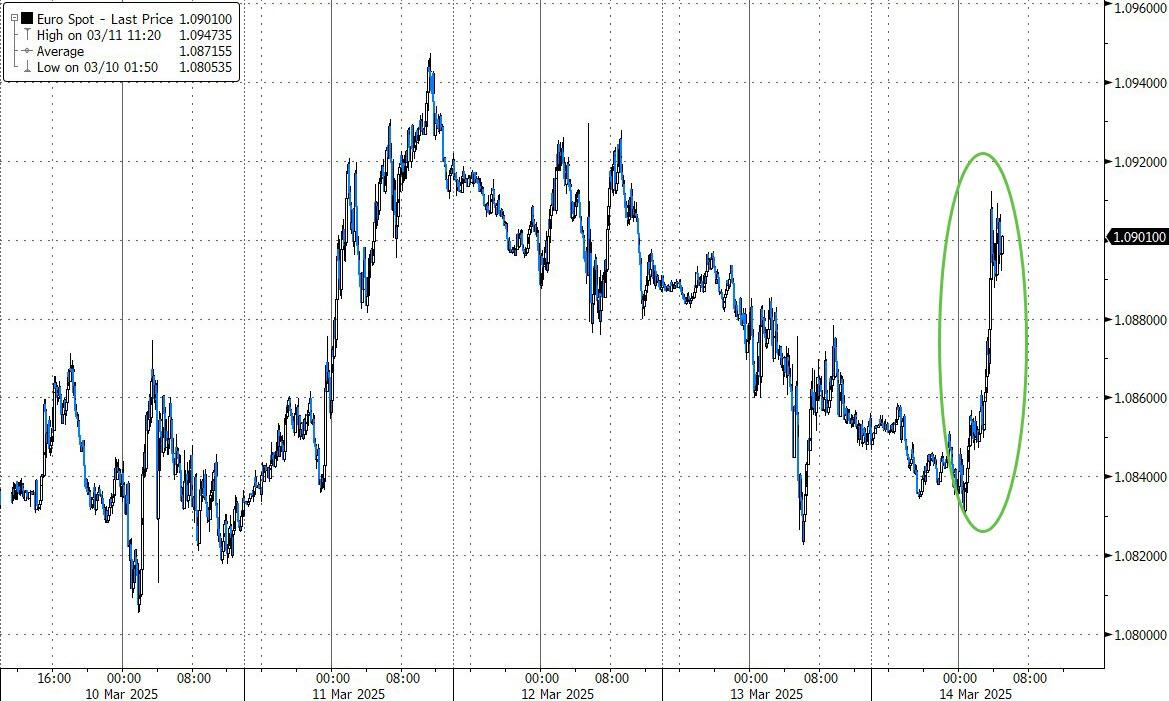 ?itok=YOSlh0i7
“Game on again for the euro,” said Brad Bechtel, head of FX at Jefferies, adding that peace talks for Ukraine are adding to the currency’s momentum. “The market is cautiously optimistic that we are progressing in the right direction.”
...but bund yields are also spiking to recent highs...
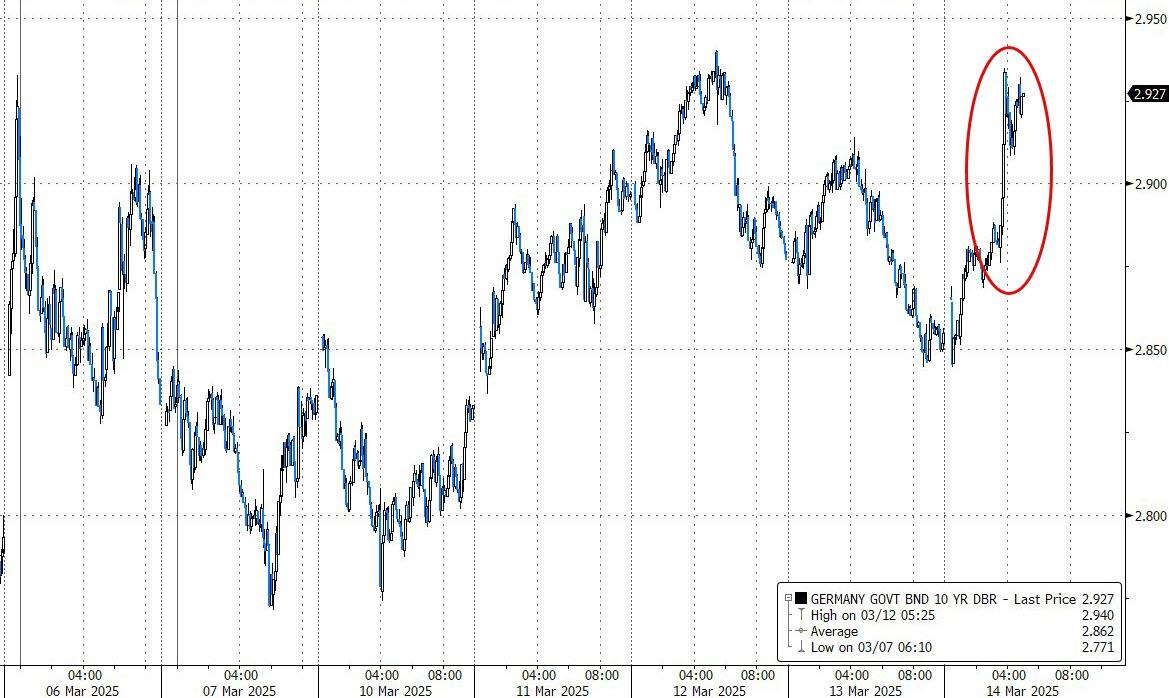 ?itok=Z2eL4y8V
Merz said late Thursday that he’s “very optimistic” that the landmark debt-spending package will be approved after a parliamentary debate on Thursday laid bare a deep rift with the Greens.
“What more do you want than what we have proposed to you?” Merz asked, prompting jeers from the party.
“The headlines are providing some comfort that the Greens are on board with the proposals,” said Evelyne Gomez-Liechti, a strategist at Mizuho International Plc, adding that markets had been pricing some chance of the agreement not passing through.
As Goldman Sachs Alberto Bacis notes, the narrative prevailing over the last 10 days is the following:
Germany has pivoted towards a fiscal expansionary stance > they have plenty of room > defense and infrastructure spending will generate a massive growth turnaround for Germany and rest of the block, bringing the following externalities:
1/ ECB must remain restrictive
2/ Inflation will fly
3/ Sky is the limit for investments
Bank of America’s sentiment survey published earlier Friday showed investors turned underweight on core euro-area fixed income for the first time since 2023.
“Core Europe duration longs collapsed as future economic growth and bond supply get priced in,” BofA strategist Ralf Preusser and colleagues wrote in a note earlier.
https://cms.zerohedge.com/users/tyler-durden
Fri, 03/14/2025 - 08:12
Judge Temporarily Blocks Trump's Yanking Of Clearances From Law Firm Tied To Steele Dossier
Judge Temporarily Blocks Trump's Yanking Of Clearances From Law Firm Tied To Steele Dossier
A federal judge on March 12 agreed to temporarily block President Donald Trump’s executive order stripping security clearances from employees at a prominent Washington law firm that was involved in generating the controversial Steele dossier.
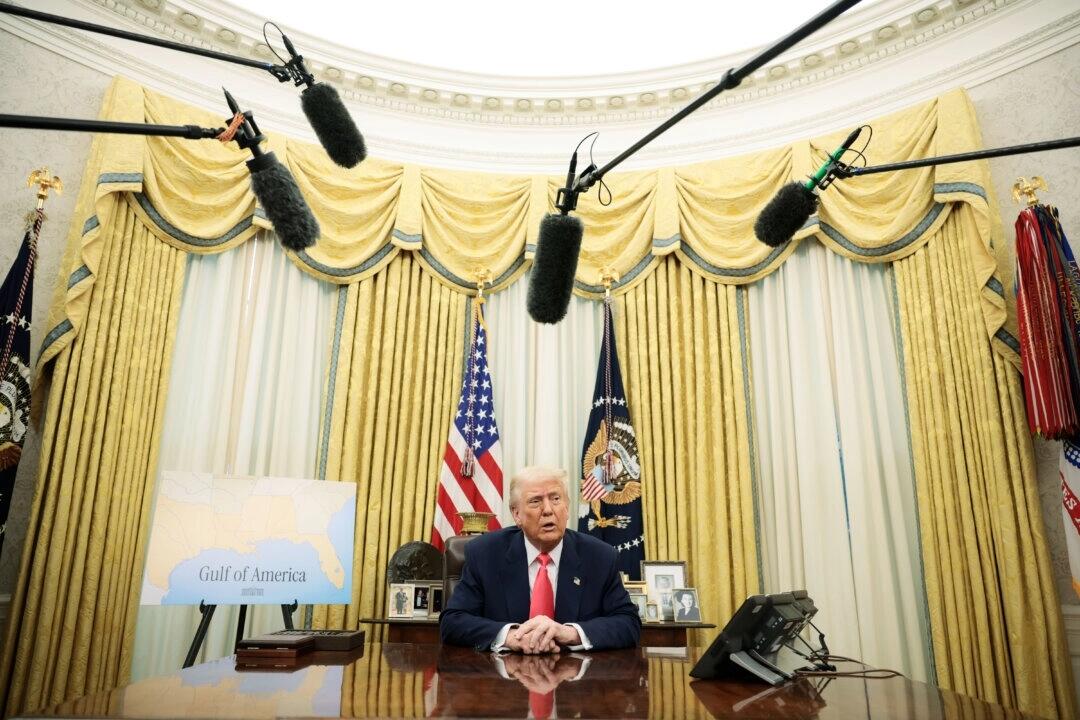 ?itok=qY465YHd
the order on March 6, citing law firm Perkins Coie’s work during the 2016 election, when Hillary Clinton’s campaign and the Democratic National Committee (DNC) paid the firm more than $1 million to hire opposition research company Fusion GPS. Trump’s order also targeted the firm’s policies promoting workforce diversity, equity, and inclusion.
Perkins Coie sued the Trump administration on Tuesday, arguing that the president’s order violated the firm’s rights of free speech, free association, and due process under the Constitution.
During a Wednesday hearing in Washington, U.S. District Judge Beryl Howell said she would grant the firm’s request for a temporary restraining order against the president’s order, which also sought to limit Perkins Coie’s work with federal contractors.
Trump ordered a government review aimed at ending all contracts the firm currently holds with any federal agencies and a review seeking to cancel contracts with its clients. The order also limits its lawyers’ ability to access government officials or retain security clearances.
In its lawsuit, Perkins Coie wrote that seven of its clients, including a major government contractor, had already pulled back legal work following Trump’s order or were planning to, resulting in “significant revenue” losses for the firm.
Government officials have also blocked or discouraged the firm’s attorneys from participating in meetings due to Trump’s order, according to the lawsuit.
In 2016, after receiving funding from the DNC and Clinton campaign, Fusion GPS hired Christopher Steele, a retired British counterintelligence specialist, to gather research into allegations that Trump’s 2016 campaign had conspired with the Russian government to win the presidential election.
Steele’s research was compiled into a dossier that BuzzFeed News published without his consent in 2017. The outlet was criticized for not first independently verifying many of the report’s salacious allegations, which sparked scrutiny among many journalists.
While some of the dossier’s more general findings—including that Russia was working to get Trump elected and sought to influence some of his associates—were later corroborated by U.S. intelligence agencies and special counsel Robert Mueller’s investigation, the report has been largely debunked, and no one in the president’s orbit was ever formally accused of conspiring with Russia.
Trump previously sued Clinton, Perkins Coie, and others, alleging they conspired to rig the 2016 election against him. A federal judge in Florida dismissed the lawsuit in 2022.
In February, Trump similarly https://www.theepochtimes.com/us/trump-suspends-security-clearances-for-law-firm-employees-tied-to-jack-smith-prosecutions-5816289
the suspension of security clearances for employees at Covington & Burling LLP, a Washington-based law firm that worked on former special counsel Jack Smith’s investigations of Trump.
https://cms.zerohedge.com/users/tyler-durden
Thu, 03/13/2025 - 14:45
White House Mum On If Trump Will Extend Sanctions Waiver Allowing Russian Oil Sales To EU
White House Mum On If Trump Will Extend Sanctions Waiver Allowing Russian Oil Sales To EU
Far-reaching EU sanctions have already placed a https://www.consilium.europa.eu/en/policies/sanctions-against-russia-explained/
on 90% of European oil imports from Russia. Some few European countries are heavily dependent, while most are not. For this reason during the Biden administration the US issued a temporary Treasury exemption allowing sanctioned Russian banks to process European payments for oil sales. But as of Wednesday that exemption expired, and at this time no one in Europe can purchase Russian oil.
The fact that the Trump administration has not renewed the exemption portends more economic pain to come for Russa, added to ongoing punitive efforts of the West toward starving funding for its war machine.
 ?itok=Tdr5FbCL
It is as yet unclear whether the White House still intends to extend the waiver, but without doubt it's being held out as leverage to induce Moscow to agree to the proposed 30-day Ukraine war ceasefire which came out of US officials' meeting with Zelensky government representatives in Jeddah.
At this moment the administration remains mum, but here's what Fox Senior White House correspondent Jacqui Heinrich wrote Wednesday, hours after the waiver https://x.com/JacquiHeinrich/status/1899908759008522731
:
Unclear if President Trump reissued waiver on Russian General License 8L - allows other countries to buy Russian oil using US dollar, US payment system. Biden’s waiver expired at midnight.
If POTUS did NOT reissue it, oil prices could rise by $5/barrel by some estimates… but if he DID, POTUS could face some of the same criticism Biden faced, saying it played to Putin’s hand. The White House Press Secretary told us she did not believe it has been reissued but would check on it.
Treasury, State, and WH did not have answers for us yesterday ahead of the deadline.
Meanwhile Reuters has highlighted Gazprom's rapid decline after its almost total loss of European markets amid the https://www.reuters.com/business/energy/gazproms-grandeur-fades-europe-abandons-russian-gas-2025-03-13/
:
Gazprom's Europe-facing export arm considers selling lavish offices, sources say
Down to just a handful of employees, job cuts also approved at headquarters, sources say
European buyers cast doubt on return to Russian gas in case of Ukraine peace
Russia's gas exports to China unlikely to replace European market losses
BREAKING: Trump had cut off all Russian oil sales to EU!
Treasury has ended the Biden exemption that allowed sanctioned Russian banks to process European payments for oil sales. Now no one in Europe can purchase Russian oil https://t.co/zOCqzlc0Di
— Marc Thiessen 🇺🇸❤️🇺🇦🇹🇼🇮🇱 (@marcthiessen) https://twitter.com/marcthiessen/status/1900190300330406116?ref_src=twsrc%5Etfw
Still, President Trump has teased the possibility of easing sanctions on Russia a reward for coming to the negotiating table and achieving a deal. But Putin has remained resistant for the time being, seeing any short-term truce as but an opportunity for Ukraine rearm and refresh its forces. Before the war, in 2021, overall the EU imported €71 billion worth of oil from Russia, which broke down to €48 billion of crude oil and €23 billion of refined oil products, according to European data.
Putin on Thursday touted the possibility of Washington easing or dropping sanctions, and the impact it would have on natural gas deliveries as well. "European gas futures dropped as much as 4.5% after President Vladimir Putin said a potential energy cooperation deal between Moscow and Washington could boost Russian gas flows to Europe," https://www.bloomberg.com/news/articles/2025-03-13/putin-says-us-deal-may-help-boost-russian-gas-flows-to-europe
reports.
"In the wake of the invasion, the European Union has taken steps to reduce its dependence on Russian gas. With the halt of gas transit via Ukraine on Jan. 1, Russia is sending just a fraction of its former shipments to Europe via one leg of the TurkStream pipeline," the report reviews.
https://cms.zerohedge.com/users/tyler-durden
Thu, 03/13/2025 - 14:25
Equity Capital Is Moving From US To Europe With Greater Zeal
Equity Capital Is Moving From US To Europe With Greater Zeal
Authored by Simon White, Bloomberg macro strategist,
The pace of outflows from US stocks is picking up, while inflows to European equities is accelerating.
Money, like water, always takes the path of least resistance. The risks of fiscal austerity and recession in the US is provoking capital to leave that market and travel eastwards to Europe, where massive fiscal expansion is on the cards.
ETFs give a very good real-time indication of capital flows in equity markets given their large size. The chart below shows the net quarterly flows for the largest ETFs, whose AUM is the majority of the total for all ETFs in the same class. It is self-explanatory.
 ?itok=JI0WY3Mu
The trend of equity capital leaving the US and heading to Europe began at the start of this year, but the pace has picked up in the last few weeks.
Chatter around a Mar-a-Lago accord has been scaring the horses. An astounding near $18 trillion of foreign capital has flowed into US equities over the last five years, pushing the US’s current account deficit much wider and contributing to the country’s now deeply negative net international investment position of over 100% of GDP.
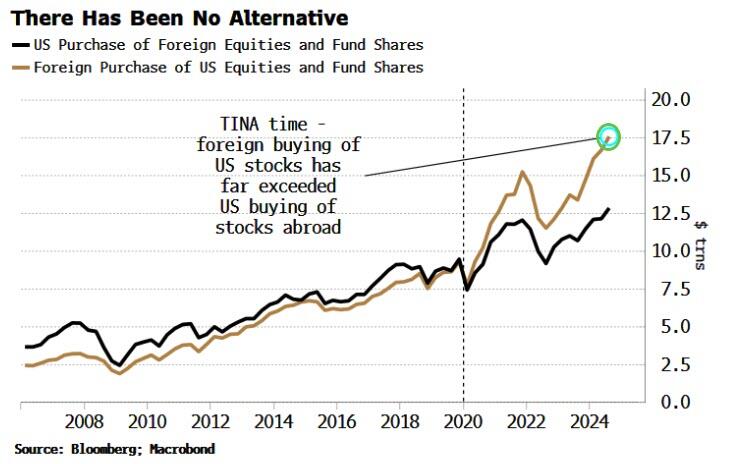 ?itok=BY0Ka2Er
Tariffs work directly on the trade deficit. But as the “stick” in a wider renegotiation of the dollar’s role in the global financial system, they are affecting capital flows too. Whether it’s intentional or not, it’s certainly one way to reduce the current account deficit, which is ultimately what matters from a rebalancing perspective.
Needless to say, $18 trillion is a lot of potential capital to flow out of the US. Whether the pace continues to accelerate will depend on how much the dollar is weaponized, ie how much or little of a putative Mar-a-Lago accord is actually put into practice; and to what extent Europe actually follows through with the huge stimulus numbers that have been suggested so far.
It also depends on whether such a large amount of capital can find a profitable home outside of the US market without taking valuations into nosebleed territory.
One way or the other, there is a lot of capital is moving across the Atlantic, and with increasing zeal.
https://cms.zerohedge.com/users/tyler-durden
Thu, 03/13/2025 - 14:05
https://www.zerohedge.com/markets/equity-capital-moving-us-europe-greater-zeal
Futures Slide Ahead Of PPI As Democrats Prepare To Shut Down Government
Futures Slide Ahead Of PPI As Democrats Prepare To Shut Down Government
US equity futures are again lower, although well off session lows, with small caps leading and tech stocks lagging as concerns over whether Democrats will push the US into a government shutdown over the weekend added to uncertainty around the outlook for the economy. As of 8:00am, S&P futures contracts fell 0.4%, in an extremely illiquid and volatile session, after gains on Wednesday spurred by a softer-than-expected inflation print. Nasdaq futures dropped 0.5%, with most Mag7 names lower; weak earnings hit software firm Adobe and clothing retailer American Eagle in premarket trading, Intel jumped as much as 11% after the chipmaker named a new chief executive officer. Senate Minority Leader Chuck Schumer said Wednesday that Democrats would not provide the necessary votes to pass the Republican plan to avert a shutdown. The yield curve is seeing yields rise in longer-dated bonds by 1-2bps. USD is flat while cmdtys are under pressure, though Ags are stronger. The market seems a bit more resilient to headline risk as macro fundamentals return to focus ahead of next week’s Fed meeting. Today’s macro data focus is on PPI to see if yesterday’s CPI (and PCE mapping) are intact ahead of tmrw’s Univ of Mich sentiment update.
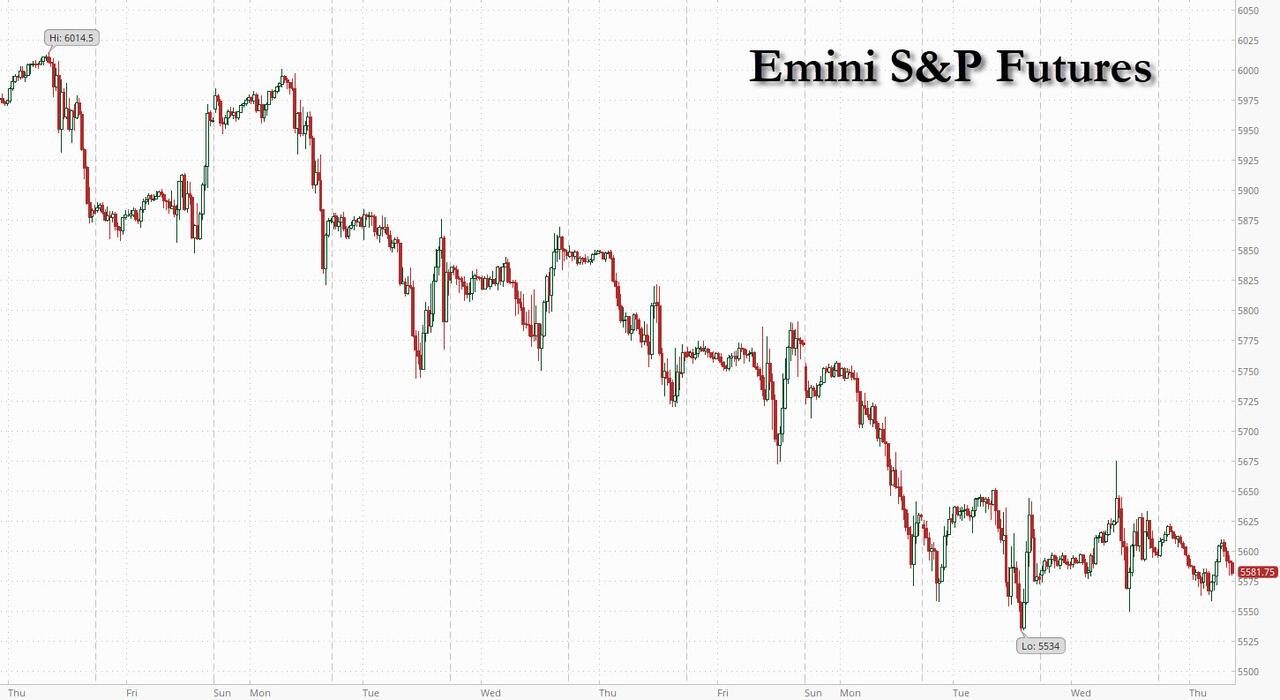 ?itok=YkBgw_8a
In premarket trading, Intel shares jump 11% after the chipmaker named Lip-Bu Tan as its CEO. Tan is signaling that he’ll stick with his predecessor Pat Gelsinger’s plan to make chips for other companies, even as he vows to learn from past mistakes. On the other end, Adobe shares slumped 4.6% after the maker of software for creative professionals gave an outlook thatwas mixed relative to expectations. While analysts are generally positive, Evercore wrote that the report wasn’t strong enough to change the narrative around the stock. Here are some other notable movers:
Wells Fargo shares edge 1% higher after RBC Capital Markets upgrades to outperform from sector perform, saying the stock’s weakness provides a good entry point.
SentinelOne shares slump 14% after the security software company gave a revenue forecast that was weaker than expected.
UiPath shares slide 18% after the automation software company gave a forecast that is weaker than expected, raising concerns about the threat it faces from AI.
American Eagle shares drop 9.1% after the apparel retailer forecast operating income for the first quarter that missed the average analyst estimate. Analysts note that the clothier’s weak forecast overshadowed its 4Q earnings beat.
The previous day’s CPI reading “has reinvigorated belief in the declining inflation narrative,” said Daniel Murray, CEO of EFG Asset Management in Zurich. Investors are now awaiting readings on US wholesale inflation and initial jobless claims, with price growth seen moderating to 0.3% last month.
Recent weeks have seen a slew of Wall Street banks including Goldman Sachs Group Inc. and Citigroup Inc. cut their forecasts for the S&P 500, predicting a hit from the slowing economy. Yardeni Research added to that bearish chorus, noting that Trump’s tariff policies have heightened the risk of stagflation. Still, some strategists think a bottom for US stocks is “probably” here, with JPMorgan Chase & Co. saying the worst of the correction may be over, with credit markets indicating a lower risk of a recession.
Meanwhile Treasury yields shrugged off the cooler inflation data to edge higher, with investors focusing on the effect higher tariffs could have on prices in the coming months. The Federal Reserve, which meets next week, has already signaled it will take a wait-and-see approach before cutting interest rates further.
European equities erased a gain of 0.5%, as earlier gains in health care, consumer product and insurance stocks were promptly reversed after Trump threatened the EU with 200% tariffs on alcohol products, and as concerns about trade persist after President Donald Trump said the US would respond to the European Union’s countermeasures to his tariffs on steel and aluminum. Poland’s Allegro leads gains, while Deilveroo and HelloFresh fall. European truckmakers slip after US regulators signaled they would dial back emissions standards, potentially derailing purchases of new trucks. Here are the biggest movers Thursday:
Allegro climbs as much as 8.9% in early trading in Warsaw after the Polish e-commerce platform reported better-than-expected adjusted Ebitda in the fourth quarter, announced a first-ever buyback
Novo Nordisk shares rise as much as 2.8% after Kepler Cheuvreux raised the stock to buy. The analysts see a recovery in the Danish drugmaker’s shares after sentiment “swung too far the other way”
Volution jumps as much as 12%, the most in over five months, after the maker of indoor air quality products delivered a beat in the first half and said annual earnings should be ahead of consensus
DFS Furniture gains as much as 12%, the most since July 2023, after the British furniture firm reported “a strong set of interims,” according to Jefferies, with 1H pre-tax profit almost doubling year on year
Lotus Bakeries rises as much as 6.1%, most since August, after analysts at KBC Securities upgraded the stock to accumulate from hold, seeing better opportunities for the sweets producer following a selloff
Halma advances as much as 4.4% after the health and safety sensor technology group delivers results that analysts view as solid, with consensus estimates now expected to nudge up slightly
Daimler Truck falls as much as 15%, leading the rest of European truckmakers lower, after the new head of the US EPA announced potential rollbacks of truck-emissions regulations starting in 2027, which could derail purchases of new trucks to comply with standards
DocMorris shares drop as much as 21% and hit a record low after the Swiss-based online pharmacy announced a potential capital increase and didn’t provide any guidance for 2025
Valeo falls as much as 5.1% as Exane cuts the car-parts maker to neutral from outperform following a rally over the past six months, preferring outperform-rated peer Forvia
Deliveroo shares fall the most in more than two years after the UK food delivery firm forecast earnings that disappointed investors
Hugo Boss shares fall as much as 5.1% to their lowest level in over three months after the high-end clothing maker’s sales outlook for 2025 missed estimates amid macroeconomic volatility
Trainline shares fall as much as 16%, the most in almost four years, after the train operator reported net ticket sales and group revenue for the full year that missed the average analyst estimate
Grenke shares slide as much as 22%, falling to the lowest since June 2012, after the German lease finance provider gave a forecast for 2025 earnings that missed the average estimate
Deliveroo shares fall as much as 6.9% to the lowest in almost a year, after the food delivery firm set guidance for adj. Ebitda below estimates, dragged by targeted investments to boost growth
Earlier in the session, Asian equities fell amid a broad risk-off mood, as traders largely looked past weaker-than-expected US inflation data. The MSCI Asia Pacific Index dropped as much as 0.5%, reversing a gain of as much as 0.6%. TSMC was the biggest drag on the gauge, with Taiwan’s benchmark the region’s biggest decliner as the central bank warned of currency risks from stock outflows. Sentiment turned sour as worries mounted about the health of the world’s largest economy amid on-again, off-again trade policies and geopolitical tensions. The regional gauge is down about 1.8% this week. “The general sense is that the world is not in a good place. There’s uncertainty everywhere and nobody wants to put on risk,” said Vey-Sern Ling, a managing director at Union Bancaire Privee. “I think economic uncertainties in the US caused by Trump’s policies will be a constant worry.”
In FX, the Bloomberg Dollar Spot Index rises 0.1%. The yen is off its best levels but still the top G-10 FX performer against the greenback. The Swedish krona is the weakest with a 0.7% drop, closely followed by the Antipodean currencies.
In rates, treasuries dip ahead of US producer price data, with US 10-year yields rising ~2 bp to 4.33%; treasury futures drifted lower as US trading begins after plying narrow ranges during Asia session and London morning, lifting cash yields by 1bp-3bp across maturities and steepening the curve. US 10-year yields around 4.33% are ~2bp cheaper on the day near session high with bunds in the sector lagging by an additional 1bp. Treasury curve spreads are steeper, 2s10s by ~1.5bp day’s high. Bunds have bigger losses as European stocks pare losses. This week’s Treasury auction cycle concludes with $22b 30-year reopening at 1pm New York time; Wednesday’s 10-year note auction stopped through by 0.5bp. WI 30-year yield at around 4.662% is ~9bp richer than February’s auction result. Focal points of US session include February PPI, weekly jobless claims data and 30-year bond supply.
In commodities, oil prices decline, with WTI falling 0.5% to $67.30 a barrel. Spot gold rises $10 to around $2,944/oz with prices rising toward record highs as several banks predicted further gains for the haven asset amid the escalation in global trade tensions. Bitcoin is steady just above $83,000.
The US economic data calendar includes February PPI and jobless claims (8:30am) and 4Q household change in net worth (12pm). Fed officials are in external communications blackout ahead of March 19 policy announcement
Market Snapshot
S&P 500 futures down 0.5% to 5,574.00
STOXX Europe 600 little changed at 540.95
MXAP down 0.3% to 184.55
MXAPJ down 0.7% to 576.88
Nikkei little changed at 36,790.03
Topix up 0.1% to 2,698.36
Hang Seng Index down 0.6% to 23,462.65
Shanghai Composite down 0.4% to 3,358.73
Sensex little changed at 73,993.34
Australia S&P/ASX 200 down 0.5% to 7,749.07
Kospi little changed at 2,573.64
German 10Y yield little changed at 2.89%
Euro little changed at $1.0878
Brent Futures up 0.2% to $71.12/bbl
Gold spot up 0.3% to $2,943.89
US Dollar Index little changed at 103.62
Top Overnight News
Senate Republicans are planning tax reductions that go well beyond an extension of President Trump’s expiring tax cuts. On the menu: Reviving lapsed business tax breaks, expanding the child tax credit, loosening the cap on the state and local tax deduction and incorporating Trump’s ideas for eliminating taxes on tips, overtime and Social Security benefits, said Finance Committee Chairman Mike Crapo (R., Idaho), who ticked through a list of ideas Wednesday that could easily top $5 trillion or more over a decade. WSJ
On the back of Trump’s Yale CEO caucus meeting Tuesday, while CEOs have largely been quiet, they affirmed that things would have to get significantly worse to publicly criticize the President. Asked how much the stock market would need to decline for them to speak out collectively, 44% said it would have to fall 20%. Another 22% said stocks would have to fall 30% before they would take a stand. WSJ
US Treasury Secretary Bessent spoke with congressional leaders about making Trump tax cuts permanent and said that is what they will deliver: Fox Business
Japanese investors registered the second-largest net purchases of overseas equities on record last week. Funds offloaded a net $2.4 billion of overseas bonds. BBG
The BOJ’s terminal rate may be 1.5% or higher, according to JST’s chief economist Hiroshi Ugai. The recent rise in long-term interest rates indicates that a similar view is spreading in markets. BBG
Intel soared premarket (INTC +11% premkt) after naming industry veteran Lip-Bu Tan as CEO. He signaled he’ll stick to the firm’s contentious foundry strategy. Chip-related stocks in Asia rallied
Poland’s president has called on the US to transfer nuclear weapons to Polish territory as a deterrent against Russian aggression, a request that is likely to be perceived as highly provocative in Moscow. FT
Global oil demand is under pressure from the escalating trade war, the IEA said. It expects a surplus of 600,000 barrels a day in 2025, which may jump to 1 million b/d following OPEC+’s decision to revive output. BBG
Fentanyl seizures along the US-Mexico border tumbled ~40% M/M in Feb to 590 pounds, hitting the lowest level since Dec ’21. BBG
Median Manhattan apartment rents hit a record $4,500 in February, with bidding wars in almost 27% of deals. The competitive market is expected to hold as economic uncertainty keeps potential homebuyers in rentals. BBG
A more detailed look at global markets courtesy of Newsquawk
APAC stocks were subdued as risk appetite soured despite the mostly positive handover from Wall St where sentiment was underpinned after softer-than-expected CPI data but with the upside capped as concerns lingered. ASX 200 was dragged lower by consumer stocks, energy and financials, with the consumer sector pressured as electricity bills are to jump as much as 9% in a cost-of-living blow following the energy regulator’s price ruling. Nikkei 225 initially outperformed and briefly reclaimed the 37,000 level before wiping out the gains. Hang Seng and Shanghai Comp gradually deteriorated following a tepid PBoC liquidity operation and with participants unfulfilled by the lack of policy action so far by the central bank post-NPC, while reports that Hong Kong is mulling reducing thresholds for purchasing the most expensive stocks did little to spur a bid.
Top Asian News
PBoC says will lower rates and the RRR at a "proper time"; will keep liquidity ample. Will guide social financing costs lower. Will balance short and long-term developments. Will keep CNY basically stable at a reasonable and balanced level. Will strengthen expectation guidance.
BoJ Governor Ueda said underlying inflation remains slightly below 2% but expects it to gradually accelerate as the economy recovers, while he added that the BoJ is gradually shrinking the size of its balance sheet and will take time to assess the ideal size, considering overseas examples. Ueda also said Japan’s monetary base and balance sheet are somewhat too big which is why bond buying is being slowed.
Hong Kong mulls reducing thresholds for purchasing the most valuable stocks, according to Bloomberg.
Japan's Bankers Association Chair says market view on BoJ's terminal rate have risen more than expected; long-term interest rates have scope to rise further due to BoJ rate hikes and bond-buying taper.
Acer (2353 TW) FY (TWD): net 5.54bln (+2.1% Y/Y); plans to raise up to TWD 10bln via unsecured bond; cash dividend of 1.7/shr; will de-list its GDR from LSE.
European bourses (STOXX 600 +0.3%) opened mostly lower, but sentiment has improved as the morning progressed to display a modestly positive picture in Europe. European sectors are mixed, and holds a slight defensive bias; Telecoms is towards the top of the pile, joined closely by Healthcare, which is propped up by Novo Nordisk (+3%); the Co. benefits from a broker upgrade at Kepler and as it bounces back from recent losses. Autos sits at the foot of the pile, with no clear driver but with tariff uncertainty still at the forefront of traders minds.
Top European News
German Green Party official says there is no progress in talks with CDU/CSU and SPD on debt plans, via an RTL interview.
German Greens Spokesperson says there is no rapprochement so far in talks with the SPD and CDU/CSU; will continue to reject the draft legislation of the CDU and SPD.
ECB's Nagel says US trade tariffs on the EU could push Germany into a recession in 2025.
ECB's Kazaks says "I cannot say everything is done on inflation"; rates will be decided meeting by meeting amid uncertainty.
ECB's Rehn says you can only hope that the Trump administration can respect central bank independence; should aim at negotiated solutions for US tariffs, encourage the administration to avoid the unnecessary and harmful measures.
IFW Institute says German economy is expected stagnate in 2025 (unchanged from prev. forecast); to grow by 1.5% in 2026 (prev. forecast of 0.9%); anticipates tailwinds from a public spending boost that incoming Chancellor Merz is pushing for.
FX
DXY is incrementally firmer/flat and trades within a 103.50-76 range, as traders await US PPI and weekly jobless claims. The former includes key components which feed into the Fed's preferred US PCE measure; following the softer-than-expected CPI yesterday, JP Morgan provisionally forecasted core PCE to have risen 0.31% M/M; this would lift Y/Y to 2.7% (prev. 2.6%). Trade updates will of course also be in focus, as will any commentary surrounding a potential US shutdown.
EUR is a little lower and trades within a 1.0860-97 range, with a slew of ECB speakers set to appear throughout the day. Traders will keep an keen out on any commentary out of Germany, where the Bundestag is set to debate fiscal reform. Commentary this morning has come via a German Green Party official who said there is no progress in talks with CDU/CSU and SPD on debt plans; remarks which sparked some modest pressure in the Single-currency, which entirely pared soon after. Elsewhere, on the growth front for Germany; IfW Institute raised its 2026 GDP forecast, citing tailwinds from a boost in public spending under incoming Chancellor Merz.
GBP is a little lower and ultimately trading rangebound, given the lack of UK-specific updates, but ahead of GDP figures on Friday. High for the day sits at 1.2973, a little shy of the prior day's peak at 1.2987.
JPY was the marginal G10 outperformer, before then paring the upside as the day progressed. USD/JPY currently sits at the mid-point of a 147.59-148.37 range. Overnight, BoJ Governor Ueda said underlying inflation remains slightly below 2% but expects it to gradually accelerate as the economy recovers, while he added that the BoJ is gradually shrinking the size of its balance sheet and will take time to assess the ideal size, considering overseas examples.
Antipodeans are the clear underperformers today, largely a factor of the subdued risk tone in Asia overnight and in a slight paring of the upside seen on Wednesday.
PBoC set USD/CNY mid-point at 7.1728 vs exp. 7.2439 (Prev. 7.1696).
Canadian Prime Minister-designate Mark Carney will be officially sworn in on Friday and is to shrink the cabinet when he takes over with the cabinet expected to have between 15 and 20 ministers, down from the current 37, according to Bloomberg
Fixed Income
USTs are flat, after spending the early portion of the morning a little firmer following a strong 10yr auction, which garnered strong demand with a stop-through of 0.5bps. Back to today, US paper has held a downward bias, in tandem with pressure seen in Bunds. Focus today will be on the US PPI, where some components will feed into the US PCE metric. Sentiment has also taken a slight hit following updates out of Washington; US Senate Democratic Leader Schumer said Senate Republicans do not have the votes to approve the House-passed government spending bill without amendments. On the supply front, a 30yr auction is due.
Bunds are on the backfoot, after spending most of the morning firmer; the complex has slipped from a intraday high of 127.53 to a current trough of 126.93. All eyes are on the German Bundestag today, where the main German officials involved will each outline their approaches and views before a general debate. Pre-debate commentary thus far has come via a German Green Official who said that there has been no progress in talks on debt plans; this sparked some modest upside in German paper, before entirely paring. More recently, a Greens official said there has been no rapprochement so far and will continue to reject the draft legislation; remarks which knee-jerked Bunds, but proved fleeting. Ultimately focus will be on the debate at 11:00 GMT / 07:00 EDT. Ahead, a slew of ECB members are set to speak throughout the day.
Gilts are lower by a handful of ticks and directionally in-fitting with peers; UK-specific newsflow has been light this week, but picks up in the form of GDP figures on Friday.
Italy sells EUR 6.75bln vs exp. EUR 5.5-6.75bln 2.65% 2028, 2.45% 2033, 4.30% 2054 BTP and EUR 1.5bln vs exp. EUR 1.25-1.5bln 4.00% 2031 Green BTP.
Commodities
Crude has been exceptionally choppy today, but is now firmly in the red and resides at session lows. Early morning trade saw a pick up in oil prices, but lacked any fundamental driver. Thereafter, crude dipped off best levels and continued lower after some US-Russia related updates; the first bout of pressure stemmed from reports that US Envoy Witkoff's plan crossed the Russia border (has since landed). A second leg lower was seen after Russia's Kremlin said President Putin may have an international call later on Thursday, and also pushed back on reports that it had laid out demands for talks. Brent'May currently at the bottom end of a USD 70.43-71.25/bbl range.
Spot gold is firmer by around USD 12/oz, continuing the upward momentum following the US CPI report on Wednesday. Currently sits at the top end of a USD 2,933.03-2,947.15/oz range.
Base metals hold a negative bias, following a subdued session in Asia overnight. 3M LME copper resides in a current USD 9,721.42-9,811.90/t range.
Citi forecasts Dutch TTF and JKM gas prices are likely to be rangebound in respective EUR 34-35/MWh and USD 11.50-13.50/MMBtu ranges during Q2-2025.
IEA OMR: Cuts 2025 oil demand growth forecast to 1.03mln BPD (prev. 1.1mln BPD); "the scope and scale of tariffs remains unclear, and with trade negotiations continuing apace, it is still too early to assess the impact on the market outlook".
Saudi Crude oil supply to China set to fall to 34mln/bbls in April, according to Reuters sources.
Qatar set to start supplying Syria with gas via Jordan with Washington's approval, according to Reuters sources.
Geopolitics: Middle East
Hamas official said they welcomed US President Trump's apparent retreat from calls for the displacement of Gazans.
Geopolitics: Ukraine
Russian Foreign Minister says the deployment to Ukraine of foreign military personnel under any flag as unacceptable. Russia considers any foreign military bases in Ukraine as unacceptable. Deployment of troops or building bases in Ukraine would mean direct involvement of these countries into the conflict with Russia. Russia would respond with all available means to deployment of foreign troops and bases in Ukraine.
US Envoy Witkoff has arrived in Moscow, according to TASS.
Russia's Kremlin says Russian President Putin may have an international phone call on later on Thursday; on reports that Russia has laid out demands for talks, says there is a huge amount of misinformation out there; confirms US envoy is flying to Russia. US National Security advisor Waltz spoke with Russia's Ushakov
US Envoy Witkoff's plane has crossed the Russian border, according to Tass citing Flightradar.
Russian President Putin said troops should defeat the enemy in the Kursk region and completely liberate the region, while it was also reported that Russia's Chief of the General Staff said Kyiv's plans in Kursk region failed and Ukrainian forces in the Kursk region are surrounded, according to IFX. It was later reported that the Kremlin said the operation in the Kursk region is at the final stage, according to TASS.
"Kremlin: Putin may comment today on the proposal for a ceasefire in Ukraine", according to Al Arabiya.
Geopolitics: Other
Polish President Duda urged for the US to move nuclear warheads to Polish territory, according to FT.
US Event Calendar
08:30: Feb. PPI Final Demand MoM, est. 0.3%, prior 0.4%
Feb. PPI Final Demand YoY, est. 3.3%, prior 3.5%
Feb. PPI Ex Food and Energy MoM, est. 0.3%, prior 0.3%
Feb. PPI Ex Food and Energy YoY, est. 3.5%, prior 3.6%
08:30: March Initial Jobless Claims, est. 225,000, prior 221,000
March Continuing Claims, est. 1.89m, prior 1.9m
12:00: 4Q US Household Change in Net Wor, prior $4.77t
DB's Jim Reid concludes the overnight wrap
Standby for an exciting special announcement from DB Research this morning. No its not me stepping down and spending more time with my family. That would be far too stressful and unaffordable.
Ahead of our exciting new announcement, the market selloff has finally begun to stabilise over the last 24 hours, with the S&P 500 (+0.49%) posting a recovery that kept it clear of correction territory for now. However the next hurdle is a potential US government shutdown this Saturday if not enough moderate Democrats vote for the Republican stopgap funding bill in the Senate ahead of the weekend. We will see if a deal can be made. The uncertainty has perhaps helped S&P (-0.57%) and Nasdaq (-0.87%) futures to give up their gains from yesterday so we will see how this story plays out.
Before this, the softer-than-expected US CPI print had dominated, reassuring investors that the Fed would still have the space to cut rates if required. But even with the weaker inflation print, the rally faded as the day progressed. There was still a lot of concern about ongoing tariffs, particularly after various retaliatory measures were announced against the United States. So that meant the S&P gave up the bulk of its initial +1.26% move straight after the open, closing at +0.49%, with nearly two thirds of S&P 500 constituents lower on the day and a lot of other risk assets still struggling to gain traction.
In terms of that CPI release, the February numbers were the mirror image of the previous month, as both headline and core CPI surprised on the downside. For instance, headline CPI fell to just +0.22% on the month (vs. +0.3% expected), which pushed the year-on-year rate down to +2.8% (vs. +2.9% expected). That monthly print was the weakest since August, and it meant the 3m annualised rate finally moved down to +4.3%, ending a run of 6 consecutive increases in the measure. Meanwhile for core CPI, there was also a decent story, with the monthly number at +0.23% (vs. +0.3% expected), which pushed the year-on-year rate down to +3.1% (vs. +3.2% expected). You can see our US economists' full CPI recap here.
As discussed, the release immediately led to a surge in US equity futures, as investors hoped it would keep the Fed on course to cut rates this year. However, that initial positivity began to tail off as the market focus returned back to tariffs, and whether that might lead to a fresh rebound in the inflation numbers. Indeed, yesterday saw Canada retaliate against the latest US steel and aluminium tariffs, announcing tariffs on around C$30bn of US products, targeting steel and aluminium as well. And that followed on from the EU’s own announcement yesterday morning, who proposed countermeasures covering €26bn of American goods, which would come into force over April. So collectively, the fear is that this ratchet could be increasingly hard to climb down from over the months ahead. Amidst a visit to Ireland, Trump himself continued to make comments implying that tariffs would go up, saying that the US would respond to the EU countermeasures, that he wasn’t happy with the EU and that April 2 would be a very big day, when he’s planning to impose reciprocal tariffs. He also referred to Ireland's large pharmaceuticals trade surplus against the US. Remember as well that Trump has said he considers VAT to be like a tariff, so that could seriously affect a lot of European countries.
With all that in hand, the S&P 500 (+0.49%) ultimately ended the day higher, but that was mainly thanks to a strong bounceback for the Magnificent 7 (+2.27%), which put in their best daily performance in six weeks. Indeed, the recovery was a pretty narrow one, with most constituents in the S&P moving lower on the day (65%), which left the equal-weighted index down -0.46%, while the Dow Jones fell -0.20%. Small-cap stocks also lagged, with the Russell 2000 only up +0.14%. But despite the caveats, the moves took the S&P further away from the -10% threshold that would mark a technical correction, leaving it -8.87% beneath its peak, while moderating volatility saw the VIX index (-2.69pts to 24.23) post its biggest decline of the year so far.
The modest risk-on tone meant that US Treasuries struggled yesterday, despite the softer-than-expected CPI print. So yields rose across the curve, with the 2yr yield (+4.5bps) up to 3.99%, whilst the 10yr yield (+3.2bps) moved up to 4.31%, its highest level in two weeks before dipping back to 4.295% in Asia this morning. In addition, the equity recovery also helped alleviate fears that the US was heading into recession, and investors dialled back their expectations for Fed rate cuts this year, despite the softer CPI print. So by the close, the rate priced in for the December meeting had actually moved up +5.7bps on the day, with futures only pricing in 70bps of cuts this year.
Over in Europe, the narrative was more consistently positive yesterday, with the STOXX 600 (+0.81%) ending a run of 4 consecutive declines, whilst the DAX saw a larger +1.56% gain. For what it’s worth, that’s now the 8th consecutive session where the DAX has moved by at least 1% in either direction, and if we get a 9th today, it would be the first time that’s happened since the pandemic turmoil of H1 2020. Bond yields also came off their recent highs, with yields on 10yr bunds (-1.9bps), OATs (-3.4bps) and BTPs (-2.3bps) all moving lower. And there was a fresh tightening in sovereign bond spreads too, with the Franco-German 10yr spread down to 67.6bps, which is the tightest it's been since July. Today sees a debate in the reconvened outgoing Bundestag which kicks off the constitutional process leading us to potentially see the largest domestic fiscal stimulus since at least German reunification. See our economists' note "Crunchtime in the Bundestag" previewing this.
Otherwise yesterday, the Bank of Canada delivered a 25bp rate cut in their latest policy decision, taking their overnight rate down to 2.75%, in line with expectations. Their statement acknowledged the ongoing trade war, saying that “heightened trade tensions and tariffs imposed by the United States will likely slow the pace of economic activity and increase inflationary pressures in Canada.” The Canadian dollar strengthened by +0.45% against the US Dollar yesterday, making it the strongest-performing G10 currency, and the statement acknowledged that they would need to assess “the timing and strength of both the downward pressures on inflation from a weaker economy and the upward pressures on inflation from higher costs.”
Asian equity markets are lower overnight with the Hang Seng (-1.42%) leading losses and heading for its fifth successive loss while the CSI (-0.58%) and the Shanghai Composite (-0.75%) are also trading lower alongside the KOSPI (-0.38%) and the S&P/ASX 200 (-0.48%). The Nikkei (+0.07%) is clinging on to gains after a larger earlier rally.
To the day ahead now, and US data releases include PPI inflation for February and the weekly initial jobless claims. Meanwhile in the Euro Area, we’ll get industrial production for January. Otherwise, central bank speakers include ECB Vice President de Guindos, and the ECB’s Rehn, Vujcic, Makhlouf, Holzmann, Villeroy and Nagel.
https://cms.zerohedge.com/users/tyler-durden
Thu, 03/13/2025 - 08:27
https://www.zerohedge.com/markets/futures-slide-ahead-ppi-democrats-prepare-shut-down-government
Euro Dips As Trump Threatens 200% Tariff On EU Alcohol
Euro Dips As Trump Threatens 200% Tariff On EU Alcohol
Another day, another tariff-based headline...
President Trump threatened to enact a 200% tariff on European wine, champagne and other alcoholic beverages, the latest escalation in a brewing trade war between the US and the EU.
The president in a social media post on Thursday said that he would move forward with the import duties if the EU doesn’t repeal a tax on US whiskey, a measure put in place to retaliate against Trump’s steel and aluminum tariffs that went into effect on Wednesday.
The European Union, one of the most hostile and abusive taxing and tariffing authorities in the World, which was formed for the sole purpose of taking advantage of the United States, has just put a nasty 50% Tariff on Whisky.
If this Tariff is not removed immediately, the U.S. will shortly place a 200% Tariff on all WINES, CHAMPAGNES, & ALCOHOLIC PRODUCTS COMING OUT OF FRANCE AND OTHER E.U. REPRESENTED COUNTRIES.
This will be great for the Wine and Champagne businesses in the U.S.
The euro sold off against the dollar...
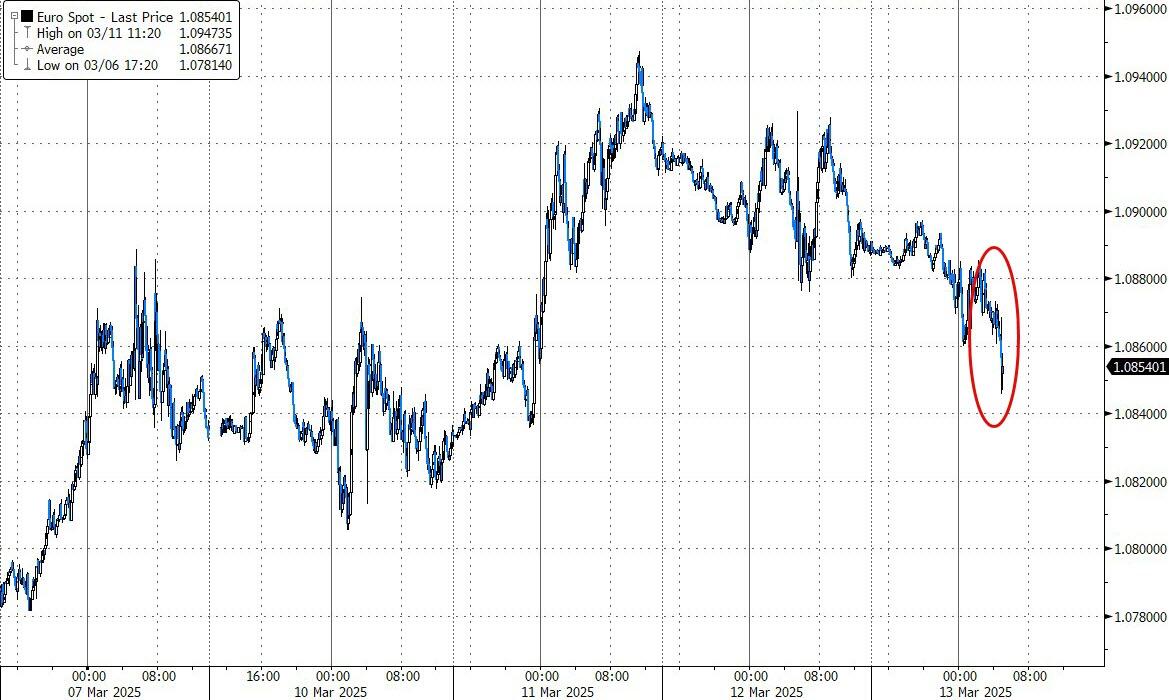 ?itok=Ful8FkVc
And US futures are fading...
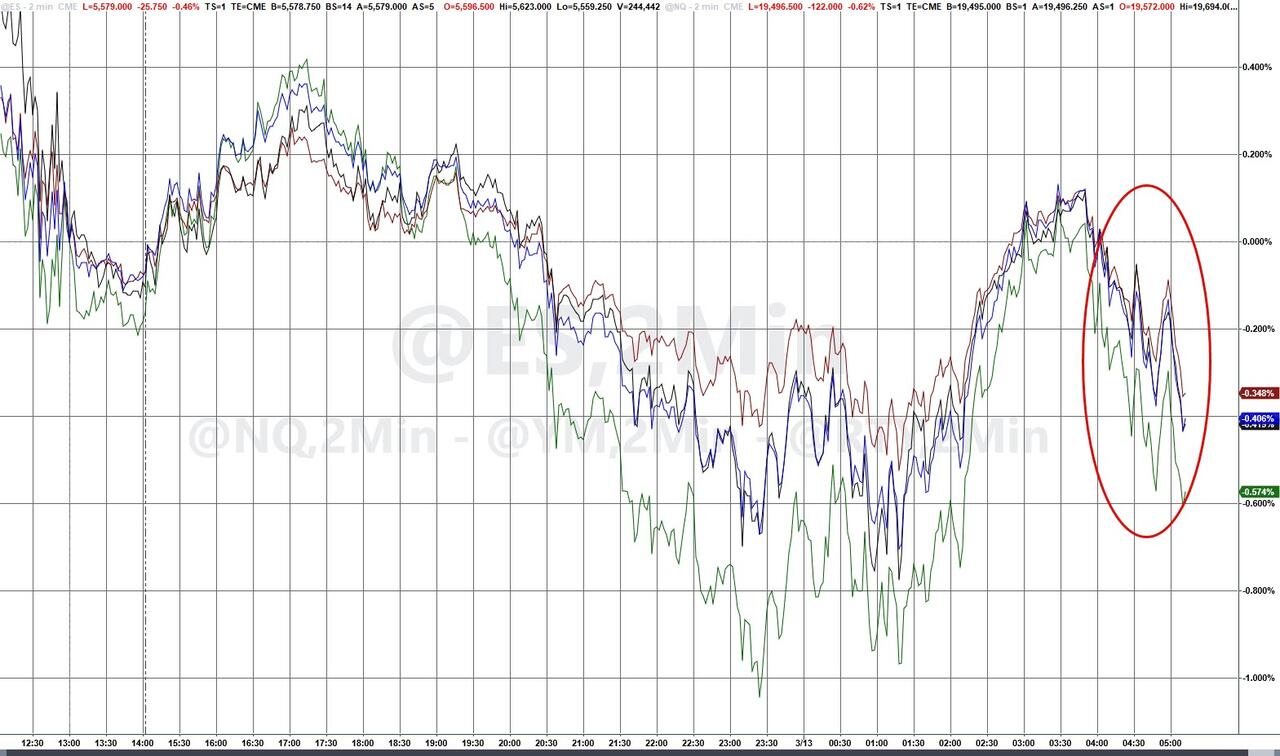 ?itok=B1q_Xy6k
European spirits and drinks makers dropped on the news: LVMH, which has wines and spirits divisions, falls 2%; spirits maker Pernod Ricard -3%, cognac producer Remy Cointreau -3.4%, Davide Campari -2.8%, Diageo -0.3%
Cue the retaliatory threats from Brussels... and around and around we go.
https://cms.zerohedge.com/users/tyler-durden
Thu, 03/13/2025 - 08:14
https://www.zerohedge.com/geopolitical/euro-dips-trump-threatens-200-tariff-eu-alcohol
Look The F*ck Out Below
Look The F*ck Out Below
Submitted by https://quoththeraven.substack.com/p/look-out-below
To most of my readers, the move in markets today won’t be much of a surprise. In fact, a couple of the names I thttps://quoththeraven.substack.com/p/trading-the-shit-show-march-2025
(and here) are actually green in today’s blood red tape.
For the most part, I’ve already https://quoththeraven.substack.com/p/trading-the-shit-show-march-2025
.
I wasn’t going to write a piece midday today until I turned on the television and, despite the best efforts of David Faber to inject some semblance of reality onto CNBC guests, watched portfolio managers justify paying 26x to 40x earnings for tech stocks they said are “on sale”. Thank God I hadn’t eaten lunch yet, or I may have heaved.
So here’s my quick take on where we stand today and what I’ll be watching for to try and denote some type of overall market bottom in the future.
First, let’s keep our bearings about us. While the NASDAQ is down more than 3% today, it is still up more than 140% over the last five years.
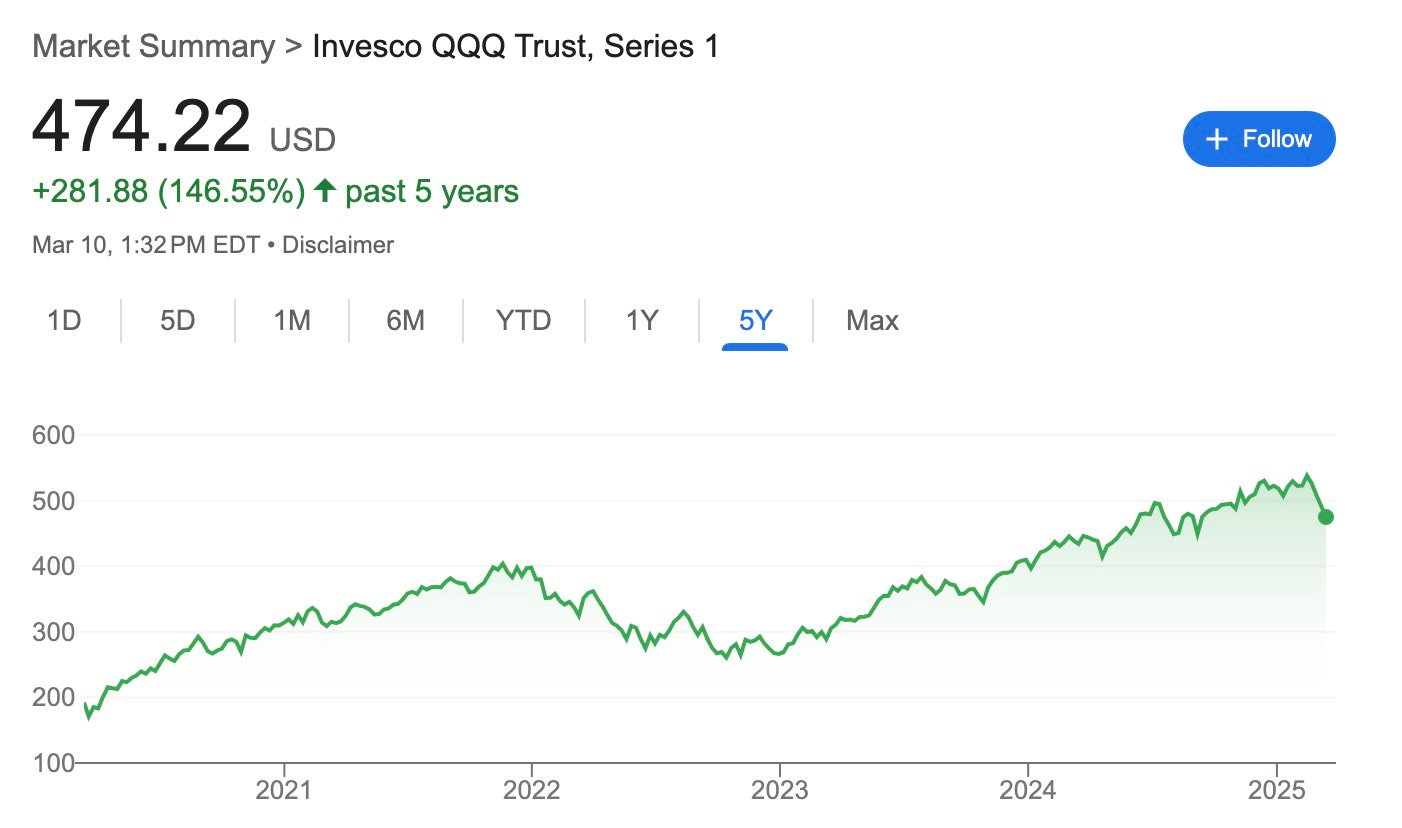
Those are astonishing returns that, in my opinion, have been fueled by insanely euphoric expectations, arrogance, hubris, a relentless passive bid as a result of Covid liquidity, and weaponized gamma in the options market.
It was a combination of these three things, in my opinion, that led us to far overshoot the euphoria mark on pretty much all valuation metrics. Which is how we got here:
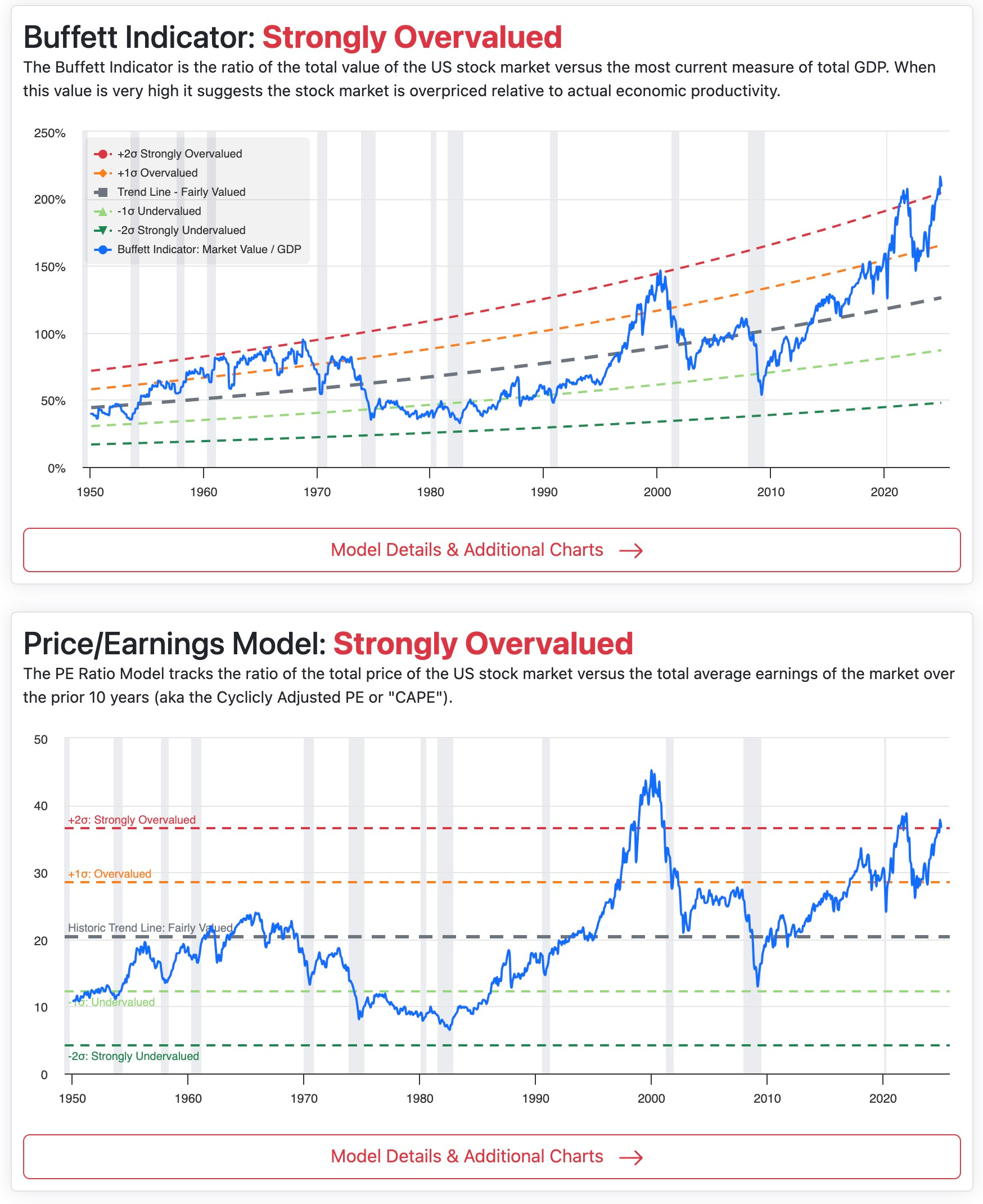
Today when I turned on CNBC, I actually saw David Faber doing a great job of trying to keep some semblance of reality in the air as multiple guests came on and tried to make the ridiculous argument that the tech bullshit they have stuffed their portfolios with at all time highs is somehow “on sale” or “cheap” with names like Apple, Microsoft, and Nvidia still sporting price-to-earnings ratios between 26x and 40x.
“Just take a long-term view,” one of the analysts said today, telling David Faber he was directing his trading team to buy more Microsoft while on the air around lunchtime.
Faber actually did a pretty good job trying to paint a picture of the psychology of the market as it stands today. What he said mostly aligns with what I have been saying over the last couple of weeks: that there is a psychological shift taking place deep in the foundations of the market, not only where people are beginning to entertain the idea that we’re entering a bear market, but also simultaneously entertaining the idea of a rotation out of risk-on speculative US technology stocks and into both US industrials and emerging markets—a sentiment that I have been predicting would take place dating all the way back to the beginning of last year. Here’s https://quoththeraven.substack.com/p/24-stocks-im-watching-for-2024-part-31a
:
2023 was a year marked by insanely aggressive gains in tech and the NASDAQ. Despite higher rates, investors still haven’t shifted their investing outlook from growth to value, and, as shown in the price of commodities, investors still aren’t positioning themselves defensively. This is a rotation that is long overdue, in my opinion.
I feel like with valuations where they are, technology names could wind up seeing a significant pullback in the coming year, while the steady and consistent dividends of utilities and consumer staples could produce a total return for the year that should be able to beat both the S&P and the NASDAQ if I’m correct.
With the Japanese bond market now on the verge of cracking up, Germany not far behind, and the US eventually going to follow suit, it sure does seem like our markets could be on a path for yield curve control and a multiple-years-long stagnant equity market, not unlike what we’ve seen in Japan over the last decade.
“Japan JGB auctions going from terrible to worse: last week saw a dismal 10Y auction with lowest Bid to Cover since 2021 and a spiking tail. And now another terrible 5Y auction, with the lowest Bid to Cover since June 2022,” Zero Hedge https://x.com/zerohedge/status/1898946678805119323
, at yields across the curve hit highs. They predict a failed auction soon. Here’s the 40Y blowing out:
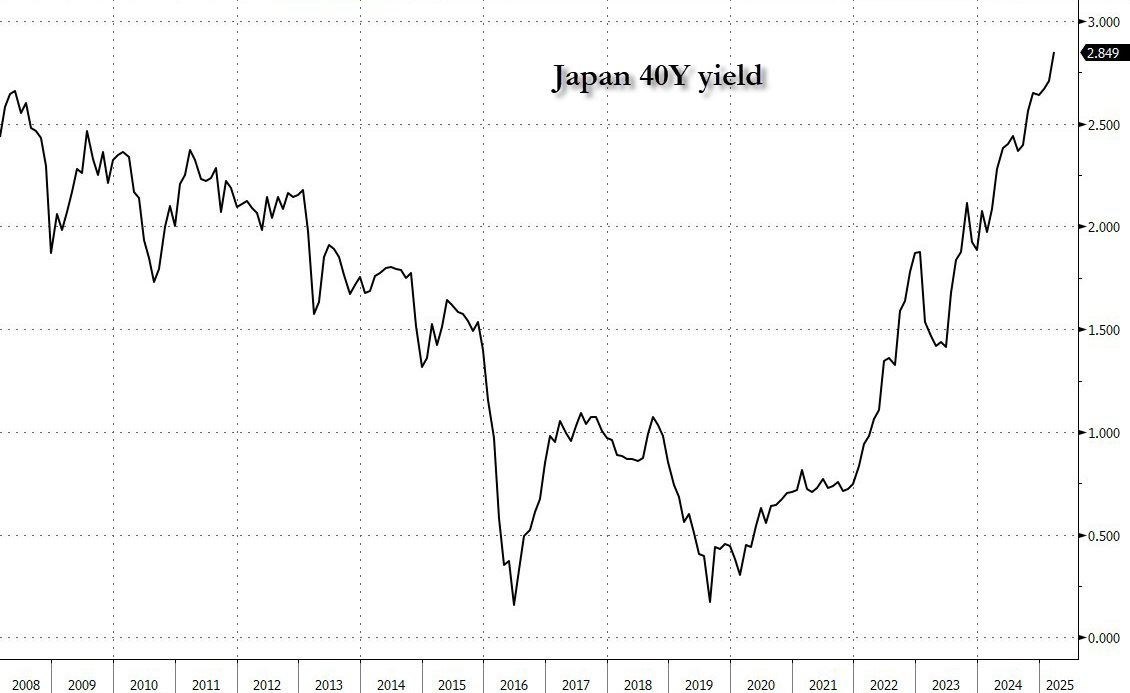
Chart: https://x.com/zerohedge/status/1898919330261213626/photo/1
In an environment like this, the sentiment would almost definitely benefit emerging markets, value stocks, industrial stocks, and any type of boring blue-chip stock you would’ve seen heralded as a safe play back in the 90s before the notion of value and stock picking in markets was taken out back and pissed on by the Federal Reserve.
But that could all be a long way away, and it’s pretty heavy talk for the market being down barely 10% off its highs. With that being said, the sentiment I’m seeing on financial news and social media isn’t anything near what I would consider capitulation and, therefore, some type of psychological bottom. As far as a bottom for fundamentals, the market could easily get cut in half in here and still not necessarily be “cheap.” I think we all know the Federal Reserve likely won’t let that happen unless a massive deleveraging runs wild and creates a one-off crash event. But let’s say valuations come in 20% to 30% on ‘25 or ‘26 earnings—this would be an area where I would start to also want to gauge psychological sentiment.
To me, psychological sentiment at the bottom literally looks like the “hell is coming” https://www.cnbc.com/2020/03/25/bill-ackman-exits-market-hedges-uses-2-billion-he-made-to-buy-more-stocks-including-hilton.html
. Right now, all these crumb bums that are flapping their gums all day on CNBC are fighting this trend of the market moving lower. It’s just one excuse after the other. “It’s a great opportunity to buy,” they clamor — yeah, with little to no acknowledgment of how overvalued everything is, the potential for the market to move lower, or things like private credit marks and commercial real estate, among other time bombs that may be waiting for the market out there as it sells off.
Everybody today on TV was trying to fight the market. And to some degree, they have to. Most of these people have been on TV every day over the last couple of weeks telling everybody to buy as the market moves lower. And so what other options do they have? Admit they were wrong? That’s never gonna f*cking happen.
🔥 50% OFF FOR LIFE: Using this coupon entitles you to 50% off an annual subscription to Fringe Finance for life: https://quoththeraven.substack.com/subscribe?coupon=d8097c43
So instead, we get every possible mental gymnastic contortion of reality and bullshit excuse available as to why today is definitely going to be the bottom—at least until tomorrow—and investors who are “savvy enough” to take a long-term view should view this as an opportunity.
Nobody ever asked a question like: What happens if the S&P reverts to an average P/E ratio of 18 times earnings for the next decade? In that case, it doesn’t matter whether you have a one-year, five-year, or 10-year outlook; it’s not an opportune time to buy here. End of story.
But I digress. What I’ll be watching for is when the very same huge-brained analysts on TV today arguing that expensive stocks are “cheap” finally surrender and admit that this market is broken and that “it’s different this time” but only to the downside.
When these people are finally liquidated, and some firms start blowing up — when anchors https://www.independent.co.uk/news/business/china-stock-market-crash-cnbc-reporter-needs-to-make-some-calls-on-black-monday-meltdown-10470626.html#:~:text=Your%20support%20makes%20all%20the%20difference.&text=Mr%20Faber%2C%20who%20has%20hosted,steep%20losses%20the%20previous%20day.
— maybe I’ll start wondering whether or not market psychology has changed.
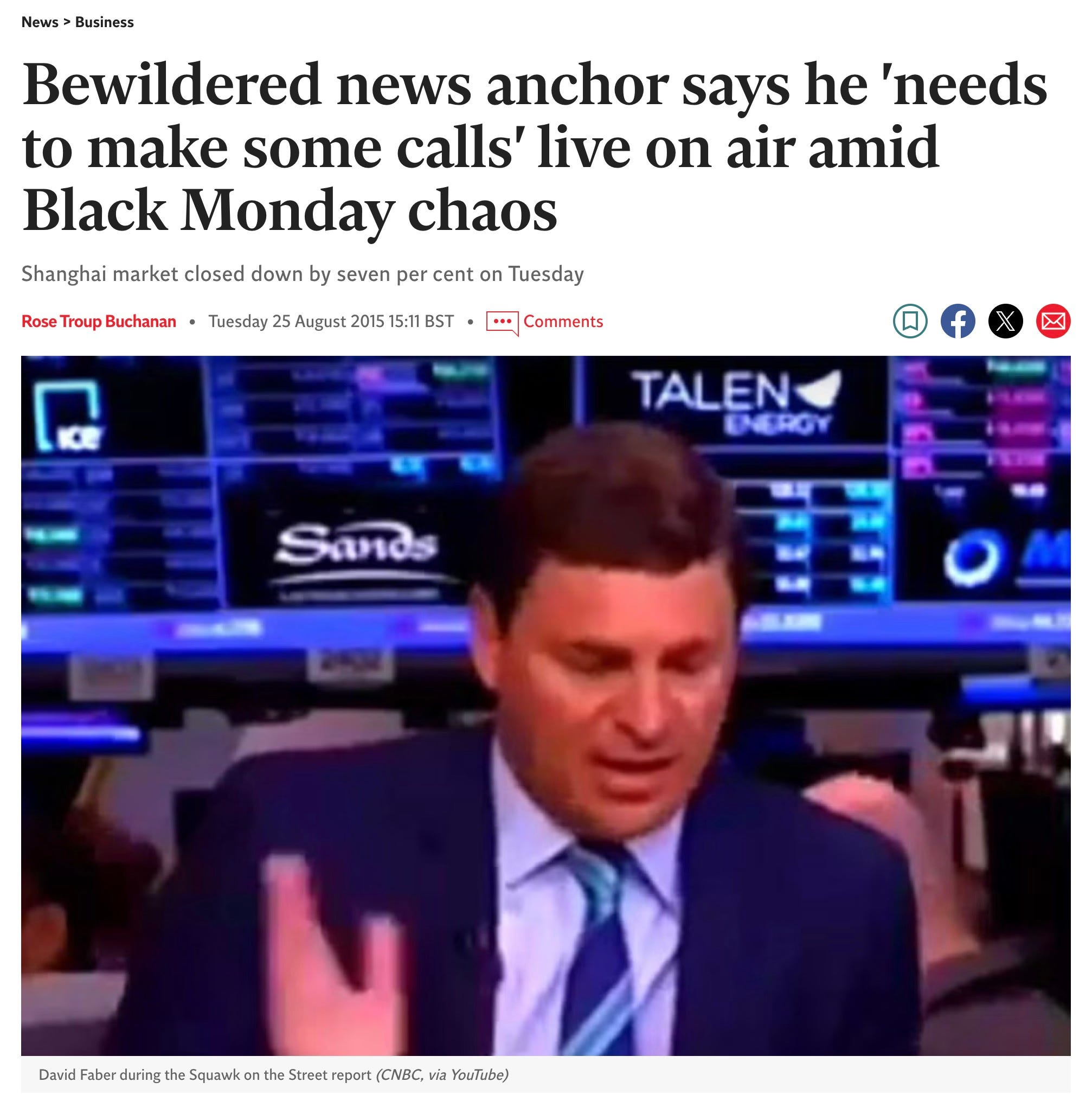
If some recurring guests on CNBC never get invited back or just outright disappear mysteriously, then I’ll start paying attention to psychological sentiment. And when the crowd that has been crowing for you to buy the dips for the last five years has their very own “hell is coming” moment and outright throws their hands up in the air to tell us that everything they’ve ever known about finance and markets has been proven wrong…well, that’ll be the time I’ll start wondering if psychological sentiment has changed.
Of course, I’m being half hyperbolic, but you get the idea. When the “hell is coming” moment happened during Covid, it felt like serious business. It felt like Ackman could be 100% right, and the unknown of the pandemic could actually be the end of the world. Looking back on it now, it’s really easy to say that marked the bottom. Keep this in mind the next time you feel scared shitless about the market in the present moment. Then ask yourself, how will I feel five years from now?
As for me right now, all I have to do is look at a six-month chart or a 12-month chart than NASDAQ as a friendly reminder that this market is still green for most participants that have entered it over the last year. And to me, that doesn’t sound like the kind of environment where capitulation or a bottom, even a temporary one, is taking place.

QTR’s Disclaimer: Please read my full legal disclaimer https://quoththeraven.substack.com/about
with my best effort to uphold what the license asks, or with the permission of the author.
This is not a recommendation to buy or sell any stocks or securities, just my opinions. I often lose money on positions I trade/invest in. I may add any name mentioned in this article and sell any name mentioned in this piece at any time, without further warning. None of this is a solicitation to buy or sell securities. I may or may not own names I write about and are watching. Sometimes I’m bullish without owning things, sometimes I’m bearish and do own things. Just assume my positions could be exactly the opposite of what you think they are just in case. If I’m long I could quickly be short and vice versa. I won’t update my positions. All positions can change immediately as soon as I publish this, with or without notice and at any point I can be long, short or neutral on any position. You are on your own. Do not make decisions based on my blog. I exist on the fringe. Assume any and all numbers in this piece are wrong and make sure you check them yourself. The publisher does not guarantee the accuracy or completeness of the information provided in this page. These are not the opinions of any of my employers, partners, or associates. I did my best to be honest about my disclosures but can’t guarantee I am right; I write these posts after a couple beers sometimes. I edit after my posts are published because I’m impatient and lazy, so if you see a typo, check back in a half hour. Also, I just straight up get shit wrong a lot. I mention it twice because it’s that important.
https://cms.zerohedge.com/users/tyler-durden
Thu, 03/13/2025 - 08:05
AI Data Center Build-Out Raises Concerns About America's Future Power Needs
AI Data Center Build-Out Raises Concerns About America's Future Power Needs
,
As the United States prepares to invest billions of dollars in artificial intelligence (AI) infrastructure, public officials, grid operators, and utility companies are addressing concerns about how the nation’s electricity grid will handle the expected surge in power usage.
 ?itok=Kl5QQhFb
According to a recent S&P Global Market Intelligence https://pages.marketintelligence.spglobal.com/Datacenter-renewables-US-Datacenter-and-Energy-Report-MS.html
forecasts total energy consumption by data centers to reach between 325 TWh and 580 TWh by 2028, potentially as much as 12 percent of total U.S. electricity.
In a March 10 research note shared with The Epoch Times, Bank of America sustainability analyst Dimple Gosai said Big Tech firms have committed more than $315 billion in capital investment for AI data centers this year. Those new projects will drive 50 GW of power demand by 2030.
“The push for 24/7 firm power has intensified as AI-driven data center growth amplifies grid stability and curtailment concerns, accelerating demand for dispatchable power,” Gosai said.
The most significant impetus behind the discussion on AI data centers and power grid infrastructure is President Donald Trump’s https://www.whitehouse.gov/presidential-actions/2025/01/removing-barriers-to-american-leadership-in-artificial-intelligence/
on Jan. 23, calling for a multi-billion dollar build-out in AI and data center capacity during his second term in office.
As part of the president’s action plan, the National Science Foundation https://www.federalregister.gov/documents/2025/02/06/2025-02305/request-for-information-on-the-development-of-an-artificial-intelligence-ai-action-plan
a request for information on Feb. 6 seeking input on federal policy recommendations “to sustain America’s AI dominance.” The plan has received 268 public comments on the Federal Register docket, with the comment period set to close on March 15.
Maksim Sonin, a Houston-based energy expert and Stanford University fellow, said power generation, grid infrastructure construction, and regulatory barriers are among the substantial obstacles facing data center development at scale. “A strategy for effective public-private partnerships can definitely help with federal policy development to bolster AI innovation,” he told The Epoch Times via email.
In Arkansas, Trump’s former press secretary, Gov. Sarah Sanders, is already working to pass legislation allowing public and private partners to get speedier approval for financing and strategic investments to upgrade and build utility-scale power projects, ranging from solar arrays to modular nuclear reactors.
On Feb. 25, the Sanders-backed https://arkleg.state.ar.us/Bills/Detail?id=sb307&ddBienniumSession=2025%2F2025R&Search=
fell one vote short of being approved in the Arkansas Senate. However, the governor said she still fully supports the 62-page bill, which utility giant Entergy Corp., the parent company of utility subsidiaries in Arkansas, Louisiana, Mississippi, and Texas, also backs.
“I meet with companies all the time and one of the number one topics they bring up is the need for affordable, reliable energy,” Sanders said in a statement provided to The Epoch Times.
“This legislation helps us keep the Natural State competitive by investing in our energy infrastructure and maintaining our reputation as a national leader in energy reliability and affordability while still maintaining the (state) regulatory authority.”
Although SB 307 has stalled, Silicon Valley tech giants Amazon.com Inc., Microsoft Corp., Google LLC, Meta Platforms Inc., OpenAI, and Elon Musk’s xAI have announced plans for so-called hyperscaler data centers in surrounding states that consume massive amounts of power.
For example, OpenAI, Oracle, MGX, and Softbank announced the Trump-endorsed https://www.theepochtimes.com/us/trump-announces-500-billion-investment-to-build-ai-infrastructure-5796524
on Jan. 21. This new venture intends to invest $500 billion over the next four years to build new AI infrastructure in Abilene, Texas. Arm, Microsoft, NVIDIA, and Oracle are the other key initial technology partners that will immediately deploy an initial $100 billion investment.
Elon Musk, who https://www.theepochtimes.com/business/elon-musk-leads-97-4-billion-bid-to-take-over-openai-5807593
a $97.4 billion bid to take over OpenAI in February, is also rapidly expanding xAI’s $6 billion Colossus supercomputer in Memphis, Tenn., which is located just across the Mississippi River from the Arkansas state line.
Last week, the Greater Memphis Chamber https://memphischamber.com/blog/press-release/expansion-follows-december-announcement-of-supercomputer-growth-and-tech-partnership-ecosystem/
it was purchasing a one-million-square-foot property in southwest Memphis to expand xAI’s existing operations and support the company’s growing presence as the Digital Delta hub, attracting other major AI tech partners such as NVIDIA, Dell, and Supermicro Computer.
The ongoing Memphis expansion pursued by xAI will incorporate a minimum of one million graphics processing units, making it one of the largest supercomputers in the world. The site also features the world’s largest Tesla Megapack deployment for supercomputing and data center operations and plans for an $80 million water recycling plant that will process 13 million gallons of water daily to cool the Colossus.
To power the facility, the Tennessee Valley Authority approved a pact in November 2024 to supply the xAI supercomputer with 150 megawatts (MW) of electricity, enough to power 100,000 homes. At full capacity, Colossus will need 300 MW of electricity to power X’s Grok chatbot feature on the social media platform.
About 250 miles south of the xAI in Memphis, Meta https://arkansasdeltainformer.com/metas-superproject-in-louisiana-could-draw-arkansas-workers-across-stateline/
in December 2024 that it is building a monumental $10 billion AI data center project in Richland Parish, Louisiana, calling it “a transformational investment that cements the state’s status as a major innovation hub and leader in the global digital revolution.”
The 4-million-square-foot data center, located an hour from the Arkansas state line, will be Meta’s largest AI center worldwide. Construction on the facility at the 2,250-acre site is expected to continue through 2030. Once operational, the northeast Louisiana data center will support Meta’s AI workloads and other advanced technologies, including Facebook, Messenger, Instagram, WhatsApp, and Threads.
Meta and Louisiana economic development officials are working with Entergy to bring at least 1,500 MW of new renewable energy to the grid to support the AI supercenter. Meta has pledged to match its electricity use with 100 percent renewable energy. However, Entergy plans to shutter its aging White Bluff and Independence coal-fired plants by the end of 2030 under a federally approved https://www.npca.org/articles/2858-agreement-to-close-entergy-s-polluting-power-plants-is-finalized
.
In early February, Nashville-based Silicon Ranch https://clearloop.us/2025/02/25/clearloop-announces-multi-year-agreement-with-microsoft/?utm_source=chatgpt.com
a new multi-year agreement with Microsoft to deploy up to 100 MW of renewable energy projects in the Arkansas, Mississippi, and Louisiana Delta region over the next three years.
The first four solar projects in the multi-year pact with the Silicon Valley technology giant are set to break ground over the next few months. They will be operational by the end of 2025 in communities across Arkansas and Louisiana.
In response to questions from The Epoch Times about mounting concerns over AI data centers’ impact on the nation’s disconnected electricity transmission system, the nation’s largest grid operator said it recently updated its long-term forecast on future load growth that highlights the “anticipated AI revolution.”
Based in Carmel, Indiana, the Midcontinent Independent System Operator (MISO) oversees electricity transmission across Arkansas and 14 U.S. states, including the Entergy footprint. MISO spokesman Brandon Morris told the Epoch Times via email that besides revising its long-term forecast, the 15-state grid operator is also redesigning its scenario plan to assess regional capacity expansion needs for the next 20 years.
“MISO does not have a specific number, but data centers have been identified as a significant contributor to the anticipated electricity demand growth in the U.S.,” Morris said.
https://cms.zerohedge.com/users/tyler-durden
Wed, 03/12/2025 - 14:00
Core Consumer Price Inflation Slowest In 4 Years As Energy Costs Tumble
Core Consumer Price Inflation Slowest In 4 Years As Energy Costs Tumble
With four times as many data points skewing towards higher February consumer prices than lower ones, whisper numbers into this morning's CPI print (expected to rise 0.3% MoM) were to the upside. However, headline and core CPI both printed below expectations (+0.2% MoM) which dragged the headline CPI down to +2.8% YoY...
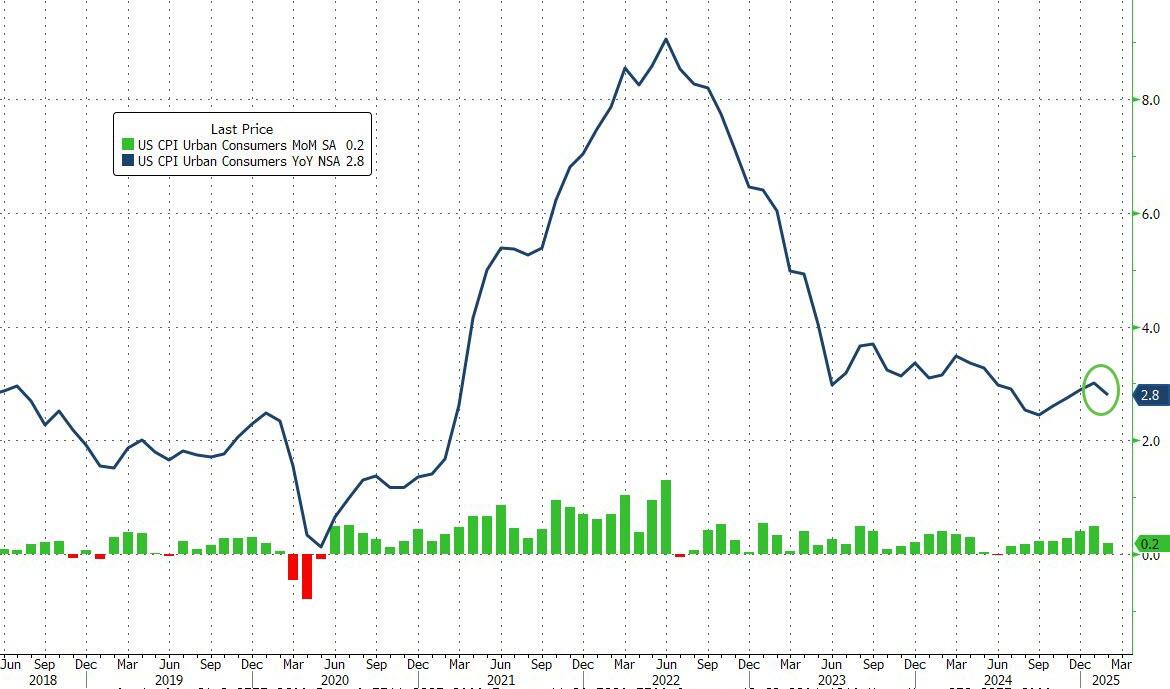 ?itok=BYkpYcsn
Source: Bloomberg
CPI Highlights:
The index for shelter rose 0.3 percent in February, accounting for nearly half of the monthly all items increase. The shelter increase was partially offset by a 4.0-percent decrease in the index for airline fares and a 1.0-percent decline in the index for gasoline.
Despite the decrease in the gasoline index, the energy index rose 0.2 percent over the month as the indexes for electricity and natural gas increased. The index for food also increased in February, rising 0.2 percent as the index for food away from home increased 0.4 percent. The food at home index was unchanged over the month.
The index for all items less food and energy rose 0.2% in February, following a 0.4% increase in January. Indexes that increased over the month include medical care, used cars and trucks, household furnishings and operations, recreation, apparel, and personal care. The indexes for airline fares and new vehicles were among the few major indexes that decreased in February.
The miss also pulled Core CPI YoY down to +3.1% - its lowest since April 2021
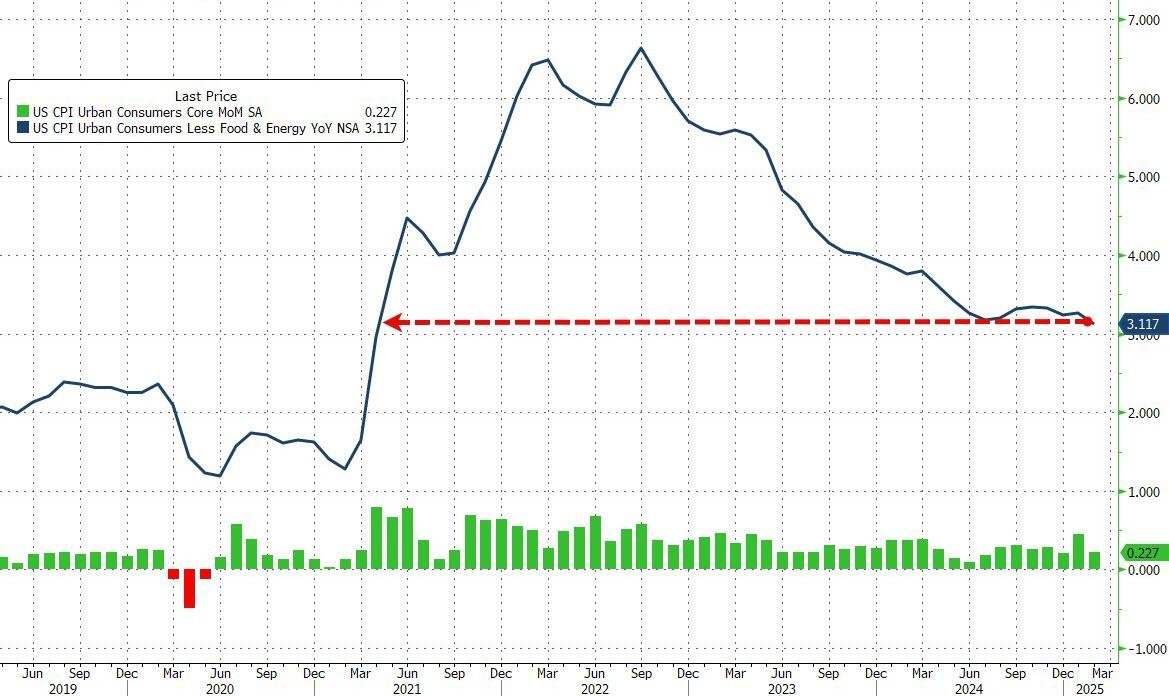 ?itok=ZamxNB1n
Source: Bloomberg
Core CPI Details:
The shelter index increased 0.3 percent over the month.
The index for owners’ equivalent rent rose 0.3 percent in February, as did the index for rent.
The lodging away from home index increased 0.2 percent in February.
The medical care index increased 0.3 percent over the month. The index for physicians’ services increased 0.4 percent in February and the index for hospital services rose 0.1 percent over the month.
The prescription drugs index was unchanged in February
The used cars and trucks index rose 0.9 percent in February.
The index for new vehicles also declined over the month, falling 0.1 percent.
The index for household furnishings and operations rose 0.4 percent over the month and the index for recreation increased 0.3 percent.
Other indexes that increased in February include apparel, personal care, and motor vehicle insurance. In contrast, the index for airline fares fell 4.0 percent in February, after rising 1.2 percent in January.
Goods 'inflation' is basically negligible currently while Services cost inflation is continuing to fall rapidly...
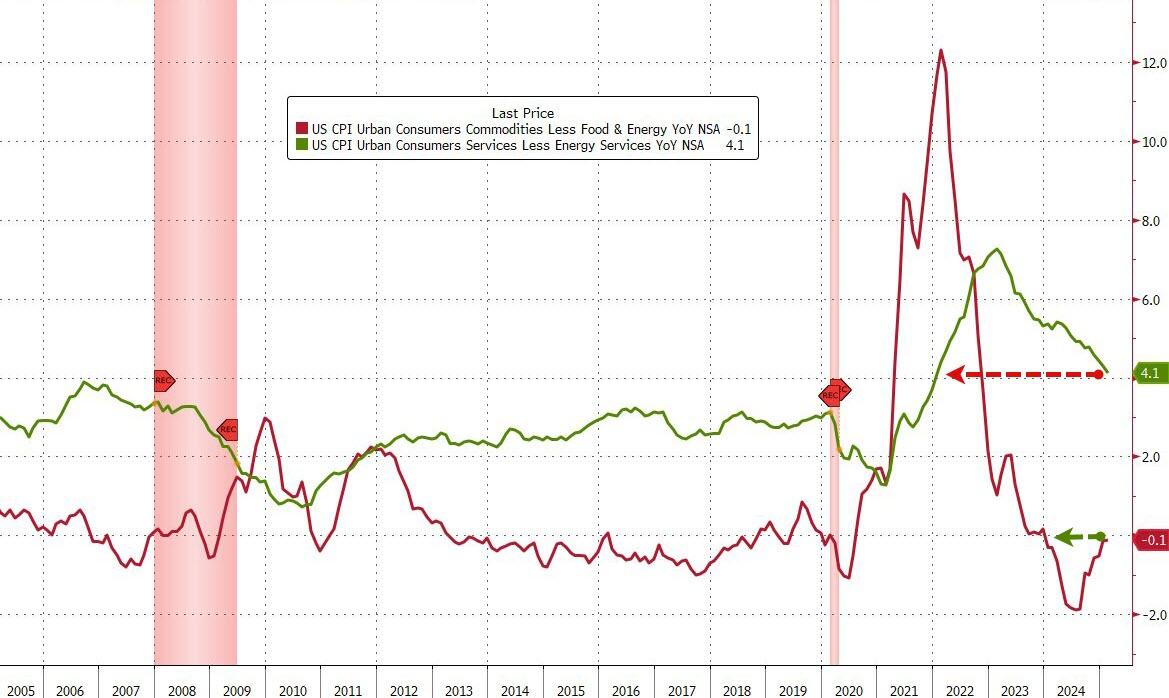 ?itok=HAPZzyOC
Source: Bloomberg
Energy and Transportation costs are tumbling (Drill baby drill?)
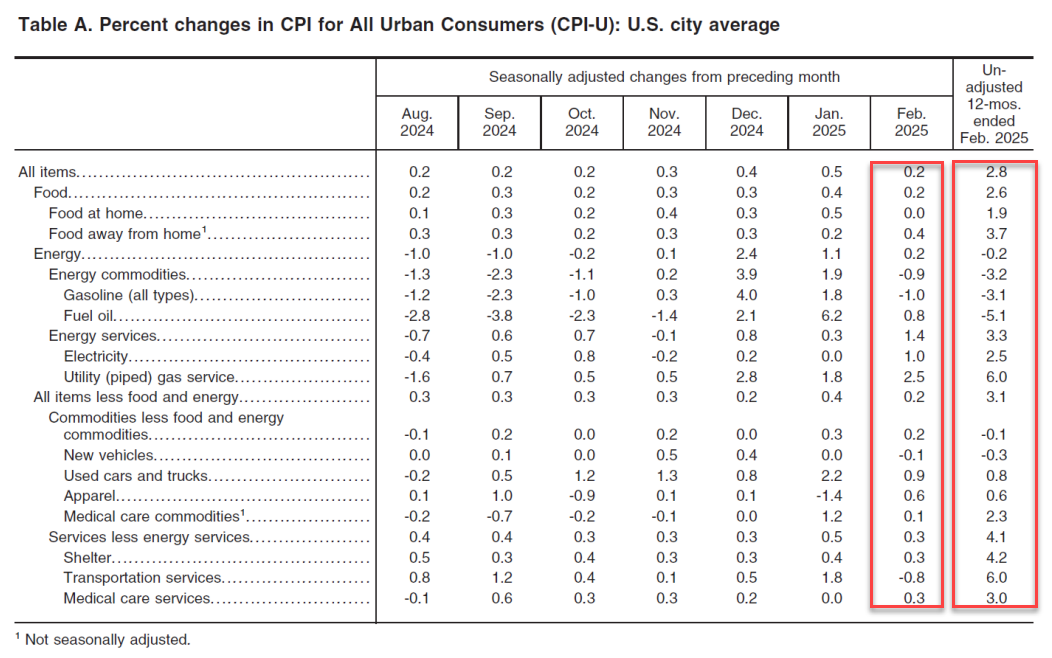 ?itok=kirwBjiZ
The so-called SuperCore CPI (Services ex-Shelter) also fell to its slowest rate since Oct 2023...
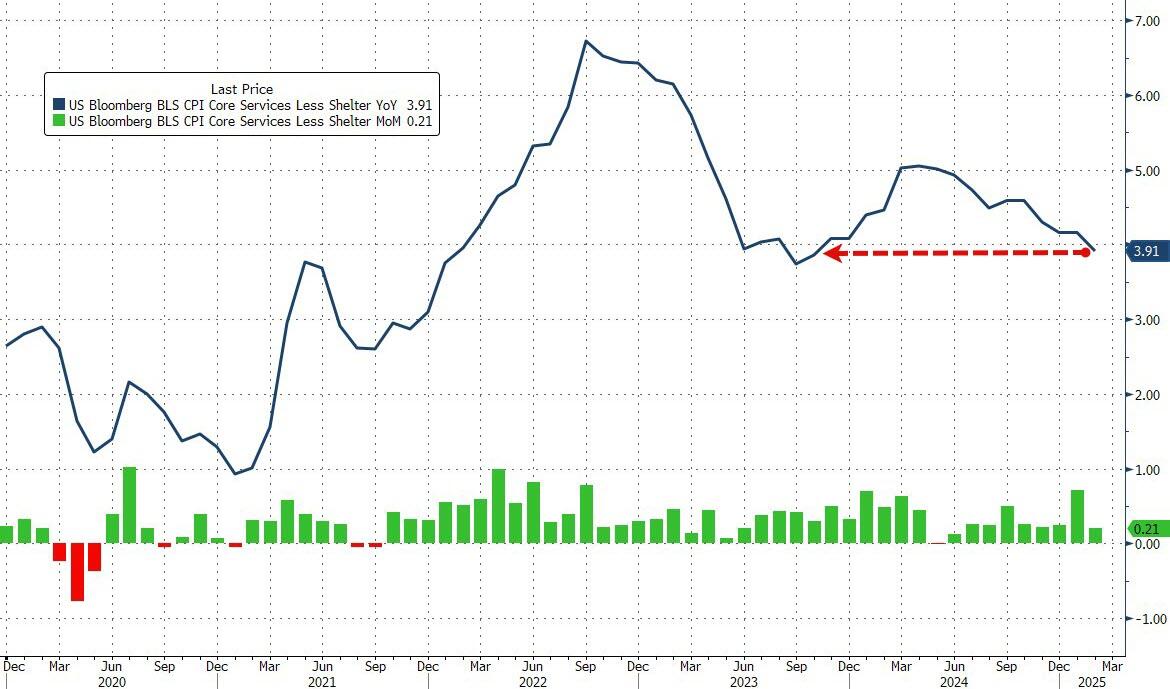 ?itok=96rEHn_W
Source: Bloomberg
So what happens next?
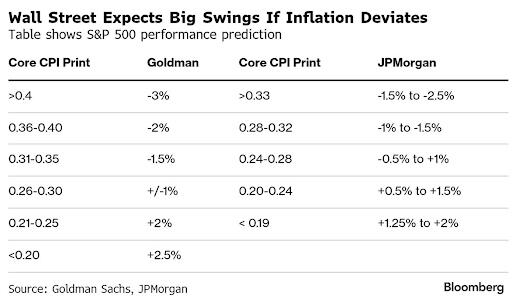 ?itok=FYKTDFwf
Is this just the ammo needed to spark a huge short squeeze higher?
https://cms.zerohedge.com/users/tyler-durden
Wed, 03/12/2025 - 08:38
Markets Need A Benign Inflation Print For Relief
Markets Need A Benign Inflation Print For Relief
By Michael Msika and Jan-Patrick Barnert, Bloomberg markets live reporters and strategists
Markets are facing an episode of de-risking that started in the US and is now feeding into Europe. While an improving geopolitical landscape is helping lift sentiment, investors are worried about growth and will be looking for more relief in economic data.
Ukraine accepted a US proposal for a 30-day truce with Russia, but the focus is also still on tariffs. The trade war escalated overnight after President Donald Trump’s 25% tariffs on steel and aluminum imports took effect, prompting a response from the European Union.
Tariff headlines have been the big market driver, and will end up becoming intertwined with economic figures. The potential impact on growth has already pushed investors to lower risk and diversify portfolios. While Europe is outperforming, the US selloff is dragging on global stocks, and the market is hoping to find comfort in lower US inflation later today. Any respite might be temporary.
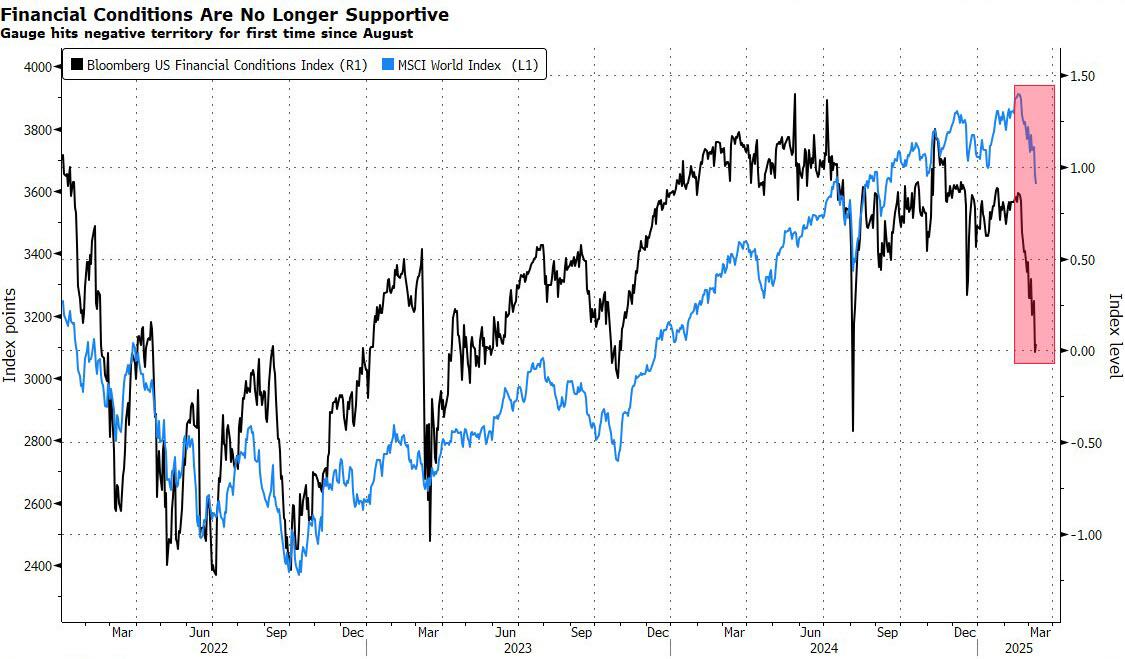 ?itok=S0vyWs7y
“We may see a relief rally this week, especially if the inflation data prints dovishly,” say JPMorgan Market Intelligence analysts led by Andrew Tyler. They see tariffs and trade wars as unambiguously negative for the US, and say the trade uncertainty is already having a negative impact on consumption, capex, sentiment and ultimately economic growth. “We would fade that rally.”
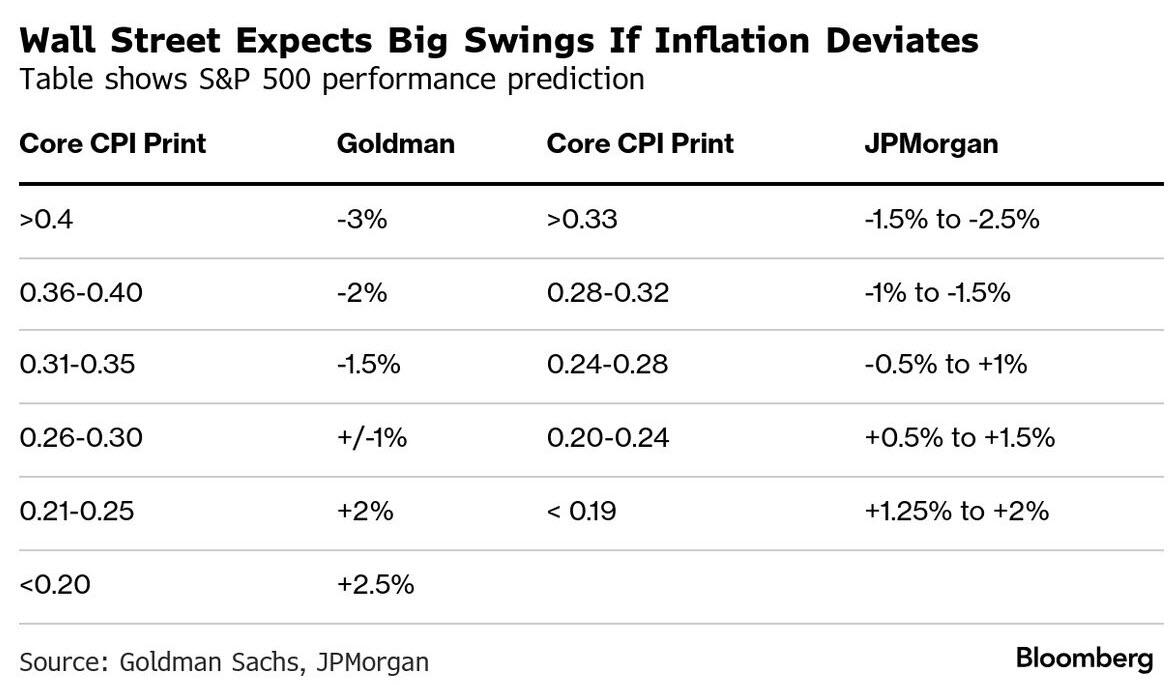 ?itok=KPkycTyD
Economists have started to cut their outlook for US economic growth, and this trend may continue until they get a better sense of the impact from trade and fiscal policies. The executive order that President Donald Trump is using to apply tariffs to China, Canada and Mexico has an escalation clause that is designed to kick in automatically in the event a country retaliates.
With US government funding due to run out at the end of the week, a shutdown is another potential negative event for sentiment. Recession fears are now mounting. Job cut plans jumped the most on record outside a recession in February, doubling from last year, in figures that sparked market volatility. While the federal government was responsible for the largest share, it remains to be seen whether the private sector will absorb workers. JOLTs figures out yesterday showed some resilience in the labor market, with openings rising in January and layoffs falling.
The overall narrative change from Trump running the economy hot to Trump stalling it into recession is producing some colorful language on trading desks. Goldman Sachs’s head of Americas execution services John Flood says that with investors on the edge of their seats, “zero offense” is being played and “PnL destruction” over the last few weeks has been real.
Meanwhile Nomura’s Charlie McElligott sees Trump acting as a “Gamma Agent,” a term usually applied to the flows of option desks that can fuel markets in a specific direction. The US administration’s remarks are “effectively the same phenomenon as introducing a sudden volatility catalyst or tail surprise,” he says.
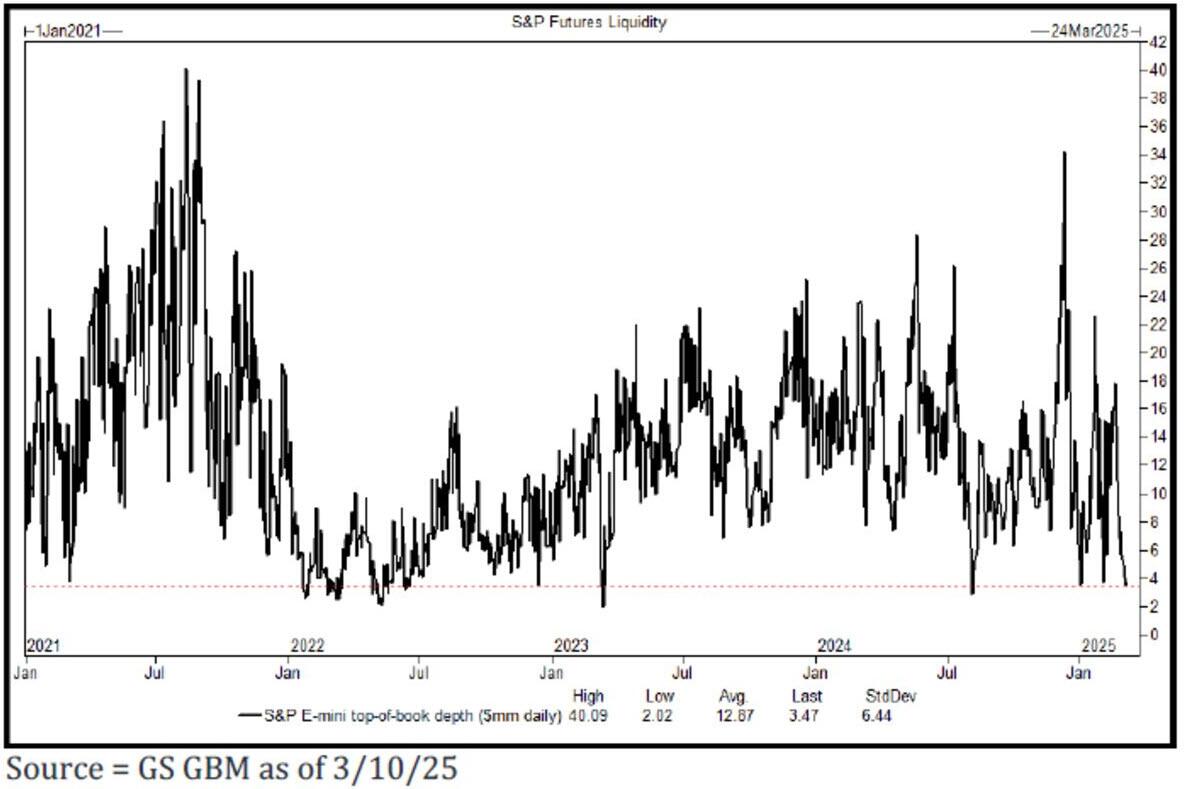 ?itok=lkuMf0Ao
All this is leading to positioning being washed out. Fast money CTAs have been offloading stocks at pace and are likely to continue to do so, according to market specialists at UBS and Goldman Sachs. They are modeling CTAs to be sellers of stocks this week in any scenario. The cleansing of portfolios is also having a bigger impact on stocks as liquidity is suffering a meltdown. Goldman Sachs traders note that S&P 500 top of book liquidity — the aggregated best bid and best offer — ticked below $4 million Monday, only around one-third of the average since 2021.
The next worry will be what asset managers are doing. “Our conversations this week suggest that asset managers are still selling futures as they are concerned about (1) growth impact of tariff discussions, and (2) lack of monetary policy tailwinds,” says Goldman Sachs’s head of derivatives research John Marshall. “We continue to watch this flow carefully as asset allocation shifts within this cohort of investor tend to take time.”
https://cms.zerohedge.com/users/tyler-durden
Wed, 03/12/2025 - 08:29
https://www.zerohedge.com/markets/markets-need-benign-inflation-print-relief
Futures, Yields, Dollar All Jump Ahead Of Key CPI Report
Futures, Yields, Dollar All Jump Ahead Of Key CPI Report
US equity futures are higher into today's CPI print with tech outperforming, as the rout that gripped markets in the past two weeks receded after https://finance.yahoo.com/news/trump-says-doubling-tariffs-canadian-142100812.html
the risk of a tariff-led recession. An acceleration of the Trade War is not impacting global Equities. As of 8:00am ET, S&P futures are up 0.9%, at session highs while Nasdaq futures rise 1.1%, with all Mag7 higher pre market (ex-AAPL, same pattern as yesterday). Bond yields are also higher by 1bp as German 10Y rates hit the highest since 2023; the USD is also rising as the euro and yen slide. Commodities are stronger led by Energy and Metals with Ags under pressure. The macro data focus is on CPI where the whisper number appears to be below the BBG consensus (0.3% MoM for core/headline; 3.2%/2.9% YoY for core/headline) but the print is important to shape the market narrative with a hotter print producing stagflation worries while propping up the USD, and a cooler print likely to assuage recent econ concerns.
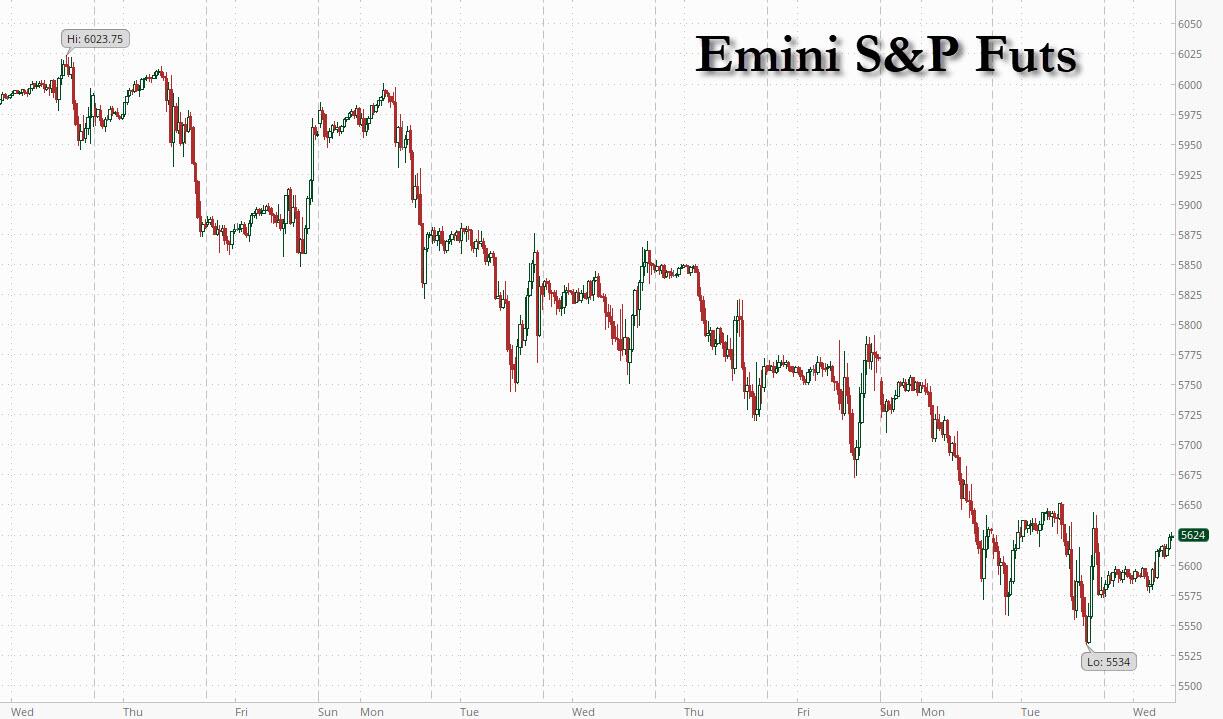 ?itok=It-dhAdw
In premarket trading, Nvidia, Palantir and Tesla were roughly 3% higher with most Mag7 names rebounding (Alphabet +0.9%, Amazon +0.8%, Apple -0.06%, Microsoft +0.6%, Meta +1.2%, Nvidia +2% and Tesla +3.4%). Intel surged 8% after Reuters reported that TSMC has pitched Nvidia, Advanced Micro Devices and Broadcom about taking stakes in a joint venture that would operate the chipmaker’s factories. Here are some other notable premarket movers:
EW Scripps rises 21% after the TV broadcasting company announced a deal to refinance its debt. The company also reported fourth-quarter revenue that beat expectations.
Groupon jumps 20% after the online coupon company gave a revenue forecast for 2025 that beat the average analyst estimate.
IRobot falls 21% after the robot vacuum company reported 4Q revenue that missed the average analyst estimate. The board has initiated a review of strategic slternatives.
LoanDepot slips 12% after the lender reported revenue for the fourth quarter that missed the average analyst estimate.
Myriad Genetics climbs 4% after the genetic testing company is upgraded to overweight at Piper Sandler on potential for a change in strategic direction.
Stitch Fix rallies 18% after the personal styling platform boosted its full year revenue forecast.
Rocket Pharmaceuticals rises 3% after BMO Capital Markets initiated coverage at outperform and set a price target more than six times above where the shares last closed, citing the likely life-long effect of the company’s gene therapies.
Some investors pointed to sentiment improving after President Donald Trump said he doesn’t see a US economic recession, as well as Ukraine’s decision to accept a US proposal for a 30-day truce with Russia. At the White House late Tuesday, Trump struck a more upbeat note when asked if he was worried about a downturn. “I don’t see it at all. I think this country’s going to boom,” he said. And he played down the markets slump, too. They’re “going to go up and they’re going to go down,” Trump said. “Doesn’t concern me.”
Meanwhile, US tariffs on steel and aluminum imports came into force Wednesday, extending the trade wars to more of the country’s top trading partners. The European Union launched countermeasures, with plans to impose its own duties on up to €26 billion ($28.3 billion) worth of American goods.
Besides the trade war, all eyes are also on the US CPI report, with economists polled by Bloomberg expecting an increase of 0.3% in February, versus the previous month’s 0.5% rise (https://www.zerohedge.com/markets/answer-top-question-goldmans-trading-floor-what-breaks-credit
). While the Federal Reserve is not expected to cut interest rates at next week’s policy meeting, a softer print should reassure investors who have been on edge over the inflation trajectory, particularly in light of brewing trade wars.
“Things are generally looking a little bit better on the inflation front in the United States and if today’s number is benign it will be good to see,” said Guy Miller, chief market strategist at Zurich Insurance Co.
Meanwhile, Goldman Sachs lowered its target for the S&P 500 Index to 6,200 from 6,500, in view of declines in the “Magnificent 7” stocks. That still sees the market rising 11% versus Tuesday’s close. “Our revised estimates reflect the recently reduced GDP growth forecast of our US economics team, a higher assumed tariff rate, and higher level of uncertainty that is typically associated with a greater equity risk premium,” strategists including David Kostin and Jenny Ma wrote in a note dated Tuesday.
In Europe, the Stoxx 600 rises 0.8% and is on course to snap a four-day losing streak, led by construction, chemical and industrial shares. The retail sector was the worst performer, trading at the lowest level since August, dragged down by Zara owner Inditex SA, which reported slowing sales. Ukraine’s decision to accept a US proposal for a 30-day truce with Russia has helped underpin broader risk sentiment, as did upbeat remarks from President Donald Trump on US economic prospects. That offset trade concerns as US tariffs on steel and aluminum came into force, prompting countermeasures from the EU. Here are some of the biggest movers on Wednesday:
Zealand Pharma shares soar as much as 48% in Copenhagen, the most on record, following its pact with Roche to co-develop and co-commercialize the Danish company’s experimental obesity drug petrelintide.
Cucinelli shares rise as much as 3.9% after the luxury goods stock was initiated with an overweight rating at Morgan Stanley, which cited the resilience of the Italian firm’s business model against a backdrop of macro uncertainty.
Rheinmetall shares rise as much as 9.3% after the German maker of tanks and armored vehicles forecast sales and operating profit will continue to rise this year, boosted by increased defense spending in Europe. The firm’s operating margin forecast for 2025 missed estimates, however.
Hill & Smith shares rise as much as 15%, the most in over three years, after the maker of products for the construction and infrastructure markets beat earnings expectations in 2024.
Hochschild shares rise as much as 17% after the miner reintroduced its first dividend since 2022 as it reported a significant improvement in 2024 earnings, according to analysts at RBC.
Puma shares drop as much as 27%, the most on record, after the sportswear maker gave a disappointing outlook, citing trade disputes and currency volatility.
Inditex shares fall as much as 8.9%, the most in three years, after the owner of Zara reported trading in the first quarter-to-date which was softer than analysts expected, offsetting a 4Q EBIT beat.
Porsche shares fall as much as 5.2% after the luxury carmaker lowered its medium term targets due, according to JPMorgan, to China and higher investments.
Defense stocks decline after US and Ukrainian negotiators reached an accord for a 30-day halt in the conflict in Ukraine.
Basic-Fit shares fall as much as 16%, its largest drop since 2022, after the fitness club company reported results and a FY25 outlook that missed expectations.
Earlier in the session, Asian stocks were mixed after a three-day selloff as investors sought to assess the economic impact of US President Donald Trump’s latest tariff moves. The MSCI Asia Pacific Index was little changed after swinging between a gain of 0.4% and a loss of 0.3%. While key gauges in South Korea, Taiwan and Japan advanced, Australia’s mining-heavy stock benchmark fell as the nation failed to secure an exemption from US steel and aluminum tariffs. Malaysia’s benchmark equity index slumped into a technical correction, partly triggered by foreign investors selling the nation’s stocks. Asia’s equity gauge pared an intraday decline after Trump sought to reassure a business roundtable over the outlook for the US economy and the steps he’s taking to boost growth. His comments followed another selloff in US equities on Tuesday. However, selling pressure resurfaced, with Chinese tech stocks falling near the end of the Hong Kong trading session to drag the MSCI Asia gauge lower.
In FX, the Bloomberg Dollar Spot Index rises 0.2%. The yen underperforms its G-10 peers, falling 0.6% against the greenback after the Trump’s administration hit out at Japan’s https://www.bloomberg.com/news/articles/2025-03-12/us-lambasts-japan-s-700-rice-tariff-hinting-at-levy-target
, raising concern that the country may be next in line for US levies. EUR/USD fell as much as 0.3% to 1.0888, pulling off the five-month peak touched earlier this week. “I think it’s time for some consolidation in the euro’s rally, which has affected the DXY index significantly,” said Alvin Tan, head of Asia foreign-exchange strategy at RBC in Singapore.
In rates, Treasury futures are down in early US session after small Asia-session gains were erased during London morning. US 10-year yields are higher by 2bps at 4.30%; Bunds lead a selloff in European government bonds, with German 10-year yields rising 3 bps to 2.92% the highest since 2023. Downside pressure stems from bund selloff following European Union’s countermeasures against US metals tariffs. Germany’s 10-year yield is getting closer to the 3% milestone as investors brace for a historic surge in spending and borrowing. Focal points of US session focus include February CPI data and 10-year note reopening. This week’s Treasury auction cycle continues with $39 billion 10-year at 1pm New York time and concludes Thursday with $22b 30-year reopening; demand was soft for Tuesday’s 3-year new-issue auction, which tailed by 0.6bp
In commodities, oil prices advance, with WTI rising over 1% to $67 a barrel. Spot gold is steady near $2,915/oz. Bitcoin falls 0.6% to around $82,200.
Today's economic data calendar includes MBA Mortgage Applications (up 11.2%, vs 20.4% last month). February CPI (8:30am) and Federal budget balance (2pm). Fed officials are in external communications blackout ahead of March 19 policy announcement
Market Snapshot
S&P 500 futures up 0.3% to 5,593.25
STOXX Europe 600 up 0.5% to 539.74
MXAP little changed at 185.03
MXAPJ down 0.1% to 580.17
Nikkei little changed at 36,819.09
Topix up 0.9% to 2,694.91
Hang Seng Index down 0.8% to 23,600.31
Shanghai Composite down 0.2% to 3,371.92
Sensex down 0.3% to 73,892.58
Australia S&P/ASX 200 down 1.3% to 7,786.24
Kospi up 1.5% to 2,574.82
German 10Y yield little changed at 2.91%
Euro little changed at $1.0909
Brent Futures up 0.6% to $69.99/bbl
Brent Futures up 0.6% to $69.97/bbl
Gold spot up 0.1% to $2,918.63
US Dollar Index up 0.13% to 103.55
Top Overnight News
Trump posted "The price of eggs have come down, interest rates have come down, gasoline prices have come down—It's all coming down! We're doing it the right way, and I have tremendous confidence in this Country and in the people of this Country…", via Truth Social.
Trump's administration is considering cutting the size of the Justice Department's public corruption unit.
The Department of Education said it initiated a reduction in force impacting nearly 50% of the department's workforce with impacted staff to be placed on administrative leave beginning March 21st.
Commerce Secretary Howard Lutnick said Tuesday that President Trump’s tariff policies will be worth it, even if the economy ends up in a recession. The Hill
Elon Musk has signalled to President Trump’s advisers in recent days that he wants to put $100mln into groups controlled by the Trump political operation, according to NYT.
US House passed the spending bill to avert a government shutdown and sent it to the Senate.
Senior US Democrats believe a government shutdown would be a lose-lose scenario, they are exploring alternative strategies to prevent this perception while avoiding accusations of supporting the President: Punchbowl.
Active funds continued to sell shares in the MSCI China Index despite its 12% gain last month, a sign of skepticism about the outlook. BBG
Beijing summoned Walmart execs to express concern after the company reportedly urged Chinese suppliers to absorb higher costs from US tariffs. Such demands, if true, would be bad for its operations in China, state-affiliated media wrote. BBG
Many of Japan's biggest companies from tech conglomerates to Toyota, have met union demands for substantial wage hikes for a third consecutive year, seeking to help workers cope with inflation and retain staff amid labor shortages. RTRS
The Kremlin said on Wednesday it needed to be briefed by the United States on the outcome of U.S.-Ukrainian talks in Saudi Arabia before it would comment on whether a proposed ceasefire was acceptable to Russia. RTRS
Europe retaliates against the US for Trump’s 25% steel/aluminum tariffs, imposing its own duties on American imports worth EU26B (including bourbon and whisky, jeans, and Harley-Davidson bikes), w/additional actions set to arrive next months. FT, WSJ
The UK split with the EU over retaliatory tariffs even as 25% levies on foreign metals came into effect, reaffirming its commitments to US trade talks. BBG
TSMC has proposed a deal to AMD, Broadcom, Nvidia, and Qualcomm about a joint venture that would operate Intel’s chip factories (TSMC would run the facilities but own no more than 50%). RTRS
Tariffs/Trade
US President Trump's 25% tariffs on steel and aluminium took effect with no exemptions.
US President Trump separately commented that tariffs are having and will have a tremendously positive impact, while he also suggested tariffs may go higher than 25% but did not specify which tariffs.
Senior EU Official says confirms it is monitoring to see if Chinese steel overcapacity is re-routed to Europe, and "we stand ready to take measures where we need to take those measures", via SCMP's Birmingham. "We may indeed have to take further measures to deal with this indirect consequence of the US tariffs."
Canada's Energy Minister said at CERAWeek that Canada may implement non-tariff measures such as restricting oil exports if the trade war with the US escalates and that ethanol is absolutely on the list of potential retaliatory tariffs being considered. Canada's Energy Minister also said Canada will respond shortly if tariffs come into play and will wait and see on tariffs, as well as noted that Canada does not want to provoke or escalate and seeks a positive outcome.
EU Commission launched countermeasures on US imports in which it will allow the suspension of existing 2018 and 2020 countermeasures against the US to lapse on April 1st, while it is putting forward a package of new countermeasures on US exports. Furthermore, it stated that EU countermeasures could apply to US goods exports worth up to EUR 26bln to match the economic scope of the US tariffs but added the EU remains ready to work with the US administration to find a negotiated solution.
French European Affairs Minister Haddad says, on EU's response to Trump tariffs, "we can go further"; reaffirms trade war is in no one's interest. Thereafter, EU Commission President von der Leyen says countermeasures will match the scope of US tariffs and will be entirely in place by April 13th.
UK Business and Trade Secretary Reynolds said it is disappointing the US has imposed global tariffs on steel and aluminium, while he stated that negotiations are ongoing for a wider economic agreement with the US to eliminate additional tariffs.
Australian PM Albanese reiterated they will not impose reciprocal tariffs on the US and will continue to engage with the US on tariffs.
A more detailed look at global markets courtesy of Newsquawk
APAC stocks traded mixed following the choppy performance stateside where the focus was centred on tariff rhetoric and Ukraine ceasefire talks, while the US's 25% tariffs on steel and aluminium took effect overnight. ASX 200 underperformed with firm losses in consumer discretionary, industrials and financials, while risk sentiment was also pressured after Australia failed in its efforts to get an exemption from looming tariffs. Nikkei 225 remained afloat but with price action choppy after mixed PPI and BSI Manufacturing data. Hang Seng and Shanghai Comp were ultimately mixed with the mood indecisive in both the mainland and Hong Kong amid light fresh catalysts although China’s securities regulator recently pledged to consolidate the momentum of market stabilisation.
Top Asian News
BoJ Governor Ueda says very worried about uncertainty regarding overseas economy and prices; underlying inflation still remains below 2%; Ready to conduct bond buying operation nimbly in exceptional cases, when long-term rates make irregular moves.
Hitachi (6501 JT), Toyota (7203 JT) and NEC (6701 JT) agreed to fully meet unions' wage hike demands for 2025, while Nissan (7201 JT), Mitsubishi Electric (6503 JT), Honda (7267 JT), Nippon Steel (5401 JT) and Panasonic (6752 JT) agreed to average monthly wage increases below unions' demands.
Global Times tweets "China’s Ministry of Commerce and other departments summoned Walmart on Tuesday for reportedly requiring some of its Chinese suppliers to slash prices significantly in an attempt to shift the burden of the US tariffs on China".
Bank of Japan officials see several reasons against intervening in the bond market even after benchmark yields hit the highest level since 2008, Bloomberg sources say
European bourses (STOXX 600 +0.8%) are stronger today, and sentiment in the complex improves following the hefty downside seen on Tuesday and as the region reacts to Ukraine ceasefire optimism. European sectors hold a strong positive bias; Construction & Materials tops the pile, whilst Retail is the clear laggard. The latter is pressured by post-earning losses in Inditex (-8.2%, slow start to Q1) and Puma (-24%, very weak 2025 outlook). In terms of key movers today; Zealand Pharma (+25%) opened higher by 45% after it secured a deal with Roche (+3%) to collaborate on obesity drugs; Novo Nordisk (-5%).
Top European News
Portugal's Parliament rejected the motion of confidence in the centre-right government, causing its collapse.
SEB, on the Norges Bank following hot February CPI, writes: "We are still leaning towards a March cut, absent any upside surprises in the Regional Network Report".
ECB's Centeno says the EZ economy remains burdened by higher rates, according to WSJ.
ECB President Lagarde says cannot ensure that inflation will always be at 2% but need to set policy so that it converges towards target. In the event of large shocks, risk grows that inflation becomes more persistent. Need to pay particular attention to anchoring inflation expectations. Cannot provide forward guidance but need to be clear about the reaction function.
ECB's Simkus says the direction of travel hasn't changed, is irrational to commit on future rate decisions; will see if the ECB cuts or pauses in April
FX
DXY spent much of the morning essentially flat, having pared overnight strength as the index initially attempted to make back some of the pressure seen on Tuesday. More recently, it has lifted towards the upper end of a 103.43-71 range. Focus has been on the trade front, whereby US President Trump's 25% tariffs on steel and aluminium took effect with no exemptions, but did cancel 50% tariff on Canada. Furthermore, the EU Commission launched countermeasures on US imports with measures to come into force by April. Tariffs aside, US inflation data will be in focus.
EUR is flat after trading lower in overnight trade, giving back some of the strength seen on the back of news Ukraine ceasefire optimism; currently at the upper end of a 1.0888-1.0923 range. As mentioned above, the EU Commission launched countermeasures on US imports; a senior EU Official suggested more measures may need to be taken place. In terms of EU-China; the Official said the bloc stands ready to take any measures in reference to re-routed Chinese steel, if it leads to overcapacity. In terms of monetary policy, a slew of ECB speakers have appeared at the ECB Watchers Conference, but their remarks had little impact on the Single-Currency.
JPY is the clear underperformer today, with USD/JPY currently just off sessions highs at 148.65; further upside may see a test of the 149.00 mark, and then a recent high at 149.33 thereafter. Today saw commentary via BoJ Governor Ueda who said he is very worried about uncertainty regarding overseas economy and prices; he also noted that the BoJ is ready to conduct bond buying operation nimbly in exceptional cases, when long-term rates make irregular moves.
GBP is essentially flat in what has been a quiet UK-specific session thus far; newsflow unlikely to pick up until Friday's GDP figures. Cable currently at the mid-point of a 1.2914-56 range.
Antipodeans are flat and trade rangebound, with a lack of pertinent newsflow for the region thus far; focus of course has been on trade developments (discussed above).
CAD is steady vs. the USD after a choppy session in which the trade agenda dominated price action. To recap events, US President Trump backed down from his plans to double tariffs on Canadian steel and aluminium imports to 50%. This followed the decision by the Ontario Premier to suspend its electricity surcharge on the US. Nonetheless, 25% tariffs on Canadian steel and aluminium have gone ahead.
PBoC set USD/CNY mid-point at 7.1696 vs exp. 7.2324 (Prev. 7.1741).
Fixed Income
USTs are firmer by a handful of ticks, but do hold a downward bias, in tandem with peers. Currently trading at the bottom end of a 110-26+ to 111-02 range. Focus today has been on the Trump's rollout of the 25% tariffs on steel and aluminium took effect with no exemptions; however, the President did rollback the 50% tariff on Canadian steel/aluminium after Ontario suspended the 25% energy surcharge. Ahead, traders will remain laser focused on the US inflation data; particularly in the context of some of the economic activity woes displayed by data in the past few weeks. Also today, USD 39bln worth of 10yr notes due.
Bunds are in the red, albeit modestly so. Currently trading around the 127.00 mark, in a 126.69-127.14 range. From a yield perspective the German 10yr has topped 2.9%; as a reminder the upside over the past week is attributed to Germany's defence spending plans. As for today the benchmark digests the inflationary implications of the EU tariff countermeasures on Trump’s metal tariffs; elsewhere, there has been a slew of ECB appearances, but with not one member sparking a significant move in German paper. ECB President Lagarde highlighted the need to set policy that it converges towards the 2% target. Ahead, markets await a few more ECB speakers as well as the Bank's Wage Tracker.
Gilts are a little lower, and to a similar magnitude as Bunds; UK-specific newsflow has been light, with the next update out of the region coming on Friday (GDP metrics). Currently in a very tight 91.66-91.90 range. Some modest pressure was seen following the 2035 Gilt auction; b/c was strong (though just shy of the 3x mark), whilst the yield tail was a little high.
UK sells GBP 4bln 4.5% 2035 Gilt: b/c 2.92x, average yield 4.679%, and yield tail 0.5bps.
Germany sells EUR 3.455bln vs exp. EUR 4.5bln 2.5% 2035 Bund: b/c 2.1x (prev. 2.8x), average yield 2.92% (prev. 2.52%) & retention 23.22% (prev. 22.8%)
Commodities
Crude is firmer today, benefitting from the generally positive risk tone, and shrugging off overnight indecisiveness after the larger-than-expected build for headline crude. The overarching theme for the complex is the optimism surrounding a 30-day Ukraine ceasefire deal; Ukraine seem ready, whilst Russian sources suggests that "It is difficult for Putin to agree to this in its current form". Brent'May 25 currently sits towards the upper end of a USD 70.33-69.80/bbl range.
Spot gold is firmer by around USD 4.5/oz; the yellow-metal traded rangebound overnight, but did climb out of those confines in early European trade, to currently sits at session highs of USD 2925.34/oz.
Base metals are entirely in the green, continuing to build on the prior day's upside; the complex is seemingly unfazed by the recent tariff updates. On that, US President Trump's 25% tariffs on steel and aluminium took effect with no exemptions and cancelled the 50% tariff on Canada, after Ontario's decision to suspend the 25% energy surcharge. 3M LME copper current trades in a USD 9,646.40-9,748.95/t parameter.
US Private Inventory Data (bbls): Crude +4.2mln (exp. +2.0mln), Distillate +0.4mln (exp. -0.8mln), Gasoline -4.6mln (exp. -1.9mln), Cushing -1.2mln.
Kazakhstan has yet to deliver oil output and CPC blend crude export cuts in March, according to sources cited by Reuters.
India's Russian oil imports have recovered in March after a three-month decline following US sanctions, according to trading sources and shipping data cited by Reuters.
Geopolitics: Middle East
US Secretary of State Rubio said the US welcomes an agreement between Syrian interim authorities and Syrian democratic forces to integrate northeast into unified Syria, while the US will continue to watch decisions made by interim authorities.
Geopolitics: Ukraine
Russia's Kremlin says it expects US National Security Advisor Waltz and Secretary of State Rubio to brief it on details of talks with Ukraine in the coming days; a potential Russian President Putin and US President Trump call can be organised "very fast". Need to hear from Waltz and Rubio before it will comment on whether it accepts the ceasefire proposal.
Russian lawmaker stated that any potential ceasefire agreement in Ukraine will be under Moscow's terms and not those set by Washington.
Russia conducted an air strike on Ukraine’s capital of Kyiv, according to the Mayor. It was also reported that a Russian missile attack killed four people and damaged a grain vessel in Ukraine's Black Sea port of Odesa, while Russian air defence units reportedly destroyed 21 Ukrainian drones overnight, according to Russian agencies.
Ukrainian Foreign Minister says they are ready to establish a team for developing a roadmap aimed at achieving a ceasefire with Russia.
Geopolitics: Other
Russian, Chinese and Iranian ships practised artillery fire in the Gulf of Oman, according to Russian agencies.
North Korea said a recent misfire by South Korean fighter jets during training shows an accident could trigger armed conflict on the Korean Peninsula and US-South Korean military drills can start the world's first nuclear war, according to KCNA
Chinese Foreign Ministry says China is to hold talks with Russia and Iran on the Iranian nuclear issue in Beijing on March 14th.
US Event Calendar
07:00: March MBA Mortgage Applications 11.2%, prior 20.4%
08:30: Feb. CPI MoM, est. 0.3%, prior 0.5%
Feb. CPI Ex Food and Energy MoM, est. 0.3%, prior 0.4%
Feb. CPI YoY, est. 2.9%, prior 3.0%
Feb. CPI Ex Food and Energy YoY, est. 3.2%, prior 3.3%
Feb. Real Avg Hourly Earning YoY, prior 1.0%, revised 0.9%
Feb. Real Avg Weekly Earnings YoY, prior 0.7%, revised 0.6%
14:00: Feb. Federal Budget Balance, est. -$308b, prior -$128.6b
DB's Jim Reid concludes the overnight wrap
Markets experienced another volatile session yesterday, as President Trump threatened a further escalation in the trade war against Canada. At the lows of the day, it even saw the S&P 500 (-0.76%) briefly fall into technical correction territory, on track to close just over 10% beneath its February peak. However, there was a late risk-on move towards the end of the session, as a retreat from some of the more aggressive tariffs and positive headlines on Ukraine helped markets to recover, with the S&P 500 ultimately avoiding a correction and “only” closing -9.31% beneath its peak. But even with that, the latest declines still meant the S&P 500 hit a 6-month low, which is the first time we’ve been able to say that since October 2022.
The risk-off tone emerged after Trump said that the US would put an additional 25% tariff on Canadian steel and aluminium, pushing the rate up to 50%, in response to Ontario putting a 25% tariff on electricity coming into the US. He also made various other statements against Canada, saying that if other tariffs weren’t dropped, “I will substantially increase, on April 2nd, the Tariffs on Cars coming into the U.S. which will, essentially, permanently shut down the automobile manufacturing business in Canada.” Then later in the session, Ontario's premier Doug Ford announced that the province would suspend the 25% electricity export tariff, with Trump in turn paring back the planned tariffs on Canadian steel and aluminium back to 25%. Overnight, those 25% US steel and aluminium tariffs have come into effect, which apply worldwide, with no exemptions granted. And the EU have also proposed countermeasures overnight covering €26bn of American goods, which would come into force over April.
Sentiment also got a boost yesterday thanks to constructive headlines out of talks between US and Ukrainian officials in Saudi Arabia. In particular, Ukraine said it was ready to accept a US proposal for a 30-day ceasefire, with the US administration in turn lifting the pause on military aid and intelligence it had announced early last week. US officials now plan to present the plan to Moscow, with Trump saying that "Hopefully President Putin will agree to that also".
With the latest developments, equity futures are now pointing to a recovery overnight, with those on the S&P 500 up +0.27%, whilst DAX futures are up +1.01%. The VIX index of volatility (-0.94pts) also moved off of its 7-month high on Monday, coming down to 26.92pts. But otherwise, it still wasn’t a great day yesterday, and the decline for stocks was a broad-based one, with the equal-weighted S&P 500 down -1.35%. Meanwhile in credit markets, US HY spreads (+6bps) moved up to 316bps, their highest since September, as did IG spreads (+3bps) with an increase to 94bps. Moreover, the selloff turned increasingly global as well, with Europe’s STOXX 600 (-1.70%) posting a 4th consecutive decline for the first time this year. European equities have been outperforming over 2025 so far, but the latest decline left the STOXX 600 -4.66% beneath its record high just over a week ago.
Looking forward, the next test for markets will be the US CPI inflation print for February, which is out at 12:30 London time. This will be an important one ahead of the Fed’s decision next Wednesday, as another strong print would make it more difficult for them to cut rates this year, particularly given the potential inflationary impact of tariffs in the coming months. In terms of what to expect, our US economists are looking for headline CPI to moderate to a monthly +0.27% pace, down from the +0.47% print in January, which was the fastest in over a year. In turn, that would push the year-on-year rate down a tenth to +2.9%. Then for core CPI, they also see that moderating to +0.26%, with the year-on-year rate falling to +3.1%.
Ahead of the CPI print, US Treasuries sold off yesterday, as a strong JOLTS report outweighed the impact of the tariffs. The release showed that the US labour market was in better shape than thought in January, with job openings up to 7.740m (vs. 7.6m expected). In addition, the quits rate of those voluntarily leaving their jobs was up to a 6-month high of 2.1%, again suggesting that workers remained confident in their prospects. By the close, yields on 10yr Treasuries were up +6.6bps to 4.28%, and the 2yr yield was up +6.0bps to 3.945%, with the selloff intensifying later in the US session. And despite the move higher in yields, the US dollar underperformed, with the dollar index falling -0.46% to its lowest since October. However, Treasuries have rallied a bit overnight, with the 10yr yield (-1.3bps) down to 4.27% this morning.
Meanwhile in Europe, bond yields hit fresh highs as the newsflow suggested that the German Greens could still reach a deal on defence spending that would pave the way for more borrowing. The Green party’s co-leader Franziska Brantner said that “of course we are ready to negotiate”. So with investors viewing a deal as possible still, that meant 10yr bund yields moved up +6.2bps on the day to 2.89%, their highest level since October 2023. Indeed, the latest move leaves them just short of their 2.97% peak that month, which itself was the highest since 2011, before yields moved sharply lower as the Euro crisis escalated. Meanwhile in France, the 10yr yield (+4.2bps) did hit a post-2011 high of 3.58%. But despite the broader risk-off move, sovereign bond spreads tightened further, with the Franco-German 10yr spread reaching just 69bps, which is their tightest level since July.
In US political news overnight, the House passed a funding bill that would keep the US government funded through to September 30 and avoid Saturday's shutdown deadline, with all but one of the Republican Representatives supporting the legislation in a 217-213 vote. The next question is if the bill can achieve sufficient Democrat support to reach the necessary 60 votes in the Senate.
Overnight in Asia, equity markets have broadly put in a steady performance, with gains for the Nikkei (+0.32%), the Shanghai Comp (+0.15%), the CSI 300 (+0.03%) and the KOSPI (+1.41%). However, the Hang Seng is down -0.35% this morning, while Australia’s S&P/ASX 200 has seen a sharper -1.32% loss after it was confirmed that Australia would not get an exemption from US steel and aluminium tariffs.
Looking at yesterday’s other data, the NFIB’s small business optimism index was broadly as expected at 100.7 (vs. 101.0 expected). However, there were fresh signs of inflationary pressures, as the share of firms raising average selling prices moved up to a net +32%, the highest since May 2023.
To the day ahead now, and the main data highlight will be the US CPI print for February. From central banks, the Bank of Canada will announce their latest policy decision, and speakers will include ECB President Lagarde, as well as the ECB’s Simkus, Villeroy, Escriva, Centeno, Nagel, Lane and Panetta.
https://cms.zerohedge.com/users/tyler-durden
Wed, 03/12/2025 - 08:23
https://www.zerohedge.com/markets/futures-yields-dollar-all-jump-ahead-key-cpi-report
Stocks Jump As Ontario Folds, Suspends Electricity Tariff
Stocks Jump As Ontario Folds, Suspends Electricity Tariff
Update (1445ET): After earlier responding to President Trump's threats with more sound and fury:
“I want to send more electricity” to the US, Ford said during an interview with CNBC, but cutting off power exports remains “a tool in our toolkit.”
Ontario Premier Doug Ford just folded like a broken deckchair and agreed to suspend its surcharge of 25% on exports of electricity to Michigan, New York and Minnesota, Ontario Premier Doug Ford https://x.com/fordnation/status/1899531171622522925
.
Today, United States Secretary of Commerce and Premier of Ontario Doug Ford had a productive conversation about the economic relationship between the United States and Canada.
Secretary Lutnick agreed to officially meet with Premier Ford in Washington on Thursday, March 13 alongside the United States Trade Representative to discuss a renewed USMCA ahead of the April 2 reciprocal tariff deadline.
In response, Ontario agreed to suspend its 25 per cent surcharge on exports of electricity to Michigan, New York and Minnesota.
As a reminder, this was not earth-shattering as Minnesota and Michigan imported about 1% of its power from Canada in 2024, and less than half of that came from Ontario, according to the region’s grid operator, Midcontinent Independent System Operator. New York imported about 4.4% of its total electricity from the country in 2023, according to Bloomberg calculations.
The response in market was immediate with stocks ramping to the highs of the day...
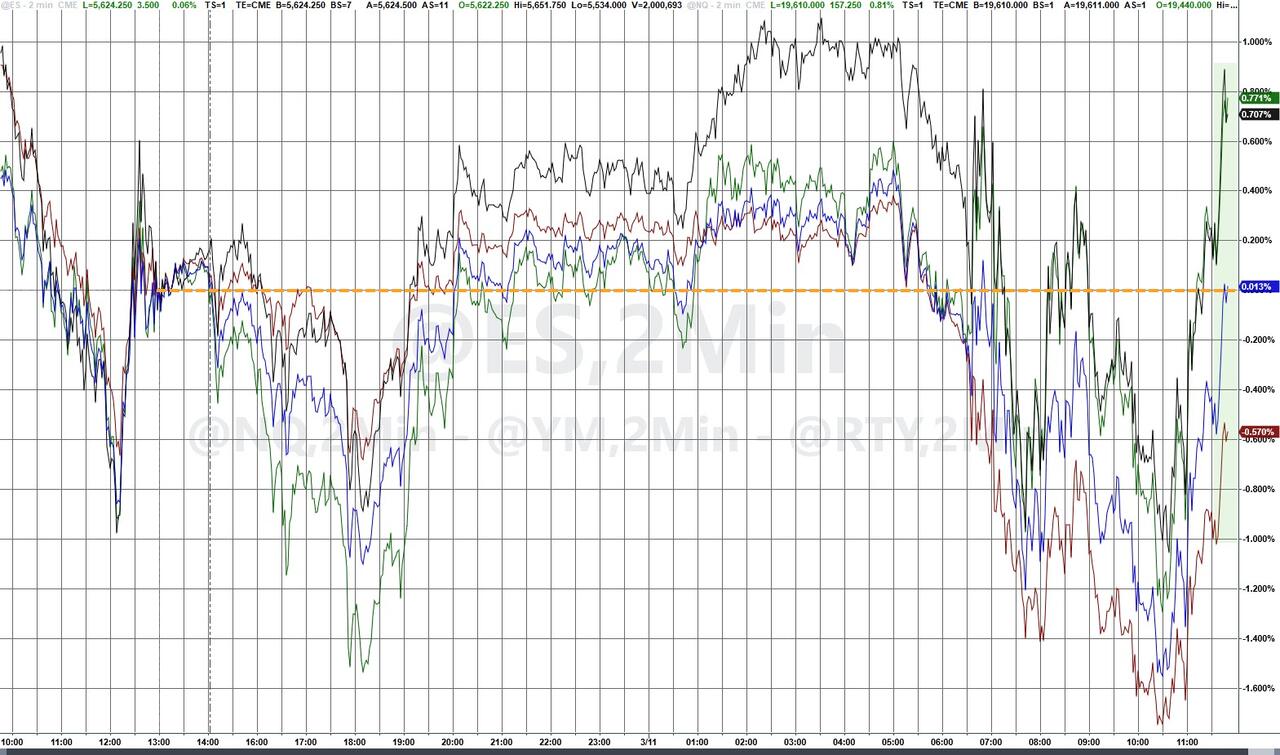 ?itok=1SJWaLpH
* * *
Just when you thought it was safe to dip your toe back in the growth-challenged markets, President Trump took to https://truthsocial.com/@realDonaldTrump/posts/114144180393726960
and unleashed a retaliatory strike against Canada (more specifcally Ontario) for its ongoing tariffs (and electricity price hike)... (emphasis ours)
Based on Ontario, Canada, placing a 25% Tariff on “Electricity” coming into the United States, I have instructed my Secretary of Commerce to add an ADDITIONAL 25% Tariff, to 50%, on all STEEL and ALUMINUM COMING INTO THE UNITED STATES FROM CANADA, ONE OF THE HIGHEST TARIFFING NATIONS ANYWHERE IN THE WORLD.
This will go into effect TOMORROW MORNING, March 12th.
Also, Canada must immediately drop their Anti-American Farmer Tariff of 250% to 390% on various U.S. dairy products, which has long been considered outrageous. I will shortly be declaring a National Emergency on Electricity within the threatened area. This will allow the U.S to quickly do what has to be done to alleviate this abusive threat from Canada.
If other egregious, long time Tariffs are not likewise dropped by Canada, I will substantially increase, on April 2nd, the Tariffs on Cars coming into the U.S. which will, essentially, permanently shut down the automobile manufacturing business in Canada.
Those cars can easily be made in the USA!
The result is that the Canadian dollar dumped...
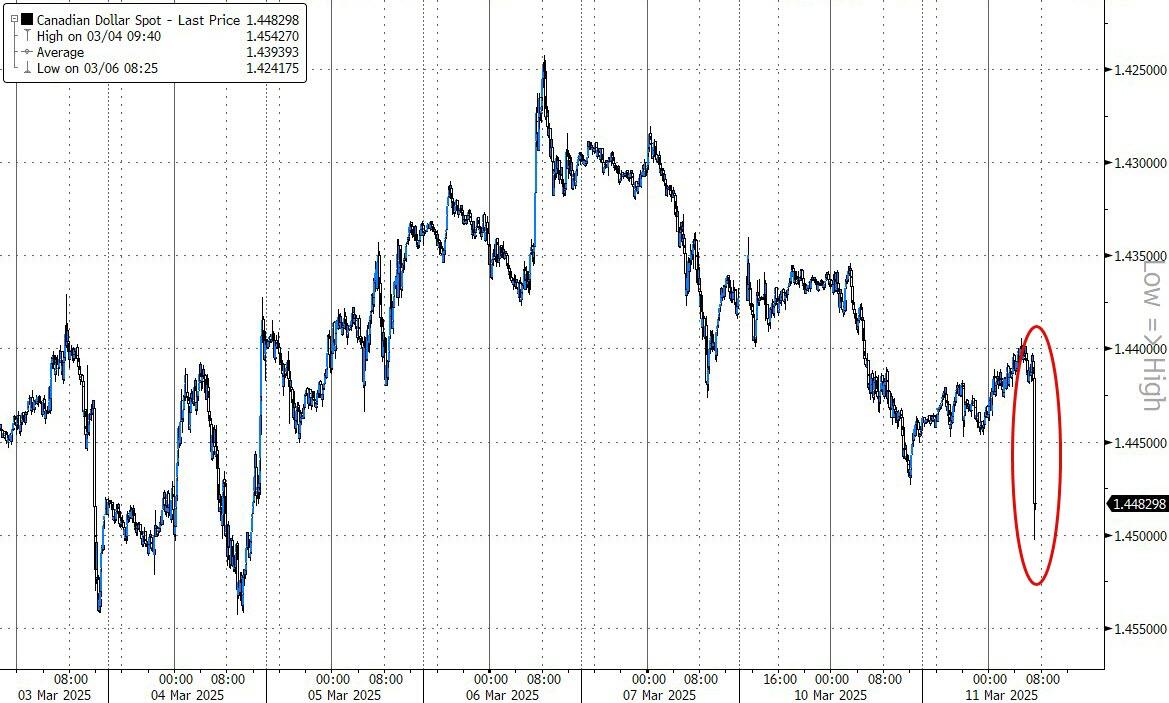 ?itok=OEh_wdnz
And US stocks gave up some their early gains.
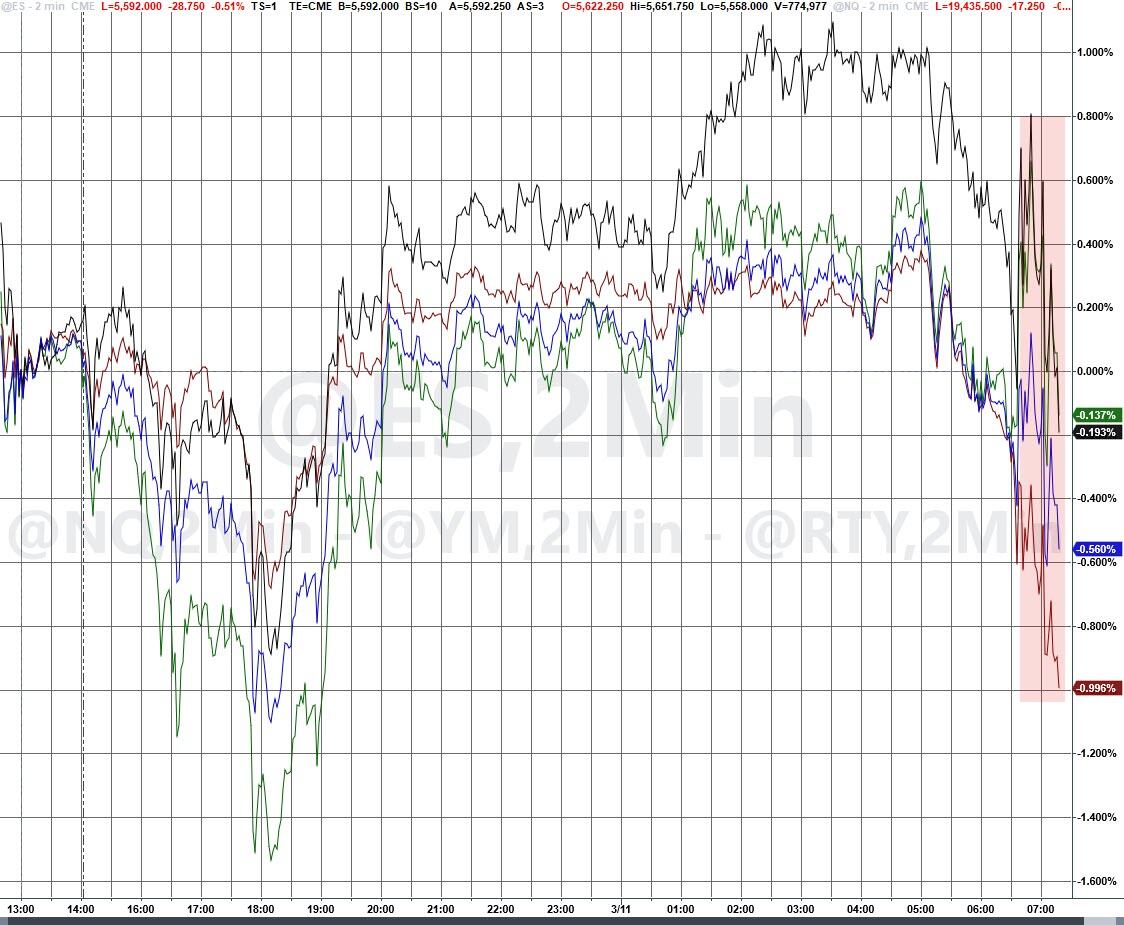 ?itok=9BDZYZw5
It's different this time.. for now...
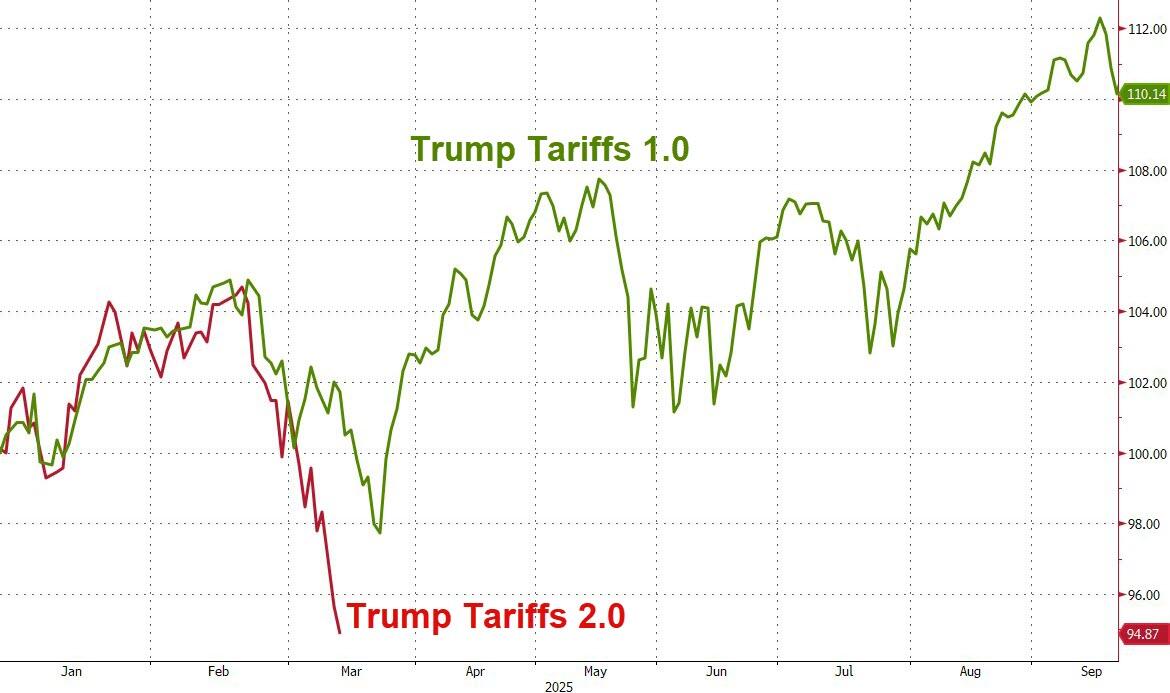 ?itok=igg9cYEg
Trump then diverted back to his previous comments on making Canada America's 51st State:
Also, Canada pays very little for National Security, relying on the United States for military protection.
We are subsidizing Canada to the tune of more than 200 Billion Dollars a year. WHY??? This cannot continue.
The only thing that makes sense is for Canada to become our cherished Fifty First State.
This would make all Tariffs, and everything else, totally disappear.
Canadians taxes will be very substantially reduced, they will be more secure, militarily and otherwise, than ever before, there would no longer be a Northern Border problem, and the greatest and most powerful nation in the World will be bigger, better and stronger than ever — And Canada will be a big part of that.
The artificial line of separation drawn many years ago will finally disappear, and we will have the safest and most beautiful Nation anywhere in the World — And your brilliant anthem, “O Canada,” will continue to play, but now representing a GREAT and POWERFUL STATE within the greatest Nation that the World has ever seen!
We are sure Mr Carney will bristle with Trump's hurtful words.
 ?itok=D3DhK47e
* * *
Top sellers from last week at https://store.zerohedge.com
:
https://store.zerohedge.com/zerohedge-multitool
https://store.zerohedge.com/swat-micarta-blued
(1 left until resupply)
https://store.zerohedge.com/wise-food-storage-heirloom-seed-vault-39-varieties-4-500-seeds
https://store.zerohedge.com/iq-colostrum
https://store.zerohedge.com/coffee/
(buy 2 bags, get free tumbler)
https://store.zerohedge.com/anza-tanto-black-micarta
https://cms.zerohedge.com/users/tyler-durden
Tue, 03/11/2025 - 14:50
Egg Prices Plummet After Trump Unveiled Plan To Reverse Biden's Bird Flu Mess
Egg Prices Plummet After Trump Unveiled Plan To Reverse Biden's Bird Flu Mess
The rudderless and delusional Democratic Party attempted to blame President Trump for the Biden-Harris regime's egg price hyperinflation crisis. However, the prior administration was hellbent on culling 150 million chickens nationwide, plunging the nation's egg-laying hen population into a disaster without any meaningful countermeasures to offset lost production.
Monday's print of the https://www.urnerbarry.com/history/4850
(EBP) shows that wholesale prices have plunged from a record high of $7.57 on Jan. 24 to $5.72—a 24% drop in just weeks—while remaining essentially unchanged since President Trump took office.
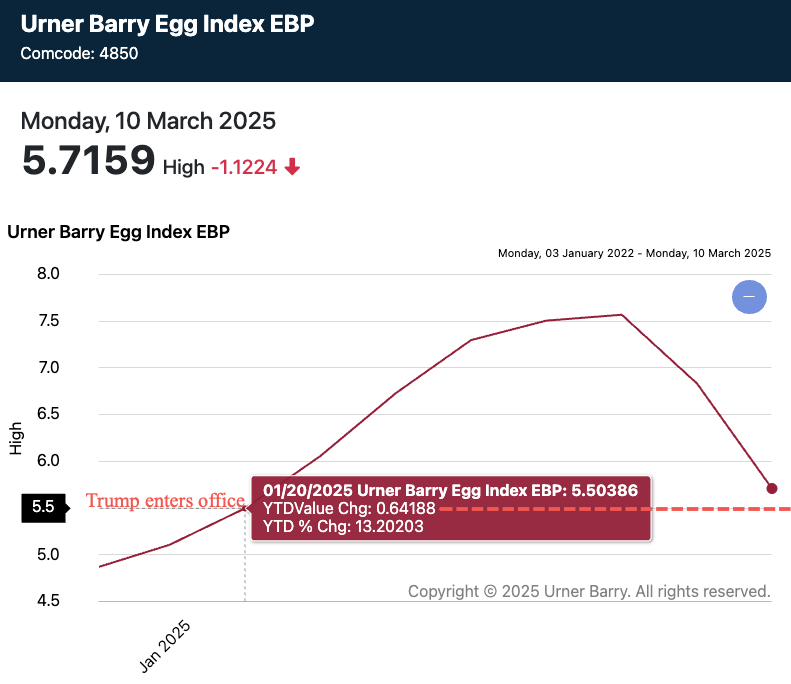 ?itok=MTyQkr_P
One week ago, Trump told a joint session of Congress that "Joe Biden especially let the price of eggs get out of control. The egg price is out of control. And we're working hard to get it back down."
Trump is entirely correct in blaming the Biden-Harris administration who culled, https://www.zerohedge.com/medical/dr-peter-mccullough-links-bird-flu-outbreak-usda-gain-function-experiment-georgia
, upwards of 150 million egg-laying hens over avian flu risks. Not once did the admin offer proper countermeasures to offset the loss of production after mass government-led cullings nationwide. It's almost as if the prior administration wanted egg-flation.
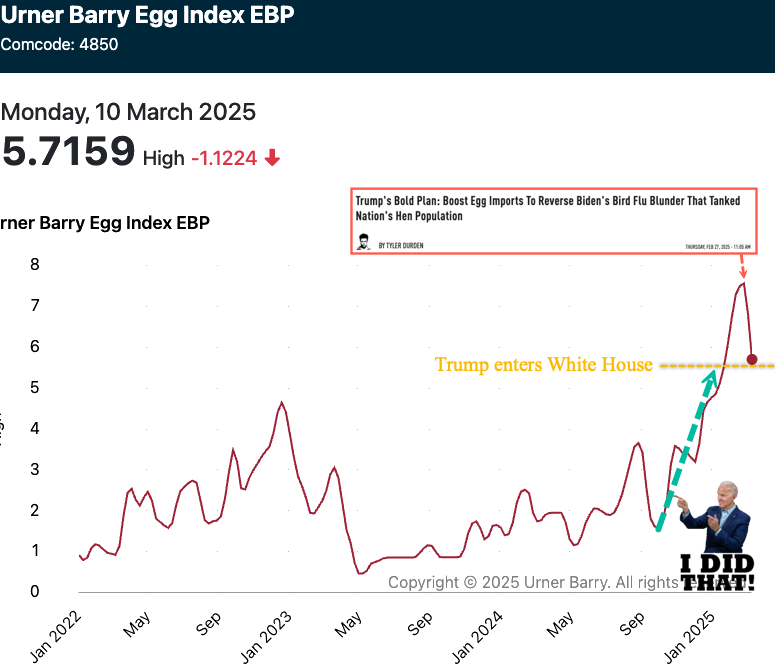 ?itok=UNRacjJV
With egg prices sliding from their peak, the Trump administration recently https://www.zerohedge.com/commodities/trumps-bold-plan-mega-egg-import-reverse-bidens-bird-flu-blunder-tanked-nations-hen
plans to import between 70 million and 100 million eggs over the next two months to cap prices. There was a follow-up report last week that US officials were speaking with large egg producers worldwide to procure new supplies.
Meanwhile...
Again, the Democratic Party's misinformation and disinformation propaganda is failing to stick as Trump scrambles leftist talking points with clear action to resolve Biden-era crises.
* * *
Become ungovernable and break free from the toxic processed foods industrial complex with a bucket of https://store.zerohedge.com/wise-food-storage-heirloom-seed-vault-39-varieties-4-500-seeds
https://store.zerohedge.com/wise-food-storage-heirloom-seed-vault-39-varieties-4-500-seeds/
Click pic... buy seeds... take food supply into your own hands...
https://cms.zerohedge.com/users/tyler-durden
Tue, 03/11/2025 - 14:45
SCOTUS Rejects Effort To Block Climate Lawsuits Against Energy Companies
SCOTUS Rejects Effort To Block Climate Lawsuits Against Energy Companies
On Monday, the Supreme Court of the United States (SCOTUS) rejected a lawsuit by Republican attorneys general that aimed at blocking left-wing lawsuits targeting energy companies for their alleged role in contributing to “global warming.”
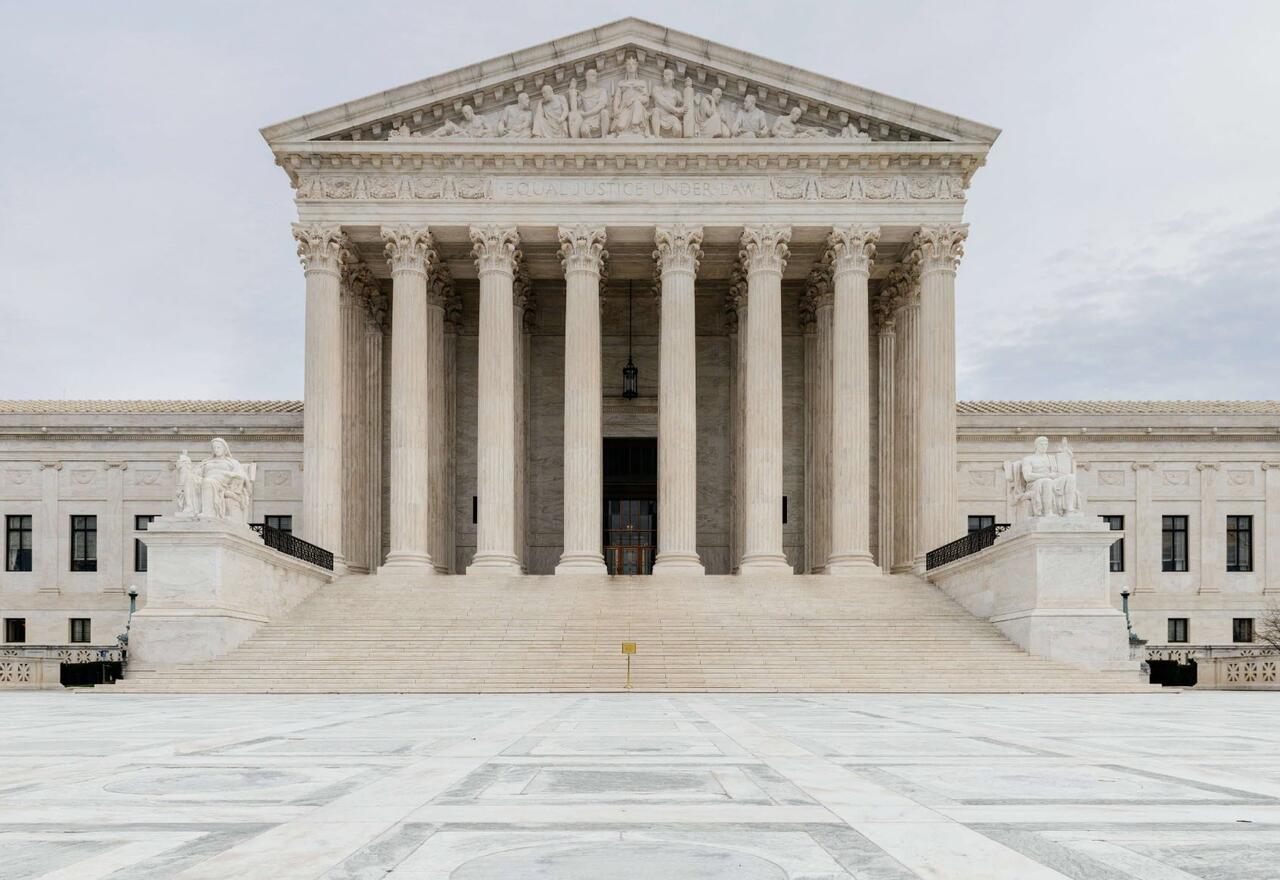 ?itok=3zEeWSdI
reports, the lawsuit was filed by attorneys general from 19 different states in response to several Democrat-led lawsuits against oil and gas companies.
The Republican lawsuit, led by Alabama Attorney General Steve Marshall, said that the lawsuits by Democratic states were essentially attempting to control national policy; he also warned that such efforts could run the risk of increasing energy prices.
States whose attorneys general have filed such lawsuits against energy companies include California, Connecticut, Minnesota, New Jersey, and Rhode Island.
The general claim by these lawsuits is that energy companies allegedly misled the public as to the environmental impact of their operations and products.
The Democratic challenges claim that these practices have led to billions of dollars in damage as the result of natural disasters, which far-left climate activists believe to be caused by global warming even though there is no proof of any such correlation.
In a 7-2 ruling, Justices Clarence Thomas and Samuel Alito dissented and said that they would have allowed the Republican lawsuit to move forward.
In his dissent, which did not comment on the merits of the case itself, Justice Thomas said that the Supreme Court did not yet have the discretion to reject the Republican lawsuit.
The high court has already rejected several appeals by energy companies, similarly seeking an end to the left-wing challenges.
https://cms.zerohedge.com/users/tyler-durden
Tue, 03/11/2025 - 14:30