
Russia Says UK & France Behind Latest Attack On Its Energy Infrastructure
Russia Says UK & France Behind Latest Attack On Its Energy Infrastructure
There's been another reported attack on the Sudzha pipeline infrastructure in Russia’s Kursk Region on Friday. Foreign Ministry spokeswoman Maria Zakharova conveyed to journalists a Russian military assessment saying a metering facility was "de facto destroyed" in a Ukrainian HIMARS attack.
But unlike some of the prior Ukrainian attacks on the area, the Kremlin is directly blaming the West, going to far as to say that orders for the new strike came directly from European capitals.
 ?itok=r_IcENBo
We "have reasons to believe that targeting and navigation were facilitated through French satellites and British specialists input [target] coordinates and launched [the missiles]," Zakharova https://www.rt.com/russia/614920-uk-ukraine-attack-violation/
, as cited in national media.
"The command came from London," she emphasized, describing it as part of a West-backed "terror" campaign meant to degrade and destroy Russia's energy infrastructure.
The Kremlin has concluded this demonstrates that Kiev is "impossible to negotiate with," she explained. The Ukrainians have done nothing to actually uphold the energy ceasefire put forward by Trump, despite that Zelensky "publicly supported" it, she said, suggesting it was all an empty game.
"Over the past 24 hours, the Kyiv regime continued its attacks on Russian energy infrastructure using various types of drones and HIMARS multiple rocket launchers," the Russian military had also described.
Russia has alleged Ukraine launched rockets on the Sudzha facility, which had already been damaged in an earlier attack this week, along with nearly 20 drones launched at an oil refinery in the southern Saratov region.
Ukraine is meanwhile denying the Russian allegations, instead suggesting it's a false flag orchestrated https://www.themoscowtimes.com/2025/03/28/russian-army-accuses-ukraine-of-attacking-sudzha-gas-metering-station-a88520
:
On Friday, Ukraine denied claims that its forces fired on the gas metering station Sudzha and accused Russia's military of striking the facility.
"Russia has again attacked the Sudzha gas transmission system in the Kursk region, which they do not control," Andriy Kovalenko, an official who is responsible for countering disinformation, said on social media.
The two sides have traded blame for violating the energy ceasefire on basically a daily basis since it was proclaimed. It seems to have barely held, if at all, despite ongoing pledges from both sides to uphold it.
Large fire at the scene of the metering station attack...
Kiev has launched another assault on the Sudzha gas metering station, signaling that Zelensky has no desire at all to reduce tensions with Russia or pursue Trump’s peace plan. https://t.co/H4fe75lU5u
— Ian Miles Cheong (@stillgray) https://twitter.com/stillgray/status/1905599847169663439?ref_src=twsrc%5Etfw
The US has claimed that it is not providing intelligence for long-range attacks inside Russia by Ukraine, but only intelligence which is defensive in nature. However, Europe is still in maximum support mode, as President Macron and Prime Minister Starmer put together a 'coalition of the willing' to defend Ukraine.
https://cms.zerohedge.com/users/tyler-durden
Sat, 03/29/2025 - 08:45
Communist Revolutionary Arrested In Connection With Vegas Tesla Firebombing Attack
Communist Revolutionary Arrested In Connection With Vegas Tesla Firebombing Attack
The Democratic Party nurtures Communist revolutionaries like 36-year-old Paul Kim, who was arrested this week after shooting and firebombing a Tesla collision center in Las Vegas, Nevada.
🚨 https://twitter.com/hashtag/BREAKING?src=hash&ref_src=twsrc%5Etfw
: The accused terrorıst who firebombed a Tesla showroom in Las Vegas has been ARRESTED, per PD
FAFO is in order!
36-year-old Paul Kim was charged with arson and possession of an explosive device
MAKE AN EXAMPLE OUT OF HIM! 20 YEARS!
Kim allegedly used Molotov… https://t.co/wj7CuIIIlJ
— Nick Sortor (@nicksortor) https://twitter.com/nicksortor/status/1905289948128743658?ref_src=twsrc%5Etfw
LVMPD officers arrested Paul Kim on Wednesday night on charges including arson and possessing an explosive device. LVMPD announced the arrest at a press conference on Thursday afternoon.
 ?itok=8bxAO9Tg
LVMPD told reporters that a review of Kim's social media profiles indicates the suspect has ties to radical extremist groups, including the Communist Party USA, Revolutionary Communist International, Hidden Palestine & Palestine Action.
NEW: Paul Hyon Kim faces a slew of charges for shooting & firebomb attack at Vegas Tesla dealership
Cops say the alleged domestic terrorist has ties to Communist Party USA, Revolutionary Communist International, Hidden Palestine & Palestine Actionhttps://t.co/RAG1fzJRIz
— Breaking911 (@Breaking911) https://twitter.com/Breaking911/status/1905373794451013730?ref_src=twsrc%5Etfw
Libs of TikTok found Kim's social media posts from the early BLM riot days, voicing his support for the Democratic Party's NGOs that facilitated the color revolution of destruction across the nation in 2020.
This appears to be the FB account belonging to Paul Kim, the dude who was arrested for allegedly setting a Tesla location on fire. He advocated for people to donate to help get violent BLM rioters get out of jail.
The Democratic Party is the party of violence. https://t.co/272okDDvAI
— Libs of TikTok (@libsoftiktok) https://twitter.com/libsoftiktok/status/1905323490669887530?ref_src=twsrc%5Etfw
Attorney General Pamela Bondi released a https://www.justice.gov/opa/pr/nevada-resident-arrested-and-charged-connection-violent-tesla-arson-las-vegas
shortly after Kim was arrested and charged in the connect with the Tesla attack:
"The Department of Justice has been clear: anyone who participates in the wave of domestic terrorism targeting Tesla properties will suffer severe legal consequences. We will continue to find, arrest, and prosecute these attackers until the lesson is learned."
FBI Director Kash Patel stated:
"As promised, acts of violence and vandalism will not be tolerated, and today law enforcement personnel acted quickly to arrest an individual on charges including arson. Under Attorney General Bondi's leadership, we will continue to pursue these investigations with the full force of law and will bring to justice anyone responsible for these attacks."
There's a race against time to defund and dismantle the Democratic Party's rogue network of NGOs that plan an imminent color revolution to "kill" the Tesla brand and send the market capitalization of the American company into a "death spiral."
Tesla Takedown Organizers Plan Color Revolution To "Kill" Brand & "Death Spiral" For Investors https://t.co/JIf80uPeEt
— zerohedge (@zerohedge) https://twitter.com/zerohedge/status/1903184890750980240?ref_src=twsrc%5Etfw
The wave of violence and destruction by Democrats nationwide—targeting Tesla, much of it caught on camera—comes as the party’s poll numbers plunge to record lows.
Even CNN had to admit that its own party had imploded.
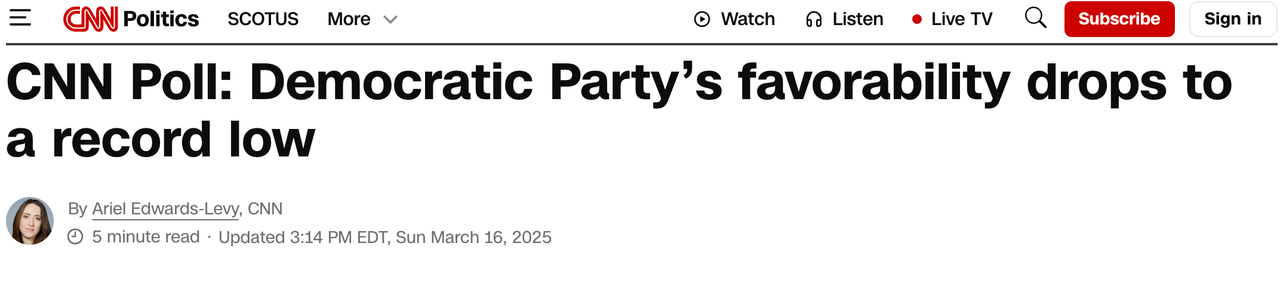 ?itok=Woon117v
What the party of revolutionary activists fails to realize is that the Overton Window shifted last year - so burning and destroying buildings, cars, and city blocks - like BLM riots - is no longer the socially acceptable norm. Doubling down on hate and violence will haunt the party in the next election cycle.
Like this:
Another lunatic who is committing violence against a Tesla ! This is insane and has to stop. 🛑 https://t.co/3m3xZh319C
— Kathleen Winchell ❤️🤍💙🇺🇸🇺🇸 (@KathleenWinche3) https://twitter.com/KathleenWinche3/status/1903370884137513140?ref_src=twsrc%5Etfw
BREAKING: MORE TRANS VIOLENCE
The person arrested for the vandalization and attempted arson of a Tesla dealership in CO is a MAN PRETENDING TO BE A WOMAN.
The media are all referring to him as a "woman" https://t.co/MVKrrZ9zij
— Libs of TikTok (@libsoftiktok) https://twitter.com/libsoftiktok/status/1894825641931112511?ref_src=twsrc%5Etfw
The Tesla attacks are getting worse.
Arson. Molotov cocktails. Bouts of gunfire.
This isn't new. The Left has used violence as a political tool for decades.
Only one thing can stop this. In the words of Pat Buchanan: "Force, rooted in justice, and backed by moral courage." 🧵 https://t.co/hajT2vFJ5c
— Eric Schmitt (@Eric_Schmitt) https://twitter.com/Eric_Schmitt/status/1902777703767400750?ref_src=twsrc%5Etfw
Anyone who tells you trans violence isn’t a problem is lying to you.
They’re even spray painting “trans rights are human rights” on the side of Tesla showrooms.
All they’re doing is exposing the woke mind virus to more and more Americans every day. This is backfiring. https://t.co/IyhNWF8iYv
— Nick Sortor (@nicksortor) https://twitter.com/nicksortor/status/1902740238021140645?ref_src=twsrc%5Etfw
Another FAFO Tesla terrorist arrested.
It’s name is Shaydan Hessner 👈
Make it famous for all the wrong reasons 👇 https://t.co/xqXPopeXaI
— ♥️🇺🇸 𝓒𝓪𝓽𝓲𝓪 🇮🇹♥️ (@CB618444) https://twitter.com/CB618444/status/1905598211831611881?ref_src=twsrc%5Etfw
GRAPHIC CONTENT: The Tesla terrorists are getting more and more insane… https://t.co/iiDFfElyAT
— Libs of TikTok (@libsoftiktok) https://twitter.com/libsoftiktok/status/1902858535534301324?ref_src=twsrc%5Etfw
Tesla Terrorist KAREN identified as Kamelia Enzer, a millionaire and spouse of Jeff Enzer -Lead Engineer DocuSign.
The Karen has been charged!
Cops say it may be road rage 🤦♀️
🎥 Daily Mail https://t.co/KDiviwULPE
— ATX Irish Gal 🙏🏼🇺🇸❤️ (@Notmyfault99) https://twitter.com/Notmyfault99/status/1905568803175481407?ref_src=twsrc%5Etfw
Who wants to bet that this fat fvck damaging the Tesla with his wheelchair is currently a SNAP and other government handouts recipient?https://t.co/DLMjI9S2sh
— I Meme Therefore I Am 🇺🇸 (@ImMeme0) https://twitter.com/ImMeme0/status/1904862263019724946?ref_src=twsrc%5Etfw
NOW: Police move Pro-Palestine protesters as they flip off the CYBERTRUCK passing by as they march against ICE arrest of Former Columbia University student Mahmoud Khalil
Video by https://twitter.com/peterhvideo?ref_src=twsrc%5Etfw
— Oliya Scootercaster 🛴 (@ScooterCasterNY) https://twitter.com/ScooterCasterNY/status/1899212779862495323?ref_src=twsrc%5Etfw
NYPD is asking for the public’s help in identifying these 2 individuals who carved a swastika and the word “Nazi” in a Cybertruck in Brooklyn.
Do you recognize them?
Call NYPD crime stoppers at 1-800-577-8477. https://t.co/JWktT6Hd6z
— Libs of TikTok (@libsoftiktok) https://twitter.com/libsoftiktok/status/1905661084054245485?ref_src=twsrc%5Etfw
. . .
https://cms.zerohedge.com/users/tyler-durden
Fri, 03/28/2025 - 15:00
https://www.zerohedge.com/political/communist-revolutionary-arrested-vegas-tesla-firebombing-attack
Rickards: Trump & The Fate Of The Dollar
Rickards: Trump & The Fate Of The Dollar
https://dailyreckoning.com/trump-and-the-fate-of-the-dollar/
What is the Mar-a-Lago Accord? And what would a Mar-a-Lago Accord mean for the value of the U.S. dollar?
We begin our analysis with the name itself. Mar-a-Lago Accord is an echo of the three major international currency accords since the original Bretton Woods Agreements reached in 1944.
 ?itok=EaVekEL-
Accords Through The Years
The first was the Smithsonian Agreement in December 1971. This came in the aftermath of President Nixon’s decision on August 15, 1971, to end the convertibility of U.S. dollars into physical gold by U.S. trading partners at the fixed rate of $35.00 per ounce. The major countries in the global system (U.S., UK, France, Germany, Italy, Japan, Netherlands, Sweden, Switzerland, Canada, Belgium, and Netherlands) met at the Smithsonian Institution in Washington DC to decide how to reopen the gold window.
The main U.S. goal was to devalue the dollar. In the end, the price of gold was increased by 8.5% to $38.00 per ounce (revalued to $42.22 per ounce in 1973), which equaled a 7.9% dollar devaluation. Other currencies were revalued against the dollar, including a 16.9% upward revaluation of the Japanese yen.
The effort to reopen the gold window failed. Instead, major countries moved to floating exchange rates, which remains the norm to this day. Gold moved to free market trading and is currently about $3,050 per ounce. That gold price represents a 98.8% devaluation of the dollar measured by weight of gold since 1971.
The period from 1971 to 1985 was tumultuous in foreign exchange markets including the Petrodollar agreement (1974), the Herstatt Bank collapse (1974), the sterling crisis (1976), U.S. hyperinflation (50% from 1977-1981), a gold price super-spike (1980), and a major global recession (1981-1982). By 1983, inflation was subdued, the dollar was gaining strength, and strong economic growth was achieved in the U.S. under Ronald Reagan.
The next major economic gathering on foreign exchange was the Plaza Accord in September 1985. This was convened by U.S. Treasury Secretary James Baker at the Plaza Hotel in New York and included the U.S., Germany, the UK, Japan and France. At the time, the dollar was at an all-time high relative to other currencies. The dollar had even strengthened against gold, which had dropped in price from $800.00 per ounce in January 1980 to around $320.00 per ounce in 1985.
The purpose of the meeting was to devalue the dollar in stages. In this respect, the meeting was a success. Importantly, the method of devaluation was to be gradual and it was to be accomplished by central bank and finance ministry interventions in the foreign exchange markets. It was not a fiat devaluation; it was a finesse.
In practice, the market interventions were quite few. Once foreign exchange traders got the message, they took the dollar where it needed to go on their own. No foreign exchange dealer wanted to be on the wrong side of the trade if the central banks decided to intervene on any particular day.
The Louvre Accord, signed on February 22, 1987, among the U.S., UK, Canada, France, Japan and Germany was, in effect, a victory lap following the Plaza Accord. Between 1985 and 1987, the dollar did devalue against other currencies. The dollar also fell against gold, which rose from $320 per ounce to $445 per ounce by the time of the meeting. It was mission accomplished for Treasury Secretary James Baker. The purpose of the Louvre Accord was to lock down the accomplishments of the Plaza Accord, stop further dollar depreciation, and return to a period of relative stability in foreign exchange markets.
This accord was also a success. The dollar was mostly stable after 1987, despite the introduction of the euro in 2000 (the euro bounced between $0.80 and $1.60 in the early 2000s. Today it’s $1.09, which is not far from its original valuation of $1.16).
The other wild card was gold. After hitting bottom at around $250 per ounce in 1999, gold surged to $1,900 per ounce in 2011, a 670% gain for gold and a de facto devaluation of the dollar when measured by weight of gold. The period of relative stability in foreign exchange markets lasted until 2010 when a new currency war was unleashed by President Obama.
A New Mar-A-Lago Accord
Which brings us to discussion of a possible new international monetary conference in the chain of conferences from the Smithsonian Agreement to the Plaza Accord to the Louvre Accord. Given Donald Trump’s dominance on the world economic scene today and his love of ornate architecture of the kind seen at the Plaza Hotel and the Louvre (Trump owned the Plaza Hotel from 1988 to 1995),it’s not a stretch to expect that Trump would convene any new world monetary conference at his equally ornate Mar-a-Lago club in Palm Beach, Florida.
The first discussion of a Mar-a-Lago Accord appears in Chapter Six of my book https://www.amazon.com/Aftermath-Secrets-Wealth-Preservation-Coming/dp/0735216959/ref=sr_1_1
(2019), published six years ahead of current attention to the topic. That chapter is titled “The Mar-a-Lago Accord” and contains extensive discussion of the evolution of the international monetary system starting in 1870, including the more recent accords noted above.
It then moves through my private meetings with IMF head John Lipsky and Treasury Secretary Tim Geithner with a focus on a possible new gold standard and the attempted replacement of gold by the Special Drawing Right (SDR), created in 1969 and used among IMF members ever since. It ends with the classic 1912 quote from Pierpont Morgan that, “Money is gold, and nothing else.” and recommends that investors acquire physical gold for their portfolios. The dollar price of gold has risen 120% since that recommendation.
Today’s vogue in Mar-a-Lago Accord research began with a November 2024 https://www.hudsonbaycapital.com/documents/FG/hudsonbay/research/638199_A_Users_Guide_to_Restructuring_the_Global_Trading_System.pdf
written by Stephan Miran titled “A User’s Guide to Restructuring the Global Trading System”, published by Hudson Bay Capital. Although the title refers to the trading system, it explains how currency devaluation can be used to offset the impact of tariffs and refers to “persistent dollar overvaluation.”
From there, it’s a short leap to the ghost of the Plaza Accord and the need for a new Mar-a-Lago Accord. (Shortly after the paper was published, Trump appointed Miran as Chair of his Council of Economic Advisors, which gives his views added weight).
Issuance of 100-Year Bonds
In the currency section of the paper (pages 27-34), Miran not only suggests a devaluation of the dollar; he proposes that the U.S. issue 100-year bonds. In Miran’s view, 100-year bonds will be attractive to foreign reserve managers and will reduce any dollar selling needed to prop up their own currencies. Those long-term dollar holdings will mitigate short-term dollar devaluation in a way that moves the entire international monetary system toward a desirable equilibrium. Miran specifically uses the term Mar-a-Lago Accord to describe his proposed system.
There are many more technical details in Miran’s plan that we don’t have room to discuss in this article. These include use of the Treasury’s Exchange Stabilization Fund, the Fed’s Bank Term Funding Program, and Fed currency swap lines. Miran also suggests using the International Emergency Economic Powers Act of 1977 (IEEPA) to impose withholding taxes on interest payments to foreign holders of Treasury securities (a form of capital controls) as a way to discourage trading partners from holding Treasuries and therefore a way to devalue the dollar.
Trading partners would be evaluated using a traffic-light system. Countries would be ranked green (friendly), yellow (neutral) and red (adversary). Green countries would get U.S. military protection and the most favorable tariffs, yellow would get reciprocal tariffs, and red countries would get no security help, punitive tariffs and possible capital controls.
A Financial Catastrophe in the Making
In effect, Miran is trying to have it both ways. He wants to devalue the dollar and at the same time keep the dollar at the center of the International Monetary System. Nixon did this in 1971 and Baker did it in 1985. With regard to Miran, one cannot resist a paraphrase of Lloyd Bensen – “Stephan, you’re no Jim Baker.” The success of the Plaza Accord depended entirely on close cooperation of the major country finance ministries. No such cooperation exists today given sanctions on Russia, tariffs on China and the U.S. isolation of the EU with respect to the War in Ukraine.
Since Miran’s paper, the topic has spun completely out of control. A recent MarketWatch https://www.marketwatch.com/story/wall-street-cant-stop-talking-about-the-mar-a-lago-accord-heres-how-the-currency-deal-would-work-f8fbbda0
says “Wall Street can’t stop talking about the ‘Mar-a-Lago Accord.’”Some analysts propose that gold on the Federal Reserve’s balance sheet (actually a gold certificate) would be revalued from $42.22 per ounce to the market price (now $3,050 per ounce) with the “profit” added to the Treasury General Account. Another idea is to use U.S. assets such as land and mineral rights to collateralize U.S. debt.
As of now, no one knows what a Mar-a-Lago Accord would actually be or whether it will even happen, so it’s impossible to describe the impact. Still, the best-known version of the plan would have unintended consequences that could lead to a global financial catastrophe.
There’s no need to force holders to swap short-term debt for long-term debt. You simply let the short-term debt mature and replace it with new 100-year bond issues through the existing primary dealer underwriting system. No coercion is needed; there would be huge demand for 100-year debt.
Dollar devaluation does not fight potential inflation from tariffs (there isn’t any). It actually causes inflation by increasing the cost of imported goods. Any gold price mark-up on the Fed’s books is simply an accounting entry. The suggested “audit” of Fort Knox by Trump and Elon Musk (if it happens) will be nothing more than a staged photo-op. Gold has a world price entirely unaffected by accounting games between the Treasury and the Fed.
Again, the Mar-a-Lago Accord as it’s envisioned today would cause a global financial crisis. That’s because it fails to understand the importance of short-term Treasury debt as collateral for inter-bank lending and derivatives. Substituting 100-year Treasury debt for short-term Treasury bills would make those bills scarce. Treasury bills are the most liquid collateral in the world and are at the root of the Eurodollar system and the $1 quadrillion derivatives market. Scarcity of Treasury bills would implode bank balance sheets and lead to the greatest banking crisis in history.
The big winner in this context is gold. The BRICS are moving toward gold as fast as they can. Investors can do the same. Don’t be left behind.
https://cms.zerohedge.com/users/tyler-durden
Fri, 03/28/2025 - 14:40
https://www.zerohedge.com/geopolitical/rickards-trump-fate-dollar
Putin Floats Plan For UN To Govern Ukraine Until Elections Held
Putin Floats Plan For UN To Govern Ukraine Until Elections Held
Amid weeks of peace talks between the US and Russia focused on Ukraine, but which largely haven't gotten anywhere (other than an energy ceasefire which quickly appeared to be broken), President Putin has presented a big-picture idea which could result in ceasefire.
The Russian leader on Friday proposed a "transitional administration" for Ukraine under the auspices of the UN. The immediate aim would be ceasefire leading toward "democratic" election, followed by the negotiation of a peace agreement with the new authorities.
"We could, of course, discuss with the United States, even with European countries, and of course with our partners and friends, under the auspices of the UN, the possibility of establishing a transitional administration in Ukraine," Putin https://www.dw.com/en/ukraine-updates-putin-suggests-un-administration-of-ukraine/live-72065497
while visiting the northwestern Russian city of Murmansk.
 ?itok=nEi_gxV6
He laid out that "we could discuss the possibility of introduction of temporary governance in Ukraine," while Ukraine holds "democratic elections, to bring to power a capable government that enjoys the trust of the people."
After this, he explained, the two warring sides would "start talks with them about a peace treaty." Putin has in the recent past complained that Zelensky is 'illegitimate' and thus can't legally be negotiated with, since he has canceled democratic elections on an indefinite basis.
As examples of where a temporary UN governance scheme has been implemented before, Putin held out "several cases of what is called external government," in East Timor, Papua New Guinea, and parts of the former Yugoslavia.
But anonymous Trump admin officials quickly dismissed the idea, for example with https://www.nbcnews.com/news/world/putin-trump-russia-ukraine-zelenskyy-un-guinea-timor-yugoslavia-rcna198520
reporting that the White House has "dismissed Russian President Vladimir Putin's suggestion that peace talks in Ukraine should depend on the country being governed by the United Nations while new elections are held."
And Reuters has cited a White House national security spokesperson who dismissed Putin’s proposal, saying that "Ukraine’s government was determined by its constitution and citizens."
The Ukrainian government did not immediately respond to Putin's plan, but will no doubt reject it based on maintaining sovereignty, and given Zelensky has not relented on demands for a new election, nor has he ordered his forces to retreat.
"That’s just one of the potential options."
🚨🇷🇺 PUTIN: THE U.N. COULD TEMPORARILY GOVERN UKRAINE
In a stunning statement, Putin said the United Nations could temporarily govern Ukraine in order to “hold democratic elections” and “bring power to a capable government.”
Putin:
"That’s just one of the potential options."… https://t.co/K8VjSiGwV5
— Mario Nawfal (@MarioNawfal) https://twitter.com/MarioNawfal/status/1905408242521702573?ref_src=twsrc%5Etfw
Putin in the fresh remarks where he floated the UN-administration plan had some other interesting comments, directed specifically at his US counterpart https://www.dw.com/en/ukraine-updates-putin-suggests-un-administration-of-ukraine/live-72065497
:
Putin also praised US President Donald Trump, saying, "In my opinion, the newly elected president of the United States sincerely wants an end to the conflict for a number of reasons."
He stressed that Moscow favored "peaceful solutions to any conflict, including this one, through peaceful means, but not at our expense."
Putin also praised Russian troops for "holding the strategic initiative" throughout the war. "There are reasons to believe that we will finish them off," he said, adding that "the Ukrainian people themselves should understand what is happening."
As for the war, drones have continued to fly across the border in both directions on a nightly basis. Even though a 'partial ceasefire' is supposed to be on - protecting both countries' energy infrastructure - it doesn't look as if this is actually sticking.
Moscow has on repeat occasions this week accused Kiev of attack its energy sites. Simultaneously, Russian missiles have rained down on Ukrainian cities.
https://cms.zerohedge.com/users/tyler-durden
Fri, 03/28/2025 - 14:20
https://www.zerohedge.com/geopolitical/putin-presents-un-should-govern-ukraine-until-elections-held
Trump Says He Will Continue Bombing Yemen For A 'Long Time'
Trump Says He Will Continue Bombing Yemen For A 'Long Time'
https://news.antiwar.com/2025/03/27/trump-says-he-will-continue-bombing-yemen-for-a-long-time/
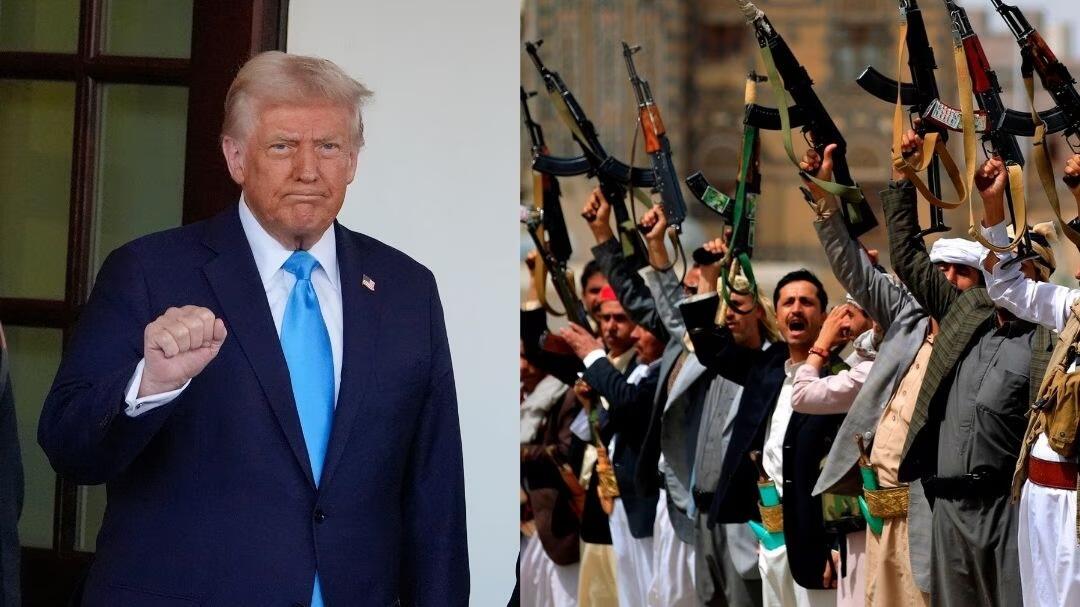
President Trump on Wednesday https://www.timesofisrael.com/trump-the-houthis-want-peace-because-theyre-getting-the-hell-knocked-out-of-them/
have been "very successful" and vowed the bombing campaign would continue for a "long time."
The US started bombing Yemen again on March 15 in response to the Houthis, officially known as Ansar Allah, announcing they would reimpose a blockade on Israeli shipping due to Israeli ceasefire violations in Gaza.
 ?itok=VEW7OOTl
Since the Trump administration launched the bombing campaign, the Houthis have restarted attacks on US warships and resumed firing missiles at Israel, operations they ceased when the Gaza ceasefire went into effect on January 19. Despite this, President Trump claims the Houthis want "peace."
"The Houthis are looking to do something. They want to know, ‘How do we stop? How do we stop? How can we have peace?’ The Houthis want peace because they’re getting the hell knocked out of them," https://www.youtube.com/watch?v=_YTgd1ugpGM
reporters in the Oval Office.
"They want us to stop so badly… They’ve got to say, ‘No mas.’ But I can only say that the attacks every day, every night… have been very successful beyond our wildest expectations… We’re going to do it for a long time. We can keep it going for a long time," the president said.
The Houthis’ message has been that they https://news.antiwar.com/2025/03/17/yemenis-hold-massive-pro-palestine-rallies-in-face-of-us-airstrikes/
and that their attacks won’t stop unless there is a ceasefire in Gaza and an end to the Israeli blockade on aid and all other goods entering the Palestinian territory.
"The Yemeni Armed Forces affirm that the American aggression will only increase the Yemenis’ steadfastness and resilience, and that the confrontations over the last few days were only the beginning of what will be a gradual expansion of defensive operations in the coming days," https://www.saba.ye/en/news3457230.htm
when announcing new attacks on US warships and on Israel.
Trump also claimed that the Houthis are being "hit harder than they have ever been." But from 2015 to 2022, the Houthis faced a brutal US-backed Saudi-UAE war against them, which involved a heavy bombing campaign, a blockade, and a ground campaign. Trump supported the war during his first term in office and https://news.antiwar.com/2019/04/16/trump-vetoes-congressional-resolution-to-end-yemen-war/
passed by Congress that would have ended US involvement in the conflict.
Trump said that President Biden should have attacked the Houthis, disregarding the fact that the Biden administration launched a bombing campaign on Yemen from January 2024 to January 2025. The message from the Trump administration has been that Biden didn’t hit Yemen hard enough, and Trump’s bombing campaign https://www.timesofisrael.com/new-us-campaign-against-yemens-houthis-far-more-intense-than-under-biden/
Bombing Yemen Is Not America First, Here's Why https://t.co/a0T6kmnmmS
— zerohedge (@zerohedge) https://twitter.com/zerohedge/status/1905429673858789633?ref_src=twsrc%5Etfw
The Trump administration’s bombing campaign has taken a heavy toll on civilians, with at least 25 killed in just the first week, https://news.antiwar.com/2025/03/25/us-killed-25-civilians-in-first-week-of-renewed-bombing-campaign-in-yemen/
, where National Security Advisor Mike Waltz claimed the Houthis’ "top missile guy" was located.
https://cms.zerohedge.com/users/tyler-durden
Fri, 03/28/2025 - 14:00
https://www.zerohedge.com/geopolitical/trump-says-he-will-continue-bombing-yemen-long-time
Futures Slide, Gold Soars Ahead Of Inflation Data Amid Tariff Turmoil
Futures Slide, Gold Soars Ahead Of Inflation Data Amid Tariff Turmoil
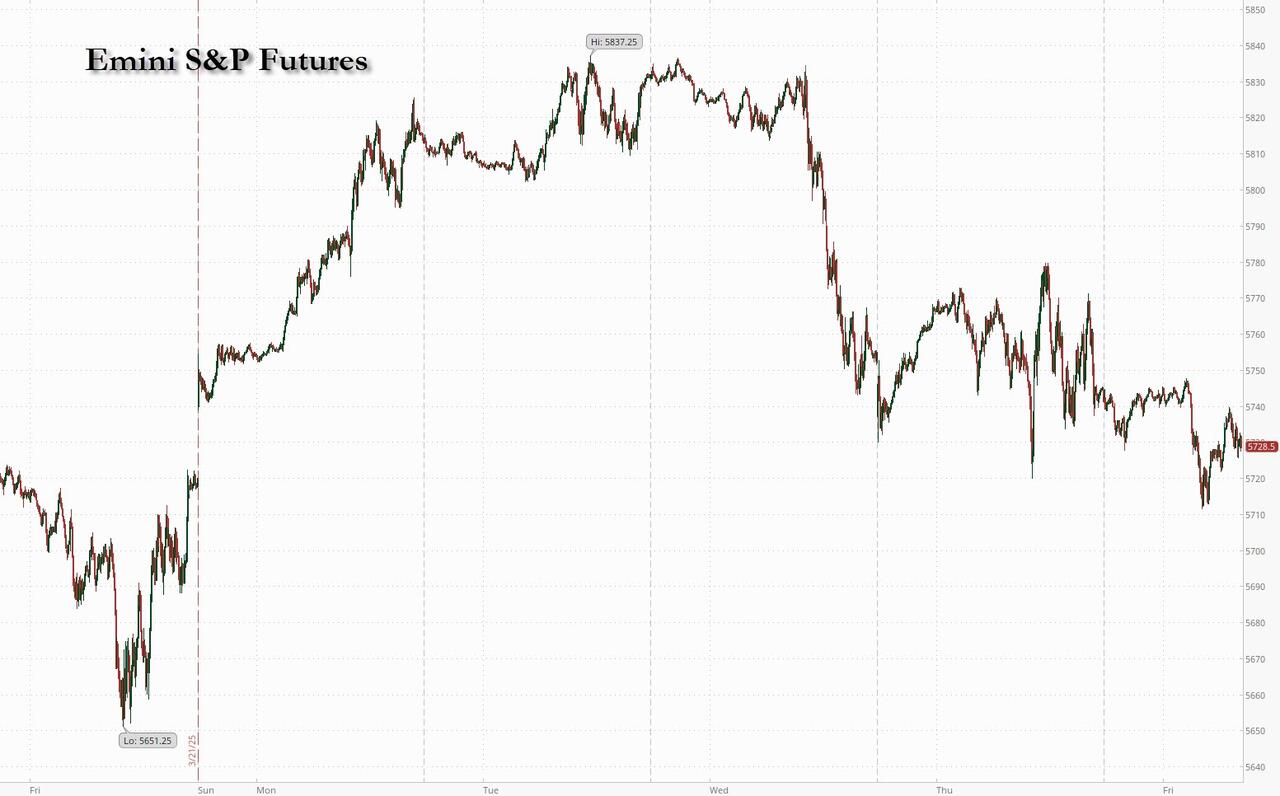
US equity and global stock markets slumped while gold topped a fresh all time high as investors braced for today's core PCE report, the Fed's preferred inflation metric, and continued to worry about the lasting economic damage of the trade war amid daily tariff news and a halt in progress on the geopolitical front, as the market now awaits the April 2 tariff announcements. As of 8:00am ET S&P futures are down 0.2% but off session highs, with the Nasdaq lagging -0.4% and small caps modestly higher; Mag 7 names are mostly lower premarket: AAPL -0.7%, AMZN -0.5%, while TSLA +1.6%. European and Asian stocks are also lower: Bond yields are lower and the USD trades near session highs. Commodities are mixed with base metals all lower this morning, but gold is making a new record high rising above $3,080 per ounce. Brent trades near session highs above $74/bbl. Looking ahead today, we will get PCE data for February at 8:30am (consensus expects headline and core PCE up 0.3% MoM, and 2.7%/2.5% YoY headline/core) followed by UMich survey data at 10am. Following the data, we will hear from Fed voter Barr and non-voter Bostic.
 ?itok=0U7iCchy
In premarket trading, Lululemon plunged 13% after the activewear maker’s annual forecasts for sales and profit disappointed, stoking worries that growth will continue to be weak in its American markets. Tesla is the top gainer among the Magnificent Seven (Alphabet -0.1%, Amazon -0.5%, Apple -0.7%, Microsoft -0.3%, Meta -0.1%, Nvidia +0.5% and Tesla +1.2%). US Steel (X) gains 5% after Semafor reported that the company is in active talks with Nippon Steel about a deal that would preserve their proposed merger citing unidentified people familiar with the matter. Here are some other notable premarket movers:
Argan Inc. (AGX) climbs 12% after the builder of power plants posted 4Q revenue that climbed 41% from the year-ago period.
Beam Therapeutics (BEAM) rises 4% after a Bank of America analyst upgraded the drug developer to buy, citing trial data of its investigative therapy for a genetic disease that can cause lung and liver damage.
CureVac (CVAC) jumps 12% after the biotech firm said the European Patent Office had upheld the mRNA patent at the center of its legal battle with BioNTech.
Hudson Pacific Properties (HPP) gains 7% after BMO raised the office REIT to outperform, saying its recent $475 million CMBS transaction helps provide “breathing room” on 2025 debt maturities.
Nio Inc. ADRs (NIO) falls about 2% as the Chinese electric vehicle maker’s upsized share sale plan raised investor concern about dilution.
Oxford Industries (OXM) declines 12% after the owner of Tommy Bahama and Lilly Pulitzer gave a disappointing forecast for the current fiscal quarter.
Rocket Lab (RKLB) rises 9% after the space company was selected by the US Space Force for a $5.6 billion program.
The Metals Company (TMC) gains 15% after the seabed mining company asked the Trump administration for approval to harvest the ocean floor for critical metals in international waters controlled by a United Nations-affiliated organization.
WR Berkley (WRB) climbs 5% after Mitsui Sumitomo Insurance agreed to buy 15% of outstanding shares in the US insurer.
Overnight, Defense Sec Hegseth said to allies in his first official trip to Asia that the Trump Administration is set to "truly prioritize and shift to this region...in a way that is unprecedented." China's Xi continued to try woo international investors noting in a meeting with 40+ global business leaders that "we are providing a transparent, steady and predictable policy environment,” calling the nation a “favorite destination” for foreign investors. “Embracing China is embracing opportunities.” (BBG). After the close yesterday, Fed voter Collins said it looks “inevitable” that tariffs will boost inflation, at least in the near term, adding it’s likely appropriate to keep interest rates steady for longer (BBG). A 7.7 magnitude earthquake has struck in Myanmar, the most powerful in a century, causing buildings to shake and triggering evacuations in Vietnam and Thailand, with at least one tower collapsing in Bangkok.
It’s been a rough quarter for US equities, with the S&P 500 getting ready to close out the first three months of the year with a 3.2% loss, the worst performance since 2023. Today's reading for the US core personal consumption expenditures price index is expected to rise 0.3% in February, an unchanged pace compared with the previous month, according to the median economist forecast. With President Trump threatening to unleash so-called reciprocal tariffs next week, money managers say they’re turning neutral, stepping back or de-risking their portfolios.
“Tariffs are creating a lot of fears in the market, not just the level of the tariffs but the way they are implemented as well,” Valerie Genin, head of investments at Barclays Private Bank Monaco told Bloomberg TV. “It seems like investors are just digesting now that tariffs have lose-lose implications for all parties.”
Meanwhile in Europe, stocks are set for their third week of losses this month, as investors brace for US tariff announcements next week pushing the Stoxx 600 index 0.4% lower on Friday. Most sub-indexes on the Stoxx 600 regional benchmark notch declines. Banks lead the underperformance, while the real estate sector is a rare outperformer. Still, banks are the standout winner this quarter with a 26% advance as investors are counting on more strong earnings, share buybacks and M&A to drive gains. Here are the biggest movers Friday:
Ubisoft shares jump as much as 12% after the video game maker said it will carve out a unit into a subsidiary with an enterprise value of about €4 billion, with Tencent to invest €1.16 to acquire a 25% stake in the new entity
UK retailers are outperforming on Friday, after sales unexpectedly grew for a second month in February to suggest consumer confidence is returning; among the biggest gainers are B&M (+1.8%), Kingfisher (+2.2%), and ASOS (+1.1%)
Grupo Catalana Occidente shares soared as much as 18% and to a record high after controlling shareholder Inoc launched takeover offer for all shares of the Spanish insurer
SSE shares rise as much as 1.9% after the energy and utility company announced it is promoting current Chief Commercial Officer Martin Pibworth to become its next chief executive
WH Smith shares slide as much as 3.1% after the company agreed to sell its struggling high street business at a price that JPMorgan said is at the lower end of expectations. The firm also said it is trading in line with market expectations
Energiekontor, a German wind and solar parks project developer, sees its shares decline over 10%, the most since August after it reported disappointing results; shareholders will be subject to a significant reduction in dividends
Rational shares drop as much as 1.9%, extending their drop following the muted growth outlook posted on Thursday. Analysts at Warburg cut their price target on the German company due to the softer outlook for this year
Earlier in the session, Asian equities suffered their biggest drop in a month, as concerns increased over a possible growth slowdown in the US stemming from new tariffs. Trading was halted in Thailand following an earthquake. The MSCI Asia Pacific Index fell as much as 1.4%, with most markets in the red. Toyota, Samsung Electronics and Mitsubishi UFJ were among the biggest drags. South Korean and Japanese stocks led the selloff, as ex-dividend trading exacerbated the impact of the hit to sentiment from US taxes on imports. President Donald Trump’s imposition of a blanket 25% levy on auto imports, and threats for similar action in other areas, have ramped up investor anxiety over the scope of the reciprocal tariffs that he intends to announce next week. The Hang Seng Tech Index, which has rallied this year on the back of Chinese technology advancements, fell to the brink of a correction amid broad risk-off sentiment.
In FX, the Bloomberg Dollar Spot Index is flat. JPY and GBP are the strongest performers in G-10 FX; SEK and NZD underperform. The greenback supported by month-end demand while it also modestly enjoys haven dynamics amid escalating trade tensions, a Europe-based trader says. The euro sank to session lows around 1.077 after traders ramped up bets on ECB interest-rate cuts as Spanish and French CPI undershot expectations. Money markets now price in about 60bps of easing by December.
In rates, treasuries hold gains in early US session led by long-end tenors with yields lower by about 4bp, arresting this week’s dramatic curve steepening. US yields are richer by at least 1bp across maturities with 2s10s curve flatter by ~2.5bp, 5s30s by ~2bp; 10-year near 4.33% is ~3bp lower on the day, with bunds and gilts in the sector outperforming by 1bp and 3bp. Core European bond markets lead after Spanish and French CPIs rose less than estimated, prompting traders to price in more easing by ECB. Focal point of US session is February personal income and spending data, which embeds PCE price index, inflation gauge targeted by the Fed.
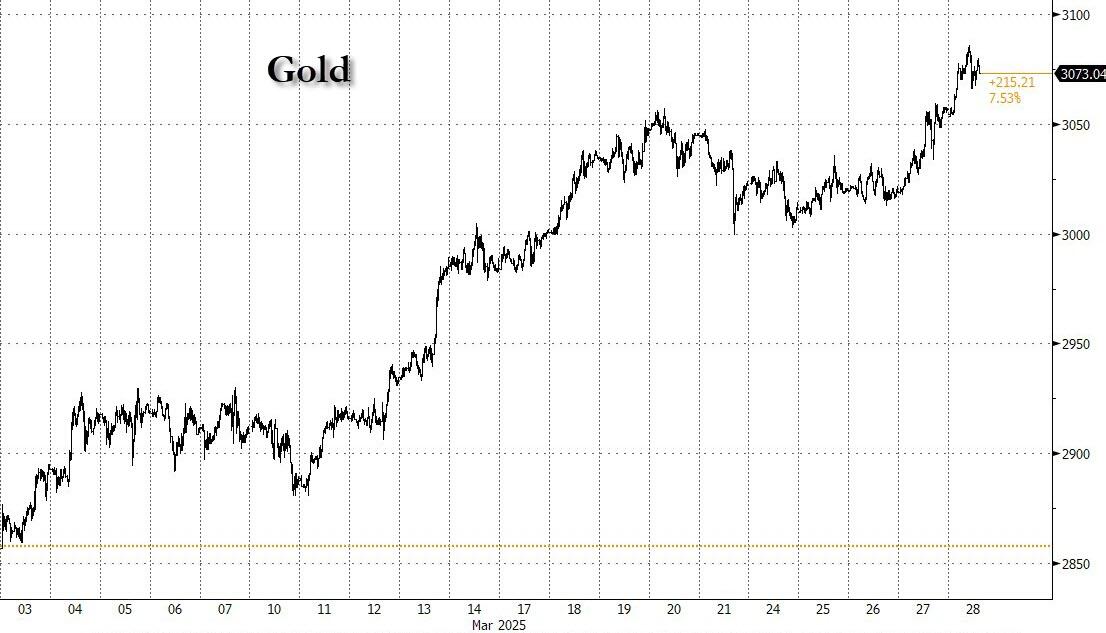
In commodities, the non stop record highs in gold are the big story again: spot gold rose roughly $15 to trade near $3,072/oz after it hit a fresh record. Crude futures are steady. WTI drifts 0.1% lower to trade near $69.88. Brent is flat at $74.02.
 ?itok=5RshhSy9
Today's US economic calendar includes February personal income/spending (8:30am), March final University of Michigan sentiment (10am) and March Kansas City Fed services activity (11am). Fed speaker slate includes Barr (12:15pm) and Bostic (3:45pm)
Market Snapshot
S&P 500 futures down 0.4% to 5,714.00
STOXX Europe 600 down 0.3% to 544.66
MXAP down 1.0% to 186.56
MXAPJ down 0.7% to 584.82
Nikkei down 1.8% to 37,120.33
Topix down 2.1% to 2,757.25
Hang Seng Index down 0.6% to 23,426.60
Shanghai Composite down 0.7% to 3,351.31
Sensex down 0.5% to 77,227.72
Australia S&P/ASX 200 up 0.2% to 7,982.01
Kospi down 1.9% to 2,557.98
German 10Y yield little changed at 2.72%
Euro down 0.2% to $1.0777
Brent Futures down 0.3% to $73.80/bbl
Gold spot up 0.4% to $3,069.18
US Dollar Index little changed at 104.37
Top Overnight News
Elon Musk commented that their goal is to reduce the deficit by USD 1tln and will achieve most of that objective within a 130-day tenure, while he added that legitimate recipients of Social Security benefits will receive more, not less money, according to Fox News.
Global bonds rallied as European consumer price data came in softer than expected and investors awaited data on the Federal Reserve’s favored inflation gauge.
Inflation in France and Spain undershot expectations, supporting calls for more interest-rate cuts by the European Central Bank.
The Zuffenhausen district of Stuttgart has been the heart of Porsche AG since the 1930s, and the sports car maker remains overwhelmingly Made in Germany, making it potentially the biggest loser in Donald Trump’s trade war.
UK retail sales increased for a second month in February, suggesting consumer confidence is returning in a surprise boost for Chancellor of the Exchequer Rachel Reeves.
The rally in European banking stocks shows few signs of cooling down after another stellar quarter.
Fed's Collins (2025 voter) said she is cautiously and realistically optimistic about the economy and stated the economy started 2025 in a good place. Collins said inflation had come down but was still elevated at the start of the year, and the outlook now is much cloudier for inflation and growth. She noted it is inevitable that tariffs will increase inflation in the near term and it remains a question how long tariff-driven inflation will last. Furthermore, she said inflation risks are on the upside and she strongly supported the Fed's decision to hold rates steady, while she expects the Fed will likely hold rates steady for longer given the outlook and stated that watching inflation expectations and sentiment data is important right now.
Fed's Barkin (2027 voter) said the current moderately restrictive stance is a good place to be and if conditions shift, the Fed can adjust. Barkin said given recent high inflation, tariffs could have more of an impact on prices, but still not known where rates will settle or how affected countries' businesses and consumers will respond. Barkin also commented that the direction of federal policy changes may be known, but the extent and how they net out in the economy remains uncertain, while he added federal policy changes create instability in the near term and the Fed is waiting for uncertainty to clear before acting.
A more detailed look at global markets courtesy of Newsquawk
APAC stocks were mostly pressured amid the ongoing themes of tariffs and growth concerns heading closer to next week's 'Liberation Day' and with markets also bracing for the latest US PCE Price Index. ASX 200 traded rangebound and was just about kept afloat by strength in consumer staples and the commodity-related sectors with gold miners rejoicing after the precious notched another fresh record high. Nikkei 225 underperformed and dipped beneath the 37,000 level as automakers continued to suffer from Trump's recent auto tariff proclamation and with firmer-than-expected Tokyo CPI data supporting the case for the BoJ to continue with future policy adjustments. Hang Seng and Shanghai Comp failed to sustain the early resilience and slipped into negative territory amid a deluge of earnings and tariff uncertainty, while it was also reported that China rejected US President Trump's offer of tariff waivers in exchange for a TikTok deal.
Top Asian News
Chinese President Xi said, at a meeting with foreign CEOs, that foreign firms' investment plays an important role and China was, is and will certainly be an ideal, safe and promising investment destination for foreign business people. Xi added they will ensure that foreign-funded enterprises have fair access to factors of production in accordance with the law and maintaining a stable, healthy, and sustainable development of China-US relations is in the fundamental interests of the two peoples. Xi also stated that blocking someone else's path will only block your own path in the end and blowing out other people's lights will not make your own lights brighter. Furthermore, he said economic and trade frictions should be properly resolved through equal dialogue and consultation, and noted that China will handle China-US relations in accordance with the principles of mutual respect, peaceful coexistence and win-win cooperation.
China is to promote high-quality development of the aluminium sector and will actively respond to trade frictions, according to a plan by ten government departments cited by Global Times.
Japanese PM Ishiba said the impact of US auto tariffs on the Japanese economy could be very big.
Bank of Japan March Meeting Summary of Opinions noted one member said inflation is somewhat overshooting expectations and a member said wage hikes in spring wage talks are somewhat exceeding last year's figures, with nominal wages rising at a pace in line with the achievement of the BoJ's price goal. There was the opinion that they don't have enough data to gauge the impact of the January policy change and recent long-term rate moves on the economy, while it was reiterated that the BoJ will continue to hike rates if economy and prices move in line with forecast, but should not have a preset idea on specific policy management. A member stated that for the time being, the BoJ must scrutinise US policy impact on the global economy and markets, as well as the effect of BoJ's past rate hike on Japan's economy, then move to the next rate hike, while a member said they must adjust the degree of monetary support nimbly to avoid a buildup of financial excess. Furthermore, there was an opinion that when they next hike rates, they must consider shifting the monetary policy stance to neutral from accommodative, and at the next meeting, they must scrutinise inflation expectations, the chance of upside price risk materialising, and progress in wage hikes when setting monetary policy.
European bourses started Friday trade on a cautious note, Euro Stoxx 50 -0.6%, after APAC stocks were pressured on tariff and growth concerns overnight, and ahead of next week’s "Liberation Day", and with markets also bracing for US PCE inflation data later today. Note, the risk tone took a hit generally on the morning's earthquakes in Myanmar. Sectors are mainly in the red, Banks lag with German names lagging while softer yields assist Real Estate names.
Top European News
Magnitude 6.9 (initially reported 7.72/7.4) earthquake occurs in Myanmar, via GFZ; reports of buildings shaking in Bangkok & Hanoi. Thereafter, magnitude 6.37 earthquake occurs in Myanmar, via GFZ; shocks reported in the Yunnan Province of southwest China and in Bangkok.
ECB's de Guindos says disinflation process is continuing, goal is for it to be reached in the coming months; caution is even more important at times of uncertainty. Trade war would mostly impact economic growth.
ECB Consumer Expectations Survey (Feb): See inflation in next 12 months at 2.6% (prev. 2.6%); 3y ahead sees 2.4% (prev. 2.4%). Consumers’ nominal income growth expectations over the next 12 months increased to 1.0% in February from 0.9% in January.
FX
DXY is attempting to claw back some of yesterday's lost ground with the USD currently firmer vs. all peers ex-JPY into PCE. Index remains within yesterday's 104.07-65 range.
JPY is the current best performer after firmer-than-expected Tokyo CPI data, which is seen as a leading indicator for national price trends and effectively supports the case for further BoJ policy normalisation. USD/JPY has pulled back from the overnight peak @ 151.21 and made its way back onto a 150 handle. The next downside target comes via Thursday's low @ 150.05.
EUR is under modest pressure and has faded gradually from the 1.08 mark against the USD. No reaction to the morning's data points or ECB speak. Thursday's base at 1.0732 and then the 200-DMA at 1.0729.
GBP flat despite a blip higher on the morning's better-than-expected Retail Sales and upward revisions to dated GDP metrics. While this lifted Cable to a 1.2968 peak it proved fleeting.
Antipodeans softer given the risk tone though action is limited given the lack of specific drivers for the region.
PBoC set USD/CNY mid-point at 7.1752 vs exp. 7.2591 (Prev. 7.1763).
Fixed Income
A firmer start to the session for the benchmarks given the tepid risk tone overnight and risk aversion entering the market on the sizable earthquakes in Myanmar.
USTs hit a 110-24 peak but since pulled back modestly but remains comfortably clear of the overnight 110-15 base. The session ahead is focussed on US PCE.
Bunds bid, USTs hit a 110-24 peak but since pulled back modestly but remains comfortably clear of the overnight 110-15 base. The session ahead is focussed on US PCE. Prelim. French and Spanish inflation this morning cooler than forecast, but spurred no move; ECB SCE maintained the inflation view.
Gilts gapped higher by 25 ticks as the Gilt open roughly coincided with the high point in USTs and Bunds as the complex generally continued to climb on the broad risk tone. Since, the benchmark has eased slightly from highs but remains above the 91.00 mark. No hawkish follow through from the Retail and GDP data this morning.
Commodities
Crude futures choppy with initial downside on broader risk aversion. Since, the benchmarks briefly moved into the green but only by around USD 0.10/bbl with the move fleeting and the benchmarks now essentially unchanged. WTI May at the top of a USD 69.53-70.05/bbl band, Brent May in-fitting in USD 73.63-74.15/bbl parameters.
Precious metals mostly firmer despite the firmer USD, benefitting from the risk tone as discussed into key events. Spot gold is currently off highs in a USD 3,054.42-3,086.21/oz intraday range.
Base metals are mostly lower, tracking sentiment, 3M LME copper resides in a USD 9,741.70-9,855.15/t range at the time of writing. Dalian iron ore prices also dipped overnight but still notched a weekly gain as hot metal output continued to increase in March - used as a gauge for iron ore demand.
Geopolitics: Middle East
Israeli military said it intercepted one launch from Lebanese territory and another one was detected.
Israeli Defense Minister said if there is no peace in Kiryat Shmona and the Galilee communities, there will be no peace in Beirut, according to Asharq News. It was separately reported that Israel's Defence Minister holds Lebanon responsible for firing on Galilee and said Israel will respond forcefully against any threats.
Iran's ambassador in Baghdad said US President Trump's message to Tehran included a request to dissolve or merge the Popular Mobilization Forces, which is unacceptable to us, while the ambassador added they refuse to negotiate on their ballistic missiles and the decision to dissolve the PMU is an Iraqi decision which he thinks is impossible, according to Sky News Arabia.
"Lebanese media: Israeli warplanes fly over Beirut", according to Sky News Arabia; thereafter, the Israeli Military says it will release an urgent statement to Beirut residents soon.
Geopolitics: Ukraine
Russia and US teams may meet regarding Ukraine in Riyadh in mid-April, according to TASS.
Russian President Putin suggested the possibility of placing Ukraine under temporary administration to allow for elections and signature of accords, according to Russian news agencies. Putin said Russia stands for resolving Ukraine conflict through peaceful means and wants to work with Europe on resolving Ukraine conflict, but the EU is acting inconsistently. It was separately reported that Putin said Russia welcomes a peaceful resolution to the Ukraine conflict "but not at our expense", according to CGTN Europe.
White House said governance in Ukraine is determined by its constitution and the people of Ukraine.
Russian Defence Ministry says Ukraine continued attacks on Russian energy infrastructure, according to Ria; attacked the Sudzha gas metering station on Friday and almost destroyed it; thereafter, Ukraine said Russia conducted the attack.
Ukrainian Deputy PM confirms Ukraine has received new US draft of the minerals deal.
Geopolitics: Other
CK Hutchison Holdings (0001 HK) will not go ahead with the expected signing of a deal next week to sell its two strategic ports at the Panama Canal, according to SCMP.
US Secretary of State Rubio warned if Venezuela attacked Guyana or Exxon (XOM), "it would be a very bad day" for them. It was also reported that the Guyanese President agreed with the US to further integrate energy production after a meeting with US Secretary of State Rubio.
US Defense Secretary Hegseth said during a visit to the Philippines that he and US President Trump want to express the ironclad commitment they have to the mutual defence treaty and are very committed to the Philippines-US alliance, friendship and cooperation they have. Hegseth added that friends need to stand shoulder to shoulder to deter conflict and ensure that there's freedom of navigation in the South China Sea, and noted that deterrence is necessary around the world, but specifically in this region considering the threats from the Communist Chinese. Hegseth later announced they are doubling down on the US-Philippines partnership and agreed on the next steps to re-establish deterrence in the Indo-Pacific with the US to deploy advanced capabilities to the Philippines.
US Event calendar
08:30: Feb. PCE Price Index MoM, est. 0.3%, prior 0.3%
Feb. PCE Price Index YoY, est. 2.5%, prior 2.5%
Feb. Core PCE Price Index MoM, est. 0.3%, prior 0.3%
Feb. Core PCE Price Index YoY, est. 2.7%, prior 2.6%
08:30: Feb. Personal Income, est. 0.4%, prior 0.9%
Feb. Personal Spending, est. 0.5%, prior -0.2%
Feb. Real Personal Spending, est. 0.3%, prior -0.5%
09:00: Bloomberg March United States Economic Survey
10:00: March U. of Mich. Sentiment, est. 57.9, prior 57.9
March U. of Mich. Current Conditions, est. 63.5, prior 63.5
March U. of Mich. Expectations, est. 54.1, prior 54.2
March U. of Mich. 1 Yr Inflation, est. 4.9%, prior 4.9%
March U. of Mich. 5-10 Yr Inflation, est. 3.9%, prior 3.9%
11:00: March Kansas City Fed Services Activ, prior 2
DB's Jim Reid concludes the overnight wrap
Markets struggled yesterday as tariff fears remained at the forefront of investors’ minds, with concern mounting ahead of the April 2 deadline for reciprocal tariffs. Notably, several automakers took a hit given the 25% tariff announcement on Wednesday night. But more broadly, there were signs that investors were becoming increasingly concerned about the stagflationary consequences. Indeed, yesterday saw the US 1yr inflation swap (+9.1bps) hit a 2-year high of 3.11%, even as the real yield on 2yr Treasuries (-11.1bps) fell to its lowest since August 2022 at 0.73%. This combination of elevated growth uncertainty and inflation fears saw gold prices hit a new closing record of $3,057/oz yesterday, and overnight they’ve seen further gains up to $3,074/oz.
In terms of the last 24 hours, one of the main fears is that the reciprocal tariffs could lead to a big round of escalation beyond the initial US tariffs. For example, shortly before we went to press yesterday, President Trump said in a post that if the EU worked with Canada “in order to do economic harm to the USA, large scale Tariffs, far larger than currently planned, will be placed on them both”. Separately, Japan’s Prime Minister Ishiba said yesterday that “We must consider appropriate responses, and naturally all options are on the table”. And Canadian Prime Minister Carney said that he’d convened the Cabinet Committee on Canada-US relations “in response to President Trump’s attack on our workers and our industries.” Carney said that “nothing is off the table” but that the Canadian government would respond based on what the US does on April 2.
Against that backdrop, automakers struggled yesterday, with Ford (-3.88%) and General Motors (-7.36%) both losing significant ground. That was echoed across the world, and in Europe, the tariff announcement meant the STOXX Automobiles and Parts Index fell -1.09% to a fresh two-month low. That tariff uncertainty also dragged down equities more broadly, with both the S&P 500 (-0.33%) and the STOXX 600 (-0.44%) losing ground for a second day running. And with just two business days of Q1 left, the S&P 500 is on track to post its first quarterly decline in six quarters, having shed -3.20% since the start of the year.
The tariffs also meant that US Treasuries faced several hurdles, particularly with investors moving to price in more inflation. In fact by the close, the 10yr yield (+1.1bps) was up to a one-month high of 4.36%, as was the 30yr yield (+2.1bps) at 4.72%. By contrast, fears about the growth impact led investors to price in more Fed rate cuts this year, and the 2yr yield fell -2.6bps to 3.99%, even as inflation breakevens rose. In turn, that meant the 2s30s yield curve moved up to its steepest level in over 3 years. And this pattern was evident elsewhere, with the German 2s30s yield curve also up to its steepest since July 2022, at 106bps.
Despite the weakness among key assets, yesterday actually brought a respectable set of US economic data, which continued to point away from a sharp slowdown. For instance, the weekly initial jobless claims were at 224k over the week ending March 22 (vs. 225k expected), meaning there were still no obvious signs of a deterioration in the labour market. At the same time, we also got the third estimate of Q4 GDP, which was revised up a tenth, and now shows an annualised growth rate of +2.4%. So it continued the recent theme whereby the hard data is still holding up, even if some of the surveys have pointed to a weaker performance.
Here in the UK, gilts sold off in the aftermath of the government’s Spring Statement, with the 10yr yield (+5.1pbs) moving up more than its global counterparts yesterday. The rise took it up to 4.78%, its highest level since mid-January, whilst the 10yr real yield (+2.7bps) hit a post-2009 high of 1.35%. So that added to concerns that the government would need to announce further fiscal tightening later this year to keep within their fiscal rules, potentially repeating the pattern from the Spring Statement where higher yields and lower growth wiped out the fiscal headroom. As a reminder, our UK economist (link here) thinks that likely economic downgrades later in the year will lead to further fiscal consolidation.
Elsewhere in Europe, sovereign bonds rallied as investors were more concerned about the negative growth impact from the tariffs. So that led investors to dial up the likelihood of further ECB rate cuts, with the amount of further cuts priced by the December meeting up +2.8bps on the day to 58bps. And in turn, yields fell across the curve, with those on 10yr bunds (-2.2bps), OATs (-2.2bps) and BTPs (-1.8bps) all moving lower.
Overnight in Asia, the major equity indices have seen sizeable losses, with the Nikkei (-2.34%) and the KOSPI (-2.14%) both slumping. In Japan, matters weren’t helped by the Tokyo CPI report for March, which came in stronger than expected at +2.9% (vs. +2.7% expected). In addition, the measure excluding fresh food and energy moved up to +2.2% (vs. +1.9% expected), the strongest in a year. In turn, that’s added to the momentum for further rate hikes from the BoJ, and the Japanese Yen has strengthened +0.10% this morning against the US Dollar. Elsewhere in Asia, the Hang Seng (-0.85%), the Shanghai Comp (-0.65%) and the CSI 300 (-0.42%) have all experienced losses as well.
To the day ahead now, and there are several data releases to look out for. In the US, there’s PCE inflation for February, along with the University of Michigan’s final consumer sentiment index for March. Meanwhile in Europe, we’ll get the French and Spanish flash CPI prints for March, along with German unemployment for March and UK retail sales for February. From central banks, we’ll hear from the Fed’s Barr and Bostic, along with the ECB’s Nagel, and Muller.
https://cms.zerohedge.com/users/tyler-durden
Fri, 03/28/2025 - 08:26
Publicity Stunt? Nikola Founder Trevor Milton Claims Trump Pardon In Bizarre Video
Publicity Stunt? Nikola Founder Trevor Milton Claims Trump Pardon In Bizarre Video
Trevor Milton—founder and former CEO of the now-bankrupt Nikola—claimed on X late Thursday that President Trump had issued him a "full and unconditional pardon" and said the president "called me personally."
Quick refresher on Milton: In 2023, a jury found him guilty of lying to investors about Nikola's electric and fuel cell semi-truck technology and sentenced him to four years in prison.
Nikola was first exposed by short seller Nathan Anderson, founder of https://www.zerohedge.com/markets/place-joy-short-seller-nathan-anderson-will-wind-down-hindenburg-research-after-7-years
, after the startup released a 2020 promotional video, which showed its Nikola One truck rolling down a hill to simulate full functionality.
 ?itok=gE9_rrou
Last month, Nikola filed for https://www.zerohedge.com/markets/nikolas-wild-ride-ends-shares-halted-following-bankruptcy-filing
in the US Bankruptcy Court for the District of Delaware. The defunct-startup also filed a motion seeking permission to pursue an auction and sale process under Section 363 of the US Bankruptcy Code.
Back to Milton, he wrote on X:
"This pardon is not just about me—it's about every American who has been railroaded by the government, and unfortunately, that's a lot of people. It is no wonder why trust and confidence in the Justice Department has eroded to nothing... I saw firsthand the tactics they use to guarantee convictions. I am incredibly grateful to President Trump for his courage in standing up for what is right and for granting me this sacred pardon of innocence."
Today I was issued a full and unconditional pardon by https://twitter.com/realDonaldTrump?ref_src=twsrc%5Etfw
himself. He called me personally to tell me.
This pardon is not just about me—it’s about every American who has been railroaded by the government, and unfortunately, that’s a lot of people. It is no wonder… https://t.co/qpT0jjI6Fy
— Trevor Milton (@nikolatrevor) https://twitter.com/nikolatrevor/status/1905412785661772107?ref_src=twsrc%5Etfw
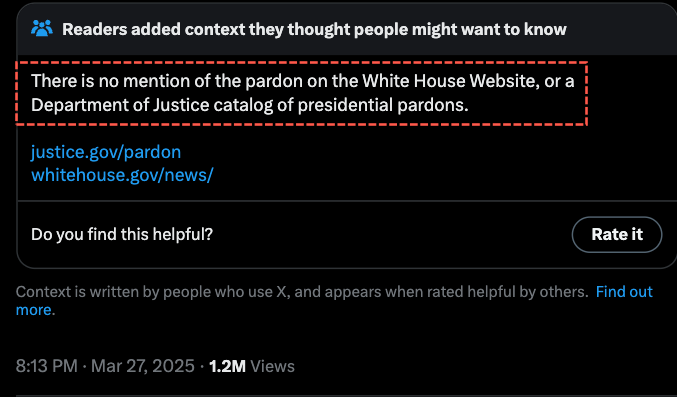
Milton's video was immediately fact-checked by Community Notes, which pointed out that multiple U.S. government databases did not show evidence of a pardon.
"There is no mention of the pardon on the White House Website, or a Department of Justice catalog of presidential pardons."
 ?itok=QQS6jCWu
Separately, Milton's media team released a press release through PR Newswire, declaring:
"Founder of Nikola Motor Company, Trevor Milton, Pardoned by President Trump."
Here's EV blog https://electrek.co/2025/03/27/trevor-milton-claims-hes-been-pardoned-but-really-its-just-an-ad-for-a-documentary/
take on the situation:
So, despite us seeing no evidence yet that this pardon is actually real, maybe it's an attempt to https://en.wikipedia.org/wiki/Inception
the idea of a pardon into the empty headcase of a vain ignoramus who for some reason has access to the pardon pen (despite there being a clear Constitutional remedy keeping insurrectionists like himself away from it).
It also seems quite similar to a proposed tactic by another corporate criminal, Sam Bankman-Fried. Fried had planned to "Go on Tucker Carlsen [sic], come out as a republican" in an attempt to angle for a pardon, again playing on the vanity, credulousness and love of fraud shown by the idiot-in-chief.
But then, in the last line of the press release, we get to what is perhaps the real point of this stunt – it ends with a link to a trailer for a documentary which purports to exonerate Milton. Kind of strange that someone would need to release a documentary making the case for exoneration when one has already been exonerated, isn't it?
So, for these reasons, we think that this pardon didn't actually happen.
. . .
https://cms.zerohedge.com/users/tyler-durden
Fri, 03/28/2025 - 08:05
White House Withdraws Stefanik Nomination To UN Ambassador
White House Withdraws Stefanik Nomination To UN Ambassador
(emphasis ours),
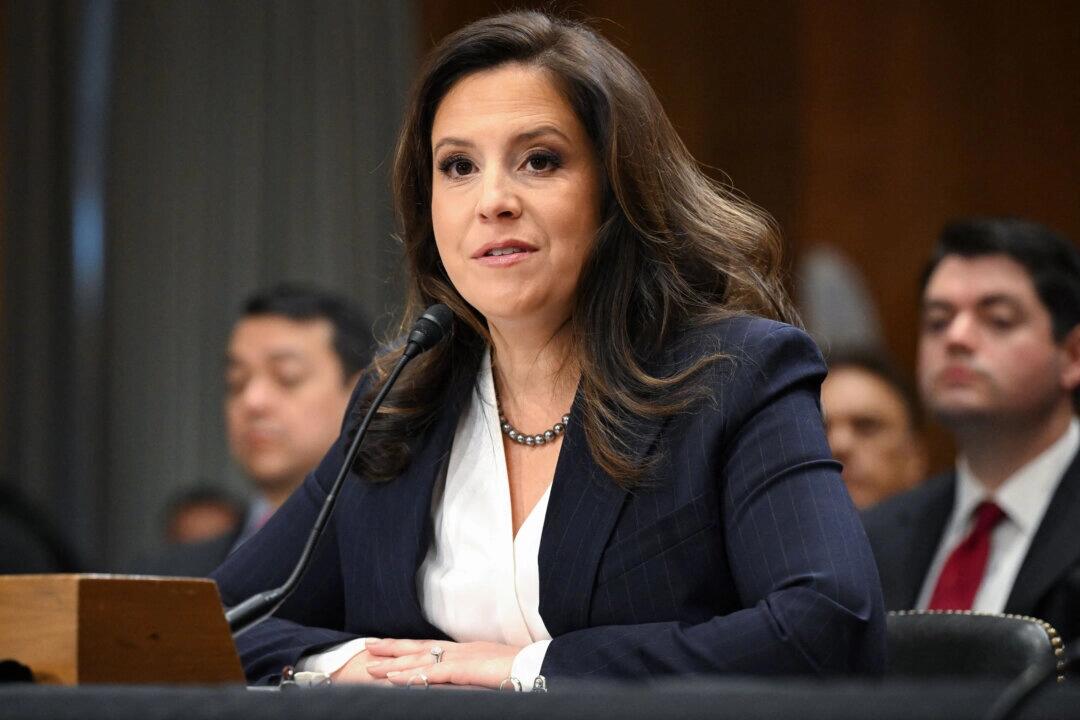
President Donald Trump has withdrawn the nomination of Rep. Elise Stefanik (R-N.Y.) to be U.S. ambassador to the United Nations.
 ?itok=y0qVcrbP
Trump https://truthsocial.com/@realDonaldTrump/posts/114235745233828789
on Truth Social on March 27, citing the narrow majority the GOP has in the House.
“As we advance our America First Agenda, it is essential that we maintain EVERY Republican Seat in Congress. We must be unified to accomplish our Mission, and Elise Stefanik has been a vital part of our efforts from the very beginning,” he wrote.
“I have asked Elise, as one of my biggest Allies, to remain in Congress to help me deliver Historic Tax Cuts, GREAT Jobs, Record Economic Growth, a Secure Border, Energy Dominance, Peace Through Strength, and much more, so we can MAKE AMERICA GREAT AGAIN.
“With a very tight Majority, I don’t want to take a chance on anyone else running for Elise’s seat.”
Trump said Stefanik will join his administration “in the future.”
The GOP has a narrow majority in the House as it looks to pass Trump’s legislative agenda.
The Epoch Times has reached out to Stefanik’s office for comment.
Stefanik served as the House GOP conference chairwoman. She stepped down from the role due to Trump nominating her to be ambassador to the U.N. She was succeeded by Rep. Lisa McClain (R-Mich.). Trump said Stefanik will rejoin House GOP leadership. It is unclear which role she would be in.
The Epoch Times has reached out to McClain for comment.
House Speaker Mike Johnson (R-La.) said Stefanik will be invited to rejoin House GOP leadership. What the role will be is unclear.
“It is well known Republicans have a razor-thin House majority, and Elise’s agreement to withdraw her nomination will allow us to keep one of the toughest, most resolute members of our Conference in place to help drive forward President Trump’s America First policies,” he wrote in a https://x.com/SpeakerJohnson/status/1905330013244915791
on social media platform X.
“There is no doubt she would have served with distinction as our ambassador to the United Nations, but we are grateful for her willingness to sacrifice that position and remain in Congress to help us save the country. I will invite her to return to the leadership table immediately.”
During her nomination hearing, Stefanik https://www.theepochtimes.com/us/in-nomination-hearing-stefanik-criticizes-anti-semitic-rot-in-un-5796356
what she said is the “anti-Semitic rot” at the U.N., given its stance toward Israel.
“The U.S. is the largest contributor to the U.N. by far,” she said. “Our tax dollars should not be complicit in propping up entities that are counter to American interests, anti-Semitic, or engaging in fraud, corruption, or terrorism.”
The committee advanced her nomination to the Senate floor by voice vote on Jan. 30.
Stefanik has been one of Trump’s staunchest allies in Congress. She was the first member of Congress to endorse his 2024 campaign.
She was first elected to represent New York’s 21st Congressional District in 2014. At that time, she was the youngest woman elected to Congress in U.S. history.
https://cms.zerohedge.com/users/tyler-durden
Thu, 03/27/2025 - 23:55
https://www.zerohedge.com/political/white-house-withdraws-stefanik-nomination-un-ambassador
A Blueprint For Dismantling The Fed
A Blueprint For Dismantling The Fed
https://mises.org/mises-wire/how-end-fed
So much has been written about why we should end the Federal Reserve, and with the recent public demand for an audit, the message has finally reached the masses. Hopefully, if such an audit manifests, it will be the first step toward ultimately dismantling the Federal Reserve. (We should start with the extremely shady Bank Term Funding Program). But very little has been written about how to end the Federal Reserve, and that is what I wish to address here.
 .jpg?itok=GSJveadq
The How
You may read through my proposed plan and disagree with me on the details. But we must agree on this point: The key objective is to minimize any fluctuations in the current money supply as best we can. This can be done in a delicate manner that might even go unnoticed by the market, outlined in 5 steps:
1. Revoke All Federal Reserve Monetary Policy Privileges
The Federal Reserve should no longer have the ability to directly manipulate the money supply. Repeal the Federal Reserve Act.
2. Lock Down All Debt Assets on the Federal Reserve Balance Sheet
This refers to all assets on the balance sheet with a contractual expiration, such as US Treasuries, mortgage-backed securities, and other loan types. These assets make up roughly 99 percent of the Fed’s balance sheet. Rather than selling them, they should be allowed to expire naturally over the next 30 years—the longest duration of USTs and MBSs. During this period, the Fed may still collect interest payments on these assets and reinvest them to prevent removing those funds from the monetary base.
3. Gradually Sell Off Non-Expiring Assets
Any assets on the Federal Reserve’s balance sheet that lack a contractual expiration should be sold off gradually over a period of 1 to 5 years. At present, I have been unable to find a reliable estimate of how much of this asset type exists, but I suspect it is relatively small—possibly less than a billion dollars.
4. The Federal Reserve Becomes a True Private Institution with No Special Legal Privileges
The Federal Reserve should operate as a fully private institution, stripped of any special legal banking privileges. Its only remaining advantages would be its established market position, its role in facilitating bank-to-bank lending, the interest payments from existing assets on its books, and its historical significance. This is far more than it deserves, but the primary objective must be to dismantle its power without triggering economic catastrophe.
5. If the Federal Reserve Cannot Function as a Private Bank
If the Federal Reserve fails to maintain its market position—which is likely, given that it has never truly faced competition—then major banks will need to determine among themselves how to facilitate interbank lending. They may assign central banking functions to other private institutions, operating within the limits of private banking law. Alternatively, the market may simply deem the Federal Reserve obsolete, allowing it to wither away naturally. Either outcome would be entirely acceptable.
The Balance Sheet Details
As of this writing, the Federal Reserve holds $6.8 trillion on its balance sheet. This follows a sharp 25 percent reduction from its previous $8.9 trillion over the past two years—a decrease of $2.1 trillion. In other words, the Fed initially printed $8.9 trillion and used this newly-created money to purchase assets in the market.
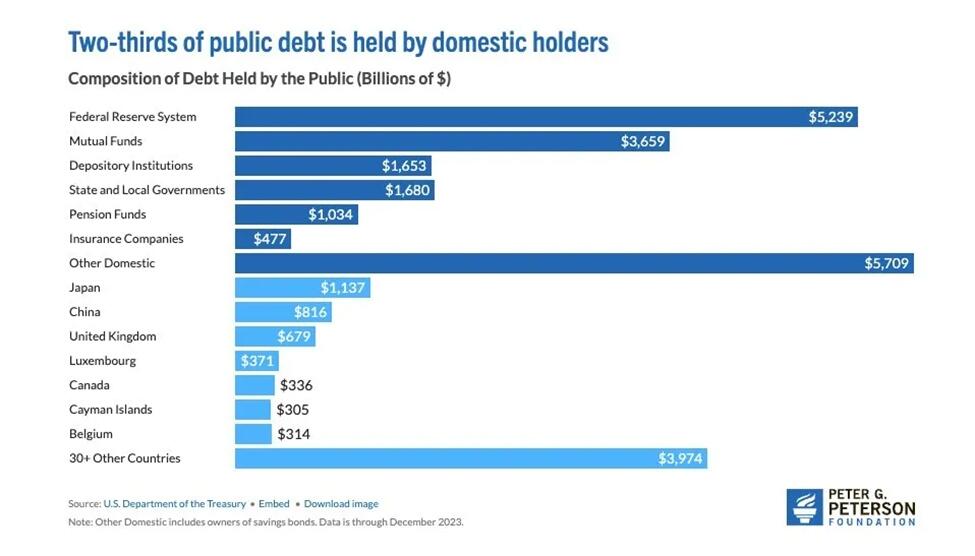
What has the Federal Reserve been buying? Primarily US debt. Our financial system functions like an ouroboros, with the Federal Reserve acting as a perpetual buyer of new government debt—funded by printed money. As of this writing, the Fed holds approximately $5 trillion of the national debt and artificially inflates domestic demand for it. Ending the Federal Reserve would severely restrict the government’s ability to create new debt, forcing a fundamental shift in government spending policy:
 ?itok=suYkBjWU
Fed Balance Sheet Composition
Currently, $4.2 trillion of the Federal Reserve’s balance sheet consists of US Treasury bonds (USTs), while another $2.2 trillion is made up of mortgage-backed securities (MBS). Together, these two asset classes account for $6.4 trillion, or about 94 percent of the total balance sheet. The remaining 6 percent is a mix of various other debt securities, including corporate debt, federal agency debt, and other loan types, all of which also have contractual expiration dates.
Natural Expiration of Debt Assets
Let’s consider the potential consequences of abandoning current monetary policy and requiring the Federal Reserve to let its debt assets naturally roll off the balance sheet. Debt contracts have expiration dates, meaning that once they reach maturity, they expire worthless and can simply be removed from the balance sheet without active intervention. This approach would gradually shrink the Fed’s holdings over time, reducing its influence on the financial system without the immediate shock of mass asset sales.
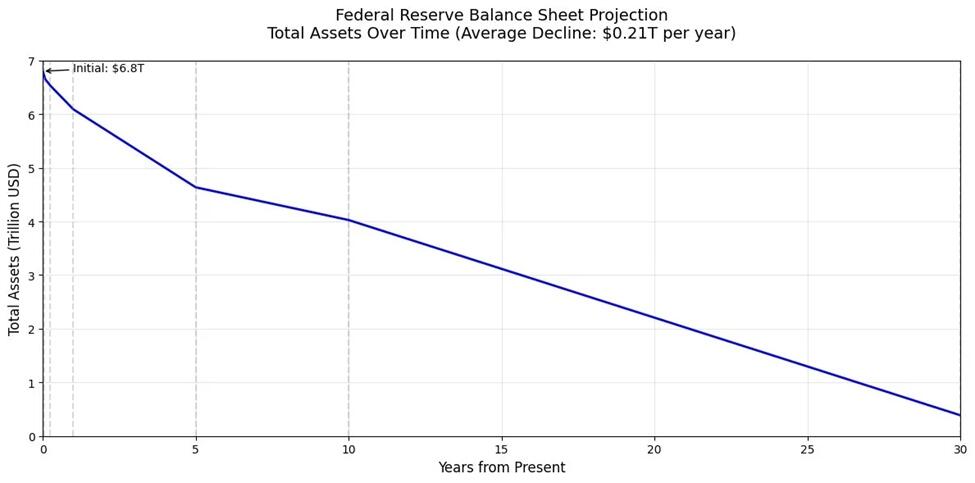
Here is a projection of the balance sheet over the next 30 years under this plan:
 ?itok=6pb3upZR
Projection of Assets Naturally Expiring on Fed Balance Sheet.
The debt expirations are front-loaded, meaning the Federal Reserve’s balance sheet would experience a sharp initial decline before tapering off over time. In the first year, we would see a significant 10 percent reduction, which would gradually level out to a 1.7 percent decrease per year. On average, the decline would be around 3.1 percent annually.
This projection assumes the Fed has purchased debt with an evenly distributed range of expiration dates across different maturity groups, which is likely accurate. In reality, the actual decline would be somewhat more volatile due to variations in the composition of the Fed’s holdings.
Not Quantitative Tightening
The key advantage of this approach is that it differs from traditional quantitative tightening. No funds would be actively removed from banks’ reserves—those reserves would remain at their current levels. Instead, the Federal Reserve’s balance sheet would shrink passively as debt assets naturally expire, avoiding the disruptive liquidity drain that comes with aggressive asset sales.
To fully understand this, a brief crash course in quantitative tightening (QT) is necessary. Admittedly, there is a certain genius to the way Federal Reserve monetary policy operates. When the Fed tightens, it sells assets from its balance sheet to primary dealers (large banks) on the open market. The Federal Reserve essentially functions as a “bank for big banks,” where major US banks store their reserves much like a savings account. These reserves not only remain at the Fed but also earn interest, just like a traditional savings account. This structure allows the Fed to influence liquidity in the financial system without directly impacting the day-to-day operations of commercial banks, making its monetary policy more indirect but highly effective.
When the Fed sells assets to primary dealers, it sells to banks that already have reserve accounts at the Fed. This means the money used to purchase these assets is already parked at the Federal Reserve. When the Fed either sells securities or allows them to mature without reinvesting, two things happen simultaneously: 1) the Fed’s assets decrease as the securities leave its balance sheet; 2) the bank’s reserve account at the Fed decreases by the same amount. These two changes cancel each other out, effectively removing that portion of the monetary base from circulation. This is how quantitative tightening (QT) functions—it contracts the money supply by destroying reserves, rather than directly pulling cash from the economy.
The key difference in my proposed approach is that the Fed would continue receiving interest payments on its remaining assets for the duration of their terms. The most realistic scenario is that these funds will be used to pay interest on reserves held by banks at the Fed, allowing normal banking operations to continue without disruption. However, unless the Fed finds an alternative revenue source, the interest on reserves rate can be expected to gradually decline over the next 30 years as assets roll off the balance sheet. This slow adjustment provides banks with ample time to determine how to manage their reserves in a post-Fed environment.
Inflationary vs. Deflationary Pressures
One likely outcome of this transition would be an increase in business investment by big banks. The interest on reserves paid by the Fed has historically discouraged banks from investing in the open market. From the bank’s perspective, why would I go make a risky investment into some startup, or some business which could hit rough waters and default, when I could just park my assets at the Fed and make a risk-free 4.4 percent? Basically, the Fed has been paying banks to not loan you money.
As the Fed’s ability to pay interest on reserves diminishes over time, banks would have a stronger incentive to deploy their capital elsewhere, likely fueling greater investment in businesses, loans, and other market-driven opportunities. This new pressure on banks to seek better investment opportunities within the first five years of this transition will create an inflationary counterbalance to the deflationary pressure that naturally comes with ending the Fed.
As banks shift their reserves into the market, increased lending and investment could stimulate economic activity, offsetting the contractionary effects of removing the Fed’s artificial demand for debt. This dynamic could help stabilize prices during the transition, preventing a sudden economic shock while still moving toward a more market-driven monetary system.
Conclusion
The ideal outcomes from this arrangement would be the following:
The Fed loses its extra-legal authority, operating solely as a private institution;
Direct central planning of interest rates ends, eliminating monetary supply manipulation;
Minimal fluctuation in the money supply, as bank reserves remain unaffected and the Fed continues receiving interest payments on its debt assets, preventing a liquidity drain;
Market stability, with little disruption to economic equilibrium;
Slight dollar appreciation, as the deflationary effects of ending the Fed are counterbalanced by banks investing their reserves;
No rush for banks to find alternative bank-to-bank lending solutions, ensuring a smooth transition;
No need to rewrite ACH payment systems, which currently rely on the Federal Reserve;
Greater urgency in reducing federal debt, as an appreciating currency increases the real debt burden;
A shift toward more prudent and productive financial behavior, as stronger purchasing power encourages saving and discourages reckless debt accumulation.
https://cms.zerohedge.com/users/tyler-durden
Thu, 03/27/2025 - 15:00
https://www.zerohedge.com/political/blueprint-dismantling-fed
Fed Urged To Bail Out Hedge Funds During Next Market Crash: Trillions In Basis Trades At Risk
Fed Urged To Bail Out Hedge Funds During Next Market Crash: Trillions In Basis Trades At Risk
Back in September 2019, when the Fed's aggressive tightening led to a sudden, catastrophic "repocalypse" when the lack of liquidity pushed overnight rates orders of magnitude higher and crushed levered Treasury cash-swap pair trades reliant on ultra-cheap funding (also known as basis trades ) there was a brief period of time when the world's largest multri-strat hedge funds such as Citadel, Millennium and Balyasny, who are exposed to hundreds of billions in basis trades, were on the verge of collapse. We described this in Dec 2019 in https://www.zerohedge.com/markets/fed-was-suddenly-facing-multiple-ltcms-bis-offers-stunning-explanation-what-really-happened
."
Several months later, when the same hedge funds were hammered by the double whammy of the covid crash, things hit a breaking point and had it not been for the Fed stepping in with unlimited multi-trillion repo operations and unleashing a massive $100BN+ monthly QE, the financial system would surely collapsed, as not just we but later Bloomberg also admitted. We discussed this in "https://www.zerohedge.com/markets/confirmed-fed-bailed-out-hedge-funds-facing-basis-trade-disaster
" where we reminded readers that "hedge funds such as Millennium, Citadel and Point 72 are not only active in the repo market, they are also the most heavily leveraged multi-strat funds in the world, taking something like $20-$30 billion in net AUM and levering it up to $200 billion. They achieve said leverage using repo."
We also quoted Morgan Creek CEO Mark Yusko who (correctly) said that "too big to fail is back, and this time it’s not the banks, it’s levered financial institutions." Yusko, who may have forgotten that the original Fed bailout was not of a bank but of an extremely levered hedge fund (LTCM), said he supported the Fed’s stepping in, but added that hedge fund firms have gotten too big by borrowing too much. “It’s a bailout,” Yusko said, https://www.zerohedge.com/markets/fed-was-suddenly-facing-multiple-ltcms-bis-offers-stunning-explanation-what-really-happened
in December.
It was a bailout, yet one which took place under the cover of the covid crash, when both the Treasury and the Fed jointly injected tens of trillions into the financial system and economy (the rest of the world joined too, in case anyone has forgotten what sparked the biggest inflation in 50 years), and without which the largest US hedge funds would no longer exist.
Unfortunately in the nearly six years since the first basis trade implosion... nothing has changed. This too we documented over time, with several notable timeline highlights below:
Ken Griffin using the HFT defense on his massive basis trades: "Look at all the basis points we are saving clients"... just bail us out again like you did in Sept 2019 and March 2020 please. https://t.co/VQkcXmP3TU
— zerohedge (@zerohedge) https://twitter.com/zerohedge/status/1717233410824196174?ref_src=twsrc%5Etfw
Why the non-strop regulatory freakout about the basis trade? The answer in two charts https://t.co/iytu85vIkR
— zerohedge (@zerohedge) https://twitter.com/zerohedge/status/1732461172476015045?ref_src=twsrc%5Etfw
basis trade leverage: from 20x to 56xhttps://t.co/esGiXp5VG4
— zerohedge (@zerohedge) https://twitter.com/zerohedge/status/1754922259389497732?ref_src=twsrc%5Etfw
Will $1 Trillion In Treasury Basis Trades Blow Up The Clearinghouses https://t.co/fb0d2xvuQ5
— zerohedge (@zerohedge) https://twitter.com/zerohedge/status/1828514098868355179?ref_src=twsrc%5Etfw
Will be hilarious if all the multi-strat HFs which are crushing their smaller peers and getting even bigger, end up in the same basis trades when we get another March 2020 TSY market lockup and everyone just LTCMs
— zerohedge (@zerohedge) https://twitter.com/zerohedge/status/1762310116399874548?ref_src=twsrc%5Etfw
And much more...
We bring up all of this because it's almost time for the Fed's next hedge fund bailout.
Bloomberg reports that a panel of financial experts advised the Fed to set up an emergency program that would close out highly leveraged hedge-fund trades "in the event of a crisis in the $29 trillion US Treasuries market."
According to the experts, a vicious unwinding of the roughly $1 trillion in hedge fund arbitrage bets would not only hamper the Treasuries market, but others as well, "requiring Fed intervention to assure financial stability." When the US central bank did that in March 2020, during the initial Covid crisis, it engaged in massive outright purchases of Treasury securities, to the tune of about $1.6 trillion over several weeks.
So, the thinking goes, since the Fed is powerless to regulate several multibillionaire hedge fund managers and rein them in, the next obvious action is to prepare trillions in taxpayer funds for another massive bailout enema, and leave them on the hook for trillions in capital just so the billionaires can keep on billionaireing.
For those asking who is behind these basis trades, we share our updated chart of hedge fund leverage among the 6 largest multi-strat funds, all of whom are known to aggressively participate in basis trades. As seen below, the regulatory capital of just the "Big 6" multistrats - Millennium, Citadel, Balyasny, Poin72, ExodusPoint and Lighthouse - is a record $1.5 trillion, an increase of $300 billion from the previous year.
What is far more scary is that the average regulatory leverage, or the ratio of regulatory assets (i.e., levered exposure) to assets under management (or actual, tangible capital), has increased to a record 7.8x from 6.3x a year ago!
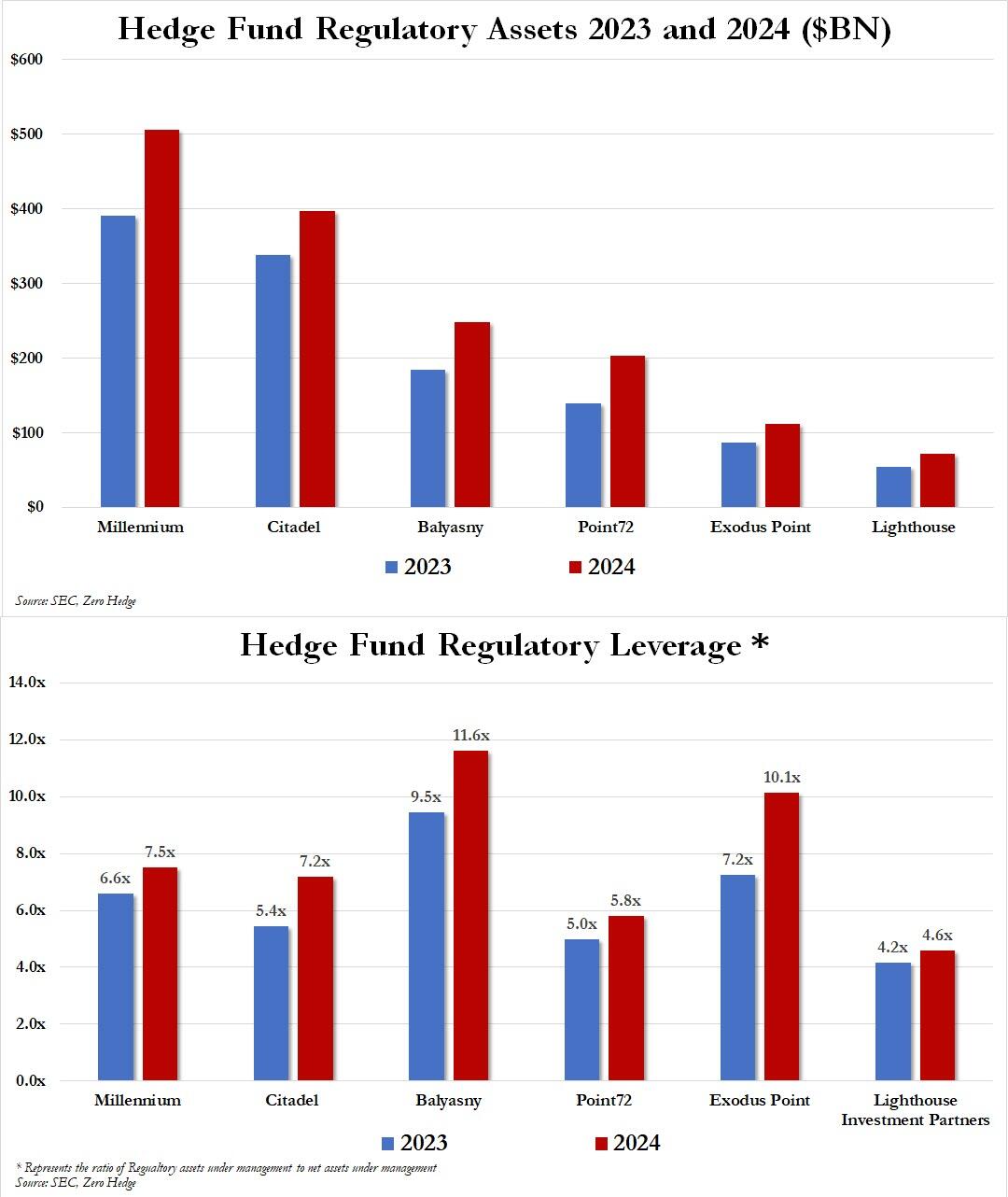 ?itok=FfvvtB9r
And for those wondering why a blow up in the $1 trillion basis trade would almost certainly require a Fed bailout, it's because the inherent leverage in going long cash and shorting futures is anywhere between 20x, according to the https://home.treasury.gov/system/files/221/TBACCharge1Q12024.pdf
...
 ?itok=DwPWF0SH
... and a stunning 56x, according to the https://www.federalreserve.gov/econres/notes/feds-notes/hedge-fund-treasury-exposures-repo-and-margining-20230908.html+
itself.
 ?itok=HUYNoODm
It is against this background that plans for the next hedge fund bailout are already swirling. Bloomberg reports that one proposed intervention would be via hedged bond purchases, according to a Brookings Institution paper by Anil Kashyap at the University of Chicago, Harvard University’s Jeremy Stein — a former Fed governor, Harvard Business School’s Jonathan Wallen and Columbia University’s Joshua Younger.
“If the Fed is tempted to buy again, we’d rather they do that on a hedged basis,” Stein told reporters in a briefing on the paper, which was released late Wednesday. This approach “can be a valuable addition to the policy toolkit” at the Fed, the authors wrote in the paper.
Echoing what ZeroHedge readers have known for over a decade, Bloomberg documents that the key source of risk to address is the so-called basis trade, where hedge funds seek to profit from tiny price gaps between Treasuries and derivatives known as futures. Kashyap also echoed what we have been saying for years, that the basis trade "is a pretty concentrated trade,” involving perhaps 10 hedge funds or fewer.
If hedge funds need to unwind their basis pair trade positions quickly, similar to what they did in Sept 2019 and March 2020 when the move itself crippled the entire bond market, the danger is that bond dealers will not be able to handle the enormous sudden volume of transactions. And consider this: when the Fed had to intervene in 2020, the basis trade was roughly $500 billion in total — less half today’s figure.
“To relieve the stress on dealers, it would be sufficient for the Fed to take the other side of this unwind – purchasing Treasury securities, and fully hedging this purchase with an offsetting sale of futures,” the authors wrote.
Ironically, the paper recognized that “bailing out hedge funds” - similar to what the Fed did after LTCM, after the Sep 2019 repocalypse and again in the depths of the covid crash, would raise questions, including moral hazard, where the existence of the facility could potentially encourage hedge funds to take on even more risk.
“The basis of comparison shouldn’t be ‘no moral hazard,’” Stein said. That’s because the 2020 example of outright purchases is already part of the Fed’s record. Simple purchases of Treasuries involve their own costs. They remove “duration” from the Treasuries market, because the Fed is buying securities maturing over time and creating bank reserves, which carry an overnight interest rate. That can blur the line between financial-stability operations and monetary policy, the authors highlighted.
The cost of massive Fed Treasuries purchases is also seen in the diminished remittances from the US central bank to the Treasury, they noted. Amusingly, the US central bank is still unwinding its bond purchases, known as quantitative easing, from the 2020-2022 period... when it last bailed out the billionaire multi-strat hedge funds!
“Purchases are an inelegant way to proceed,” Kashyap said on the reporter call Tuesday. “Buying looks a lot like QE and probably influences term premia,” he said, referring to the extra yield investors demand for longer-term securities versus just rolling over short-term ones. Another advantage is that it’s basically self-liquidating — removing questions about the timing of future bond sales or a new quantitative tightening regimen. It also protects the Fed from taking on interest-rate risk.
He is right, and yet when the next crash happens (one of those not if but when things), QE is precisely what the Fed will use again, because it is a known and effective way of bailing out the entire financial sector. On the other hand, trying to convince markets that some sterilized, "hedged" trade will have the same firepower as stocks are puking 10% per day, is a shortcut to the financial apocalypse.
The authors were so enamored in their thought experiment of bailing out hedge funds without someone bailing out hedge funds, they argued that a basis purchase facility wouldn’t be “that far afield from current open market operations.” The Fed already engages in repo transactions, either through standing facilities or open market operations. Because basis trades involve a spot purchase and future sale, they are “conceptually very similar” to repo transactions — the only difference being different counterparties for the purchase and sale, according to the paper.
Right... the only difference is that repo operations are used by everyone in the market, directly and indirectly, while basis trades only serve to pick the proverbial penny in front of steamrollers, and the only ones profiting from this are "less than 10 hedge funds." Might as well put all taxpayers on the hook for when this trade eventually blows up, why not/
The legality of such a new facility “is an important question but beyond the scope of this discussion,” the authors wrote.
Policymakers in recent years have put forward suggestions to improve Treasury market functioning, ranging from adjusting bank regulations that impair dealer capacity, the creation of a Standing Repo Facility where the Fed could lend directly to hedge funds and imposing minimum margin requirements for repo-financed Treasury purchases. A mandate for central clearing for Treasuries and repo is set to take effect Dec. 31, 2026.
“Hedge funds are in a very aggressive position, where a relatively small move in the basis could push them out,” Stein said. “It doesn’t look like the dealers are super well positioned to handle this.”
Here, for once, the paper authors are spot on for one simple reason: we said all of this more than a year ago...
btw this is where the next really big crash will start https://t.co/XcK2RezYEk
— zerohedge (@zerohedge) https://twitter.com/zerohedge/status/1752849551138926710?ref_src=twsrc%5Etfw
https://cms.zerohedge.com/users/tyler-durden
Thu, 03/27/2025 - 14:40
Judge Declines Trump Admin Request That She Recuse Herself From Perkins Coie Case
Judge Declines Trump Admin Request That She Recuse Herself From Perkins Coie Case
A federal judge has declined a request by the Trump administration that she remove herself from overseeing a lawsuit challenging an executive action targeting Perkins Coie LLP, accusing the Justice Department of attacking her character in an effort to undermine the integrity of the judicial system.
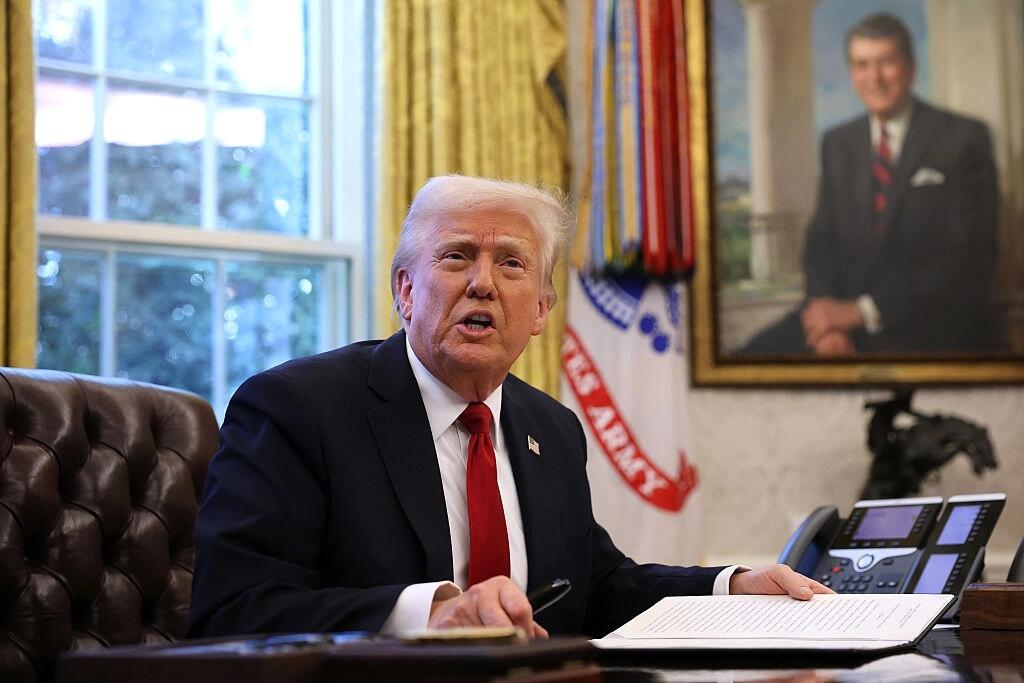 ?itok=3PSxwIWP
U.S. District Judge Beryl Howell wrote in a March 26 ruling that a Trump administration filing seeking her recusal was “rife with innuendo” and that none of the claims it put forward “come close to meeting the standard for disqualification.”
“Though this adage is commonplace, and the tactic overused, it is called to mind by defendants’ pending motion to disqualify this Court: ‘When you can’t attack the message, attack the messenger,’” U.S. District Judge Beryl Howell wrote in a March 26 ruling.
President Donald Trump’s https://www.whitehouse.gov/presidential-actions/2025/03/addressing-risks-from-perkins-coie-llp/
issued on March 6 prevents law firm Perkins Coie from doing business with federal contractors and blocks its lawyers from accessing government officials.
Additionally, it suspends any active security clearances held by individuals at the firm, pending a review of whether such clearances are consistent with the national interest.
Perkins Coie was hired by Hillary Clinton’s presidential campaign and the Democratic National Committee in 2016.
According to the presidential action issued by Trump, the law firm has engaged in “dishonest and dangerous activity” that has affected the United States “for decades.”
the administration over the order in federal court in Washington on March 11, alleging Trump’s actions violated its rights under the U.S. Constitution.
Roughly a week after Trump’s executive action was first issued, Howell temporarily blocked the administration from enforcing much of it, finding the law firm was likely to win its lawsuit.
Last week, the Department of Justice (DOJ) https://www.theepochtimes.com/us/doj-wants-judge-removed-from-case-challenging-trumps-executive-order-5829482
for the case to be moved to another judge in Washington’s federal court, citing Howell’s public comments about the president and her connection with key aspects of the case.
“This Court has not kept its disdain for President Trump secret,” Chad Mizelle, acting associate attorney general at the DOJ, wrote in a motion seeking her disqualification.
“It has voiced its thoughts loudly—both inside and outside the courtroom.”
Speaking inside the court, Mizelle also pointed to now-former special counsel Jack Smith’s prosecution of Trump, during which he said that Howell found “reason to believe that the former President would ‘flee from prosecution.’”
The judge also “pierced attorney-client privilege, ordering President Trump’s attorney to testify before a D.C. grand jury” investigating his alleged retention of classified documents in the South Florida case, he said.
Mizelle added that Howell also previously rejected Trump’s view that the indictments against individuals involved in the Jan. 6, 2021, breach of the U.S. Capitol were a “national injustice” and called his supporters “sore losers.”
In her 21-page ruling, Howell wrote that when the DOJ “engages in this rhetorical strategy of ad hominem attack, the stakes become much larger than only the reputation of the targeted federal judge.”
“This strategy is designed to impugn the integrity of the federal judicial system and blame any loss on the decision-maker rather than fallacies in the substantive legal arguments presented,” she added.
The judge said she welcomed the Trump administration’s opportunity “to set the record straight, because facts matter.”
“Every litigating party deserves a fair and impartial hearing to determine both what the material facts are and how the law best applies to those facts,” she wrote.
“That fundamental promise, however, does not entitle any party—not even those with the power and prestige of the President of the United States or a federal agency—to demand adherence to their own version of the facts and preferred legal outcome.”
“The clear absence of any legitimate basis for disqualification requires denial” of the DOJ’s request that she recuse herself from the case, the judge said.
Howell is set to decide in the coming weeks whether to extend her block on Trump’s order against Perkins Coie.
The Epoch Times has reached out to Perkins Coie for comment.
https://cms.zerohedge.com/users/tyler-durden
Thu, 03/27/2025 - 14:25
Bankrupt 23andMe Cleared By Judge To Sell Americans' DNA Data To Highest Bidder
Bankrupt 23andMe Cleared By Judge To Sell Americans' DNA Data To Highest Bidder
Let's start with this week's chaotic events surrounding the bankrupt genetic testing startup, 23andMe Holding Co.:
Wednesday: https://www.zerohedge.com/technology/23andme-customers-panic-delete-genetic-data
Fast-forward to Thursday: https://www.bloomberg.com/news/articles/2025-03-26/bankrupt-23andme-s-dna-data-gets-nod-for-sale-as-concerns-linger
reports the worst fear for 15 million 23andMe customers: US Bankruptcy Judge Brian C. Walsh has granted the defunct genetic testing startup permission to sell its massive genetic database, potentially ending up in the hands of private equity firms that will find new ways to monetize the sensitive data.
 ?itok=CMZkg5V1
Here's more from the report:
Under the sale procedures, the company set quick deadlines for potential bidders, including May 7 when definitive offers are due, and a final hearing the following month.
But US Bankruptcy Judge Brian C. Walsh required the company to slow the overall pace by two weeks, in part to accommodate his schedule and in part to give creditors a chance to weigh in before the court makes a final decision on a buyer.
"My overall reaction to the timeline is that it's pretty tight," Walsh said at the company's first bankruptcy hearing, held in St. Louis. At his request, the company agreed to push back the final court hearing for possible sale from June 2 to June 17.
Walsh's ruling didn't resolve concerns raised by the looming auction of the sensitive data or complaints from shareholders about the months 23andMe spent trying to find a buyer before filing for court protection earlier this week.
. . .
Walsh at the hearing said speed in the sale process is partly justified because the company spent so much time trying to find a buyer before it filed bankruptcy. But the goal, he added, should be to "balance the desire to move quickly with the desire to avoid collateral damage."
More color:
Carole J. Ryczek, a lawyer with the US Trustee's office, which acts as a public watchdog in bankruptcy court, told Walsh that a privacy ombudsman is necessary to oversee the sale of customers' private genetic information.
The bankruptcy case "needs a neutral third party" involved in the sale process to protect customers, Ryczek said. Company lawyers and company investment bankers declined to comment on the value of the customer data.
Walsh declined to say whether he would support a consumer privacy ombudsman, or how he would respond to a demand by two investors that he appoint an official committee to represent shareholders. Those shareholders complained about how the company tried to sell itself before filing for court protection.
23andMe lawyer Grace Hotz argued that an ombudsman was unnecessary because of the extensive privacy policies. Under the US Bankruptcy Code, companies cannot sell personally identifiable information about a consumer unless the sale conforms to the firm's privacy policies or until after an ombudsman is appointed.
23andMe's shares in New York have been on a rollercoaster—from the bankruptcy news that sent them crashing below $1 at the start of the week to erupting as much as 158% earlier today after the judge granted the defunct startup permission to sell customer data...
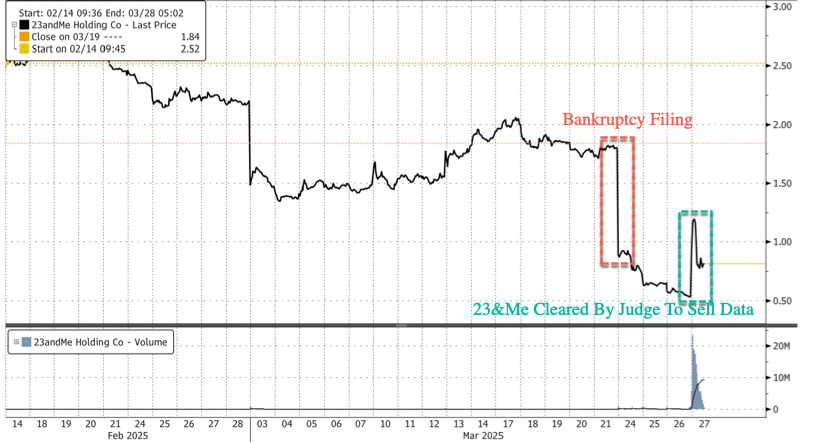 ?itok=F3hlC1s_
The takeaway for consumers is to never hand over your biometric data to corporations, the government, or anyone else—those who did are now on a list that will be sold to the highest bidder.
https://cms.zerohedge.com/users/tyler-durden
Thu, 03/27/2025 - 14:05
Is DOGE Winning? Continuing Jobless Claims In DC Highest Since 2021
Is DOGE Winning? Continuing Jobless Claims In DC Highest Since 2021
Headline initial jobless claims rose by 224k last week - a very boring, very steady, very non-recessionary signal that the labor market is just fine despite all the partisan panic in 'soft' data surveys...
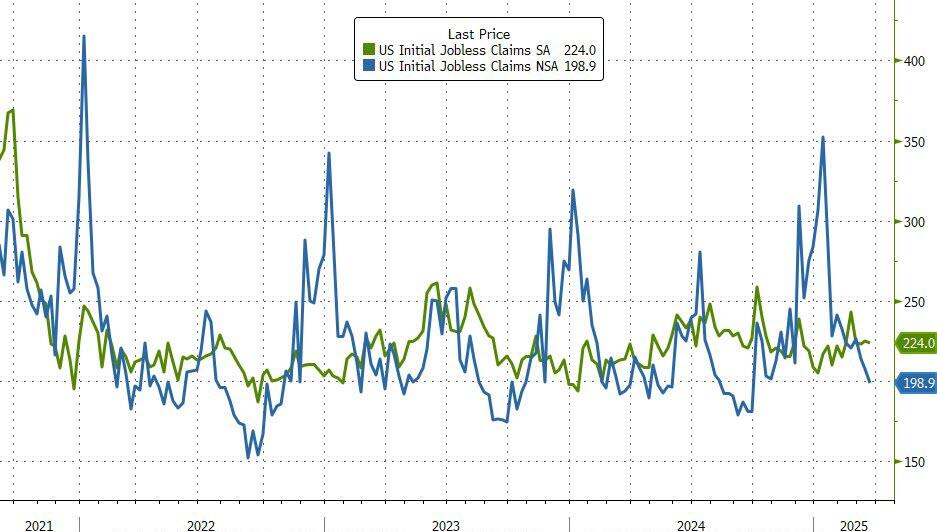 ?itok=qqP8CFFy
Michigan and Texas saw the biggest decline in jobless claims last week, while Oregon and Kentucky saw the biggest increase...
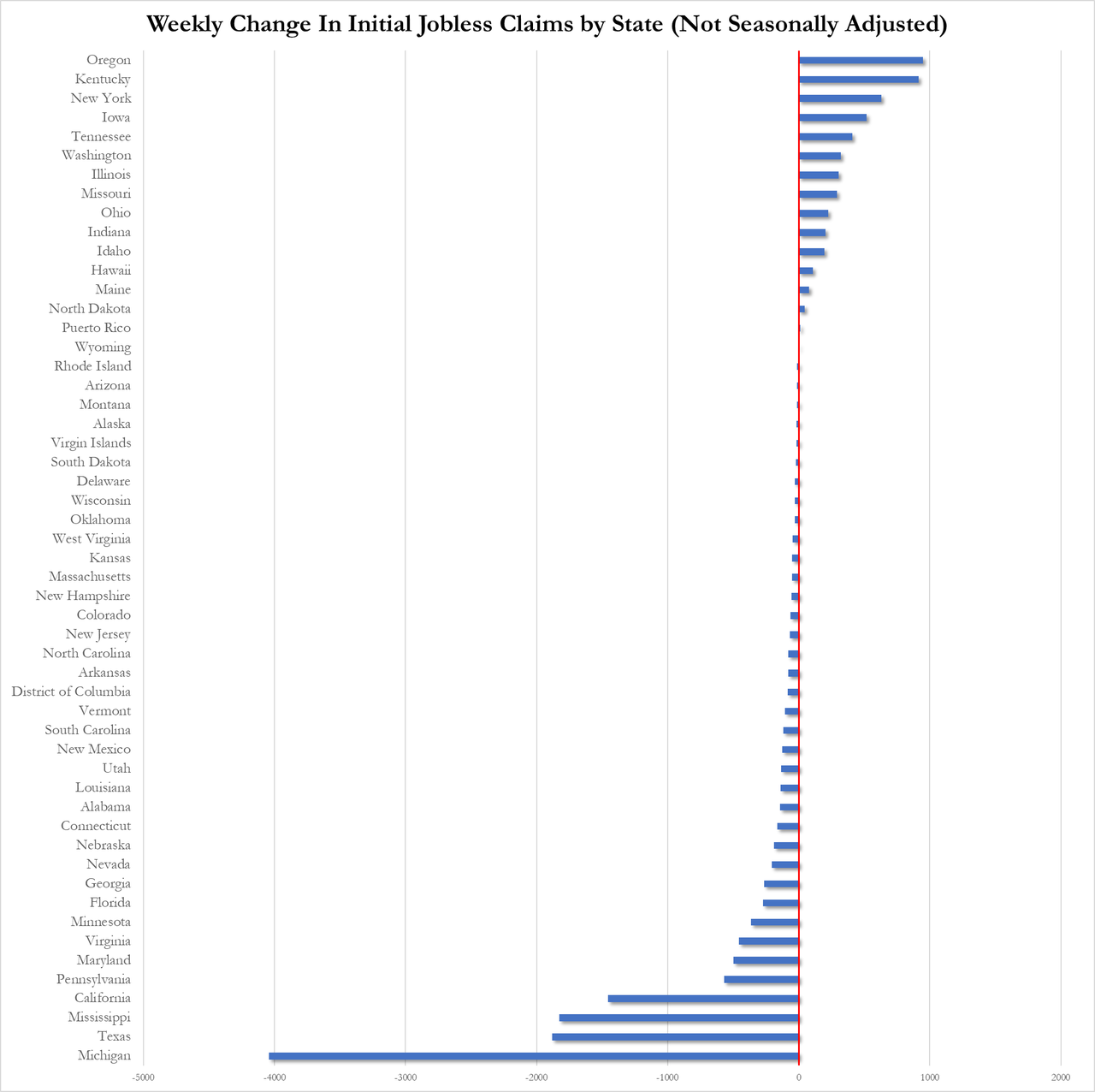 ?itok=A_LVo5jr
Nationwide continuing jobless claims continue to oscillate around 1.9 million Americans...
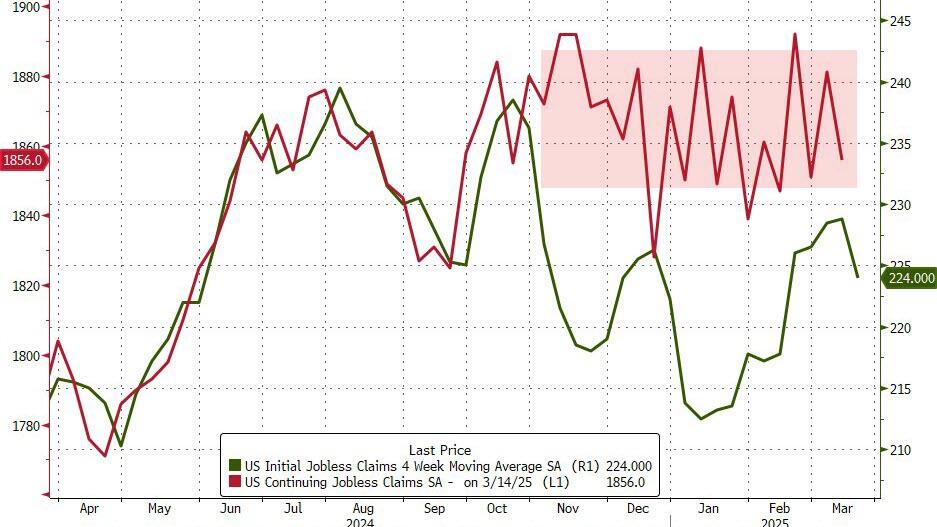 ?itok=rTDchuYS
Of course, all eyes are on DC and the impact of DOGE. While initial jobless claims are slowing in the region (as a multitude of lawsuits stall the process of draining the swamp)...
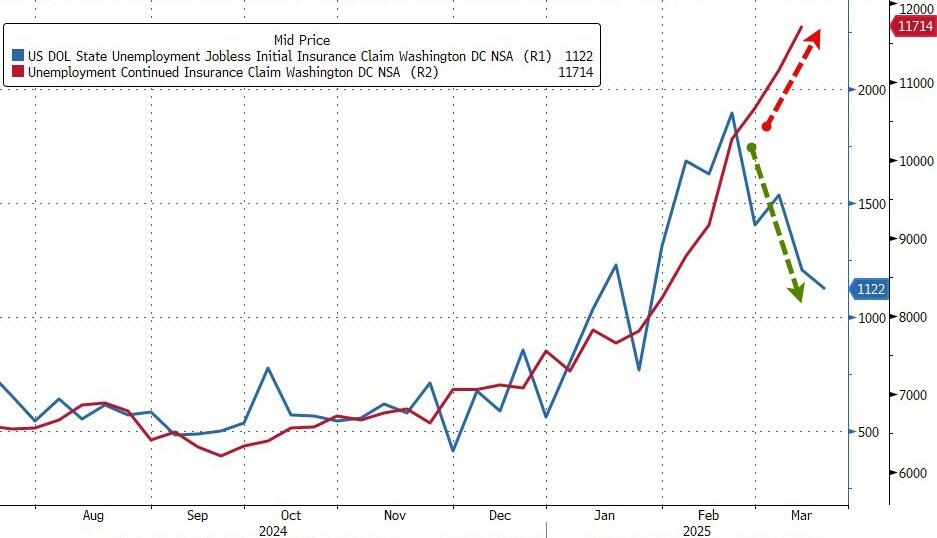 ?itok=1WbXYmsc
...we note that continuing jobless claims in DC are now at their highest since 2021...
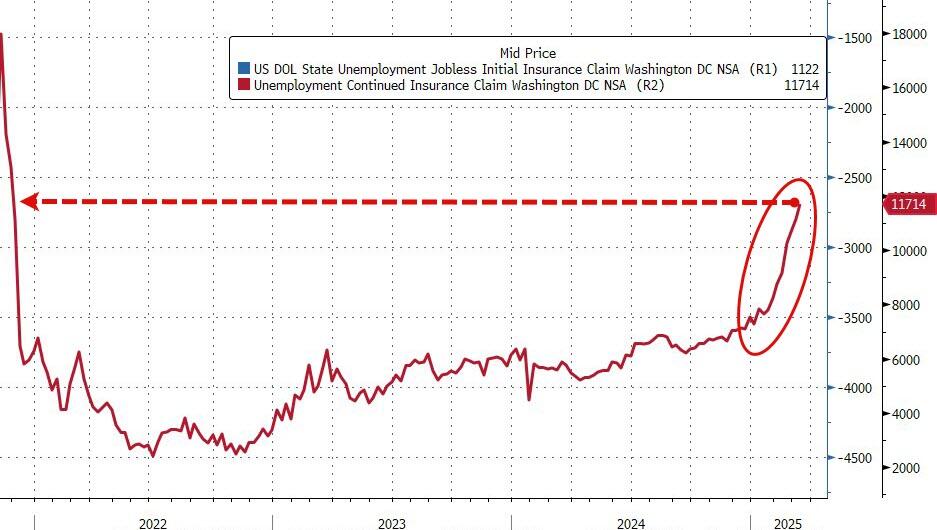 ?itok=LNn0JtN0
So, is DOGE winning?
https://cms.zerohedge.com/users/tyler-durden
Thu, 03/27/2025 - 08:42
https://www.zerohedge.com/political/doge-winning-continuing-jobless-claims-dc-highest-2021
Global Markets Slide Spooked By Trump Auto Tariffs
Global Markets Slide Spooked By Trump Auto Tariffs
US stock futures faded earlier gains, but were also off session lows after a tariff-driven selloff in equities on Wednesday which hit the Mag7 names. Futures on the S&P 500 are flat after Trump announced 25% uniform tariffs on auto imports, while Nasdaq futures dropped 0.3% amid a reversal of the Monday price action as investors seem to be back to the recession playbook ahead of April 2 announcement. Mag 7, Cyclicals and High Short Interest are among the worst performing baskets, while Defensives outperformed. AI and data center names faced a slew of negative catalysts so far this week, including NVDA’s China environmental curbs, sell-side report on MSFT lease cancellation, BABA’s comments earlier this week: NVDA-5.7%; JPM's Data Center basket -3.0%. Commodities are higher led by oil and base metals. Outside the US, China ADRs outperformed US domestics with KWEB up 54bps today as China PBOC adviser promised (once again) that China will ramp up stimulus if growth falters.
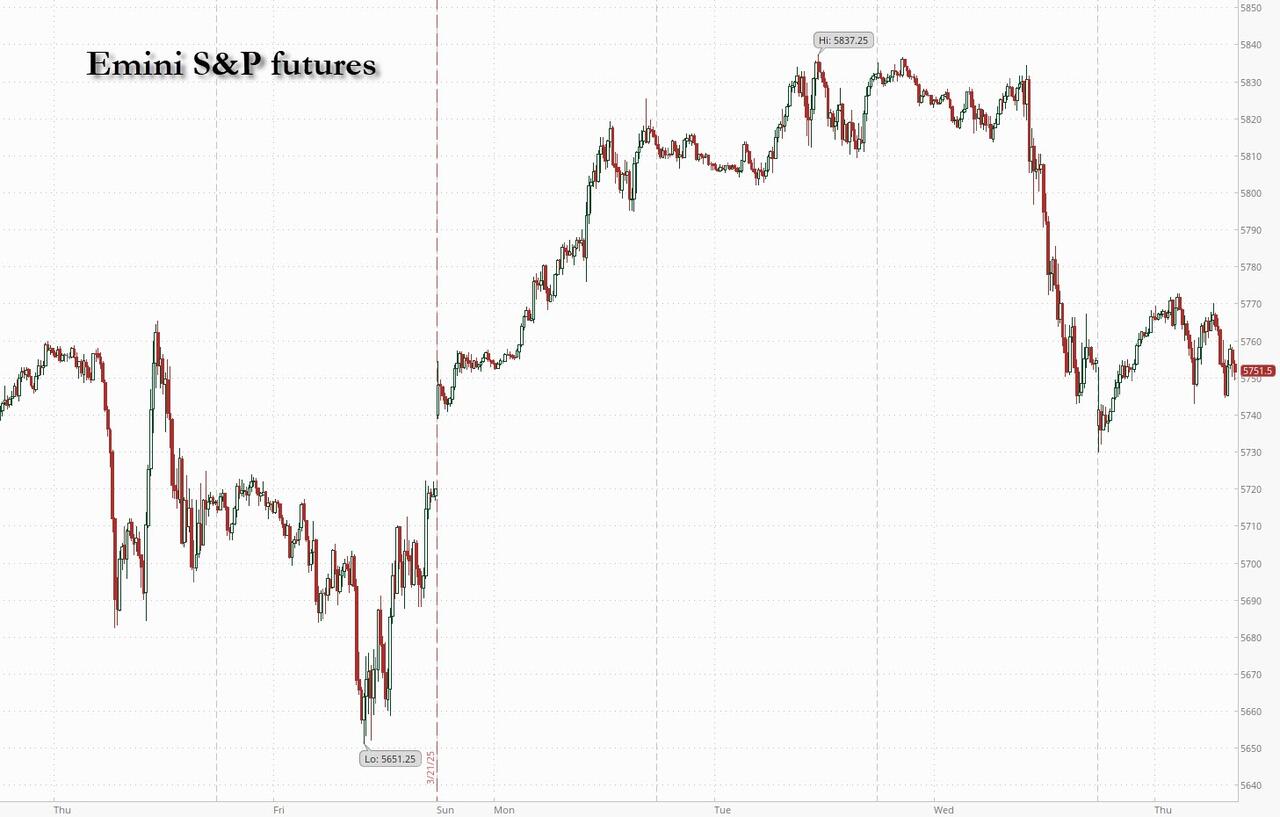 ?itok=HjNcry7B
In premarket trading, shares of US automakers and auto-parts suppliers dropped with peers in Europe also declining following Trump’s tariff announcement. Gamestop fell as the company said it plans to offer convertible bonds to buy Bitcoin. Nvidia slips, leading Mag7 declines and extending losses into a third straight session amid growing concerns over the outlook for spending on AI (Alphabet -0.3%, Amazon -0.3%, Apple -0.4%, Microsoft -0.1%, Meta -0.5%, Nvidia -1.7% and Tesla +0.5%). Automaker stocks fall after President Donald Trump hit auto imports with a 25% tariff starting next week. Analysts say Ford and General Motors are set to see the biggest impact, while Stellantis and Tesla are in a better position (General Motors -6%, Ford -0.7%, Stellantis’s US-listed shares -1.6%; Auto-parts firms: Autoliv -3%, Magna -1.8, BorgWarner -0.7%). Here are some other notable premarket movers:
3D Systems (DDD) falls 5% after the 3D-printing company issued annual forecasts for revenue and adjusted gross margin that trailed Wall Street expectations.
AMD (AMD) slips 3% after Jefferies downgraded the chipmaker to hold, with analysts citing limited traction in artificial intelligence among other negatives.
Cava Group (CAVA) climbs 2% as the company will replace Altair Engineering Inc. in the S&P MidCap 400 effective prior to the opening of trading on March 31.
Coursera (COUR) falls 2.2% after Bank of America resumed coverage of the online educational firm with an underperform rating, citing a “muted” 2025 revenue growth outlook.
GameStop (GME) drops 6% as the company seeks to sell $1.3 billion of convertible bonds to fund Bitcoin purchases as it embraces a strategy that was developed by the cryptocurrency advocate Michael Saylor.
Jefferies (JEF) slips 5% after fiscal first-quarter earnings declined amid a drop in investment-banking and capital-markets revenue, with activity hurt by uncertainty around US policy and geopolitics.
MicroVision (MVIS) falls 5% after the electronics components company reported fourth-quarter revenue that trailed Wall Street projections and a wider-than-anticipated loss.
Petco Health and Wellness (WOOF) gains 6% after the retailer provided a 1Q forecast for adj. Ebitda that topped expectations and said the company expects double-digit improvement in the metric this year.
Robinhood Markets (HOOD) climbs about 1% after the financial services platform introduced several new products at a Wednesday event, including Robinhood Strategies, Robinhood Banking and Robinhood Cortex.
Soleno (SLNO) jumps 36% after the biotech won US FDA approval for its Vykat extended-release tablets for the treatment of a condition where sufferers have a sense of being hungry all the time.
Verint (VRNT) drops 12% after the customer-service software firm reported adjusted revenue and profits for the fourth quarter that fell short of Wall Street’s expectations.
Worries over President Donald Trump’s tariffs hit markets again on Wednesday, with the S&P 500 halting a three-day win streak to close down 1.1%. Trump implemented a 25% levy on auto imports, while threatening further duties on the EU and Canada. The S&P 500 fell 10% between February and March over concern that harsher tariffs will lead to slower economic growth and higher inflation. The index then staged a mild recovery since hitting a low on March 13, but now all eyes are on the so-called reciprocal tariffs, with details due on April 2, the so-called "Liberation Day."
“Tariffs are front and center on people’s minds,” said Arun Sai, senior multi-asset strategist at Pictet Asset Management. “We all know that tariffs are stagflationary and markets have been trying to price that to different extents. What we don’t know yet is what’s the ultimate lasting impact.”
The tariff drama is also casting doubt over European equities’ recent outperformance against US peers. Pictet’s Sai has downgraded his view on Europe, citing an inevitable hit to economic growth and earnings. Over at BlackRock Investment Institute, managers expect US stocks to soon regain their edge.
“We have been overweight global equities over fixed income for many, many quarters – even as valuations looked increasingly stretched. But for the first time in years, we find ourselves genuinely worried about risk assets,” said Ajay Rajadhyaksha, global chairman for research at Barclays. “Cash allocations should be higher until policy clarity stages at least a mild comeback.”
Technology stocks have come under heavier pressure in recent sessions, as investors question how much longer will the artificial intelligence boom cycle last. Such anxiety resurfaced on Wednesday after a team of TD Cowen analysts said Microsoft Corp. has walked away from new data center projects in the US and Europe.
European stocks also fell as the US pushed ahead with harsh tariffs on automakers and threatened more sweeping trade levies, reinforcing investor concern about the hit to global economic growth. The Stoxx 600 slid 0.5%. Stellantis NV, which makes the Jeep Compass SUV in Mexico, and Mercedes-Benz Group AG fell about 3%. Traders also sold US auto shares, with General Motors Co. tumbling 6% in pre-market trading. Here are some of the biggest movers on Thursday:
Next shares rise as much as 9% after the UK fashion retailer said it’s made a stronger-than-expected start to the new year and boosted its profit guidance.
Umicore shares rise as much as 11% after the materials technology company outlined ambitious targets for 2028, with its earnings goal coming in above analyst expectations.
Coor shares gain as much as 6.1% after the Swedish facility services firm’s price target was raised to SEK52 from SEK48 at DNB.
Sofina advances as much as 3.3% after releasing its full-year results, with KBC Securities subsequently boosting its price target and saying this is the year in which the investment company “bounces back.”
European auto stocks fall after President Donald Trump announced a “permanent” 25% tariff on any car not produced in the US.
UBS shares fall as much as 5.6% as Bank of America downgrades the lender to underperform, saying the lack of clarity on regulation is likely to drag on for months.
Air France-KLM, EasyJet shares fall as Deutsche Bank downgrades the stocks. The bank cuts earnings forecasts for firms across Europe’s transport sector, noting near-term downside risks to GDP for the US and Europe.
MFE shares dropped as much as 7.2% in Milan, before paring declines, after the company owned by Italy’s Berlusconi family launched a tender offer on ProSiebenSat.1 Media in a bid to tighten its grip over the German entertainment company.
Trigano shares drop as much as 15%, the most since 2021, after the maker of motorhomes and leisure vehicles reported a steeper fall in quarterly revenue than anticipated.
eDreams falls as much as 18% after a shareholder offloaded shares in the firm at a discount to yesterday’s close.
Kontron shares dive as much as 6.2%, the most in over two months, after the German IT firm experienced a more challenging fourth-quarter than anticipated, according to analysts.
Asian equities edged lower as President Donald Trump’s auto tariffs and threat of more levies on Europe and Canada weighed on sentiment. Chinese shares advanced. The MSCI Asia Pacific Index fell as much as 0.6% before paring the loss, with benchmarks in South Korea and Taiwan underperforming. Toyota Motor slumped following Trump’s decision to slap 25% tariffs on all cars that aren’t manufactured in the US. TSMC was the biggest drag on the gauge after a report that China’s energy rules for advanced chips could dent Nvidia’s sales. Asian equities have been range-bound recently as traders brace for Trump’s renewed tariff offensive to land on April 2. For the month, the MSCI Asia benchmark has gained nearly 3% and is headed for its best monthly performance since September. Benchmarks on Chinese and Hong Kong stocks rallied before ending the day with modest gains of around 0.3%. Optimism over China’s AI breakthrough and supportive macro policy has helped the market beat peers this year.
In FX, the dollar slipped as investors weighed the possibility that President Trump’s latest tariffs could limit the country’s growth potential, although the realty is that the tariffs will lead to a recession elsewhere much faster. The Bloomberg Dollar Spot Index slipped 0.1%, reversing the previous day’s 0.3% gain. JPY and CAD are the weakest performers in G-10 FX, while GBP and NZD are outperforming. Trump “could be recognizing that his trade policies might be having a ricocheting effect on the US consumers and business owners,” said Fiona Lim, a senior strategist at Malayan Banking Bhd in Singapore. “That makes US dollar gains susceptible to reversal." USD/JPY rose 0.3% to 150.97, outperforming as the Trump’s latest announcement to slap a 25% tax on Japanese auto imports hit home the prospect that the Japanese economy will suffer from tariffs, keeping the Bank of Japan cautious on raising interest rates. Earlier, the Norwegian krone recovered losses versus the euro after Norges Bank delayed a cut in borrowing costs until later this year as inflation picked up. Elsewhere in Asia, Indian stocks rose ahead of the expiry of monthly derivative contracts. The Nifty 50 Index is on pace for its biggest monthly advance since at least June 2024.
In rates, the 10-year Treasury yield rose 4bps to 4.39% after St Louis Fed President Musalem stuck to the central bank’s position that it is in no hurry to keep cutting rates, while voicing concerns that trade levies will fan inflation. Musalem said it’s not clear the impact of tariffs will prove temporary, and cautioned that secondary effects could prompt officials to hold interest rates steady for longer. Euro-area bond yields slipped as expectations grew that the central bank will cut interest rates to cushion the fallout from trade-related shocks; German 10-year yields have nearly erased their drop and are at 2.78%. UK bonds slumped across the curve, underperforming US Treasuries and German bunds, amid lingering concerns over the government’s fiscal position. UK 10-year yields are up 7 basis points to 4.80%, and at the highest since January. Focal points of US session include $44 billion 7-year note auction at 1pm New York time and economic data slate including weekly jobless claims and final 4Q GDP revision.
In commodities, WTI crude is trading within Wednesday’s range, falling 0.1% to around $69.56. Spot gold is up roughly $35 to near $3,055/oz. Gold has been benefiting from haven demand. Goldman Sachs Group Inc. ramped up its forecast to $3,300 an ounce by year-end, the latest in a series of banks to up their prediction. Bitcoin has risen to above $87,000.
The US economic calendar includes 4Q GDP revision, February wholesale inventories, and weekly jobless claims (8:30am), February pending home sales (10am) and March Kansas City Fed manufacturing activity (11am). Fed speaker slate includes Barkin and Collins (both 4:30pm)
Market Snapshot
S&P 500 futures little changed at 5,756.00
STOXX Europe 600 down 0.8% to 544.30
MXAP down 0.1% to 188.48
MXAPJ down 0.2% to 588.03
Nikkei down 0.6% to 37,799.97
Topix little changed at 2,815.47
Hang Seng Index up 0.4% to 23,578.80
Shanghai Composite up 0.1% to 3,373.75
Sensex up 0.5% to 77,708.16
Australia S&P/ASX 200 down 0.4% to 7,969.04
Kospi down 1.4% to 2,607.15
German 10Y yield little changed at 2.75%
Euro up 0.1% to $1.0765
Brent Futures down 0.4% to $73.51/bbl
Gold spot up 0.5% to $3,034.94
US Dollar Index little changed at 104.49
Top Overnight News
President Trump posted on Truth "If the European Union works with Canada in order to do economic harm to the USA, large scale Tariffs, far larger than currently planned, will be placed on them both in order to protect the best friend that each of those two countries has ever had!"
President Trump announced the US is to impose 25% tariffs on all cars not made in the US, while he said they will be doing tariffs on pharmaceuticals and tariffs on lumber. Trump stated auto tariffs are going into effect on April 2nd and will start being collected on April 3rd, as well as noted that he will have a news conference on April 2nd which is the real Liberation Day. Furthermore, reciprocal tariffs on April 2nd will be on all tariffs but they will be lenient and in many cases, the tariffs will be less than the tariff charged on the US.
President Trump said there will be some form of a deal on TikTok and if the deal is not finished, it will be extended. Trump said there are numerous ways to buy TikTok and there is a lot of interest in TikTok, while he added that China has to play a role and he may give China a little reduction in tariffs to get it done
China reject Trump's offer of tariff waivers in exchange for TikTok deal, according to AFP
OpenAI is said to be close to a SoftBank-led $40 billion funding deal that would double its valuation to $300 billion. The AI developer’s funding round would be the largest of all time. BBG
US President Trump effectively cut 10% of funding for the Commerce Department's Bureau of Industry and Security which is the key agency in the US-China tech race: BBG
The Trump administration’s deep cuts to the federal workforce and research funding threaten to erode the quality and credibility of “gold standard” US statistics, economists have warned. US data, from the jobs report to inflation indices, can swing the Street’s $105tn stock and bond markets in milliseconds, and underpin policies that influence the trajectory of the world’s biggest economy. FT
Chinese Vice Premier Ding Xuexiang on Thursday pledged stronger policy support for the world's No.2 economy, which he said had started 2025 well and was on track to hit this year's growth target, buoyed by advancements in AI and other technologies. RTRS
Chinese financial authorities have told some companies and advisers that they can begin the process of launching mainland initial public offerings once more, in an early sign of a rebound in listings in the world’s second largest economy. Authorities have informed groups in the tech, advanced manufacturing, and consumer sectors in the past few weeks that they can file IPO paperwork. FT
China may inject up to $260 billion of liquidity into developers this year, Bloomberg Economics said. Meanwhile the biggest banks are said to be accelerating write-offs of soured property loans to clean up their balance sheets. BBG
Japanese PM Shigeru Ishiba said he won’t rule out taking countermeasures against the 25% tariff on US car imports. The new levies greatly reduce the likelihood of the BOJ raising rates on May 1, central bank watchers said. BBG
Ukraine is reviewing a economic partnership proposal from the US that may be signed as soon as next week, Scott Bessent told Fox. European leaders are meeting in Paris today to try to carve a role for themselves in the US-led ceasefire talks. BBG
Donald Trump said he’d impose tariffs “far larger than currently planned” on Canada and the EU if they work together against the US. Earlier, he announced a 25% levy on all car imports, effective next week. Reciprocal tariffs will be imposed on all nations, Trump added, though rates may be lower than expected. Trump also said he’d consider lowering levies on China to secure a TikTok deal. BBG
Copper traders are racing against time to ship the metal to the US before tariffs hit in weeks — not months. They risk losses on shipping costs and that may wipe out profits for those that locked in the spread between Comex and LME prices. BBG
Tariffs/Trade
White House official said Commerce Secretary Lutnick informed President Trump that national security concerns raised in the earlier autos probe remain and may have escalated. The official stated the 25% tariff applies to autos and auto parts, in addition to any other duties or fees, while the new 25% tariff will be added to the existing 25% tariff on light trucks and cars coming to the US under USMCA will be tariffed according to their foreign part content. Furthermore, the official stated that tariffs take effect after midnight on April 3rd and it was also reported that Trump's autos proclamation provides a one-month tariff exemption for auto parts imports until May 3rd.
Canadian PM Carney said Trump's tariff announcement is a direct attack on Canadian workers and they will defend their country, while he will convene a high-level meeting on Thursday to discuss trade options and noted that tariffs will hurt Canada but the country will emerge stronger. Furthermore, he said if retaliatory tariffs are appropriate, Canada will take steps in its own interest and that Ottawa will react soon in which it can introduce retaliatory tariffs, while he is sure he will speak to Trump soon.
Ontario's Premier said he spoke to PM Carney and they agreed Canada needs to stand firm, strong and united, while he fully supports the government preparing retaliatory tariffs to show that Canada will never back down.
Unifor said regarding US auto tariffs that President Trump fails to understand the chaos and damages tariffs will inflict on workers and consumers in both Canada and the US.
Mexico's Foreign Minister held a call with US Deputy Secretary of State Landau in which they talked about security, migration and commerce, while they agreed to exchange information regularly and to schedule a face-to-face meeting in the near future, according to Mexico's Exterior Ministry
European Commission President Von der Leyen said she deeply regrets the US decision to impose tariffs on European automotive exports, while the European Commission will assess the announcement along with other measures the US is expected to unveil in the coming days and the EU will continue to seek negotiated solutions while safeguarding its economic interests.
Japanese PM Ishiba said various options are on the table for consideration regarding US auto tariffs and need to think about the appropriate response. Ishiba added that Japan is making the largest investment in the US and questions whether it makes sense to apply higher auto tariffs equally to all countries, which is a point it has made and will continue to make to the US.
China's ambassador to the US said using fentanyl as an excuse to raise taxes for no reason will only turn another point of cooperation into a point of friction, while the ambassador added that the development of China-US relations has reached a new and important juncture and hopes the US will work with China in the same direction.
A more detailed look at global markets courtesy of Newsquawk
APAC stocks were ultimately mixed with cautiousness seen after Trump's latest tariff salvo in which he announced the US is to impose 25% tariffs on all cars made outside of the US effective on April 2nd and reiterated that reciprocal tariffs are also set for next week but stated they will be lenient, and in many cases, tariffs will be less than the tariffs charged on the US. ASX 200 declined with the index dragged lower by underperformance in tech, real estate and financials but with further downside stemmed by resilience in utilities and the commodity-related sectors. Nikkei 225 slipped back beneath the 38,000 level with automakers among the worst hit following Trump's 25% auto tariff announcement. Hang Seng and Shanghai Comp kept afloat with outperformance in Hong Kong amid a slew of earnings releases and after US President Trump also suggested he may give China a little reduction in tariffs to get a TikTok deal done, while China's Vice Premier vowed to push forward reforms to help high-quality economic growth in a speech at the Boao Forum.
Top Asian News
China's Vice Premier Ding Xuexiang said at the Boao Forum that there is a significant rise in uncertainties in the world and that China will resolutely oppose protectionism, as well as promote globalisation and safeguard free trade. Ding said China's economy has had a good start this year and the improving trend in China's economy has become more consolidated, while he is confident in China achieving its growth target and contributing to Asia and world growth. Furthermore, he said they will push forward key reforms to help high-quality economic growth, promote the development of private firms and make greater efforts to promote the healthy development of the property and stock market.
Chinese FX Regulator Deputy Head says will resolutely prevent overshooting risks in CNY exchange rates; will keep CNY exchange rate basically stable.
European bourses were primed for a softer open with losses accelerating modestly thereafter given the latest US tariff rhetoric, Euro Stoxx 50 -0.5%. Auto names lag given the focus of Trump's commentary with marked pressure in names across the board though they are off lows. H3C says NVIDIA (NVDA) H20 chip stocks are nearly depleted, new shipments are due Mid April, according to a client notice; H3C will distribute the chips based on profit margins. Microsoft (MSFT) mulls developing own high-end generative AI, according to Nikkei citing Microsoft CEO Nadella; CEO added that having its proprietary platform will make it easier to provide services optimised for its business software.
Top European News
ECB's Kazaks says we can probably keep cutting rates if the baseline holds, adds uncertainty is really high and geopolitics is the main cause.
ECB's Wunsch says the ECB is facing a difficult balancing act as tariffs would be bad for the economy and inflationary, via CNBC; a pause should be on the table in April. Unclear what the impact of the recent German fiscal announcement will be. Inflation risks might be on the upside.
ECB's Villeroy says France needs to bring the deficit back to the 3% mark Earlier: French 2024 budget deficit at 5.8% of GDP vs gov't exp. 6.0% (5.4% in 2023), via INSEE.
UK Chancellor says UK is in “intense negotiations” with the US on all tariffs and “working on” exempting the UK because “we don't run a surplus”, via BBC.
FX
DXY in the red after gaining on Wednesday, currently posting a slightly mixed performance against peers. DXY pivoting the 104.50 mark and awaiting tariff developments alongside a handful of other drivers.
EUR is modestly firmer but off a 1.0787 high against the USD, yet to make its way back onto a 1.08 handle and approach yesterday's peak @ 1.0803. To the downside, attention is on the 200DMA @ 1.0729.
Cable is back above the 1.29 handle with the recovery from Wednesday's pressure a tentative one and we are still shy of that session's 1.2949 peak. Specifics light thus far, with commentary very much just digesting the statement and tariff implications.
USD/JPY has extended on yesterday's upside with JPY the worst performer across the majors. Fresh macro drivers for Japan are light as markets look ahead to Tokyo CPI overnight. Finds itself at a 150.96 peak.
NOK picked up on the Norges Bank announcement (details below), with EUR/NOK knee jerking to a 11.3374 low before then paring modestly.
Antipodeans attempting to recoup lost ground and take advantage of USD downside, of note is the suggestion that Trump could give China some tariff relief for a TikTok deal.
Norges Bank maintains its Key Policy Rate at 4.50% as expected; current assessment of the outlook implies that the policy rate will most likely be reduced in the course of 2025; Q4-2025 Repo Path 4.21% (prev. 3.80%).
PBoC set USD/CNY mid-point at 7.1763 vs exp. 7.2728 (Prev. 7.1754).
Fixed Income
Modest divergence between EGBs and USTs with Bunds firmer and yields lower given the growth implications of the latest tariff commentary, though Bunds have faded from early 128.69 peaks and are at session lows some 40 ticks below but still just in the green.
USTs meanwhile find themselves in the red, with yields picking up on the global and US inflationary implications of such action, as such yields are firmer with the curve steepening ahead of data and 7yr supply; a sale which follows a robust 2yr and more a tepid 5yr outing earlier in the week.
Gilts in the red despite opening with very modest gains. Pressure which comes given the inflationary implications of the above and despite officials in the UK stressing that they do not plan to retaliate to US action and are seeking favourable deals. Thus far, at a 90.55 trough, below Wednesday’s 90.75 low which printed during the statement.
Reuters calculations suggest China stepped up fiscal support and accelerated bond issuance to the highest on record in Q1 2025, issuing a total of CNY 3.28tln.
Commodities
Crude benchmarks are both in the red with sentiment feeling heavy amid the US administration's ongoing tariff rhetoric. Otherwise, rhetoric has been light but prices found somewhat of a floor around the time that Russia's Deputy Foreign Minister said that given the current circumstances, it is impossible that Russia will make any concessions on strategic stability, and there is no concrete agreement on the Black Sea deal.
WTI May resides in a USD 69.22-69.96/bbl range while its Brent counterpart trades in a USD 73.35-73.97/bbl.
Dutch TTF shifts between modest gains and losses in early European hours, with complex-specific newsflow light this morning but with traders cognizant of the heating season coming to an end, with stockpiling season ahead.
Precious metals are mostly firmer with gold gaining on haven flows and most recently extending above the USD 3050/oz mark, a much which occurred without a fresh fundamental driver and may be more technically driven.
Base metals hit on the risk tone and tariff commentary. 3M LME copper current resides in a USD 9,828.80-9,997.75/t range at the time of writing.
Geopolitics: Middle East
US President Trump said US attacks on Houthis will continue for a long time.
Hamas spokesperson Abdel Latif al-Qanoua was killed in an Israeli airstrike on northern Gaza, according to Hamas media cited by Reuters. In relevant news, Lebanese media reported an Israeli march targeted a car on a road in Tyre in southern Lebanon, according to Sky News Arabia.
"US official to Al-Arabiya: The Pentagon is considering plans to deploy additional forces in the Middle East", according to Al Arabiya.
Geopolitics: Ukraine
Russia's Foreign Ministry says recent Russia-US contacts are at the beginning of a long and difficult process of restoring relations, according to RIA.
Russian Deputy Foreign Minister says given the current circumstances, it is impossible that Russia will make any concessions on strategic stability, via Tass; no concrete agreement on Black Sea deal.
European Council President Costa says EU must keep the pressure on Russia via sanctions and he will convey this message in today's leaders' meeting on Ukraine
North Korean leader Kim supervised tests of kamikaze drones and the nation was presumed to send at least 3,000 more troops to Russia, according to Yonhap.
US Event Calendar
08:30: 4Q GDP Annualized QoQ, est. 2.3%, prior 2.3%
4Q Personal Consumption, est. 4.2%, prior 4.2%
4Q GDP Price Index, est. 2.4%, prior 2.4%
4Q Core PCE Price Index QoQ, est. 2.7%, prior 2.7%
08:30: Feb. Advance Goods Trade Balance, est. -$138b, prior -$153.3b, revised -$155.6b
08:30: March Initial Jobless Claims, est. 225,000, prior 223,000
March Continuing Claims, est. 1.89m, prior 1.89m
08:30: Feb. Retail Inventories MoM, est. 0.4%, prior -0.1%
Feb. Wholesale Inventories MoM, est. 0.7%, prior 0.8%
10:00: Feb. Pending Home Sales (MoM), est. 1.0%, prior -4.6%
Feb. Pending Home Sales YoY, prior -5.2%
11:00: March Kansas City Fed Manf. Activity, est. -5, prior -5
DB's Jim Reid concludes the overnight wrap
Shortly after the US market close last night, President Trump announced additional 25% tariffs on all cars not made in the US, which will start to be collected from April 3. President Trump framed the tariffs as “permanent”, and the tariffs will apply not just to fully assembled cars, but also to key auto parts, including engines, transmissions and electrical components with the tariffs on auto parts set to take effect no later than May 3. President Trump separately said that reciprocal tariffs were still coming on April 2, although he later added that these will be “very lenient”, while also mentioning upcoming tariffs on pharmaceuticals and lumber. President Trump also said that Republicans in Congress would work on approving tax deductions on car interest rate payments.
The announcement on auto tariffs came after the US close, but the shares of automakers lost ground in after-hours trading as a result. For instance, General Motors was down -6.26%, whilst Ford fell -4.66%. That’s been echoed in Asian markets overnight, with Toyota down -2.72%, making it one of the weaker performers in the Nikkei, which itself has fallen -0.96%. Looking forward, DAX futures have also slumped another -0.75% overnight, reflecting the number of automakers in the index and Germany’s dependence on trade. However, US equities have showed signs of stabilising this morning, with S&P 500 futures up +0.11%.
Before the tariff announcement, equities had shown some signs of bottoming out, which followed a WSJ story that President Trump and his trade team were considering a narrower tariff regime than they once envisaged. But a negative tone still dominated overall, as reports had already come out that President Trump was preparing an announcement on auto tariffs (before any specifics came out) leading to a clear risk-off mood, which also wasn’t helped by an FT report claiming that EU Trade Commissioner Maroš Šefčovič expected US tariffs “in the realm of 20%”. Unsurprisingly, the most-exposed sectors took a particular hit, and Europe’s STOXX Automobiles and Parts Index ended the session down -2.56%. The moves also meant the German DAX (-1.17%) underperformed, and US automakers also lost ground, with GM down -3.12% in the main session, before the subsequent -6.26% decline after-hours.
That tariff hit was evident more broadly among global equities. In the US, the Magnificent 7 (-3.00%) saw a particularly large slump, reversing course after its strongest 3-day performance since the US election. In turn, that dragged down the S&P 500 (-1.12%), which fell back even though a narrow majority of the index’s components actually moved higher on the day, which just goes to show how much influence the Mag 7 still have. Some of the more defensive sectors including consumer staples (+1.42%) and utilities (+0.70%) put in a solid performance, but Nvidia (-5.74%) and Tesla (-5.58%) led the declines, ending the session as the 5th and 7th worst performers in the S&P 500, respectively. There was also a team of equity analysts who said Microsoft (-1.31%) had walked away from more data centre projects. Their note last month, that first discussed this trend, was part of the reason the Mag-7 sell-off gathered some momentum in February. Earlier in the, week Alibaba chairman Joe Tsai warned of a potential bubble in data centres. So one to continue to watch. Back in Europe, there was also a slump across the board led by tech and auto stocks, with the STOXX 600 (-0.70%) posting its biggest daily decline in two weeks.
Elsewhere, the tariff news also saw copper futures (+0.64%) rise to a record high, which followed Bloomberg’s report that US copper tariffs could happen within several weeks, which would be much sooner than the 270-day deadline for the investigation launched last month. So that added to fears about inflationary pressures, pushing the 10yr Treasury yield (+3.9bps) up to a one-month closing high of 4.35%. Matters also weren’t helped by a fresh rise in oil prices, with Brent crude (+1.05%) up to its highest level so far this month, at $73.79/bbl. So by the close, the US 1yr inflation swap was up +3.5bps to 3.02%, only just beneath its recent closing peak of 3.05% last month. Higher yields and the risk-off tone helped the dollar index (+0.33%) rise to its highest in three weeks.
Whilst tariffs were the main global news story yesterday, there were several economic headlines from the UK too, as the government announced fresh spending cuts at their Spring Statement. The context is that without the cuts, the government would have risked breaching their fiscal rules, thanks to a combination of growth downgrades and higher bond yields since their Budget in October. So if they hadn’t done anything, their margin against the rules would have been cut from £9.9bn in October to -£4.1bn today. However, the latest measures have now restored that headroom back to £9.9bn, which include benefit changes and reforms to public services. Nevertheless, it’s still quite a narrow margin by historical standards, and the OBR judged that the probability of meeting the fiscal mandate (for the current budget to balance in 2029-30) is only 54%. So the risk is that further fiscal tightening might be required later in the year if growth keeps surprising on the downside or bond yields creep higher.
Against that backdrop, UK gilts outperformed yesterday, with a big boost after the UK Debt Management Office said they’d sell £299.2bn of gilts in the 2025-26 fiscal year, a bit beneath the £302bn expected by the consensus. That gilt rally also got further support from the softer-than-expected CPI print for February, with headline CPI down to +2.8% (vs. +3.0% expected). So that led investors to dial up the likelihood of another rate cut at the Bank of England’s next meeting in May, with the probability up from 61% on Tuesday to 77% by yesterday’s close. In turn, that saw gilts rally across the curve, with the 2yr yield (-2.4bps) and the 10yr yield (-3.1bps) both falling.
Elsewhere in Europe, bond yields were fairly steady, with those on 10yr bunds (-0.2bps), OATs (+0.6bps) and BTPs (+0.4bps) not seeing much movement in either direction. There was a bit of ECB commentary, with Austria’s Holzmann (a hawk) saying that there was “a need to be cautious in reducing the interest rate too much.” But France’s Villeroy said they “still have room to cut pragmatically”, and investors moved to price in a growing likelihood that we’d still get another rate cut at the next meeting in April. In fact, overnight index swaps raised the probability of another cut to 76%.
Overnight in Asia, that negative market reaction has continued following the auto tariff announcement from President Trump. The Nikkei (-0.96%) and the KOSPI (-1.35%) are leading the losses, with Australia’s S&P/ASX/200 also down -0.37%. However, it hasn’t all been bad news, with the Hang Seng (+0.90%) posting a strong performance this morning, whilst the CSI 300 (+0.32%) and the Shanghai Comp (+0.22%) are also in positive territory.
To the day ahead now, and US data releases include the third estimate of Q4 GDP, the weekly initial jobless claims, and pending home sales for February. We’ll also get the Euro Area M3 money supply for February. Otherwise, central bank speakers include ECB Vice President de Guindos, the ECB’s Villeroy, Wunsch, Escriva and Schnabel, the Fed’s Barkin and Collins, and the BoE’s Dhingra.
https://cms.zerohedge.com/users/tyler-durden
Thu, 03/27/2025 - 08:25
https://www.zerohedge.com/markets/global-markets-slide-spooked-trump-auto-tariffs
The Mechanics of Silver Price Suppression
The Mechanics of Silver Price Suppression
https://thebubblebubble.substack.com/p/the-mechanics-of-silver-price-suppression
Many precious metals investors have heard about silver manipulation or suspected it, but few fully understand how it works or can clearly explain it. Many also intuitively sense that silver’s price is artificially low and should be much higher but struggle to identify what—or who—is keeping it suppressed. I have committed myself to studying silver price manipulation, documenting the evidence, educating others, and exposing these practices to bring them to an end and ensure justice is served. In this article, I will explain in clear and accessible terms how silver’s price is systematically manipulated and suppressed.
Simply put, the goal of silver price manipulation is to keep silver’s price artificially low as well as prevent it from breaking above key technical levels that could trigger a full-blown bull market. According to consensus within the precious metals community, the primary culprits behind silver price manipulation are the bullion banks—the most influential players in the precious metals market. These include major financial institutions such as JPMorgan Chase, UBS, HSBC, and Goldman Sachs, several of which have been found guilty of manipulating precious metals markets—particularly gold and silver.
 ?itok=TpZVbNHZ
The LBMA’s office in the heart of the City of London. Source: https://www.lbma.org.uk/publications/the-otc-guide/london-bullion-market-association
.
Bullion banks are typically members of the London Bullion Market Association (LBMA), the leading authority overseeing the global over-the-counter (OTC) precious metals market. As LBMA members, these banks play a central role in the market by acting as market makers, facilitating large trades, managing vaulting and storage, and participating in price-setting mechanisms such as the daily London Gold and Silver Fix. This dominant position allows them to exert significant influence over silver prices, making manipulation not just possible, but systemic.
The most common, obvious, and widespread form of silver manipulation is price slams—also known as "tamps"—which almost exclusively take place during the New York COMEX trading session between 8:30 and 11 AM EST. As I’ll explain in greater detail shortly, these slams occur on a high percentage of mornings, but they become even more frequent and aggressive when silver is attempting to break above a key technical or psychological level.
When silver approaches a breakout point that could trigger a snowball effect of additional buying, bullion banks step in to drop the hammer, forcefully slamming the price back down below that level. This calculated suppression is designed to demoralize existing silver investors, discourage new participants, and ensure that silver’s price languishes, preventing momentum from building in its favor.
Silver’s price action over the past year serves as a textbook example of how silver tamping works. As the chart below illustrates, silver has repeatedly attempted to break above the $32–$33 resistance zone, only to be slammed back down each time—except for the current breakout attempt (the outcome of which remains uncertain).
Notably, these persistent price slams have kept silver stagnant, even as gold has surged by approximately $1,000 per ounce to $3,000—a powerful 50% bull market rally that, under normal conditions, would have pulled silver higher due to their historically strong price relationship. However, bullion banks have gone to extraordinary lengths to prevent silver from following its sibling, gold.
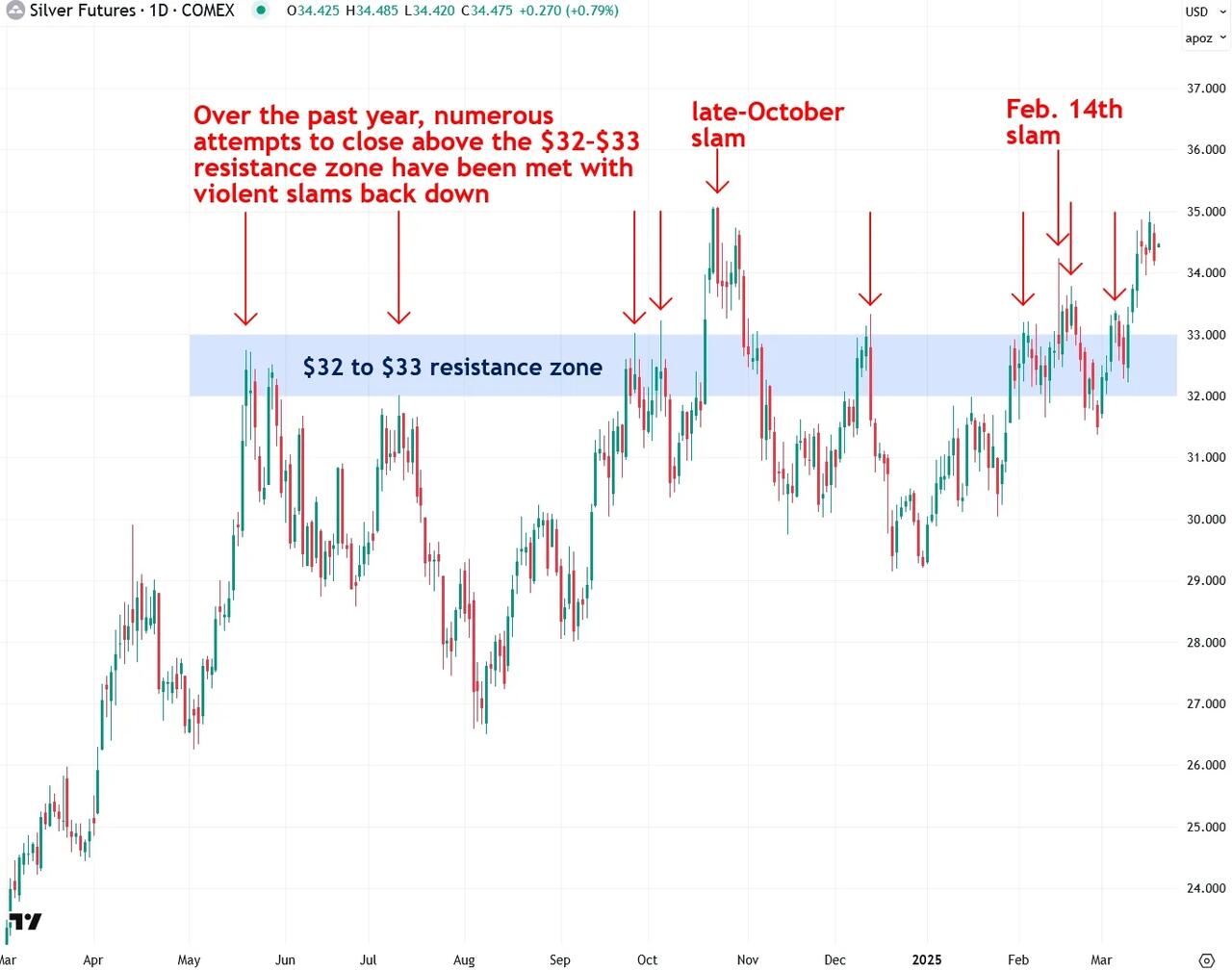 ?itok=w__sINCI
To see what one of these slams or tamps looks like on an intraday chart, let’s examine a particularly egregious example from Friday morning, February 14th. While the daily chart above provides a broader view of the price action, the intraday chart below captures exactly how it unfolded that morning. Bullion banks rely on the assumption that most people won’t scrutinize their tactics too closely—but that’s exactly what we’re going to do here.
Some of the most aggressive slams tend to occur on Friday mornings during the U.S. trading session. With the Asian and European markets closed, trading volume and liquidity are significantly lower, creating the perfect conditions for bullion banks to manipulate silver’s price with minimal resistance. This lack of market depth allows them to maximize their impact, giving them more “bang for their buck” when executing price suppression tactics.
As you can see from the 5-minute intraday chart, silver staged a powerful breakout, surging $1 per ounce (3%) during the Asian and European trading sessions. This rally pushed silver above the key $33 resistance level, which had acted as a ceiling for much of the past year, sparking excitement within the precious metals community as many believed silver was finally taking off.
However, around 9 AM New York time, as the U.S. trading session got underway, a massive flood of "paper" silver—in the form of futures contracts—was suddenly dumped onto the market. This deliberate maneuver drove silver back below the critical $33 level, halting the breakout in its tracks and demoralizing silver investors once again.
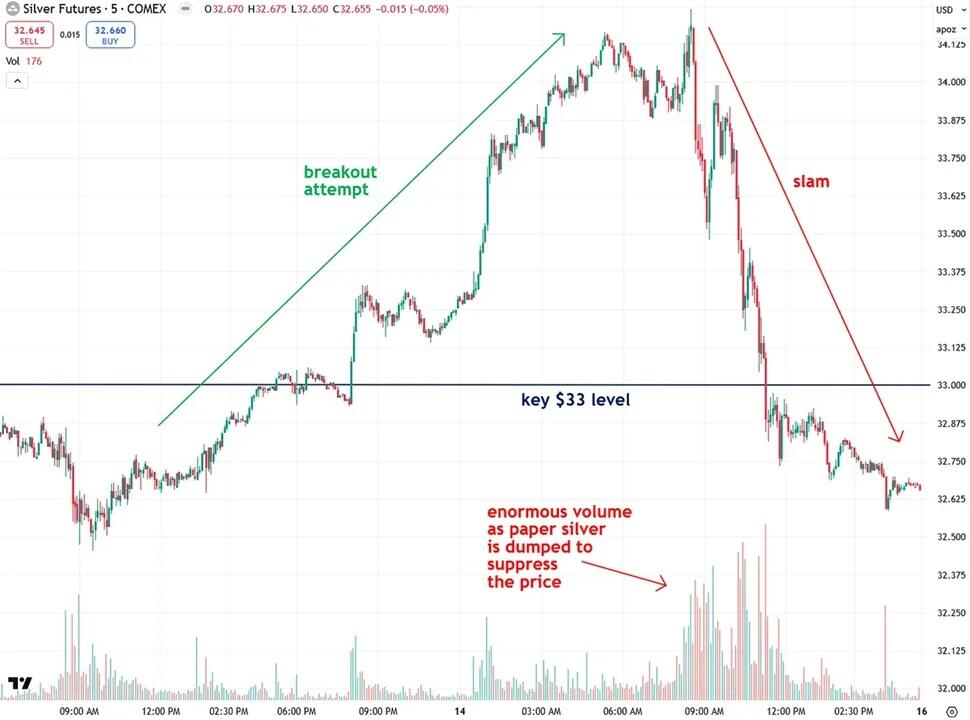 ?itok=BfHMp72O
Note that the silver dumped onto the market was "paper" silver—futures contracts largely unbacked by physical metal. This is the primary way bullion banks artificially suppress silver’s price, keeping it well below where it should be based on true supply and demand for physical silver. What’s both infuriating and disheartening is that this manipulative pattern has persisted almost daily for decades, consistently driving prices downward—never upward.
The chart below shows another egregious example of the manipulation slam pattern, captured on the intraday silver futures chart from late October to early November. During this period, silver made a strong breakout attempt, reaching as high as $35 per ounce, only to be aggressively slammed lower nearly every morning between 8:30 AM and 11:00 AM EST. The heavy selling pressure during the U.S. trading session repeatedly drove silver’s price back down, putting the kibosh on the widely watched late October breakout attempt.
These manipulation slams almost exclusively occur in the morning and rarely at any other time of the trading day. To me, these are unmistakable fingerprints of bullion banks deliberately suppressing silver’s price. This is anything but an organic or natural market.
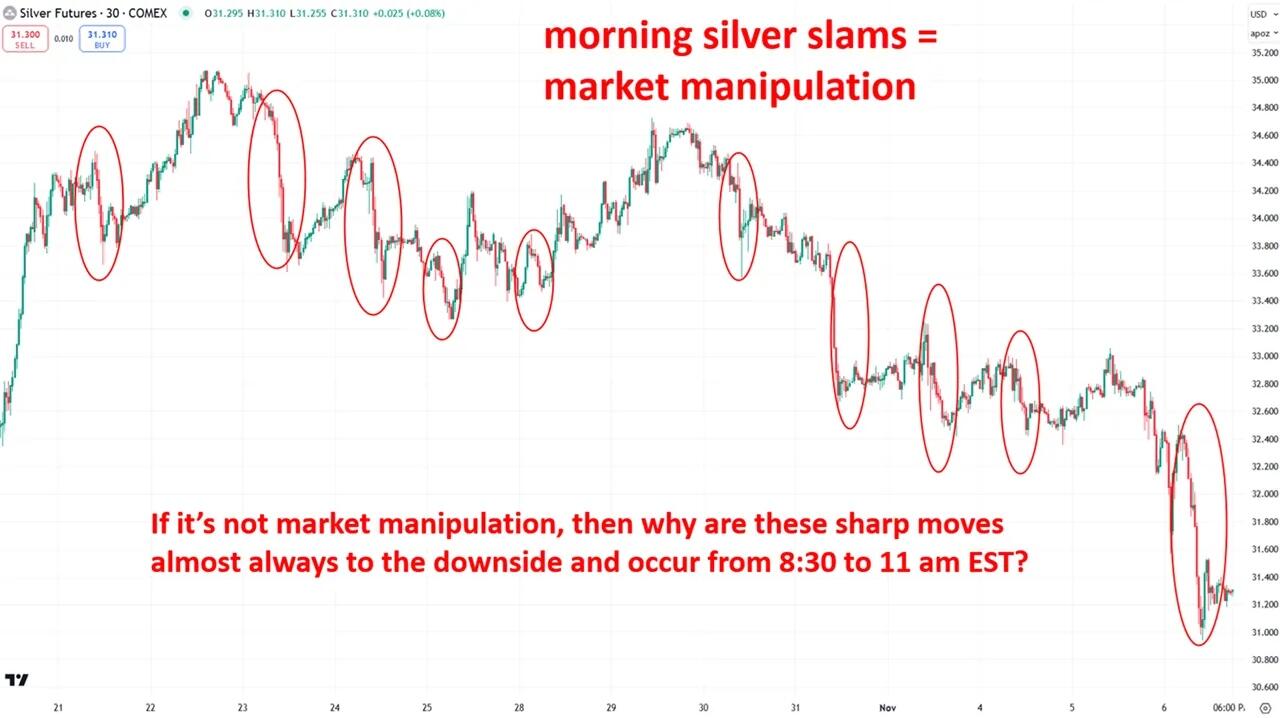 ?itok=TMa5_Xr0
And sure enough, at the time of writing on March 19, 2025, silver has been slammed in all four of the last four trading sessions, proving that this manipulation pattern remains alive and well:
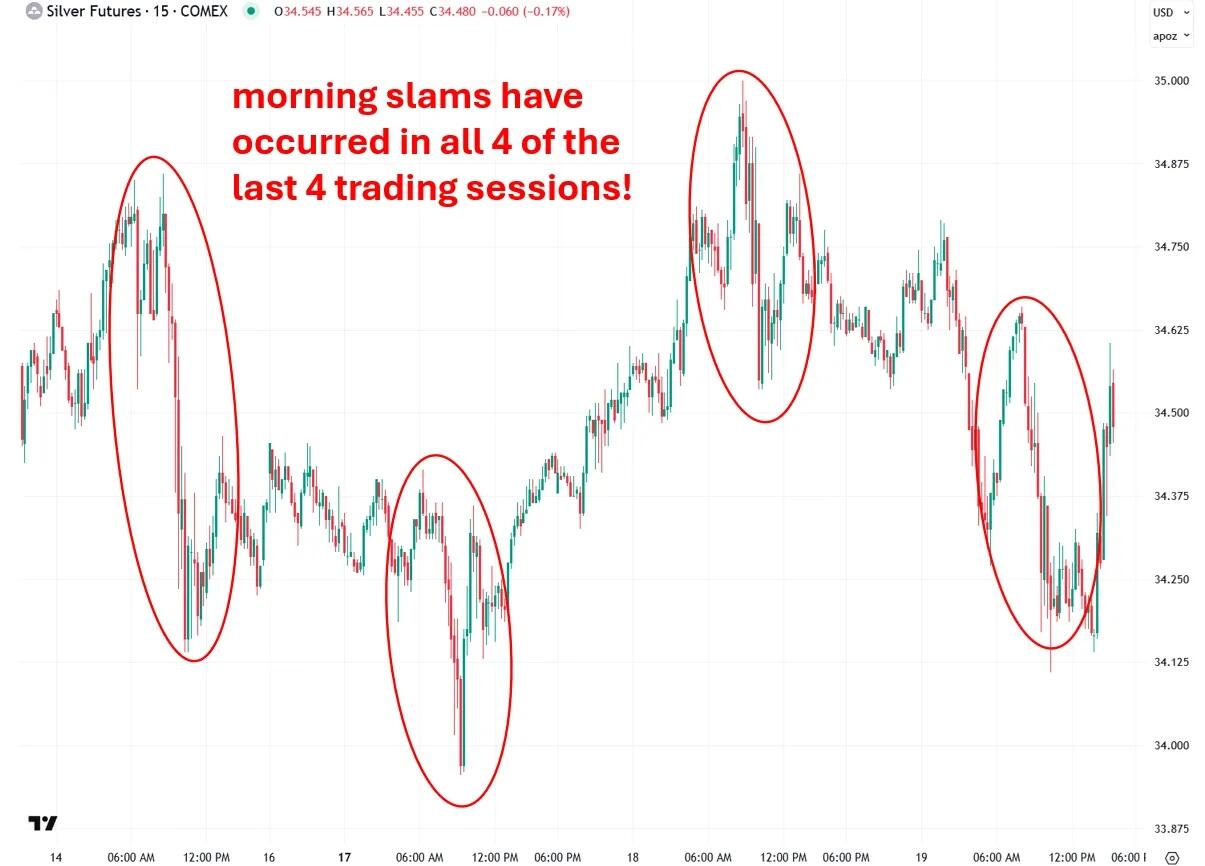 ?itok=p7AgsQub
Interestingly, Gold Charts R Us—a leading provider of precious metals data—analyzed and averaged every silver futures trading session from 2007 to 2013. Their findings revealed a clear and consistent pattern: sharp price slams during the New York morning session, followed by recoveries in the afternoon and overnight as the Asian and European markets open. This exact pattern is clearly visible in the chart, and unfortunately, the same phenomenon continues in 2025.
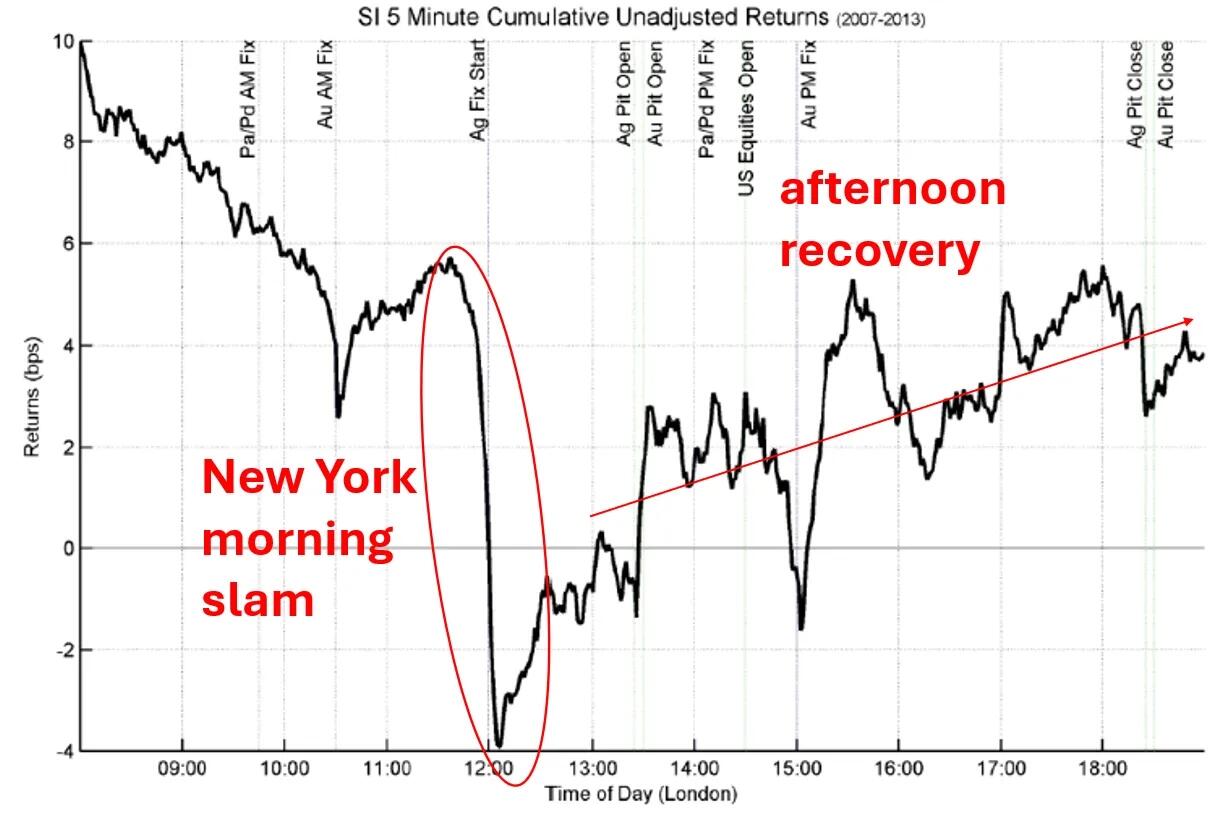 ?itok=wM7z50Mu
Gold Charts R Us also provided statistical evidence through another model, demonstrating that for literally decades, silver has been consistently slammed during the New York morning trading sessions, only to recover later in the European and Asian sessions.
The black line on this chart represents the New York Intraday Silver Index, which tracks the theoretical price of silver if one were to buy at the New York open, hold throughout the trading day, and sell at the New York close. This index further illustrates how silver’s price is regularly pressured downward during U.S. market hours before rebounding in overseas sessions. Starting from a base of 100 in 1970, this index has been relentlessly eroded, plunging to just 8.19 by February 2025—a staggering decline of nearly 92%.
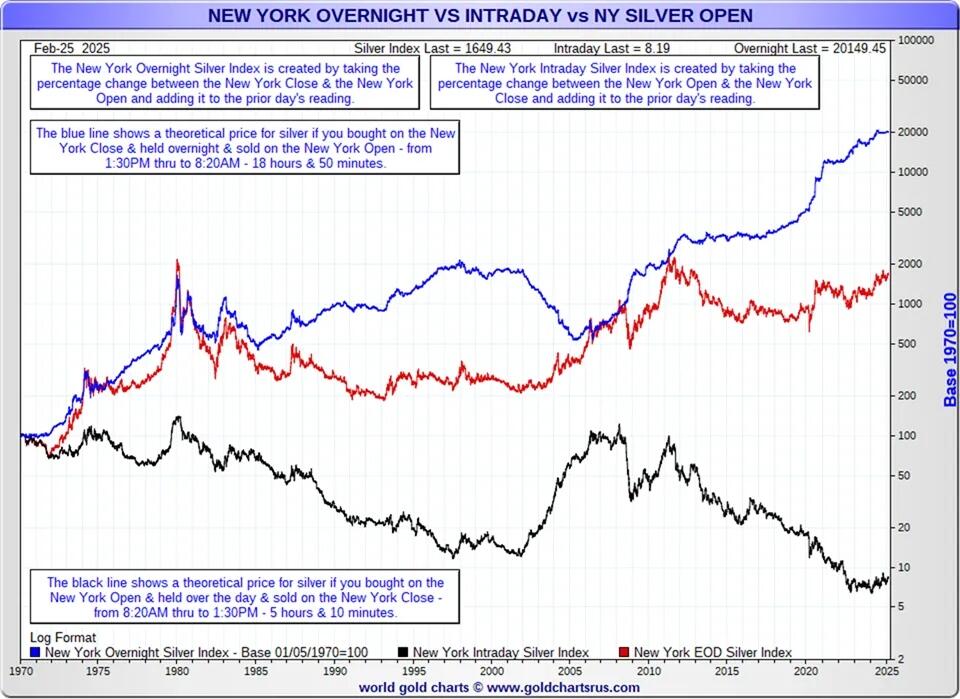 ?itok=tep7TkLB
In stark contrast, the New York Overnight Silver Index, represented by the blue line on the chart, tracks the theoretical price of silver if one were to buy at the New York close in the afternoon and sell at the New York open the following morning. Starting from a base of 100 in 1970, this index has skyrocketed to over 20,000 by February 2025—an astonishing gain of 19,900%.
Gold Charts R Us also included the standard price of silver, represented by the red line on the chart, as a baseline for comparison. Since 1970, it has risen a little more than 16-fold, significantly outperforming the New York Intraday Silver Index but falling far short of the explosive gains seen in the New York Overnight Silver Index.
This is clear evidence that normal market forces are not at play. Instead, it points to blatant downward manipulation. Unfortunately, this suppression discourages both existing silver investors and potential newcomers, which is precisely the intended goal. By keeping silver artificially low, the manipulators aim to undermine assets that compete with the U.S. dollar, which itself is no longer backed by anything.
Silver slams, or tamps, have become so normalized and expected that the precious metals community even jokes about a mythical figure known as Mr. Slammy—a fictional character who appears each morning to manipulate the price of gold and silver by slamming them down.
Adding to the humor, there is even https://x.com/MisterSlammy
on X impersonating Mr. Slammy, playfully teasing and tormenting precious metals investors whenever gold and silver surge higher. When the metals inevitably get slammed back down, the account takes mock victory laps, celebrating the suppression.
 ?itok=qOJE_mAK
The origin of the term “tamp” or “tamping down” in reference to intentionally slamming silver prices traces back to https://arcadiaeconomics.com/cftc-behnam-silver-futures-were-able-to-tamp-down-what-could-have-been-a-much-worse-situation/
in 2021 by Rostin Behnam, who was then chairman of the Commodity Futures Trading Commission (CFTC). Behnam essentially admitted that silver was deliberately slammed by 10% on February 2, 2021, and, in an approving tone, stated that silver futures were able to “tamp down what could have been a much worse situation.”
That “situation” referred to growing fears of a silver shortage and a potential squeeze, which was on the verge of sending prices significantly higher. Instead of preventing market manipulation, as the CFTC is supposed to do, it essentially acknowledged it and gave it tacit approval—which is infuriating. This clearly shows that the agency is protecting the big banks rather than looking out for everyday investors and traders.
 ?itok=eUePx4Vw
Another method bullion banks use to suppress silver prices, aside from flooding the market with massive quantities of paper silver almost daily, is spoofing. This tactic involves placing large sell orders on the futures limit order book to create an artificial price ceiling, reinforcing resistance at key levels.
This form of manipulation isn't just theoretical. In 2023, two former JP Morgan precious metals traders, Michael Nowak and Gregg Smith, https://www.ft.com/content/2d6e942e-d6ba-4126-b1f6-8fe816018e05
of price manipulation and spoofing as part of a broader market-rigging scheme, resulting in fines and prison sentences. Yet, despite these convictions, similar tactics continue to be used in one form or another.
 ?itok=fzrO5yQz
As I’ve been explaining, one of the key factors keeping silver’s price suppressed over the past year has been the heavy short selling of COMEX silver futures by swap dealers—primarily the trading desks of bullion banks such as JP Morgan and UBS. In the process, these entities amassed a massive net short position of 42,116 futures contracts, equivalent to 211 million ounces of silver—or roughly a quarter of the world’s annual silver production. This staggering figure underscores the immense downward pressure being exerted on the silver market.
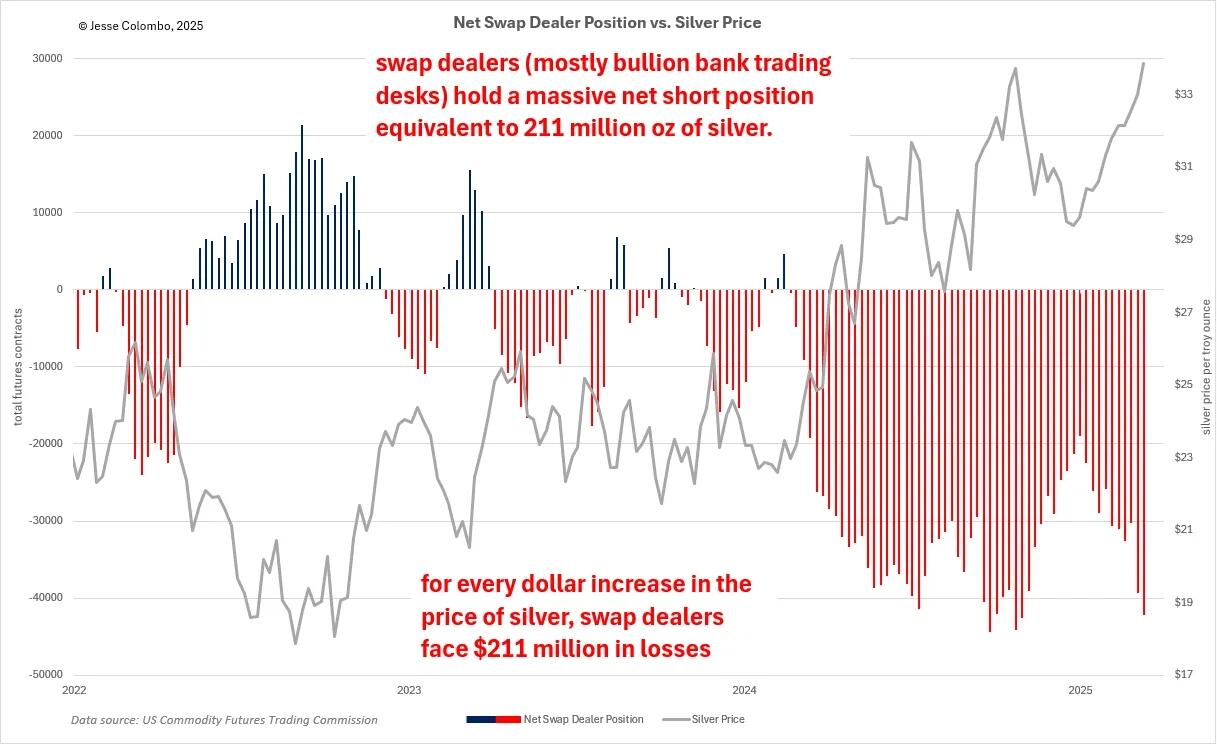 ?itok=y5KdBFkB
What’s even more astonishing is how much of this massive short position in silver futures is naked, meaning it isn’t backed by physical silver. Instead, it consists largely of “paper” silver being dumped onto the market to artificially suppress prices. However, once silver finally breaks out, it is likely trigger a wave of short covering, where the banks that bet against silver through naked short selling are forced to buy it back as prices rise to limit their losses.As the price climbs, these banks will become increasingly desperate to close their positions, further fueling the rally.
If the buying pressure is strong enough, it could even lead to a short squeeze, dramatically amplifying silver’s upward momentum. Given the sheer size of their short position, bullion banks stand to lose approximately $211 million for every $1 increase in silver’s price—a setup for a major price surge. Now, imagine what happens if silver climbs by $5, $10, $20, or more from this point.
The risk of an explosive silver short squeeze is further amplified by the astonishing ratio of 378 ounces of paper silver—including ETFs, futures, and other derivatives—for every single ounce of physical silver. This extreme imbalance highlights just how overleveraged the paper silver market has become.
In a violent short squeeze, holders of paper silver could be forced to scramble for the extremely scarce physical silver to fulfill their contractual obligations. This would likely cause the price of paper silver products to collapse, while physical silver prices could skyrocket to jaw-dropping levels, potentially reaching several hundred dollars per ounce.
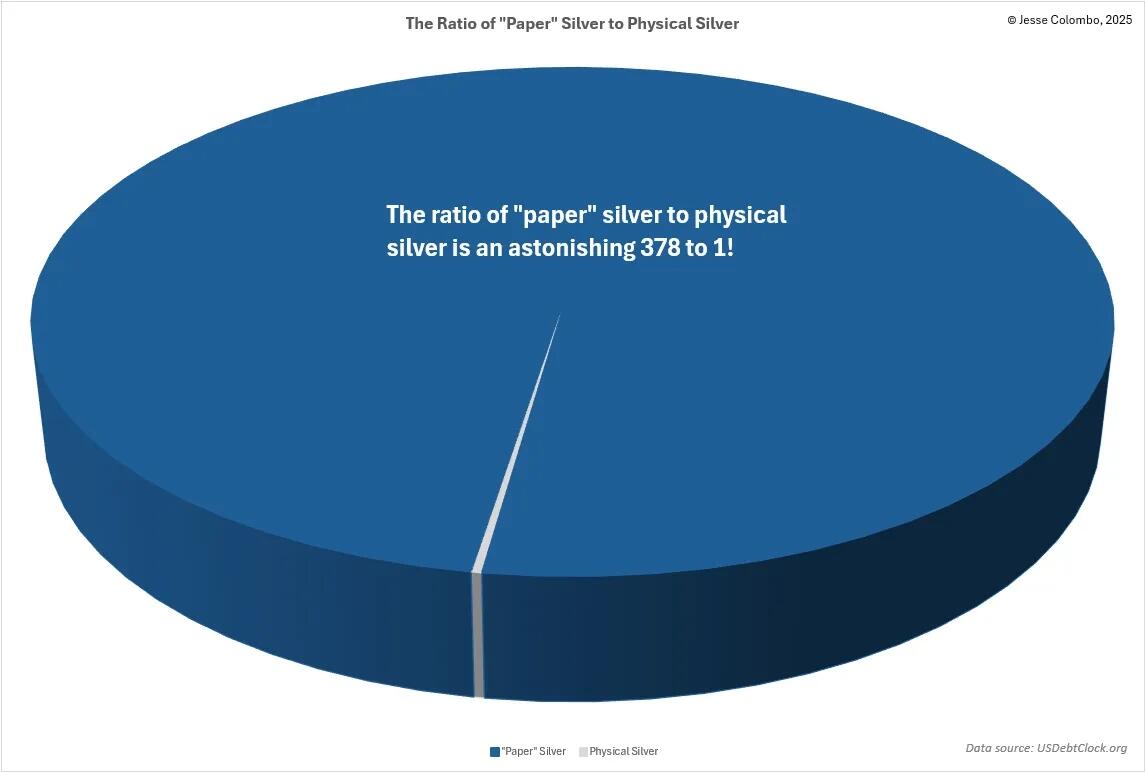 ?itok=EKqwqjCc
What motivates bullion banks to suppress the price of silver? They do so on behalf of central banks, such as the Federal Reserve, which seek to maintain confidence in paper currencies like the U.S. dollar. A soaring silver price signals weakness in fiat money, raising doubts about its strength and stability. By keeping silver artificially low, bullion banks help preserve the illusion of a strong dollar.
This motivation becomes clear when considering that the U.S. money supply has surged by over 85,000% since 1920, drastically eroding the dollar’s purchasing power. As the dollar declines, the cost of living continues to rise, making a normal middle-class lifestyle increasingly out of reach for most Americans. In contrast, while paper currencies around the world have steadily lost value, silver has retained its purchasing power, serving as a hedge against inflation and currency devaluation.
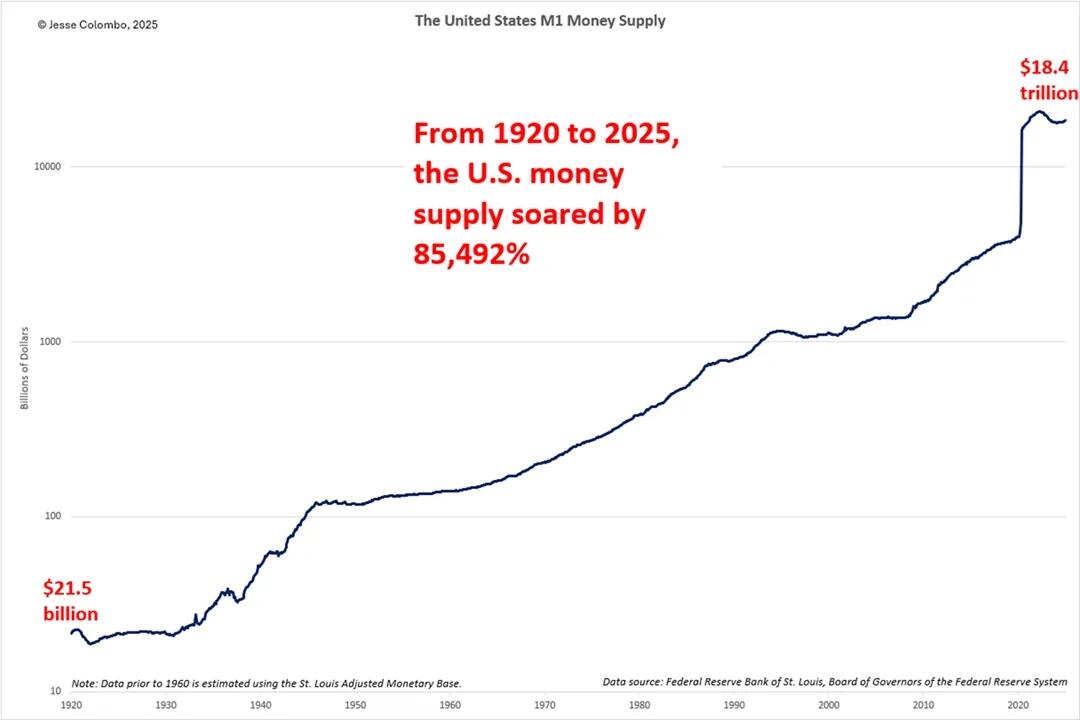 ?itok=RJZ4chIL
While the supply of dollars has surged and continues to expand, silver has consistently preserved its purchasing power. The compelling chart below illustrates how the purchasing power of $1,000 in silver ounces has changed over time. In 1960, $1,000 could buy 1,087 ounces of silver, but today, it purchases only 29.74 ounces—a staggering 97% decline in the dollar's purchasing power relative to silver. This means that the same amount of silver in 1960 could buy roughly the same quantity of goods and services then as it does today, whereas the dollar has lost significant value. That’s a powerful reason to consider storing wealth in physical silver.
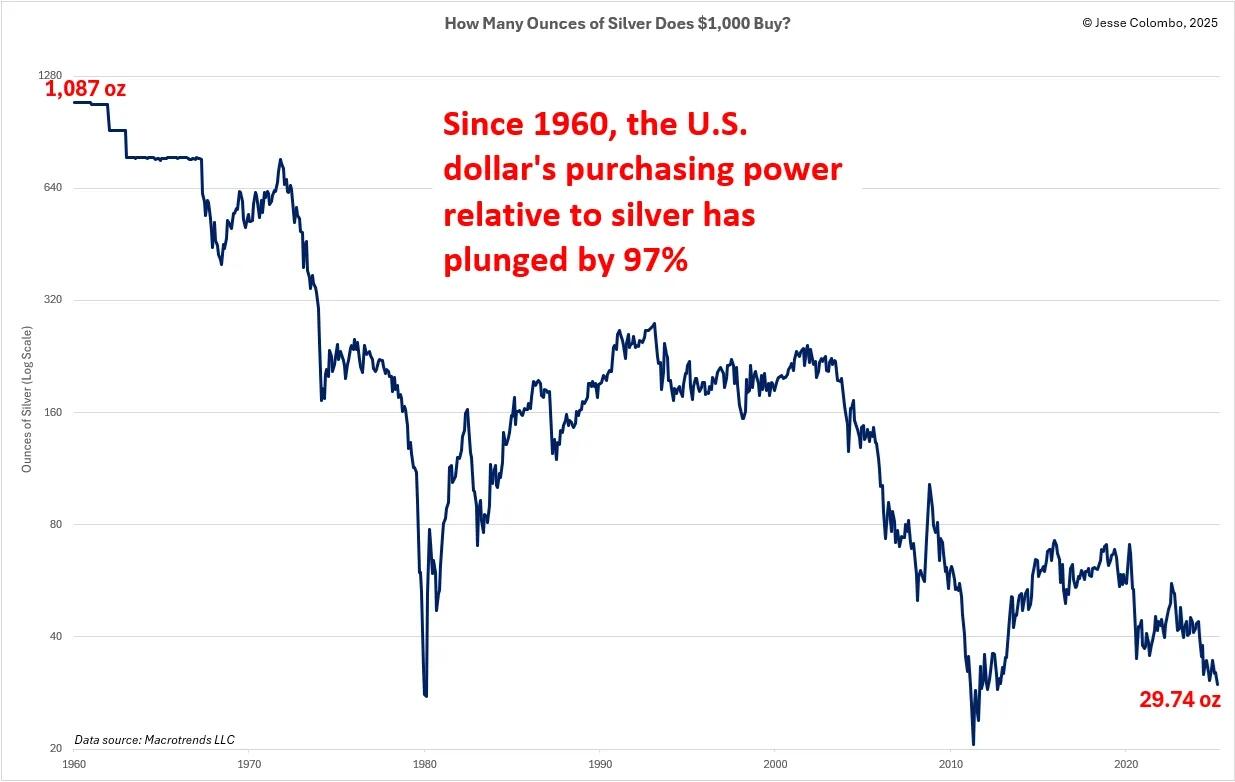 ?itok=hBQp1R3r
Though silver is heavily manipulated and suppressed—possibly the most manipulated asset on the planet—I have strong hope that it will soon break free and thrive. I explained this in detail in https://thebubblebubble.substack.com/p/its-go-time-for-silver
, which I highly recommend reading for further insights, as I don’t have space to cover it fully in this already lengthy piece.
The key reasons for my optimism include the fact that silver has been in a supply deficit for the past five years, with demand consistently outpacing supply. Additionally, silver is extremely undervalued by nearly every measure. I see it as a beach ball being held underwater—it can’t stay suppressed much longer and is bound to pop back up with force.
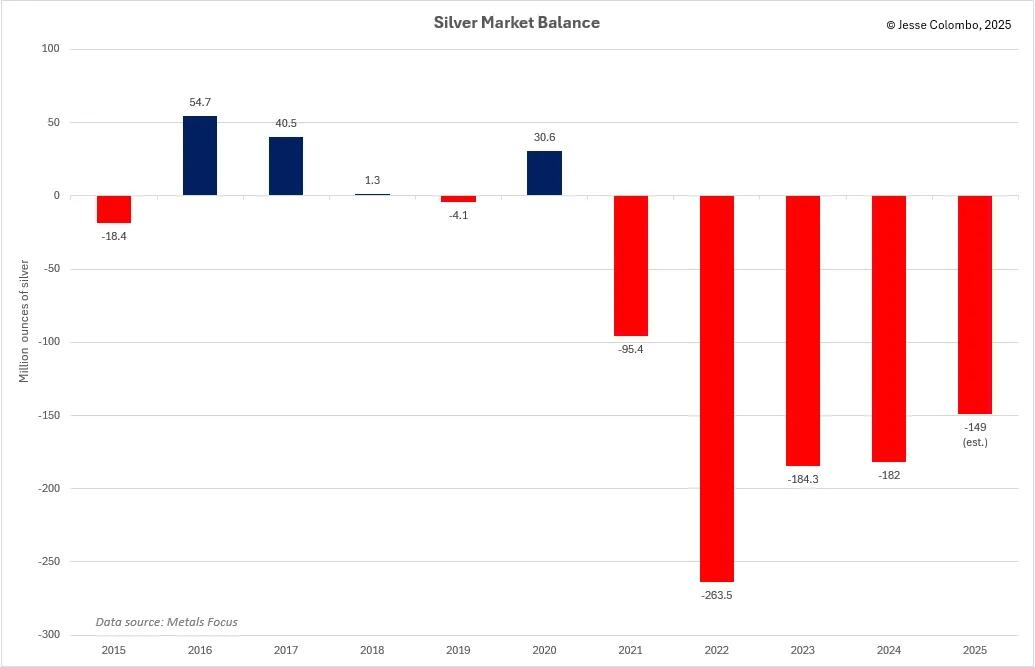 ?itok=cawHoWpD
Also, take a look at the chart below and notice how gold struggled from 2020 to early 2024 to break above the $2,000–$2,100 resistance zone, which acted as a price ceiling for much of that period. Despite multiple attempts, gold was repeatedly pushed back down. However, in March 2024, it finally broke out, igniting the powerful bull market we see today. I see striking parallels with silver’s $32–$33 resistance zone over the past year and believe that once silver manages to close above this level, it will soar just as gold did.
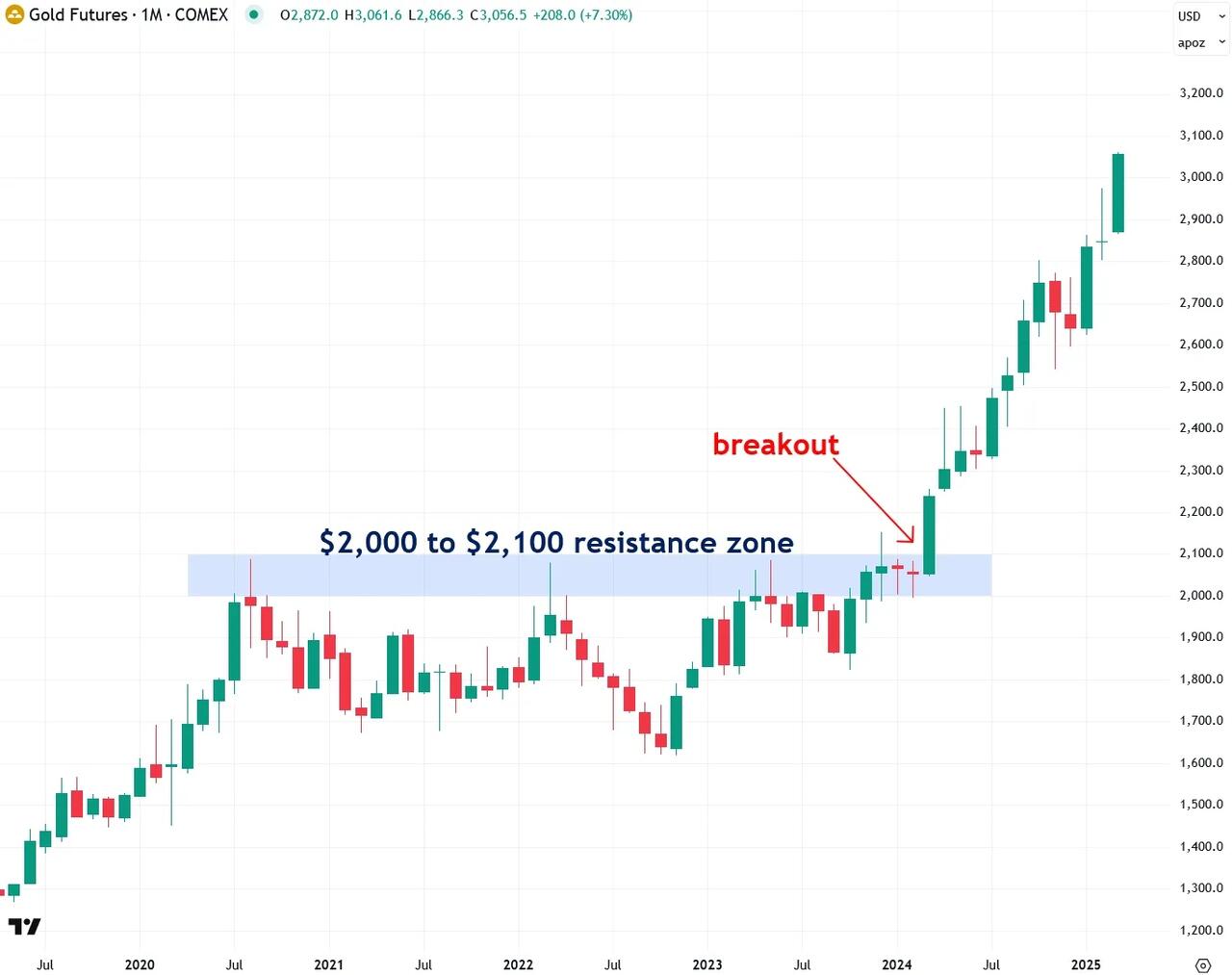 ?itok=fxmDFFo_
To summarize, silver is heavily manipulated and suppressed by bullion banks like JP Morgan and UBS, acting on behalf of central banks. The price of silver should be significantly higher than its current level. While this is infuriating from a moral standpoint, it also presents a once-in-a-lifetime opportunity for patient silver stackers to acquire the metal at artificially low prices before it breaks free from manipulation and soars—just as gold did one year ago.
At the same time, I am working tirelessly to understand, document, expose, and educate the broader public about silver price manipulation, with the goal of bringing it to an end and ensuring that justice is served. Please help me spread the word by sharing this report with anyone who may be interested.
Disclaimer: the information provided in The Bubble Bubble Report and related content is for informational and educational purposes only and should not be construed as investment, financial, or trading advice. Nothing in this publication constitutes a recommendation, solicitation, or offer to buy or sell any securities, commodities, or financial instruments.
All investments carry risk, and past performance is not indicative of future results. Readers should conduct their own research and consult with a qualified financial advisor before making any investment decisions. The author and publisher disclaim any liability for financial losses or damages incurred as a result of reliance on the information provided.
https://cms.zerohedge.com/users/tyler-durden
Thu, 03/27/2025 - 08:05
https://www.zerohedge.com/precious-metals/mechanics-silver-price-suppression
Al Gore Is Still Wrong About Everything
Al Gore Is Still Wrong About Everything
https://modernity.news/2025/03/26/al-gore-is-still-wrong-about-everything
Remember in 2006 when Al Gore released An Inconvenient Truth and made lots of frightening claims about climate change, none of which came true?
 ?itok=A8IAk2J5
He said the global ice caps would be gone and that all of us would be underwater by now.
Here’s another one that is still spectacularly wrong.
“Within the decade there will be no more snows of Kilimanjaro.”
– Al Gore, 2006
Mount Kilimanjaro in 2025 ⬇️ https://t.co/NXgK5wbI0Q
— Jeremy Wayne Tate (@JeremyTate41) https://twitter.com/JeremyTate41/status/1903940733356192002?ref_src=twsrc%5Etfw
Gore said that within a decade there would be no snow on the mountain.
“Within the decade there will be no more snow on Kilimanjaro” – Al Gore
Looks like we beat climate change everyone, no more need to panic. https://t.co/heD8vvRrXg
— Alex Armstrong (@alexharmstrong) https://twitter.com/alexharmstrong/status/1901559798820172127?ref_src=twsrc%5Etfw
Almost two decades later and… yep it’s still covered in the stuff.
Mt. Kilimanjaro summit yesterday was incredibly beautiful with thick snow covering literally everywhere. Snow storm started to rain on us from Gillman’s Point (5,685 meters or 18,652 ft) to the Uhuru peak (5,895m or 19,341ft), about 2 hours climb, and one could not see beyond 10… https://t.co/XX9MybqGHp
— Ali Mohamed (@ClimateEnvoyKe) https://twitter.com/ClimateEnvoyKe/status/1877351073842675953?ref_src=twsrc%5Etfw
Looks really cold.
Mount Kilimanjaro 🇹🇿 https://t.co/w2JJ5vh4jN
— Visit Tanzania (@VisitTanzania1) https://twitter.com/VisitTanzania1/status/1901204964011016415?ref_src=twsrc%5Etfw
Can you say fearmongering?
Scaremongering is core to the climate fight👇In point of fact these scaremongers are rarely right. https://t.co/ta4HmepVTz
— Mark Tluszcz (@marktluszcz) https://twitter.com/marktluszcz/status/1904149069691265353?ref_src=twsrc%5Etfw
This begs the question…
Did any of Al Gore’s Oscar winning documentary’s predictions come true? https://t.co/pK62Ygn3O8
— Allen Covert (@suspendedcovert) https://twitter.com/suspendedcovert/status/1904211525512134784?ref_src=twsrc%5Etfw
Nope.
Al Gore was wrong. The UN was wrong. All the climate "scientists" stuffing their pockets with grant money to push the fake pseudo-science of global warming were wrong.
Why is anyone still listening to them?https://t.co/FD62dyJkdj
— Paul Joseph Watson (@PrisonPlanet) https://twitter.com/PrisonPlanet/status/946711257243144199?ref_src=twsrc%5Etfw
From saying there was “a 75% chance that the entire north polar ice cap, during some of the summer months, could be completely ice-free within the next five to seven years,” to claiming that the global sea level could rise as much as 20 feet “in the near future,” Gore has just been wrong wrong wrong about everything.
Al Gore has history of climate predictions, statements proven false https://t.co/xwxf0E3spA
— Fox News Politics (@foxnewspolitics) https://twitter.com/foxnewspolitics/status/1617146795791945737?ref_src=twsrc%5Etfw
He has always been wrong.
1982: CBS News report—featuring a 34-year-old Al Gore—predicts the "widespread disruption of agriculture", and 25% of Florida ending up underwater "due to the burning of coal and oil". 🤡
"Climate changes could produce widespread disruption of agriculture. The American farm belt… https://t.co/0nRF9oHXpd
— Wide Awake Media (@wideawake_media) https://twitter.com/wideawake_media/status/1834502583488057459?ref_src=twsrc%5Etfw
“Now we’ve got acid rain”
“We’ve only got 10 years left to save our planet – we’ve got to act now”
Flashback to 1992 where Al Gore actually debated Climate Change with Rush Limbaugh.
Notice how you don’t see these debates on Legacy Media anymore?
Why? – Because Climate… https://t.co/OfO6oVXyZv
— Concerned Citizen (@BGatesIsaPyscho) https://twitter.com/BGatesIsaPyscho/status/1862675077730640177?ref_src=twsrc%5Etfw
Wrong but rich!
Al Gore has made a huge fortune from Climate catastrophising..
It's worth noting his 5 key predictions over the last 30 years have all been WRONG! https://t.co/lTeAWszuBG
— June Slater (@juneslater17) https://twitter.com/juneslater17/status/1777619363824111643?ref_src=twsrc%5Etfw
One of Al Gore's houses uses more than 20 times the energy of the average American home, but he's gonna lecture you about global warming. https://t.co/xTF1sYCzNm
— Paul Joseph Watson (@PrisonPlanet) https://twitter.com/PrisonPlanet/status/870683584792739841?ref_src=twsrc%5Etfw
Director of National Intelligence Tulsi Gabbard yesterday went to Capitol Hill to testify before the Senate Intelligence Committee, and told Maine Democrat Angus King that the threat of climate change is not critical.
Three things NOT in Tulsi's national security assessment for the same reason:
Attack of the Yeti
Emperor Palpatine's new death star
Climate change https://t.co/7QNP4doqa2
— Good Lawgic (@TheFollowingPro) https://twitter.com/TheFollowingPro/status/1904621788384157968?ref_src=twsrc%5Etfw
* * *
Your support is crucial in helping us defeat mass censorship. Please consider donating via https://pauljosephwatson.locals.com/support
.
https://cms.zerohedge.com/users/tyler-durden
Thu, 03/27/2025 - 07:20
https://www.zerohedge.com/geopolitical/al-gore-still-wrong-about-everything
Japanese Carmakers Face Catastrophic Profit Hit From Trump's Auto Tariffs
Japanese Carmakers Face Catastrophic Profit Hit From Trump's Auto Tariffs
As the fallout from Trump’s tariff plans comes into relief, a harsh truth is emerging for the automotive industry: there are lots of losers and not many winners. But foreign automakers, those without US facilities, will be hit especially hard.
As Bloomberg notes, from South Korea’s Hyundai to Germany’s Volkswagen, and to a lesser extent America’s own General Motors, many of the world’s most prominent carmakers will soon face higher costs from Trump’s new levies on auto imports and key components. That's because about 46% of all new cars sold in the US are imported.
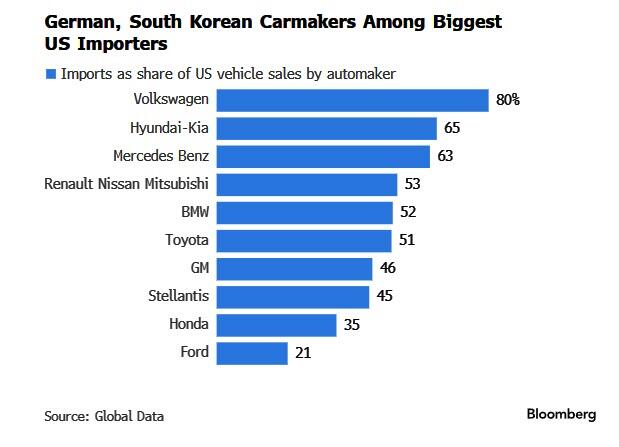 ?itok=SvcFDHA2
“There are very few winners,” Sam Fiorani, vice president of global vehicle forecasting for AutoForecast Solutions, said in a phone interview. “Consumers will be losers because they will have reduced choice and higher prices.”
One notable winner in the tariff chaos is Elon Musk. His Tesla, which has large factories in California and Texas, churns out all the electric vehicles it sells in the US, although as Elon noted late on Wednesday, the company will also not remain unscathed.
Important to note that Tesla is NOT unscathed here. The tariff impact on Tesla is still significant.
— Elon Musk (@elonmusk) https://twitter.com/elonmusk/status/1905076240479895932?ref_src=twsrc%5Etfw
Ford could also face a less-severe impact than some rivals, with about 80% of the cars it sells in the US being built domestically.
Others will be less lucky: starting April 2, the new 25% tariffs will apply to all imported passenger vehicles and light trucks, as well as key parts like engines, transmissions.
Not surprisingly, the tariffs give automakers that heavily source parts in the US an edge, and Trump also allowed an exemption: the new levies will only apply to the non-US share of vehicles and parts imported under a free-trade agreement with Canada and Mexico. That may soften the blow for vehicles whose supply lines zig-zag across the continent.
Tariffs on parts from Canada and Mexico that comply with the trade deal also won’t take effect until the US sets up a process to collect those levies. The US neighbors could use that window to try to stave off full implementation, even if it’s a long shot.
And while NAFTA, pardon USMCA, nations will do everything in their power to be loopholed out, foreign brands heavily reliant on imported vehicles are fresh out of luck. South Korea’s auto giant Hyundai risks being among the hardest hit: although the carmaker and its affiliate Kia have plants in Alabama and Georgia, and just yesterday announced a $21 billion US expansion plan, it imported more than a million vehicles to the US last year, accounting for more than half of its sales in the country, according to figures from Global Data.
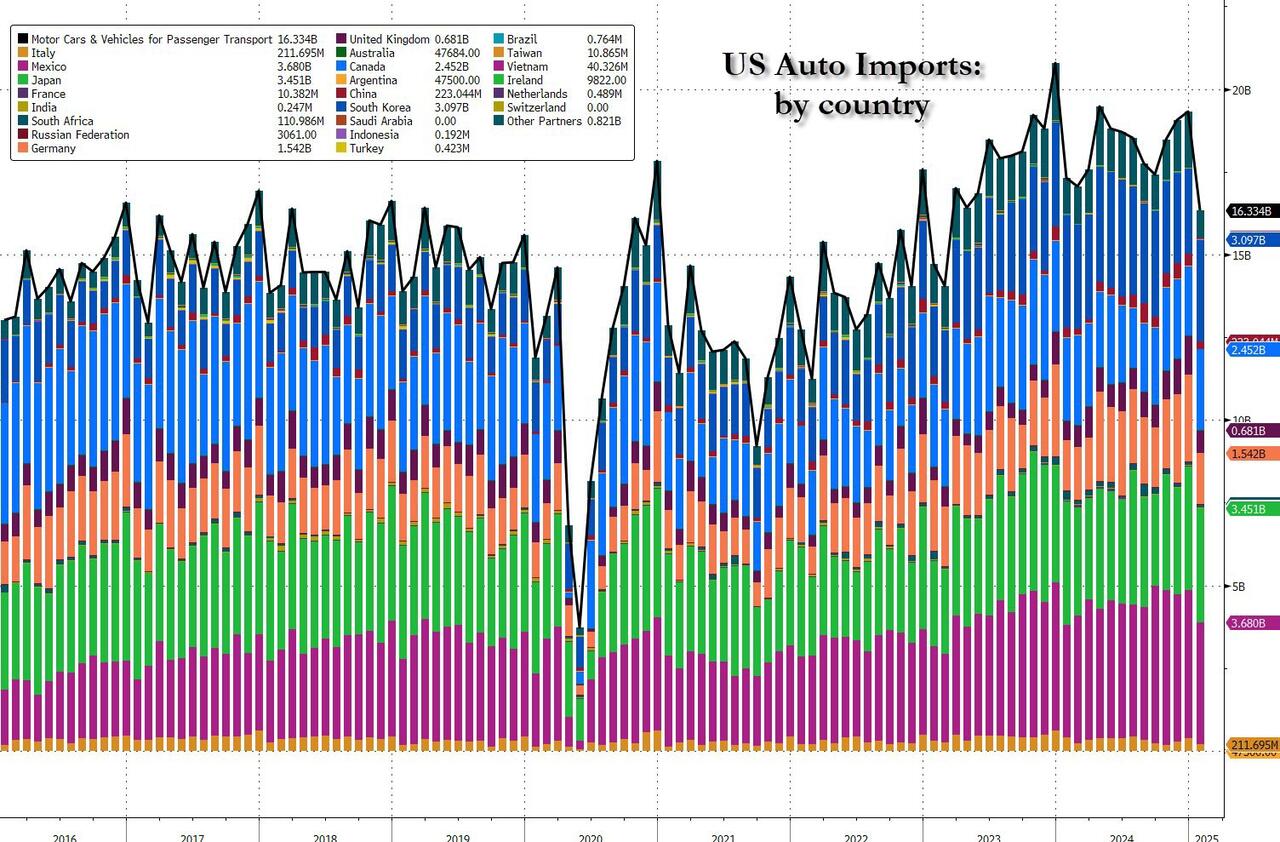 ?itok=FG5VdC2P
Hyundai “remains committed to the long-term growth of the US automotive industry through localized production and innovation,” the company said in a statement, noting it employs 570,000 people in the US. Unfortunately, according to Trump, it should employ many more, and if the company - which imports almost 60% of the cars it sells in the US - wishes to avoid tariffs, it will have to not only hire more American workers, but build many more US plants. Oh, and this is just the beginning: once the reciprocal tariffs kick in next week, South Korean exporters will find themselves in a world of pain.
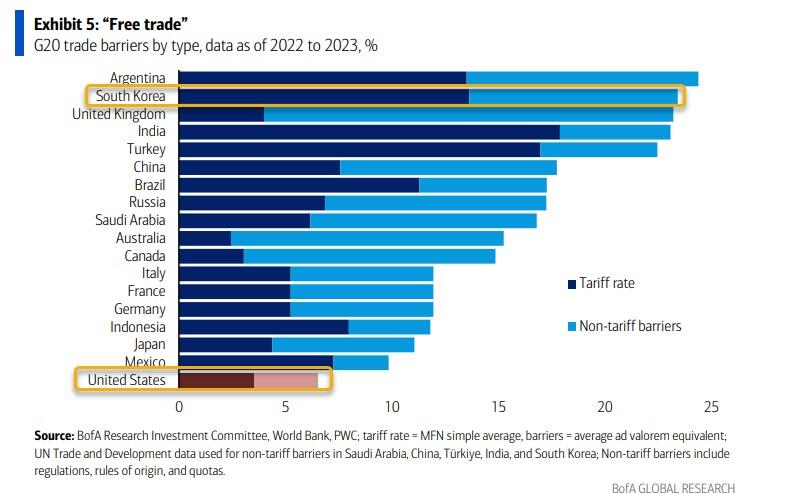 ?itok=h89yB9Ic
What about Japan? Let's take a closer look at the country which historically has been the biggest global auto maker, and which produces 1.3 million (and another 0.4 million tolled in Mexico) of the 16 million annual car sales (Toyota 0.6mn, Subaru 0.3mn, Nissan 0.2mn, Mazda 0.2mn, MMC 0.1mn, Honda 0.01mn). For Japan, autos account for >30% of Japan’s exports to the US, which imports about 46% of all autos sold each year.
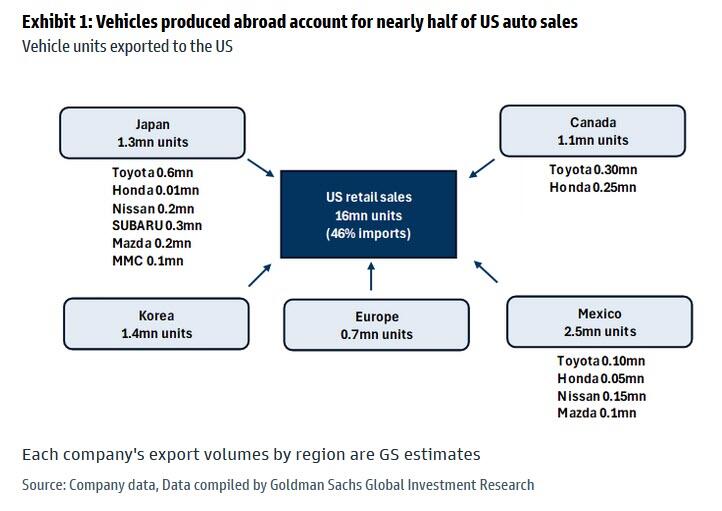 ?itok=uXOOzYyt
Based on an average sales price of US$45,000, the value of imports would exceed US$330 billion, and US import tariffs could have a major impact on sales prices and auto demand. All else equal, they would raise about $100 billion in annual tax revenues. But all else will certainly not be equal, especially once exporting nations slide into recession, and their export industries are crippled.
In an analysis published three weeks ago (https://www.dropbox.com/scl/fi/naco5pvm19c89e96h8bwe/Japan-Automobiles_-Scenario-analysis-on-US-tariffs-on-Mexico_Canada-for-Japanese-automakers.pdf?rlkey=5khsxhq1bl7lxxw7vetgddnja&dl=0
), Goldman looked at one scenario where Japanese cars are hit with 25% tariffs, along with imports from Mexico and Canada. The results were dire. According to Goldman analyst Kota Yuzawa, the potential impact on Japanese auto companies' operating profit - assuming a tariff of 25% on Japan in line with that imposed on imports from Canada and Mexico - is shown below. In this scenario Goldman assumes that sales volumes decline as a result of price hikes made by each company in order to offset the negative impact of tariffs (volume decline of 8-26% based on a 25% price hike for Canada/Mexico/Japan-made vehicles). In that scenario the profit hit will be anywhere between 6% for Toyota to 59% for Mazda.
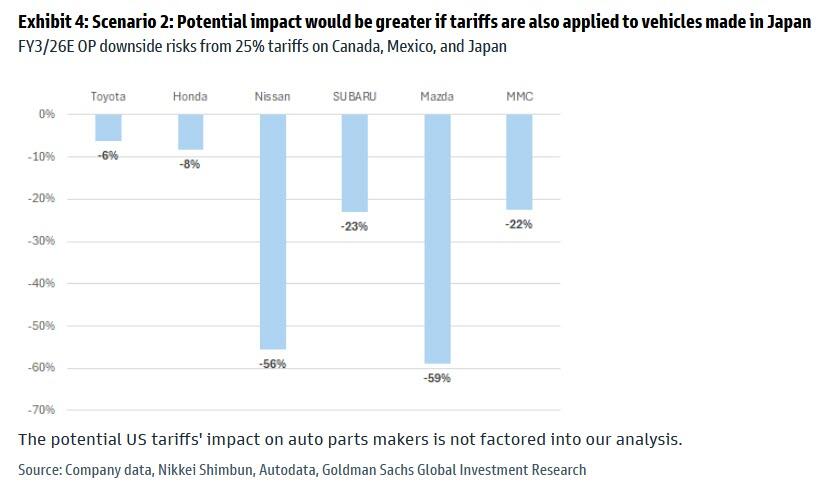 ?itok=bPsETBTV
In terms of exposure, Yuzawa calculates that production volume in US is largest for Subaru (39%), Honda (27%), Toyota (13%), Nissan (13%), Mazda (7%).
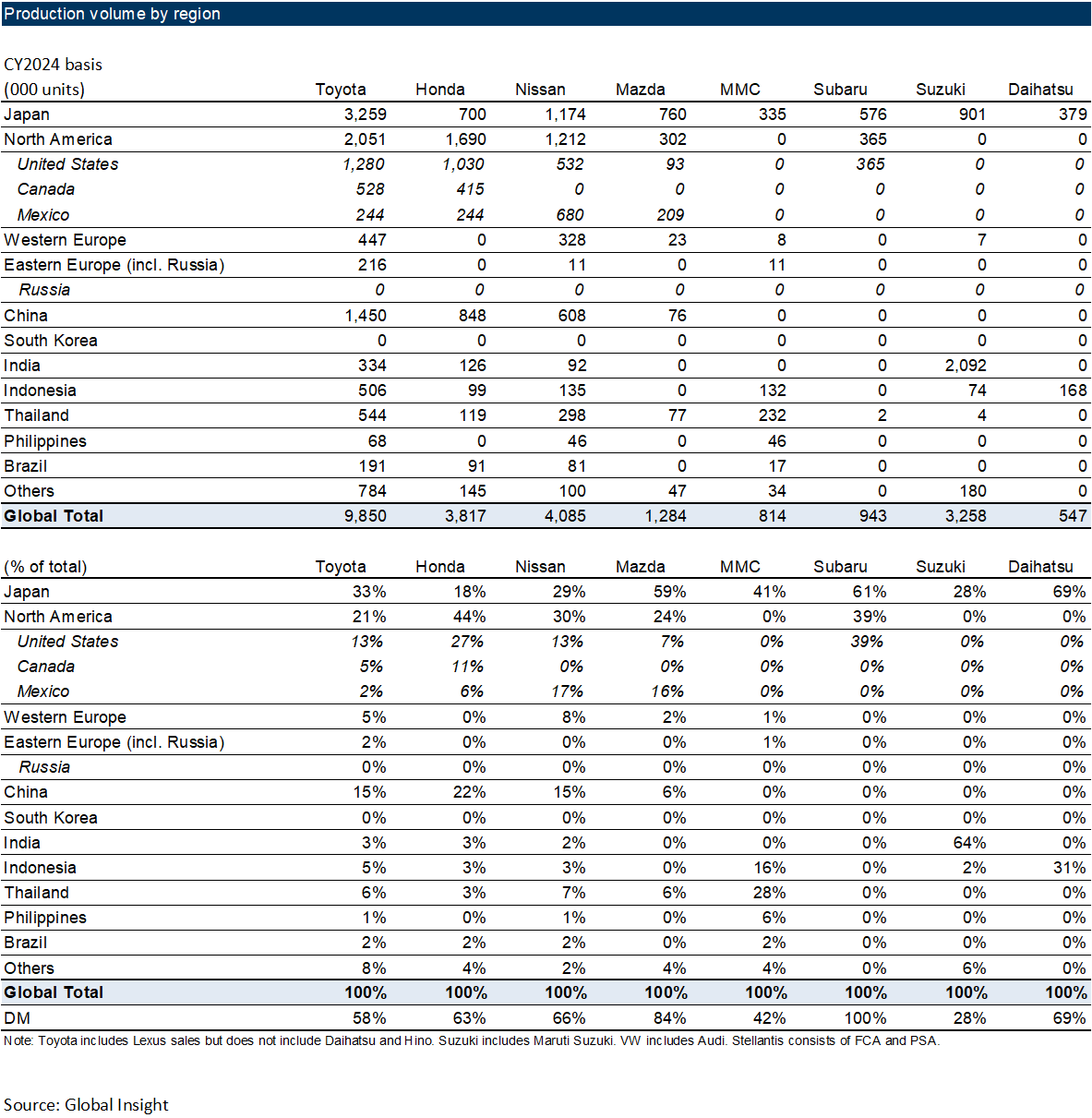 ?itok=-8-p1O9M
In another, far more draconian scenario, Japanese automakers are unable or simply refuse to hike prices to offset volume declines. The consequences are catastrophic and result in the following hit to operating profits: Toyota -¥570 bn, Honda -¥350 bn, Nissan -¥130 bn, and Mazda -¥60 bn. The implied impact on Goldman's FY3/26 operating profit forecasts would be as follows: Toyota -11%, Honda -23%, Nissan -66%, and Mazda -34%, with Nissan and Mazda seeing relatively large impacts given their larger export mix from Canada/Mexico.
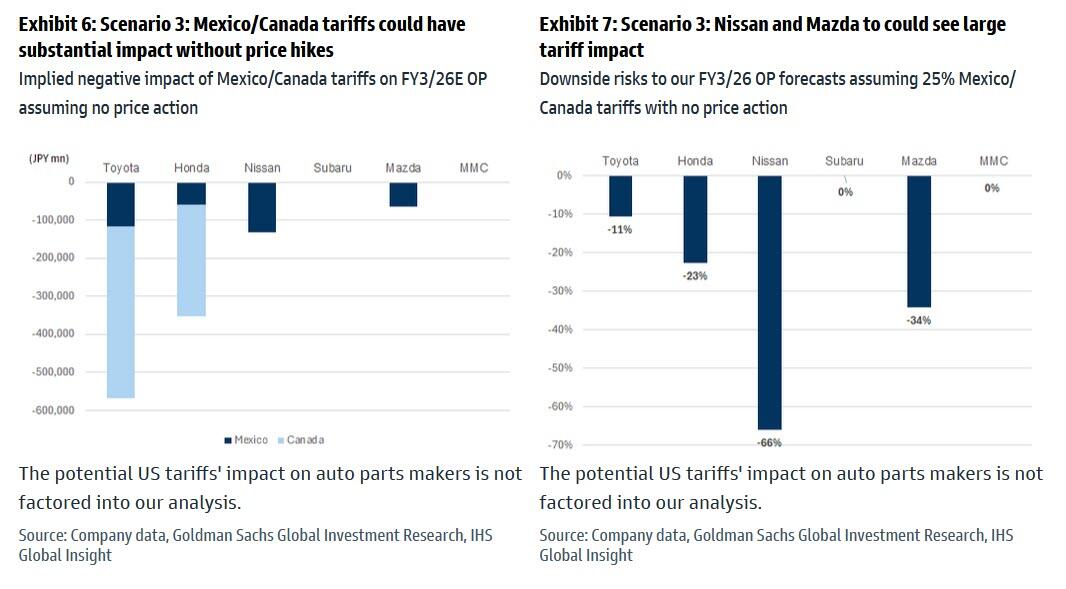 ?itok=GjwiiROx
That's just the start: in addition to the direct potential impact on finished vehicle exports described above, parts makers also have supply chains spanning multiple countries. Indeed, Toyota-affiliated companies that announced 3Q (October-December) results on January 31 referred to tariff risks. Denso’s sales from Mexico/Canada operations to the US total about ¥220 bn, while Aisin’s are about ¥60 bn. If a 25% tariff were also imposed on parts, Goldman warns forecasts potential profit declines of ¥55 bn/¥15 bn at Denso/Aisin. Toyota Boshoku did not disclose figures but noted a large potential impact, as much of its seat sewing is conducted in Mexico. Parts makers are working to pass on higher costs to automakers. Denso’s management expressed hope that tariff impact would be mitigated to some extent by the possibility of US corporate tax cuts and a weaker Mexican peso.
Ultimately, Goldman's Yuzawa expects price increases to spread across the US auto industry, and after several years of pain, tariffed exports will find some parity with domestic producers: “Automobiles are essential goods, however, and in the longer term we expect demand for them to recover and the negative impact of tariffs on volume to gradually diminish as production of US-made models and procurement of US-made parts increases. In addition, the used car market is also robust. Higher new car prices are likely to lead to higher used car prices, which could also boost vehicle purchasing power through higher residual values. Our economists estimate price elasticity of demand at 1.2-1.5 in the short term and 0.2 in the medium term, and we use the midpoint of 1.35 in our scenario analysis in this report.”
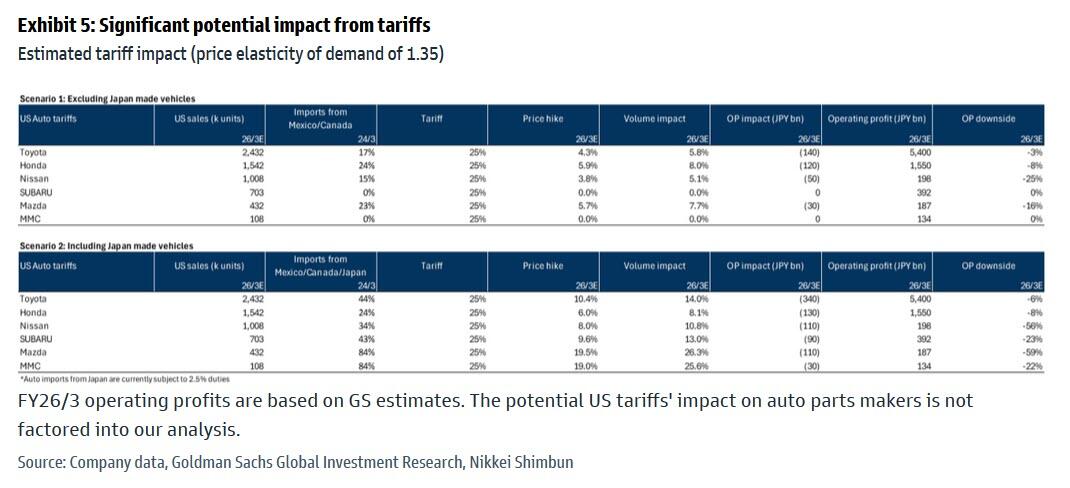 ?itok=-2E2AmLJ
The problem is what happens until the equilibrium point is reached over several years, and how painful will the looming Japanese recession be, because make no mistake: Japan is now almost certainly facing a recession: Takahide Kiuchi, executive economist at Nomura Research Institute (NRI), expects an 25% increase in U.S. auto tariffs to push down Japan's GDP by at least 0.2%.
"The Trump tariff has the potential to immediately push Japan's economy into deterioration," he said.
But what is worst of all for Japan is that the so-called virtuous wage-price cycle in which the perenially deflating nation managed to find itself, is now also doomed. That's because the auto industry has been the driver of recent wage hikes according to Reuters, as automakers distribute the huge profits they reaped overseas to their employees. Starting April 2, kiss those profits goodbye... and if Japanese automakers want to avoid plummeting stock prices, or worse, bankruptcy, what they will immediately do is announce that any future wage increases have been put on hold and, just as likely, are about to hit reverse.
More in the full Goldman note "https://www.dropbox.com/scl/fi/naco5pvm19c89e96h8bwe/Japan-Automobiles_-Scenario-analysis-on-US-tariffs-on-Mexico_Canada-for-Japanese-automakers.pdf?rlkey=5khsxhq1bl7lxxw7vetgddnja&dl=0
.
https://cms.zerohedge.com/users/tyler-durden
Thu, 03/27/2025 - 00:12
55 Ways That Everything That You Think That You Own Is Being Systematically Taken Away From You
55 Ways That Everything That You Think That You Own Is Being Systematically Taken Away From You
The entire system has been designed to generate as much revenue from your activity as possible until someday you eventually drop dead.
It is tax season, and that means that it is time to feed the largest and most bloated government in the history of the entire planet once again. Of course the federal income tax is just one of the ways that they are systematically draining your wealth. As you will see below, there are literally dozens of taxes that Americans must pay each year.
Many of our politicians seem to revel in inventing ways to extract money out of us, and that needs to stop.
 ?itok=m28IZdsa
Most Americans are working extremely hard, and yet money seems to keep going out the other end faster than it is coming in.
The truth is that the entire system has been designed to take what you have away from you.
There are many ways that this is accomplished – taxation, inflation, debt, interest, fines, fees, tickets, government seizures and good old-fashioned corporate greed.
If you decided to just sit back and do nothing but hold on to the wealth that you already have, you would find out that it would disappear quite rapidly.
It is not an accident that most Americans are experiencing a declining standard of living. The system is rigged, and the rigging has not been in our favor.
The following are 55 ways that everything that you think that you own is being systematically taken away from you…
#1 Do you think that you own your home? You might want to think again. Most Americans that “own a home” are paying a mortgage. If you stop paying that mortgage you will lose that home. The number of foreclosures in the United States last year was up 174 percent from 2021, and mortgage delinquencies have been rising in recent months.
When homeowners get booted out of their homes, they don’t get their down payments back.
They also don’t get all of the mortgage payments that they have made back.
The banks get to keep the money and the homes.
Perhaps you have paid off your mortgage. Does that mean that you now “own your home”?
No, not really. Just refuse to pay your property taxes and see what happens. At best, you can say that you have the right to rent your home from the government.
In any event, the reality is that the banks now own more of “our homes” than we do.
Just check out your most recent mortgage statement and see how much “home equity” you actually have.
If you recently purchased your home, it probably isn’t much at all.
Things used to be far different in this country. Once upon a time, ordinary Americans owned most of the homes and most of the land in this nation.
But now the banks own most of it. Sadly, most American families that believe that they “own homes” are actually enslaved to 20 or 30 year debt contracts.
And if something happens and you are unable to keep making payments, you could lose everything.
#2 Do you think that you own your vehicle? You don’t own it if you are still making payments on it. Of course if you stop making payments you will rapidly lose that vehicle.
But even if it is paid off, you can only operate that vehicle if you do the following…
*You must pay the license fee.
*You must pay the car registration fee.
*You must pay the emissions inspection fee.
*You must pay the property taxes on that vehicle if that applies in your area.
*You must pay the tire taxes.
*You must pay the gas taxes.
If you have paid all of those taxes, then you are permitted to drive only where the government allows you to drive and only under the rules that the government sets for you.
But at least you “own” your vehicle, right?
#3 What about your possessions? Do you own them?
Well, yes, you probably own some possessions.
But that doesn’t mean that they are not enslaving you.
After all, did you use a credit card to pay for any of them?
If so, you could end up paying far more for your possessions than you originally thought that they cost.
#4 Do you own your education? Well, it is undeniable that nobody can ever take it away from you. But if you took out student loans to get your education, that debt may end up enslaving you for decades.
The borrower is the servant of the lender and student loan debt is more of a financial drain on Americans than ever before. Americans now owe more on their student loans than they do on their credit cards.
Today, Americans owe more than 1.7 trillion dollars on their student loans, which is a new all-time record.
#5 Will you protect your wealth if you put your money in the bank?
No, in fact your wealth will be systematically destroyed in the bank.
Inflation is a hidden tax on every single dollar that you own, because it destroys the value of all dollars in existence.
There are some Americans that have been saving money for decades, but those savings are being taxed into oblivion by inflation.
Just compare the price of a carton of 12 eggs five years ago to the price of a carton of eggs today.
When the cost of living goes up, the value of the money that we have put in the bank goes down.
#6 Insurance costs continue to soar. After insuring virtually everything in our lives, many of us barely have any money left over to actually live our lives with.
#7 State and local governments all over the nation have turned to ticket writing as a primary revenue source. They know that most people do not carefully follow the speed limit, and so they have turned that behavior into a revenue-generating tool.
#8 Some states have decided to simply confiscate wealth even if nothing has been done wrong. For example, some states are now aggressively seizing “unclaimed” safe deposit boxes. If you have a safe deposit box that you have not checked on in a while, you might want to make sure that it is still there.
#9 You might end up losing your valuables when you cross the border. U.S. border agents regularly seize laptops and other electronic devices as people cross the border. In many cases those items are never returned.
#10 If you don’t pay your property taxes, you will lose your home and it will likely be a big Wall Street bank that will end up owning it. The big Wall Street banks have been buying up thousands of tax liens and are making a killing by socking distressed homeowners with predatory interest, outrageous penalties and almost unbelievable legal fees.
#11 Of course the federal income tax is one of the biggest ways that our wealth is being drained. One of the primary reasons why the Federal Reserve and the IRS were established back in 1913 was to redistribute wealth. Wealth is transferred from hard working Americans to the U.S. government, and then it is redistributed to those that aren’t working or spent on some of the most wasteful programs imaginable.
Needless to say, federal taxes are just one of the taxes that we pay. The truth is that the average American pays dozens of different taxes each year. The following are just a few examples of the insidious forms of taxation that drain our wealth…
#12 Building Permit Tax
#13 Capital Gains Tax
#14 CDL License Tax
#15 Cigarette Tax
#16 Corporate Income Tax
#17 Court Fines (an indirect tax)
#18 Dog License Tax
#19 Federal Unemployment Tax (FUTA)
#20 Fishing License Tax
#21 Food License Tax
#22 Fuel Permit Tax
#23 Gasoline Tax
#24 Gift Tax
#25 Hunting License Tax
#26 Inheritance Tax
#27 IRS Penalties (tax on top of tax)
#28 Liquor Tax
#29 Local Income Tax
#30 Luxury Taxes
#31 Marriage License Tax
#32 Medicare Tax
#33 Payroll Taxes
#34 Phone Taxes
#35 Property Taxes
#36 Real Estate Tax
#37 Recreational Vehicle Tax
#38 Road Toll Booth Taxes
#39 Road Usage Taxes (Truckers)
#40 Sales Taxes
#41 School Tax
#42 Septic Permit Tax
#43 Social Security Tax
#44 State Income Tax
#45 State Unemployment Tax (SUTA)
#46 Toll Bridge Taxes
#47 Toll Tunnel Taxes
#48 Traffic Fines (indirect taxation)
#49 Trailer Registration Tax
#50 Utility Taxes
#51 Vehicle License Registration Tax
#52 Vehicle Sales Tax
#53 Watercraft Registration Tax
#54 Well Permit Tax
#55 Workers Compensation Tax
When you take all forms of taxation into account, there are some people that hand over more than 50 percent of their incomes to various levels of government each year.
Even the future is being taken away from us. The future is literally being stolen from our children and our grandchildren. They will be inheriting the 36 trillion dollar national debt that we have accumulated.
What we have done to future generations is unthinkable, and yet we continue to borrow colossal mountains of money.
When you base an entire economy on debt, eventually you end up with money problems that never seem to end. As a nation, we are now enslaved to a vicious spiral of debt that threatens to destroy everything that our forefathers worked so hard to build.
As the debt loads of our federal, state and local governments become even more burdensome, they are going to want even more money from us. For decades we gave in to new tax after new tax thinking that it would finally satisfy them.
But it never seems to be enough. They always want more.
Unfortunately, most Americans are so caught up in the “rat race” that they never take much time to think about who designed the race or why they are running it.
It is time to wake up.
We are being systematically abused by the control freaks that are running things, and it is time to say that enough is enough.
* * *
Michael’s new book entitled https://www.amazon.com/dp/B0DFVKTRJR
.
https://cms.zerohedge.com/users/tyler-durden
Wed, 03/26/2025 - 23:25
Florida Considers Easing Child Labor Laws To Make Up For Fewer Illegal Workers
Florida Considers Easing Child Labor Laws To Make Up For Fewer Illegal Workers
With an eye on offsetting the loss of illegal-immigrant labor, the Florida legislature is considering a bill that would ease the state's child labor laws. A bill that advanced from a committee on Tuesday would make it legal for children as young as 14 to work graveyard shifts on school nights.
The hours at issue are those between 11pm and 6:30 am. The controversial bill was given the blessing of the Florida Commerce and Tourism Committee by a narrow 5-4 vote, and now faces the scrutiny of two more committees before it can receive a vote of the Senate. Governor Ron DeSantis has https://www.cnn.com/2025/03/25/business/florida-child-labor-laws/index.html
the proposal, saying an easing of child labor laws can help fill employers' needs as the state makes it increasingly difficult for illegal immigrants to work there.
Last year, Florida started to allow 16- and 17-year-old home-schooled and virtually-schooled children to work anytime at all. The new bill would extend that freedom to 14- and 15-year-olds. However, it would also let 16- and 17-year-olds in traditional schools work any hour of the day. It would also allow them to work https://www.wuwf.org/florida-news/2025-03-25/florida-senate-panel-gives-approval-to-relaxing-child-labor-laws
while schools are in session.
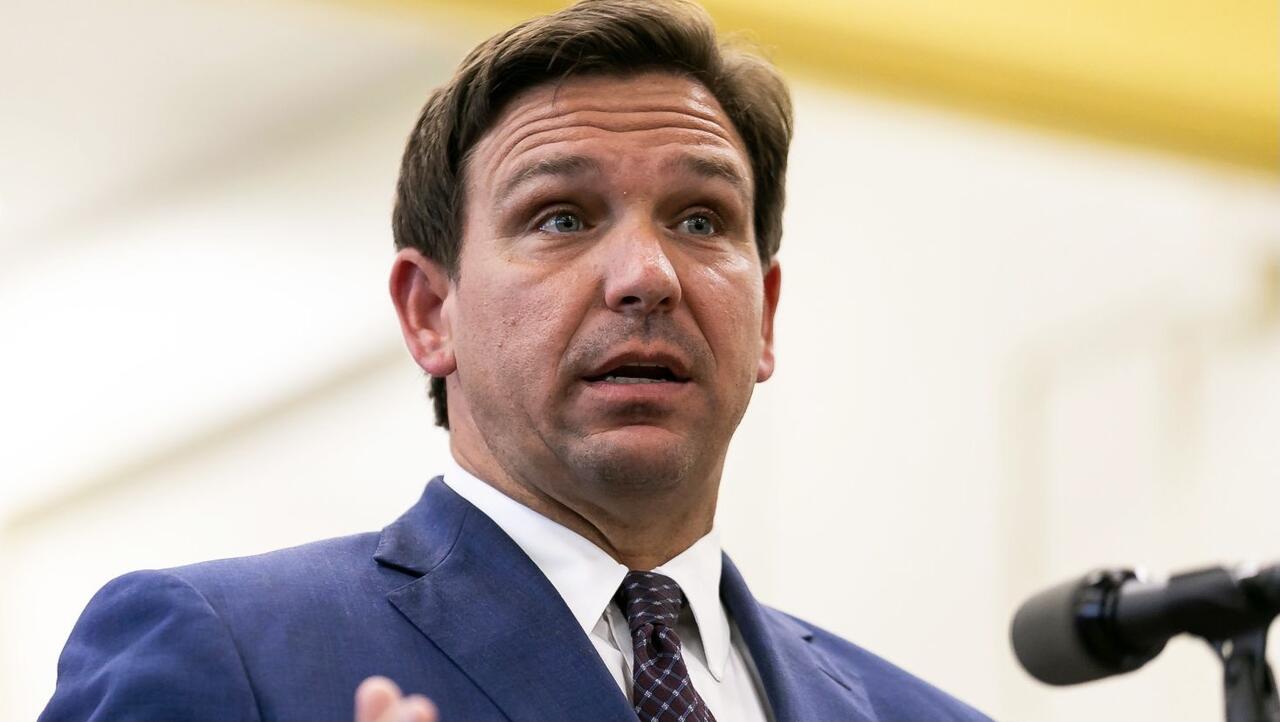 ?itok=u7oK2NJ_
The move comes in the wake of a statewide crackdown on the use of illegal immigrants. A 2023 Florida law compels employers with 26 or more workers to confirm their immigration status by using the federal https://www.e-verify.gov/about-e-verify/what-is-e-verify
system -- under threat of $1,000 daily fines for non-compliance. That internet-based system cross-checks the information the employees put on "Form I-9, Employment Eligibility Verification." The loss of illegal labor has some people worried about the effect on the Sunshine State's economy.
DeSantis has argued that loosening restrictions on younger workers is a big part of solution. “Why do we say we need to import foreigners -- even import them illegally --- when teenagers used to work at these resorts, college students should be able to do this stuff,” DeSantis https://www.tampabay.com/news/education/2025/03/20/desantis-touts-florida-immigration-crackdown-blasts-dc-republicans/
during a panel discussion last week with Tom Homan, acting director of Immigration and Customs Enforcement (ICE). "What’s wrong with expecting our young people to be working part-time now? I mean, that’s how it used to be when I was growing up,” added DeSantis.
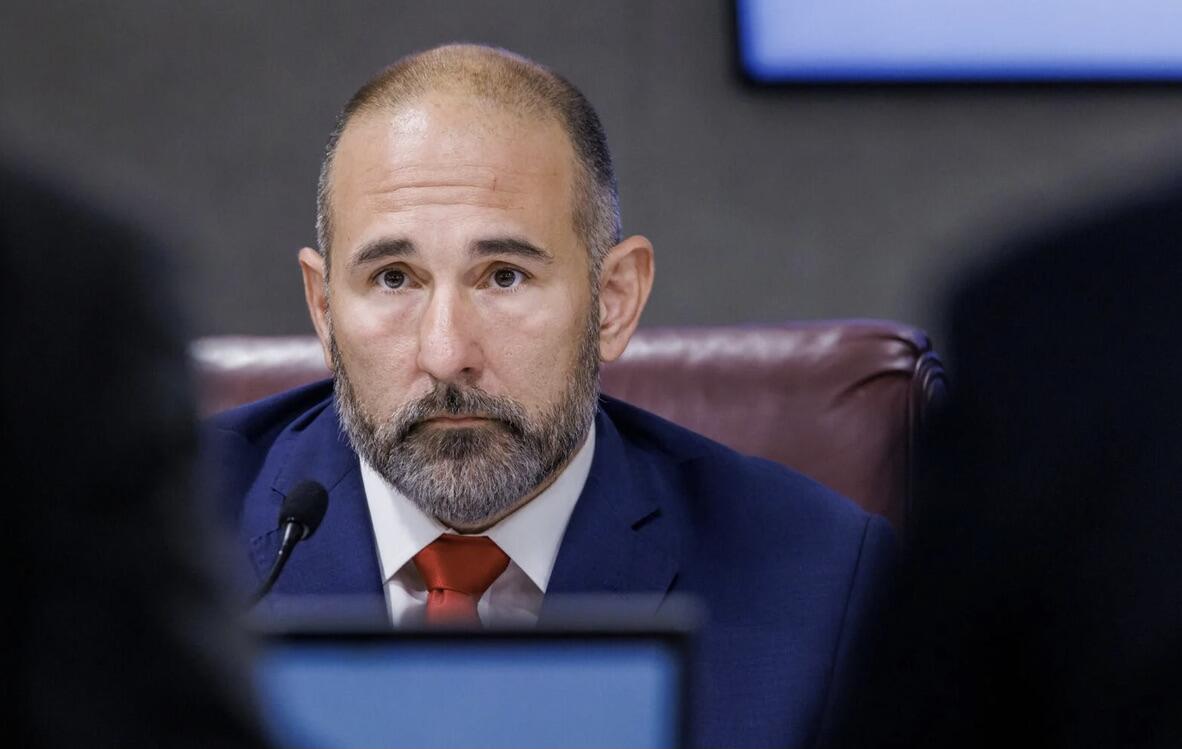 ?itok=RD_ijppF
Some have expressed concern that teenagers will be put in tougher situations at work, as they won't be able to point to a state law as a reason for being available to labor into the wee hours. “The teens who will be most harmed by this bill are low-income young people or those without documented status who are compelled by their situation to work,” Nina Mast of the left-leaning Economic Policy Institute told the https://www.miamiherald.com/news/local/immigration/article302704319.html
. She argued that the legislature is "essentially trying to legalize violations that employers are already committing.”
In the committee hearing, the bill's sponsor, Tampa Republican Jay Collins, argued that “This is a parental rights thing. Parents know their kids best." Dismissing visions of teens slaving away in hazardous envionments, he said, "Ultimately, we’re not talking about ‘https://www.amazon.com/Jungle-Upton-Sinclair/dp/1503331865
’ by Upton Sinclair. We’re talking about them working at Publix, at Piggly Wiggly or jobs within the industry."
There's another dynamic to consider: If families are so hard-pressed that they need their children to work night jobs, lacking the opportunity for legal employment may help push desperate adults and children into illegal activity -- from thievery to prostitution and drug sales.
https://cms.zerohedge.com/users/tyler-durden
Wed, 03/26/2025 - 23:00
House Panel To Consider Bill For Concealed-Carry Permit Reciprocity
House Panel To Consider Bill For Concealed-Carry Permit Reciprocity
(emphasis ours),
For the sixth Congress in a row, bills to require states to honor out-of-state concealed weapons permits are in both chambers of Congress.
 ?itok=F61hhjUs
The House Judiciary Committee will mark up its version of the legislation on March 25. President Donald Trump has promised to sign it if it reaches his desk.
Rep. Richard Hudson (R-N.C.) introduced HR 38 in the House on Jan. 3. The Senate version, S 65, introduced by Sen. John Cornyn (R-Texas) on Jan. 9, is before that chamber’s Judiciary Committee.
Proponents of the reciprocity bills say they require concealed weapons permit holders to comply with all other gun laws in whatever state they are in. For example, if the state prohibits guns in places of worship, he or she couldn’t concealed carry in those places even if their home state allows it.
Opponents of the legislation say that’s not true.
David LaBahn, president and CEO of the Association of Prosecuting Attorneys, said his organization opposed the legislation when it was introduced in 2017 and that it has not changed its position.
He said the bills, as they are currently written, would require police to know the gun laws in all 50 states and to take the word of out-of-state visitors that whatever state gun permit they present is valid.
The critics contend that states with strict gun laws, like California and New York, would be forced to recognize permits from states with fewer restrictions. According to LaBahn, that means that people from states with less gun control would not be subject to the stricter regulations.
“As long as you’re from an open-carry state, you can open carry any place in the country you choose,” LaBahn told The Epoch Times.
On its website, Giffords.org—the gun control group founded by former Congresswoman Gabby Giffords, who was shot during an event in Tucson, Arizona—criticized Republicans for introducing the legislation on Jan. 8, the anniversary of Giffords’s shooting.
Her  fords.org/wp-content/uploads/2025/01/GIFFORDS-Concealed-Carry-Reciprocity.pdf
has links to objections it presented in 2017, when HR 38 was voted out of the Judiciary Committee. The bill did not get a floor vote at that time.
“A New York police officer is not trained to enforce Montana gun laws,” the website reads. “Under some versions of [concealed carry reciprocity], if an officer accidentally arrests someone they think is breaking the wrong state’s law, the police officer could be charged with a crime.”
LaBahn said that states currently arrange reciprocity compacts. Compacts ensure that officials understand the laws in each member state.
However, the reciprocity bills disregard state laws, he said.
“This is really an anti-10th Amendment Bill where the federal authorities are stepping in,” LaBahn said.
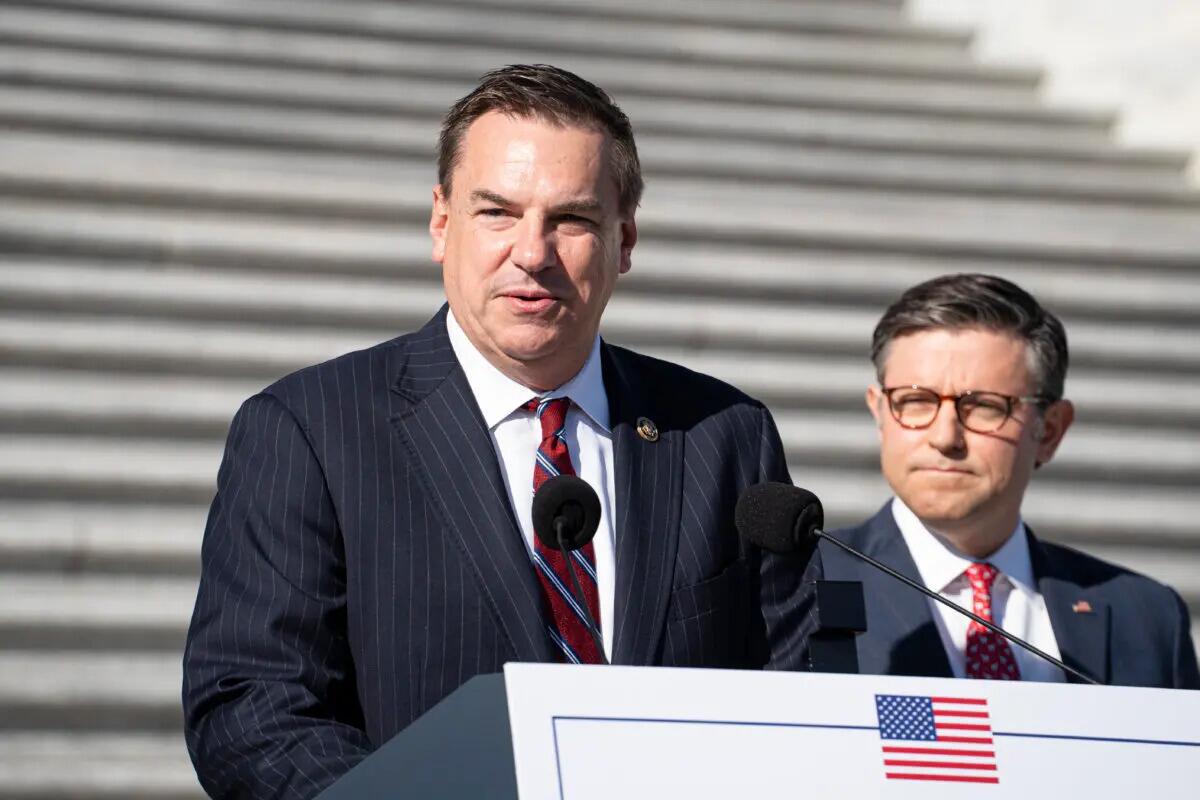 ?itok=koGgQcEM
Proponents of the bills say that LaBahn’s interpretation is wrong.
Amy Swearer, an attorney and a senior legal fellow at The Heritage Foundation, carries a concealed firearm. She said reciprocity for concealed carry permits would make her life easier.
Swearer lives in Virginia but travels through other states regularly for work. She said the reciprocity would give her peace of mind, knowing that she is not breaking the law in a state she’s visiting by simply exercising her Second Amendment rights.
“The state in which [the concealed carry permit holder is] in can’t prosecute them for the offense of carrying without a license or unlawful carry. [But] that person would still have to abide by all the other carry laws in that state,” Swearer told The Epoch Times.
Currently, under the federal Firearm Owners Protection Act, nonresidents can legally transport unloaded firearms through a state if they are traveling to or from a place where they can legally possess the firearm.
Swearer said that with the bill, there may end up being some other local gun laws that won’t apply to out-of-state visitors, such as gun registration requirements. But importantly, reciprocity does not require the state of New York, with strict gun regulations, to allow Oklahoma residents act in accordance with only Oklahoma’s gun regulations when they are in the Empire State.
“So nothing in this bill would require states in any capacity to change their existing gun laws or restrictions on where people can or cannot carry,” Swearer said.
John Commerford, executive director of the National Rifle Association’s (NRA) Institute for Legislative Action, said national reciprocity for concealed carry is the NRA’s top goal for this Congress. He said Trump has promised to sign the bill if it reaches his desk.
 ?itok=enw-HBwz
Commerford said the law does have one requirement that gun owners in at least 29 states with permitless carry should be aware of.
“Under HR 38, you would need a permit from your state to carry in the other states,” Commerford told The Epoch Times.
According to Commerford, 29 states are “Constitutional Carry” states. These states do not require permits to carry a concealed firearm in public for individuals who can legally possess a firearm.
All but one of these states offer a permit even though it isn’t required. Vermont has never required a concealed carry permit.
Commerford said a permit provides evidence that the gun owner has met some legal requirements for carrying a firearm. He also said that the bill is part of a larger objective.
“The ultimate goal would be to have constitutional carry nationwide. However, HR 38 is politically viable in this Congress,” Commerford said.
Commerford admitted that politically viable isn’t the same as a done deal. However, with a majority of the states adopting Constitutional Carry and Republicans controlling both chambers and the White House, Commerford said the NRA will work to get the bill on the floor of the House and then on to the Senate.
LaBahn said his organization will monitor the bill and take any action they deem appropriate to prevent its progress. He said that if the bill’s supporters really believe they have the backing of the majority of states, perhaps they should change their strategy.
“If the desire is to have national right to carry, Congress can establish that, and [eliminate] state to state confusion. This act is ... a very poor second best to their intent and will likely get people hurt,” LaBahn said.
https://cms.zerohedge.com/users/tyler-durden
Wed, 03/26/2025 - 22:35
https://www.zerohedge.com/political/house-panel-consider-bill-concealed-carry-permit-reciprocity