
What $1 Million Can Buy In Prime Real Estate Around The World
What $1 Million Can Buy In Prime Real Estate Around The World
Across global luxury property markets, $1 million doesn’t go as far as it used to.
In Dubai, for instance, a $1 million dollar property in 2020 is worth $2.7 million today. Meanwhile, in Miami, it would be worth $1.9 million. However, in some markets, cracks are beginning to show amid higher rates and https://www.visualcapitalist.com/global-real-estate-bubble-risk-in-2024/
spurred by the pandemic.
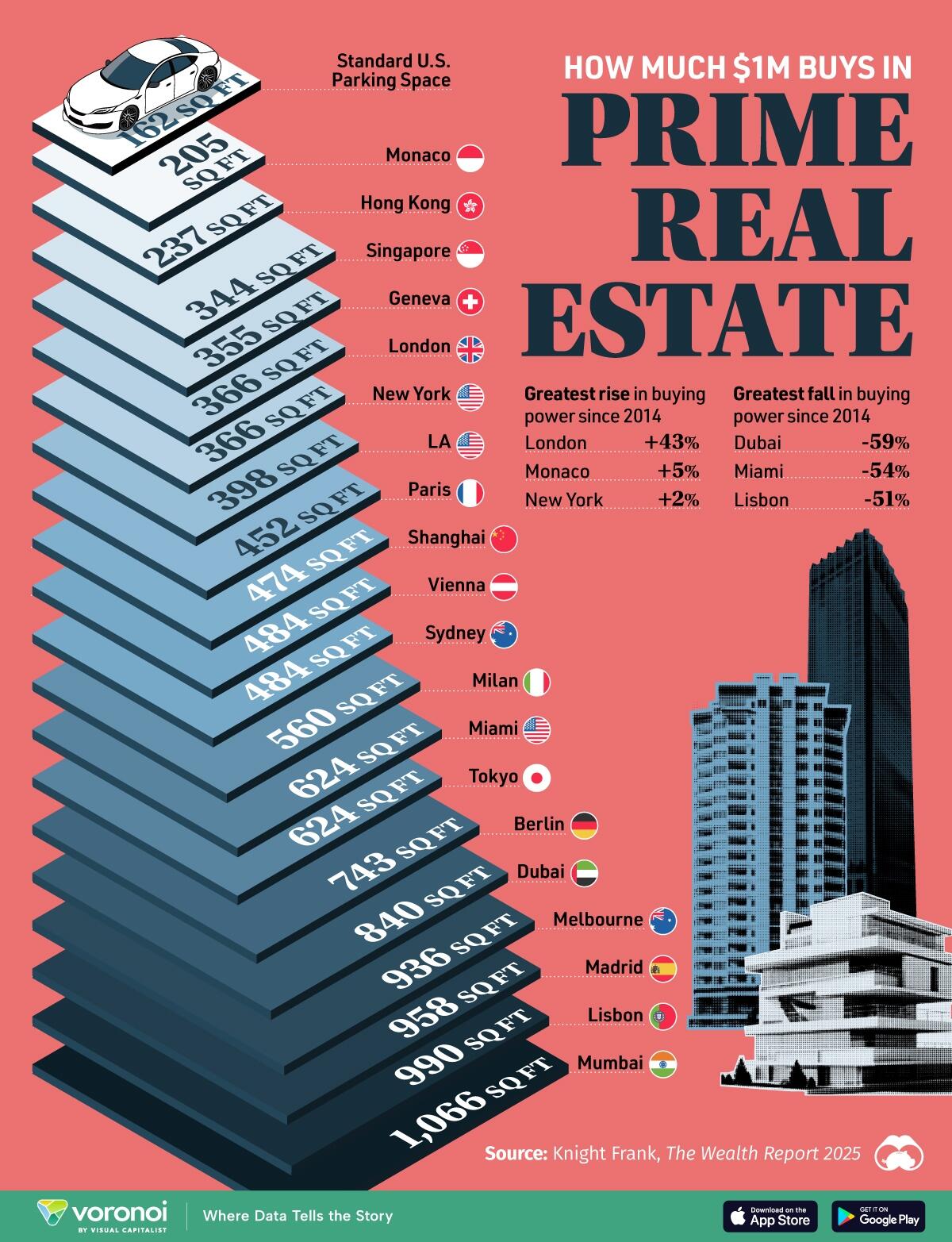
This graphic,https://www.visualcapitalist.com/what-1-million-can-buy-in-prime-real-estate-around-the-world/
.
 ?itok=0BGwshGH
Luxury Properties Are Getting Pricier
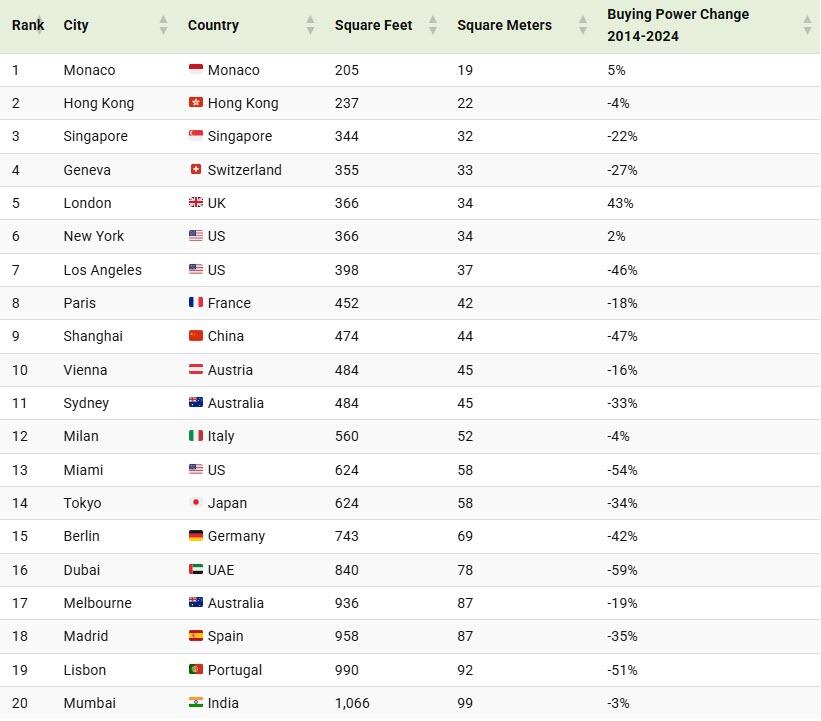
Below, we show the square footage that $1 million covers across luxury real estate markets, defined as the top 5% of residential listings as of 2024:
 ?itok=isNJCBpV
As we can see, $1 million covers just 205 square feet in Monaco, with an average new build costing a staggering $39 million in 2024.
Monaco’s appeal for the ultra-rich largely stems from its tax-haven status as it has no income tax, inheritance tax, or capital gains tax. Additionally, the scarcity of land met with high demand contributes to high property values.
Despite economic challenges, Hong Kong ranks as the second-most expensive luxury market. While many properties of Chinese real estate tycoons have sold at a sharp discount since the collapse of China Evergrande, it still commands top dollar for the most exclusive residences. Overall, buying power has moderately decreased compared to 2014 levels.
On the other hand, buying power has risen notably in London due to a falling pound against the dollar and a property market correction. Over the last decade, it has increased by 43%, the biggest jump across cities analyzed.
In many ways, this bucks the trend of a majority of prime real estate markets globally. In particular, Dubai has seen buying power drop 59% since 2014, followed by Miami (-54%) Lisbon (-51%), and Shanghai (-47%) amid robust demand and rising affluence.
To learn more about this topic from a real estate perspective, check out this https://www.voronoiapp.com/real-estate/These-Cities-Are-Considered-Impossibly-Unaffordable--1596
on the world’s least affordable housing markets.
https://cms.zerohedge.com/users/tyler-durden
Sun, 04/13/2025 - 22:35
https://www.zerohedge.com/personal-finance/what-1-million-can-buy-prime-real-estate-around-world
Escobar: Why China Won't Call The "Tariff-Wielding Barbarian"
Escobar: Why China Won't Call The "Tariff-Wielding Barbarian"
Authored by Pepe Escobar,
The Toddler Temper Tantrum-style https://strategic-culture.su/news/2025/04/03/how-trumps-tariff-tizzy-burning-down-house/
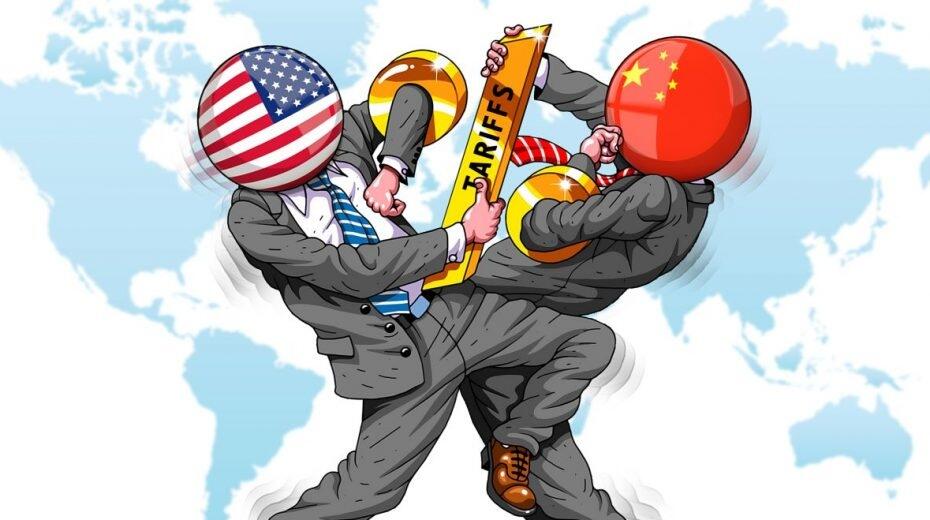
, now accelerated to 145% – and counting – is yet another thunderous trademark pigeon smashing the chessboard gambit.
 ?itok=RmQW96VC
It won’t work. Trump claimed that China would call him to “make a deal”. That’s reality show territory. Reality is more like the statement by the Customs Tariff Commission of the State Council: “Given that U.S. exports to China already have no market acceptability under the current tariff rates, if the U.S. further imposes additional tariffs on Chinese goods, China will simply ignore them.”
Translation: keep vociferating/tariffing. We don’t care. And we will stop buying from you. Anything.
The Chinese Foreign Ministry: A “tariff-wielding barbarian can never expect a call from China.”
Basic numbers. China’s GDP for 2025 is projected at 5%. U.S. imports account for at best 4% of Chinese GDP. China’s share of total exports to the U.S. dropped to 13.4 per cent in 2024.
Goldman Sachs – not exactly a CCP “mouthpiece” – has just projected that TTT will cost China only 0.5% of GDP in 2025, while costing no less than 2% of U.S. GDP. Talk about blowback.
Still, from now on, what matters most for Beijing is to keep diversifying the supply chain.
Asia-wide, the extra wheels are in motion. President Xi Jinping will soon start an ASEAN mini-tour (Vietnam, Cambodia, Malaysia). The Shanghai Cooperation Organization – increasingly focused on geoeconomics – is about to meet. The EU, for all the mendacity of its “elites”, is absolutely itching to strike trade deals with China.
Zhao Minghao, deputy director at the Centre for American Studies at Fudan University, in Shanghai, refers to the current incandescence as “a game of strategic resolve.”
Previously, the eminent Wang Yiwei, international relations star professor at Renmin University in Beijing and an expert on the New Silk Roads, noted that the current tariff rate already made China’s exports to the U.S. “almost impossible”.
https://www.guancha.cn/MeiXinYu/2025_04_10_771633.shtml
noted how China started to deal with TTT with a “courtesy before force” approach, then turned to “we don’t care”, while cultivating “the art of timing” in its asymmetric attack on U.S. stocks.
A fascinating window on the real wheels of Chinese trade is offered by a timely visit to the vast https://www.guancha.cn/caoshu/2025_04_11_771693.shtml
, the largest concentration of small traders on the planet.
Less than 10% of Yiwu’s phenomenal amount of business involves the U.S. Among the 75,000 business operators in Yiwu Small Commodity City, only a little over 3,000 do business with the U.S.
Two Sinophobes meet one mirage
TTT is largely the product of two crude Team Trump arrogant/ignorant Sinophobes, economic advisor Peter Navarro and Secretary of the Treasury Scott Bessent, who know less than zero about all things China.
In fact it was Bessent who right at the start gave the game away:
“This was driven by the president’s strategy… You might even say that he goaded China into a bad position. They responded. They have shown themselves to the world to be the bad actors, and we are willing to cooperate with our allies and with our trading partners who did not retaliate.”
A crude trap. With the sole focus on China. That had nothing to do with the initial tawdry plot line: tariffs, Mafia-style, on most of the planet, penguins included. If you don’t retaliate, fine. If you do, we hit harder.
of the so-called “Miran mirage” – after Trump’s alleged economic brain Stephen Miran. What is actually happening, fast, bypassing the stupid notion that tariffs will be paid for by current depreciation elsewhere (https://www.hudsonbaycapital.com/documents/FG/hudsonbay/research/638199_A_Users_Guide_to_Restructuring_the_Global_Trading_System.pdf
), is the uncontrolled demolition of the U.S. as a world trade center.
Asked why he paused the tariffs, Trump answered: “I thought people were jumping a bit out of line. They were getting a little bit yipee. They were getting afraid.”
Nonsense. Trump cannot possibly admit on the record that the U.S. oligarchy, Jamie Dimon and co., freaked out big time; and that, plus the debacle in the bond market, forced him to backtrack.
Nobody in neoliberal heaven and earth can mess with the Goddess of the Market.
As for the long-term strategy of several nations of the Global Majority caught in TTT’s crossfire hurricane, not to mention big players like China and the EU, they will all avidly reduce their dependence on U.S. markets.
Once again, the elaborate “deal” offered by Trump and his illiterate advisors boiled down to a Mafioso “offer you can’t refuse”: blow up, or significantly diminish, your trade with China – the largest trading partner of nearly all of these nations – and trade with Exceptionalistan, plus 10% tariffs. To hell with your economic sovereignty and strategic flexibility. Once again: it’s our way or the – tariff – highway.
Reality instead will dictate that the U.S. will increasingly import Chinese products from third countries – while China will continue to get paid for it. China will export even more to ASEAN and other Global Majority actors.
As it stands, Trump’s “plan” – if there is any – remains to “stabilize” his allies while concentrating all the firepower on China, in theory to drive China’s complex supply chains to chaos and force companies to move production lines to, for example, Vietnam or India.
Shakedown leading to breakdown
China containment will be on overdrive. Expect a tsunami of technological restrictions, investment red lines and, of course, extra sanctions. Sinophobe Bessent does not rule out delisting Chinese stocks from U.S. exchanges: “I think everything’s on the table (…) That will be President Trump’s decision.”
Beijing, for its part, can easily go nuclear, deciding for a sell-off of its U.S. Treasuries en masse, with catastrophic cascading consequences. As of January, Beijing held $760 billion in U.S. debt. With a delightful diplomatic touch, Yang Panpan and Xu Qiuyan, researchers at the Chinese Academy of Social Sciences, note that what happens next with U.S. Treasury bonds remains “highly uncertain”.
Bridgewater billionaire investor Ray Dalio, for his part, while incisive, was also heavy on diplomacy: “We are seeing a classic breakdown of the major monetary, political and geopolitical orders.”
There’s no more “cooperative world order” led by the U.S. (in fact that was anything but cooperative”); Dalio at least recognizes the unilateralism manifest in “the U.S.-led trade-war, geopolitical war, technology war, and, in some cases, military wars.”
Chinese Foreign Ministry Spokesperson Lin Jian de facto synthesized Beijing’s position. No more Mr. Nice Guy, which was the default Chinese position until recently: if the U.S. insists on fighting a tariff war and a trade war, China will fight to the end.
So here we are. And once again, it’s the Empire of Chaos against BRICS.
The Empire of Chaos embarks on a hot geoeconomics war against its peer competitor China; contemplates a hot military war against sovereign Iran; and at the same time tries to appease nuclear/hypersonic power Russia into a sort of hazy deal to somewhat freeze the Forever War by proxy in Ukraine.
The new Primakov triangle, RIC (Russia-Iran-China) is perfectly aware of these moves. Putin had metaphorically characterized the Russian position in the U.S.-China trade war when he mentioned that the Chinese have a good proverb: when tigers fight in the valley, the smart monkey sits and watches how it ends.
Now is more the case of three wise monkeys perfectly aware of what a pigeon posing as eagle is really up to.
* * *
Views expressed in this article are opinions of the author and do not necessarily reflect the views of ZeroHedge.
https://cms.zerohedge.com/users/tyler-durden
Sun, 04/13/2025 - 22:00
https://www.zerohedge.com/geopolitical/escobar-why-china-wont-call-tariff-wielding-barbarian
Trade War? Policy Pivot?
Trade War? Policy Pivot?
By Peter Tchir of Academy Securities
For anyone who has been reading the T-Report for the past few months, you know that we have become increasingly concerned about the administration’s tariff policy and its impact on markets and the economy.
 ?itok=q5ou3e53
As recently as Thursday on https://www.bloomberg.com/news/videos/2025-04-10/us-won-t-be-spared-from-global-recession-tchir-says-video
, I was bearish on the economy and thought that we had evolved from a Trade War to an Economic War with China. That fits the D.I.M.E. framework for levers of power (Diplomacy, Information, Military, and Economic).
On Wednesday (it seems like so much longer ago), after the “reciprocal” tariffs went into place (which weren’t actually reciprocal), the administration backed down in two important ways:
The new “reciprocal” rate would be 10% (much more in line with the weighted average tariffs that the U.S. faces with many countries).
There would be a 90-day pause, or roll-back, to give time for countries to negotiate.
China was singled out as not benefiting from either of the above.
We discussed this briefly on Wednesday and in more detail on Thursday morning when we reviewed the https://academysecurities.com/macro-strategy-insights/liberation-day-do-over/?asmac=fc8c7fe2-ca2b-4390-9b7c-1b507f6675cb
. The argument was that the pause and reduced rate was good, but probably not good enough to get us back to pre-Rose Garden levels. This also seemed to fit with the escalation of the Trade War to an Economic War with China.
Then, Friday night, we got some major exemptions:
Chips, smartphones, and a wide variety of primarily tech-related products have been exempted from tariffs. There are some details that I haven’t seen on what products specifically will be exempted. Also, not sure whether the exemption is from the “reciprocal” tariffs, or if other, older tariffs still apply? Weirdly, I’m fine ignoring the details for the moment.
China was INCLUDED in the exemptions.
The fact that China was included in the exemptions makes this quite powerful indeed. It certainly seems to ratchet down the full Economic War with China (for now).
Had 10% “reciprocal” tariffs, with 90 days to negotiate, and exemptions for vital/expensive tech been excluded from the initial Liberation Day announcement, we probably all could have been saved a lot of time and suffering!
But they weren’t.
Before moving on to analyzing where I think we are and where we are headed, I want to thank management here at Academy for supporting the macro analysis we supply. I can guarantee that not everyone in management, or every employee, agreed with my take. I’m sure that many of our clients did not either. But the decision was made that the views were generated based on information at hand and by applying logic, as I saw it, to analyze the potential outcome. Provocative? Yes. But intentionally one-sided? No! It was this freedom that probably helped get Academy Securities quoted on the front page of the weekend edition of the FT.
So, let’s move on and figure out what we’ve learned and where this might all be headed.
What We’ve Learned
Here is what I think we’ve learned. It is based on my assessments coming into this weekend, so what I think I’ve learned is based on what I had previously thought.
Wall Street and Main Street are inextricably linked. Wall Street, Main Street, and the Economy form a Gordian Knot. Anything that affects Wall Street or Main Street impacts the economy, which is the mechanism by which it transfers impact between the two.
Economic common sense can win out. We are back to something that makes some degree of sense to me. A reasonable pushback on most of the world and time to negotiate. Tail risk related to headlines from this administration will be reduced (after what is likely to be a big gap higher for all asset classes on Monday). Quite simply, if the administration is saying something that doesn’t make sense for the economy (therefore Wall Street and Main Street), then there is chance it won’t occur or will be dialed back rapidly.
The China Response Function. This is quite likely the most interesting thing and the one I’m most curious about, as I’m not sure I have an incredibly strong view.
Did China push back too hard, thinking the administration was hell bent on the original Liberation Day Plans? Did China get sucked into fighting harder than they would have, believing the U.S. was going to play incredible hardball with other countries? That is possible and would put China in a weakened position going forward.
Was China extremely well prepared for this all along? Both the administration and China have had at least since November to plan for Trade Wars, and presumably had been making contingency plans long before the election results. Is China prepared to forego about 15% of their exports (and an even smaller portion of their GDP) because they are prepared and have plans in motion to win, and know that their people will tolerate much more suffering, for much longer than the U.S.? Look at their lockdown versus ours – yes, eventually Xi had to capitulate but not right away. It is useful information to know that China seems prepared to fight this out, and might indicate they believe they “hold the cards.”
While I can see both sides of the argument, I’m going to be working under the assumption that China was much bettered prepared than the U.S. was. That they have plans in place to fight back across the globe and we had expected relatively quick capitulation (I think the same applies, to a much lower degree, to Europe). That is how I’m interpreting the events of the past few weeks. I could be wrong, I might be missing the “art of the deal” or am incapable of playing 4D Chess, but that’s where I’m coming out as my base case when thinking about how things move.
The administration has no problem pivoting. While we’ve focused only on the tariff side of things, there have been shifts in geopolitical rhetoric as well. For a while it seemed like Ukraine could do nothing right in the eyes of the administration and Russia could do no wrong, but that has changed. According to Grok, Marco Rubio, all the way back to March 14th, was the last senior official to refer to Canada as the 51st state. Google Trends confirms that searches for 51st State have dropped to the lowest level of the year. (Yes, I am Canadian, but I do think that is an important shift in messaging from the administration). It is great that the administration can pivot and back away from things that may be playing out detrimentally for their plans. However, it is a bit concerning that they are so comfortable starting these types of things in the first place. This should reduce tail risk in markets for now, as it seems that across the board, there is a willingness to reflect and change course.
Bottom line is we’ve learned that all sorts of things might be said and done and even undone, which is both comforting (lower tail risk) and concerning (difficult to see how this is helpful long term). I think we have learned that China was ready to move this from a Trade War to an Economic War, so we better understand what hand they think they have.
Deals
Next on the slate must be the finalization of some deals. My first question is whether these will be tariff deals or comprehensive trade deals? I think we are going to see “trade” deals, which may be trickier to negotiate than we believe, but let’s go through the various steps.
Reduced or eliminated tariffs. This will be relatively easy, and I think it could have been achieved without the Liberation Day process as executed. Many of the tariffs are quite small and are not the primary reason the U.S. isn’t selling goods into that country. I’ve spent a lot of time over the past month examining tariffs, and I am not convinced that even if every country in the world reduced their tariffs to 0, that we would see a surge in U.S. exports.
For small tariffs, it seems unlikely that they are the differential between selling some and selling a lot. At the margin, it was a bit helpful, but only a bit.
Tariffs with low GDP per capita nations can be reduced to zero, but the spending power of those nations is still low. The rich are likely paying up to get the American items already. Plus, many of the American Brands aren’t made in the U.S., so they aren’t impacted – the tariffs are based on where things are made, not where the corporate headquarters are domiciled.
Non-tariff barriers are real. At the “cannot do anything about it” level of non-tariff barriers, is taste or consumer preferences. If for whatever reason things made in the U.S. don’t resonate with consumers in other countries, that can only be fixed by developing products for those markets – which presumably would have occurred if someone thought the demand was worth it. Then you do have rules on things, whether it is emissions, GMO, etc., that are true deterrents to trade, but can you really force countries to change those? This could be difficult to negotiate.
Currency control and manipulation. I have no idea how to determine the amount a currency is undervalued due to manipulation. That is a problem that I just haven’t spent much time on. Maybe it is easy to determine, but I suspect that it is far more difficult to determine an appropriate “level” of manipulation. Currency controls are easier to see, and China does that. But you know who else has tight controls on their currency? India! If the administration is looking closely at currency controls, India, who I think should be a country we work closely with (a long running theme of T-Reports), should come under scrutiny. They might not (probably won’t), because it isn’t pragmatic, but something to watch.
All in all, I think tariffs will be reduced dramatically, and that could have been achieved without the angst of the past two weeks, and it won’t do much to spur American manufacturing.
Which leads me to import quotas.
I suspect we will see import quotas playing a large role in trade negotiations. The President still strongly believes in balanced trade, and forcing countries to buy U.S. goods fits into that view extremely well.
If we just wanted lower tariffs, the President could have given that to Israel as Netanyahu sat in the oval office. Israel had already agreed to eliminate all tariffs on U.S. goods.
So, if we get back to the first principle – more manufacturing in the U.S. – it is reasonable to assume that the administration will try to force the buying of American goods.
Quotas are likely going to be more difficult for countries to accept. Countries may have to change what they consume to meet quotes. This just seems more difficult than reducing tariffs (since I don’t think that will change the trade balance much, but quotas will).
The quotas are likely to have “teeth” to them. From all of our sources who worked with Trump 1.0, it is quite widely accepted that the President is angry that Xi never followed through on buying U.S. agriculture the way he had supposedly committed to do. So, for anyone thinking that countries will just agree to quotas and not honor them, I think you have another thing coming. Quotas are likely to be part of any trade deal and countries will face repercussions if they don’t live up to their obligations.
I believe import quotas, with penalties for violating them (which is completely appropriate if they agree to them), will play an important role in trade deals and may slow things down.
Restricting trade with China. There are 100s if not 1,000s of stories about how China uses loopholes in international trade to get around existing rules and regulations. The administration needs to stop that if the tariffs against China are going to be effective.
To reduce the opportunities for China to sidestep tariffs, there are likely going to be demands put on countries to reduce trade with China, or to have some sort of reporting requirements that take away these obvious loopholes that have been used in the past.
I certainly believe countries have been shocked and concerned by the trade policy approach. That may have been the intent and maybe all of the consequences have been intended. Many countries will and already had engaged more fulsomely with China. If the biggest economy in the world, which the U.S. is, acts erratically (from other countries’ perspective), the 2nd largest economy in the world is something you’d potentially turn to. Maybe, thinking of the Eurozone again, as a giant trading block (which it hasn’t acted like since Brexit), may also shake things up. So, if you think U.S. policy can change (dramatically in 4 years, and it may change dramatically this week), would you not turn to China? As sketchy as it seems, that is a logical response, and we are seeing it play out. Which is yet another reason for the U.S. to want to incorporate limitations on trade with China (forcing countries to impose tariffs on China is one possibility).
Basically, I’m at:
Reduced or not, tariffs will be in 100% of all trade deals. This will be achieved easily and could have been achieved through other means.
Non-tariff barriers and currency related issues are too difficult to deal with and point the U.S. in some directions the administration may not want to go in, so they won’t impact deals much.
Import Quotas. I expect these to play a prominent role in deals. It is a far easier way to guarantee that trade balances correct themselves. It is also far more contentious and difficult to get agreements. I think the U.S. will achieve some success on this front, but it will slow negotiations.
Including China Clauses. I think the administration will try to force this issue. It will be framed as “us or them” (which is consistent with current messaging). This may be very difficult to achieve. Will countries agree to something along these lines after what they have just gone through? Their people probably do appreciate the cheap prices, and the U.S. itself just capitulated on a big portion of China’s trade with the U.S. Maybe this isn’t something that the U.S. will decide it needs?
Given that this is my speculation (which I view is logical from what we’ve heard from the administration and what we can infer as being required to achieve their stated goals – which I believe are still their goals), I think trade deals are going to take longer to achieve with some of the most important trading partners!
I hope I’m wrong, but the more bells and whistles these trade deals try to incorporate, the more difficult it will be for richer, larger countries to agree to them.
The Economy and Risk Assets
I still think we have a high risk of recession, for a number of reasons, but I can dial back my concerns based on what we know of the policy adjustments.
I can also be comfortable, that for now, the lows are in for stocks and the wides are in for credit spreads, as the economic slowdown I fear will take longer to play out, and might be preempted by rapid policy “realignment” like we’ve just seen.
Rates and the Dollar
I expect, near-term, for rates to do well, and that should help the dollar. We should see inflation expectations drop, and the economic outlook to improve (kind of a wash).
The U.S. is in the process of passing a very large increase in the debt ceiling. There is already talk about a much greater military spending budget (from $800 billion to $1 trillion). If I’m correct on pivoting to domestic growth (see next section), then we could see pressure on the deficit to increase (it would not be the first time an administration with the best of intentions on the deficit decides they need to spend now, to make it better later).
Here's the bigger play at hand, and why there is only token pushback to DOGE.
You cut enough spending - even if it's all grift and fraud - you eventually get a recession, guaranteed. That's all Congress is waiting for cause then they use the "emergency" to vote through a far…
— zerohedge (@zerohedge) https://twitter.com/zerohedge/status/1888351368785604870?ref_src=twsrc%5Etfw
There are 3 things that have not changed that may put ongoing pressure on bond yields:
10-year German bonds yield 2.56%. You can get 3.35% in France. 3.26% for 10s in Canada and even 3% in Japan if you go out to 40 years. If you want income in any of those currencies, you can now get it directly, without buying Treasuries and hedging out the FX risk (given recent moves, the FX risk is significant).
Prior to Liberation Day, I’m not sure anyone took very seriously the “threat” that the U.S. would effectively force conversion of Central Bank Holdings of Treasuries into 0% coupon perpetual debt. That is one feature of the Mar-a-Lago Accord that seemed easy to ignore. But if the U.S. is going to spend more on its military (and this conversion is loosely tied to the benefits provided to global trade by the U.S. Navy) while trying to reduce the deficit, this may well be in play. Some level of dollars will likely be held for a variety of reasons, but I can see many central banks wanting to reduce their exposure to this risk. It is a binary type of risk, and it seems like you might be able to avoid it (or reduce it) by holding fewer Treasuries.
According to Grok: “Stephen Miran, Chair of the U.S. Council of Economic Advisers, proposed fees on foreign holders of U.S. assets, including Treasury bonds, in a November 2024 paper. He suggested this as a way to offset costs of the U.S. dollar’s global role. White House remarks in April 2025 have aligned with this idea, though no official policy has been confirmed.”
Supposedly this sort of tax has been implemented before, as a way to reduce trade deficits. If taxes force holders to reduce their exposure, it should help the trade with nations of those holders. This would not be limited to Treasuries and would not be limited to central banks. How real is the risk? I have no idea, but it is out there, and once again leaves me in the position of if you don’t need exposure to U.S. Treasuries (and it could encompass more than just Treasuries), then why keep your existing exposure?
I just see lots of reasons for countries, insurance companies, and pension funds in other countries to reduce their exposure to the U.S. Some mechanisms raise money for the U.S. (the fees, unlike tariffs, would be paid by foreigners) and allegedly help on trade balances, so why wouldn’t the administration consider it? Especially now that the tariff fees that they were relying on will be much lower and will start much later?
The basis trade and leveraged exposure played a role in driving yields higher, but the combination of higher yields and dollar weakness seems to point the finger to foreign net selling of Treasuries.
what if https://t.co/34mLPz8FAC
— zerohedge (@zerohedge) https://twitter.com/zerohedge/status/1910816757398294866?ref_src=twsrc%5Etfw
I’ve been told that the indirect bids at the auctions throw cold water on the theory that foreigners are selling. Yes, it does make you question the theory, but let’s toss out a couple of other things:
Everyone in the bond market is going to be watching those indirect bids. People who haven’t used the words indirect bid in their entire career were looking to that number. Any weakness there would have caused a large, immediate sell-off (that was consensus, and I agree with it).
Is it possible that Bessent, who is an incredibly knowledgeable trader, or Lutnick, whose firm is a Primary Dealer, saw that risk and tried to alleviate it? Maybe calling “friendly” countries and getting them to take down a huge chunk of the auction? That is what I would have done if I were in their shoes.
If I’m sitting on 100s of billions of dollars in Treasuries, even after having sold a lot of Treasuries, maybe the smart trade is to show up and alleviate the fear surrounding the most publicly available, real-time information on foreign flows by buying a big block at auction? Anyone who has traded knows that sometimes to get the best price for something you are selling, you have to convince the world you are a buyer. Not to mention that after yields back up, it is often profitable to get hit on the auction.
Yes indirect bids typically indicate foreign interest, but these were no ordinary auctions and the price action after the auctions seems to fit the foreign selling narrative.
I believe the Fed will provide temporary support as needed, but QE isn’t coming and the trend of foreigners selling U.S. bonds isn’t over, even after all the recent tariff concessions. If anything, some fears of foreign holders may escalate as this administration goes through their list of ways to reduce the deficit and the two methods above get traction.
Pivot to Domestic Production for Domestic Security
I’m tired of writing, and you are probably tired of reading.
It suffices to say, I’d love to see a pivot towards domestic production of things required for domestic security (I’d love “Fortress North America” chatter to pick up again, but I think that ship may have sailed).
Release the money from the Chips Act.
At least two cabinet members mentioned U.S. shipbuilding. Put in a massive order for ships that will take years to fill, but also give time for the shipyards to retool and domestic sources of steel and other materials to be developed.
Focus on domestic deregulation both to extract commodities from the earth, but also to process them!
There is a lot to be done that would achieve many of the policy goals that don’t come at the expense of global relations. Yes, it will hurt the deficit for a bit, but the path to success is much clearer than some of the things that have already been tried.
Bottom Line
I am all in for Make America Great Again. But my starting point was that America Is Already Pretty Darn Good, and not everyone has been picking on us even though everyone is jealous of America Exceptionalism.
I think there is a lot we can do that creates a smoother path to achieve the goals of:
Rebuilding a robust middle class.
Reducing the deficits.
Building more here (though a focus on high tech, high margin, and things we need for national security would be ideal).
China remains the country we have to compete with, and even if that competition was slightly dialed back by Friday’s tariff exemptions, it is real competition and I don’t think it will be easy to win. Definitely winnable, but not necessarily easily winnable.
I cannot believe Liberation Day was only April 2nd!
It feels like a lifetime ago, but hopefully, we don’t have to respond to every headline as dramatically as we have had to recently and will be able to make better assessments of the range of likely outcomes for the economy, which impacts both Wall Street and Main Street. For the first time in weeks, I’m optimistic about the outlook for the economy and markets, but it is tempered slightly by all the messiness it took to get here.
https://cms.zerohedge.com/users/tyler-durden
Sun, 04/13/2025 - 13:50
Watch: Taxpayer-Funded NGO With China & Democratic Party Ties Giving ICE Evasion Training
Watch: Taxpayer-Funded NGO With China & Democratic Party Ties Giving ICE Evasion Training
The https://x.com/ItsYourGov/status/1907794060141609216
to uncover a taxpayer-funded NGO allegedly providing "ICE evasion training" to help illegal aliens subvert federal immigration laws. Even more alarming, prominent left-wing politicians are reportedly linked to the NGO, which appears to have questionable ties with China.
Undercover footage obtained by https://www.muckraker.com/
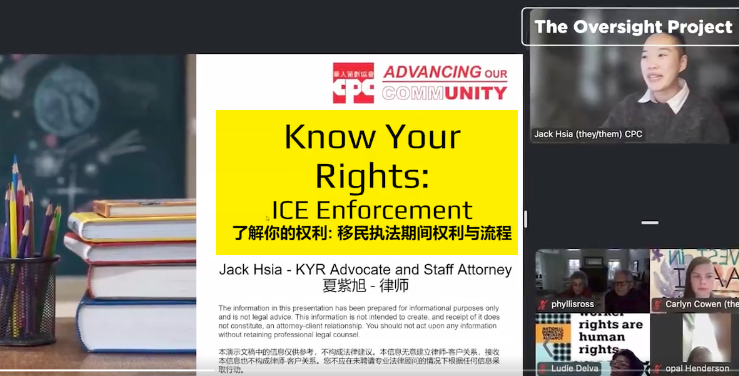
and later published online by the Oversight Project shows Carlyn Cowen, the leftist Chief Policy and Public Affairs Officer of the taxpayer-funded Chinese-American Planning Council (CPC), delivering a lecture at a radical activist meeting held in a New York City church on how illegal aliens can subvert federal immigration laws to evade ICE.
explained in the video that CPC sponsored the radical activist event. He called CPC "a radical New York-based NGO that has ties to the highest levels of the Democratic Party in New York State."
Oversight Project listed high-level Democrats that are reportedly connected with the radical NGO:
Senate Minority Leader Chuck Schumer (D-NY)
NY Gov. Kathy Hochul
Rep. Dan Goldman (D-NY)
Rep. Nydia Velazquez (D-NY)
Why are prominent Democrat politicians such ashttps://twitter.com/GovKathyHochul?ref_src=twsrc%5Etfw
— Muckraker.com (@realmuckraker) https://twitter.com/realmuckraker/status/1907798433638850806?ref_src=twsrc%5Etfw
Rubin explained that the CPC has conducted several seminars to instruct illegal aliens on how to evade ICE agents.
Tax-Payer Funded NGO Caught Giving ICE Evasion Training
Undercover footage obtained by https://twitter.com/realmuckraker?ref_src=twsrc%5Etfw
and to keep illegal aliens in the United States.
This group has… https://t.co/pQIZkwHd44
— Oversight Project (@ItsYourGov) https://twitter.com/ItsYourGov/status/1907794060141609216?ref_src=twsrc%5Etfw
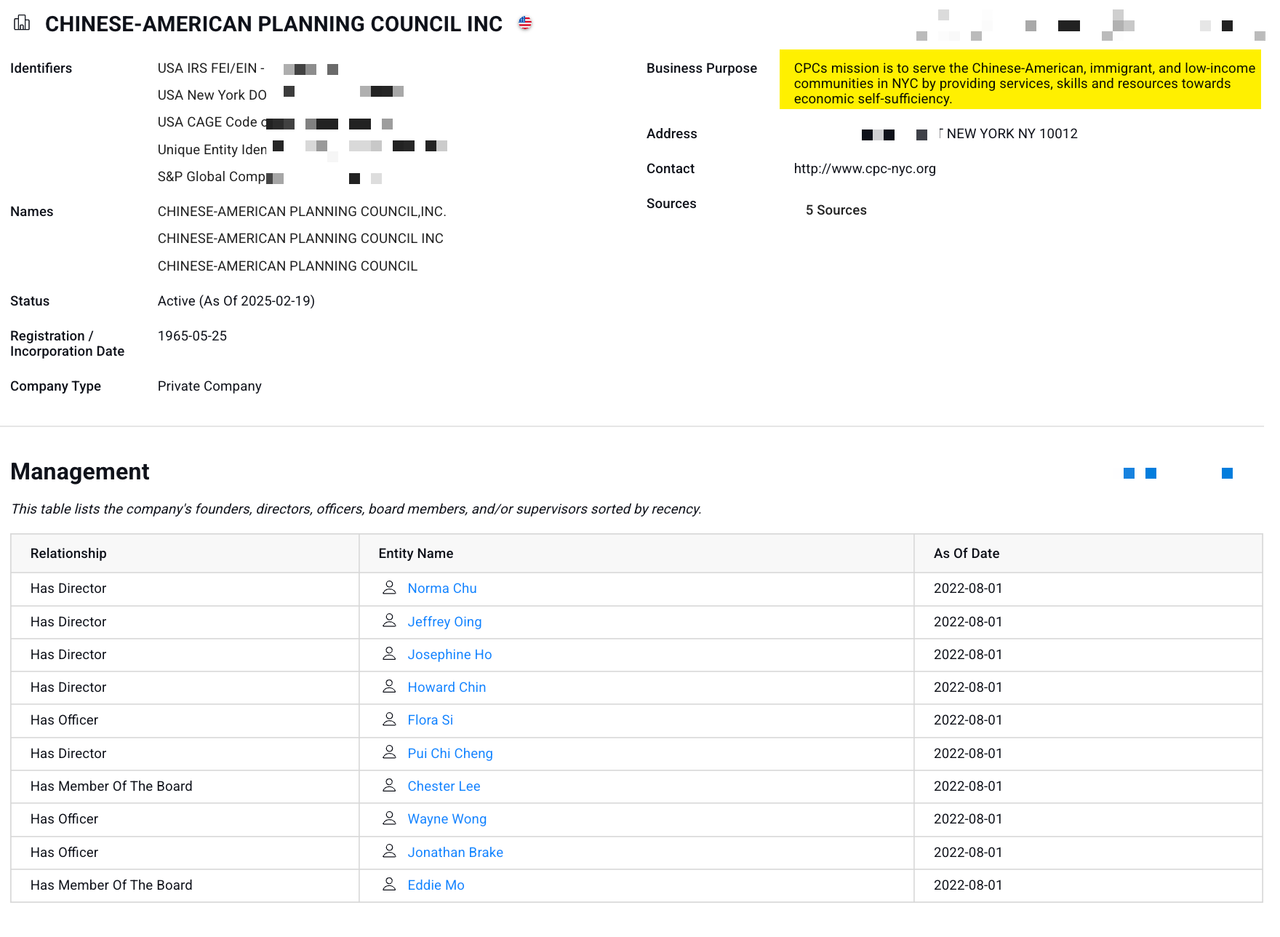
A review of public records shows that CPC's stated mission is "to serve the Chinese-American, immigrant, and low-income communities in NYC by providing services, skills, and resources toward economic self-sufficiency."
 ?itok=fsjYmPX3
Nowhere in the mission statement does it mention sponsoring seminars that instruct illegal aliens on how to break federal immigration laws.
 ?itok=GwaI1RI8
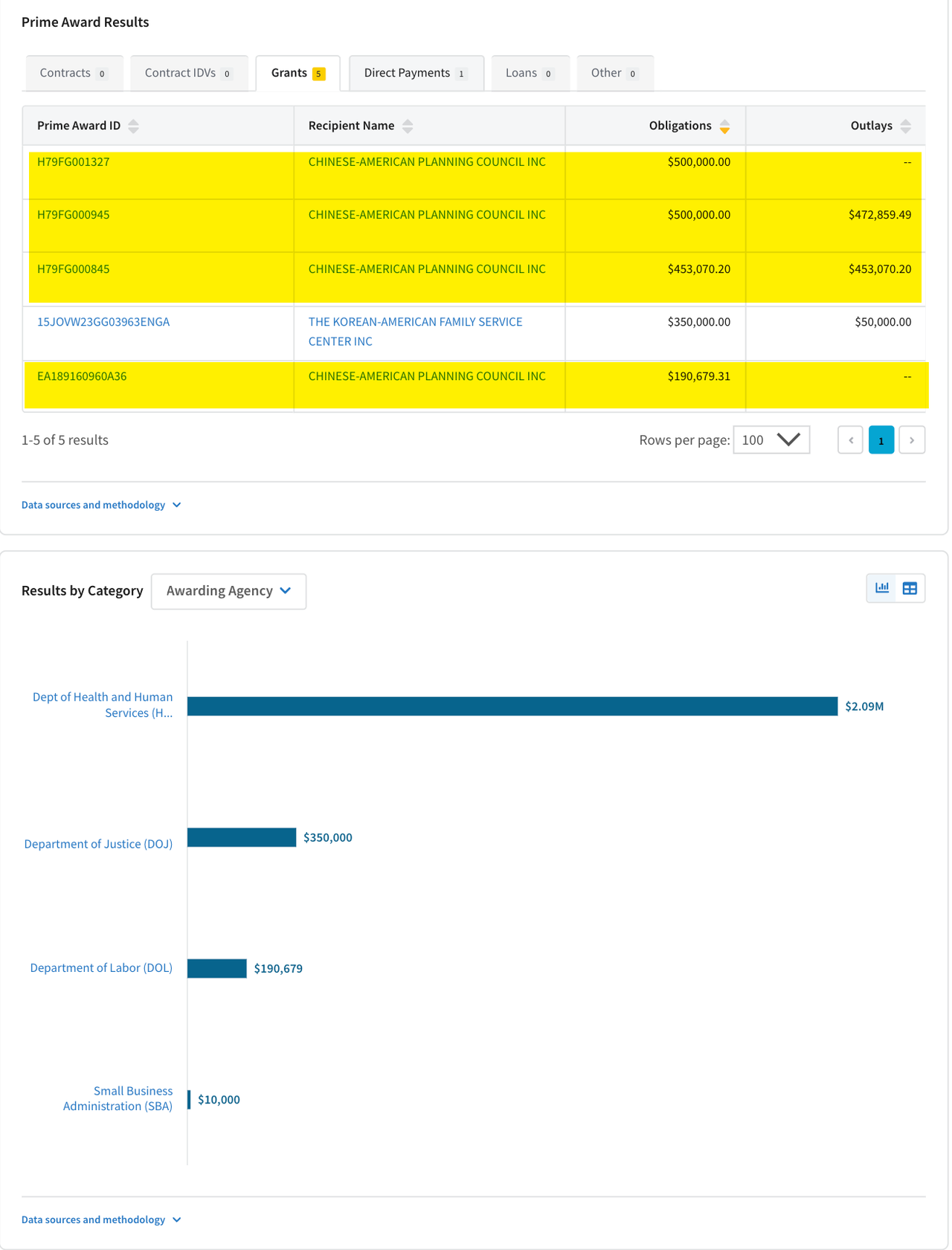
According to USA Spending, CPC has received several awards from the Department of Health and Human Services (HHS) totaling more than a million dollars.
 ?itok=VoudhoCw
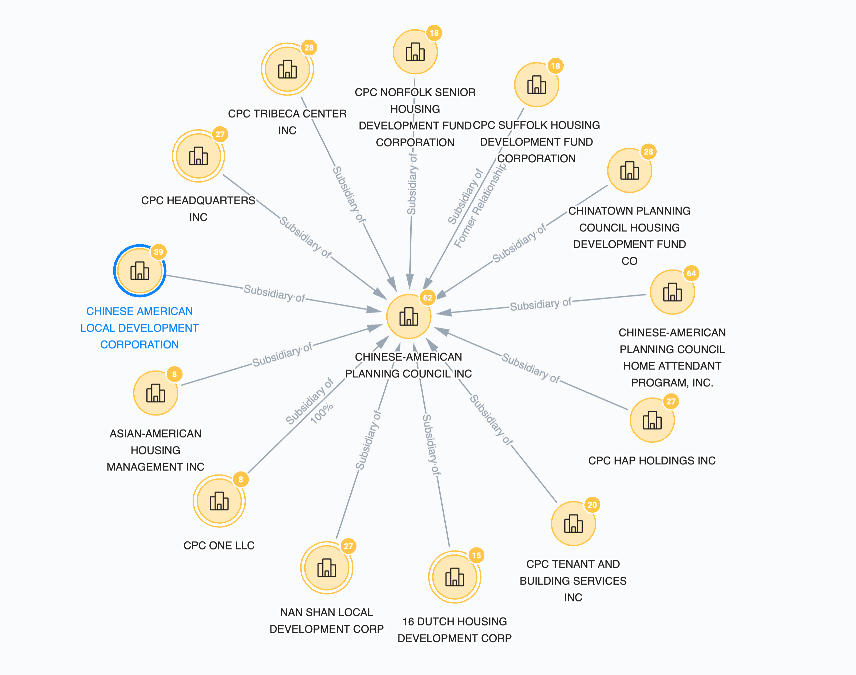
Further review of public records shows CPC's subsidiaries...
 ?itok=O3opsz21
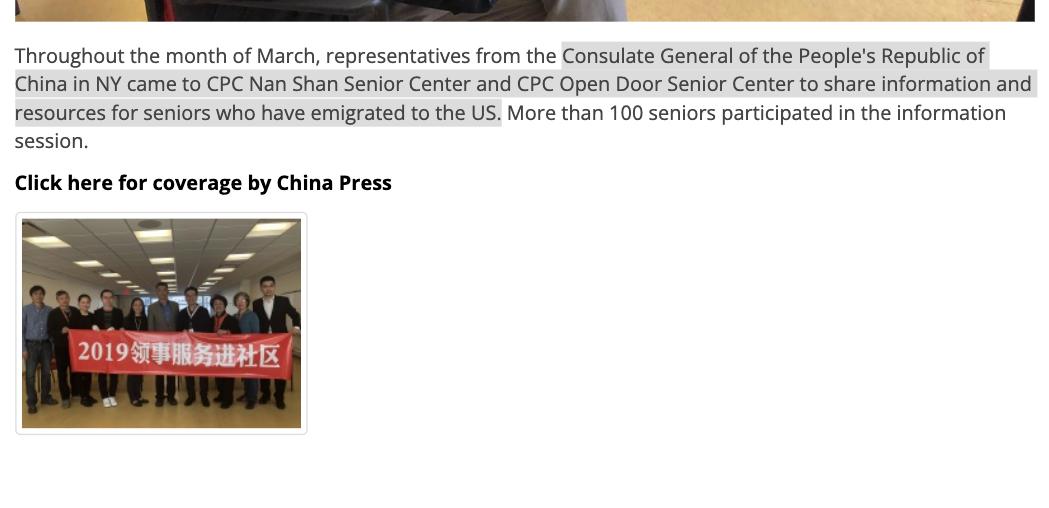
CPC has questionable ties with the https://www.cpc-nyc.org/news/1972/consulate-general-peoples-republic-china-ny-visits-senior-centers
...
 ?itok=3YMfdLSn
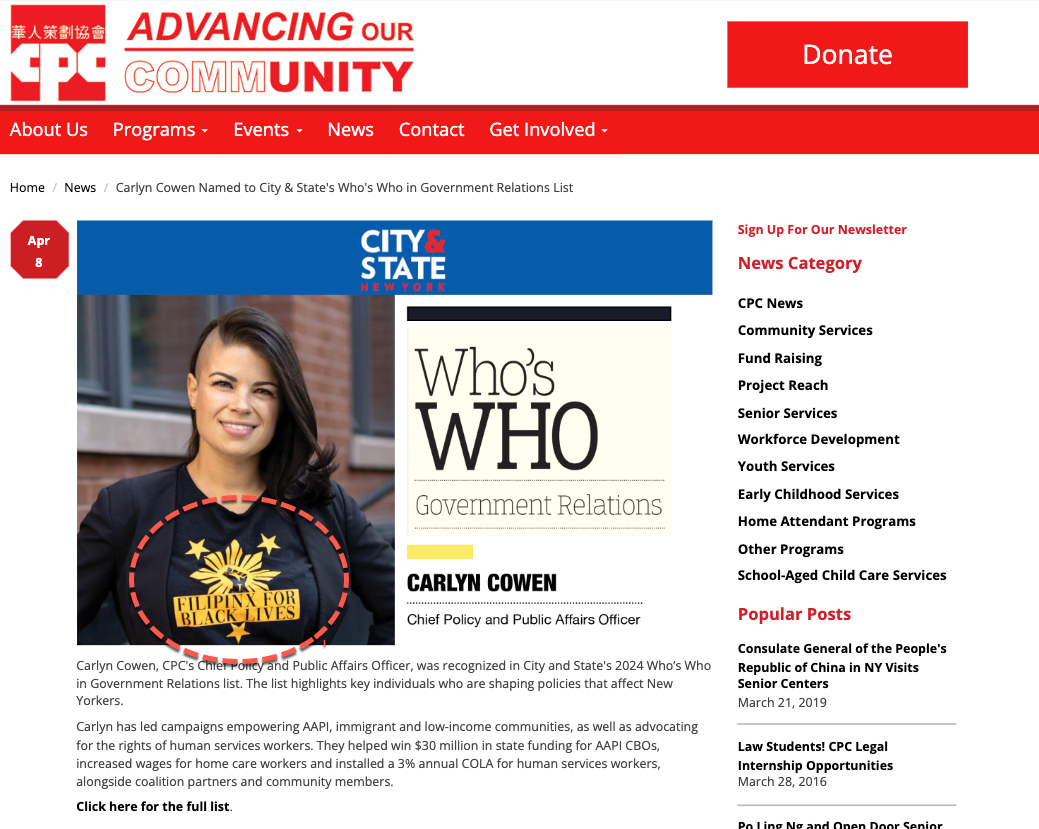
Back to CPC's Carlyn Cowen, featured in the undercover video via Oversight Project/Muckraker above, a very recent https://www.cpc-nyc.org/news/4611/carlyn-cowen-named-city-states-whos-who-government-relations-list
from the organization profiled the leftist organizer - even to the extent of providing critical detail in an image of her - wearing a "Filipinx For Black Lives" shirt.
 ?itok=IuiIK1i-
Cowen's shirt might be the biggest red flag yet, suggesting that the taxpayer-funded NGO—with questionable ties to China—could potentially be supporting Marxist causes in the U.S., aiming to subvert the nation as China plays the long game to weaken the nation from within.
https://cms.zerohedge.com/users/tyler-durden
Sun, 04/13/2025 - 13:15
The Most Important 4-Minutes On America's Middle East Wars We Have Ever Heard
The Most Important 4-Minutes On America's Middle East Wars We Have Ever Heard
Economist Jeffrey Sachs strikes again... this time by dropping truth bombs at Saturday's Antalya Diplomacy Forum — an annual conference on international diplomacy held in Antalya, Turkey. Sachs is also director of the Center for Sustainable Development at Columbia University and has been an adviser to the United Nations for decades.
Below is a clip from his mainstage speech, which is the most important four-minute commentary on the Middle East we have heard in a long time. He told the audience while discussing regime change in Syria and America's legacy in the region to look up the CIA's 'Operation Timber Sycamore' while pointing out that "This region (the Middle East) has been manipulated by Britain, France and the US for 100 years since the Treaty of Versailles."
"It will not have safety or peace until the U.S. is out of this region. If you think your big friend U.S. is gonna do your bidding and help you get your way," Sachs asserted. "Empires divide to rule. They’re not doing the bidding of Syria, Türkiye… You are calling the US to balance Iran… This is gonna work out well? It’s not gonna work out well." Sitting in a large room of foreign ministers and defense ministers from across the world, he held nothing back, destroying the NeoCon roots of contemporary US foreign policy and the recent disasters left in its wake. Watch:
American economist Jeffrey Sachs: (at Antalya Diplomacy Forum)
This region (Middle East) has been manipulated by Britain, France and the U.S. for 100 years since the Treaty of Versailles.
It will not have safety or peace until the U.S. is out of this region. If you think your… https://t.co/EOJ8eDCuSK
— Clash Report (@clashreport) https://twitter.com/clashreport/status/1911004324030804288?ref_src=twsrc%5Etfw
https://cms.zerohedge.com/users/tyler-durden
Sun, 04/13/2025 - 07:35
Whites Need Not Apply... British Police Force Blocks Applications In Favor Of 'Diversity' Candidates
Whites Need Not Apply... British Police Force Blocks Applications In Favor Of 'Diversity' Candidates
White applicants from a British or Eastern European background are at a disadvantage when applying for entry-level police constable roles at one of the U.K.’s largest police forces, according to reports by https://www.telegraph.co.uk/news/2025/04/09/west-yorkshire-police-blocks-white-applicants-diversity/
newspaper.
 ?itok=I8PZywsM
It has emerged that West Yorkshire Police permits Black, Asian, and Minority Ethnic (BAME) candidates to submit job applications all year round, but White people must wait for specific recruitment drives, sparking accusations of positive discrimination.
The police force claims the move is designed to boost diversity numbers and make the police more reflective of the area’s multicultural society.
An internal whistleblower told the U.K. newspaper that Black and Asian applicants are labeled as “gold” category candidates and are encouraged to apply at any time. White candidates from Britain, Ireland, and Eastern Europe, meanwhile, are “bronze” applicants.
Rather than focusing on how qualified an applicant is, the branding effectively sees candidates prioritized initially purely on the color of their skin.
According to documents reviewed by The Telegraph, the whistleblower expressed concerns to senior management over the application process, stating:
“The process restricts progression opportunities for White British candidates, while individuals from other backgrounds are swiftly advanced through recruitment stages.”
“We are currently accepting applications for the two police constable entry programmes (uniform and detective) from people from our under-represented groups… If you are not from one of these groups, please keep checking this page for future recruitment opportunities,” reads the recruitment page of the West Yorkshire Police website.
The force, Britain’s fourth-largest, insisted that “enabling people from an ethnic minority background to apply early does not give them an advantage in the application process” and that all applications are held until recruitment is opened for everyone.”
It claimed the current system simply allows the force to “attract talent from a pool of applicants who reflect the diverse communities we serve.”
West Yorkshire, a county in the north of England, has become an increasingly diverse area of Britain with a large Asian population, particularly from India and Pakistan.
According to the https://www.ons.gov.uk/visualisations/censusareachanges/E08000032/
, 23.4 percent of the population in West Yorkshire identified as belonging to non-White ethnic groups. This had more than doubled from the 11.4 percent registered two decades previously at the 2001 Census.
Some 15.9 percent identify as Asian and 3.1 percent as Black.
In certain areas, particularly cities, this percentage increases considerably. In Bradford, for example, 61.1 percent of residents are White, with 31.1 percent identifying as Asian, Asian British, or Asian Welsh — over three times the national average.
A West Yorkshire Police spokesperson told the newspaper, “The most recent census found that 23 percent of people in West Yorkshire identified as being from an ethnic minority background. Our current police officer representation from ethnic minority backgrounds is around 9 percent. To address this under-representation, we use Positive Action under the Equality Act 2010.
“Positive Action allows people from under-represented groups who express an interest in joining the force to complete an application, which is then held on file until a recruitment window is opened.
“No interviews are held until the window is officially opened to all candidates.”
The whistleblower, however, suggested that while broadly accurate, ethnic minority candidates are regularly “shortlisted, sifted, assessed and invited to an interview before White candidates can even apply.”
https://cms.zerohedge.com/users/tyler-durden
Sun, 04/13/2025 - 07:00
Restoring American Industrial Might To Counter China
Restoring American Industrial Might To Counter China
,
U.S. intelligence predicts a Chinese invasion of Taiwan byhttps://urldefense.com/v3/__https:/www.defensenews.com/pentagon/2024/05/07/how-dc-became-obsessed-with-a-potential-2027-chinese-invasion-of-taiwan/__;!!Bg5easoyC-OII2vlEqY8mTBrtW-N4OJKAQ!KTdHsghsNcRZawHZEN6G_rAgg22e6vcH8SrquenUppxoAxhsJ7awQJz6RGflhqk8b9RuScFKPm-3esKKl4sRULxUmB1xzZFFZw%24
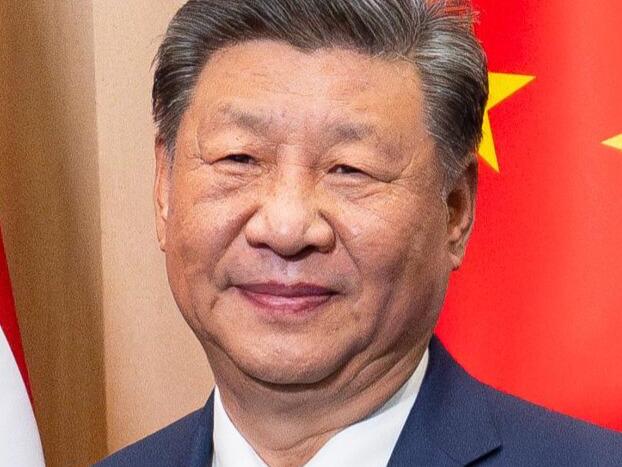
, just two short years away. The fall of Taiwan would ensure China corners the world’s market for semiconductor chips—used in everything from cars to smartphones to satellites. A victory here for the Chinese Communist Party (CCP) would also no doubt embolden the authoritarian regime’s expansionist ambitions elsewhere.
 ?itok=L3peypvB
The CCP has made it abundantly clear that its goal is to challenge U.S. global dominance and undermine the West politically, economically, and militarily. It’s no secret that China’s military expansion is proceeding at an alarming rate, even after you account for Beijing’s propaganda campaigns. Without a robust navy, the U.S. will be unable to project power in the Indo-Pacific and maintain the capability to deter CCP belligerence. In fact, while the U.S. Navy currently holds a technological advantage in terms of the ships and weapons systems at its disposal, China’s navy currently holds a four-to-one advantage in terms of ships deployed to the region. The United States would likely struggle to replace the loss of even a portion of its fleet should it become involved in a hot conflict with China in the near future.
The CCP has made up significant ground thanks to the weak leadership and inaction seen under the Biden Administration. At the same time, the focus of U.S. defense policy on counterinsurgency and post-Cold War consolidation has contributed to an atrophied defense industrial base. China has capitalized on this golden opportunity to modernize its military in significant ways, namely shipbuilding.
As of 2024, China controls over half of the world’s commercial shipbuilding market, while the United States’ share is abouthttps://urldefense.com/v3/__https:/www.defensenews.com/global/asia-pacific/2025/03/11/chinas-shipbuilding-dominance-a-national-security-risk-for-us-report/__;!!Bg5easoyC-OII2vlEqY8mTBrtW-N4OJKAQ!KTdHsghsNcRZawHZEN6G_rAgg22e6vcH8SrquenUppxoAxhsJ7awQJz6RGflhqk8b9RuScFKPm-3esKKl4sRULxUmB1ClQUM2Q%24
.
The most critical aspect of China’s naval expansion is its focus on quantity, speed, and versatility. While the U.S. Navy has traditionally focused on deploying fewer but more technologically advanced ships, China has adopted a strategy of sheer volume, rapidly expanding the capabilities of its fleet. Additionally, China’s aggressive pursuit of advanced naval systems, such as anti-ship missiles and nuclear-powered submarines, positions them as a major threat to U.S. naval dominance. As the PLAN grows in size and technological assets, it creates significant challenges for the U.S. and its allies in maintaining military strength and preventing conflicts in the Indo-Pacific.
Because unlike the U.S., which has two coasts to defend, China’s shipbuilding efforts are mainly centered around a single state-owned institution: China State Shipbuilding Corporation (CSSC). By employing the concept of “military-civil fusion,” abouthttps://urldefense.com/v3/__https:/www.defensenews.com/global/asia-pacific/2025/03/11/chinas-shipbuilding-dominance-a-national-security-risk-for-us-report/__;!!Bg5easoyC-OII2vlEqY8mTBrtW-N4OJKAQ!KTdHsghsNcRZawHZEN6G_rAgg22e6vcH8SrquenUppxoAxhsJ7awQJz6RGflhqk8b9RuScFKPm-3esKKl4sRULxUmB1ClQUM2Q%24
. Even more worrisome, Taiwan has purchased a large quantity from these high-risk shipyards, despite the CCP’s constant threats of aggression towards the island. We must emphasize the shared risks posed to our allies and partners by their continued, even indirect, support for CSSC, which poses a considerable risk to U.S. national security and underscores the need for increased domestic production here at home.
Restoring the United States’ shipbuilding industry must be viewed as a national security priority.
This is a daunting task, but the U.S. defense establishment cannot sit idle and cede this industry to our greatest adversary. While it may not be feasible to completely surpass Chinese production levels in the near future, the U.S. can still ensure that we have immediate access to the resources our navy needs by increasing funding for stockpiles of various crucial munitions, including long-range anti-ship missiles, torpedoes, and standard missiles.
The overall dilapidated state and overcentralization on the East Coast of U.S. shipyards has proven to be a consistent problem. If we want to be able to quickly build and repair ships and relevant assets at both scale and a rapid pace, the U.S. must diversify our shipyards to focus on getting the right systems into the hands of the warfighter. Too much of our defense budget is being poured into ineffective programs and overcomplicated contracts that don't keep pace with evolving threats. Eliminating unnecessary bureaucratic red tape is necessary here to unshackle our domestic defense industrial base. Incentivizing private companies to contribute to our defenses and infrastructure would help to streamline this process and allow for faster development and deployment of new technologies that can give us an edge over China in key areas.
If the U.S. is serious about deterring CCP aggression in the Indo-Pacific, we must give our navy the tools and resources to do so. This means embarking on a concerted effort to restore our domestic defense industrial base so as to prevent the projected 2027 scenario from happening in the first place.
Congressman Pat Fallon represents Texas’s 4th Congressional District. An Air Force veteran, he is a member of the House Armed Services, Intelligence, and Oversight and Accountability committees.
https://cms.zerohedge.com/users/tyler-durden
Sat, 04/12/2025 - 23:20
https://www.zerohedge.com/markets/restoring-american-industrial-might-counter-china
Trump Exempts Computers, Handsets, Chips From Reciprocal Tariff Blitz, Still Subject To Original 20%
Trump Exempts Computers, Handsets, Chips From Reciprocal Tariff Blitz, Still Subject To Original 20%
Update (1255ET): As Trump adviser Stephen Miller points out, the products are still "subject to the tariff under the original IEEPA on China of 20 percent."
Washington Post: maybe your reporters should try reading before posting. These products are subject to the tariff under the original IEEPA on China of 20 percent. https://t.co/MI4oDEb8S3
— Stephen Miller (@StephenM) https://twitter.com/StephenM/status/1911092862076289243?ref_src=twsrc%5Etfw
* * *
U.S. Customs and Border Protection (CBP) issued an updated guidance late Friday night on product exclusions from President Trump's reciprocal tariffs, imposed under Executive Order 14257 and its amendments (EO 14259). The exclusions cover a wide range of electronic devices, including smartphones, laptops, and related components.
First, President Trump paused reciprocal tariffs for non-retaliating countries (e.g., China) for 90 days last week. Now, updated guidance from CBP reveals that some of the highest-value trade—particularly a wide range of electronics—is excluded from the reciprocal tariffs.
Among the 20 tariff codes https://content.govdelivery.com/bulletins/gd/USDHSCBP-3db9e55?wgt_ref=USDHSCBP_WIDGET_2
for exemption, three stand out in particular:
8471 – Automatic data processing machines and units thereof (e.g., laptops, desktops, servers).
8517.13.00 – Smartphones and other telecommunication apparatus for cellular networks.
8542 – Electronic integrated circuits (e.g., microprocessors, memory chips).
Here's the complete list:
8471 – Automatic data processing machines and units thereof (e.g., laptops, desktops, servers).
8473.30 – Parts and accessories for automatic data processing machines (e.g., computer parts).
8486 – Machines and apparatus for the manufacture of semiconductor devices or electronic integrated circuits.
8517.13.00 – Smartphones and other telecommunication apparatus for cellular networks.
8517.62.00 – Machines for the reception, conversion, and transmission/regeneration of voice, images, or other data (e.g., modems, routers).
8523.51.00 – Solid-state non-volatile storage devices (e.g., flash memory, SSDs).
8524 – Media for the recording of sound or other phenomena, not elsewhere specified (can include CDs, DVDs, etc.).
8528.52.00 – Monitors capable of directly connecting to an automatic data processing machine (e.g., computer monitors).
8541.10.00 – Diodes, other than photosensitive or light-emitting diodes (LEDs).
8541.21.00 – Transistors with a dissipation rate of <1 W.
8541.29.00 – Other transistors.
8541.30.00 – Thyristors, diacs, and triacs (semiconductor switching devices).
8541.49.10 – Light-emitting diodes (LEDs) – chips mounted in discrete packages.
8541.49.70 – Other LEDs, not listed elsewhere.
8541.49.80 – Infrared LEDs.
8541.49.95 – Other light-emitting semiconductor devices.
8541.51.00 – Silicon-based photovoltaic devices (solar cells), whether or not assembled in modules or panels.
8541.59.00 – Other photovoltaic devices.
8541.90.00 – Parts of the goods of heading 8541 (e.g., parts for diodes, transistors, LEDs).
8542 – Electronic integrated circuits (e.g., microprocessors, memory chips).
To close out the week, the U.S.–China trade war escalated in a highly predictable tit-for-tat fashion. The U.S. now imposes a 145% effective tariff rate on Chinese goods, while Beijing has retaliated with a https://www.zerohedge.com/markets/china-escalates-125-tariff-us-imports-signals-will-ignore-future-retaliation
.
 ?itok=0GO5y1jM
Meanwhile, Wall Street analysts have already trimmed sales estimates for U.S. companies with Chinese exposure, including Apple and Tesla, as economic storm clouds gather over global trade.
Notably, most of the products now exempt from reciprocal tariffs are those the U.S. lacks the capacity to produce at scale—highlighting the need for significant reshoring, investment, and supply chain restructuring.
 ?itok=_qRk15R8
Many of these products are also consumer essentials—items Americans couldn’t live without, such as smartphones and computers—making them politically sensitive. The Trump administration likely chose not to risk upsetting consumers ahead of the Midterms.
In markets, this news will be fuel to stage a further recovery...
 ?itok=WyIe7ts4
Nasdaq Breadth...
 ?itok=w_0RGzsE
As Wedbush's Dan Ives notes, Big Tech and investors 'got the dream news'. . .
This is for all reciprocal tariffs including China….Big Tech and investors got the dream news🐂🔥🏆 https://t.co/tWEv0WwNxU
— Dan Ives (@DivesTech) https://twitter.com/DivesTech/status/1911048280399560829?ref_src=twsrc%5Etfw
https://cms.zerohedge.com/users/tyler-durden
Sat, 04/12/2025 - 12:55
https://www.zerohedge.com/markets/trump-exempts-computers-handsets-chips-reciprocal-tariff-blitz
Points For Honesty: UK Tech Firm Says "Only Immigrants From India Will Be Considered" In DevOps Want Ad
Points For Honesty: UK Tech Firm Says "Only Immigrants From India Will Be Considered" In DevOps Want Ad
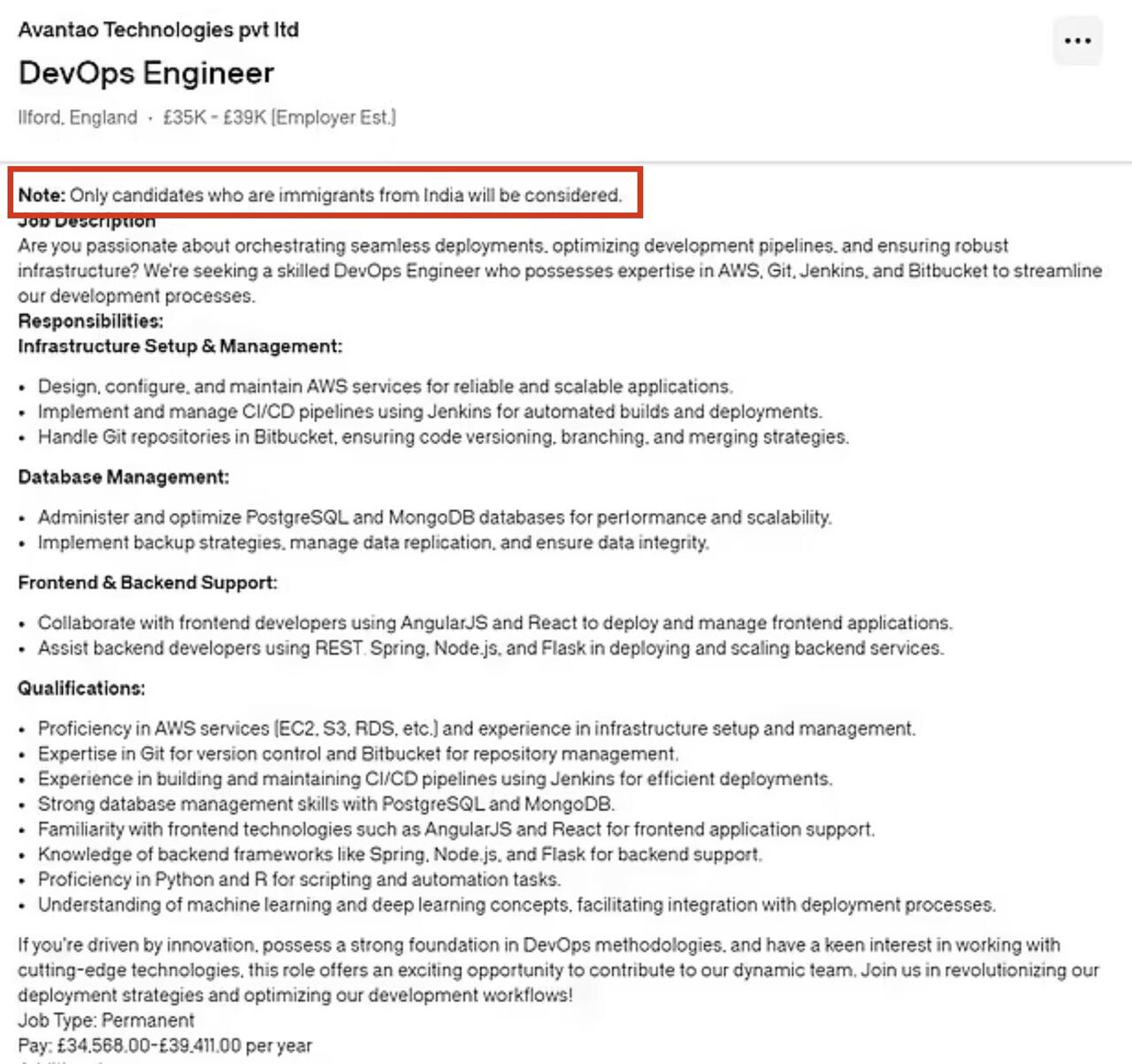
UK tech firm Avantao Technologies has apologized after posting a job ad stating “only candidates who are immigrants from India will be considered”, https://www.dailymail.co.uk/news/article-14583375/tech-company-apology-job-advert-immigrants-India-considered.html
.
The listing, for a DevOps engineer role in Ilford, also asked visa-related questions like “What is your native country?” and “Are you seeking sponsorship for employment in the UK?”
The Daily Mail https://www.dailymail.co.uk/news/article-14583375/tech-company-apology-job-advert-immigrants-India-considered.html
says that the company claims the ad was a staff training "test" that was mistakenly published. Sure.
 ?itok=diApHfXj
“Unfortunately, that has been published, and we are unable to retract it because it was a mistake made by the employee who posted it live and then departed on holiday,” a spokesperson told MailOnline.
“We are very sorry to hear that this has occurred... a mistake is a mistake, and we have taken action against the individual... we genuinely apologise.”
Avantao has offices in Hyderabad, Bangalore, and New Jersey. Chitra Ranjeeth serves as the director of the Ilford branch, which operates out of a shared business center in London alongside various other unrelated businesses.
No one was hired, and the advert expired on March 24.
https://cms.zerohedge.com/users/tyler-durden
Sat, 04/12/2025 - 07:35
NATO Is A Corpse
NATO Is A Corpse
https://realclearwire.com/articles/2025/04/10/nato_is_a_corpse_1103126.html
,
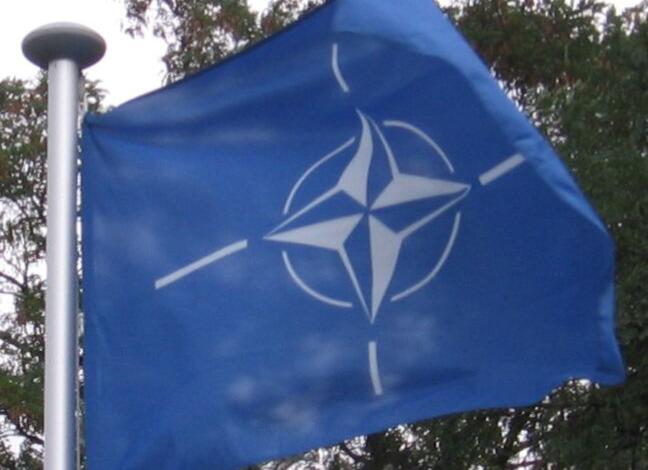
NATO is a corpse. All that remains is the grotesque performance art of a diplomatic zombie stumbling from summit to summit, mouthing tired clichés about “shared values” and “burden sharing,” even as its core strategic logic lies rotting beneath the surface. The Atlantic Alliance, once the steel scaffolding of Western security, has become a hollow ritual. Its military readiness is an illusion. Its political cohesion is fraying. Its future, if it has one, lies not in revival—but in reinvention or replacement.
 ?itok=4a-5iFH5
This is not a triumphalist declaration from the Kremlin or Beijing. It is a sober diagnosis, grounded in realism and restraint. And it should be a wake-up call in Washington, Ottawa, Berlin, and beyond.
NATO’s death was not caused by Donald Trump, though he may soon become its undertaker. Nor was it caused by Vladimir Putin’s invasion of Ukraine, though that war has exposed the Alliance’s hollowness in ways no war game or communique ever could. The real cause lies in decades of European free-riding, American strategic drift, and a foundational lie at the heart of the Alliance: the idea that an empire can masquerade as a collective defense pact without consequences.
Let’s start with the numbers. Most NATO members still do not meet the 2 percent of GDP defense spending benchmark, despite years of promises and performative panic. Canada, which has taken freeloading to an art form, has shown no serious intention of meeting its obligations. As I’ve written elsewhere, Trudeau’s empty pledges mask a decaying defense industrial base, a stagnant recruiting system, and an Arctic strategy made of snow and sentiment.
Germany—the economic motor of Europe—still can’t field a combat-ready army for more than a few weeks at a time. The Bundeswehr is a shell. Its special fund is already mostly spent, and its political class remains addicted to strategic ambiguity and military minimalism. France wants “strategic autonomy” but lacks the scale and will to lead Europe alone. Poland, despite its impressive rearmament, cannot carry the continent’s defense burden on its shoulders—certainly not while Berlin dithers and Washington increasingly looks west, not east.
Meanwhile, the United States—still NATO’s military backbone—faces a fiscal cliff, a recruitment crisis, and an overstretched force posture. The era of limitless resources is over. American global primacy has ended. Multipolarity has arrived. The U.S. must now prioritize. And that means making hard choices about where its forces are truly needed—and where others must finally step up or face the consequences.
The war in Ukraine has laid these contradictions bare. NATO as an institution is not fighting the war. The United States is. Some European countries are helping—but most are hedging. NATO has been bypassed in favor of bilateral and ad hoc coalitions. Article 5 hasn’t been tested, and it may never be. The idea that NATO is “more united than ever” is a comforting fiction, trotted out to conceal the fact that the Alliance can no longer mount a serious, conventional defense of Europe without massive and prolonged American escalation.
Even the so-called Nordic expansion—Sweden and Finland joining NATO—has not changed the equation. It’s a strategic sideshow. Unless Europe can build up a credible, conventional deterrent in the East, without expecting Washington to always bail it out, the Alliance will remain a Potemkin village: flags, acronyms, and summits without substance.
Trump’s likely return to the White House in 2025 should not be viewed as a cataclysm but as an overdue reckoning. He will not end NATO. He will force Europe to decide whether it is willing to pay for its own defense or not. He will not blow up the Alliance. He will make it answer for its contradictions. And that, frankly, is what a serious ally should do.
Some critics will scream that this is the death knell of the “rules-based international order.” But the order they mourn was already breaking down—long before Trump, long before Ukraine, long before Brexit or Crimea. What we are witnessing is not a collapse but a transition: from the illusion of Atlanticism to the reality of multipolarity. And NATO, if it is to matter at all in this new world, must either become a true European-led military alliance with American support—or fade into history like SEATO and CENTO before it.
This doesn’t mean abandoning Europe to Russian domination. It means telling uncomfortable truths. Europe is rich. Europe is populous. Europe is not helpless. The United States can and should support its European allies—but it should not subsidize their illusions indefinitely. A more self-reliant Europe is not a threat to American interests; it is a precondition for strategic focus on the North Pacific, the Arctic, and the Western Hemisphere—where the real contests of the 21st century will be decided.
In my writing here and elsewhere, I have repeatedly argued that Canada must stop pretending it is a global power and start acting like what it is: a North Pacific, Arctic, and North Atlantic state. That means prioritizing regional defense, rebuilding naval and aerospace capabilities, and getting serious about continental defense. NATO is not the vehicle for that anymore—if it ever was. For Canada, continuing to hide behind NATO rhetoric while failing to meet even the most basic obligations is not only cowardly—it is dangerous.
A dead NATO still carries risks. Strategic ambiguity, brittle expectations, and performative deterrence are a recipe for miscalculation. The Alliance’s political leadership must either acknowledge the need for transformation or risk a future crisis that reveals, in real time and in blood, what we already know: that the emperor has no tanks.
The solution is not sentimental nostalgia. It is clear-eyed realism. NATO in its current form is not worth saving. But its core idea—collective defense among likeminded powers—still has value. What’s needed is a reset: a reimagined Euro-Atlantic security framework led by capable European states, with American support but not American dominance. A NATO that deters by capability, not by assumption. A NATO that can say no as well as yes. A NATO, in short, that lives in the real world.
The alternative is strategic decay. A slow slide into irrelevance. More summits, more selfies, more hollow communiqués. Until, one day, NATO doesn’t die with a bang—but with a bureaucratic whimper.
That future is already here. NATO is dead. The only question now is what comes next—and whether we have the courage to build it.
Andrew Latham,Ph.D., a tenured professor at Macalester College in Saint Paul, Minnesota. He is also a Senior Washington Fellow with the Institute for Peace and Diplomacy in Ottawa and a non-resident fellow with Defense Priorities, a think tank in Washington, DC.
https://cms.zerohedge.com/users/tyler-durden
Sat, 04/12/2025 - 07:00
Escobar: Russia–Iran–China - All For One, And One For All?
Escobar: Russia–Iran–China - All For One, And One For All?
https://thecradle.co/articles/russia-iran-china-all-for-one-and-one-for-all
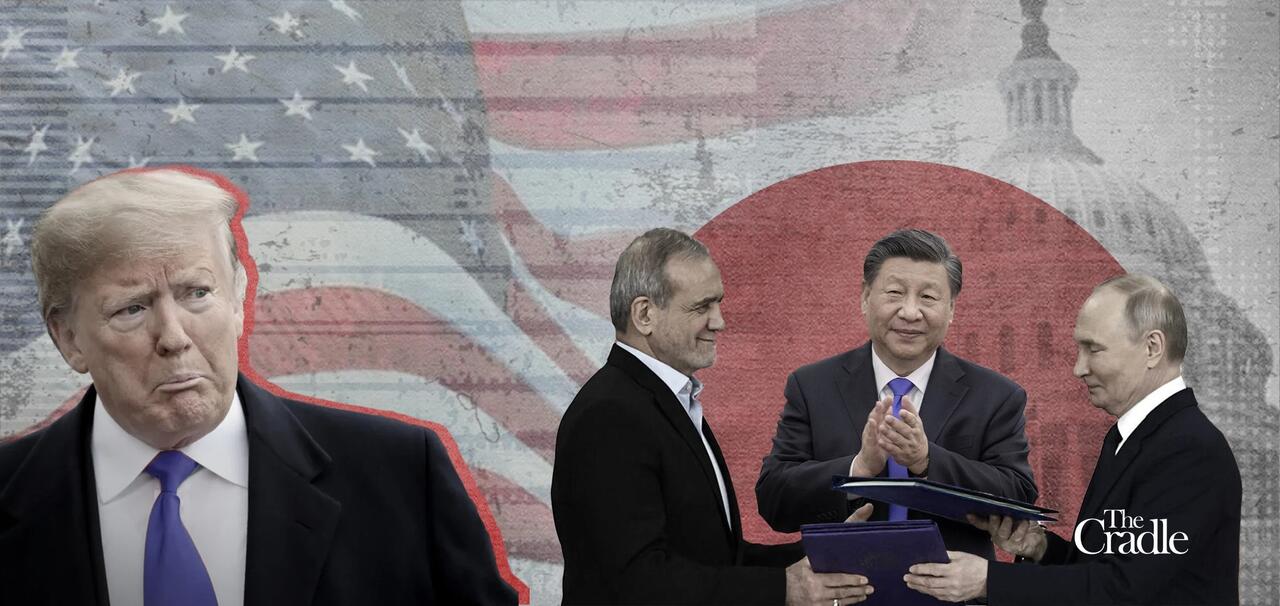
Russia and Iran are at the forefront of the multi-layered Eurasia integration process – the most crucial geopolitical development of the young 21st century.
 ?itok=3PMYe16E
Both are top members of BRICS+ and the Shanghai Cooperation Organization (SCO). Both are seriously implicated as Global Majority leaders to build a multi-nodal, multipolar world. And both have signed, in late January in Moscow, a detailed, comprehensive strategic partnership.
The second administration of US President Donald Trump, starting with the “maximum pressure” antics employed by the bombastic Circus Ringmaster himself, seems to ignore these imperatives.
It was up to the Russian Foreign Ministry to re-introduce rationality in what was fast becoming an out of control shouting match: essentially Moscow, alongside its partner Tehran, simply will not accept outside threats of bombing Iran’s nuclear and energy infrastructure, while insisting on the search for viable negotiated solutions for the Islamic Republic's nuclear program.
And then, just like lightning, the Washington narrative changed. US Special Envoy for Middle East Affairs, Steven Witkoff – not exactly a Metternich, and previously a “maximum pressure” hardliner – started talking about the need for “confidence-building” and even “resolving disagreements,” implying Washington began “seriously considering,” according to the proverbial “officials,” indirect nuclear talks.
These implications turned to reality on Monday afternoon when Trump allegedly blindsided the visiting Israeli Prime Minister Benjamin Netanyahu with the announcement of a “very big meeting” with Iranian officials in the next few days. Tehran later confirmed the news, with Iran's Foreign Minister Abbas Araghchi saying he would engage in indirect nuclear negotiations with Witkoff in Oman on Saturday.
It’s as if Trump had at least listened to the arguments exposed by the Islamic Republic's Supreme Leader Ayatollah Ali Khamenei. But then again, he can change his mind in a Trump New York minute.
The finer points of the Russia–Iran–China axis
Essential background to decipher the “Will Russia help Iran” conundrum can be found in these https://valdaiclub.com/events/own/an-expert-discussion-of-the-russia-iran-partnership-treaty/
at the Valdai Club in Moscow.
The key points were made by https://valdaiclub.com/about/experts/6240/
, Russia’s ambassador to Iran from 2001 to 2005. Maryasov argues that the Russia–Iran treaty is not only a symbolic milestone, but “serves as a roadmap for advancing our cooperation across virtually all domains.” It is more of “a bilateral relations document” – not a defense treaty.
The treaty was extensively discussed – then approved – as a counter-point to “the intensified military-political and economic pressure exerted by western nations on both Russia and Iran.”
The main rationale was how to fight against the sanctions tsunami.
Yet even if it does not constitute a military alliance, the treaty details mutually agreed moves if there is an attack or threats to either nation’s national security – as in Trump’s careless bombing threats against Iran. The treaty also defines the vast scope of military-technical and defense cooperation, including, crucially, regular intel talk.
Maryasov identified the key security points as the Caspian, the South Caucasus, Central Asia, and last but not least, West Asia, including the breadth and reach of the Axis of Resistance.
The official Moscow position on the Axis of Resistance is an extremely delicate affair. For instance, let’s look at Yemen. Moscow does not officially recognize the Yemeni resistance government embodied by Ansarallah and with its HQ in the capital Sanaa; rather, it recognizes, just like Washington, a puppet government in Aden, which is in fact housed in a five-star hotel in Riyadh, sponsored by Saudi Arabia.
Last summer two different Yemeni delegations were visiting Moscow. As I witnessed it, the Sanaa delegation faced tremendous bureaucratic problems to clinch official meetings.
There is, of course, sympathy for Ansarallah across Moscow intel and military circles. But as https://sputnikglobe.com/20250331/pepe-escobar-from-sanaa-to-saada--yemen-during-wartime-1121717925.html
, these contacts occur via “privileged channels,” and not institutionally.
The same applies to Lebanon's Hezbollah, which was a key Russian ally in routing ISIS and other Islamist extremist groups during the Syrian war. When it comes to Syria, the only thing that really matters for official Moscow, after the Al-Qaeda-linked extremists took power in Damascus last December, is to preserve the Russian bases in Tartous and Hmeimim.
There’s no question that the Syrian debacle was an extremely serious setback for both Moscow and Tehran, further aggravated by Trump's non-stop escalation over Iran’s nuclear program and his “maximum pressure” obsession.
The nature of the Russia–Iran treaty differs substantially from that of Russia–China. For Beijing, the partnership with Moscow is so solid, it develops so dynamically, that they don’t even need a treaty: they have a “comprehensive strategic partnership.”
Chinese Foreign Minister Wang Yi, in his recent visit to Russia, after coining a pearl – “those who live in the 21st century but think in Cold War blocs and zero-sum games cannot keep up with the times” – neatly summarized Sino–Russian relations in three vectors: The two Asian giants are “forever friends and never enemies;” Equality and mutually beneficial cooperation; Non-alignment with blocs; Non-confrontation, and non-targeting of third parties. So even as we have a Russia–Iran treaty, between China and Russia, and China and Iran, we have essentially close partnerships.
Witness, for instance, the fifth annual https://edition.cnn.com/2025/03/10/asia/iran-china-russia-joint-navy-drills-intl-hnk/index.html
that took place in the Gulf of Oman in March. This trilateral synergy is not new; it has been under development for years.
But it's lazy to characterize this improved RIC Primakov triangle (Russia–Iran–China instead of Russia–India–China) as an alliance. The only “alliance” that exists today on the geopolitical chessboard is NATO – a warmongering outfit composed of intimidated vassals corralled together by the Empire of Chaos.
Cue to yet another hard-to-resist Wang Yi jade pearl: “The US is sick but forces others to take the medicine.” Takeaways: Russia is not switching sides; China won’t be encircled; and Iran will be defended.
When the new Primakov triangle meets in Beijing
At the Valdai discussion, https://valdaiclub.com/about/experts/30124/
, assistant professor in the Department of Theory and History of International Relations at the Moscow-based RUDN University, made a crucial point: “For the first time in history, the diplomatic outlooks of Russia and Iran converge." He's referring to the obvious parallels between official policies: Russia’s “pivot to the east” and Iran’s “look east” policies.
All those interconnections plainly escape the new administration in Washington, as well as bombastic Trump–Netanyahu rhetoric that has zero basis in reality – even the US National Security Council admitted that Iran is not working on a nuclear bomb.
And that brings us to the Big Picture.
The Circus Ringmaster – at least until he changes his mind again – is essentially working on a triangulation deal, allegedly offering Russia a transportation framework, access to grain exports in the Black Sea, and Russian banks off the sanction list of SWIFT so he may execute his “pivot” to then attack Iran (deadline to Tehran included).
And if Russia defends Iran, no deal.
That’s as mendacious as Mafia-style “offer you can’t refuse” maximum pressure can get. Russian Deputy Foreign Minister Sergey Ryabkov – an exceptionally able diplomat – destroyed the whole rationale: “Russia cannot accept US proposals to end the war in Ukraine in their current form because they do not solve the problems Moscow considers the cause of the conflict.” Even as Moscow “takes the models and solutions proposed by the Americans very seriously.”
As the Russian angle of Trump’s triangulation falters, Tehran is not merely watching the river flow. How Iran adapted for decades to a sanctions tsunami is now firm knowledge deeply shared with Moscow, part of their deepening cooperation enshrined in the treaty.
For all of Trump’s volatility, non-Zionist-contaminated voices across the Beltway are slowly but surely imprinting the rational view that a war on Iran is absolutely suicidal for the Empire itself. So the odds resurface that Trump 2.0 verbal barrages may be paving the way for a temporary deal that will be spun to death – after all, this is always a battle of narratives – as a diplomatic victory.
Bets can be made that the only leader on the planet capable of making Trump understand reality is Russian President Vladimir Putin, in their next phone call. After all, it is the Circus Ringmaster himself who created the revamped “nuclear Iran” drama. RIC – or the revamped Primakov triangle – duly addressed it, together, in a crucial, discreet, not-publicized recent meeting in Beijing, as confirmed by diplomatic sources.
Essentially, the RIC has developed a “nuclear Iran” road map. These are the highlights:
Dialogue. No escalation. No “maximum pressure”. Step-by-step moves. Build mutual confidence.
As Iran re-emphasizes its veto on developing nuclear weapons, the much-debated “international community”, actually the UN Security Council, recognizes, again, Iran’s right to peaceful nuclear energy under the NPT.
Back to the JCPOA – and reboot it. To get Trump back on board, the reboot will be an extremely hard sell.
This roadmap was ratified during a second round of RIC trilateral talks in Moscow on Tuesday, where senior officials from the allied nations discussed collaborative efforts to address the challenges faced by Iran.
That summit in Moscow
As it stands, the road map is just that: a map. The breathless Zionist axis from Washington to Tel Aviv will continue to insist that Iran, if attacked, will not be supported by Russia, and extra, non-stop “maximum pressure” will force Tehran to eventually fold and abandon its support to the Axis of Resistance.
All that, once again, eschews reality. For Moscow, Iran is an absolutely key geopolitical priority; beyond Iran, to the east, is Central Asia. The Zionist obsessive fantasy of regime change in Tehran masks NATO's then penetrating into Central Asia, building military bases, and at the same time blocking several strategically crucial Chinese Belt and Road Initiative (BRI) projects. Iran is as essential to China’s long-term foreign policy as it is to Russia’s.
It's not by accident that Russia and China will meet at the presidential level – Vladimir Putin and Xi Jinping – at a summit in Moscow around 9 May, Victory Day in the Great Patriotic War. They will be analyzing in detail the next stage of “changes that we have not seen in 100 years,” as formulated by https://www.youtube.com/watch?v=bEpTRr7QcWg
in their groundbreaking 2023 summer in Moscow.
They, of course, will be discussing how the Circus Ringmaster dreams of closing down one Forever War just to start another: the specter of a US–Israel attack on their strategic partner Iran – complete with the counterpunch of blocking the Strait of Hormuz (transit for 24 million barrels of oil a day); a barrel of oil skyrocketing to $200 and even more; and the collapse of the humongous $730 trillion pile of derivatives in the global economy.
No, President Circus Ringmaster: You don't have the cards.
* * *
Views expressed in this article are opinions of the author and do not necessarily reflect the views of ZeroHedge.
https://cms.zerohedge.com/users/tyler-durden
Fri, 04/11/2025 - 23:25
https://www.zerohedge.com/geopolitical/escobar-russia-iran-china-all-one-and-one-all
These Are Most Common Types Of Fraud In America
These Are Most Common Types Of Fraud In America
Americans are losing more money to scams than ever before. The Federal Trade Commission (FTC) estimates that Americans lost $12.5 billion to fraud schemes in 2024, up $2.5 billion from the previous year.
In 2023, consumers around the world https://www.visualcapitalist.com/global-losses-from-financial-scams/#google_vignette
to scams.
While certain scams were much more commonly reported, other types led to bigger financial losses for consumers.
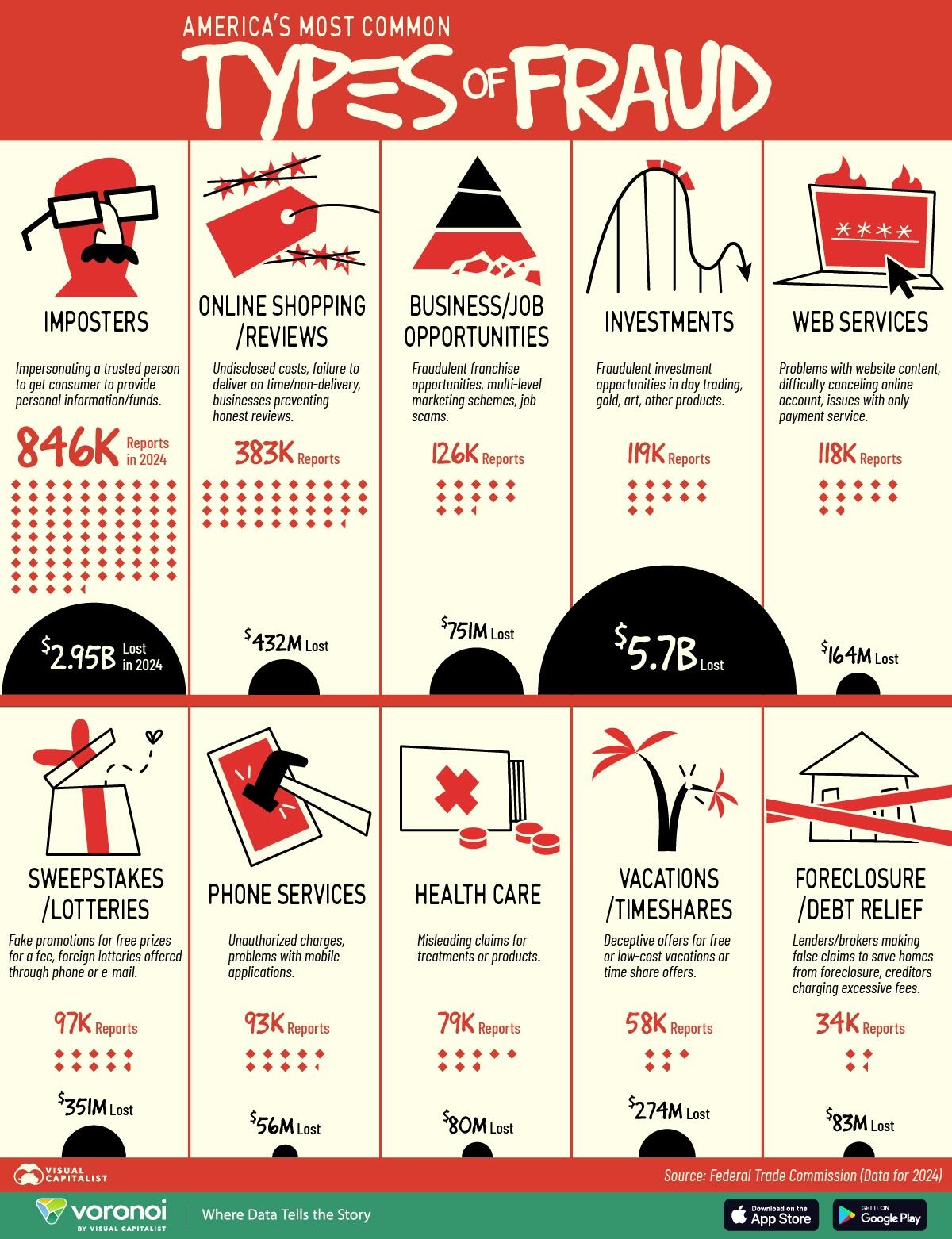
This visualization, https://www.visualcapitalist.com/ranked-most-common-types-of-fraud-in-america/
shows the 10 most common types of fraud in the U.S. by the number of reports made to the FTC in 2024, and the total dollar value lost from each type of fraud.
 ?itok=8mVuieou
Data comes from the https://public.tableau.com/app/profile/federal.trade.commission/viz/TheBigViewAllSentinelReports/TopReports
and is updated as of March 2025.
What Type of Fraud is the Most Common?
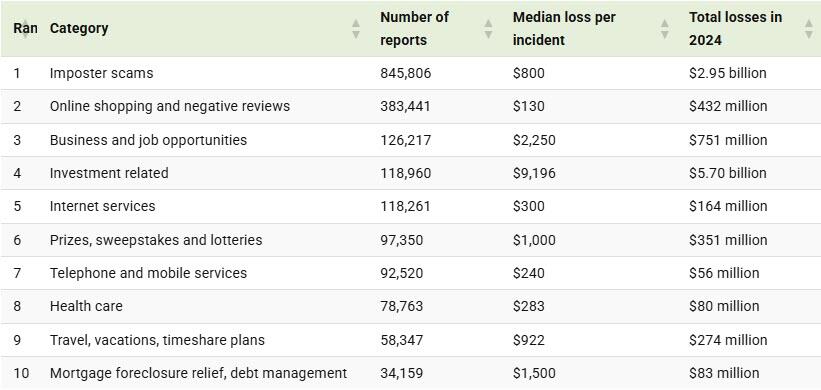
Below, we show the top 10 most commonly reported fraud types to the FTC, the total dollar value lost from each type of fraud, and the median loss per incident.
 ?itok=AOK1Tqcj
Imposter scams—where fraudsters pose as government officials, friends, coworkers, or other trusted parties to steal money or personal information—were the most frequently reported type of fraud in the U.S. last year, with over 840,000 cases filed with the FTC.
This cost consumers almost $3 billion in losses last year.
However, while imposter scams were the most common, investment-related scams led to the biggest financial losses, costing Americans a total of $5.7 billion. The median loss per victim exceeded $9,000.
According to the https://consumer.ftc.gov/consumer-alerts/2025/03/top-scams-2024
, scams through email made up the highest number of reports while scams through social media had the highest losses.
https://www.visualcapitalist.com/how-much-do-scam-text-messages-cost-americans/
are also common, making up 22% of all fraud reports to the FTC in 2022.
Types of Fraud
A full list of all fraud types can be found on the https://www.ftc.gov/system/files/attachments/data-sets/category_definitions.pdf
website.
Imposter scams: Someone pretends to be a trusted person to get consumer to send money/give personal information
Online shopping/negative reviews: Undisclosed costs, failure to deliver on time, non-delivery, business preventing honest reviews
Business/job opportunities: Fraudulent franchise opportunities, multi-level marketing schemes, job scams
Investment related: Fraudulent investment opportunities in day trading, gold, art, other products
Internet services: Problems with website content, difficulty canceling online account, issues with payment service, undisclosed charges
Prizes, sweepstakes and lotteries: Promotions for free prizes for a fee, foreign lotteries offered through phone or e-mail
Telephone and mobile services: Unauthorized charges, problems with mobile applications
Health care: Fraudulent, misleading or deceptive claims for treatments or products
Travel, vacations, timeshare plans: Deceptive offers for free or low-cost vacations, misleading time share offers
Mortgage foreclosure relief, debt management: Lenders/brokers making false promises to save consumers’ homes from foreclosure, credit organizations charging excessive fees
To learn more about common scams, check out this https://www.voronoiapp.com/technology/The-Companies-Online-Scammers-Impersonate-the-Most-1110
that visualizes companies are impersonated most often in online scams.
https://cms.zerohedge.com/users/tyler-durden
Fri, 04/11/2025 - 23:00
https://www.zerohedge.com/personal-finance/these-are-most-common-types-fraud-america
DOJ Launches 'Second Amendment Task Force' To Guard Gun Rights
DOJ Launches 'Second Amendment Task Force' To Guard Gun Rights
(emphasis ours),
The Department of Justice (DOJ) has announced the establishment of a task force aimed at protecting the Second Amendment rights of law-abiding American citizens.
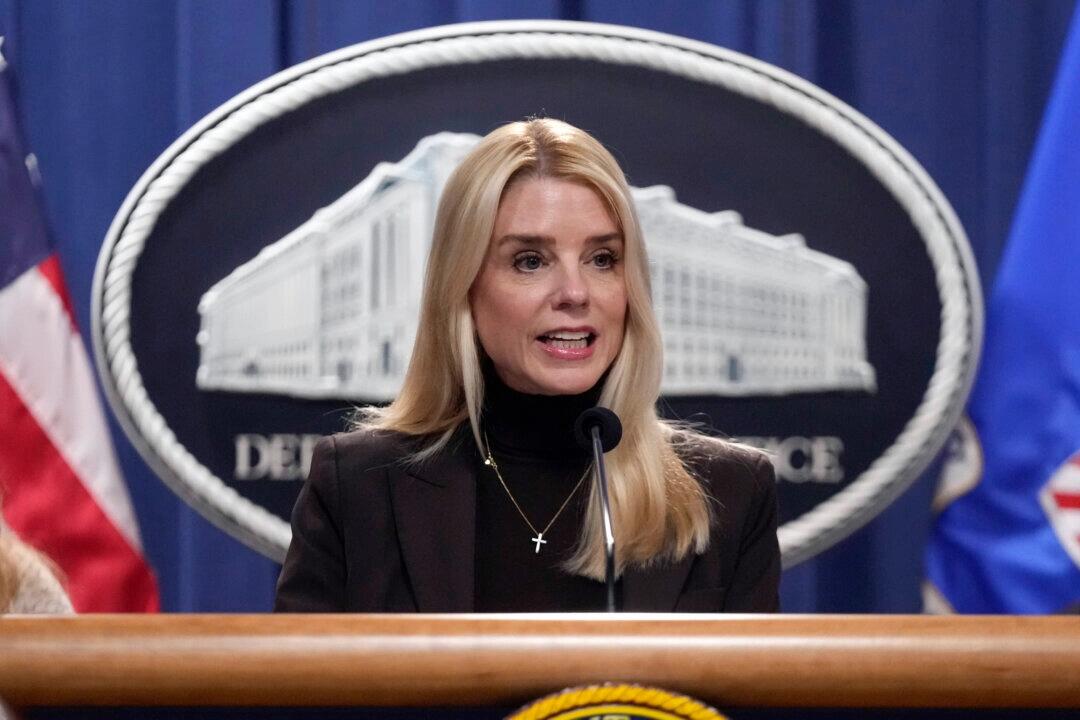 ?itok=ksxDvxK0
“For too long, the Second Amendment, which establishes the fundamental individual right of Americans to keep and bear arms, has been treated as a second-class right. No more,” Attorney General Pamela Bondi wrote in a Tuesday https://www.justice.gov/ag/media/1395956/dl?inline
to all DOJ employees.
“President [Donald] Trump has made protecting the Second Amendment rights a priority for this administration,” she said.
The attorney general said the president directed her to propose a plan of action designed “to protect the Second Amendment rights of all Americans.”
Bondi said the prime objective of the “Second Amendment Task Force” is to develop policies and legal strategies to “advance, protect, and promote compliance with the Second Amendment.”
The task force, chaired by Bondi, will consist of staff members from her office and from the Deputy and Assistant AGs’ offices, from the Solicitor General’s office, the Civil Division, the Civil Rights Division, the Criminal Division, the Bureau of Alcohol, Tobacco, Firearms, and Explosives (ATF), and the FBI.
Personnel from additional agencies may be summoned to assist in the task force’s operations as needed.
Trump’s Executive Order
The task force serves to implement Trump’s https://www.whitehouse.gov/presidential-actions/2025/02/protecting-second-amendment-rights/
, “Protecting Second Amendment Rights,” which instructed the attorney general to review all of the Biden administration’s firearms-related actions.
In a Wednesday https://www.justice.gov/opa/pr/attorney-general-pamela-bondi-statement-regarding-creation-2nd-amendment-task-force
, Bondi said the “prior administration placed an undue burden on gun owners and vendors by targeting law-abiding citizens exercising their 2nd Amendment rights.”
On Monday, the ATF said it had https://www.theepochtimes.com/us/doj-repeals-zero-tolerance-firearm-rules-5838363
President Joe Biden’s Enhanced Regulatory Enforcement Policy. The 2021 initiative—also known as the “Zero Tolerance Policy”—set strict inspection standards for arms dealers and allowed the ATF to revoke licenses over minor clerical errors that were previously considered excusable.
“This Department of Justice believes that the 2nd Amendment is not a second-class right,” Bondi said in an ATF https://www.atf.gov/news/press-releases/doj-atf-repeal-ffl-inspection-policy-and-begin-review-two-final-rules
.
“The prior administration’s ‘Zero Tolerance’ policy unfairly targeted law-abiding gun owners and created an undue burden on Americans seeking to exercise their constitutional right to bear arms—it ends today,” she said.
The DOJ and the ATF are also planning to revise the “stabilizing brace rule” and the boundaries for determining who is considered “engaged in the business” of selling firearms.
The stabilizing brace rule sought to reclassify guns with attached stabilizing braces—accessories originally designed to help people with disabilities shoot pistols more comfortably—as short-barreled rifles, which implies stricter regulations. Critics argued the rule turned millions of law-abiding gun owners into potential felons overnight by reclassifying their legally purchased pistols.
 ?itok=2U1n7O1S
The 2024 “engaged in the business” of firearms dealing rule expanded the definition of who qualifies as a firearms dealer under federal law, which critics said blurred the line between private sales and commercial dealing, potentially criminalizing hobbyists.
Then-acting ATF Director Kash Patel, who was succeeded at the ATF by Army Secretary Daniel P. Driscoll on Wednesday, called the measures “a pivotal step toward restoring fairness and clarity in firearms regulation.”
The DOJ said it will work with gun rights organizations, gun manufacturers, and legal experts over the coming months to ensure that the polices align with Americans’ constitutional rights.
From https://www.ntd.com/doj-launches-second-amendment-task-force-to-guard-gun-rights_1059570.html
https://cms.zerohedge.com/users/tyler-durden
Fri, 04/11/2025 - 17:40
https://www.zerohedge.com/political/doj-launches-second-amendment-task-force-guard-gun-rights
The Wicked Flee...
The Wicked Flee...
https://www.kunstler.com/p/the-wicked-flee
"No more government in the shadows."
- Mike Benz
The decade-long treasonous hectoring of Mr. Trump keeps on coming, you understand, for the simple reason that there have been absolutely zero consequences for any of the vicious rogues behind it.
Not so much as a rap on the knuckles for seeking to overthrow a president, steal elections, hide high crimes, rob the treasury, and recklessly frame the innocent.
And suddenly this week, as startling as a mythic goddess of justice riding a spring zephyr, comes a brisk demonstration of exactly what-to-do.
 ?itok=_Si6NVwq
Days ago, Governor Phil Murphy of New Jersey ordered his state police to not cooperate with federal immigration enforcement officers (ICE) — a nice bit of grandstanding for a guy seeking to occupy the Democratic Party’s leadership vacuum. So, Thursday night, newly-appointed US Attorney for the New Jersey federal district, Alina Habba, opened a criminal investigation against Gov. Murphy for “obstruction and concealment.”
That means, possibly, jail. Badda-bing! This ain’t no foolin’ around.
The reason the Democrat pols and their activist agents pule and mewl about “retribution” is because they know they are guilty of so many manifest crimes against the country and against decency, that a fair system would have jailed or hanged them by now.
They evaded their reckonings only because their own filthy mitts gripped the levers of justice until very recently.
Since January 20, that has obviously changed.
But two questions have dogged the necessary restoration of fairness and good faith in the backbone of government we call the law. 1) Since the culpable are such well-known figures — the Clintons, Obama, Biden, Comey, Brennan, Mayorkas, Garland, Wray, Fauci, Collins, Pelosi, Eisen, Weissmann, McCord, Schiff, and dozens more:
how do you seek justice without appearing to “go after” individuals in the old Soviet mode of “show me the person and I’ll find you the crime”? And
where do you begin with such a cosmic-scale panorama of treasonous malfeasance spanning many years and many theaters-of-action?
I’d say US Attorney Alina Habba’s move this week is an excellent place to start.
For one thing, Governor Murphy’s defiant act is a fresh crime, only days old, and a clear-cut one: you can’t order state officials to flout federal law, especially where public safety is concerned. Ms. Habba smacked him instantly, like an insolent biting insect. Now, follow through. Prosecute. Mere apologies not accepted. No “mulligan” on that shot. If she brings a case, then other mayors and governors of the many self-proclaimed “sanctuary” jurisdictions around the country, trolling for virtue brownie points in their Woke waters, will rethink their lawless posturing.
Couple of other good starts just this week.
Mr. Trump issued executive orders yesterday that will afford a fresh look into some older but critical crimes against the nation.
One directs US Attorney General Bondi to investigate the actions of a key player in wide-ranging 2020 election mischief. From the White House memo itself:
Christopher Krebs, the former head of the Cybersecurity and Infrastructure Security Agency (CISA), is a significant bad-faith actor who weaponized and abused his government authority. Krebs’ misconduct involved the censorship of disfavored speech implicating the 2020 election and COVID-19 pandemic. CISA, under Krebs’ leadership, suppressed conservative viewpoints under the guise of combatting supposed disinformation, and recruited and coerced major social media platforms to further its partisan mission. CISA covertly worked to blind the American public to the controversy surrounding Hunter Biden’s laptop. Krebs, through CISA, promoted the censorship of election information, including known risks associated with certain voting practices. Similarly, Krebs, through CISA, falsely and baselessly denied that the 2020 election was rigged and stolen, including by inappropriately and categorically dismissing widespread election malfeasance and serious vulnerabilities with voting machines. Krebs skewed the bona fide debate about COVID-19 by attempting to discredit widely shared views that ran contrary to CISA’s favored perspective.
Next, the White House directed an investigation of Homeland Security officer Miles Taylor who proclaimed, during the first Trump term in an anonymous New York Times op-ed, that he was party to “a resistance within the Federal Government that ‘vowed’ to undermine and render ineffective a sitting president... [T]his conduct could properly be characterized as treasonous and as possibly violating the Espionage Act,” the EO said.
Sounds serious, a little bit.
Next, in another EO, the White House severely disciplined the swamp law firm Susman Godfrey for its racist DEI activism in the federal agencies it did work for, saying, “Lawyers and law firms that engage in activities detrimental to critical American interests should not have access to our nation’s secrets, nor should their conduct be subsidized by Federal taxpayer funds or contracts.” Hence, Sussman Godfrey lost its security clearances, its federal work contracts were cancelled, and its lawyers are barred from entering federal buildings, including courthouses.
FAFO.
Next, Director of National Intelligence, Tulsi Gabbard announced at Thursday’s cabinet meeting that her office has obtained evidence of massive vulnerabilities in voting machines that allow hackers to flip votes. This has long been written off as “baseless conspiracy theory” for years by degenerate news outlets like The New York Times. The key word in Ms. Gabbard’s statement, is “evidence.” You realize, of course, that there is no reason to use vote-counting machines in our election except for the purpose of hacking and cheating. Most other putatively “democratic” nations use paper ballots and manage to tabulate and report election results within twenty-four hours.
Of course, this motley batch of sudden cases — Gov. Murphy of NJ, Chris Krebs, Miles Taylor, Susman Godfrey — are relative outliers to the notorious operations such as RussiaGate, the Schiff-Vindman-Ciaramella-Eisen plot behind Impeachment No. 1, The Covid-19 intrigue, The BLM rampage, the Hunter Biden Laptop ruse (and Biden family’s bribery and treason), J-6 riot and the DNC Pipe-bomb caper, and four years of a wide-open border.
That long train of crimes, seditions, and treasons came close to wrecking the country.
We know exactly who was behind and involved in all of that.
What remains is the heavy-lifting to build cases that can be brought to grand juries in good faith.
Perhaps a comprehensive omnibus RICO case can incorporate all of these in what appears to amount to a single, complex orchestrated, long-running attempted coup. Don’t bet that this isn’t coming. And, by-the-way, the infamous “Crossfire-Hurricane” binder was just released last night. As of this writing, there is almost no analysis available yet. Stand by.
https://cms.zerohedge.com/users/tyler-durden
Fri, 04/11/2025 - 16:20
Paying A Heavy Price For Going After A Tax-Cheat Named Hunter Biden
Paying A Heavy Price For Going After A Tax-Cheat Named Hunter Biden
,
Joe Ziegler is not a beaten man – not for his antagonists’ lack of trying. Across his seven-year pursuit of Hunter Biden’s unpaid taxes, Ziegler, a special agent in the Internal Revenue Service’s criminal investigative division, and his colleague Gary Shapley were shunned, threatened, and lied to. Ziegler was doxed. Shapley was told to accept a demotion or resign. Convinced the IRS and Department of Justice were stonewalling their efforts to bring charges against a sitting president’s son, the agents went public as whistleblowers in 2023.
 ?itok=uBvGe6Sq
The result, during the hyper-polarized years spanning the Trump-to-Biden-to-Trump administrations, was predictable: The two men were accused of partisanship, lambasted by Democratic members of Congress and the press, and had their reputations impugned by high-powered lawyers paid for by those sympathetic to the Bidens.
The fortunes of these political victims have now turned. In mid-March, incoming Treasury Secretary Scott Bessent announced Ziegler and Shapley would start work as senior advisers, helping to guide tax reform.
Which is all the agents had ever wanted and tried to do. “At the end of the day, this is truly about doing the right thing and standing up for what is right,” Ziegler would testify before the House Ways & Means Committee in December 2023. “I will say this again and again, this is much bigger than the Hunter Biden investigation. This was not a personal attack on Hunter Biden, but a call for change.”
While the reprisals they say they endured for their acts of conscience appear to have ended, Ziegler and Shapely do not want their experience to be memory-holed – especially because https://www.realclearinvestigations.com/articles/2025/02/13/a_weaponized_fbi_its_real_testify_whistleblowers_boasting_scars_to_prove_it_1091034.html
during the Biden administration have received less attention for their tribulations. Speaking with RealClearInvestigations recently, the two men gave their first in-depth interviews on the years-long case that upended their lives and careers.
***
“He was paying individuals, so, prostitutes, that were associated with that company,” Ziegler said. A little digging revealed Hunter Biden’s ex-wife reporting he had not paid his taxes and, in their divorce filings, mentioning “a very large diamond he received,” a gem allegedly valued at $80,000 and given to him by an executive at a Chinese energy company.
“I look into our IRS systems and see that he had unfiled tax returns for multiple years,” said Ziegler. “When you fail to file tax returns and you have income that qualifies you to file tax returns, that’s a misdemeanor offense.”
A misdemeanor that can rise to the level of a felony, depending on the dollar amount and the length of time the would-be filer has been delinquent. Hunter Biden looked to qualify on both counts.
The case should have been a cakewalk, and yet almost immediately, Ziegler suspected he was being stonewalled: Interviews he requested were denied, and coworkers subtly and not so subtly warned him to tap the brakes.
“My manager at the time, who wasn’t Gary [Shapley], made it very, very hard for me,” Ziegler told RCI. “He said, ‘When you work with high-profile people like this, you need way more information, way more evidence.’ He essentially set the bar higher, which I didn’t agree with at all.”
Even if he had set the bar higher, Hunter Biden’s actions would have cleared it, with multiple and well-documented instances of tax evasion, including not reporting more than $1 million in payments from the Ukrainian energy company Burisma. Still, Ziegler noted a determined lack of urgency within the IRS to move the case along. “It was a lot of hard work on my end, pushing everyone on the case to be like, ‘We need to do this. We need to go interview these people.’ And every single time I hit a roadblock or hit someone telling me, ‘No, we shouldn’t do that.’”
After more than a year of pushback, Ziegler found an ally in Shapley, who took control of the investigation in January 2020.
A supervisory special agent with 14 years at the agency, Shapley assumed the case would be handled routinely. “I expected everyone was going to act appropriately,” he said. “It was just another case, and that’s how I approached it.”
And not much of one, compared to others he’d worked on, including getting Credit Suisse to plead guilty in 2014 to helping U.S. taxpayers hide offshore accounts, resulting in a $2.6 billion fine.
“When you stick to just the way that it’s always been done, then it doesn't matter who you’re investigating,” he said. “I really thought that, even though [people] did a lot of these things that shielded Joe Biden from a full investigation, that they were still going to do the right thing concerning Hunter Biden.”
This might have been the case had Trump/Biden politics not become a blood sport. Shapley found no appetite within his department to issue subpoenas or execute search warrants. The lack of access accelerated when Joe Biden became the presidential nominee. A request in late 2020 to search a guest house he owned and in which Hunter Biden was staying was denied, as were requests to interview Biden family members.
Why the hold-ups? Shapley said he’d “never been told by our leadership, ‘nod nod, wink wink,’” that they were meant to handle the case with a delicacy that actually prevented them from doing their jobs. Fearing their investigation was turning into Kabuki theater, Shapley began creating a second record of what the agents saw as untoward resistance.
“When we started having problems, I started documenting issues and deviations from normal procedures,” said Shapley.“With the search warrants that weren’t being executed, even though there was probable cause, that’s when it became apparent that he [Hunter Biden] was receiving special treatment.”
The agents, too, were receiving special treatment of a sort. Ziegler was yanked off other investigations he was working on. Requests that Shapley made went unacknowledged or disappeared into the ether. And both agents saw colleagues keep their distance, reluctant apparently to offer even the appearance of support.
“They completely isolated us,” said Ziegler. “No one reaching out, no one asking questions. There was a lack of empathy, a lack of caring within my agency, and it’s sad.”
For two years, he and Shapley engaged in a Sisyphean struggle to move the Hunter Biden case along, a situation that went from remarkable to ludicrous to untenable.
“It was me and Gary on weekly FaceTime calls, literally [saying], ‘I can’t believe they did this. I can’t believe they’re not letting me do my job. They’re not letting us do the right thing,’” said Ziegler. “And then it culminated to a point where we ended up blowing the whistle.”
***
Their concern and frustration grew ever more intense because the facts of wrongdoing the agents uncovered were so clear. Between 2014 and 2019, they found that Hunter Biden had failed to pay taxes on more than $8.3 million in income derived from various sources, including those in China, Ukraine, and Romania.
Whether some of that money landed in the bank accounts of Joseph Robinette Biden Jr. may continue to be debated until only cockroaches roam the earth, but one can assume the people who gave the younger Biden a 3.4-carat diamond were at least hoping for access to his father.
The evidence showed that Hunter Biden evaded paying taxes by filing false returns, claiming personal expenses such as payments to prostitutes, a $25,000 sex club membership, and, more wholesome if alas nondeductible, college tuition for his children. As a result, he owed at least $1.4 million in federal taxes, elevating his alleged violations to a possible felony for tax evasion and fraud. The alleged crimes – which also included another possible felony charge for lying on a gun permit in 2018 – occurred during the time when Hunter Biden has described himself as a heavy user of crack cocaine.
Despite Ziegler and Shapley’s efforts, their investigation might have been buried if Hunter Biden had not failed to retrieve the laptop he left at a Wilmington, Delaware, repair shop in 2019. Although the FBI has admitted it took possession of the computer that same year and soon verified it belonged to Hunter Biden, its contents – which documented Joe’s connections to his son’s business affairs along with salacious photos – surfaced only in October 2020, after Trump adviser Rudy Guiliani gave the New York Post a copy of the hard drive he said he had received from the repair shop owner. In an echo of the pushback Ziegler and Shapley were experiencing, Biden supporters worked to discredit the laptop story.
Contrary to the media circus, Ziegler knew the laptop was not, as Joe Biden would claim, a “Russian plant.”
“Yes, absolutely,” he told RCI in March from his home in Atlanta. His team was aware of the contents of the laptop but had made no hay from it; it was just another part of the investigation, which made the reaction to its discovery, including 51 former senior intelligence officials publishing a letter https://www.foxnews.com/video/6320328169112
“has all the classic earmarks of a Russian information operation,” seem especially bizarre.
“Comparing that to the information we had on our end is, in hindsight, extremely disappointing,” he said. “But I guess at the time I just didn’t think about the politics of it.”
By late 2020, Shapley had come to see nothing but the politics of it, including among fellow federal employees whose unwillingness to hold Hunter Biden accountable for his actions Shapley found disappointing, if unsurprising, the “yes man’s” way forward.
“These people were institutionalized by the federal government. They are only in those very high positions because they played this game to move up the ladder,” he said from his office in Baltimore. A ladder being held firmly in place by Team Biden.
There was also something too clever by half in the higher-ups putting Shapley, who for years had received the agency’s highest recommendations, in charge of a case the IRS seemed to be doing its best to spike.
“They knew I was the expert, and they knew that I knew more than them about working these types of cases, so they put me on the hot seat,” he said. “Then they stuck their head in the sand, and pretended that everything was going to be fine ... and [that] the problems you were moving into in 2020, 2021, and 2022 were just going to go away.”
Meanwhile, the chances of any charges being filed against Hunter Biden were growing tenuous. Shapley was alert to this eventuality when he decided to take notes during an Oct. 7, 2022, meeting, where U.S. Attorney David Weiss, who was overseeing the case, stated he was “not the deciding person” on whether charges would be filed.
“He said that he had to go to the President Biden-appointed U.S. Attorneys to get approval and they said no,” recalled Shapley. Weiss, a Trump appointee, had been working on the Hunter Biden case since 2020. When Merrick Garland became attorney general in 2021, he allowed Weiss to continue the probe, in part to avoid the appearance of political interference. Then why, Shapley wondered, was Weiss more than a year later saying he didn’t have the authority? That Weiss later denied he’d ever said he didn’t have official approval did not wash with Shapley, https://www.cbsnews.com/news/hunter-biden-see-irs-whistleblower-gary-shapleys-handwritten-notes-meeting/
– which he’d shared contemporaneously with other attendees – specifically had Weiss saying he’d been told he was “not the deciding person on whether charges were filed.”
“My red line meeting was Oct. 7,” he said, and afterward, he “immediately started seeking a counsel to help me legally follow the legal path to blow the whistle.”
Ziegler’s red line intersected with Shapley’s on May 15, 2023, when the agents learned Hunter Biden would be offered a deferred prosecution agreement, which meant he would not only not face felony charges; he would not be charged with anything at all. May 15 was also the day the agents learned they’d been removed from the Hunter Biden investigation in December 2022, but that no one had bothered to tell them. “Leaders within my organization, to hear they had removed us six months prior to actually removing us?” said Ziegler. “This was a huge slap in the face.”
As for why they had been taken off the investigation, the men were told the IRS and DOJ had not known in December whether the case would move forward, and thus, the departments had not wanted to waste resources. “Which is a bunch of malarkey,” said Shapley, as was Hunter Biden being allowed to slip away from the charges he and Ziegler had worked hard to make stick.
To the agents, this was a betrayal on multiple levels. First, by colleagues inside the department and out (“They come to my house and with their wife and children, I know these people,” said Shapley, of DOJ tax prosecutors who “went behind my back to get me removed from the case”), second, to the jobs they had constitutionally pledged to carry out, and third, of the country’s taxpayers, in that it created a two-tiered system of justice, one for regular Americans, the other for a president’s son and anyone else the people at the top decided to protect.
“What kind of leaders remove an entire team from a high-profile case without telling them?” Shapley would later ask in a hearing before the House Ways & Means Committee.
***
Becoming the public faces of the Hunter Biden case, which included testifying before Congress and running the media gauntlet, meant the agents were in for new and different types of punishment. Explaining that the tax crimes Hunter Biden had committed, which Ziegler testified to in excruciating detail, should be adjudicated as they would be for any other citizen was cast as batting against Team Blue. This would not do. In the run-up to another Trump/Biden face-off, the powers that be needed to vanquish (or at least humiliate) their perceived enemies, to turn the poison arrow away from their candidate and his kid.
“It was extremely important to Gary and me that we stay as bipartisan as we could possibly stay,” said Ziegler of their many appearances on network news shows. “And I think as much as we tried to do that effort, I think the left side of the media didn’t, in my opinion, do a good enough job... it was kind of like, ‘Anyone else but Trump, we have to protect!’”
“I remember [Congressman] Dan Goldman giving a press conference after an oversight committee, saying, ‘This is just a disagreement between investigators and prosecutors, and the prosecutors know what’s right,’” recalled Shapley. “‘The prosecutors are smart, the [IRS agents] are stupid,’ is essentially what he said. And I haven’t gotten a sorry yet from him.”
Attacks also came from the right, as when Ziegler’s personal information was https://www.newsweek.com/irs-whistleblower-revealed-joe-ziegler-1814050
who believed that Ziegler, being a Democrat and gay, was a secret liberal intent on stalling the Hunter Biden case. “I got a phone call right around Christmas time that said, ‘Hey, just so you know, your driver’s license is out there in the media. He has a whole bunch of pictures, photos of you and your partner.’” Ziegler paused. “He is now my ex-partner. So, that was another piece or element as a part of this investigation.”
The exposure and stress proved too much for the marriage. “I do think,” he said, “it played a role in essentially losing that relationship.”
***
In a case this controversial, in a climate where tearing down the other side had become reflexive, things were bound to get messier. Hunter Biden’s plea deal – which had him pleading guilty to two misdemeanor tax charges for failing to pay taxes in 2017 and 2018, as well as a pretrial diversion program for a felony gun charge – collapsed in July 2023 when the judge raised concerns about the scope of immunity the deal. “When the judge literally struck down that plea, I cried,” said Ziegler. “I was like, finally, someone gets it.”
The relief would not last. Hunter Biden sued the IRS that September, claiming the agency failed to protect his tax records. (As of this writing, the case remains ongoing.) In September 2024, Ziegler and Shapley sued Hunter Biden’s lawyer, https://www.nationalreview.com/wp-content/uploads/2024/09/Lowell-defamation-suit.pdf
to the chairman of the House Ways & Means Committee in June 2023, alleging the agents had improperly released tax information, and characterizing them as “self-styled IRS ‘whistleblowers’ who may be claiming that title in an attempt to evade their own misconduct [which] was an obvious ploy to feed the misinformation campaign to harm our client, Hunter Biden, as a vehicle to attack his father.” (Lowell’s request that the case against him be dismissed was denied.)
And the big one, which shocked just about no one: On Dec. 1, 2024, outgoing president Joe Biden granted a “full and unconditional pardon” to Hunter Biden for federal tax and gun convictions, as well as any other federal offenses he may have committed since Jan. 1, 2014. This, despite repeatedly having stated he would rule out a pardon for his son. (On the last day of his presidency, Biden further issued blanket pardons for six other family members.)
The Hunter Biden pardon was seen, variously, as a display of fatherly devotion; a cynical way to bury Biden family tracks; a preemptive measure to keep Hunter Biden from the well-known vengefulness of the incoming president; and a giant waste of taxpayer dollars and attention.
“The pardon was the biggest positive for the Republican Party and the biggest hit against the Democratic Party that could have possibly happened,” is how Shapley saw it. “The Democratic Party can no longer say, ‘We’re for the little guy, that we’ll hold rich people accountable, et cetera, et cetera.’ And the Republicans, they can always go back and say, ‘Well, the Democrat president lied to the American people and then pardoned his felon son.’”
“Those pardons that were handed down at the last day of his presidency would’ve never happened if we didn’t do what we did,” said Ziegler. “You can try and discredit me as much as you want. But since day one, since we came forward, none of what I testified to changed. There was nothing where I had to come out and say, ‘Oh, yep, what I said there wasn’t accurate.’ We came out, we testified [before Congress], and then we gave them the receipts. Regardless of what anyone else says out there, we follow the law.”
The U.S. Office of Special Counsel agreed when, in December 2024, it determined that Ziegler and Shapley had been retaliated against by the IRS, including their being improperly removed from the Hunter Biden investigation.
Was the Trump administration playing tit-for-tat when they reinstated the agents, who, in 2026, will transition to senior leadership roles within the IRS? Almost assuredly, or at least in part. And yet that has no bearing on the fact that the two men stood firm when all around them others were willing not to; were willing to compromise – some of whom now are greeting Shapley and Ziegler as heroes.
“The rank and file agent here that has paid any intention, they know the burden that I assumed by doing the right thing, and they support me,” said Shapley. “One of them in particular said, ‘You guys did the right thing. You’re going to be teaching ethics classes in two years here.’”
Shapley estimated that “hundreds and hundreds of people” have come out in support. “But none,” he said, “have come out publicly.”
Back home in Atlanta, Ziegler remains incredulous that anyone would think he did what he did for political reasons.
“Why blow up your life, get a divorce, ruin your reputation? Why do all of this?” he asked. “To be honest with you, I want change. I want policy change. I want political change... If you’re Joe Biden, if you’re Hunter Biden, if you are a celebrity, if you are whoever, you are going to get treated the same exact way as someone else. I do feel there is a lot of preferential treatment with the Department of Justice, and specifically the IRS. And I think that we need to stop that.”
As he starts his new job, he is still metabolizing what was done during the course of what should have been a routine investigation: the isolation, the subterfuge, and the slow roll, the people he’d assumed would be and by law should have been allies, instead treating him as expendable.
“There was just so much heartbreak that it became like a depression, became hard to get up and do my job. You just didn’t feel appreciated at all,” he said. “It’s kind of crazy because now that Donald Trump is president, things have kind of changed a little bit. I think some [colleagues] are working from a sense of fear within our agency; that Gary and I will get promoted to positions where we have some power, and the ability to create change in the IRS.”
If it’s within the law, Ziegler says, that’s something his coworkers can count on.
“I knew what we were doing was right,” he said. “And looking back on everything, I would absolutely do it again.”
https://cms.zerohedge.com/users/tyler-durden
Fri, 04/11/2025 - 13:25
https://www.zerohedge.com/political/paying-heavy-cost-going-after-tax-cheat-named-hunter-biden
"We Are Now A Global Destabilizer": Larry Fink Stunned By Trump Tariffs
"We Are Now A Global Destabilizer": Larry Fink Stunned By Trump Tariffs
Speaking after BlackRock's Q1 earnings report on a call with Wall Street analysts, CEO Larry Fink said he was troubled by the size of President Trump's tariff war with China.
"The sweeping US tariff announcements went beyond anything I could have imagined in my 49 years in finance," Fink told analysts.
As of Friday morning, https://www.zerohedge.com/markets/where-next-wall-streets-thoughts-after-activation-trump-put
against President Trump's tariffs by hiking levies on U.S. goods to 125%, up from the prior 84%. The retaliation came a day after Trump hit China with an effective tariff rate of 145% as both the U.S. and China are locked in a heated, once-in-a-century trade war.
"This isn't Wall Street versus Main Street," Fink emphasized, adding, "The market downturn impacts millions of ordinary people's retirement savings."
The good news: Two days earlier, Trump announced a https://www.zerohedge.com/markets/china-holds-back-retaliation-opts-strategic-messaging-through-white-paper-trade
of additional country-specific tariffs for countries that have refrained from taking retaliatory measures—an apparent attempt to isolate China and use tariffs to get Beijing to strike a trade deal.
"Yes, in the short run, we have an economy that is at risk," Fink said, but noted that artificial intelligence and rising infrastructure demand present "transformative investment opportunities."
After the earnings call, Fink joined CNBC, where the globalist voiced even more concerns...
BlackRock CEO Larry Fink is in full panic mode over Trump’s new tariffs, warning they’re shaking global markets and pushing the U.S. toward deeper economic trouble.
He says the U.S. has gone from being a global stabilizer to a destabilizer under Trump’s leadership.
Fink also… https://t.co/j5bBa8aqtU
— Shadow of Ezra (@ShadowofEzra) https://twitter.com/ShadowofEzra/status/1910693995698700558?ref_src=twsrc%5Etfw
Yet Trump’s trade war is fundamentally about reviving America’s hollowed-out manufacturing base. Naturally, reshaping global supply chains will come with disruptions.
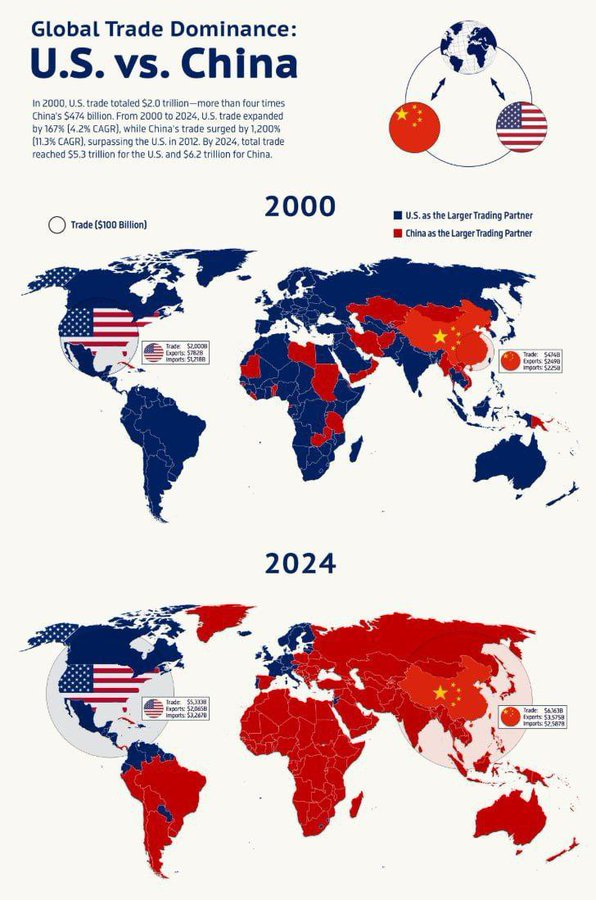 ?itok=lDKM5qJ6
To end the week, there are no indications that either China or the U.S. is willing to sit down and resolve trade disputes, while new evidence mounts that dislocations in global trade have begun to emerge:
https://www.zerohedge.com/markets/amazon-cancels-orders-walmart-pulls-forecast-tariffs-take-hold
https://www.zerohedge.com/markets/chinese-sellers-amazon-panic-after-trumps-tariff-bazooka
https://www.zerohedge.com/technology/tesla-quietly-removes-model-sx-order-now-button-chinese-site
Separately, HSBC Head EM strategist Alastair Pinder and the legendary Matt King (formerly Citi's top strategist who correctly called the Lehman collapse) debated on https://www.zerohedge.com/markets/hsbc-and-former-citi-heavyweights-breakdown-tariffs-impact-global-economy
on Thursday night with warnings about the incoming economic fallout from the trade war...
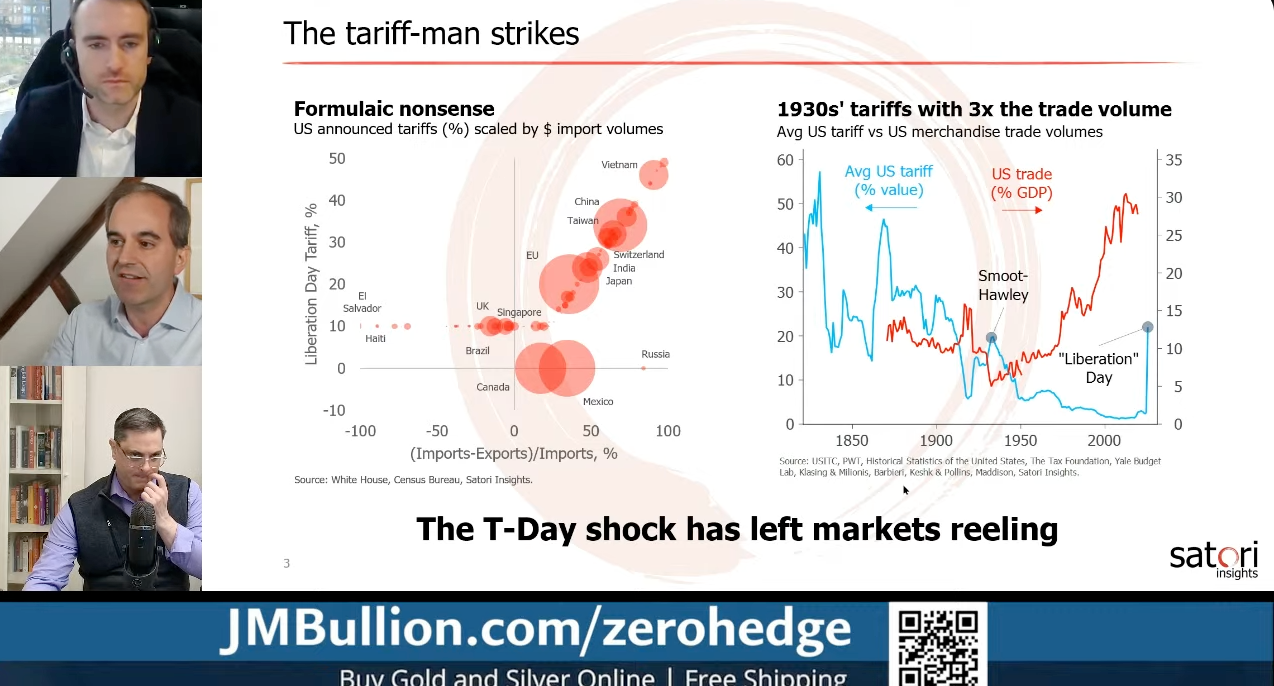 ?itok=ZrUCm6ZM
Continuing on the theme of global trade disruptions, Goldman analysts Dominic Wilson and Vickie Chang provided clients earlier with a note titled: Too Early for the "All Clear" that https://www.zerohedge.com/markets/goldman-explains-why-its-too-early-all-clear
:
 ?itok=Ja72MeuH
Substantial tariffs remain in place and the outcome even as it stands today looks considerably hawkish than was expected ahead of April 2. A simple thought experiment is to imagine that the current outcome—a 10% across the board tariff, a more than 100% China tariff, potential sectoral tariffs and large reciprocal tariffs to be implemented after a 90-day pause—had been announced. The implied roughly 15pp overall effective tariff rate increase would still have been a significant negative surprise to markets and its impact is still likely to be meaningful without further changes.
While the pause to reciprocal tariffs reduces some key tail risks, policy uncertainty remains very high, and businesses and consumers are likely to continue to be wary of making long-term commitments when the path of policy going forward remains very unclear.
Allocators are also likely to remain worried about the institutional and policy uncertainties that have led them to question their historic overweight in U.S. assets, while the recent price action has highlighted the risks both to longer-dated Treasury holdings and to the potential for simultaneous declines in U.S. equities and the USD that are especially painful for unhedged overseas investors. With some of the financial stress risk receding that often ultimately works to push the USD stronger (the left edge of the "dollar smile"), we think the case for ongoing USD weakness is intact, if not clearer.
The turmoil has revealed some cracks in the ability of the market to function effectively in the face of these kinds of large shocks. Confidence that Treasuries will provide an effective "safe haven" in periods of extreme risk is likely to have been dented and the back end of the UST curve could remain fragile.
What's clear is that global trade disruptions are emerging, and this risk suggests to Goldman analysts that it's still too early to give the "all clear" for markets.
As we were the first to warn this week - all eyes are on the Basis Trade blowing up (read https://www.zerohedge.com/markets/absolutely-spectacular-meltdown-basis-trade-blowing-sparking-multi-trillion-liquidation
).
https://cms.zerohedge.com/users/tyler-durden
Fri, 04/11/2025 - 10:45
China Escalates With 125% Tariff On US Imports, Signals Will "Ignore" Future Retaliation
China Escalates With 125% Tariff On US Imports, Signals Will "Ignore" Future Retaliation
Around the close of Hong Kong trading hours, Beijing retaliated against President Trump's tariffs by hiking levies on U.S. goods to 125%, up from the prior 84%. In a notable shift, the Chinese Communist Party announced it would "no longer respond" to any further tariff increases from Washington.
As the week concludes, the U.S. and China are locked in a heated, once-in-a-century trade war. Earlier, President Trump announced a 90-day suspension of additional country-specific tariffs for countries that have refrained from taking retaliatory measures—an apparent attempt to isolate China and use tariffs to get Beijing to strike a trade deal.
The State Council Tariff Commission announced that China will raise tariffs on U.S. goods from 84% to 125% effective Saturday. The move comes in direct response to President Trump's effective tariff rate on Chinese imports, which now totals a whopping 145%.
"Given that at the current tariff level, there is no market acceptance for U.S. goods exported to China. If the U.S. continues to impose tariffs on Chinese goods exported to the U.S., China will ignore it," the council said.
In a separate statement, the Commerce Ministry expressed, "Even if the U.S. continues to impose higher tariffs, it will no longer make economic sense and will become a joke in the history of the world economy."
In what appears to mark a pause in the escalation of the bilateral tariff war, Beijing has shifted toward non-tariff retaliation—limiting https://www.zerohedge.com/markets/hollywoods-box-office-blow-china-plans-moderately-reduce-us-film-releases
.
"This is the end of the escalation in terms of bilateral tariff rates. Both China and the U.S. have sent clear messages, there is no point of raising tariffs further," said Zhiwei Zhang, president and chief economist at Pinpoint Asset Management, quoted by CNBC.
Wall Street analysts have already trimmed sales estimates for Apple and Tesla in China, the world's second-largest economy. Meanwhile, speculation mounts that Beijing may have quietly reduced its holdings of U.S. Treasury bonds as part of its broader counteroffensive.
Zhang noted that assessing the U.S. and China's economic fallout will be next. He emphasized there are no indications that either government is preparing to reenter negotiations. Meanwhile, early signs of supply chain disruptions have been reported:
https://www.zerohedge.com/markets/amazon-cancels-orders-walmart-pulls-forecast-tariffs-take-hold
https://www.zerohedge.com/markets/chinese-sellers-amazon-panic-after-trumps-tariff-bazooka
Goldman analysts Andrew Tilton, Hui Shan, and others lowered their China GDP forecasts because of the trade war:
"We are revising our real GDP growth forecasts for 2025 and 2026 downward to 4.0% and 3.5%, respectively, from our previous projections of 4.5% and 4.0%."
 ?itok=M4N3AOEL
Tilton expects the Chinese government to ramp up easing support to offset tariff turmoil.
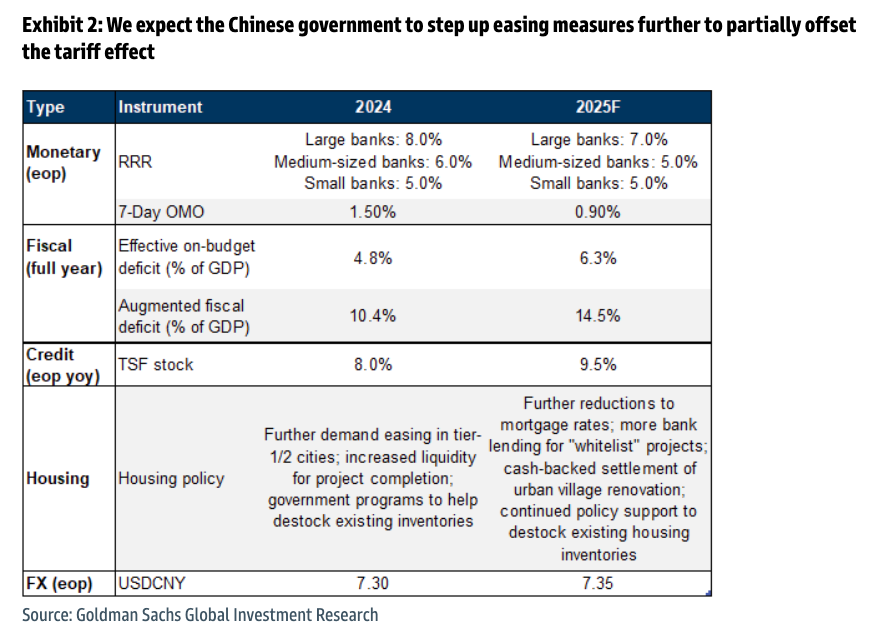 ?itok=bFZcWoJc
Despite a week of tit-for-tat trade wars, a spokesperson for China's commerce ministry reiterated that Beijing is open to negotiating with the U.S.
?itok=0GO5y1jM
The question becomes how long China can weather the economic storm, given U.S. Treasury Secretary Scott Bessent's comments earlier this week, calling the Chinese economy "the most imbalanced economy in the history of the modern world, and I can tell you that this escalation is a loser for them." Hence, the PBoC is easing.
China also reiterated that it would continue to "resolutely counter-attack and fight to the end" if the trade war deepened.
https://cms.zerohedge.com/users/tyler-durden
Fri, 04/11/2025 - 07:20
Bud Light Reclaims Top Spot As America's Favorite Beer
Bud Light Reclaims Top Spot As America's Favorite Beer
As Americans celebrated National Beer Day on April 7 – the anniversary of the Cullen-Harrison Act, which marked the end of Prohibition in the United States – what better way to honor this historic day than by delving deeper into the minds of https://www.statista.com/topics/1654/beer-industry-in-the-united-states/
lovers and finding out what their favorite brews are?
https://www.statista.com/chart/32031/most-popular-beer-brands-in-the-united-states/
is American again, as Bud Light re-claimed the top spot from Corona Extra - the leader in last year's edition of the same survey.
https://www.statista.com/chart/32031/most-popular-beer-brands-in-the-united-states/
You will find more infographics at https://www.statista.com/chartoftheday/
Corona, made in Mexico and exclusively imported, distributed and marketed by Constellation Brands in the U.S., came in second this year.
Dutch Heineken, a true global player in terms of beer, ranked fourth ahead American Budweiser and Blue Moon, a Belgian-style witbier brewed by Molson Coors in Colorado.
https://cms.zerohedge.com/users/tyler-durden
Fri, 04/11/2025 - 06:55
https://www.zerohedge.com/personal-finance/bud-light-reclaims-top-spot-americas-favorite-beer
US Geopolitical Chess: Strategies Against China, Russia, And Iran
US Geopolitical Chess: Strategies Against China, Russia, And Iran
As the United States brokers a cease-fire between Russia and Ukraine, the Trump administration’s unique strategies toward China, Russia, and Iran are becoming more apparent.
At the same time, the administration is redefining alliances while urging partners to step up their defense instead of depending on America’s traditional generosity.
This multifaceted strategy aims to reshape the global order by isolating the three adversaries of the United States, with the ultimate goal of delivering a decisive blow to the Chinese Communist Party (CCP).
 ?itok=oSjKGnBV
Russia Strategy
President Donald Trump is focused on quickly resolving the Russia–Ukraine conflict by providing Moscow with a way out while maintaining pressure on the CCP, which remains his main target. After taking office, he shifted U.S. policy toward Russia, incorporating a mix of incentives and some level of coercion, with a stronger emphasis on the former. This strategy has yielded positive results, initiating discussions for a cease-fire.
On Jan. 22, just days into his presidency, Trump https://truthsocial.com/@realDonaldTrump/posts/113872782548137314
on his Truth Social platform: “I’m going to do Russia, whose Economy is failing, and President Putin, a very big FAVOR. Settle now, and STOP this ridiculous war! IT’S ONLY GOING TO GET WORSE. If we don’t make a ‘deal,’ and soon, I have no other choice but to put high levels of Taxes, Tariffs, and Sanctions on anything being sold by Russia to the United States, and various other participating countries. Let’s get this war, which never would have started if I were President, over with!”
The Kremlin responded swiftly. On Feb. 12, Trump and Russian President Vladimir Putin spoke by phone, agreeing to start negotiations right away to halt the conflict, breaking a diplomatic stalemate.
On Feb. 18, the U.S. and Russian teams met in Saudi Arabia, resuming normal engagement and laying the groundwork for cease-fire discussions. By March 18, a second call between Trump and Putin focused on halting attacks on energy infrastructure. This initiated technical talks regarding a maritime cease-fire in the Black Sea, a broader truce, and a lasting peace deal.
On March 25, the White House detailed separate U.S. meetings with Russia and Ukraine, securing safe Black Sea navigation and a mutual pledge to spare energy infrastructure. The United States also committed to aiding Russia’s agricultural and fertilizer exports while helping Ukraine recover detained civilians and children displaced by Russia.
The next steps will likely address issues related to territorial borders, peacekeeping, sanctions relief, and security guarantees. As long as Moscow is cooperative, Trump will prefer to offer incentives. However, if Russia adopts a more rigid position, he is prepared to walk away, compelling the Kremlin to consider its alternatives—especially in light of potential betrayal by Beijing. Trump’s strategy focuses on creating a rift between Russia and China while simultaneously applying pressure on both nations.
China Strategy
Regarding the CCP, Trump employs a dual approach of intense pressure and selective engagement.
Tariffs lead the charge. Citing China’s failure to stem fentanyl flows into the United States, he imposed an additional 10 percent tariff on Chinese imports effective on March 4.
during a meeting in Canada on March 14, issued a statement that hardened their position on the Chinese regime’s trade practices, military expansion, and regional tensions. Notably, the joint statement did not reference the “One China” policy, indicating support for Taiwan’s participation in global organizations. Washington likely influenced this shift.
These actions rattled the CCP, yet Trump had sought to engage with Beijing.
In December, the U.S. president invited CCP leader Xi Jinping to his inauguration; however, Xi declined the invitation and sent his deputy, Han Zheng, in his place. The https://www.reuters.com/world/china/chinas-xi-may-visit-us-not-too-distant-future-trump-says-2025-03-17/
generated significant interest, but it appeared that the White House was merely trying to gauge reactions and test the waters.
On March 22, Sen. Steve Daines (R-Mont.) https://www.theepochtimes.com/china/us-senator-meets-chinas-vice-premier-in-beijing-visit-5829932
Beijing, where he discussed the issue of fentanyl with Vice Premier He Lifeng and suggested the possibility of future high-level talks. Later, Daines also met with Chinese Premier Li Qiang, who told the United States to opt for “dialogue” rather than “confrontation.”
Yet Beijing’s actions suggest resistance. On March 24, it enacted an anti-foreign sanctions law, signaling defiance.
Washington acted quickly. The next day, the United States added https://public-inspection.federalregister.gov/2025-05426.pdf
on all goods imported from those countries that purchase Venezuelan oil, essentially halting China’s purchases.
Beijing remains resolute in its stance against the United States. A https://ustr.gov/about-us/policy-offices/press-office/press-releases/2025/march/readout-ambassador-jamieson-greers-meeting-chinas-vice-premier-he-lifeng
of Panama Canal port rights to BlackRock on March 4 drew late criticism from Beijing, but this response came too late to be of any significance.
Iran Strategy
Trump has not overlooked Iran, especially following the country’s naval drills with China and Russia on March 9.
The U.S. president sent a letter to Iranian Supreme Leader Ali Khamenei in early March, seeking to negotiate a deal to restrain Tehran’s rapidly advancing nuclear program.
However, Khamenei https://www.theepochtimes.com/world/iranian-supreme-leader-rebuffs-negotiations-following-new-trump-outreach-5822404
direct negotiations with the United States over the issue, saying, “Some foreign governments and domineering figures insist on negotiations, while their goal is not to resolve issues but to exert control and impose their own agendas.”
On March 15, as the trilateral exercise ended, U.S. forces https://www.theepochtimes.com/us/us-strikes-on-iran-backed-houthis-in-yemen-killed-multiple-leaders-waltz-5826450
.”
Trump followed up with a social media post on March 17, vowing “https://truthsocial.com/@realDonaldTrump/posts/114178483249053992
Iran halt supplies “immediately,” predicting the Houthis’s swift defeat.
The strikes served a dual purpose: they sent a message to Beijing and Moscow. Following a meeting on March 14 in Beijing that involved representatives from China, Russia, and Iran discussing Tehran’s nuclear program, Trump’s escalation with the Houthis undermined Beijing’s mediation efforts. As U.S.–Russia–Ukraine discussions progressed in Saudi Arabia, it highlighted Trump’s willingness to pivot against Moscow if necessary.
Trump is playing a different game with China, Russia, and Iran to divide them, aiming to hit the CCP the hardest.
The Bigger Picture
In a chaotic, uncertain world, Trump effectively utilizes every available resource. The United States must bring all its resources together to confront the CCP. The sooner America’s allies and partners understand this strategy and offer their support, the faster the CCP will weaken and potentially collapse.
Once the CCP falls, Russia will lack the means to sustain its war efforts, Iran will find itself without a backer, and terrorist organizations will struggle to survive. Only then can global stability be restored, the international order reestablished, and nations begin to enjoy a peaceful existence.
Views expressed in this article are opinions of the author and do not necessarily reflect the views of The Epoch Times or ZeroHedge.
https://cms.zerohedge.com/users/tyler-durden
Thu, 04/10/2025 - 23:25
Most Americans Now Have Negative View Of Israel - Under-50 GOP Support Craters
Most Americans Now Have Negative View Of Israel - Under-50 GOP Support Craters
While the Trump administration earnestly redistributes billions of dollars of American wealth to Israel, that country's immensely-destructive war in Gaza appears to be taking a growing toll on its support among Americans. According to the latest Pew Research survey, a majority of Americans now have an unfavorable view of Israel. In a finding that will cause the greatest alarm in Israeli government offices and at US-based pro-Israel organizations, there's now a huge generational divide within the GOP ranks.
53% of Americans now have an unfavorable view of Israel, thanks to the share of Americans with dim views of Israel surging by 11 points in three years. The comparison point is Pew's survey in March 2022, seven months before the Oct 7 Hamas invasion of southern Israel sparked a massive military response that's killed more than 50,000 Palestinians -- about a third of them under 18 -- according to health officials in Gaza. Over the same span, https://www.pewresearch.org/short-reads/2025/04/08/how-americans-view-israel-and-the-israel-hamas-war-at-the-start-of-trumps-second-term/#hwdt
.
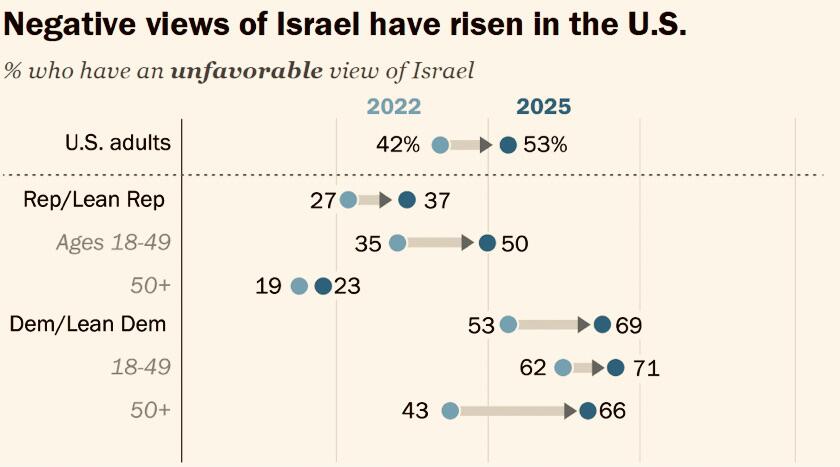 ?itok=FM_uEVBU
Extending back several years, support for Israel had started to sharply polarize along major-party lines, with Democrats' affinity for Israel plummeting while GOP support held relatively steady. In the https://www.pewresearch.org/short-reads/2025/04/08/how-americans-view-israel-and-the-israel-hamas-war-at-the-start-of-trumps-second-term/#hwdt
's most striking statistic of all, disdain for the State of Israel among Republicans under age 50 has soared 15 points in three years, which could signal that support for Israel is poised for a bipartisan decline for years to come. Among Republicans and Republican leaners age 50 and older, unfavorable views of Israel crept up just four points since 2022, from 19% to 23%. Among the under-50 GOP set, it rose from 35% to 50%.
Democrats' low views of Israel also surged higher over the three-year interval: 69% have an unfavorable view in 2025, up 16 points from 2022. On that side of party divide, age is much less of a factor: 66% of age-50+ Dems have a negative view of Israel, compared to 71% for those 18 to 49.
Pew also found interesting distinctions among views held by Americans as divided by religious affiliations. One of the key pillars of Israeli political influence inside the United States is white evangelical protestants, and 72% of them accordingly view Israel favorably today. Non-evangelical protestants are net-negative on Israel by a small 50% to 47% margin, while Catholics take a dim view of Israel by a more substantial 53% to 43% spread. 73% of Jews are favorable, but a quite-substantial 27% give a thumbs-down to the self-declared "Jewish state."
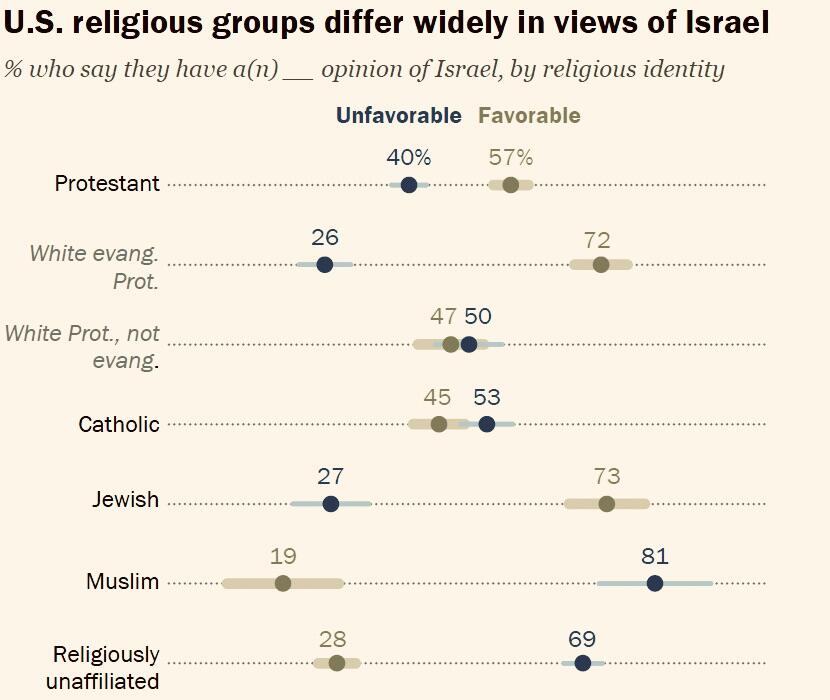 ?itok=WtifH2jn
Pew's survey didn't probe the factors driving rising negative views of Israel, but it's safe to say the major shift springs from Israel's conduct of the war in Gaza. Beyond the war per se, the exposure of that war's horrors on social media platforms has also been decisive in our view, with Americans having access to raw portrayals of the bloodshed and suffering, including reporting from alternative and foreign media outlets that shines a light on the high civilian death toll, destruction of hospitals, mass-displacement from homes, hunger and disease.
An IDF soldier laughs and smashes up a shop in Jabalia refugee camp. The store will have been someone’s pride and joy, and a source of livelihood.
Such brutal cruelty without a second thought — carried out with pride and a camera. https://t.co/pQ4AG6rfwe
— Philip Proudfoot (@PhilipProudfoot) https://twitter.com/PhilipProudfoot/status/1733270685751935464?ref_src=twsrc%5Etfw
Ironically, many of the most damning social-media glimpses into the Israeli Defense Forces' conduct of the war have come from IDF soldiers themselves, who've shared photos and videos of themselves https://x.com/AricToler/status/1754858189785272821
.
That's not to say mainstream media hasn't also played a role in Israel's surging unpopularity in the United States. One of the most unsettling reports of the war was aired by CBS Sunday Morning, which featured the accounts of American doctors who'd volunteered in Gaza and https://www.zerohedge.com/geopolitical/us-doctors-stunned-number-gaza-children-headshot-wounds
.
And of course IDF 'soldiers' wearing the underwear of (probably dead) Palestinian women doesn't look revoltingly gross at all... https://t.co/ssDDv3kKcV
— The Prole Star (@TheProleStar) https://twitter.com/TheProleStar/status/1895482343344992762?ref_src=twsrc%5Etfw
As for younger Republicans, whether or not they have empathy for Palestinian civilians, many under-50 GOP voters no doubt see America's open-checkbook support for Israel as inconsistent with the "America First" philosophy that's supposed to underpin Trumpian Republicanism. In a move last month that surely aggravated them, fresh after amusingly humiliating Ukrainian President Volodymyr Zelensky en route to ending the money-pit that is the proxy war against Russia, https://www.zerohedge.com/geopolitical/us-back-turned-ukraine-rubio-expedites-delivery-4bn-military-aid-israel
in military aid to Israel.
As today's under-50 crowd proceeds to dominates the Republican electorate, those moves could start to become a political liability for GOP officials who've been conditioned to expect Red-Team praise for sending US wealth, weapons and soldiers to the Middle East to advance Israel's agenda. If rank-and-file Republicans increasingly embrace https://starkrealities.substack.com/p/george-washington-warned-against
that make the United States "a slave to its fondness," a seismic shift in the 77-year US-Israel relationship could be in the offing.
https://cms.zerohedge.com/users/tyler-durden
Thu, 04/10/2025 - 23:00