
Container Orders Plummet - Trade Deals Now Or Economic Depression Soon
Container Orders Plummet - Trade Deals Now Or Economic Depression Soon
https://www.dlacalle.com/en/container-orders-plummet-trade-deals-now-or-economic-depression-soon
Global container booking volumes fell by 49% between the last week of March and the first week of April 2025, according to Freight Waves. Imports from China to the United States collapsed by 64%, with imports of apparel and textiles declining by a whopping 59% and 57%, respectively. The figures coming from shipping companies are worse than those seen during the Covid-19 crisis.
These alarming figures suggest that importers are unwilling to accept higher prices in the middle of a tariff war, that exporters cannot simply choose to move their products elsewhere easily, and that the excess capacity in many sectors is much larger than initially expected.
No one wants to accept the cost of tariffs, and this means that the only option for the economies with elevated productive overcapacity is to negotiate a trade deal, and quickly, or face an economic depression.
The mainstream view about tariffs was that United States consumers would pay the entire negative impact. This news suggests otherwise. The purchasing power of importers is higher than expected.
The number of order cancellations is so large that ports in China have had to take emergency measures to address the challenges created by piles of unsold containers.
The negative impact is enormous on ports, as fees plummet, but we cannot forget the dramatic effect on producers with excess capacity. Many global exporters are going to face bankruptcy if no trade deal is reached due to insufficient working capital.
In the European Union, leaders are concerned that the trade war between the United States and China will bring a flood of cheap products from China that could endanger local producers and create a significant economic problem.
Many exporters are facing a harsh reality: They cannot sell their products if they don’t export them to the United States, and the importers are not going to accept higher prices due to tariffs.
The reason why exporters cannot pass the cost of tariffs to United States consumers is because most of the products they delivered to America were only attractive because they were exceedingly cheap. When prices rise, demand decreases significantly. The tariff war has shown that demand is not inelastic.
The collapse in container orders proves Menger’s imputation theory. Output prices determine factor prices, not the other way around.
The unsustainable state of global shipping will compel countries to expedite trade agreements with the United States, failing which they risk a cascade of economic collapses within their business structures.
The slump in container orders proves that United States importers are not going to accept any price, that excess capacity in the main retail sectors is enormous, and that there is no straightforward alternative for American consumers.
If you believed that other countries would hesitate to negotiate trade agreements with the United States, you need to reconsider. The American consumer loves cheap products but does not want the same goods at twice the price.
The United States economy may suffer a contraction due to this sudden slump in imports, but the consequences are much larger for the exporter nations.
The outcome is not positive for any country, so there is only one choice to make: negotiate or lose. If countries fail to establish significant trade agreements with the United States in the near future, their retailers are likely to face a severe working capital crisis.
https://cms.zerohedge.com/users/tyler-durden
Tue, 04/22/2025 - 13:20
Stocks Reverse Bessent Gains On Reports "It May Take Months To Hammer Out Final Trade Deals"
Stocks Reverse Bessent Gains On Reports "It May Take Months To Hammer Out Final Trade Deals"
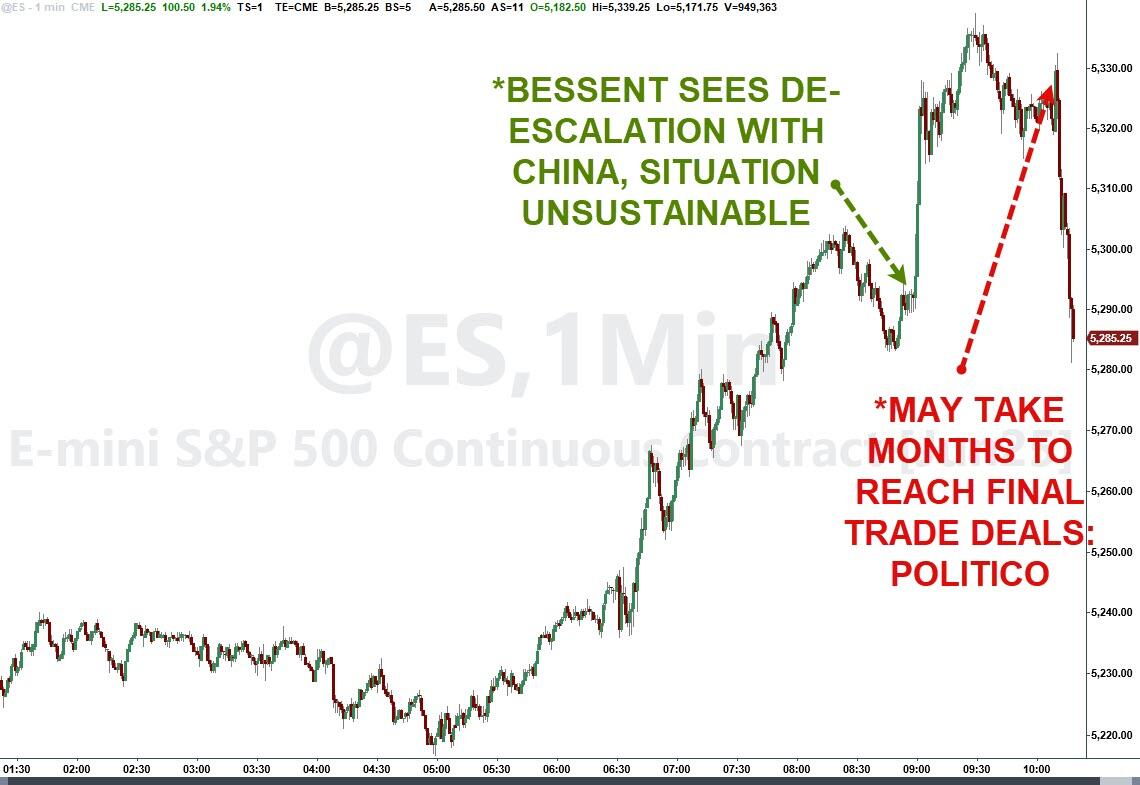
Update (1315ET): Shortly after the Bessent headlines moved stocks higher, https://www.politico.com/news/2025/04/22/white-house-is-close-on-japan-india-agreements-but-expect-them-to-be-light-on-specifics-00302762
, while The White House is closing in on general agreements with Japan and India to stave off massive U.S. tariffs, it “may take months to hammer out the final deals,” said one of the people, conceding, “these things are complicated.”
Worse still, the optimism on the initial Bessent headlines has been erased as his actual comments were far less hopeful:
BESSENT: REBALANCING OF CHINA ECONOMY TOWARDS CONSUMPTION AND U.S. ECONOMY TOWARDS MANUFACTURING IN TWO TO THREE YEARS WOULD BE A 'HUGE WIN' - RTRS
BESSENT SAYS CHINA NEGOTIATIONS WILL BE A 'SLOG', DESCRIBES CURRENT BILATERAL TRADE SITUATION AS AN EMBARGO -PERSON WHO HEARD JP MORGAN SESSION
And just like that all the gains are gone...
 ?itok=kP2aQ16I
* * *
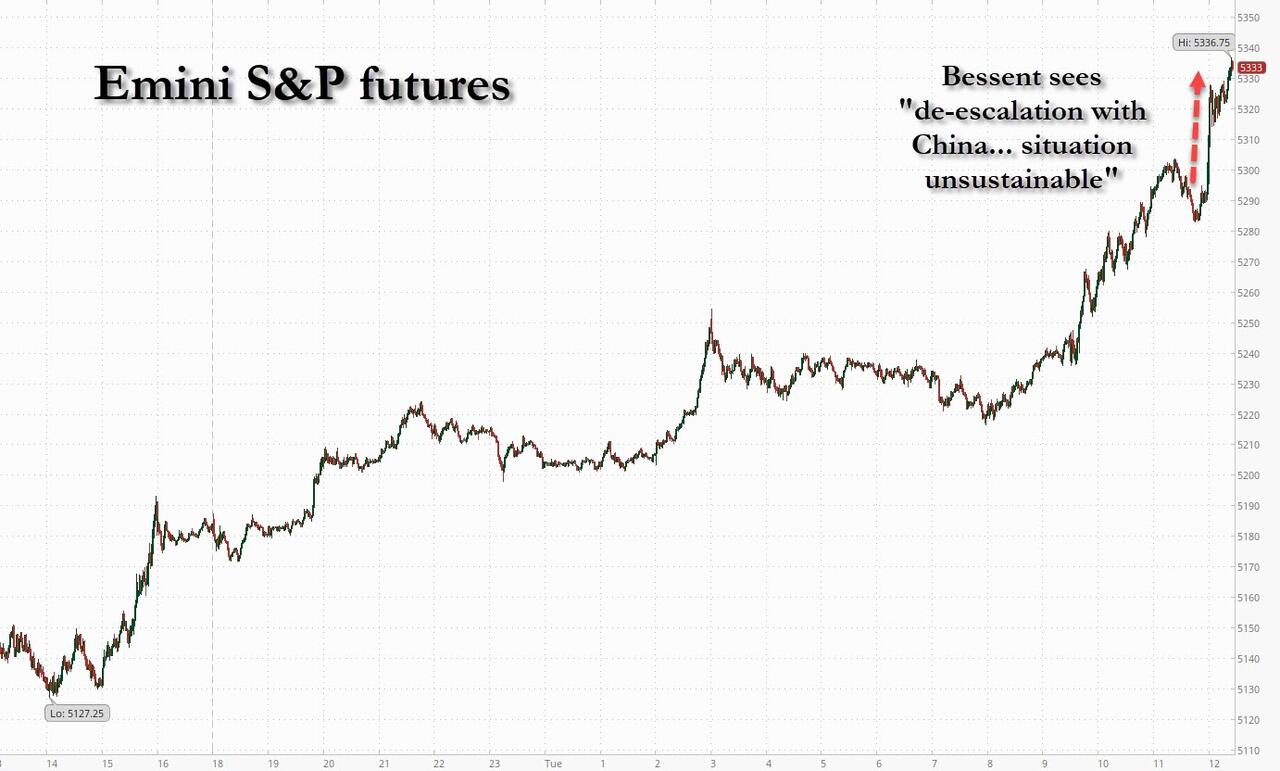
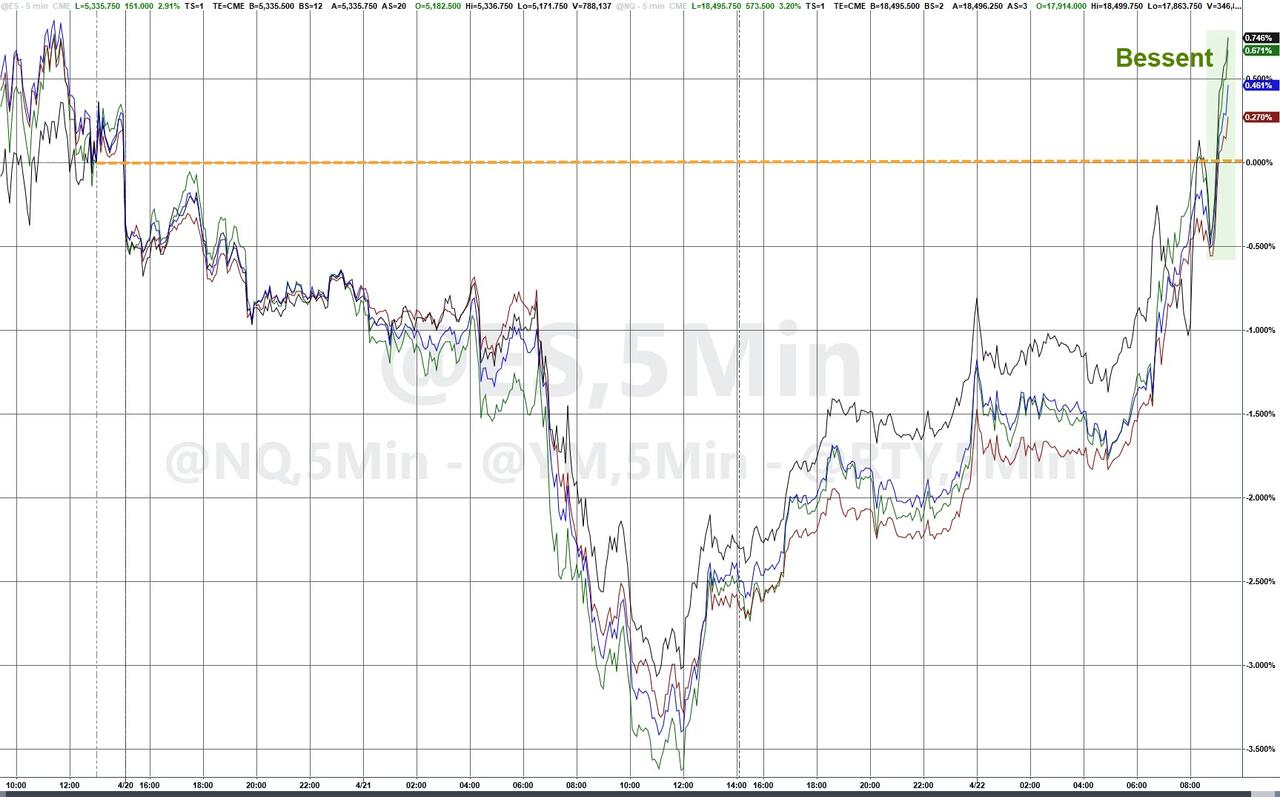
US equity markets were already ramping higher, as yesterday's massive short pile up reversed and transformed into a squeeze (and force out of underexposed systematic funds), when an 11:58am ET headlines from Bloomberg, suggesting... well... the obvious, namely that the trade war with China is unsustainable in the long run according to Bessent...
*BESSENT SEES DE-ESCALATION WITH CHINA, SITUATION UNSUSTAINABLE
... sent the US equities to session highs, up 3%...
 ?itok=tDGY8KKg
...and reversing all of yesterday losses...
 ?itok=CcyCko4p
Started with a major short-squeeze...
 ?itok=oAFeoNTz
The broad risk on move has sent the dollar higher, hitting the yen and euro, and pushing the USDJPY well above 141 (after sliding below 140 overnight) and the EURUSD has pushed to session lows, down 0.5%, while the US 10y yield is near its richest levels of the day, down 3bp. Gold is also sliding and was below $3400 after hitting a record high $3500 just a few hours earlier.
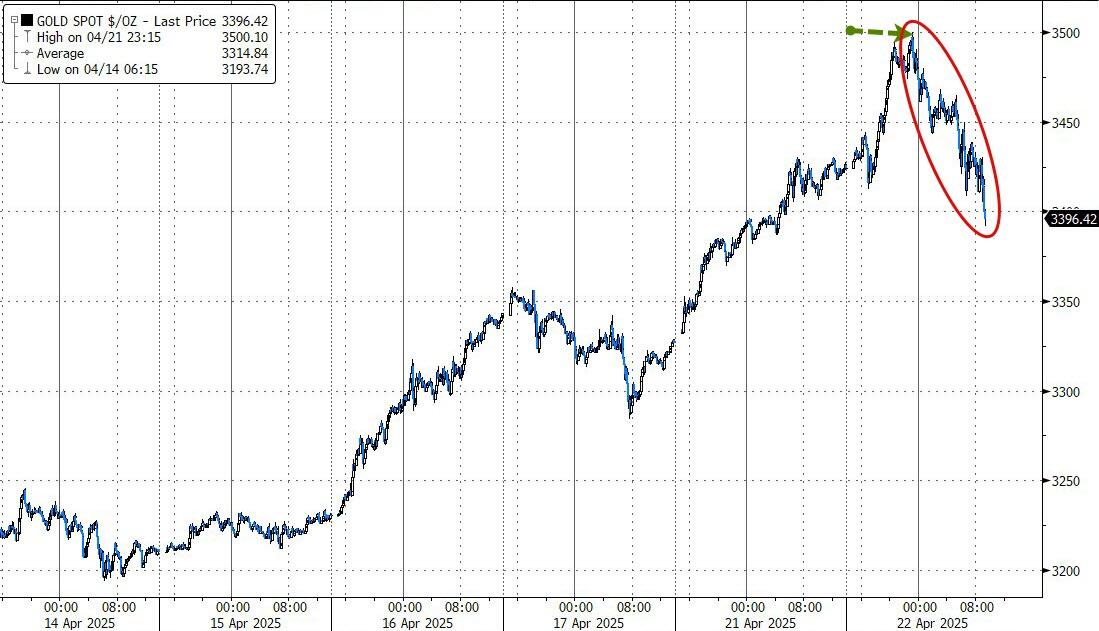 ?itok=Knkn7B4q
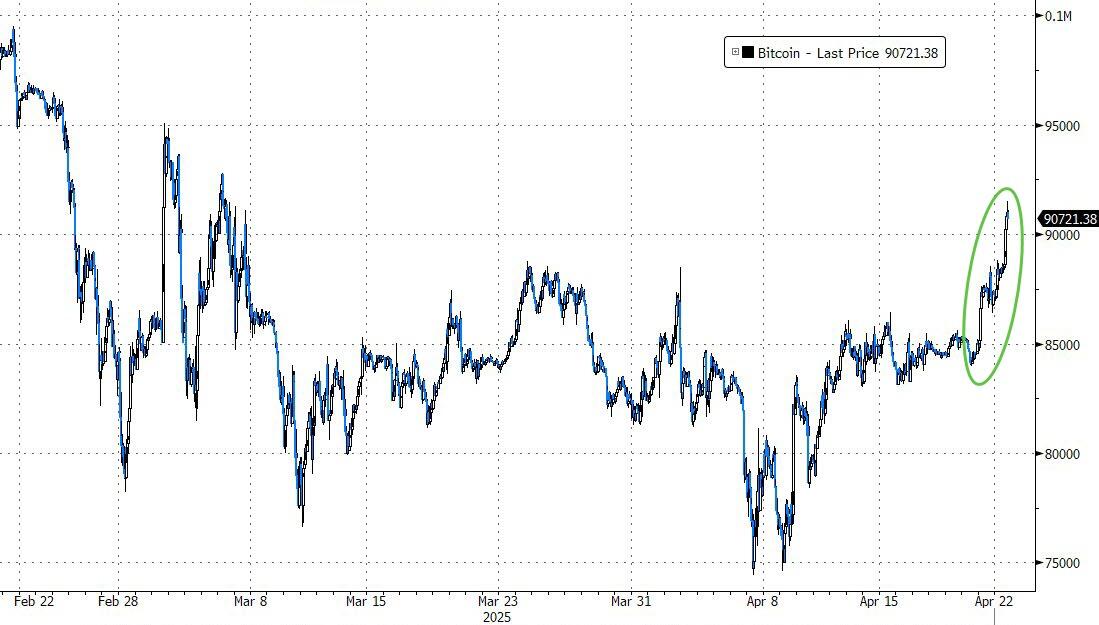
While gold is sliding, bitcoin topped $91,000...
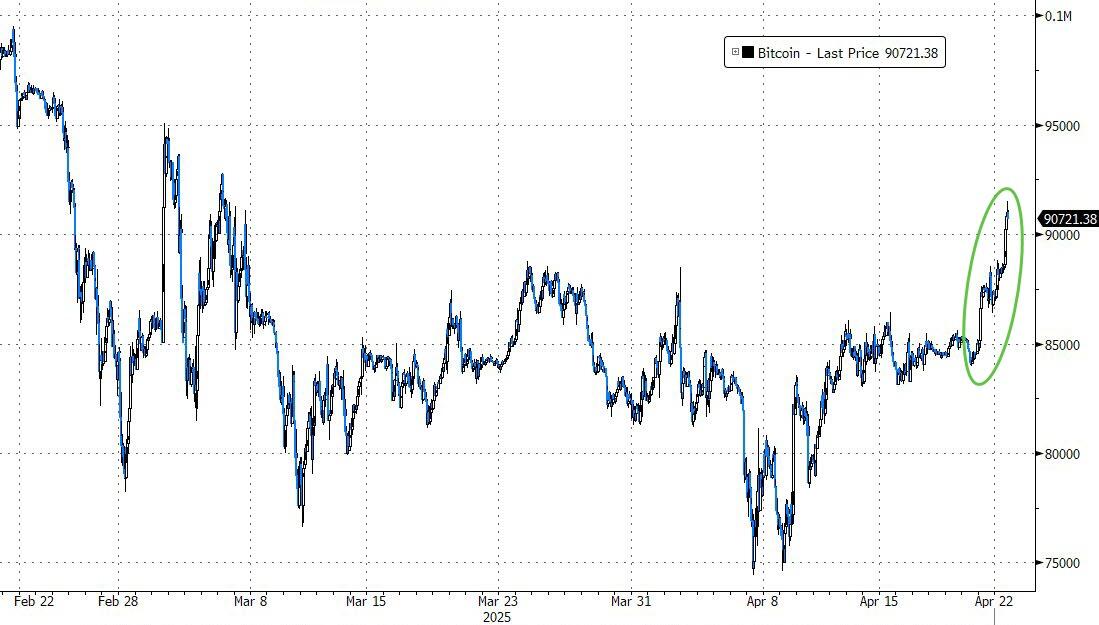 ?itok=qqlqHB6K
Today's rally is already shaping up as the biggest since Trump’s tariff pivot on April 9. According to UBS S&T, money is flowing back into High Momentum {UBQQHMTM}, up 3.5%, with groups like M&A Banks {UBXXMABK}, up 2.8%, and AI Power {UBXXVOLT}, up 3.4%, benefitting. Some more notable flows:
A risk-on rotation is visible in Volatility {UBPTVOL}, up +2.5%, versus Quality {UBPTQLTY}, down 1.4%. Lower quality pockets are bouncing back most forcefully with De-SPACs {UBXXDSPC} up 3.5%, and Low Quality Credit {UBXXCRED} up 3%.
Tariff Losers {UBXXTTL}, up 2.8% stabilise, note the basket outperformed meaningfully during Monday's selloff in a sign of washed out positioning.
Defence Primes {UBXXPRME} are down 3%, though note about two-thirds of the move is driven by Northrop after disappointing earnings.
Another reason for today's meltup is the reversal of yesterday's meltdown, as panicked systematic funds scramble to buy. According to Goldman's Cullen Morgan, the systematic macro rebalance has effectively been completed, with global equity length going from approximately an 8 out of 10 during the YTD/February highs to a 1 out of 10 currently, of $53bn and representing a short position from CTA/trend followers and 1-yr low lengths from risk parity style + VA vol-control products.
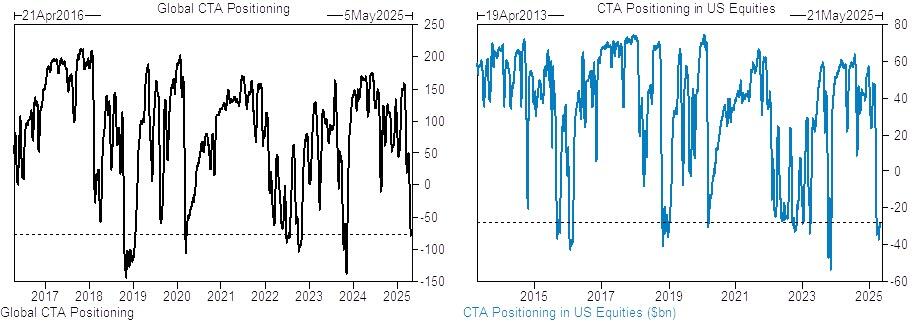 ?itok=1q7VOsx9
As a result, Goldman now has CTAs as modeled buyers in every scenario over the next week and month.
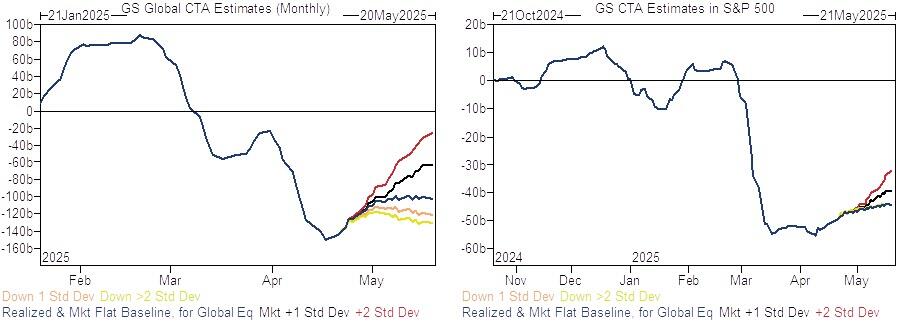 ?itok=MpohkGl8
https://cms.zerohedge.com/users/tyler-durden
Tue, 04/22/2025 - 13:15
Wells Fargo Analysts Say Amazon Paused Some Data Center Lease Commitments
Wells Fargo Analysts Say Amazon Paused Some Data Center Lease Commitments
First came China's "https://www.zerohedge.com/technology/chinas-deepseek-ai-moves-capital-tech-palo-alto-hangzhou
its peak data center forecast to this year. Now, Wells Fargo analysts report that Amazon has paused some data center lease negotiations for its cloud division.
"Over the weekend, we heard from several industry sources that Amazon Web Services (AWS) has paused a portion of its leasing discussions on the colocation side (particularly international ones)," Wells Fargo analysts wrote in a note on Monday, adding, "The positioning is similar to what we've heard recently from MSFT."
The analysts noted that Amazon is not canceling signed deals. Instead, they're digesting recent aggressive lease-up deals.
"It does appear like the hyperscalers (big cloud companies) are being more discerning with leasing large clusters of power, and tightening up pre-lease windows for capacity that (would) be delivered before the end of 2026," the analysts said, noting that Meta and Alphabet-owned Google remain active in data center leasing.
 ?itok=oawnsIDH
Kevin Miller, Vice President of AWS Global Data Centers, downplayed the Wells Fargo report in a LinkedIn post, calling the move "routine capacity management" and stating that there have been no recent fundamental changes to Amazon's expansion plans.
After the unveiling of China's ultra-cheap DeepSeek rival to ChatGPT in January, TD Cowen's Michael Elias, a month later, first reported on Microsoft data center order cancellations - followed by a more recent note from the analyst that specified the big tech firm has walked away from data center projects in the U.S. and Europe, amounting to a capacity of https://www.zerohedge.com/markets/microsoft-scales-back-ai-data-center-projects-us-australia-uk
.
"We continue to believe the lease cancellations and deferrals of capacity points to data center oversupply relative to its current demand forecast," Elias wrote in a note last month.
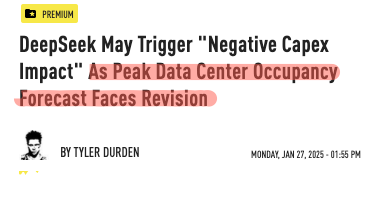
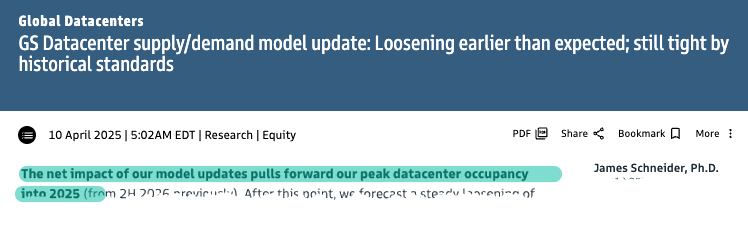
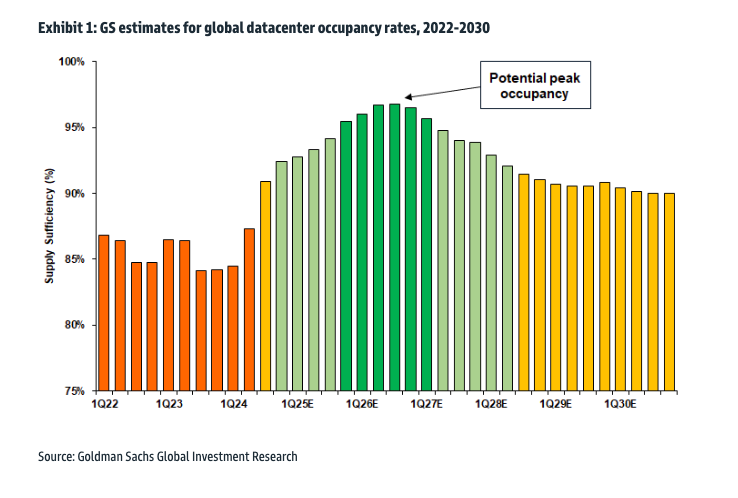
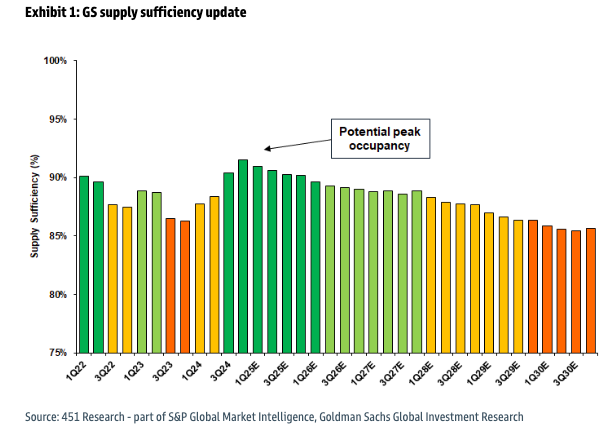
Just a few weeks ago, Goldman's James Schneider, Michael Smith, and others https://www.zerohedge.com/markets/goldman-revises-peak-data-center-occupancy-forecast
forward to 2025 (from late 2026).
As soon as the Deep Seek moment happened. We said this development will likely revise the forecast.
 ?itok=Mmsa8RGb
And that's precisely what happened.
 ?itok=zYtMEFY_
The peak data center capacity forecast was issued in January.
 ?itok=V82KxJOD
April's revision.
 ?itok=zl_Zokga
Meanwhile, Amazon CEO Andy Jassy recently told CNBC's Andrew Ross Sorkin that he did not forecast any cuts in data center construction.
https://cms.zerohedge.com/users/tyler-durden
Tue, 04/22/2025 - 13:00
Just 30% Of Illinois 4th Graders Read At Proficiency Standards
Just 30% Of Illinois 4th Graders Read At Proficiency Standards
Authored by Glenn Minnis via https://www.thecentersquare.com/illinois/article_d91c7486-7950-4db0-8004-b1eff240b65c.html
,
Illinois Republican state Rep. Dan Ugaste is speaking out against a “nationwide literacy crisis” that counts Illinois among the more than 40 states where just one out of every three fourth grade students are now meeting reading proficiency standards.
 ?itok=PI48u68i
Data from the National Assessment of Educational Progress report card shows that in Illinois, just 30% of fourth graders are hitting such standards.
In a 2024 national exam, the state’s students finished 29th in the country for the percentage of fourth graders at or above proficiency.
“This is a huge problem across the country, but it’s a real problem here in Illinois,” Ugaste told The Center Square.
“It’s my understanding that our 8th graders are doing a bit better. It speaks to the amount of damage that was done when the schools closed during the pandemic. That’s when these children would have first been in school and first learning how to read, write and do math.”
With researchers identifying third and fourth grades as being a critical period in a student’s overall academic development, school system critics like Ugaste argue that now more than ever, parents should be allowed to make use of school choice to send their children to the best school for them.
Researchers stress such assessments can be early predictors for critical milestones such as future employment and overall earning potential.
Ugaste is urging parents to take immediate action.
“First and foremost, you got to do what you can to help your own kids,” he said.
“Start reaching out to your legislators; start reaching out to your school boards, get involved in what’s happening in your schools, what they’re teaching them, how much time they’re spending on things like reading and math versus other subjects. We have to be involved in our kids’ education; we have to be involved in our government; we have to be involved in our communities.”
Ugaste said he’d also like to see parents demanding lawmakers in Springfield repeal some of the mandates they’ve enacted, giving local school boards and parents greater control over curriculum.
“Let the communities, the parents and the educators locally decide how much time should be spent on subjects and things of that nature,” he said.
“We’re trying to dictate from Springfield what they should be learning, how much recess time they should have, and all these other issues. We just need to get out of that arena.”
The legislature allowed the state’s only school choice program, Invest in Kids, to expire in 2023. Invest in Kinds was a scholarship program that allowed lower-income families to use tax-credited donations to pay for private schools.
https://cms.zerohedge.com/users/tyler-durden
Tue, 04/22/2025 - 07:20
https://www.zerohedge.com/political/just-30-illinois-4th-graders-read-proficiency-standards
Trump Meets Walmart, Target Bosses Amid Tariff War Anxiety
Trump Meets Walmart, Target Bosses Amid Tariff War Anxiety
With U.S. tariff rates now at their highest levels since President Franklin D. Roosevelt's first inauguration, executives from Walmart, Target, Home Depot, and Lowe's met with President Donald Trump on Monday to seek relief from sweeping trade duties that have disrupted global supply chains that could soon spark turmoil for US consumers.
"We had a productive meeting with President Trump and our retail peers to discuss the path forward on trade, and we remain committed to delivering value for American consumers," a Target spokesman told https://news.bloomberglaw.com/health-law-and-business/trump-to-meet-walmart-target-executives-as-tariff-angst-spreads
in an emailed statement.
Spokeswomen from Walmart and Home Depot called the meeting at the White House productive and looked forward to continuing constructive dialogue to resolve the deepening trade war. Bloomberg noted that Lowe's did not respond for comment.
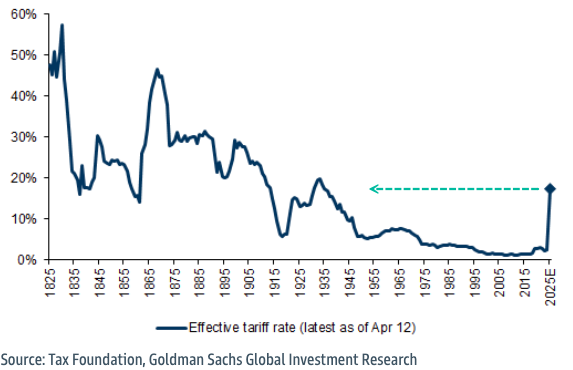
Trump's blanket tariffs have raised the average US tariff rate on goods entering US ports of entry to the highest level since https://www.zerohedge.com/markets/us-tariffs-rate-return-fdr-era-levels-goldman-says-economy-far-stronger-1930s
was being sworn in as president and the Great Depression and Dust Bowl roiled the economy.
 ?itok=UuI_vZ1i
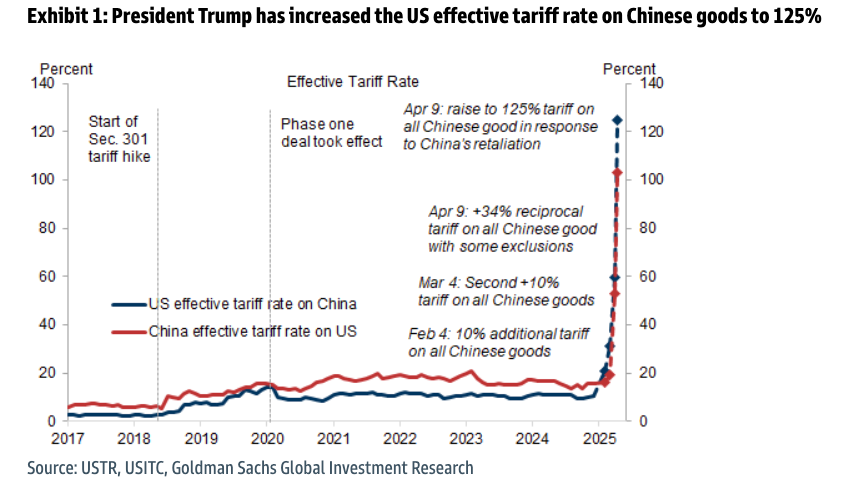
Goldman analysts have pointed out the most tariff-exposed (mainly Chinese exposed with a tariff rate of 145%) hardline and softline companies under their coverage, including conversations with investor relations and management teams about tariff impacts:
https://www.zerohedge.com/markets/what-americas-hardline-retailers-are-saying-about-tariff-fallout
 ?itok=OssV0dM6
Last week, China laid out a set of https://www.zerohedge.com/markets/respect-clarity-china-demands-prerequisites-reengaging-trump-trade-talks
for resuming trade talks with President Trump and his administration, including a demand for respect, a unified approach by US officials, and a point person for trade talks.
as the economic superpowers so far struggle to strike a trade deal.
https://cms.zerohedge.com/users/tyler-durden
Tue, 04/22/2025 - 06:55
https://www.zerohedge.com/markets/trump-meets-walmart-target-bosses-amid-tariff-war-anxiety
Exposing Beijing's 'Gray Trade' Tariff Avoidance Scheme
Exposing Beijing's 'Gray Trade' Tariff Avoidance Scheme
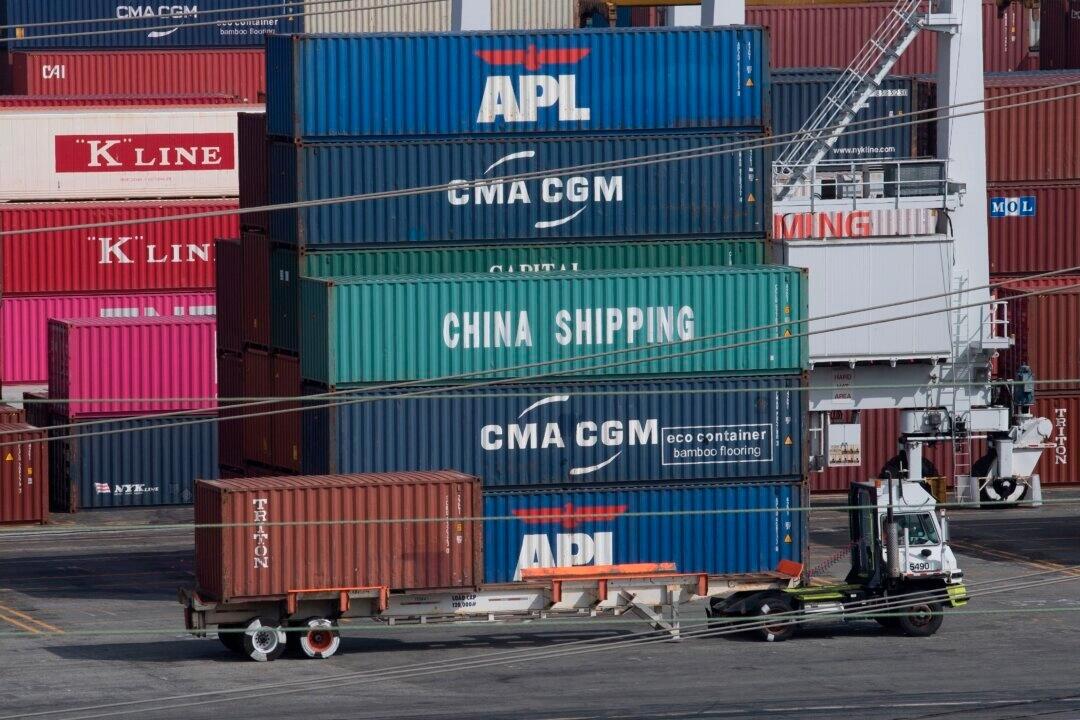
Is a new boom in deceptive trading practices taking shape in many parts of the world? As the U.S.–China trade war intensifies, it certainly looks that way.
 ?itok=ErxUs8Zn
China’s Gray Trade Strategy Blunts Impact of US Tariffs
With U.S. tariffs reaching 145 percent on Chinese imports—at least at the time of this writing—Beijing’s new strategy seems to include the use of so-called https://www.caixinglobal.com/2025-04-14/chinese-exporters-look-to-go-gray-to-circumvent-trump-tariffs-102309377.html
to bypass American trade barriers. Gray trade involves rerouting goods through low-tariff countries, such as Vietnam, Mexico, or Malaysia, to conceal their Chinese origin and thereby reduce U.S. import duties.
This sneaky tactic has surged as a response to President Donald Trump’s aggressive tariff policies, making China’s goods less competitive in the U.S. market due to their added cost.
Gray Trade Loophole Strategy
The simple idea behind gray trade is to exploit loopholes in https://www.trade.gov/identify-and-apply-rules-origin
, the trading guidance for determining a product’s country of origin for tariff purposes. Chinese goods, for example, will remain unassembled or may be about 90 percent manufactured before being shipped to an intermediary country. There, they undergo final production, assembly, processing, repackaging, or relabeling to qualify as originating from that country, rather than from China.
For example, Chinese electronic parts may be sent to Vietnam, assembled into a product, and then labeled, “https://www.reuters.com/world/asia-pacific/facing-trump-tariffs-vietnam-eyes-crackdown-some-china-trade-2025-04-11/
.” This enables China to benefit from the 10 percent tariff on Vietnamese imports under Trump’s 2025 reciprocal tariff regime, instead of the 145 percent tariffs on Chinese goods.
It’s a perfectly sensible response by Beijing, and there’s no doubt that Chinese firms are rerouting goods through Vietnam, Mexico, and Turkey to exploit lower tariffs on goods sourced from those countries. A related tactic occurring in Mexico involves dividing goods into packages that are below the $800 tariff-free threshold for non-Chinese origins, a tactic called the “https://www.economist.com/finance-and-economics/2024/06/27/how-chinese-goods-dodge-american-tariffs
.”
China Has to Resort to Gray Trade
But gray trade isn’t new or even unfamiliar to the second Trump administration. During Trump’s first term, Chinese solar manufacturers bypassed 30 percent tariffs by partnering with their neighbors in Southeast Asia. In 2025, https://oilprice.com/Energy/Energy-General/China-Uses-Gray-Trade-Tactics-To-Circumvent-US-Tariffs.html
the movement and provenance of vast numbers of products is complex at best and nearly impossible at worst, making it a challenge to disrupt gray trade.
It’s no mystery why Beijing is engaging in gray trade. With its exports to the United States accounting for 10 percent of its trade and supporting between 10 million and 20 million jobs, some experts say the world’s largest manufacturer faces an estimated https://www.cnbc.com/2025/04/11/how-chinas-exporters-are-scrambling-to-mitigate-the-impact-of-punishing-us-tariffs-.html
decline in its exports over the next two years, if the gray trade were to cease.
As domestic economic conditions decline due to the anticipated extensive trade tensions, China’s 2025 GDP projections have fallen from 5 percent to as low as 4 percent, potentially resulting in a 20 percent drop in GDP growth in just one year. With joblessness among its young people (ages 16 to 24) already https://www.reuters.com/world/china/chinas-youth-jobless-rate-rises-169-february-2025-03-20/#:~:text=BEIJING%2C%20March%2020%20(Reuters),official%20data%20showed%20on%20Thursday.
among its people. The Party would like to avoid an uprising by its younger generation.
The gray trade has provided a much-needed cushion against the blow of the Trump administration’s high tariffs. For instance, according to official data, China’s exports surged by 12.4 percent in March, with exports to ASEAN increasing by 11.6 percent and exports to Vietnam climbing by nearly 19 percent.
Impact on Low-Tariff Countries
But it’s not just China that gains from gray trade. Its low-tariff country partners also gain economically from gray trade but face risks, too. Gray trading partners, such as Vietnam, Malaysia, and Mexico, profit from trade and processing fees, with some estimates on the social media platform X reaching as high as 10 percent. It’s worth noting that between 2017 and 2022, https://www.hbs.edu/ris/Publication%20Files/24-072_269c46d6-2410-40b0-b680-348c488c6730.pdf
almost half of China’s lost market share in U.S. imports.
However, gray trading partner countries risk the consequences of U.S. pushback, resulting in a delicate balancing act for these countries caught between gray trade with China and managing important trading relationships with the United States.
Economic and Geopolitical Implications
Economically, gray trade preserves China’s U.S. market access for the moment, but it raises costs as intermediaries take their cut, with logistics costs also increasing. For U.S. consumers, it may delay steep price hikes, but won’t eliminate them.
Geopolitically, Beijing’s retaliatory 125 percent tariffs on U.S. goods, plus adding barriers to U.S. beef and LNG imports, raise tensions even higher. CCP leader Xi Jinping’s recent visits to Vietnam, Malaysia, and Cambodia could have secured their gray trade hubs going forward.
A Rough Road Ahead?
But the impact of gray trade is perhaps deeper and wider than many may expect. On the one hand, it’s a reasonable response on China’s part to U.S. tariffs. But on the other hand, there are greater risks. The United States could expand tariffs or use the International Emergency Economic Powers Act (https://www.csis.org/analysis/tariffs-using-emergency-economic-powers-risk-undermining-us-economic-security
) to close loopholes.
That, too, may be a rational response by the United States, or it could make things worse.
“The global trade system for the past ninety years is collapsing, leaving it difficult for people to forecast the economic impact and tell where the bottom for a market is,” Vincent Chan, a China strategist at Aletheia Capital Ltd., https://www.bloomberg.com/news/articles/2025-04-07/chinese-stocks-plunge-amid-growing-fear-of-full-blown-trade-war#:~:text=%E2%80%9CThe%20global%20trade%20system%20for,strategist%20at%20Aletheia%20Capital%20Ltd.
Bloomberg.
As new phases of U.S. trade policy and responses unfold, the biggest risk may be uncontrolled escalation in both tariff retaliation and other forms of retaliation. In short, the impact of the gray trade may be deeper and wider than many expect, and it could even lead to a global trade war, with its own far-reaching implications.
Views expressed in this article are opinions of the author and do not necessarily reflect the views of The Epoch Times or ZeroHedge.
https://cms.zerohedge.com/users/tyler-durden
Mon, 04/21/2025 - 23:55
https://www.zerohedge.com/geopolitical/exposing-beijings-gray-trade-tariff-avoidance-scheme
Dhillon Promises Action To Enforce Trump's Executive Orders On Civil Rights
Dhillon Promises Action To Enforce Trump's Executive Orders On Civil Rights
(emphasis ours),
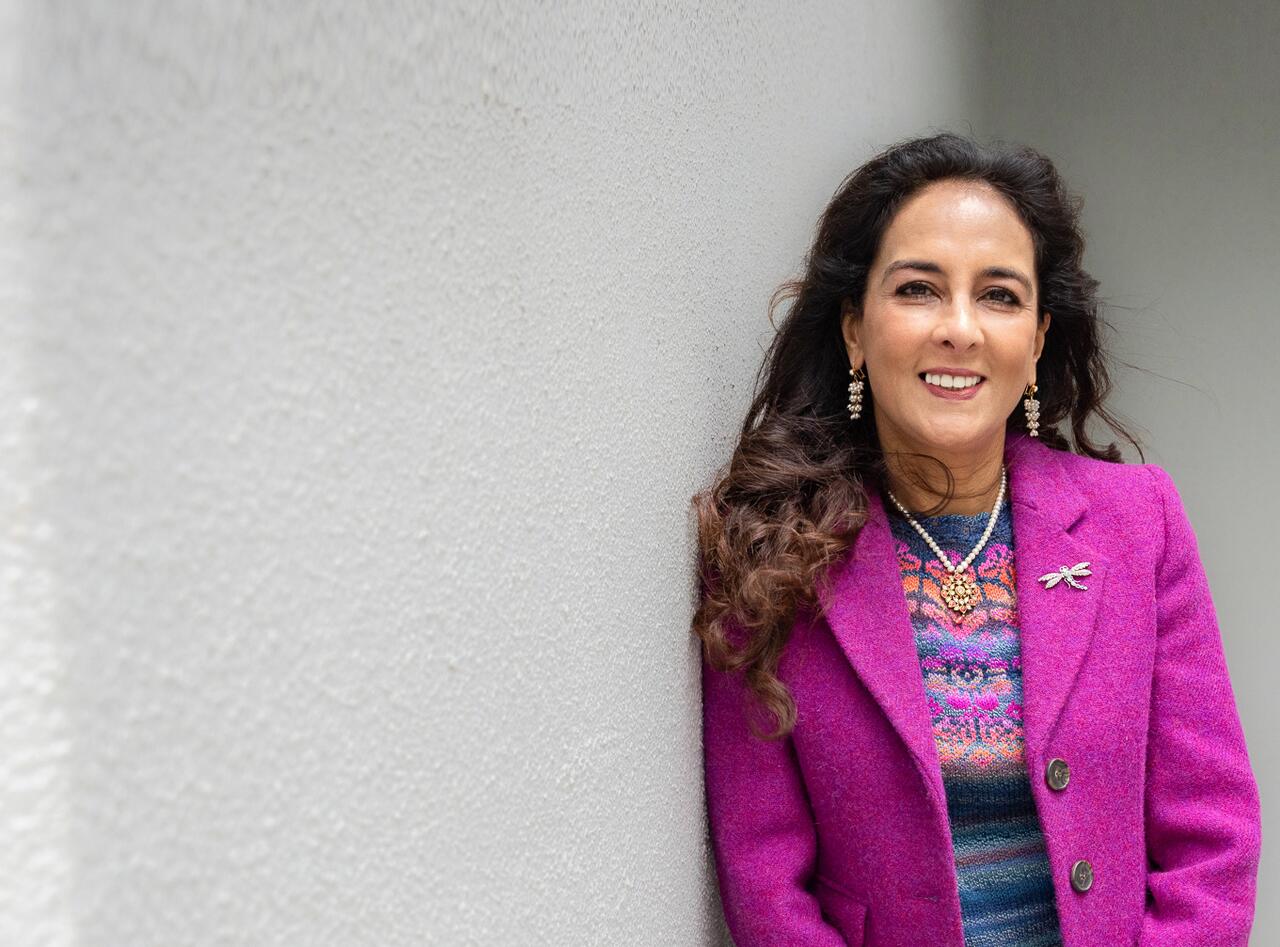
Harmeet Dhillon’s decision to step down as the CEO of the Center of American Liberty to accept her new role as an assistant attorney general is one of mixed emotions, but it’s the right move, she says.
 ?itok=M2_v-iAe
President Donald Trump chose Dhillon, who is known for championing parental rights, to lead the civil rights division of the Department of Justice (DOJ) under the direction of Attorney General Pam Bondi. She was confirmed on April 3.
“Our priorities are the president’s priorities,” Dhillon told The Epoch Times. “You’re not going to see any sunlight between us and the White House on their policy prerogatives.”
Trump’s executive orders that aim to protect women’s and girls’ rights in sports and target gender ideology, anti-Semitism, and “unconstitutional and discriminatory behavior at America’s top institutions of higher learning” indicate a few focal points for the civil rights division, she said.
“Those are our top civil rights priorities, and I don’t think anyone will be surprised to learn that,” she said. “I’m pretty sure I was selected for this role because of the background in civil rights on a number of aligned issues that we have done at the Center for American Liberty ... as well as my private practice and the Dhillon Law Group.”
The DOJ’s civil rights division is the nation’s primary defender of religious liberties, which are protected by the First Amendment and many federal statutes, “so you can expect that to be a priority of this administration,” she said.
With more than 400 attorneys, 600 employees in the DOJ’s civil rights division, and a heavy backlog of work, Dhillon said she’s getting up to speed on the division’s activities and beginning new investigations and initiatives.
“Every few minutes, something different crosses my desk,” she said, on her seventh day on the job.
While people on social media are asking her to investigate a wide range of issues, Dhillon said it will take time.
“I can’t put the cart before the horse. We have to do our investigations in due order,” she said. “As lawyers, we need to get our facts straight and go through a particular process before we file lawsuits, but I can assure you that the civil rights division under Bondi’s leadership, and under President Trump’s leadership is going to be extremely active on the issues that Americans care about.”
And those issues, she said, are the ones the president has spoken about on the campaign trail and in the Oval Office.
“Once we get started with some of these lawsuits becoming public and investigations—having some teeth into them—I think people are going to see those results to a much greater degree than ever in a Republican administration,” she said.
Dhillon recently launched a new https://x.com/AAGDhillon
on social media platform X, where people can follow her official government posts.
 ?itok=jSIsSHKC
‘Bittersweet’ Sentiments
When she accepted the nomination, she knew it would mean stepping down as CEO of the Center for American Liberty, which she founded in 2018.
“It’s bittersweet,” she said. “I’m sad about moving on because it was a dream of mine,” she said.
But she is confident in her colleague Mark Trammell’s ability to take the reins. Trammell is the former executive director.
Dhillon said she started the organization because she saw conservative organizations “doing little slices of civil rights work in very narrow areas, but nobody comprehensively taking on the rights of American citizens who are suffering from novel forms of discrimination or traditional forms of discrimination.”
The center has defended the rights of free speech for students on campus and filed more lawsuits during the COVID-19 pandemic lockdown, mainly on the grounds of religious freedom, than any other organization, and is well-known for representing young people who had undergone medical and hormonal treatments as teens in attempts to change their gender, which they are now trying to reverse; they’re known as detransitioners.
“We have led the nation in standing up for the rights of young women to hold their physicians and medical institutions accountable for misleading them about the gender transition industry and the harm that it does to so many thousands of American young women and men as well,” Dhillon said.
A New Role
When asked if she would investigate complaints from parents of gender dysphoric children who say they’ve faced the threat of having a child taken from their custody for refusing to call the child by opposite sex or preferred pronouns, Dhillon said, “Center for American Liberty took on several cases like that and that should be a clue.”
“I find it to be a very troubling trend,” she said. “It is absolutely a violation of Supreme Court jurisprudence, as well as natural law and civil rights law, for any state to usurp parental rights the way that we have seen.”
 ?itok=0f9JFd2U
Coercing parents to use preferred pronouns as a condition of enjoying their natural rights as parents is a violation of the First Amendment, due process, and equal protection, she said.
Dhillon said she is also concerned about states that prohibit foster parents from helping orphaned children or troubled youth because they refuse to align with certain viewpoints on gender.
* * *
Top products last week at ZeroHedge Store:
anti-inflammatory)
(made in the USA)
https://cms.zerohedge.com/users/tyler-durden
Mon, 04/21/2025 - 23:05
Pope Francis Dead At 88
Pope Francis Dead At 88
Vatican News reports that Pope Francis died at the age of 88 at 7:35 a.m. local time (1:35 a.m. EST). Earlier this year, he experienced a severe health crisis that resulted in over a month of hospitalization due to https://www.zerohedge.com/medical/pope-franciss-condition-worsens-after-respiratory-crisis-vatican
.
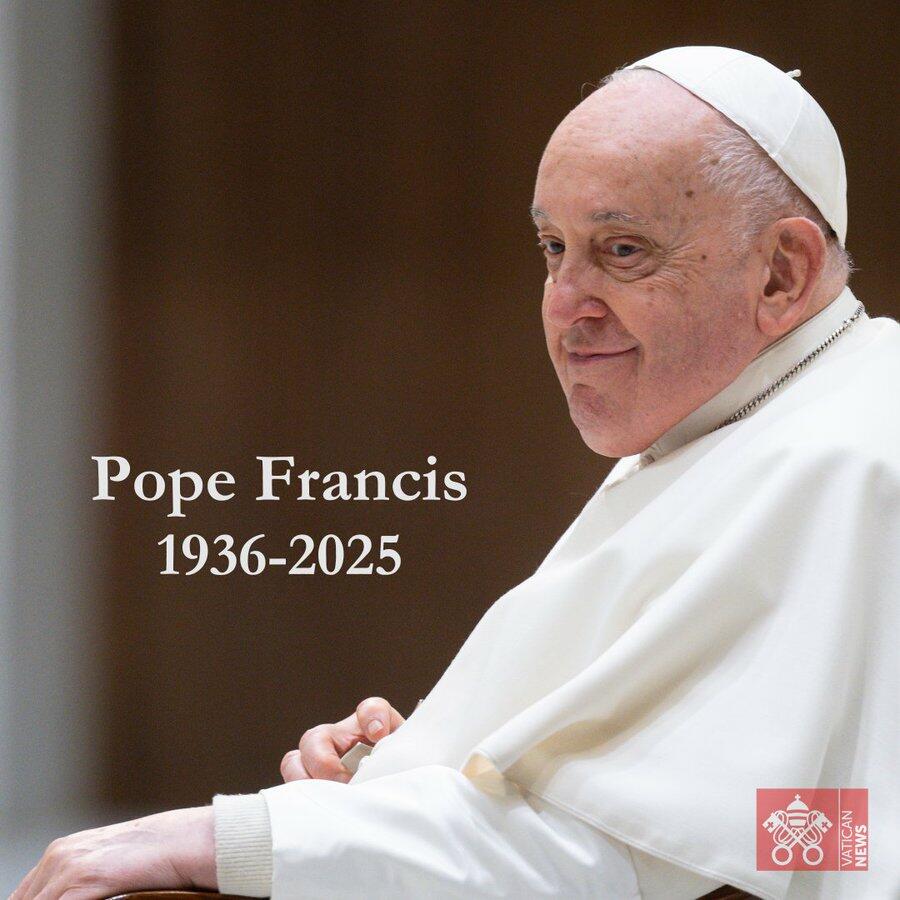 ?itok=37d4eCvg
Cardinal Kevin Farrell, Camerlengo of the Apostolic Chamber, https://www.vaticannews.va/en/pope/news/2025-04/pope-francis-dies-on-easter-monday-aged-88.html
the death of the 266th pope via this statement:
"Dearest brothers and sisters, with deep sorrow I must announce the death of our Holy Father Francis. At 7:35 this morning, the Bishop of Rome, Francis, returned to the house of the Father. His entire life was dedicated to the service of the Lord and of His Church. He taught us to live the values of the Gospel with fidelity, courage, and universal love, especially in favor of the poorest and most marginalized. With immense gratitude for his example as a true disciple of the Lord Jesus, we commend the soul of Pope Francis to the infinite merciful love of the One and Triune God."
Vatican News provided more color on the Pope's deteriorating health leading up to his death on Easter Monday:
The Pope was admitted to the Agostino Gemelli Polyclinic Hospital on Friday, February 14, 2025, after suffering from a bout of bronchitis for several days.
Pope Francis' clinical situation gradually worsened, and his doctors diagnosed bilateral pneumonia on Tuesday, February 18.
After 38 days in hospital, the late Pope returned to his Vatican residence at the Casa Santa Marta to continue his recovery.
To his 1.3 billion followers, Francis signaled a more inclusive stance toward LGBTQ+ Catholics and advocated for open borders in the United States.
The Pope is Appalled there are Discussions About Closing the US Border - He Says we Need to Open the Doors to Illegal Aliens
“The solution is migration. To open the doors to migration…. For an immigration policy to be good, it must have four things:
1. The illegal alien must… https://t.co/EJmGVwvfPw
— MJTruthUltra (@MJTruthUltra) https://twitter.com/MJTruthUltra/status/1793338069552128123?ref_src=twsrc%5Etfw
Francis was the first pope from Latin America, the first Jesuit to become the head of the Catholic Church, and the first to take the name Francis, inspired by St. Francis of Assisi, who gave up his vast amounts of wealth to live in poverty.
Throughout his tenure (March 13, 2013 to April 21, 2025), Francis also spoke about multiple recurring themes, including compassion, humility, and advocacy. He told followers, "My people are poor, and I am one of them."
On Sunday, U.S. Vice President JD Vance met with Francis to exchange Easter greetings.
"I know you have not been feeling great, but it's good to see you in better health," Vance told the Pope, adding, "Thank you for seeing me."
The White House on Monday morning issued condolences on X:
Rest in Peace, Pope Francis. ✝️ https://t.co/8CGwKaNnTh
— The White House (@WhiteHouse) https://twitter.com/WhiteHouse/status/1914246037125857689?ref_src=twsrc%5Etfw
The death of Francis sets in motion a chain of centuries-old procedures to secure a new pope. Cardinal Kevin Farrell, the Vatican camerlengo, will act as the head of the Vatican in the meantime.
The question is whether the cardinals who choose Francis' successor will read the latest cultural shifts across the West and pick a more traditional pope or continue down the path of progressive inclusiveness.
https://cms.zerohedge.com/users/tyler-durden
Mon, 04/21/2025 - 06:55
Switching From The Tariff Phase To The Deal Phase
Switching From The Tariff Phase To The Deal Phase
By Peter Tchir of Academy Securities
Dealpalooza
It was a relatively quiet week on the tariff front. Last Friday night we had more tariff exemptions, followed by promises (or threats) of sectoral tariffs. But since then, the chatter has become all about the deals.
Ok, there is the talk about firing Fed Chair Powell, but away from that, on the economic front, we seemed to have switched from the tariff phase to the deal phase.
I do not think firing Powell would be a good thing over time. It would be a step towards reducing (or eliminating) the Fed’s independence. I don’t always agree with their policy. I do think it is weird that they feel the need to have less dissent than the politburo on their votes. But I think the appearance (and largely reality) of Fed independence helps the dollar and the Treasury market.
But markets are more likely to move on “deals” than anything else in the coming days and weeks (assuming some new, major topic doesn’t get introduced into the conversation).
Deal Messaging
The administration is touting deals. Progress. More deals. However, the administration seems to have backed off from stating that countries are begging for deals.
The U.S. messaging is clear (and less aggressive than before):
Countries are calling. Countries are lined up.
We will get deals. Good deals.
The messaging from the rest of the world is far from clear:
Japan specifically met on trade and provided almost no detail. Neither side seems to have leaked any details.
China has said very little, if anything, through official channels. Not too surprising as they are “public enemy number 1” but it doesn’t support the administration’s messaging that China is coming for a deal.
I’ve spent hours looking for details on the deals, from the U.S. and abroad, and cannot find anything outside of the U.S. Even within the U.S. the messaging seems a bit mixed, though it is still leaning towards rectifying unfair situations and improving trade balances.
With little to no information, we have to guess which is an issue, but at least it can help us prepare a plan for how to react to the headlines.
What Are Tariffs Meant to Achieve?
The first problem in trying to evaluate our trade and tariff policy is trying to understand what tariffs are supposed to achieve.
A bargaining position.
I’m not sure what we are bargaining for, but this would indicate that tariffs would be temporary.
Increased sales of Made in the U.S.A.
Imported goods would rise in cost relative to domestic goods, which should increase domestic sales. That requires tariffs to stay in place.
If tariffs against the U.S. are reduced or eliminated, then American made goods would be less expensive to import. This would likely occur only if the tariffs were temporary.
A revenue source. Tariffs would have to remain in place for them to generate money.
Some of the objectives that have been presented by senior people in the administration cannot co-exist. Deciphering which reasons are most important has been incredibly difficult.
One question that comes to mind is how big of an impact will tariffs have on the ability to increase sales of Made in America products?
If tariffs stay in place, will the price increase on imports be enough to drive Made in America sales? Will it be enough to invest in factories, etc., to build more to sell?
If other countries abandon tariffs, how much will Made in America sales increase? Very difficult to tell as non-tariff barriers can be as impactful or more impactful than tariffs. Also, it is unclear how much is a function of demand for American products, as opposed to tariffs.
With that part of the equation as clear as mud, let’s move on.
What is Missing in Trade Math
I think we can all safely agree that the administration is focused on trade deficits. We can all argue about a lot of things, but this much is clear. It is consistent with Trump 1.0 as well. Heck, it is consistent with things President Trump said long before he became president.
There are two things that I think are insane to be left out of the trade conversation, yet they are.
The trade balance of services.
Why aren’t services included in our overall analysis of trade with other countries? The U.S. currently has service surpluses with most countries. Maybe it is more difficult to imagine “cloud computing” being manufactured, but it is the sort of thing that the U.S. is exporting – very effectively. Since we all know that the U.S. has become a service economy (for better or worse), it seems insane not to include this number as part of any overall trade analysis.
Profitability of trade.
I assume some things are more profitable than others. If we export things with a higher profit margin than the profit margin made on what we import, basic trade balances overstate the issue. If I buy $200 of stuff from you, that you make 10% on, but sell to you $100 of stuff we make 20% on, are we more balanced than a 2:1 import vs. export ratio would indicate? I think somewhere in the conversation there should be a consideration about profitability, but nowhere does that seem to show up. Services that we export are likely very high profit margin.
A couple of other things “irk” me. Not insane, but curious at least, why they don’t come up more.
Raw materials and intermediate goods, versus finished products. I haven’t spent much time on this, but it seems to be that knowing more details about this type of trade would help us make better decisions. Are all trade balances equally bad?
What happens to goods manufactured for an American company that don’t come to America? I presume (for many global companies) that only a portion of the goods they make come back to the U.S. Some are probably sold in China. I assume, that for many, if you want to sell into Asia, you don’t bring them back to the U.S. to sell into Asia. So, an American company that builds something overseas and then doesn’t import it helps that American company. Though conversely, that also means that even more things could be made here because the trade deficit is even worse.
I’m not sure how we got to where we are on trade balances, but I suspect a more detailed discussion and analysis would reduce the perceived problem, rather than amplifying it. But that is not where we are.
The Tariff Rollout
Before thinking about what deals might occur, we do need to look at the tariff rollout.
China, Canada, and Mexico. Initial wave of tariffs were given a “Fentanyl Reprieve” for Canada and Mexico. Despite what looked like some efforts on that front (especially from Mexico) the tariffs went ahead as the fentanyl reprieve was waived. Maybe the reprieve can come back again. The initial reprieve was positive regarding how the U.S. might address tariffs, but that went to the wayside and hinted at some level of confusion.
Steel and Aluminum. Separate from other tariffs and were implemented globally. Demonstrated the administration was serious about tariffs.
Backing off on USMCA Compliant Goods. First autos and then all USMCA compliant goods were exempted from the Canada/Mexico tariffs. Seems like this could have been anticipated, which likely affects how countries come to the negotiating table.
The Liberation Day tariffs. Literally instant disbelief over the numbers presented. Reciprocal tariffs were anything but reciprocal. To the rest of the world, this looked like the U.S. had gone “off the deep end” on tariffs. (Even to many in the states).
The Liberation Day tariffs went into effect. More confusion for markets.
90-Day Reprieve and “Reciprocal” Tariffs of “only” 10%. What an amazing rally in the stock market. Suddenly 90 days to negotiate (which seems like it would have made sense from day 1). Also, while 10% is at the high side of overall tariffs between countries, it was at least in the ballpark. China was not given a break. It seemed like maybe the administration was reading the T-Reports, and this had pulled us back to the “somewhat reasonable” zone and clearly indicated that China was the main priority.
Some further exemptions on products, primarily tech. Another thing that made sense, though this looked like the U.S. was once again backing down on something they could have foreseen as an issue.
Then statements about how National Security and sectoral tariffs would pick up the slack here. Though it has been quiet since then.
Further restrictions on what chips can be sold to China. Hit some U.S. stocks, but further enforced the view that China is public enemy number 1.
How the tariffs have been rolled out and have evolved, I think is important.
The Foreign Mindset Coming Into Negotiations
As countries come to the negotiating table, I think this is a reasonable assessment of their state of mind.
Some confusion over why they were targeted and the amount they were targeted with.
Some trepidation about needing the U.S. market, but also about how much they can depend on any deal going forward.
At least somewhat encouraged by what they may see as a series of miscalculations where the administration had to back down because of damage done to our markets or economy.
The Art of the Deal is quite simple and easily understood. During Trump 1.0, few seemed to understand that. This time, many, particularly Xi, seem to understand that. Presumably, Trump knows that others know the art of the deal and they are adapting. Though, given how events have unfolded, I am not sure that the U.S. policy wasn’t dependent on getting the same reactions from world leaders as they received under Trump 1.0.
My view is that countries are coming in concerned about the economic impact on their country, but with the sense that mistakes have been made, and there is some lack of trust (i.e. deals are going to be viewed as a stopgap solution, giving them time to figure out longer-term solutions).
The Deals
Finally, we get to the main point. Are we going to get “rip your face off” rallies on the back of deals? Or will deals or the lack of deals drag markets (and the economy) lower?
Face-saving deal. Let’s for a moment assume the administration has had a “rethink” on tariff and trade policy. That they are hearing from so many businesses that the tariff policy as enacted is not helpful. That bringing manufacturing jobs back to America will take years (and would be better accomplished by focusing on domestic policy first, to get the ball rolling). The administration has clearly backed off, so, what would a face-saving deal look like?
Reduced tariffs on both sides. I’m 98% convinced this could have been achieved without taking many of the steps that have hurt the administration. The other countries, at this stage, are far more likely to understand both the tariff and non-tariff barriers they have in place and where to cave and where not to cave to get the best deal for themselves.
Commitments to buy American made goods – with a focus on defense and agriculture. No real teeth to enforce compliance.
Some commitment to not allowing China to use them to change “country of origin” designations. It’s a bit tricky, but not a big deal.
My estimate for this type of deal being offered by the U.S. to most countries has jumped from about 20% likely to 70% likely (given recent news flow and actions around tariffs).
The administration can claim a win, and anyone trying to point out that these results could have been achieved without damaging the U.S. reputation, will be shouted down in social media. The end state will be a similar economy to what we had before. Tariffs were only a portion of the problem, and a minor one at that. Countries won’t increase their actual purchases of U.S. goods for long. They will take the lull to figure out ways to be less dependent on the U.S. So, markets may rally on the first deal headline or two, but fade as markets will establish that the U.S. economy and U.S. corporations are in a worse spot after these deals than before this whole thing started.
Real Trade Balance Deals. If the side that has advocated for bringing production home wins, then the U.S. will need deals like this:
Commitment to buy American made goods, with hard figures and punishments for failing to comply. A real effort to ramp up sales of American made goods. Countries commit to buying from America and face punishment (presumably high tariffs) for failing to comply. This might be difficult for many countries to agree to.
Restrictions on business with China. At the very least, countries will be forced to acknowledge that China can not use them as a conduit to change country of origination. The U.S. may try to get other countries to tariff China (which would make U.S. imports look cheap relative to China). Some willingness to combat China’s worst offenses is likely palatable, but countries will be careful about being too aggressive against China, given China’s size, and in some cases, its proximity. Also, given the erratic nature of U.S. trade policy since the inauguration, countries have to be more hesitant to be perceived as anti-China than before the policies were launched.
Tariffs as a mix of revenue, punishment, and wins. Tariffs drop in importance if the true aim is to get trade balances in line.
It would be nice if the two things that I think are missing from the tariff math are incorporated into the administration’s view, as the starting point would be much closer than it is currently being viewed.
Let’s assume this approach is now only used 30% of the time. I think this approach has a very low success rate. Countries, for a variety of reasons, are likely to resist this. As time goes on, if we don’t get deals, the market will sense that the U.S. has over-reached and will have to price in more economic problems and lower corporate profits. If the U.S. gets deals of this nature, it would be a big and actual win.
The Path of Negotiations and Deals
My base case is that the U.S. likely started down the “Real Trade Balance Deals” path and that is why we are hearing so little from other countries. They are potentially left confused or even flabbergasted by U.S. demands and are not in a rush to sign that type of deal.
Maybe some countries cave and sign that type of deal, bringing more countries to that type of deal.
But if we go weeks without deals, or worse, leaks that countries are far apart, look for the negotiating strategy to shift to “Face Saving Deals” (if it hasn’t already).
I could be wrong on how I read the “cards” at the table, but that is my best estimate of who is holding what. I think the biggest risk for markets and the economy, is that one side thinks their cards are far better than they are (and from what I’ve seen so far, that risk seems to be more likely on the American side). That would mean the problems in the global economy would mount and the risk of a deep recession would grow.
Damage to the American Brand
If the entire world lets bygones be bygones, we can get back to roughly where we were before.
I just don’t see that.
I think there will be an extended period where American stocks, bonds, and products suffer from the geopolitical and economic actions taken.
I would love to be wrong here, but I don’t think I am. Especially since even if deals are signed, the news flow, economically, geopolitically, and domestically will certainly highlight divisiveness that doesn’t help heal any wounds that have been created.
Bottom Line
I think the volatility and “beta” to any given headline has been reduced.
I think this is a path back to where we all thought we were headed – growth fueled by business-friendly strategies. Taking actions to spur the development of domestic industries, with an emphasis on issues linked to National Security. The extraction and PROCESSING of commodities, especially those that are energy-related, or crucial to future tech. Chips. A more domestic-focused policy can achieve the goals over time, and have a narrower range of outcomes (that are more predictable than trying to rebalance global trade relationships, that took years to form, in a matter of months).
A pivot is required, and we might get it.
I would be pleasantly surprised to see some very strong trade deals announced, but my base case is that we realize that this approach isn’t working, and we wind up getting some face-saving deals.
The economy is slowing, and I think that will become more evident in the coming weeks (unless I’m surprised on the “big trade deal” front).
The U.S., as an investment choice, a tourist destination, or a brand more broadly, is going to act to slow the economy and markets.
That should be good for rates, but all the hope about deficit reduction seems to be diminishing. Much of what I think would be required to make a pivot successful will involve spending.
I think that keeps bonds in a range (maybe a wide range of 4.1% to 4.5% on 10s) but a range, nonetheless. At the moment, the risk of breaking out of this range is to the higher yield side. I see more headline risk to bonds than optimism, especially on the deficit side of the equation.
Equities will suffer, in dribs and drabs, if the U.S. doesn’t back down on what we hope to achieve in trade negotiations.
To me, it comes down to undoing a lot on the trade front and pivoting sharply to doing what is in primarily U.S. control.
Good luck and hopefully the shelf life of this thought process is more than a few hours.
The rate at which announcements shaping the geopolitical environment, the economic environment, and the investing landscape is staggering.
Hope you have been able to use the long weekend to regroup and get ready for more! And hopefully it is Dealpalooza time – we could all use that!
https://cms.zerohedge.com/users/tyler-durden
Sun, 04/20/2025 - 14:00
https://www.zerohedge.com/markets/switching-tariff-phase-deal-phase
Far-Left Boston Mayor's Campaign Allegedly Funded By Dem Power Broker Linked To China
Far-Left Boston Mayor's Campaign Allegedly Funded By Dem Power Broker Linked To China
Boston Democratic Mayor Michelle Wu has positioned herself as anything but 'America First'—doubling down on sanctuary policies that defend criminal illegal aliens. Her liberal sanctuary city laws increasingly undermine national security, raising serious questions about why she has embraced such a dangerous stance.
🚨SCOOP🚨 Boston Democratic Mayor Michelle Wu’s 2021 campaign received hundreds of thousands of dollars from a fundraiser who is listed by a Chinese intelligence agency as an official, a Daily Caller News Foundation investigation discovered. https://t.co/9M8UdA1KQk
— Daily Caller (@DailyCaller) https://twitter.com/DailyCaller/status/1911760278607233216?ref_src=twsrc%5Etfw
A https://dailycaller.com/2025/04/14/michelle-wu-campaign-bankrolled-gary-yu-chinese-intel-agency/
investigation has potentially uncovered why the far-left mayor stands with illegal aliens and not with bolstering national security after the disastrous Biden-Harris regime's migrant invasion:
Boston Democratic Mayor Michelle Wu's 2021 campaign received hundreds of thousands of dollars from a fundraiser who is listed by a Chinese intelligence agency as an official, a Daily Caller News Foundation investigation discovered.
Gary Yu, the founder of Boston International Media Consulting, helped raise over $300,000 for Wu with the help of a Chinese civic association he leads. However, Yu — whose Chinese name is Yu Guoliang — is listed as an official by an agency of a Chinese Communist Party (CCP) influence and intelligence service called the United Front Work Department (UFWD), and also operates as a recruiter for the Chinese government, according to reports from the CCP, Chinese state media and civic associations led by Yu.
Forensic analysis of public records reveals a web of entities connected to "Gary Guoliang Yu" by one degree of separation, including DCNF's target: Boston International Media Consulting.
 ?itok=rQOvNa6j
"China's strategy to influence state and local policymakers is executed, in part, through hundreds of ostensibly 'civil society' organizations that are actually affiliated with the CCP's UFWD," Michael Lucci, CEO of State Armor, a nonprofit focused on countering the CCP, told the DCNF.
Lucci noted, "Xi Jinping considers United Front work a critical tool to undermine democracies. It involves influence peddling, intelligence collection, and intellectual property theft, all for the end goal of aligning U.S. subnational governments with China's foreign policy and exploiting weaknesses they find."
China expert Gordon Chang told the DCNF, "There is no ethnic Chinese official in America who is not targeted. It's time for law enforcement to investigate the CCP's ties to Gary Yu and Yu's ties to Mayor Michelle Wu."
"Wu's ultra-leftism makes her the perfect candidate for CCP recruitment and capture," Chang said, adding, "Or do we have it backward? Is her ultra-leftism the result of CCP recruitment and capture? More than just the people of Boston would like to know."
Mayor Wu has continued to state she will not comply with mass deportations of criminal illegal aliens.
Does Boston’s Mayor Michelle Wu think these violent criminal illegal aliens are above the law? She and her fellow Sanctuary City mayors want a lawless nation.
President Trump and Secretary Noem are restoring the rule of law and putting the safety of Americans first. https://t.co/gtIR2i7VMq
— Homeland Security (@DHSgov) https://twitter.com/DHSgov/status/1903183426108198940?ref_src=twsrc%5Etfw
Wu's stance is deeply alarming, as harboring criminal illegal aliens poses a very clear threat to national security.
Policies like these don't serve the American people—they serve foreign adversaries like China, which seeks to destabilize the U.S. from within as it prepares for war.
https://cms.zerohedge.com/users/tyler-durden
Sun, 04/20/2025 - 13:25
Europe, You Can't Sit On The Sidelines Anymore
Europe, You Can't Sit On The Sidelines Anymore
https://www.dailysignal.com/2025/04/17/europe-you-cant-sit-on-the-sidelines-anymore/
I’d like to talk today about the role of China, the United States, and the European Union, or just https://www.dailysignal.com/tag/europe
, in the context of these tariffs and the so-called trade wars.
Right now, https://www.dailysignal.com/tag/donald-trump
has given a 90-day reprieve from high tariffs. I think that 10% tariffs are still in existence. And they are negotiating with a number of European countries and particularly, Asian dynamic economies, such as South Korea, Taiwan, and Japan. In addition to that, they are targeting China with tit-for-tat tariffs. And we are maybe on the brink—nobody wants it, but we might be on the brink of a trade war, which we’ve addressed in earlier videos.
But here’s my point.
What is the attitude of Europe?
Roughly, China has a $1 trillion deficit with the world. We have about a $1 trillion deficit in trade with the world. But here’s the ratios. About a third of our deficit is with China, which makes up a third of their surplus. In addition to that, Europe makes up about a third of their surplus.
So, China has called on Europe to join forces with it to prevent all of the retaliatory tariffs that the United States has threatened Europe, which has a $200 billion surplus with us, and China, which has a nearly high $300 billion, maybe even $400 billion, who knows?
It’s kind of crazy, isn’t it, that these illiberal apparatchiks https://www.dailysignal.com/tag/china
would think that a Western democracy would want to join them against the United States?
I don’t think that’s gonna happen.
But the European Left is very angry at the Trump administration.
So, Choice One might be, “Well, we don’t like the Chinese and we are an ally of the Americans, who subsidize our defense, but we detest the Trump administration. So maybe, (wink and nod) we’ll either be quiet or hope China wins that trade war and the United States, under the Trump administration, backs off all tariffs.”
That would be a big mistake given their vulnerabilities they have with the United States vis-a-vis security.
The second attitude might be the Europeans will just say, “We’ll lay low. We won’t say much at all. We’ll kind of drag out our tariff negotiations with the Trump administration. And we’ll let the Chinese and the United States battle it out. And if Trump should win and he lowers the amount of trade with China, maybe that will be an opening for us to replace China as the United States chief importer.”
That is something that I don’t think will happen.
The third scenario is what I would suggest for the Europeans. They should say the following: “Despite our disagreements with the Trump administration, the United States is an ally. And we know that we have been as victimized by Chinese mercantilism, high tariffs, cheating on patents, copyrights, dumping, financial money manipulation—all the things the United States complains about, we do too. In fact, we as Europeans in a whole have about the same deficit with China as the United States does. So, we are kindred spirits. So, what we will do is, even though we have disagreements on our surplus with the United States and their efforts to reduce it, we will ally with the United States.”
And that would represent about two-thirds of China’s total https://www.dailysignal.com/tag/trade
, Taiwan would join, then China would find out that about 85% of its trade is in a block. That is, they are united. And they have common complaints against China. And China would not be able to say to the United States, “We’re going to cut deals with Vietnam and Japan and Taiwan and South Korea and the EU and leave you out in the cold.”
Instead, the Europeans and, to a lesser extent, the Asian powerhouses would join the United States and say, “You know what? We’ve been quiet. We’re afraid of China. They’re bullies. But now that you’ve stood up, we’re embolden ourselves to air the same complaints as you are and hope that you win. And maybe a byproduct of reduced trade with China from the United States will open a door. So, even though we might have to lower our tariffs, there will be more opportunity in the American market with a less prominent Chinese trade profile that we can then be welcomed in as a kindred ally.”
So, Europe has two or three choices in this proposed Chinese-American trade standoff. Nobody wants a trade war with anybody. No one wants it with China. But this is long overdue. And Europe has to decide what course they’re going to take. And for everybody’s sake, let’s hope they choose wisely.
https://cms.zerohedge.com/users/tyler-durden
Sun, 04/20/2025 - 08:10
https://www.zerohedge.com/geopolitical/europe-you-cant-sit-sidelines-anymore
Cocoa: The Global Trade Of "Brown Gold"
Cocoa: The Global Trade Of "Brown Gold"
Last year, a https://www.statista.com/topics/3211/cocoa-industry/
shortage drove up prices for European chocolate makers and consumers.
This was largely due to an exceptionally wet rainy season as well as a viral cocoa disease that severely impacted the 2023/2024 harvest in West Africa. However, the situation is expected to improve this year, according to industry experts.
In a note published at the end of February, the International Cocoa Organization (https://www.icco.org/statistics/#data
) estimated that the 2024/2025 harvest is expected to show a surplus, after three consecutive years of deficit.
https://www.statista.com/chart/34325/main-cocoa-bean-producing-and-importing-countries/
the global cocoa market relies heavily on harvests in the Gulf of Guinea for its supply.
Nearly 65 percent of the world's cocoa is harvested in just four West African countries: Côte d'Ivoire (38 percent), Ghana (12 percent), Nigeria (7 percent), and Cameroon (7 percent).
https://www.statista.com/chart/34325/main-cocoa-bean-producing-and-importing-countries/
You will find more infographics at https://www.statista.com/chartoftheday/
South America comes in a distant second place for volume, with Ecuador and Brazil as the main producing countries, accounting for 10 percent and 4 percent of global production, respectively.
The vast majority of the world's cocoa is then exported to Europe and North America, where it is processed into https://www.statista.com/topics/1638/chocolate-industry/
and primarily consumed.
The Netherlands, Germany, and Belgium, for example, together import approximately 25 percent of the world's cocoa beans. This makes the European Union the world's largest importer of cocoa, accounting for 60 percent of global imports.
The United States and Canada, for their part, together import the equivalent of approximately seven percent of global production.
https://cms.zerohedge.com/users/tyler-durden
Sun, 04/20/2025 - 07:35
https://www.zerohedge.com/commodities/cocoa-global-trade-brown-gold
Germany Deploys Troops To Lithuania In First Permanent Foreign Deployment Since World War II
Germany Deploys Troops To Lithuania In First Permanent Foreign Deployment Since World War II
Authored by Sarah Kuehberger and Wilson Beaver via https://www.dailysignal.com/
,
Germany has activated its first permanent foreign troop deployment since World War II, establishing a 5,000-strong armored brigade in Lithuania. This decision follows Defense Minister Boris Pistorius’ https://www.dw.com/en/germany-to-station-4000-troops-permanently-in-lithuania/a-66031051
‘s eastern flank in response to the ongoing Russian-Ukrainian War.
 ?itok=F4Bw9JTS
The deployment demonstrates Germany’s willingness to take a leading role in the https://www.dailysignal.com/2025/03/03/leave-nato-republicans-sour-on-defense-pact-after-london-summit/
of Europe with Brig. Gen. Christoph Huber emphasizing, “We’re not only moving toward operational readiness; we’re taking responsibility.”
https://www.bundeswehr.de/en/news/bundeswehr-lithuania
, the brigade will consist of three major combat units—including a mechanized infantry battalion, a tank battalion, and the multinational enhanced Foreign Presence Battle Group Lithuania—and will be complemented by combat and support elements. The brigade aims to be at full operating capability by 2027.
Addressing a NATO Vulnerability
The need for additional NATO forces in Lithuania is largely due to its geographical location between Russian-allied Belarus and the https://www.defensenews.com/2022/06/21/why-is-lithuania-risking-russias-wrath-over-kaliningrad/
.
The narrow corridor between Lithuania and Belarus, known as the https://www.defensenews.com/2022/06/21/why-is-lithuania-risking-russias-wrath-over-kaliningrad/
, is widely regarded as NATO’s most vulnerable point. Should Russian forces launch an attack on Lithuania, Latvia, or Estonia, which are all NATO member states, they could potentially sever their supply lines from Poland by linking Belarus and Kaliningrad through an offensive. Stationing permanent NATO troops in the three Baltic states serves as a long-term security guarantee.
Germany’s New Policy of ‘Zeitenwende’
Due to its historical responsibility following World War II, Germany has traditionally maintained a cautious and restrained military stance. Massive defense cuts in the 1990s and 2000s further weakened its defense capabilities. In response to new geopolitical challenges, Federal Chancellor https://www.dailysignal.com/2025/02/28/america-first-trump-allies-blast-zelenskyy-while-european-leaders-take-zelenskyys-side-after-disaster-meeting/
introduced in 2022 the Zeitenwende—a “turning point”—in German security policy. This new strategy aims to strengthen defense capabilities, increase military spending to meet NATO targets—which Germany achieved for the first time in 2024 by reaching the 2 percent mark—and enhance European security cooperation. The recent deployment to Lithuania serves as its flagship project.
Germany has made https://www.heritage.org/defense/report/next-steps-germanys-national-security-zeitenwende
and a clear shift in thinking within the German defense establishment is evident, particularly through initiatives like the creation of a special fund for defense spending to kick-start military investment.
Europe Needs to Step Up So US Can Shift Focus to Indo-Pacific
In times when European politicians express concerns that the https://www.bbc.com/news/articles/cpv4n0dg3v3o
, it’s important to remember that the current administration is encouraging allies to step up and ensure they are able to deter potential dangers on their own terms. This is a task that all sovereign nations must undertake.
The United States needs to shift strategic focus to the https://www.dailysignal.com/2024/09/20/4-issues-to-consider-as-the-us-and-its-indo-pacific-allies-meet-to-counter-china/
to deter China, and steps like this one taken by Berlin are critical if Germany and other European NATO members are to take primary responsibility for their own conventional defense. Washington should applaud the new German base in Lithuania and encourage other wealthy Western European nations to follow suit with bases in Latvia and Estonia.
* * *
Views expressed in this article are opinions of the author and do not necessarily reflect the views of The Epoch Times or ZeroHedge.
https://cms.zerohedge.com/users/tyler-durden
Sun, 04/20/2025 - 07:00
China's Workers, Companies Fear Economic Crisis As Beijing Vows To 'Fight To The End' On US Tariffs
China's Workers, Companies Fear Economic Crisis As Beijing Vows To 'Fight To The End' On US Tariffs
(emphasis ours),
People and businesses across China are feeling the pressure as the Chinese authorities vow staunch resistance to the United States and the Trump administration’s tough approach to trade and bilateral relations.
 ?itok=yAIF6nFK
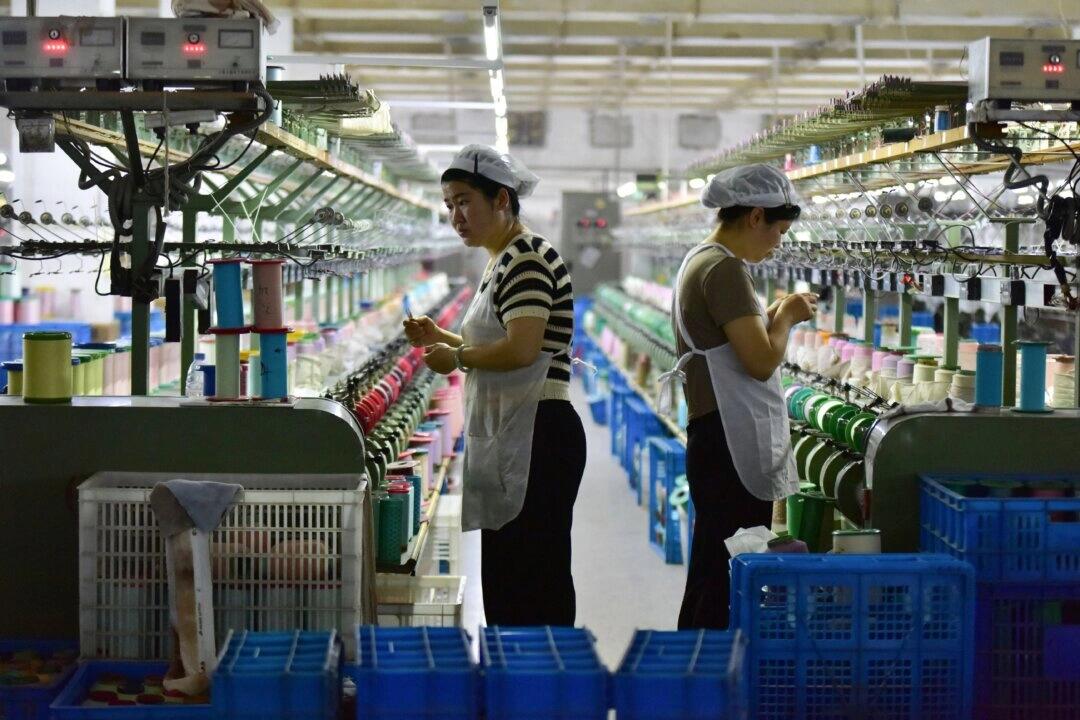
Chinese companies, workers, and industry insiders have reported being caught in a bind by the escalating U.S. tariffs, as usual orders are not coming in, and some companies are being compelled to take extreme measures.
While Chinese social media is flooded with anti-U.S. propaganda and nationalist content, posts and videos warning of mass layoffs and prolonged “vacations” offer some indication of the unease spreading throughout an export-driven economy already struggling with high unemployment, shrinking profits, and declining foreign investment.
On April 11, U.S. President Donald Trump hiked the blanket tariff on most Chinese products to 145 percent in response to the Chinese regime slapping its own 125 percent retaliatory duty on American goods the same day.
In addition, Beijing on April 14 restricted the export of seven types of rare earth products critical for high-tech and military manufacturing in the United States and other countries.
According to a White House https://www.whitehouse.gov/fact-sheets/2025/04/fact-sheet-president-donald-j-trump-ensures-national-security-and-economic-resilience-through-section-232-actions-on-processed-critical-minerals-and-derivative-products/
published on April 15, some Chinese products may now face U.S. tariffs of up to 245 percent.
Trump has cited unfair trade practices and illegal drug trafficking as reasons for imposing the levies on Chinese goods.
Washington, particularly starting with the first Trump administration, has long called out the Chinese regime for decades of distortionary and protectionist economic policies, as well as rampant industrial espionage.
Trump also criticized Beijing for failing to curb the production and export of the deadly synthetic opioid fentanyl, which often entered the United States through Mexico.
The U.S. Drug Enforcement Administration https://www.dea.gov/press-releases/2024/12/16/overdose-deaths-decline-fentanyl-threat-looms#:~:text=More%20than%20107%2C000%20people%20lost,to%20opioids%20such%20as%20fentanyl.
in a December 2024 press release that more than 107,000 people died from drug overdose in 2023, with nearly 70 percent of those deaths linked to opioids such as fentanyl.
Chinese Companies Feel the Crunch
Li Meng-chü, a Taiwanese businessman, told the Chinese edition of The Epoch Times that the heightened U.S. tariffs will force a significant number of export-oriented factories in China to scale back their businesses or close entirely.
The owner of a factory that makes flashlights in the city of Yiwu, Zhejiang Province, told The Epoch Times that while export companies used to place three or four bulk orders with the factory a month, business has completely dried up as of late. Many workers who used to work six days a week now take three or four days off.
Li, the Taiwanese businessman, said that to his knowledge, factories in the southern Chinese province of Guangdong that produce electronics, garments, and lighting that had U.S. orders placed through to the end of the year, have now seen those orders abruptly canceled. Much stock has been left sitting in the factories.
The South China Morning Post, a Hong Kong-based English-language outlet, https://www.scmp.com/economy/china-economy/article/3305834/chinese-exporters-said-be-ditching-shipments-mid-voyage-avoid-crushing-trump-tariffs
on April 10 that some Chinese exporters have opted to surrender their cargo to the shipping companies mid-voyage rather than deal with the new tariffs.
“No one will buy them after the tariffs are imposed,” the publication quoted one client as saying to a Chinese exporter.
Mainland Chinese outlet Caixin reported that the port of Shanghai—normally bustling with ships—was virtually empty on the day after the United States imposed its 145 percent tariff. The outlet expects U.S.–China shipping to fall by half in the near future.
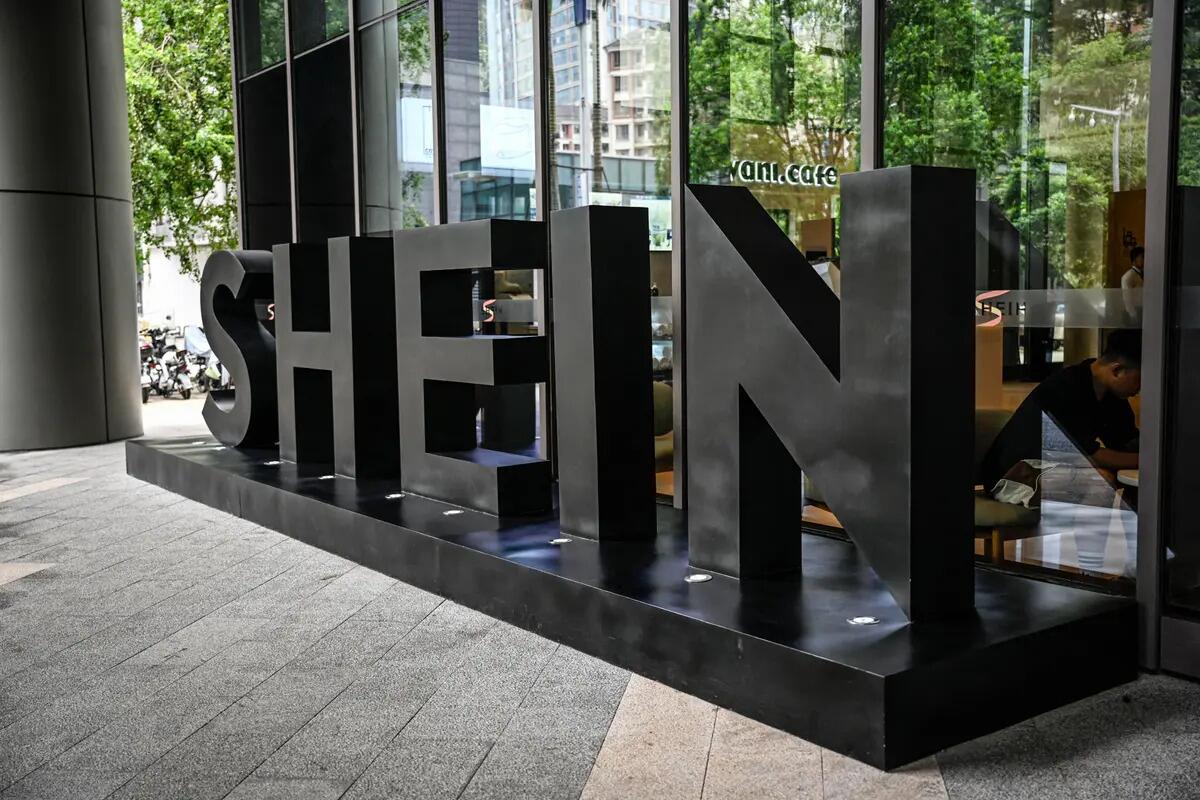
In the wake of the tariff hikes, Chinese fashion giant Shein attempted to shift some of its production out of China, but was barred from doing so by the Chinese authorities.
 ?itok=0YzcApUd
Shein and Temu, another Chinese online retailer, will see price hikes following the cancellation of the de minimis shipping exemption, which allows packages containing goods worth $800 or less to be imported duty-free to the United States.
The restriction is set to apply to mainland China and Hong Kong starting on May 2, affecting about 11 percent of current U.S.–China trade.
Beijing Doubles Down
On April 8, a day before the Trump administration put a 90-day pause on tariff hikes targeting scores of countries worldwide, Beijing’s commerce ministry said it would “fight to the end” with the United States on trade.
The Chinese commerce ministry said China’s retaliatory actions were a “completely legitimate” means of protecting national interests and “maintaining the normal international trade order.”
Introducing a 28,000-word white paper on U.S.–China trade, a commerce ministry official said on April 9 that Beijing “possesses resolute determination and a wide range of measures” to counter American tariffs and other economic and trade restrictions.
In a regular press conference held April 10, Chinese foreign ministry spokesman Lin Jian said that Beijing “is not scared” of fighting a trade war.
Tough Times Ahead
Meanwhile, Chinese businessmen and bloggers have questioned where the Chinese Communist Party’s (CCP) obstinacy and propaganda will lead them.
According to an early April report by a mainland Chinese blog called “Logistics and Supply Chain Management,” a furniture factory owner in Jiangsu Province, eastern China, calculated that with all the additional fees, a tariff of just 20 percent would consume the factory’s entire profit.
Liu Ming, director of an electronics factory in the Jiangsu city of Suzhou, who used a pseudonym, told the blog that while the company had a profit margin of 16 percent in 2024, “now that the tariffs have been applied, we are operating at a loss.”
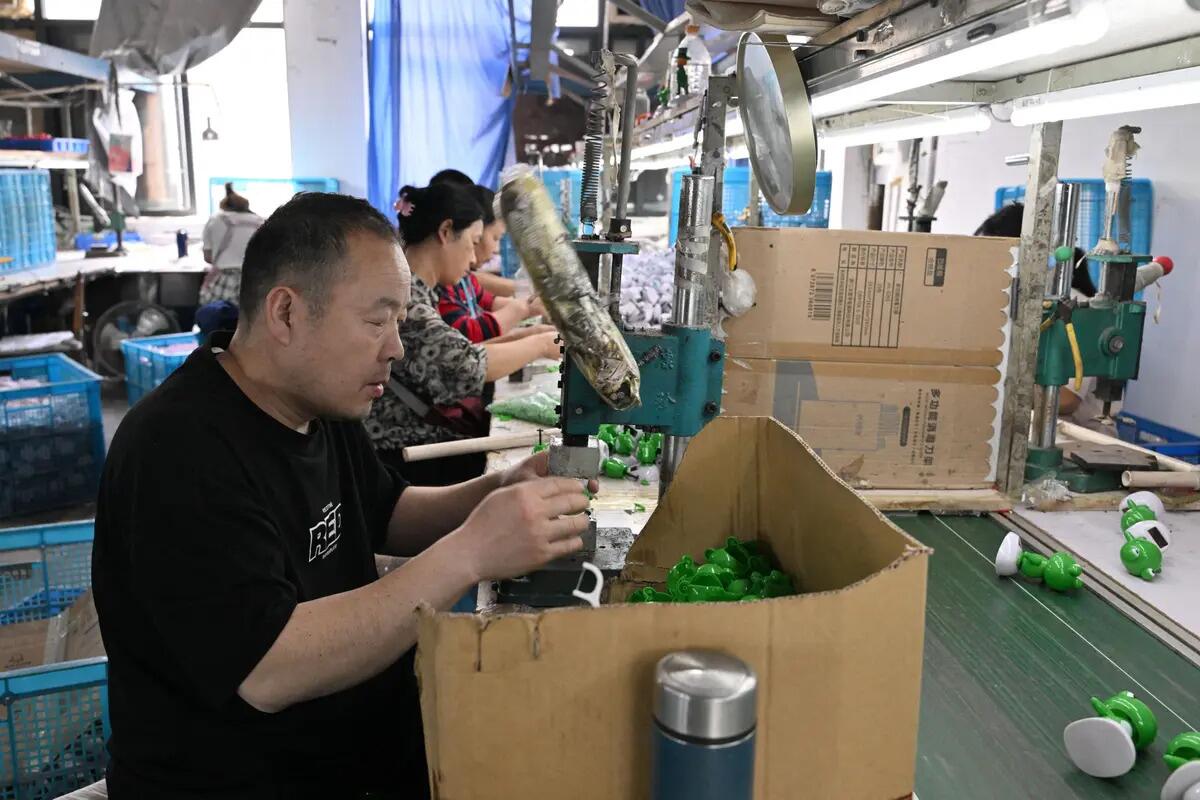
Posting on social media platform X, a Chinese exporter who works with American clients said that when the tariff was still 34 percent, it was still possible to work with the raised rate, but the 125 percent tariff “amounts to wiping out Chinese workers’ jobs.”
“As far as I know, nearly all U.S. importers have stopped shipments from China,” he said.
 ?itok=JUPWKuzx
A worker in Dongguan, Guangdong Province, said in an April 9 video posted to Chinese social media that with tariffs eliminating all profit margins from those exporting to the United States, factories and suppliers will be compelled to compete with each other in the domestic Chinese market.
“It’s going to be a race to the bottom,” he said. While not directly criticizing how the CCP handled the trade disputes, he called out Chinese netizens who “spend all day on the internet talking about fighting [the trade war] ‘at all costs.’”
“I bet you’ll soon find yourselves among those ‘costs,’” he added.
A vlogger in Nanjing, the capital of Jiangsu Province, said earlier this month on social media that the Chinese market’s ability to absorb the country’s consumer products would not be enough for a significant number of workers to keep their jobs.
“Many companies engaged in foreign trade are sure to cut production,” the vlogger said.
A finance worker in Xiamen, a coastal Chinese city in Fujian Province, warned on April 9 that the export business coming to a standstill would have far-reaching effects beyond manufacturing and logistics. “Don’t quit your job, keep it if you can,” she said in a social media post.
‘A Series of Traps’
China expert and current affairs commentator Wang He told The Epoch Times that the CCP may not have anticipated Trump’s move to pause the raft of global reciprocal tariffs he announced on April 2.
“The CCP wanted to take the opportunity to form an anti-U.S. united front” with countries around the world affected by the U.S. tariffs, only to be the odd one out in refusing to negotiate, he said. “As a result, communist China walked into a series of traps that Trump set for it.”
Earlier, on April 9, while at a White House event, Trump had expressed confidence that “China wants to make a deal.” However, he added, “It’s one of those things they don’t know quite—they’re proud people.”
Speaking on April 15 at a https://www.theepochtimes.com/us/ball-is-in-chinas-court-for-trade-talks-white-house-5842375
, White House press secretary Karoline Leavitt said that “the ball is in China’s court” as far as talks go.
“China needs to make a deal with us. We don’t have to make a deal with them,” Leavitt said, noting that she was quoting the president.
On April 17, Trump https://www.theepochtimes.com/us/trump-says-china-has-reached-out-on-tariffs-tiktok-deal-may-come-later-5843835?ea_src=frontpage&ea_cnt=a&ea_med=us-politics-left-medium-0
at the White House that China had contacted his administration.
“I believe we’re going to have a deal with China, and if we don’t, we’re going to have a deal anyway, because we will set a certain target, and that’s going to be it,” the president said.
https://cms.zerohedge.com/users/tyler-durden
Sat, 04/19/2025 - 23:20
Palantir Building ICE "ImmigrationOS" To Track Migrants
Palantir Building ICE "ImmigrationOS" To Track Migrants
Palantir CEO Alex Karp might soon be receiving similar 'https://www.zerohedge.com/political/follow-money-ex-wsj-journalist-reveals-24-organizations-funding-tesla-takedown
' treatment from unhinged Democrats after news broke late this week that Immigration and Customs Enforcement has partnered with the defense contractor to deploy new "near real-time visibility" software to facilitate the deportation of illegal immigrants.
A contract first reviewed by https://www.businessinsider.com/ice-palantir-new-technology-30-million-visa-overstays-self-deportation-2025-4
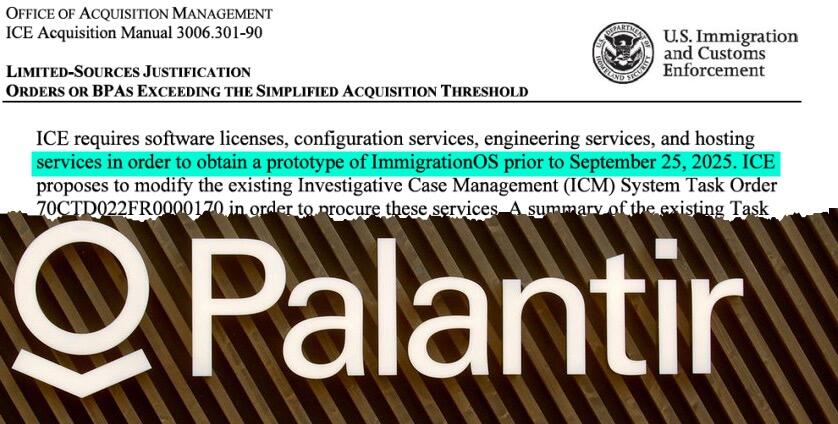
stated that ICE and Palantir are working to deploy the Immigration Lifecycle Operating System — or ImmigrationOS — to support ICE's Enforcement and Removal Operations (ERO) in response to urgent deportation national security goals outlined in President Trump's Executive Orders (EO 14159 and EO 13773).
Palantir will deliver a prototype of ImmigrationOS by September 25. The contract sets the deadline for a fully operational ImmigrationOS by September 2027.
 ?itok=u-VuQTzf
Here's a description of ImmigrationOS' capabilities:
Targeting and Enforcement Prioritization: Streamlining operations to apprehend illegal aliens, focusing on transnational criminal organizations (TCOs), violent criminals, and visa overstays.
Self-Deportation Tracking: Real-time visibility into self-deportation instances to inform policy and resource allocation.
Immigration Lifecycle Process: End-to-end management from identification to removal, optimizing deportation logistics
Services include software licenses, configuration, engineering, and hosting to deliver a prototype by September 25, 2025.
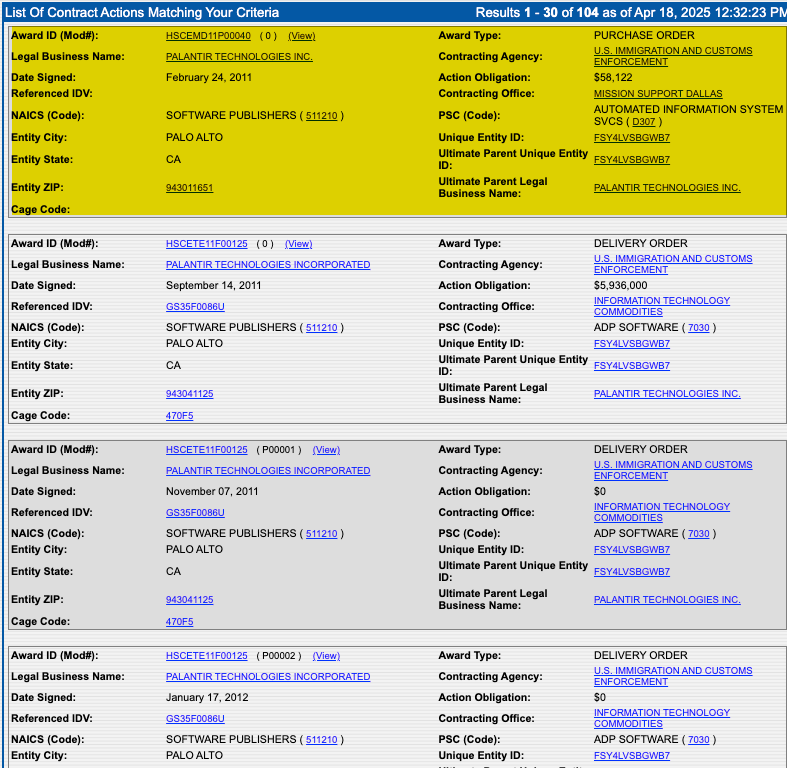
Federal data shows Palantir has been an ICE contractor since 2011.
 ?itok=cVGdjxsX
According to the contract, the ImmigrationOS award is expected to cost taxpayers $29.8 million.
Separately, Palantir has been working with Elon Musk's Department of Government Efficiency (DOGE) to build a "mega API" for the Internal Revenue Service, which would allow better record searching across the agency's databases.
ICE justifies ImmigrationOS as a way for the federal government to meet the critical national security objectives outlined in the president's executive orders.
https://cms.zerohedge.com/users/tyler-durden
Sat, 04/19/2025 - 13:25
https://www.zerohedge.com/technology/palantir-building-ice-immigrationos-track-migrants
Major European Country Enshrines Biological Sex In Its Constitution
Major European Country Enshrines Biological Sex In Its Constitution
The government of Hungary has ratified a new amendment to the nation’s Constitution that recognises the biological scientific fact that there are only two genders.
 ?itok=Rzg0G94M
The Hungarian parliament voted in favour of the resolution, which simply states a person is “either man or woman,” by a huge margin of 140 votes in favour to 21 votes against.
The amendment also asserts that “protection of children precedes the right of assembly” and grants police new powers to shut down gatherings such as Pride parades if they are determined to be lewd in nature and potentially damaging to “physical, mental, and moral development” of minors.
🚨 BREAKING: Hungary’s National Assembly has passed the 15th amendment to the Fundamental Law. The sweeping changes prioritize children’s rights, affirm biological gender in law, protect the right to cash payments, and allow new safeguards for national citizenship and community… https://t.co/gDbBmoShgw
— Zoltan Kovacs (@zoltanspox) https://twitter.com/zoltanspox/status/1911808225915129862?ref_src=twsrc%5Etfw
The fifteenth amendment to Hungary’s constitution also enshrines other rights such as paying for goods and services with cash.
The law will also allow the government to strip dual citizens of their Hungarian passport and potentially deport them if they are deemed to be a threat to public order or national security.
🚨Hungary’s Parliament passed the 15th amendment to the Constitution, reinforcing traditional gender definitions, enshrining the right to pay with cash, and tightening rules on dual citizenship and government powers in emergencies👇https://t.co/MD4L0tIJVO
— Hungarian Conservative (@hu_conservative) https://twitter.com/hu_conservative/status/1912111602507063484?ref_src=twsrc%5Etfw
Prime Minister Viktor Orbán remarked “In Hungary, common sense matters.”
🇭🇺📜 Hungary’s constitutional amendment is now law.
We’re protecting children’s development, affirming that a person is born either male or female, and standing firm against drugs and foreign interference.
In Hungary, common sense matters.
— Orbán Viktor (@PM_ViktorOrban) https://twitter.com/PM_ViktorOrban/status/1911830707300675637?ref_src=twsrc%5Etfw
Orbán’s Political director, Baláz Orbán https://twitter.com/BalazsOrban_HU/status/1911890197861499084
“These measures respond to growing liberal pressure to dismantle the foundations of family, normality, and national identity. In Hungary, these are not negotiable. We will defend them—not just in policy, but in our constitution.”
Far left extremists protested the passage of the measure in the Hungarian parliament by screeching whistles and generally freaking out. They had previously set off smoke bombs inside the parliament.
💥Hungary sliding further into authoritarianism: Orbán’s close ally, Speaker László Kövér, banned the entire liberal Momentum party faction from parliament and fined them €175,000 for protesting Orbán's Pride crackdown—setting a precedent to ban other elected opposition MPs too. https://t.co/mIK50TKax7
— Szabolcs Panyi (@panyiszabolcs) https://twitter.com/panyiszabolcs/status/1903024589967434036?ref_src=twsrc%5Etfw
Hungary Bans https://twitter.com/hashtag/LGBT?src=hash&ref_src=twsrc%5Etfw
* Parades: Parliament Approves Law
The initiative of the ruling Fidesz party was supported by 136 deputies, while 27 voted against. An attempt to disrupt the vote was made by representatives of the opposition movement Momentum.
☮️✌️🙏🏿 https://t.co/GPKjskRNSb
— Dada Shastoni (@DadaShastoni) https://twitter.com/DadaShastoni/status/1902244789401108492?ref_src=twsrc%5Etfw
The media is framing the move as an attack on LGBTQ communities, claiming that Hungary has completely banned Pride events.
Hungary’s parliament passes an amendment to the constitution that allows the government to ban public events by LGBTQ communities. https://t.co/BjwZWxjIsW
— NBC News (@NBCNews) https://twitter.com/NBCNews/status/1911891000353566918?ref_src=twsrc%5Etfw
In 2020, Hungary passed a constitutional amendment affirming the right of children to identify with their birth gender and defining marriage as between a man and a woman.
* * *
Your support is crucial in helping us defeat mass censorship. Please consider donating via https://pauljosephwatson.locals.com/support
.
https://cms.zerohedge.com/users/tyler-durden
Sat, 04/19/2025 - 08:10
'Cyborg 1.0': World's First Robocop Debuts With Facial Recognition And 360° Camera Vision
'Cyborg 1.0': World's First Robocop Debuts With Facial Recognition And 360° Camera Vision
Thailand has debuted the world's first 'Robocop' designed to detect and prevent crime with advanced AI.
 ?itok=Lu12-tpH
Equipped with 360-degree cameras for eyes, the cutting-edge cyborg maintains constant surveillance with real-time monitoring. The robocop, named Police Colonel Nakhonpathom Plod Phai, meaning "Nakhonpathom is safe," was unveiled during the Songkran festival in Nakhon Pathom province on Wednesday. The debut was announced via a Facebook post by the Royal Thai Police, according to a report by https://www.the-sun.com/news/14051335/robocop-ai-police-cyborg/
.
 ?itok=lrMlWLpt
The robocop is also able to detect weapons, such as knives and wooden batons. In neighboring China, humanoid robots have started supporting police patrols.
https://interestingengineering.com/innovation/ai-thai-robocop-patrols-streets?group=test_a
reports:
In Shenzhen, PM01 model robots developed by EngineAI have been deployed alongside officers, wearing high-visibility police vests. These robots have been seen engaging with pedestrians—waving, shaking hands, and responding to voice commands—according to local media reports. A recent video shows a PM01 robot waving to a crowd, sparking curiosity about its purpose in law enforcement.
First launched in December 2024, the PM01 features agile mobility, an interactive touchscreen, and an open-source platform. This design allows developers worldwide to contribute to its evolution by adding new features and capabilities through secondary development.
Last year, Logon Technology, a Chinese robotics company, unveiled the RT-G autonomous spherical robot, described as a "technological breakthrough," with an army of these spherical robocops spotted rolling through cities across China, https://www.the-sun.com/news/14051335/robocop-ai-police-cyborg/
said. The robocop’s debut underscores the growing importance of robot technology. During Tesla’s Q1 2025 All-Hands meeting, CEO Elon Musk revealed the the company is preparing aiming to begin the production of its own humanoid, Optimus, this year.
🚨ELON MUSK: "This year we hope to make about 5,000 Optimus robots...but even 5,000 robots is the size of a Roman legion FYI. That's a scary thought, a legion of robots. I think we'll literally build a legion of robots this year, and maybe 10 legions next year? It's kind of a… https://t.co/R992X5OA8r
— Autism Capital 🧩 (@AutismCapital) https://twitter.com/AutismCapital/status/1902916859382599751?ref_src=twsrc%5Etfw
“This year, we hopefully will be able to make about 5,000 Optimus robots,” Musk said. “We’re technically aiming for enough parts to make 10,000, maybe 12,000, but since it’s a totally new product with a totally new, like everything is totally new, I’ll say we’re succeeding if we get to half go the 10,000.”
“But even 5,000 robots, that’s the size of a Roman legion, FYI, which is like a little scary thought. Like a whole legion of robots, I’ll be like ‘whoa.’ But I think we will literally build a legion, at least one legion of robots this year, and then probably 10 legions next year. I think it’s kind of a cool unit, you know? Units of legion. So probably 50,000-ish next year,” the world’s richest man added.
https://cms.zerohedge.com/users/tyler-durden
Sat, 04/19/2025 - 07:35
Ukraine's Extension Of Martial Law Exposes Zelensky's Fear Of Losing Re-Election
Ukraine's Extension Of Martial Law Exposes Zelensky's Fear Of Losing Re-Election
https://korybko.substack.com/p/ukraines-extension-of-martial-law
The US might pressure him to assemble a government of national unity on pain of once again suspending military and intelligence aid if he refuses to dilute his power in lieu of holding elections...
 ?itok=mNL2zrKR
Ukraine https://interfax.com/newsroom/top-stories/110989/
in the White House.
To that end, the Trump Administration might not turn a blind eye to https://korybko.substack.com/p/zelensky-might-have-an-ace-up-his
to commit in order to hold onto power, instead refusing to recognize the outcome unless one of his rivals wins.
As for who could realistically replace him, Russia’s Foreign Intelligence Service https://korybko.substack.com/p/russia-hopes-to-influence-ukraines
last May that the US had reportedly entered into talks with Petro Poroshenko, Vitaly Klitschko, Andrey Yermak, Valery Zaluzhny, and Dmytro Razumkov.
The New York Times (NYT) just ran a feature article on Poroshenko, who took the opportunity to propose a government of national unity (GNU) almost 18 months after this idea was https://korybko.substack.com/p/the-walls-are-closing-in-on-zelensky
in December 2023, but even the article’s author felt obligated to inform readers that he’s unlikely to return to power.
Citing unnamed political analysts, they assessed that “Mr. Poroshenko may be angling for an electoral alliance with General Zaluzhny…[who] has remained mostly silent about politics” till now.
Nevertheless, Poroshenko’s NYT feature article succeeded in raising wider awareness of the GNU scenario, which the Trump Administration might seek to advance over the summer.
Zelensky continues to irritate Trump, most recently by alleging that Russia has “https://www.rt.com/news/615785-vance-zelensky-us-ukraine/
in talks with Putin.
This comes as Ukraine continues dragging its heels on agreeing to the https://korybko.substack.com/p/zelensky-has-no-feasible-alternative
with the US.
From the US’ perspective, since the increasingly troublesome Zelensky can’t be democratically replaced through summertime elections, the next best course of action could be to pressure him into forming a GNU that would be filled with figures like Poroshenko who’d be easier for the US to work with.
This could also serve to dilute Zelensky’s power in a reversal of the Biden Administration’s policy that saw the US turning a blind eye to his anti-democratic consolidation of power on national security pretexts.
The pretext could be that any Russian-US breakthrough on resolving the https://thealtworld.com/andrew_korybko/heres-what-i-learned-from-analyzing-the-new-cold-war-every-day-for-three-years-straight
requires the approval of a politically inclusive Ukrainian government given Zelensky’s questionable legitimacy after remaining in power following the expiry of his term last May and the enormity of what’s being proposed.
In pursuit of this goal, the US could threaten to https://thealtworld.com/andrew_korybko/five-takeaways-from-trumps-fateful-decision-to-freeze-all-military-aid-to-ukraine
its military and intelligence aid to Ukraine unless Zelensky speedily assembles a GNU that’s acceptable to the Trump Administration.
The purpose would be to push through a ceasefire for lifting martial law, finally holding elections, and ultimately replacing Zelensky.
The GNU could also help prevent the fraud that he might be planning to commit if he decides to run again under these much more politically difficult circumstances, especially if they invite the US to supervise their efforts, both before and during the vote.
Through these means, the US could therefore still get rid of Zelensky, who might think that extending martial law will prevent this.
https://cms.zerohedge.com/users/tyler-durden
Sat, 04/19/2025 - 07:00
Extraordinary US-China Cyber Meeting Revealed
Extraordinary US-China Cyber Meeting Revealed
The Wall Street Journal recently https://archive.is/SFQAa
an unprecedented meeting that occurred in December 2024, which addressed the ongoing series of cyberattacks on U.S. critical infrastructure. In this meeting, described as a “summit,” about 12 U.S. national security officials engaged in candid discussions with their Chinese counterparts.
This meeting marked the first acknowledgment by China that the Volt Typhoon and the Salt Typhoon cyber intrusions originated from the Chinese regime.
“The Chinese official’s remarks at the December meeting were indirect and somewhat ambiguous, but most of the American delegation in the room interpreted it as a tacit admission and a warning to the U.S. about Taiwan, a former U.S. official familiar with the meeting said,” the Journal reported.
 ?itok=GJ-Ns-d2
Chinese Cyber Assaults
Volt Typhoon was first publicly reported in early 2023, as Microsoft and the Department of Homeland Security revealed cyber intrusions into critical infrastructure in Guam. A Chinese state-sponsored group was the announced culprit, and one U.S. official said this was https://www.engadget.com/microsoft-says-china-installed-malware-in-us-systems-in-guam-195805235.html
Chinese intelligence-gathering system.
The department’s Security’s Cybersecurity and Infrastructure Security Agency (CISA) released an advisory with perhaps a new cybersecurity buzz phrase of “https://www.cisa.gov/news-events/cybersecurity-advisories/aa23-144a
whether this event signaled preparation for a Chinese attack.
In 2024, congressional testimony by then-FBI Director Wray and then-CISA Director Jen Easterly was sobering. https://www.defenseone.com/technology/2024/02/chinese-hacking-operations-have-entered-far-more-dangerous-phase-us-warns/393843/
the Chinese actions starkly, saying, “This is truly an ‘Everything Everywhere, All at Once’ scenario.”
The Journal https://archive.is/SFQAa
, published on April 10, provided further information on the motives of the Chinese regime. “The Chinese delegation linked years of intrusions into computer networks at U.S. ports, water utilities, airports and other targets, to increasing U.S. policy support for Taiwan … underscoring how hostilities between the two superpowers are continuing to escalate,” the report said.
Leadership Accountability for Cyber Failures
In his first term, President Donald Trump’s initial https://www.federalregister.gov/documents/2017/05/16/2017-10004/strengthening-the-cybersecurity-of-federal-networks-and-critical-infrastructure
stressed one theme: leadership accountability.
The executive order states:
“The President will hold heads of executive departments and agencies (agency heads) accountable for managing cybersecurity risk to their enterprises. In addition, because risk management decisions made by agency heads can affect the risk to the executive branch as a whole, and to national security, it is also the policy of the United States to manage cybersecurity risk as an executive branch enterprise.”
To clarify, the executive order said that cyber breaches would be considered a direct reflection of the senior leadership of the affected departments and agencies.
The revelation of the December 2024 Geneva meeting may provide further background on the recent leadership changes at Fort Meade, Maryland.
Beijing’s cyber campaign has been relentless since early 2023 and includes the full spectrum of U.S. critical infrastructure, including power, water, telecommunications, air traffic control, and maritime navigation-related systems.
A Cyber ‘Plucking’ to Ensure Best Leadership
Retired Lt. General Michael Flynn, Trump’s initial national security adviser during his first term, told me “there are more flag officers [generals and admirals] that need to go,” pointing out that “this is a ‘Marshall Moment’ to effect these changes.”
This refers to the “plucking” used by Gen. George Marshall before and during the Second World War.
Herm Hasken, a retired military officer and senior adviser to several cyber and electronic warfare companies, told me that “the public is only getting a portion of the whole story regarding the size and scope of China’s intrusions across all 16 sectors of our critical infrastructure.”
Retired Secret Service Senior Executive Robert Rodriguez told me that industry practitioners are extremely concerned about the Chinese regime’s Salt Typhoon cyberattacks.
Rodriguez helped establish the early cyber capabilities of the Secret Service. He is still active in cybersecurity innovation efforts.
“The threat was so serious they formed a coalition of U.S. and Canadian [chief information security officers] to host a series of ongoing workshops” to address the broad and pervasive Chinese cyber intrusions, Rodriguez said.
He said China is “by far the No. 1 threat” to the United States and the world.
dove deeply into the Salt Typhoon cyberattacks. The bipartisan dissatisfaction in Congress regarding the U.S. government’s inability to shut down and remove Chinese cyber intruders was evident.
“I think the American people need to know the extent of the breach here, I think they will be shocked at the extent of it,” Sen. Josh Hawley (R-Mo.) said at the time.
“I think they need to know about their text messages, their voicemail, their phone calls. It’s very bad, it’s very, very bad, and it is ongoing.”
Then-Senate Intelligence Committee Chair Mark Warner (D-Va.), who has direct experience as an executive in the telecommunications market, was concerned about the unaddressed “gaping holes” in the U.S. cybersecurity posture.
“I think there is huge concern, far and away the worst telecom hack, and the fact is that they are still in the systems,” Warner told reporters at the time.
The unabated and continuous Chinese cyber assault, confirmed by The Wall Street Journal in relation to the high-level Geneva security summit between the outgoing U.S. national security team and China, may be a significant causal factor for changes in U.S. cybersecurity leadership.
Views expressed in this article are opinions of the author and do not necessarily reflect the views of The Epoch Times or ZeroHedge.
https://cms.zerohedge.com/users/tyler-durden
Fri, 04/18/2025 - 23:40
https://www.zerohedge.com/geopolitical/extraordinary-us-china-cyber-meeting-revealed
Single Deadliest Yemen Strike Of Trump Presidency Destroys Vital Oil Port
Single Deadliest Yemen Strike Of Trump Presidency Destroys Vital Oil Port
Fresh US airstrikes on Yemen Thursday marked the single-deadliest known attack under President Donald Trump's new campaign targeting the Houthi rebels. The Pentagon has been intensely bombing Yemen since March 15, when the Gaza truce collapsed.
A Houthi spokesman announced Friday that the attacks killed 38 people and wounded 102 others. The death toll was hours later updated to at least 74 killed. The operation mainly targeted and destroyed the Ras Isa oil port, which sent massive fireballs shooting into the night sky.
 ?itok=D0ydc5jv
The Red Sea port includes a collection of three large oil tanks, and is the terminus of an oil pipeline going to Yemen's energy-rich Marib governorate. On Friday open-source satellite imagery showed an extensive blaze at the site.
Local footage of the aftermath of the strikes has widely circulated on social media. Much of it is very graphic, showing corpses strewn across the ground as huge fires rage all around.
United States Central Command (CENTCOM) had quickly confirmed the strikes on the oil terminal. "The Houthis have continued to benefit economically and militarily from countries and companies that provide material support to a designated foreign terrorist organization," a statement began.
"The Iran-backed Houthis use fuel to sustain their military operations, as a weapon of control, and to benefit economically from embezzling the profits from the import. This fuel should be legitimately supplied to the people of Yemen."
The statement further noted that fuel has continued to be be shipped via the port of Ras Isa, and that profits have helped bolster the Houthis' military capabilities.
Perhaps anticipating large civilian casualties, CENTCOM continued, "This strike was not intended to harm the people of Yemen, who rightly want to throw off the yoke of Houthi subjugation and live peacefully."
And that's when the Pentagon highlighted Iran's role, at a moment the White House has warned it could bomb Tehran if it doesn't come to the table to forge a new nuclear agreement. "The Houthis, their Iranian masters, and those who knowingly aid and abet their terrorist actions should be put on notice that the world will not accept illicit smuggling of fuel and war material to a terrorist organization," it said.
Huge fireball at the Ras Isa oil port on the Red Sea coast...
⚠️ BREAKING:
17 civilians killed, dozens injured in the U.S. strike on the Ras Isa oil port in Hodeidah.
This is the “defensive” operation the world keeps justifying.https://twitter.com/hashtag/Yemen?src=hash&ref_src=twsrc%5Etfw
— Hala Jaber (@HalaJaber) https://twitter.com/HalaJaber/status/1913004937165815884?ref_src=twsrc%5Etfw
The Houthis, in response, have rejected and denounced the attack which killed civilians, saying: "This completely unjustified aggression represents a flagrant violation of Yemen's sovereignty and independence and a direct targeting of the entire Yemeni people."
The statement featured by the SABA news agency then said, "It targets a vital civilian facility that has served the Yemeni people for decades."
Another video from the scene:
⚡️🇺🇸🇾🇪BREAKING:
Al-Hudaydah Health Office: The death toll from the American attack on the Ras Issa oil port in Hodeidah, Yemen has risen to 58 and 126 wounded, in a preliminary count.
The attack was carried out in two stages. After the first wave of airstrikes, ambulance crews… https://t.co/KG8TpLnNuK
— Suppressed News. (@SuppressedNws) https://twitter.com/SuppressedNws/status/1913164099485127007?ref_src=twsrc%5Etfw
Some local sources are claiming it was a 'double-tap' strike, and that the death toll is so high because the second wave hit after emergency crews first arrived at the scene, but these statements cannot be verified.
https://cms.zerohedge.com/users/tyler-durden
Fri, 04/18/2025 - 23:05