
PepsiCo Prints "Rare" Earnings Miss As Volatility & Uncertainty Mount
PepsiCo Prints "Rare" Earnings Miss As Volatility & Uncertainty Mount
It's rare for PepsiCo to miss Bloomberg Consensus earnings estimates. Still, the soda and snack giant has stumbled amid growing uncertainty surrounding the trade war and waning consumer sentiment—factors that ultimately prompted the company to lower its full-year earnings outlook.
The maker of Pepsi beverages and Frito-Lay snacks missed the consensus estimate, with Barclays analyst Lauren Lieberman calling the miss "exceedingly rare to see PEP results fall short of consensus expectations and while the miss was just 1c, we think it exemplifies just how challenging things are at the company today given in the past decade-plus, there's always been a way to deliver the bottom line."
Here's a snapshot of Pepsi's 1Q25 earnings:
Core EPS: $1.48 (vs. $1.61 YoY), slightly below Bloomberg Consensus expectations of $1.49
Reported EPS: $1.33 (vs. $1.48 YoY), missed the estimate of $1.48
Operating Profit: $2.58B, down 4.9% YoY, missed $2.78B estimate
Revenue: $17.92B, down 1.8% YoY, beat $17.77B estimate
Organic Revenue Growth: +1.2% (vs. +2.7% YoY), above +0.53% estimate
Capex: $603M, below $657M estimate
Convenient Foods Volume: -3%
Regional Breakdown:
Foods North America: $6.21B
Latin America Foods: $1.66B
EMEA: $2.39B
International Beverages: $759M
PepsiCo Beverages North America: $5.88B (vs. $5.87B YoY, beat $5.83B estimate)
"As we look ahead, we expect more volatility and uncertainty, particularly related to global trade developments," CEO Ramon Laguarta stated.
 ?itok=yj8um3SD
The common theme among US companies has been a reduction in or complete withdrawal of guidance (https://www.zerohedge.com/markets/american-air-yanks-full-year-guidance-trade-wars-hinder-travel-demand-prediction
) due to tariff uncertainty. Pepsi slashed its EPS outlook for the year due to mounting macroeconomic headwinds but maintained its organic revenue growth forecast and shareholder return targets.
Here's more color on the changing outlook:
Core EPS: Now expected to decline 3% YoY (previously expected a low-single-digit increase)
Core EPS (constant currency): Now flat YoY (previously expected mid-single-digit growth)
Organic Revenue: Still expects a low-single-digit increase
Tax Rate: Core annual effective tax rate expected at ~20%
Shareholder Returns: Still targeting ~$8.6 billion in total cash returns for the year
Goldman analysts Bonnie Herzog and Ethan Huntley, along with others, provided clients with their initial summary of the mixed earnings report, indicating a "Q1 topline beat but a slight EPS miss - FY25 EPS guide lowered given tariffs & macro pressures."
Here's more color on their take:
Investor expectations heading into PEP's Q1 print were quite low, dragged largely by ongoing concerns over the health of the consumer which have pressured consumption trends - as seen in recent scanner data trends, particularly for FLNA. And as expected, PEP's Q1 results were soft with +1.2% organic revenue growth (vs our/cons ests of +0.9%/+0.6%), though the planned timing and phasing of certain productivity initiatives weighed on core operating margins - leading to a slight EPS miss at $1.48 (vs our/FactSet cons ests of $1.50/$1.49). Further, given expected higher supply chain costs related to tariffs, elevated macroeconomic volatility, and a subdued consumer backdrop, PEP lowered its FY25 f/x neutral EPS growth to ~flat y/y (vs +MSD growth prior) but maintained its organic sales guidance of +LSD% (vs our/Visible Alpha cons ests of +2.5%/+2.3% ahead of the print). Surprisingly given the weaker dollar, PEP continues to expect a ~3pt headwind from f/x to impact reported net revenue and EPS growth and therefore expects core EPS growth of -~3% implying FY25 EPS of ~$7.92 (vs $8.16 last year, and vs our/FactSet cons est of $8.29/$8.26 into the print). Furthermore, PEP restated its financial segments this morning making it difficult to analyze their new segmented results vs expectations. However, PEP's PBNA segment delivered 1% organic sales (vs our/cons ests of +0.5%/-0.1%) and 14% operating profit growth and PEP's new PepsiCo Foods North America (PFNA, comprised of the former FLNA and QFNA) delivered -2% organic sales and -7% f/x neutral operating profit growth. While optically concerning, we think today's results could serve as a clearing event - helping to reset investor expectations at a much more realistic level. However, we expect the stock to underperform today.
Taking a step back, Q1 organic sales growth was up +1.2% (vs our/cons ests of +0.9%/+0.6%) - despite the benefits of an easier y/y compare (1Q24 organic sales growth of +2.7%, with vols -2%) - driven by healthy price/mix and relative strength internationally. As expected, the top-line growth continued to be driven by net price realization (+3% vs our +1.8% est), reflecting mgmt's continued efforts to offset inflationary cost pressures with strong revenue management actions. That said, organic volumes were under pressure, as expected, down -2% (vs our/cons ests of -0.9%/-1.5%) - and were sequentially weaker than Q4 (-1%).
By segment, PEP's PBNA segment delivered 1% organic sales (vs our/cons ests of +0.5%/-0.1%), with price mix of +2% and volumes down -1%. PFNA organic topline growth was down -2%, with price mix of +1% and volumes down -3%. Internationally, PEP's new International Beverages Franchise (IB Franchise) organic topline growth was up +7%, with healthy +5% volume growth and price mix of +2%. EMEA organic topline growth was up a solid +8%, driven by price mix of +16% with volumes -8%. Elsewhere, Latin America Foods (LatAm Foods) organic topline growth was up +3%, driven by price mix of +3% with volumes down -0.5%. Lastly, Asia Pacific Foods organic topline growth was down -1%, driven by healthy volumes of +3.5%, albeit offset by price mix (-4%). Moving down the line, gross margins were broadly flat y/y at 55.7% (vs our/cons ests of 55.8%/55.5%), while Op margins were down ~50bps y/y to 15.6% (vs our/cons ests of 15.7%/15.8%), as SG&A expenses as a % of sales were up ~60bps y/y to 40.1%. As a result, PEP delivered Q1 core f/x neutral EPS growth that was down -4% to $1.48 (vs our/cons ests of $1.50/$1.49).
Bottom Line - We maintain our Buy rating on PEP as we believe it remains well positioned given its strong brand portfolio (esp. Frito Lay) and long-term growth opportunities in Beverages, particularly given its impressive revenue growth management capabilities, its owned distribution network and superior supply chain, which ensures the right (& affordable) products are available when & where needed. Overall, we continue to believe PEP should be able to deliver sustainable average annual +MSD% organic sales growth in the next decade - despite some potential near-term headwinds.
Here's more commentary from other Wall Street desks (courtesy of Bloomberg):
Barclays (equal-weight), Lauren Lieberman
"It is exceedingly rare to see PEP results fall short of consensus expectations and while the miss was just 1c, we think it exemplifies just how challenging things are at the company today given in the past decade-plus, there's always been a way to deliver the bottom line," Lieberman writes
PEP's reduced annual EPS guidance reflects higher supply chain costs (tariffs); in prepared remarks, PEP also discussed upping commercial investments
PEP mentioned two new areas of focus for cost savings within the new Pepsi Foods North America division: "optimizing and right-sizing" the supply chain and the "go-to-market footprint"; increasing efficiencies in transportation & logistics
Both of these are "critical points" given its outsized investment in Frito over the past five years, which has generated a "disappointing ROI," according to Lieberman
JPMorgan (neutral), Andrea Teixeira
Expects negative stock reaction to the "sizeable net tariff impact" and macro/consumption volatility
It's the first time PEP misses EPS estimates in "many years"
Core EPS guidance lowered by a "very high magnitude" despite the company's plan to take mitigating actions
North America savory snacks volumes were down 4% in 1Q, worse than Teixeira's -3.5% estimate, and will likely "remain the key concern for investors as far as calling for a potential inflection given the several headwinds (low-income consumer under pressure, GLP-1, etc)"
Bloomberg Intelligence, Kenneth Shea
Higher-than-expected supply-chain costs related to global trade volatility were the "key factor" to 8% drop in 1Q adjusted EPS
Shea blames the "lingering weakness" in the PepsiCo Foods North America segment as the main reason for the EPS guidance cut
Piper Sandler (overweight), Michael Lavery
NA Food segment remains challenged, while organic revenue growth in international business continues to be healthy, growing 5% in the quarter, driven by beverages
Lavery said she expects to hear more about productivity savings progress and promotional outlook for the salty snack category on the company's earnings call
Also hopes to better understand what tariff assumptions are included in PEP's updated guidance
Additional headlines from the Pepsi CEO:
PEPSI CEO: WORKING ON 'RIGHT-SIZING' COST OF FRITO LAY PRODUCTS
PEPSI CEO: CONSUMERS IN CHINA, MEXICO 'HURTING A BIT'
PEPSI CEO ON DYE BANS: SHIFTING ENTIRE PORTFOLIO NATURAL COLORS
PEPSI CEO: TRANSITION TO NATURAL COLORS IN NEXT FEW YEARS
PEPSI CEO: EXPECTING LIMITED IMPACT IN US SNAP PROGRAM CHANGES
PEPSI CEO: DEVELOPING PROTEIN PRODUCTS, KEY FOR GLP-1 USERS
Proteins for GLP-1 users??
https://cms.zerohedge.com/users/tyler-durden
Thu, 04/24/2025 - 10:20
https://www.zerohedge.com/markets/pepsico-prints-rare-earnings-miss-volatility-uncertainty-mount
US Existing Home Sales Weakest March Since Great Financial Crisis
US Existing Home Sales Weakest March Since Great Financial Crisis
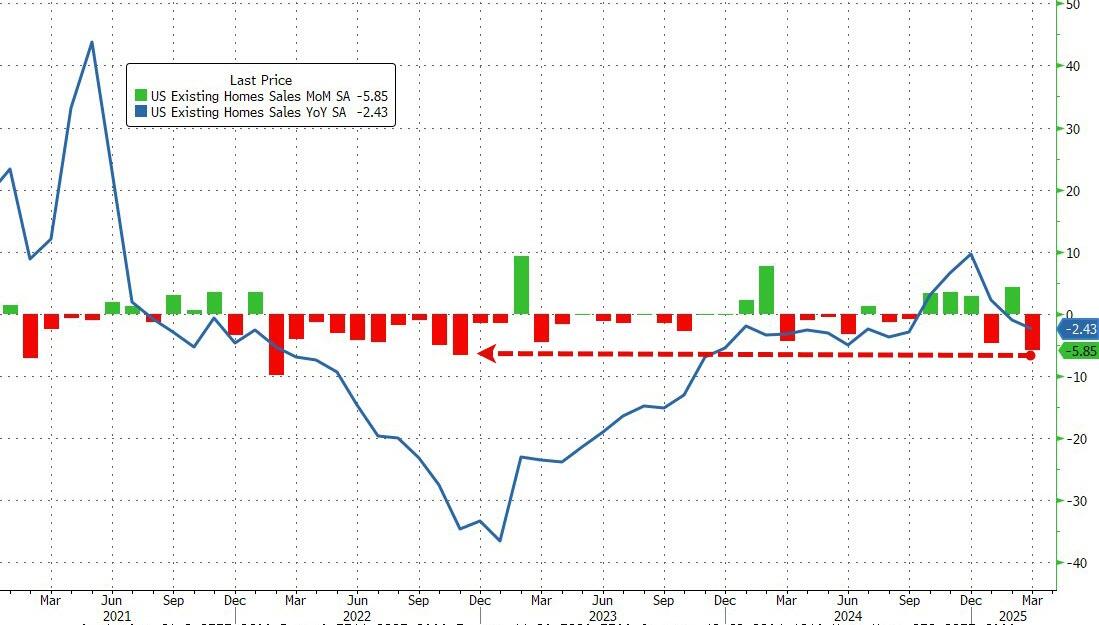
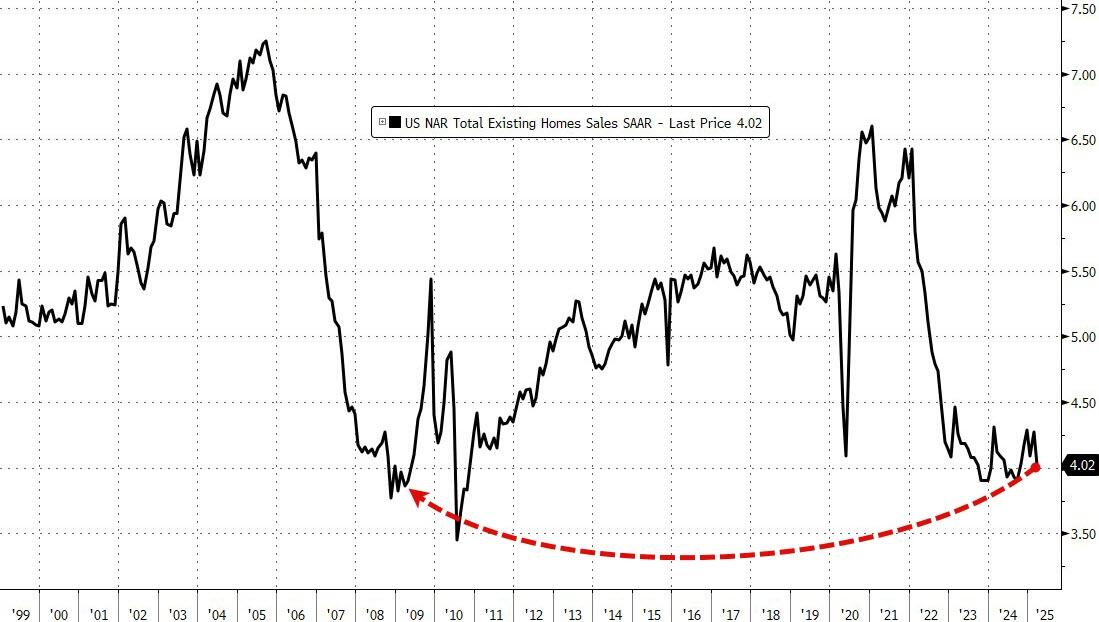
Following an unexpectedly large jump in February (biggest in a year), existing home sales were expected to drop significantly in March, and they did. Existing home sales fell 5.9% MoM (considerably worse than the 3.1% MoM drop expected) reversing the upwardly revised 4.4% MoM rise in February, dragging sales down 2.4% YoY...
 ?itok=u_p5GRBH
Source: Bloomberg
This is the weakest March sales pace since 2009... and biggest MoM drop since Nov 2022.
 ?itok=5AEUJI46
Source: Bloomberg
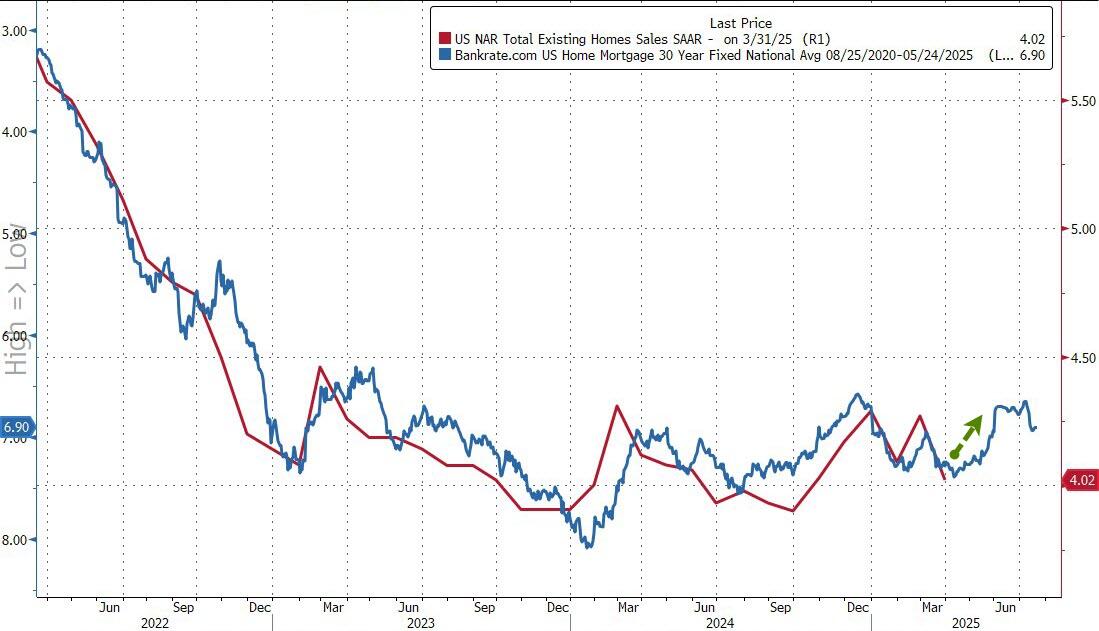
The drop in sales aligns perfectly with the lagged rebound in mortgage rates, which suggests the next two months will see an improvement before weakness resumes...
 ?itok=UevPcwAS
Source: Bloomberg
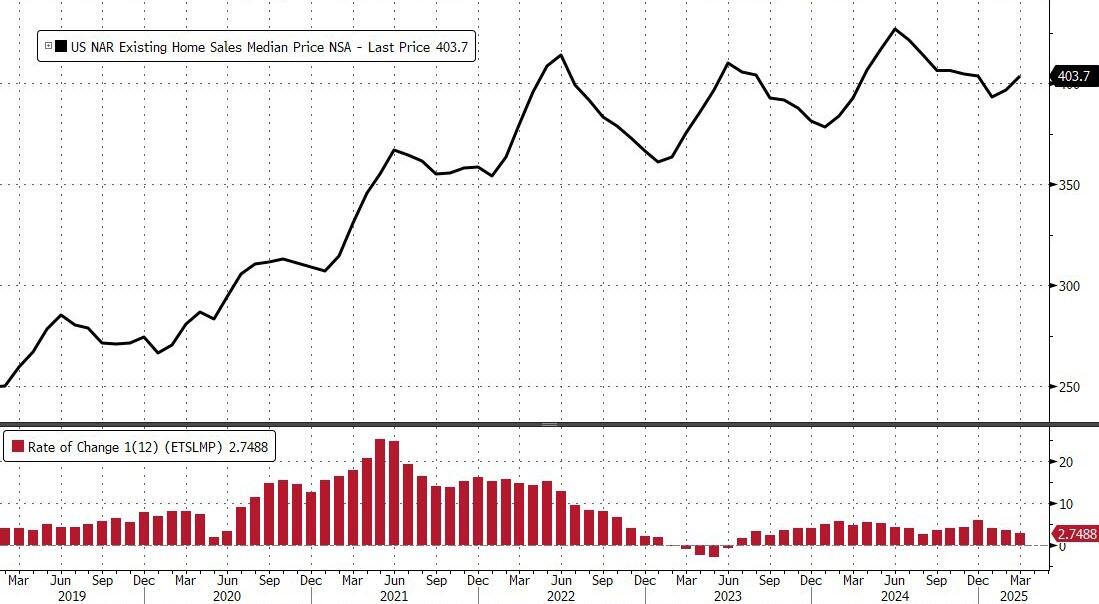
The median sales price increased 2.7% from a year ago to $403,700, a record for the month of March and extending a run of year-over-year price gains dating back to mid-2023.
 ?itok=9KPq7VhJ
Source: Bloomberg
The gain in prices largely reflected more sales activity for homes priced above $1 million, NAR Chief Economist Lawrence Yun said on a call with reporters. However, he also noted that the size of the increase was relatively mild compared to wage growth.
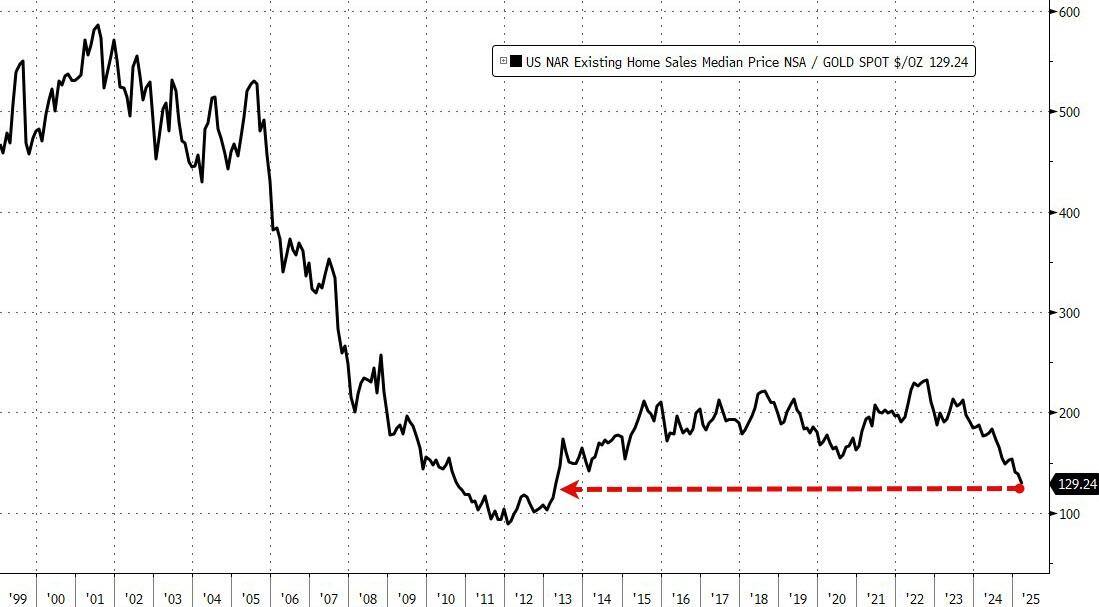
Finally, while home prices are at record highs, on a 'real' inflation adjusted basis (relative to gold, we mean), they are at 12 year lows...
 ?itok=o6o3uFCh
If you had 129 ounces of gold right now, would you swap them for a 'used' house?
https://cms.zerohedge.com/users/tyler-durden
Thu, 04/24/2025 - 10:11
Anduril Co-Founder Warns: U.S. Munitions Stockpile Would Last One Week In Hot Conflict
Anduril Co-Founder Warns: U.S. Munitions Stockpile Would Last One Week In Hot Conflict
The United States would deplete its munitions stockpile if it entered into genetic warfare against a global superpower, Anduril co-founder Trae Stephens warns.
Stephens, who co-founded of the cutting-edge defense startup alongside Palmer Luckey, dropped the chilling warning on Auren Hoffman’s World of DaaS podcast.
“The reality is, if we got into a hot conflict with a great power, we would run out of munitions in a week,” Stephens told Hoffman. “We’ve built these capabilities that are incredibly exquisite, incredibly custom, with really complicated supply chains.”
Anduril co-founder https://twitter.com/traestephens?ref_src=twsrc%5Etfw
: "If the U.S. got into a hot conflict with a great power, we would run out of munitions in a week."
"You see situations like Ukraine where we deplete not only available inventory, we also deplete our own inventory." https://t.co/DD3mz7H04j
— Josh Caplan (@joshdcaplan) https://twitter.com/joshdcaplan/status/1914782383401848891?ref_src=twsrc%5Etfw
Stephens, who is also a partner at Peter Thiel’s venture capital fund Founders Fund, pointed out that the U.S. is struggling to supply Saudi Arabia with enough Patriot missiles to counter daily Houthi attacks, leaving the the Middle East Kingdom to seek out additional inventories from other nations due to limited availability.
“What that means is, our partner nations, like Saudi Arabia, for example, which is fighting this ongoing conflict with the Houthis—they’ve got stuff being shot into their sovereign territory, creating havoc on a daily basis,” Stephens explained. “We cannot sell them enough Patriot missiles. They literally have to go to other partner nations and try to buy their inventory of Patriot missiles”
Stephens also highlighted that in cases like Ukraine, the U.S. is rapidly depleting both its own and available inventories of military capabilities to support the war effort, with limited resupply options, as manufacturers resort to calling retirees back to rebuild assembly lines.
“Then you see situations like Ukraine, where we deplete not only the available inventory but also our own inventory of the capabilities we’re sending to support the war effort, with no ability to actually resupply,” the technology executive said. “The Primes are literally calling people out of retirement to rebuild assembly lines to make some of these capabilities.”
reported back in November 2024:
The wars in Ukraine and the Middle East are eating away at critical U.S. weapons stockpiles and could hamper the military’s ability to respond to China should a conflict arise in the Indo-Pacific, the top U.S. commander for that region said Tuesday. Head of U.S. Indo-Pacific Command Adm. Samuel Paparo cautioned Tuesday that the U.S. providing or selling billions of dollars worth of air defenses to both Ukraine and Israel is now impeding his ability to respond in the Indo-Pacific, such as if China invades Taiwan.
“It’s now eating into stocks, and to say otherwise would be dishonest,” Paparo https://apnews.com/article/ukraine-weapons-taiwan-missiles-stockpiles-28564bbed21f72b9a3c6b3cd9c086bc7
the Brookings Institution last year.
Stephens’ stark warning echoes a recent interview with Luckey, who stressed that rebuilding the U.S. manufacturing base is not only feasible but critical to counter rising global volatility.
“If we can't make the things that we need to maintain our quality of life, then we are actually just subservient to our adversaries,” Luckey, who leads Anduril as CEO, told legendary music producer Rick Rubin on his Tetragrammaton podcast.
.https://twitter.com/PalmerLuckey?ref_src=twsrc%5Etfw
supports tariffs on China, affirming that reindustrialization is both "absolutely" possible and necessary.
"If we can't make the things that we need to maintain our quality of life, then we are actually subservient to our adversaries." https://t.co/x4LwS5T8t1
— Josh Caplan (@joshdcaplan) https://twitter.com/joshdcaplan/status/1913282742512501058?ref_src=twsrc%5Etfw
“Is there a possibility that over time America could get back its manufacturing base? Absolutely,” Luckey told Rubin. “The problem that we did, I mean there's a million problems, but what we did is hollowed out our country by allowing China into the World Trade Organization and allowing American companies to outsource manufacturing to China without penalty, without import tariffs, without any reason to not do it.”
“Why wouldn't you, if you're allowed to just send it to another country where everything's cheap, where it's dirt cheap and there's no environmental regulations and no labor laws, why wouldn't you do that? And we've been able to get a bunch of cheap shit over the last 50 years as a result,” the startup billionaire added. “That has helped the United States. Everyone's able to buy cheap TVs and cheap cars and cheap stuff because of China's rise. The flip side of that is that there's no more manufacturing in the United States.”
https://cms.zerohedge.com/users/tyler-durden
Thu, 04/24/2025 - 09:55
Nintendo Switch 2 Frenzy: "Selling Out" Across US Retailers As Tariffs Won't Impact Pricing
Nintendo Switch 2 Frenzy: "Selling Out" Across US Retailers As Tariffs Won't Impact Pricing
U.S. families with young gamers can breathe a sigh of relief this week as Goldman analysts told clients that the upcoming Nintendo Switch 2 won't see price hikes due to the ongoing trade war.
Nintendo's hotly anticipated Switch 2 is now available for pre-orders at major U.S. retailers as of early Thursday morning.
According to the tech blog https://www.tomsguide.com/live/news/nintendo-switch-2-pre-orders-live-updates-retailers-to-check
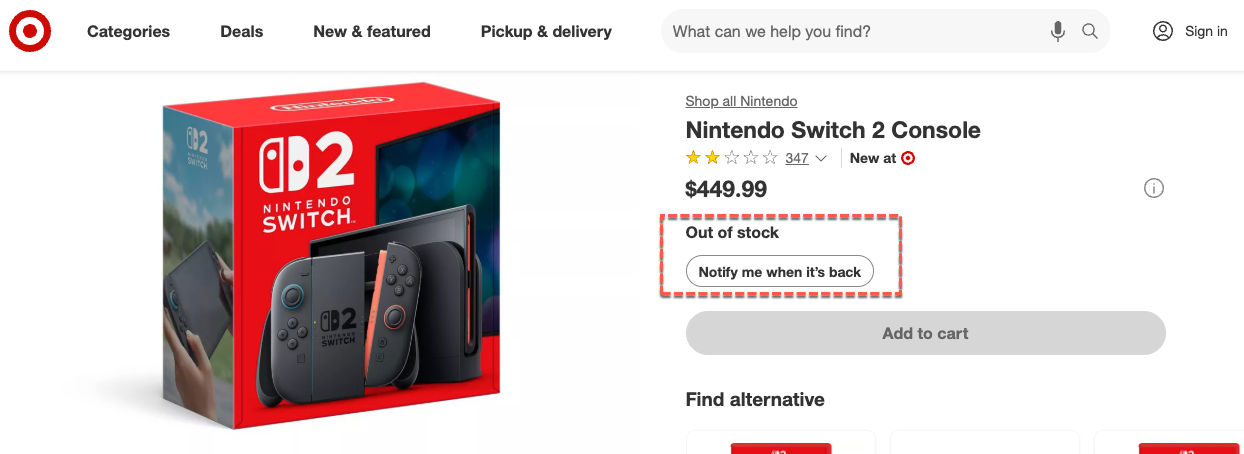
, demand for the new console is so intense that major retailers' websites are crashing, with "sold out" notifications appearing across some platforms operated by Walmart, Target, and Best Buy.
 ?itok=KvswGX4U
Nintendo Switch 2 will retail for $449, with the Mario Kart World bundle costing $499.
 ?itok=r_9XkbDJ
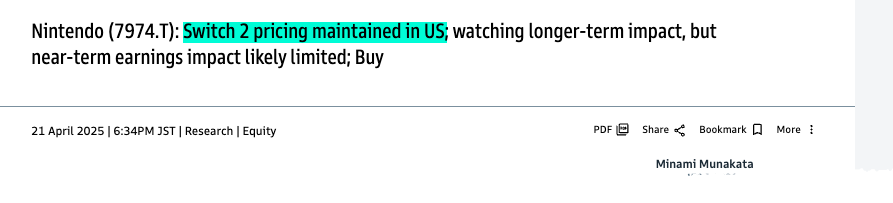
The good news for U.S. families who are avoiding tariff landmines as President Trump tries to negotiate an 'America First' trade deal with the Communist Chinese is that Goldman gaming analysts Minami Munakata and Haruki Kubota said console prices will remain at pre-trade war levels.
 ?itok=5Dodhc7f
Here's more color on this from Munakata:
On April 18 (U.S. time), Nintendo announced that pre-orders for the Nintendo Switch 2 will begin in the U.S. on April 24. The company had originally planned to begin pre-orders on April 9 but announced on April 5 (U.S. time) that it was postponing the start of pre-orders following the Trump administration's announcement of new tariff policies.
The console price will be US$449.99, as originally announced. However, prices for peripherals, such as controllers and cameras, have been raised by around 5%-10% from the initially announced prices, and the company said that further price revisions are possible depending on changes in the market environment.
Munakata explained to clients Nintendo's move to keep console prices at pre-trade war prices "makes sense in view of potential medium- to long-term impact on software sales."
She continued:
We believe the decision to keep the console price unchanged reduces the need for concern about the impact on unit sales forecasts. Growth in the installed base for game hardware is essential for sales of game software, which accounts for the majority of Nintendo's profits. While US-bound hardware, which we assume will be shipped from Vietnam, will likely face a cost increase due to the 10% universal tariff (reciprocal tariff is paused), we view Nintendo's decision to prioritize a smooth launch for the Nintendo Switch 2 by keeping the console price unchanged in the U.S. (one of its most important markets) as a reasonable one, given the focus on long-term growth of the Nintendo Switch 2 platform.
Separately, an overnight report from Bloomberg stated that the demand for Switch 2 in Japan has been "overwhelming."
Nintendo President Shuntaro Furukawa wrote on X:
"We have received 2.2 million applications for the lottery sale at our official online store for customers in Japan alone, which is far larger than what we had anticipated. As such, we apologize that a significant number of the applicants won't be selected."
Uh oh...Nintendo President Shuntaro Furukawa has publicly apologized for underestimating Switch 2 demand in Japan after the lottery system there received 2.2 million applications. They are expecting that a "significant number" of people will not be selected to purchase a console. https://t.co/tZ3XPQW9i9
— Nintendeal (@Nintendeal) https://twitter.com/Nintendeal/status/1915118857553113169?ref_src=twsrc%5Etfw
Pelham Smithers of Japan-focused equity research house Pelham Smithers Associates said Japan accounts for about a third of the global Switch installation base, which implies 6.6 million pre-orders globally.
Back to Goldman's Munakata, she provided more details about Nintendo's tariff impact:
A Bloomberg report on April 10 suggested that over 1 mn game consoles were exported from Vietnam to the U.S. in Jan-Feb 2025 (we believe that Nintendo accounts for the majority of game consoles produced in Vietnam, and that most US-bound Nintendo hardware is produced there). Based on the report, Nintendo may be able to build up inventory to meet most of its U.S. demand for FY3/26 before the end of the tariff pause (90 days from April 9). We believe this means the potential negative earnings impact from lower hardware profitability is likely to be limited in the near term (our FY3/26 Nintendo Switch 2 shipment assumption is 6 mn units for the Americas and 14.5 mn units overall).
Near-term earnings impact likely limited, but watching news flow for any medium- to long-term impact.
On the other hand, if the announced 46% tariff gets imposed on exports from Vietnam after the tariff pause, we believe extended imposition of reciprocal tariffs by the Trump administration could still put downward pressure on Nintendo's earnings over the medium to long term. If the impact of the tariffs were to be passed on through higher selling prices, this could lead to a lower unit sales outlook for hardware. If Nintendo were to absorb the costs while keeping the selling price unchanged, this could lower hardware profitability. In either case, the tariffs could put downward pressure on Nintendo's earnings, so we will continue to monitor news flow related to tariffs.
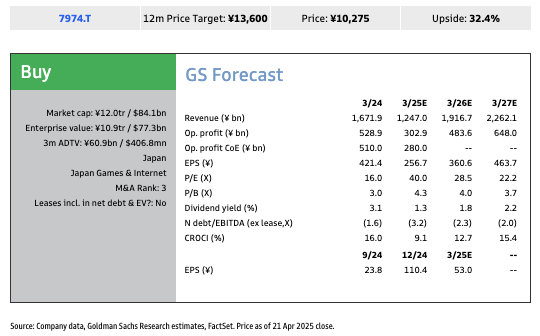
Despite the tariff impacts, Munakata remained "Buy" rated on Nintendo...
Our 12-month target price of ¥13,600 is unchanged, and we maintain our Buy rating.
 ?itok=VCZqBe74
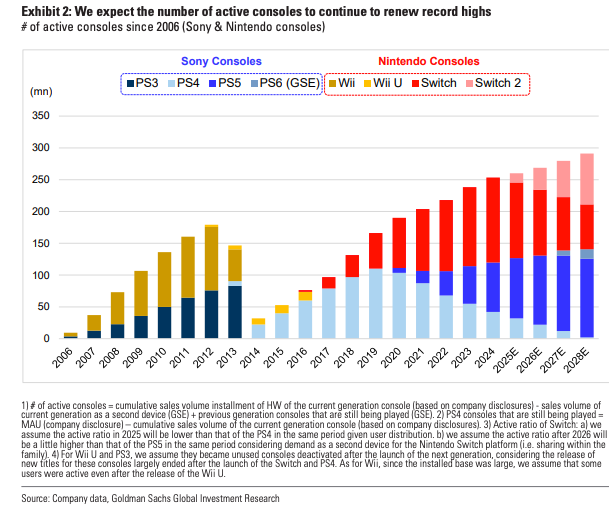
Last month, Munakata wrote a note stating that Switch 2 will "https://www.zerohedge.com/technology/nintendo-shares-jump-after-goldman-sees-switch-2-unlocking-dormant-users
" and send "the number of active consoles to continue to renew record highs."
 ?itok=3lfcyvx5
Separately, https://www.zerohedge.com/technology/grand-theft-auto-6-priced-100-gaming-analyst-believes-so
later this year is expected to provide additional tailwinds for the gaming industry, which had been stuck in a rut for years but appears to have entered a renewed growth trajectory in 2024.
The good news is that Switch 2 remains at pre-trade war prices.
https://cms.zerohedge.com/users/tyler-durden
Thu, 04/24/2025 - 09:20
NPR: Abrego Garcia Was "Living Quietly" In Maryland Before He Was Deported
NPR: Abrego Garcia Was "Living Quietly" In Maryland Before He Was Deported
Yesterday, I tweeted out after hearing a segment on National Public Radio on the case of Kilmar Abrego Garcia. NPR https://www.npr.org/2025/04/23/nx-s1-5373746/federal-judge-blasts-trump-stonewalling-deportation-case
that there was no evidence presented that Abrego Garcia was an MS-13 member and that “he had been living quietly in Maryland” before he was suddenly arrested and deported.
 ?itok=47DcYoJ5
While many disagree on the handling of the case, few would agree that Abrego Garcia who was reported for spousal abuse and suspected of human trafficking was “living quietly in Maryland.”
Anyone listening to the radio program would have been left with an incomplete and distorted account of the case.
The print story used the same language as the radio segment. NPR claimed that Abrego Garcia
“was granted protection by an immigration judge in 2019 that should have prevented his deportation. He had been living quietly in Maryland with his wife and three children and working in construction until Immigration and Customs Enforcement officers arrested and deported him last month.”
I have previously said that I believe the Administration should have returned Abrego Garcia to the United States for a correct and prompt deportation. If he were to be brought back, I cannot see any barrier to Abrego Garcia not only being deported but deported back to El Salvador.
NPR leaves out a couple of facts in its passing reference to his being “granted protection by an immigration judge.”
Abrego Garcia already had a hearing at which the judge found evidence that he was an MS-13 member. It was not only based on his being arrested with MS-13 gang members and wearing clothing associated with the gang. It was also based on a confidential source connected to the gang. After losing at his hearing, Abrego Garcia then lost on appeal.
The only reason that Abrego Garcia was not removed is that he said that he was being threatened by a gang that could harm him in El Salvador. That gang, however, reportedly no longer exists.
More importantly, President Trump has declared MS-13 a Foreign Terrorist Organization, which bars the use of the justification for his not being removed. In other words, he has little factual or legal foundation under his original claims to remain in the country.
However, putting the merits aside, NPR’s portrayal of Abrego Garcia was bizarre. He was repeatedly accused of https://www.foxnews.com/politics/maryland-man-kilmar-abrego-garcia-exposed-police-records-violent-repeat-wife-beater
. The court record states:
“Per the Prince Georges County Police Gang Unit, ABREGO-Garcia was validated as a member of the Mara Salvatrucha (MS13) Gang. Subject was identified as a member of the Mara Salvatrucha MS-13, “Chequeo” from the Western Clique a transnational criminal street gang. This information was provided by tested source who has provided truthful accurate information in the past. See Prince Georges County Police Department (Gang Sheet).”
Abrego Garcia was also suspected of human trafficking. Indeed, the description of the stop leaves one astonished that he was allowed to simply drive away. According to DHS:
“On Dec. 1, 2022, Abrego Garcia was stopped by the Tennessee Highway Patrol for speeding. Upon approach to the vehicle, the encountering officer noted eight other individuals in the vehicle. There was no luggage in the vehicle, leading the encountering officer to suspect this was a human trafficking incident. Additionally, all the passengers gave the same home address as the subject’s home address. During the interview, Abrego Garcia pretended to speak less English than he was capable of and attempted to put the encountering officer off-track by responding to questions with questions. When asked what relationship he had with the registered owner of the vehicle, Abrego Garcia replied that the owner of the vehicle is his boss, and that he worked in construction…
The encountering officer decided not to cite the subject for driving infractions but gave him a warning citation for driving with an expired driver’s license. Abrego Garcia’s driver’s license was a MD “Limited Term Temporary” license. The encountering officer gathered names of other occupants in the vehicle but could not read their handwriting. The officer did not pursue further information due to no citation being issued.”
So Abrego Garcia, an undocumented immigrant, was stopped with an expired license in a car with eight others and no luggage on a trip from Texas to Maryland. He gave a false statement and the officer suspected human trafficking but let him go.
It is now being https://justthenews.com/government/courts-law/hlddeported-el-salvadoran-drove-vehicle-owned-alien-previously-plead-guilty
that the person whom Abrego Garcia described as his “boss” at a construction job was Jose Ramon Hernandez Reyes, an illegal migrant previously convicted of human smuggling. The black 2001 Chevrolet Suburban belonged to Hernandez Reyez.
One can reasonably object that there was no final adjudication of these claims from spousal abuse to human trafficking to gang membership. However, it strains credulity to claim that Abrego Garcia was living a “quiet” life in Maryland. The complaint of his wife that he was a wife-beater alone would seem to contradict NPR’s claim.
The claim has that certain “https://thehill.com/homenews/media/513902-cnn-ridiculed-for-fiery-but-mostly-peaceful-caption-with-video-of-burning/
” quality to it . . . except NPR just decided to leave out the “fiery” and the “mostly” parts.
NPR repeating a false claim that the Supreme Court rejected the claim the government was involved in censorship — despite the express statement of the Court to the contrary.
NPR has long been accused of showing bias in its coverage. It is now https://jonathanturley.org/2025/02/02/this-is-npr-npr-faces-reckoning-on-what-it-is/
for the news outlet.
https://cms.zerohedge.com/users/tyler-durden
Thu, 04/24/2025 - 09:05
https://www.zerohedge.com/political/npr-abrego-garcia-was-living-quietly-maryland-he-was-deported
Massive Buying Of Boeing Aircraft Sends US Durable Goods Orders Soaring In March
Massive Buying Of Boeing Aircraft Sends US Durable Goods Orders Soaring In March
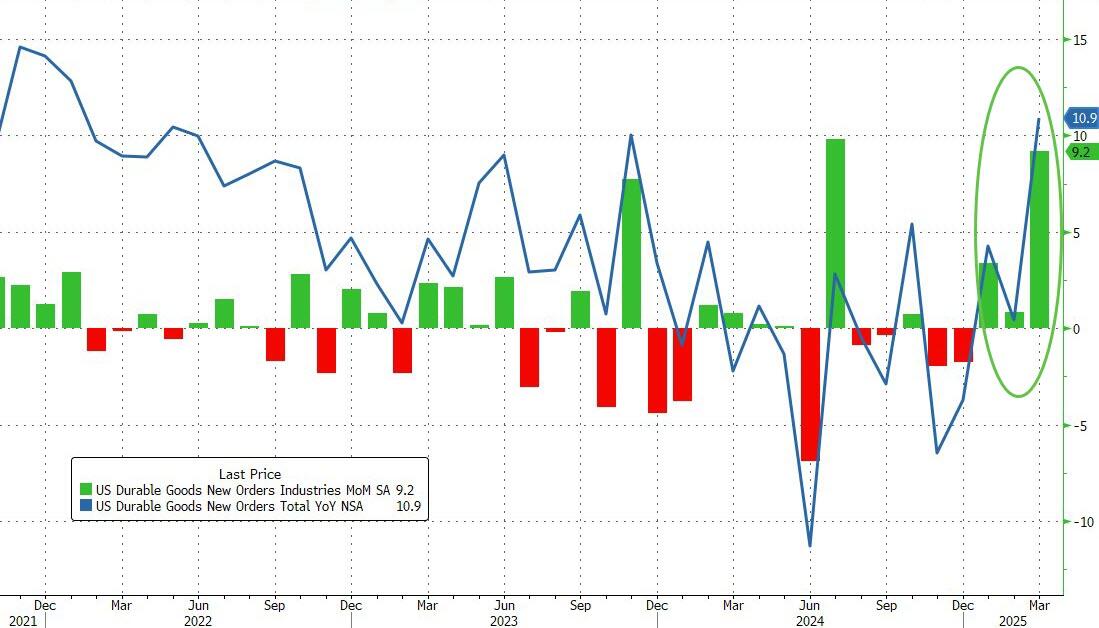
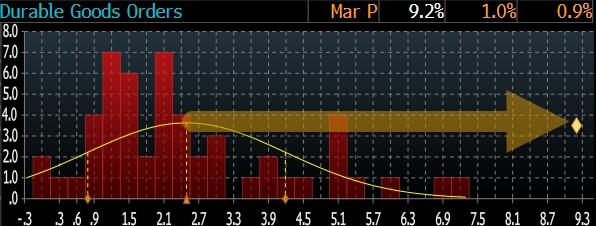
US Durable Goods Orders printed a massive 9.2% MoM surge in preliminary March data, massively beating the +2.0% MoM expectation) and pulling orders up 10.9% YoY - the highest since Jan 2022. This is the third straight month of strong orders...
 ?itok=1t3bsjxm
Source: Bloomberg
That is a four sigma beat of expectations...
 ?itok=Du6uiAFY
Source: Bloomberg
But... and its a big but!
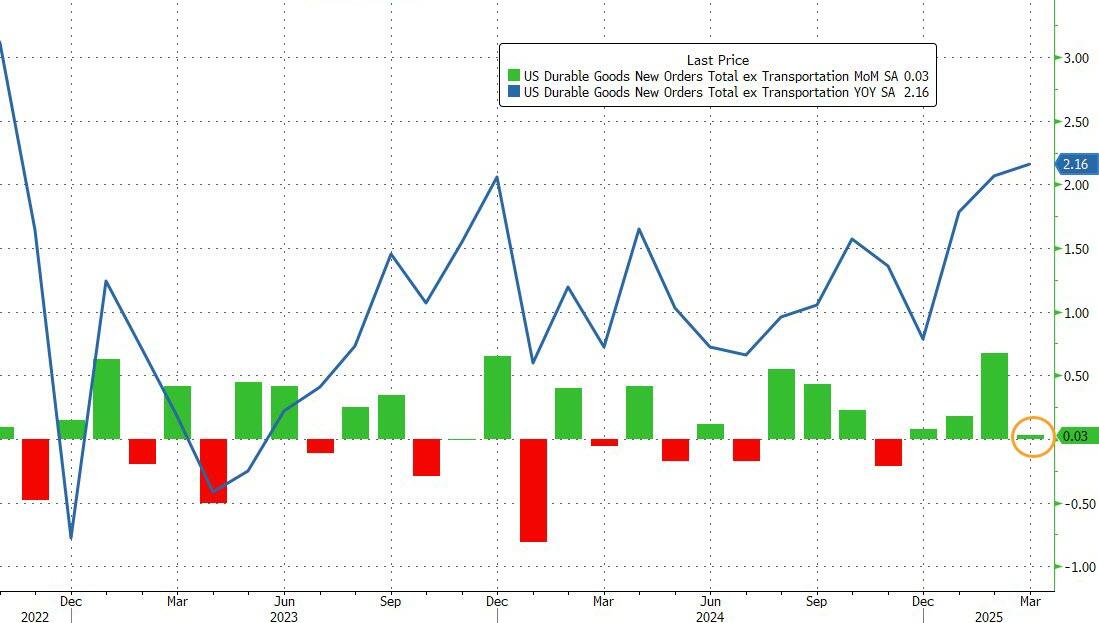
Ex-Transportation, durable goods orders were unchanged MoM (rising 2.2% YoY)...
 ?itok=OzSUVbC1
Source: Bloomberg
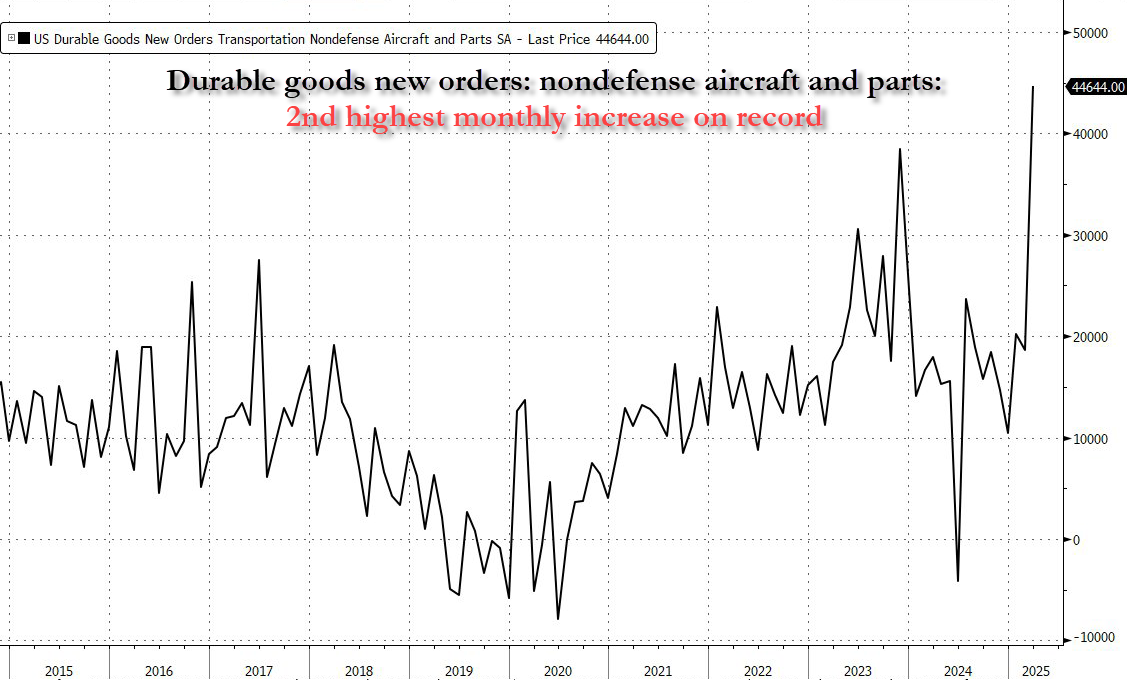
And so - all of the gains in the headline orders print were due to a 139% surge in orders for commercial aircraft and parts...
 ?itok=DOxWAKLP
Source: Bloomberg
Boeing Co. said it received 192 orders in March, the most since the end of 2023 and up from 13 in the previous month. At the same time, China recently ordered its airlines not to take further deliveries of Boeing jets as the trade war escalates.
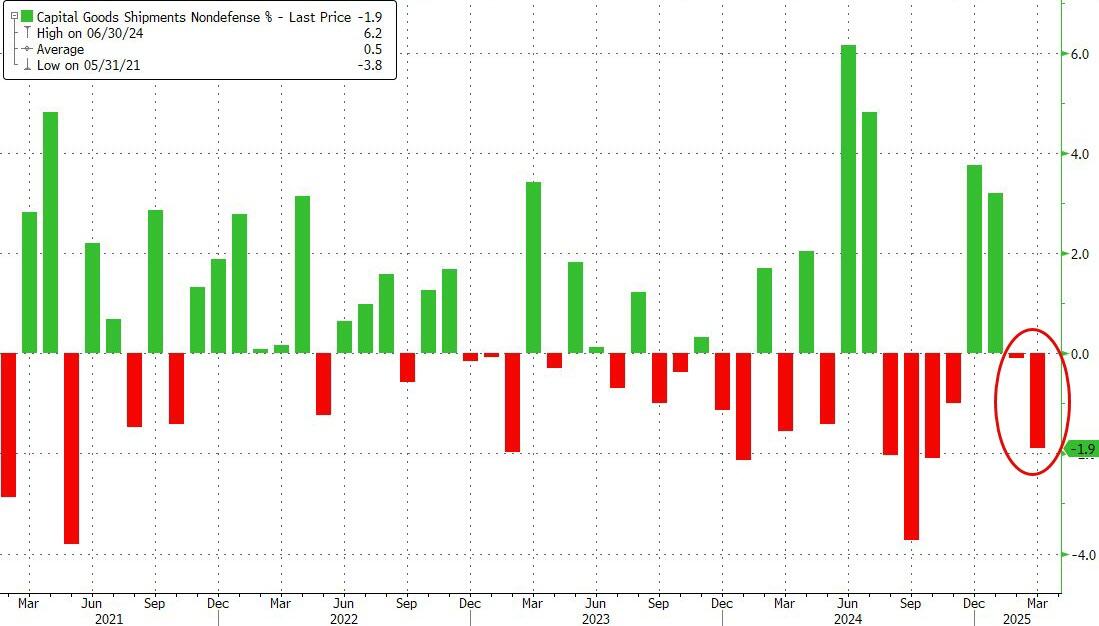
However, non-defense capital goods shipments including aircraft, which feed directly into the equipment investment portion of the gross domestic product report, dropped 1.9%, the most since October.
 ?itok=EbU1ePKN
What will The Atlanta Fed GDPNOW forecast do with this massively mixed big picture data?
https://cms.zerohedge.com/users/tyler-durden
Thu, 04/24/2025 - 08:53
"Vladimir, STOP!" Trump Responds To 'Massive' Russian Missile Strike On Kiev, Leaving 9 Dead
"Vladimir, STOP!" Trump Responds To 'Massive' Russian Missile Strike On Kiev, Leaving 9 Dead
Amid stalled US-led peace talks, Russia launched a massive overnight attack on Ukraine, including raining down ballistic missiles on the center of Kiev, unleashing large-scale death and destruction.
At least nine people have been reported killed and over 70 injured in the capital city, in what was one of the largest and deadliest missile strikes on Ukraine in months. Some other cities, including Kharkiv, were also hit.
 ?itok=mSwu96IW
Anti-aircraft systems began engaging inbound missiles and drones at about 1am local time. But after drones and missiles were able to make it through, several buildings - including a factory - and a house, as well as cars, were set on fire.
BBC https://www.bbc.com/news/articles/cd7v0lgg18xo
, "An apartment block was completely flattened during the attack and the windows of surrounding buildings were blown out and balconies ripped down."
"Russia has launched a massive combined strike on Kyiv," Ukraine’s state emergency service announced on Telegram. "According to preliminary data, nine people were killed, 63 injured."
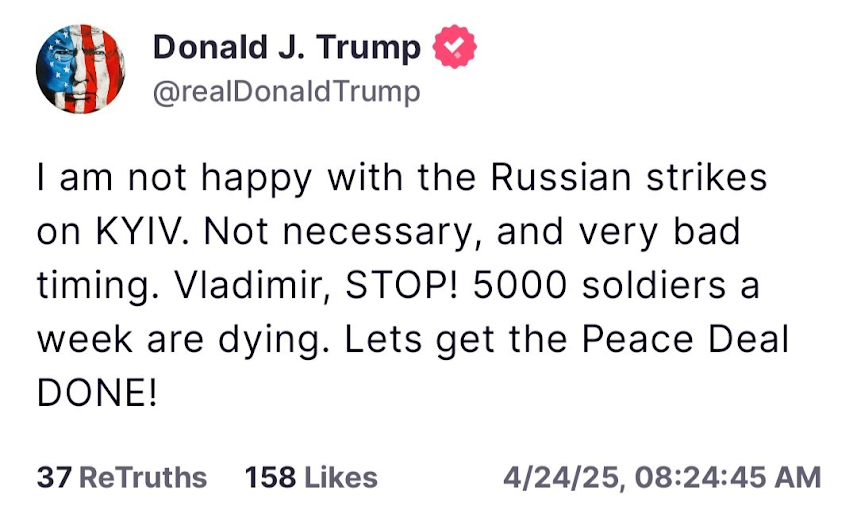
President Trump early Thursday condemned the attack, saying he's "not happy" with the Russian move. "Vladimir, STOP!" he wrote on Truth Social. "5000 soldiers a week are dying. Let's get the Peace Deal DONE!"
 ?itok=MppVNU3n
A large rescue effort has been underway given a missile head a densely populated area, with Ukraine’s interior minister, Ihor Klymenko, saying of Svyatoshinsky district of Kiev, "Mobile phones can be heard ringing under the ruins. The search will continue until everybody is got out. We have information about two children who cannot be found at the scene of the incident."
Ukrainian officials have cited that some 70 missiles and up to 150 drones were used against several cities in the devastating overnight attack.
BBC footage from the Russian attack in Kyiv last night.
According to available information, at least 8 people were killed during the strikes in the Ukrainian capital.
Ukrainian Air Force informed that Russia launched 11 Iskander-M/KN-23 ballistic missiles, 37 Kh-101… https://t.co/zucVYlpWi9
— Status-6 (Military & Conflict News) (BlueSky too) (@Archer83Able) https://twitter.com/Archer83Able/status/1915350700424392816?ref_src=twsrc%5Etfw
This new Thursday attack on the capital was the deadliest since last year's July 8 attack on Kiev, which left 34 people dead and 121 injured.
It comes after the Zelensky government has expressed frustration that the White House should be more concerned and standing by Ukraine's side, instead of holding bilateral talks toward diplomatic normalization with Russia.
The latest Trump and Zelensky back-and-forth has focused on Crimea. Trump on Wednesday slammed the Ukrainian leader for rejecting a US proposal that would see Kiev give up all claims on Crimea. Trump pointed out that Crimea "was lost years ago" and that Zelensky has "no cards to play".
Zelensky then cited the 2018 "Crimea declaration" by Trump's then secretary of state Mike Pompeo, which laid out that the United States "rejects Russia's attempted annexation".
Emotions have run high today. But it is good that 5 countries met to bring peace closer. Ukraine, the USA, the UK, France and Germany. The sides expressed their views and respectfully received each other’s positions. It’s important that each side was not just a participant but… https://t.co/lDFV5WK8tw
— Volodymyr Zelenskyy / Володимир Зеленський (@ZelenskyyUa) https://twitter.com/ZelenskyyUa/status/1915120034487189631?ref_src=twsrc%5Etfw
"There is nothing to talk about. This violates our Constitution. This is our territory, the territory of the people of Ukraine," Zelensky had initially told reporters of the question of giving up Crimea permanently.
But Vice President JD Vance had also articulated while traveling in India, "We’ve issued a very explicit proposal to both the Russians and the Ukrainians, and it’s time for them to either say yes or for the United States to walk away from this process."
Kyiv is under Russian attack. 21 people are hospitalized, including a pregnant woman and three children. https://t.co/IQZw9TkV8I
— Marta Havryshko (@HavryshkoMarta) https://twitter.com/HavryshkoMarta/status/1915195583931048024?ref_src=twsrc%5Etfw
He emphasized "The only way to really stop the killing is for the armies to both put down their weapons, to freeze this thing and to get on with the business of actually building a better Russia and a better Ukraine."
Freezing the war now would certainly give Russian forces a huge advantage, given the immense territory in the East they now hold, and this is in large part why Zelensky is refusing such a deal.
https://cms.zerohedge.com/users/tyler-durden
Thu, 04/24/2025 - 08:45
https://www.zerohedge.com/geopolitical/russia-launches-massive-missile-strike-kiev-leaving-9-dead
WTF Are CEOs Waiting For? Jobless Claims Refuse To Buckle To 'Recession' Narrative
WTF Are CEOs Waiting For? Jobless Claims Refuse To Buckle To 'Recession' Narrative
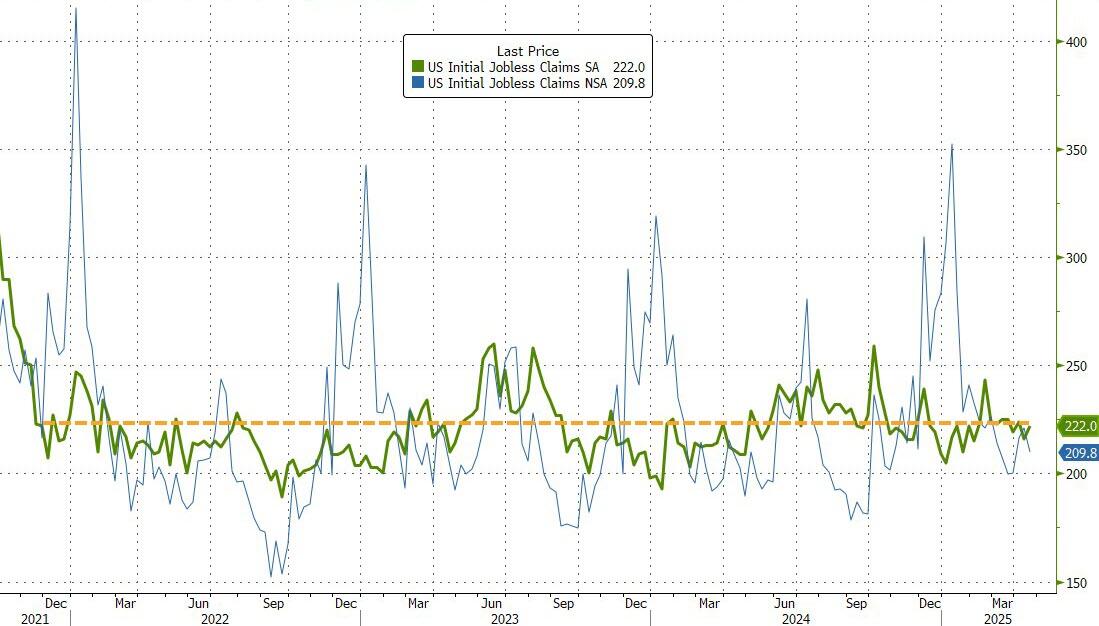
The number of Americans filing for jobless benefits for the first time rose very modestly to 222k last week. Since Nov 2021, jobless claims have barely blipped higher (or lower), despite the recent tsunami of calls for imminent recession...
 ?itok=FDbIQQfe
Source: Bloomberg
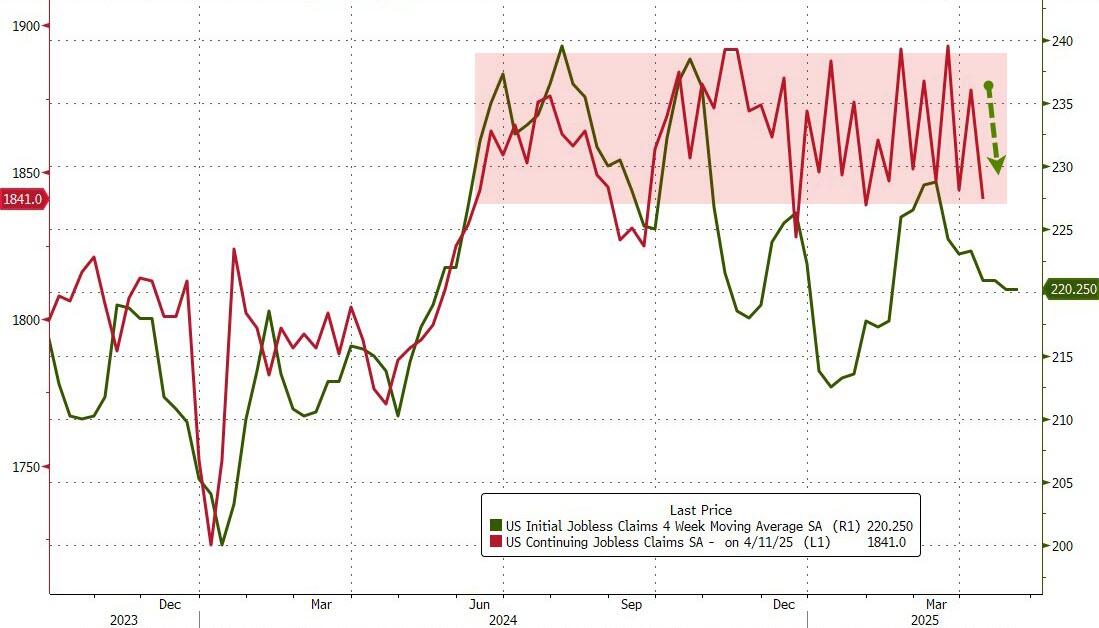
Continuing jobless claims dropped to 3 month lows...
 ?itok=GaTDJDau
Source: Bloomberg
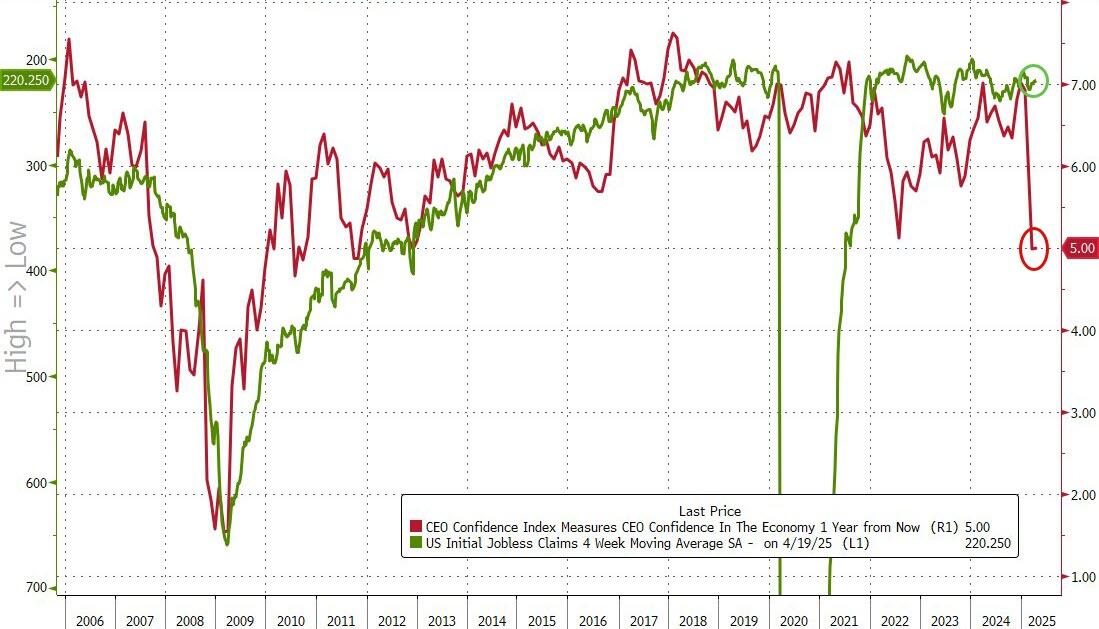
But here's the big picture - despite CEO panic, employment remains unquestionably strong...
 ?itok=sidequYs
Source: Bloomberg
So are these CEOs delinquent in their roles? Why aren't they firing 1000s of staff? Or are they just full of shit in their public prevarications?
https://cms.zerohedge.com/users/tyler-durden
Thu, 04/24/2025 - 08:39
Futures Drop On Tariff Concerns As Dollar Slides
Futures Drop On Tariff Concerns As Dollar Slides
It's risk-off price action this morning, with US equity futures lower, rates rallying across the curve, macro credit opening softer, while the USD trades broadly lower. The two-day rally in US stocks fizzled amid mixed Trump signals on China tariffs as the president floated a fresh levy timeline while simultaneously denying easing efforts and Beijing called for full rollback of all US duties. As of 8:00am S&P futures slipped -0.3% as China maintained a defiant stance over tariffs imposed by Trump, but were off session lows as investors continue to live headline to headline; Nasdaq futures dropped 0.2% with all Mag7 names in the red; NVDA (-1.5%), TSLA (-1.6%), and AAPL (-1.2%) are leading the losses. With Trump reigniting tariff volatility, IBM warning on federal cuts and China denying trade talks entirely, the rotation out of US risk remains intact. Europe was mixed, Real Estate (+1.16%) and Autos (+0.71%) outperforming but Banks (-0.76%) and Travel (-0.69%) lagged. Overnight, China responded to the recent headlines regarding “US-China talk”: Beijing pointed out that “there are absolutely no negotiation on the economy and trade between China and the US and called to cancel all the unilateral measures on China. Meanwhile Trump downplayed the idea of millionaire tax rate, one that some Republicans sees as a way to pay for the economic package (BBG). Bond yields are lower and USD is weaker; 2-, 5-, 10-yr yields are 4.5bp, 4.8bp, 3.3bp lower. The dollar extended its decline (-0.56%), with gold climbing (+1.3%) as investors hedge against prolonged US policy risk. VIX is flat (+0.28%), MOVE dipped (-1.48%) and USYC2Y10 (+1.6%) suggesting caution is returning despite the bounce in crude (+0.74%) copper (+0.57%) and gold (+1.4%). Flows are risk-off: SPY -$1.98B, QQQ -$689M and IWM -$614M, while GLD picked up another +$643M and XLU +$109M. Looking ahead today, we have durable good orders, initial and jobless claims, existing home sales, as well as non-voter Kashkari speaking.
In premarket trading, Mag 7 stocks fall (Tesla -0.6%, Nvidia -0.3%, Meta -0.5%, Apple -0.2%, Amazon -0.3%, Alphabet -0.2%, Microsoft -0.06%). IBM slumped 6.8% after 1Q results failed ease investor concerns. Chipotle fell 3.6% after the Mexican restaurant chain lowered its full-year outlook after quarterly sales declined for the first time in almost five years. Comcast fell 3% after reporting first-quarter losses of pay-TV and broadband customers that exceeded analysts’ estimates, a reflection of the growing competition from streaming companies and wireless providers. Here are some other notable premarket movers:
Alaska Air (ALK) tumbles 6.5% after the carrier’s 2Q forecast for adjusted earnings per share trailed the average analyst estimate.
Edwards Lifesciences (EW) climbs 3% after the medical device maker boosted its sales forecast for the full year.
Hasbro (HAS) gains 6% after the toymaker posted 1Q profit that beat estimates.
Impinj (PI) climbs 17% after the semiconductor device company reported first-quarter results that beat expectations and gave a positive revenue forecast.
Procter & Gamble (PG) falls 1.8% after the consumer products company cut its core earnings per share growth forecast for the full year.
Robert Half (RHI) tumbles 15% after the staffing services company reported first-quarter EPS that missed the average analyst estimate and noted that US trade policy is weighing on business confidence.
ServiceNow (NOW) rallies 8% after the software company reported first-quarter results that beat expectations and gave an outlook that is seen as strong.
Southwest Air (LUV) drops 4% after the carrier said it is not reiterating its 2025 or 2026 Ebit guidance as a result of weakening consumer spending and “macroeconomic uncertainty.”
Texas Instruments (TXN) rises 9% after the chipmaker reported first-quarter results that beat expectations and gave an outlook that is seen as strong.
Tractor Supply (TSCO) falls 4% after the farm-store chain reported sales for the first quarter that missed the average analyst estimate.
Stocks are struggling to extend Wednesday’s global rally, which was spurred by signs Trump is rethinking the most aggressive elements of his stances on trade and the Federal Reserve. The market moves underscore how investors are grappling to keep up with pronouncements from officials in the administration and frequent back-and-forth by Trump on his tariffs. Bessent tempered some of the optimism over that development, as he said the US was not looking to unilaterally lower tariffs and that a full trade deal could take two to three years. China, in turn, said Thursday that the US should revoke all unilateral tariffs and that Washington needs to show sincerity if it wants to hold trade negotiations.
“In terms of geopolitical risk, there’s a chance that we have reached a bottom, even if that’s not necessarily the case for markets,” said Francois Antomarchi, a fund manager at Degroof Petercam asset management. “Trump has touched the limits of what he can inflict on corporate America. That being said, there’s always a possibility he starts acting on another political front and triggers more volatility.”
Overnight, we continued to see mixed messages on trade negotiations, with President Trump saying last night that China may receive a new levy rate in two to three weeks, while China’s Foreign Ministry denied both countries are in talks and said the US should revoke all unilateral tariffs. Also had reports that the US is considering reducing certain tariffs targeting the auto industry although Trump said he wasn’t. CNBC reported that EU officials have warned that there’s still a lot of work that needs to get done before a trade deal can be reached with the US. Japan is hoping to finalize an agreement around the Group of Seven summit in June, however, they are likely going to resist Trump efforts to form trade bloc against China.
“You’re just seeing conflicting statements and noise coming from the US, where the overall narrative is just all over the place,” said Peter Kinsella, head of foreign-currency strategy at Union Bancaire Privee Ubp SA in London. “It’s impossible to trade.”
Deutsche Bank strategists were the latest to slash their year-end S&P 500 target by 12%, citing the blow to US companies from tariffs. While the new target of 6,150 points leaves 14% upside from Wednesday’s close, it means the index will only recover losses sustained since its February peak. Up until this change, the Deutsche Bank team had one of the most bullish views for the benchmark.
“With the potential impact of the announced tariffs large and likely to fall disproportionately on US companies, we lower our S&P 500 EPS estimate for 2025 from $282 to $240,” the strategists wrote in a note, adding that the consensus view is at risk of further downgrades.
Europe's Stoxx 600 is down 0.4% with bank, retail and technology shares posting the largest declines.Real Estate (+1.16%) and Autos (+0.71%) outperform but Banks (-0.76%) and Travel (-0.69%) lag. Germany’s IFO Survey was better (for both current and expectations) helping push the euro higher. Here are the biggest movers on Thursday:
Galderma shares climb as much as 7.9% after the Swiss dermatology company reaffirms its core Ebitda margin forecast for the full year, which RBC flags as positive given it includes the impact of US tariffs
Beijer Ref shares gain as much as 9.8% to touch a one-month high, after the Swedish industrial cooling and ventilation firm posted strong earnings. Analysts praised the company’s solid organic growth
Indivior shares gain as much as 8.1% after the UK drugmaker posted earnings. Jefferies welcomed the 1Q beat and reiterated guidance, with expectations for a second-half rebound driven by Sublocade support
Belimo rises as much as 10% after the Swiss manufacturer of heating, ventilation and air conditioning upwardly revises its guidance for the full year. Analysts note particular strength in US data center demand
Inchcape shares plummet as much as 17%, marking their worst drop since 2008, after the automotive distributor posted a drop in organic sales and added a caveat to its guidance as tariffs inject more uncertainty
Kering shares fall as much as 6.9% following a sales miss which analysts said showed that its key Gucci brand continues to struggle. The update raised doubts that the French luxury group can bounce back in 2H
BNP Paribas shares dropped 2.2%, making it one of the worst performing banks in Europe, after the French lender reported a drop in first-quarter net income despite record result from equities trading
Nokia shares fall as much as 5.8% after the telecom equipment firm reported weaker-than-expected 1Q earnings and said reaching the top end of its guidance now appears more challenging
Dassault Systemes shares slide as much as 9.7%, to the lowest intraday since 2020. The software company issued a mixed first-quarter report, as softness in licenses driven by broader macro uncertaint
Worldline shares slide as much as 8.8% after the payments firm removed its previous full-year guidance, citing management’s limited tenure and macro-related uncertainty
Husqvarna shares fall as much as 7.7%, the most since April 7, after the Swedish garden and outdoor equipment firm reported weak earnings and announced its CEO would depart
Thales shares fall as much as 6.1% after the French defense company’s orders were softer than expected in the first quarter — according to Jefferies. JPMorgan highlights some weakness in non-defense divisions
EssilorLuxottica shares fall as much as 3% after the Ray-Ban maker’s earnings fell in line with expectations, not enough to push the outperforming stock any higher as macro headwinds marred the update
Earlier in the session, Asian stock rally took a breather on Thursday as investors digested the latest commentary from the Trump administration on its tariff plan. The MSCI Asia Pacific Index edged lower after a five-day run of gains. Shares in Taiwan, South Korea and Hong Kong fell. Stock benchmarks in Japan bucked the trend to gain about 1%, buoyed by carmakers on news that the US is considering whether to reduce certain tariffs targeting the auto industry. While signs that President Donald Trump is easing up on his tough stance against China and the Federal Reserve drove a relief rally globally on Wednesday, the momentum cooled after Treasury Secretary Scott Bessent cast doubt on a timely resolution to the US-China trade war. A reduction in US import tariffs is “conditional on China coming to the table and perhaps then after a two to three-year period we could see a bilateral trade deal in the works,” said Chris Weston, head of research at Pepperstone. “For now, the collective takes the news flow to mean that we’ve seen the worst of tariff policy.”
In FX, the Bloomberg Dollar Spot Index fell 0.4%, snapping a two-day winning streak after China also demanded that the US revoke all unilateral tariffs; ongoing tensions underscored the risks stemming from aggressive US tariffs. The euro rises 0.6%, helped by stronger-than-expected German IFO data although Rehn’s comments saw it pullback from the highs. The Norwegian krone is leading G-10 currency gains against the dollar, rising 1.2%. The Canadian dollar underperforms, albeit still up 0.3%. USD/JPY fell as much as 0.8% to 142.31.
“The dollar rebound this week doesn’t represent much more than a squeeze on speculative short dollar positions generated by the ‘no intention to fire Powell’ headlines and signs of back peddling on some of the tariff items,” said Ray Attrill, head of foreign-exchange strategy at National Australia Bank Ltd. “It doesn’t change the negative big picture view of the dollar”
In rates, the 10-year Treasury yield fell 3bps to 4.35%, sliding back toward a 4.24% touched on Wednesday, its lowest since April 8. Treasuries hold modest curve-steepening gains in early US trading, led by German government bonds which are also higher, having extended gains after ECB’s Rehn said they shouldn’t rule out a larger interest-rate cut. German 10-year borrowing costs fall 3 bps. Gilts are also higher, albeit lagging peers. Bund curve steepened as traders priced in additional ECB easing. The US session includes a 7-year note auction, last coupon sale until May 5, following good demand for Wednesday’s 5-year offering.
In commodities, oil prices advance, with WTI rising 0.6% to $62.60 a barrel. Gold jumps $50 to around $3,336/oz. Bitcoin falls 1% to below $93,000.
On today's calendar, we have Initial Jobless Claims and Durable Goods at 8:30am, Existing Home Sales at 10am, and Kansas City Fed Manf at 11am. Fed’s Kashkari speaks at 5pm. We get another slew of EPS and $44bn 7yr UST auction at 1pm.
Market Snapshot
S&P 500 mini -0.3%
Nasdaq 100 mini -0.3%
Russell 2000 mini -0.2%
Stoxx Europe 600 -0.3%
DAX -0.5%
CAC 40 -0.6%
10-year Treasury yield -3 basis points at 4.35%
VIX +1 points at 29.49
Bloomberg Dollar Index -0.3% at 1225.41
euro +0.5% at $1.137
WTI crude +0.8% at $62.74/barrel
Top Overnight News
Factories in China have begun slowing production and furloughing some workers as the trade war unleashed by Trump dries up orders for products ranging from jeans to home appliances. With most Chinese goods now facing US Duties of at least 145%, some factory owners say American customers have cancelled or suspended orders, forcing them to cut production. FT
US House Republicans will seek a $150bln Pentagon spending hike as part of their party-line mega bill: Politico.
Trump said he might call Jerome Powell and reiterated the Fed chair is making a mistake by not lowering rates. Cleveland President Beth Hammack said slowing the pace of the Fed’s balance-sheet runoff may let it continue for longer. BBG
Trump and House Speaker Mike Johnson signal opposition to a new 40% tax bracket for those earning $1M+, likely putting a “nail in the coffin of the idea.” Politico
BofA Institute Total Card Spending (Week-to-Apr-19th): +3.1% (Y/Y) (prev. 2.3%); said easter continues to be a major retail event for the US
Trump is planning to spare carmakers from some of his most onerous tariffs, on another trade war climbdown. The move would exempt car parts from the tariffs that Trump is imposing on imports from China. Exemptions would leave in place a 25% tariff Trump imposed on all imports of foreign made cars and a separate 25% levy on parts would also remain and is due to take effect from May 3. FT
Marco Rubio refuted a Politico story that reported the White House may lift sanctions on Russian energy assets as part of a Ukraine peace deal. Overnight, Russia hit Kyiv with one of the heaviest aerial strikes this year. BBG
China on Thursday said that there were no ongoing discussions with the U.S. on tariffs, despite indications from the White House this week that there would be some easing in tensions with Beijing. “If the U.S. really wants to resolve the problem ... it should cancel all the unilateral measures on China,” Ministry of Commerce Spokesperson He Yadong told reporters. CNBC
Japanese bonds and stocks are set to draw the biggest combined monthly foreign inflows on record, adding to signs global funds are seeking alternatives to US assets. BBG
EU officials warn that there’s still a lot of work that needs to get done before a trade deal can be reached with the US. CNBC
The ECB will probably have to cut rates further and shouldn’t exclude a larger reduction, Governing Council member Olli Rehn said. BBG
Fed's Hammack (2026 voter) said uncertainty is a big issue in the economy and is causing businesses to pause, while she added that an incredibly high bar exists for the Fed to step in and they have not seen the need for Fed market intervention. Hammack also commented that recent market troubles were a risk transfer and that markets were functioning, as well as noted it is not a good time to be pre-emptive amid policy uncertainty and reiterated now is a good time for monetary policy to take its time.
Tariffs/Trade
China's Vice Premier He Lifeng said the nation must face up to the new situation of the US tariff increase on China; need to increase policy supply and solve practical problems.
China's Foreign Ministry spokesperson, on US trade talks, said "As far as I know, China and the US have not consulted or negotiated on the issue of tariffs, let alone reached an agreement," via Global Times.
China's MOFCOM said any content about China-US economic and trade talks is "groundless and has no factual basis" If US really wants to resolve the issue, it should life all unilateral tariff measures against China.
China Foreign Ministry spokesperson Gou said China and the US are not yet in talks on tariffs; will fight tariff war "if we have to" Respect is condition for any talks to happen. Tariffs disrupt TWO rules, and harm people of all countries.
China's MOFCOM held a meeting with foreign firms to discuss the impact of US tariff increases on the investment and operations of foreign enterprises in China; committed to further opening-up, with policies that are stable, consistent, and predictable.
US President Trump said it depends on China how soon tariffs can come down and they have spoken to 90 countries regarding tariffs already. Trump said if they don't have a deal, they will set tariffs and could set the tariff for China over the next two or three weeks, while he suggested that there is daily direct contact between US and China. Furthermore, Trump commented that they don't want cars from Canada and that car tariffs from Canada could go up, as well as noted that they are working on a deal with Canada and will see what happens.
It was earlier reported that US President Trump is to exempt carmakers from some US tariffs in which he was said to be planning to spare carmakers from some of his most onerous tariffs, in another trade war climbdown following intense lobbying by industry executives over recent weeks, according to FT.
White House Economic Advisor Hassett said the USTR has 14 meetings scheduled this week with foreign trade ministers and there are 18 written offers from trade ministers, while he stated China is open to talks.
PBoC Governor Pan said in Washington that there are no winners in trade wars and tariff wars, while he added that unilateralism and protectionism have no way out and are not in the interests of anyone. Furthermore, Pan said China will adhere to opening up and firmly supports free trade rules and the multilateral trading system.
Chinese embassy in the US posted a statement from an official saying “Our doors are open, if the US wants to talk. If a negotiated solution is truly what the US wants, it should stop threatening and blackmailing China and seek dialogue based on equality, respect and mutual benefit. To keep asking for a deal while exerting extreme pressure is not the right way to deal with China and simply will not work."
China Customs will no longer supervise goods and articles included in the management of drugs, veterinary drugs, and medical devices, while it will no longer supervise import and export of microbial agents for environmental protection with these goods to no longer be supervised as special items entering and leaving China.
Japan Economic Minister Akazawa plans to visit the US for tariff talks from April 30th, while it was also reported that the US told Japan it cannot give special treatment regarding tariffs during talks held earlier this month, according to NHK citing multiple Japanese government sources.
Taiwan's representative to the US said Taiwan is willing to increase purchases of weapons and energy from the US to reduce its trade deficit.
White House said regarding the EU fine on Meta (META) and Apple (AAPL) that novel forms of economic extortion will not be tolerated.
Swiss Economy Minister said he held a productive meeting with USTR Greer to discuss bilateral trade relations and is looking forward to future exchanges and continued collaboration.
Chile’s President said the best way to respond to this trade war is not with high-sounding statements, while they are not going to respond with retaliation and are going to respond with greater integration. Furthermore, he said they must continue working hard to facilitate customs processes and promote investments to improve logistics.
A more detailed look at global markets courtesy of Newsquawk
APAC stocks were ultimately mixed despite the positive handover from Wall Street - the risk momentum waned overnight as trade uncertainty lingered owing to the mixed signals from the US. ASX 200 was led higher by outperformance in mining stocks and tech, with gold producers buoyed by a rebound in the precious metal. Nikkei 225 advanced at the open but gradually pared most of the gains following firmer Services PPI data from Japan and after a report that the US told Japan it cannot give it special treatment regarding tariffs during talks held earlier this month. Hang Seng and Shanghai Comp were subdued following the mixed signals from the US as a report noted the White House was mulling cutting China tariffs by around half to de-escalate the trade war although officials declared they are not considering something unilaterally. Furthermore, President Trump stated it depends on China how soon tariffs can come down and if they don't have a deal, they will set the tariff but said they are having daily talks with China.
Top Asian News
PBoC to sell CNY 600bln of 1yr medium-term lending facility (MLF) loans on Friday April 25th.
China issued its new market access "Negative List" in which the number of items in the negative list was reduced to 106 from 117, while China's 2025 negative list for market access removed eight national access restrictions and partially liberalises eight national measures including for telecommunications services, TV production, pharmaceuticals, internet information services for drugs and medical devices, and forest seed imports.
South Korea Information Protection Agency said DeepSeek transferred user information and prompts without permission, according to Yonhap.
European bourses (STOXX 600 -0.8%) opened with modest losses, but sentiment gradually deteriorated as the morning progressed, to display a clear negative bias. European sectors opened mixed but now display a bit more of a negative picture. Real Estate takes the top spot, alongside strength in Energy; although upside is very modest. Tech is the clear underperformer today, given the risk-tone and as traders digest the latest earnings from Dassault Systemes, which slumped after downgrading its 2025 margin outlook. The banking sector is pressured by post-earning losses in BNP Paribas, whilst the Luxury sector is hit after poor Kering results. US equity futures (ES -0.6% NQ -0.8% RTY -0.6%) are entirely in the red, in-fitting with the broader risk tone; the NQ lags, with sentiment in the Tech sector hit after IBM (-8% pre-market) results. Focus now turns to US Durable Goods, Jobless Claims and earnings from the likes of Alphabet and Intel.
Top European News
ECB's Rehn said should not rule out a larger rate cut; risks are beginning to materialise There are few good arguments to pause rate cuts. Defence outlays will not have much impact on medium-term inflation.
FX
DXY has pulled back with the USD lower vs. all peers after gaining yesterday on account of hopes on the trade front and more conciliatory language from President Trump re Fed Chair Powell. In terms of the latest state-of-play, Trump said it depends on China how soon tariffs can come down and they have spoken to 90 countries regarding tariffs already. Trump added that if they don't have a deal, they will set tariffs and could set the tariff for China over the next two or three weeks. Note, China this morning said they are not yet in trade talks with the US.
EUR is firmer vs. the USD and the best performer across the majors with the EUR benefitting from its status as the most liquid alternative to the USD. On the trade front, not a great deal has changed for the EU with the Trump administration focusing more on the likes of India and China. Elsewhere, ECB speak has continued to lean towards suggesting that tariffs will weigh on inflation in the Eurozone. German IFO data exceeded expectations but failed to have any material sway on the EUR given the headwinds facing the nation. EUR/USD is currently stuck on a 1.13 handle and within yesterday's 1.1308-1.1440 range.
USD/JPY pulled back from the 143.00 territory after rallying yesterday owing to the positive risk appetite and stronger buck, while recent data showed firmer Services PPI from Japan. On the trade front, Japanese Economic Minister Akazawa plans to visit the US for tariff talks from April 30th. USD/JPY has delved as low as 142.56 but is still some way clear of Wednesday's trough at 141.49.
GBP is firmer vs. the USD but to a lesser extent than most peers. Newsflow out of the UK remains on the light side. However, on the trade front, UK Chancellor Reeves said the UK will not rush trade talks with the US and will not relax food standards to secure a deal. BoE's Lombardelli is both due later. Cable is currently stuck at the top end of a 1.32 handle and within Wednesday's 1.3234-1.3339 range.
Antipodeans are both a touch firmer vs. the broadly weaker USD with little in the way of newsflow from Australia or New Zealand. As such, direction for both will likely be dictated by trade developments and the broader risk tone.
Barclays said its passive month-end rebalancing model shows strong dollar buying against all majors.
PBoC set USD/CNY mid-point at 7.2098 vs exp. 7.3111 (Prev. 7.2116).
Fixed Income
US paper is higher alongside downside in stocks and following a choppy session yesterday which saw T-notes ultimately settle lower. In terms of the latest state-of-play for trade, Trump said it depends on China how soon tariffs can come down and they have spoken to 90 countries regarding tariffs already. Trump added that if they don't have a deal, they will set tariffs and could set the tariff for China over the next two or three weeks. Note, China this morning said they are not yet in trade talks with the US. For today's docket, data releases include US durables and weekly claims figures, whilst Kashkari is due to deliver remarks - a 7yr note offering is also due. Jun'25 USTs currently sit towards the bottom-end of Wednesday's 110.18+ to 111.18+ range.
Bunds are firmer on the session after a session of losses on Wednesday on account of the upbeat risk tone that was triggered by optimism on the trade front and Trump remarks re Powell. ECB speak has continued to lean towards suggesting that tariffs will weigh on inflation in the Eurozone, albeit there is a high level of uncertainty surrounding forecasts. ECB's Rehn has suggested that the GC should not rule out larger cuts than 25bps. German IFO data exceeded expectations but failed to have any material sway on prices given the headwinds facing the nation. Jun'25 Bunds are currently towards the middle of yesterday's 131.11-131.93 range with the 10yr yield @ 2.477% vs. yesterday's 2.454-2.518% range.
UK paper is sitting just above the unchanged mark after a choppy session yesterday which saw initial gains (triggered by the UK DMO issuance adjustment and soft UK PMI data) reversed following the strong risk tone in the market. On the trade front, UK Chancellor Reeves said the UK will not rush trade talks with the US and will not relax food standards to secure a deal. A strong UK 2043 outing had little impact on Gilts, and currently trade within Wednesday's 92.34-93.29 range.
Norwegian Sovereign Wealth Fund CEO said it has not gone massively to buy stocks but individual portfolio managers have been able to buy more "if they wanted to"; have not changed view on USTs.
UK sells GBP 1.75bln 4.75% 2043 Gilt: b/c 3.38x (prev. 2.97x), average yield 5.155% (prev. 5.232%) & tail 0.3bps (prev. 0.5bps).
Italy sells EUR 3bln vs exp. EUR 2.5-3.0bln 2.55% 2027 BTP: b/c 1.65x (prev. 1.55x) & gross yield 2% (prev. 2.38%).
Commodities
A firmer session in the crude complex this morning following yesterday's slump in prices on account of the OPEC+ discord after Kazakhstan said it cannot lower oil output and prioritises domestic interest over the cartel's. WTI resides in a USD 62.11-63.00/bbl range while its Brent counterpart resides in a USD 65.95-66.81/bbl range.
Once again a mixed picture across precious metals with spot gold now the gainer whilst spot silver and palladium falter. Little new to add aside from the ongoing theme of tariff uncertainty, with investors rushing back into the yellow metal following two days of heavy losses. Spot gold currently resides in a USD 3,305.37-3,367.69/oz parameter.
Base metals are trading modestly firmer on the back of a softer Dollar but upside remains capped by lingering trade uncertainty. 3M LME copper resides in a USD 9,352.03-9,413.80/t range at the time of writing.
Geopolitics: Middle East
Israel's army carries out a series of bombing operations in the city of Rafah in the southern Gaza Strip.
Geopolitics: Ukraine
Ukrainian air defence units were active around Kyiv and witnesses reported several explosions and drones in the air, while the second largest city of Kharkiv was also under missile attack with explosions heard.
US Treasury Secretary Bessent met with Ukraine's PM Shmyhal and Finance Minister Marchenko, while he reaffirmed US dedication to secure peace and emphasised the need to conclude technical talks and sign an economic partnership between the US and Ukraine as soon as possible.
Geopolitics: Other
Russia said it may resume nuclear tests in response to similar measures from Washington, via Al Arabiya.
China's Military said it monitored US warship's transit in Taiwan Strait on Apr 23.
US Event Calendar
8:30 am: Apr 19 Initial Jobless Claims, est. 222k, prior 215k
Apr 12 Continuing Claims, est. 1868.5k, prior 1885k
8:30 am: Mar P Durable Goods Orders, est. 2%, prior 1%
Mar P Durables Ex Transportation, est. 0.3%, prior 0.7%
Mar P Cap Goods Orders Nondef Ex Air, est. 0.1%, prior -0.2%
Mar P Cap Goods Ship Nondef Ex Air, est. 0.2%, prior 0.8%
8:30 am: Mar Chicago Fed Nat Activity Index, est. 0.12, prior 0.18
10:00 am: Mar Existing Home Sales, est. 4.13m, prior 4.26m
Mar Existing Home Sales MoM, est. -3.05%, prior 4.2%
Central Bank speakers
5:00 pm: Fed’s Kashkari Speaks in Moderated Discussion
DB's Jim Reid concludes the overnight wrap
I'm on my way to Luxembourg this morning. It's always a very pleasant trip apart from the fact that it's the one time a year I go on a small twin propellor plane. Last time in extreme turbulence I think I clung onto my colleague Mark Wall as we came into land. Fortunately for Mark the weather looks pretty calm today!
Markets are a little bumpier in Asia this morning and reversing a little after a relentlessly bullish run since Easter. Yesterday saw a further positive batch of headlines on the trade war with Trump saying “We’re going to have a fair deal with China”, as the WSJ reported that the China tariffs could be slashed down towards 50-65%. That would be less than half the 145% rate that’s in place right now, and that led to a lot of excitement that US policy would move in a more predictable direction from here. In fact we're moving back closer towards Trump's campaign pledges of a 10% universal baseline tariff and a 60% tariff on China, albeit 2 weeks into a 90-day reprieve on the more aggressive reciprocal tariffs.
The latest positive developments collectively led to a huge sigh of relief in markets, and meant several assets unwound their tariff-driven moves. Equities climbed as a result, with the S&P 500 (+1.67% after +2.51% Tuesday) posting consecutive gains of above 1% for the first time since November 6, the day after Trump’s election win. Indeed, it now means the S&P has pared back more than half of its losses since the closing low on April 8. And in Europe it was much the same story, and the STOXX 600 (+1.78%) also posted a solid advance, having now risen by nearly 10% (+9.98%) since its closing low on April 9. That said, the S&P 500 is still -5.20% down since April 2 and volatility remains high as the index gave up about half of yesterday’s +3.44% peak intra-day gain as investors struggled to gauge just how much tariff reversal was likely, with Bessent saying there was no unilateral offer to cut tariffs on China. So we’re not quite out of the woods yet.
We’ll have to see what happens from here, but a large part of the optimism has come about because investors think the US administration will relent more. That view was supported by the WSJ’s report yesterday, which suggested the China tariffs could be slashed lower. So that seemed to back up Trump’s own comments on Tuesday evening that the China tariffs would “come down substantially”, and that “we’re going to be very nice and they’re going to be very nice, and we’ll see what happens.” The WSJ report also floated the idea of a tiered approach, saying that one possibility was for a 35% tariff on items that weren’t a national security threat, and a 100% tariff on strategic items. Shortly after yesterday’s close the FT also reported that the US administration was planning to exempt car parts from some of the most onerous tariffs, avoiding stacking 20% China fentanyl and 25% steel and aluminium levies on top of the 25% auto tariffs.
For US Treasuries, the tariff relief and the latest Powell comments led to a further flattening of the curve. Long-term Treasuries continued to recover, with the 10yr Treasury yield down -1.9bps to 4.38% and the 30yr yield (-5.5bps) seeing an even bigger decline to 4.82%. On the other hand, the 2yr yield rose +5.3bps to 3.87%, its highest since April 11 as investors dialed back prospects for near-term Fed cuts. A rate cut was 57% priced by the June meeting as of yesterday’s close, down from 78% on Monday.
The dollar index (+0.94%) strengthened for a second day running, continuing to pick up from its three-year low on Monday after Trump’s critical comments about Powell. And although it might seem anomalous that the currency is strengthening even as long-term interest rates were falling, the moves demonstrated that investors were becoming more optimistic on US assets more broadly, with greater confidence in their safe haven status again. So that reversed the moves we saw after Liberation Day, when bonds and the currency were selling off simultaneously, in a manner reminiscent of the UK in late-2022 when Liz Truss was Prime Minister.
Elsewhere, the other big focus yesterday was on the April flash PMIs from around the world, which offered an initial indication on how the global economy was reacting to the tariffs. Overall, they showed a clear but modest deterioration, and in the US at least, they were still above the 50-mark separating expansion from contraction. So that helped to alleviate fears about an imminent recession, and the broader market rally demonstrated that investors are still sceptical that we’re heading for a sharp downturn. In terms of the numbers themselves, the US composite PMI was down to 51.2, which was the weakest print since December 2023. Meanwhile the Euro Area composite PMI just about remained in expansionary territory at 50.1, but that was also the weakest print since December.
More broadly, there were several signs across different asset classes that the recent market stress was easing. In particular, the VIX index (-2.12pts) closed at 28.45, its lowest level since Liberation Day itself on April 2. Another was US HY spreads (-26bps) which also reached their tightest level since Liberation Day, at 371bps. At the same time, yesterday also saw investors move out of several assets that had done incredibly well since the Liberation Day announcements. For instance, gold prices (-2.73%) fell back to $3,288/oz, having closed at a record high on Monday. In addition, the Swiss Franc was the worst-performing G10 currency, weakening -1.41% against the US Dollar. And European sovereign bonds also struggled significantly, with 10yr bund yields (+5.5bps) rising back up to 2.49%, alongside smaller moves for 10yr OATs (+2.5bps) and BTPs (+2.1bps).
As mentioned at the top, this week's rally is reversing a bit in Asia with the Hang Seng (-1.26%) the biggest underperformer with the CSI (-0.08%) and the Shanghai Composite (-0.10%) also seeing slight losses. Elsewhere, the KOSPI (-0.46%) is also edging lower as South Korea’s GDP data showed an unexpected contraction for the first quarter (more below). However the Nikkei is higher (+0.82%) alongside the S&P/ASX 200 (+0.60%). S&P 500 (-0.25%) and NASDAQ 100 (-0.24%) futures are also lower with 10yr USTs -2.3bps lower trading at 4.36% as I type.
Early morning data showed that South Korea's economy unexpectedly contracted in the first quarter (-0.2%), shrinking for the first time since the second quarter of 2024 and missing forecasts for a gain of 0.1%. The weak data will increase calls for the Bank of Korea (BOK) to cut interest rates again as soon as next month as policymakers worry about the consequences of Trump's tariff policies.
To the day ahead now, and data releases include the Ifo’s business climate indicator from Germany, and in the US we’ll get the weekly initial jobless claims, existing home sales for March, and the preliminary durable goods orders for March. Otherwise from central banks, we’ll hear from the Fed’s Kashkari, the ECB’s Nagel, Lane, Simkus and Rehn, and the BoE’s Lombardelli.
https://cms.zerohedge.com/users/tyler-durden
Thu, 04/24/2025 - 08:27
https://www.zerohedge.com/market-recaps/futures-drop-tariff-concerns-dollar-slides
American Air Yanks Full Year Guidance As Trade Wars Hinder Travel Demand Prediction
American Air Yanks Full Year Guidance As Trade Wars Hinder Travel Demand Prediction
American Airlines https://news.aa.com/news/news-details/2025/American-Airlines-reports-first-quarter-2025-financial-results-CORP-FI-04/default.aspx
a mixed first-quarter report, highlighted by an earnings beat, continued debt reduction, and firm performance in its loyalty program and international markets. However, mounting economic uncertainty and softening passenger demand—compounded by the ongoing trade war—prompted the airline to withdraw its full-year guidance.
"The actions American has taken over the past several years to refresh our fleet, manage costs and strengthen our balance sheet position us well for the uncertainty our industry is facing," AA CEO Robert Isom stated in a press release.
 ?itok=KZh2OXb8
Isom pointed out, "The resiliency of the American Airlines team, combined with the investments we have made to differentiate our network, product and customer experience, give us extreme confidence in our ability to navigate the current environment and deliver strong results for the long term."
Here's the breakdown of 1Q25 earnings:
Headline Takeaways:
Revenue and Earnings Beat Estimates: Operating revenue of $12.55B slightly beat Bloomberg Consensus estimates ($12.53B), and the adjusted loss per share (59c) was narrower than forecasted (69c).
Improving Bottom Line: While the adjusted net loss of $386M is up 71% YoY, it's still significantly better than the consensus estimate of a $468.8M loss.
Operational Weakness:
Decline in Passenger Metrics
Passenger Revenue: Down .6% YoY to $11.39B, slightly beating the $11.36B estimate.
Available Seat Miles (ASM) and Revenue Passenger Miles (RPM) declined YoY, showing reduced capacity and demand.
Load Factor (80.6%) fell short of expectations (81.9%) and last year's level (81.5%), indicating weaker aircraft utilization.
Cost Pressures:
Cost per Available Seat Mile (CASM) rose 2.9% YoY to 18.34c, outpacing revenue growth and squeezing margins.
Passenger Yield rose 1.4% YoY, which may help offset some of the cost pressure, but is not keeping pace with inflation or cost increases.
Fleet Growth:
Aircraft Count increased 2.3% YoY to 1,552, signaling long-term confidence despite short-term weakness.
Overall Takeaway:
Positives: Narrower-than-expected losses, slight revenue beat, and modest improvement in yields.
Negatives: Declining traffic and capacity metrics, rising costs, and weaker operational efficiency.
Structural challenges, including demand and cost inflation, linger for the airline heading into the second half of the year...
Perhaps that's why management pulled its full-year earnings guidance:
Based on present demand trends, the current fuel price forecast and excluding the impact of special items, the company expects its second-quarter 2025 adjusted earnings per diluted share4 to be between $0.50 and $1.00. The company is withdrawing its full-year guidance at this time. American intends to provide a full-year update as the economic outlook becomes clearer.
UBS analysts offered clients their first take on the earnings:
American Airlines Withdraws Guidance For This Year American Airlines withdrew its profit forecast for 2025 on Thursday, citing concerns over discretionary budget amid tariff pressures and government spending uncertainties. They said this makes it difficult for them to predict travel demand.
According to the Transportation Security Administration's Checkpoint throughput data on passengers at U.S. airports, travel demand remains robust in the spring and is expected to increase based on seasonal trends. Any sharp slowdown in the checkpoint data in the coming months will likely be attributed the trade war.
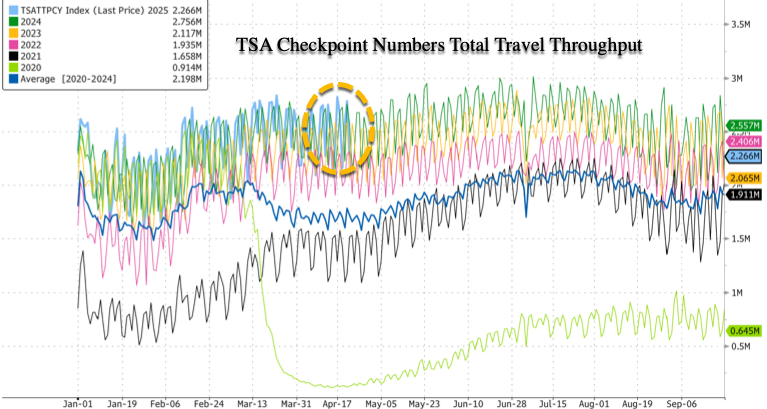 ?itok=ZZvttDXf
Shares of American Airlines are muted in premarket trading in New York following the earnings release. The uncertainty about the economy's reaction to tariffs will likely spark turbulence in the industry.
https://cms.zerohedge.com/users/tyler-durden
Thu, 04/24/2025 - 08:05
China Dismisses Reports Of US Trade Progress As "Fake News," Demands Removal Of Unilateral Tariffs Before Negotiating Table
China Dismisses Reports Of US Trade Progress As "Fake News," Demands Removal Of Unilateral Tariffs Before Negotiating Table
Wednesday's equity market rollercoaster—https://www.zerohedge.com/markets/stocks-spike-session-highs-wsj-report-white-house-looking-slash-china-tariffs
—was driven by conflicting reports on headlines surrounding potential U.S.-China trade talks.
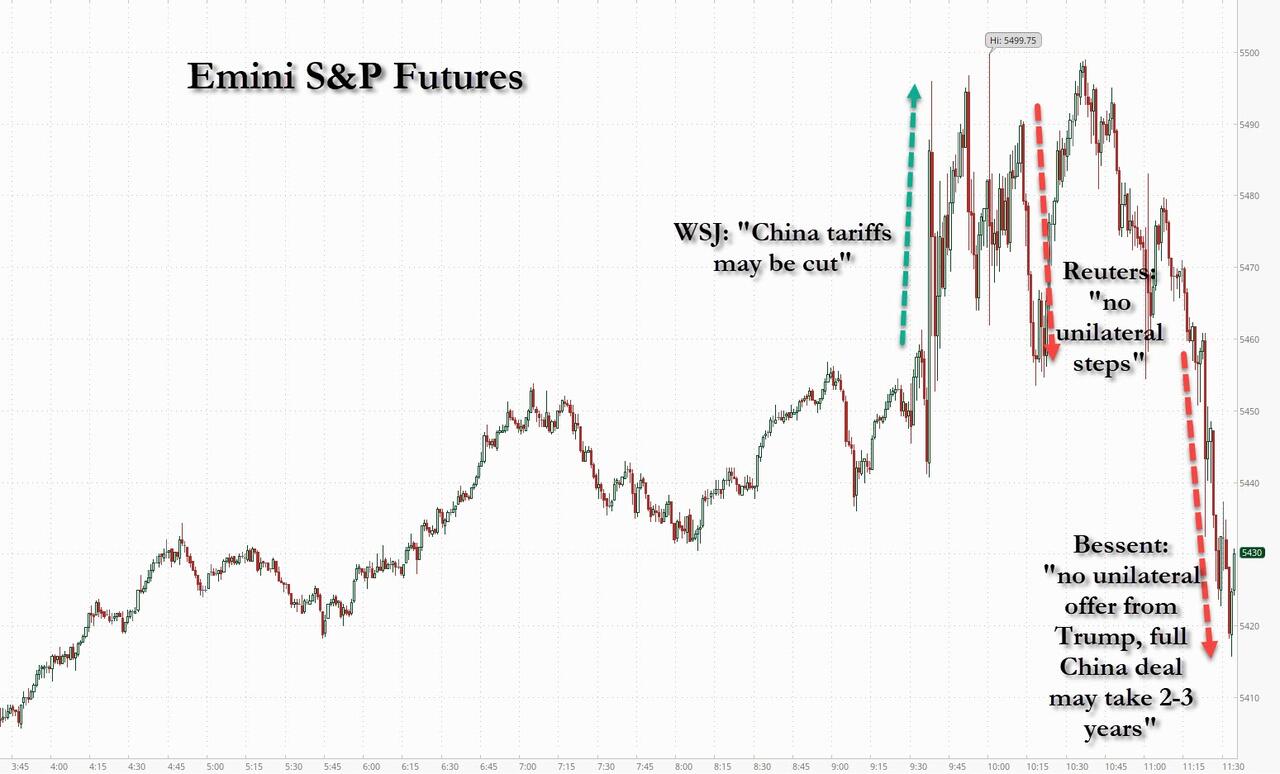 ?itok=ubAJ8dzB
Markets surged after a Wall Street Journal report suggested President Trump considered cutting steep tariffs on Chinese imports. But sentiment quickly reversed when Reuters poured cold water on the claim. Further declines followed after Treasury Secretary Scott Bessent clarified there had been "no unilateral offer from Trump" to reduce Chinese tariffs and that a trade deal could take two to three years to finalize.
In the overnight hours, China demanded Washington remove unilateral tariffs before engaging in trade talks and rejected the claim that any negotiations had progressed.
"The US should respond to rational voices in the international community and within its own borders and thoroughly remove all unilateral tariffs imposed on China, if it really wants to solve the problem," Ministry of Commerce's spokesman He Yadong told reporters at a regular briefing on Thursday in Beijing.
Yadong rejected any signs of progress in bilateral communications, indicating that "reports on development in talks are groundless." He said Washington needs to "show sincerity" if both sides want to make a deal.
Ministry of Foreign Affairs spokesperson Guo Jiakun also called any rhetoric coming from the Trump administration about deal progress "fake news" in a press conference.
The Trump administration's softening stance—reported by the WSJ, which sent US equity markets higher early Wednesday—may signal a willingness by the US to de-escalate the trade war with Beijing in order to shift to the negotiating phase.
Trump told reporters on Wednesday: "Maybe we'll make a special deal, and we'll see what it will be. Right now, [the tariffs are] 145%, that's very high."
One day earlier, Treasury Secretary Bessent told investors at a closed-door meeting: "No one thinks the current status quo is sustainable, at 145% and 125%, so I would posit that over the very near future, there will be a de-escalation. We have an embargo now on both sides."
Alfredo Montufar-Helu, senior adviser at The Conference Board's China Center, told the https://www.scmp.com/economy/global-economy/article/3307745/china-denies-rumours-us-trade-talks-says-claims-have-no-factual-basis?utm_medium=email&utm_source=cm&utm_campaign=enlz-breaking_news&utm_content=20250424&UUID=bc049cc7426498d49950e21e49a2fb73&tc=2
that "news today confirms China has no intention to reach out first with a proposal of its own."
"The impasse in negotiations is driven by a very simple dynamic; no side wants to bear with the political costs of being seen as capitulating to the other side," Montufar-Helu explained.
According to Zhang Zhiwei, chief economist at Pinpoint Asset Management, even if the negotiations between China and the US start immediately, reaching an agreement could take time, and mounting risks exist. The tariff war on both sides could soon unleash pain across global trade.
"It takes time for trade negotiations to proceed between the US and other countries. This means the tariffs will hit global trade and economies for at least several months. It is not clear to what extent inventory build-up and pre-loading of trade in the past few months will help to soften the immediate damage. The question now is how bad trade and other macro data will be in China, the US and other countries," Zhiwei said.
The economic trade storm brews:
https://www.zerohedge.com/markets/amazon-cancels-orders-walmart-pulls-forecast-tariffs-take-hold
https://www.zerohedge.com/markets/chinese-sellers-amazon-panic-after-trumps-tariff-bazooka
https://www.zerohedge.com/markets/chinese-plastics-factories-face-mass-closure-us-ethane-disappears
https://www.zerohedge.com/economics/west-coast-tipping-point-los-angeles-port-set-steep-drop-traffic
Bloomberg reported last week that Beijing wants to see several things from Trump's administration before trade talks begin, such as more respect and naming a point person for the dialogue.
Neither side has announced any upcoming bilateral trade meetings despite Trump's announcement this week to ease tariffs potentially.
https://cms.zerohedge.com/users/tyler-durden
Thu, 04/24/2025 - 07:45
The Path Ahead: Soar, Stall, Or Plummet
The Path Ahead: Soar, Stall, Or Plummet
https://realinvestmentadvice.com/resources/blog/the-path-ahead-soar-stall-or-plummet/
We have good and bad news for investors who want to know whether the stock market will soar, stall, or plummet. First, the good news. This article presents the market path for what lies ahead. Unfortunately, the “right” path is among three likely scenarios.
Despite our inability to definitively show you the way forward, we can share the technical patterns that will help guide us and, in time, assign better odds as to which of the three paths will be the “right” path. Importantly, we also lay out the possible economic, geopolitical, and monetary policy scenarios that would likely correspond with each forecast.
 ?itok=yeOZ7Z7S
Mapping Our Paths
The graph below plots the three most likely market paths going forward.
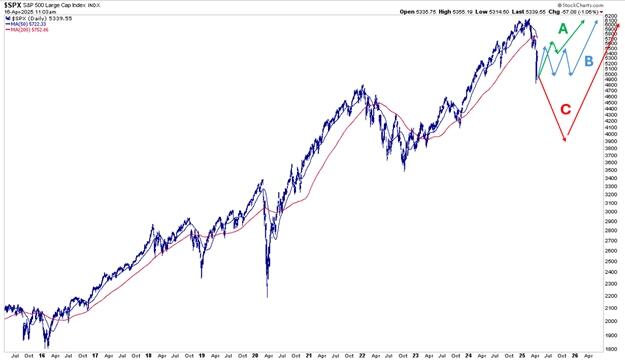 ?itok=nx_5Gt0I
Forecast A is the most bullish scenario. In this scenario, the S&P 500 has already seen its lows for the cycle. The market will grind higher until it meets resistance near the key 50- and 200-day moving averages. After a brief period of consolidation, the market would break above those important moving averages, the death cross between the two important moving averages would flip back to a golden cross, and new highs would follow.
In our opinion, scenario B is the most likely path. It argues that, like scenario A, we may have seen the year’s lows, but the stock market will consolidate in a wide range for many months before resuming a bullish trend.
C is the most concerning path. It entails a series of lower highs and lower lows for the foreseeable future. Moreover, a recession would most likely accompany this scenario.
We now present each forecast in more detail to better understand which event is most likely and how geopolitical, economic, fiscal, and monetary policy decisions can help guide us down the right path or switch paths as the environment changes.
Scenario A (Soar)- Politics, Economics, and the Fed
This scenario argues that the damage tariffs have caused the markets, and the economy is nearing an end. From a geopolitical perspective, this would mean President Trump and many of our important trade partners are close to signing beneficial trade agreements. Moreover, our bullish scenario would also likely require a trade agreement with China or, at a minimum, constructive discussions.
A less hawkish Fed would also promote this outlook, in addition to tariffs. Chairman Powell came out relatively hawkish in mid-April. He claims the Fed is handcuffed due to its low unemployment and tame inflation mandates. To his point, they would cut rates as early as May if they saw the economy weakening and unemployment rising. However, they are still scared of the inflation boogeyman; thus, they are less likely to cut in advance of weakening labor conditions. In Powell’s opinion, tariffs are temporarily inflationary. But he raised the hawkish specter that they might be persistent.
We must also remember that liquidity in the bond market appears to be a potential problem. Bullish markets are fueled by positive sentiment and ample liquidity. If the Fed addresses the liquidity problem, the odds of a bullish outlook rise.
Lastly, case A assumes that any economic damage caused by tariffs and related consumer and corporate financial decisions is short-lived. The scenario assumes that economic activity will resume at its prior pace once a resolution on the tariffs is reached.
Donald Trump has a so-called “Trump Card” in his back pocket. Tax reductions, reduced regulations, and other pro-business legislation could be additional support for a rally to new highs.
Scenario A- Technical Analysis
The graph below shows multiple areas of potential resistance between 5600 and 5800 for the S&P 500. The combination of the key 50 and 200-day moving averages (5705 and 5751), a Fibonacci retracement level (5630), and the green support/resistance line (5800) will likely keep a lid on prices. However, if the news is bullish enough, it will break through that resistance, resuming the bullish trend, and a record high is more likely.
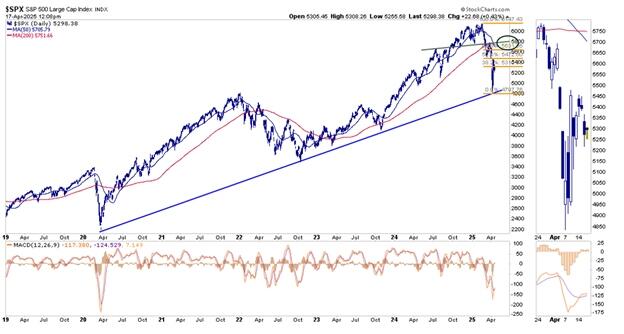 ?itok=zEMTATEg
Scenario B (Stall)- Politics, Economics, and the Fed
Unlike scenario A, scenario B is based on a more extended period for tariff resolution. Furthermore, the signed agreements may not be as economically friendly as we envision for scenario A. Discussions with China may occur. Still, they would likely be embattled with an agreement seemingly far off.
From time to time, tariff deals will be completed, and with each significant trade partner signing an agreement, the market will breathe a sigh of relief and provide optimism, which will help keep a floor on the market near recent lows. Conversely, ongoing trade spats, new tariffs, and retaliatory tariffs will keep a lid on the market.
The potential consolidation range is wide, and activity could be volatile as investors quickly rotate between optimism and pessimism, between the ceiling and the floor. This is the roller coaster scenario we laid out at the beginning of the year.
The Fed may remain hawkish but be willing to cut rates and possibly end QT if tariffs prove to be less of an inflation threat than they worry about. Like trade deals, a more friendly Fed would help keep a floor on losses at the recent lows.
Scenario B- Technical Analysis
We use the same graph as scenario A. However, we added the yellow box to approximate the range the market could travel in throughout most of the year. The consolidation is likely between 5800 and 4900.
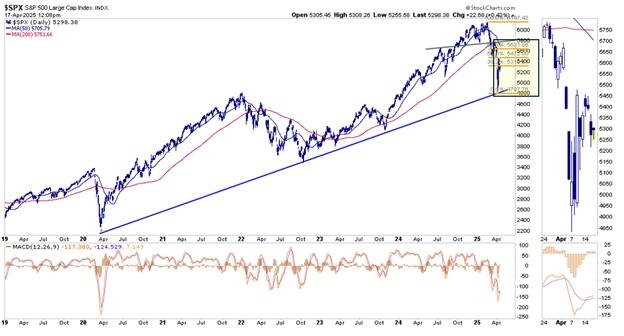 ?itok=A2CPVCcH
Scenario C (Plummet)- Politics, Economics, and the Fed
Scenario C is our bearish outlook. Given that the S&P 500 is already 20+% off its peak, the market is priced to some degree for weaker earnings, slower economic growth, deficit reductions, and prolonged tariff negotiations. For C to play out, i.e., a peak-to-trough decline of 40% or more, the economic outlook and tariff concerns would worsen appreciably.
This scenario would likely coincide with a recession and or a credit event. Moreover, we suspect it also entails that the Fed is slow to react to liquidity issues and the government is providing less fiscal support than normal during downturns.
Corporations will find it hard to make decisions in such an environment and thus have trouble committing capital expenditures. Moreover, with reduced economic activity, they will reduce expenses, including laying off employees. Higher joblessness, a weaker economy, and poor consumer sentiment would result in consumers saving more and spending less.
While this is not our base case forecast, it’s certainly plausible. However, a sharp decline from current levels suggests that the Fed and government do not appreciate, or care, how their policies harm the economy in the short term.
Scenario C- Technical Analysis
Scenario C will likely play out in a series of lower highs and lower lows. Optimistically, this could be like 2022 as shown below. From peak to trough, the S&P 500 fell by 28%. The recent peak to trough was 21%. Thus, if this scenario plays out similarly to 2022, 4400 may mark the low.
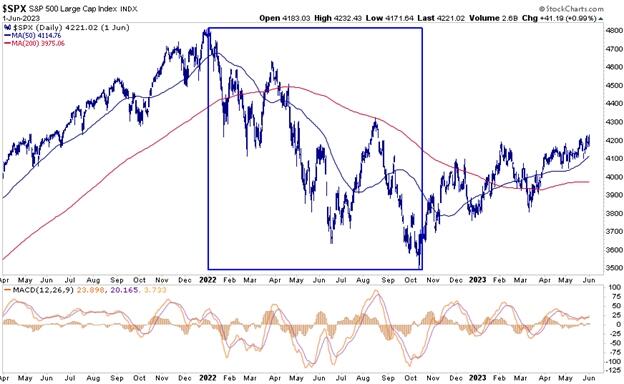 ?itok=aSl0kodO
Another way to estimate a potential bottom is to assume the S&P 500 regresses to its long-term trend. Despite the recent decline, the S&P 500 is about 30% above its 55-year trend (4120), as shown below. Unfortunately, as the graph shows, it can fall below its trend and result in an even more significant loss.
 ?itok=xRIzrhIr
We can also use fundamentals to help us find a reasonable floor. For this exercise, we lean on a https://realinvestmentadvice.com/resources/blog/prediction-for-2025-using-valuation-levels/
we shared in December 2024, which forecasted an S&P price of 4840 if valuations reverted to 2022 levels and earnings growth is flat. As we wrote:
But what if the U.S. encounters a recession due to economic or political policies or a credit-related event? Then, a decline in valuations toward the 2022 level of 22x earnings should be expected. Such would equate to roughly a 20% decline from current levels.
 ?itok=23hzj-Uz
Lastly, we share the graph below to help provide more context for drawdowns from record highs, such as the one we are currently experiencing. Since 1969, nine drawdowns have been worse than the current one. Six of the nine have been limited to -35% or less, leaving three, including the dot-com crash and the financial crisis with larger losses.
 ?itok=SD9m1zpe
Summary
We lean toward scenario B, the roller coaster with periods of intense volatility. If this holds, our ability to follow our trading rules and technical indicators while trying to ignore unproductive behavioral traits will be fully tested.
It’s impossible to predict the path, but considering different scenarios and understanding the likely fundamental factors determining each path provides us with a road map to help us follow one or switch paths if needed.
https://cms.zerohedge.com/users/tyler-durden
Thu, 04/24/2025 - 07:20
https://www.zerohedge.com/markets/path-ahead-soar-stall-or-plummet
These Are The States Where Americans Have The Most Cash In The Bank
These Are The States Where Americans Have The Most Cash In The Bank
In times of economic uncertainty, cash is king.
But where do Americans have the most cash in the bank?
https://www.visualcapitalist.com/states-americans-most-cash-bank-deposits/
, households in Hawaii have the highest median bank balance at $43,600. In contrast, households in Mississippi hold about $2,000 in the bank.
 ?itok=_EkY9ApO
Personal finance advisers https://smartasset.com/data-studies/net-worth-states-2025
analyzed median bank deposit data from the Bureau of Labor Statistics. The latest government figures are from 2022, and a 6.34% inflation rate was applied to convert those figures into 2024 dollars.
This median bank balance number visualized includes checking and savings deposits. Data is unavailable for six states: Alaska, Delaware, North Dakota, South Dakota, Vermont and Wyoming.
While households in states with large economies (California, Florida, Washington) do tend to have more money in the bank, Texas and New York both buck the trend.
Instead, cross-referencing this map with an earlier visualization on https://www.visualcapitalist.com/mapped-median-income-by-state-in-2024/
offers the most correlation. Households in wealthier states tend to have more in the bank.
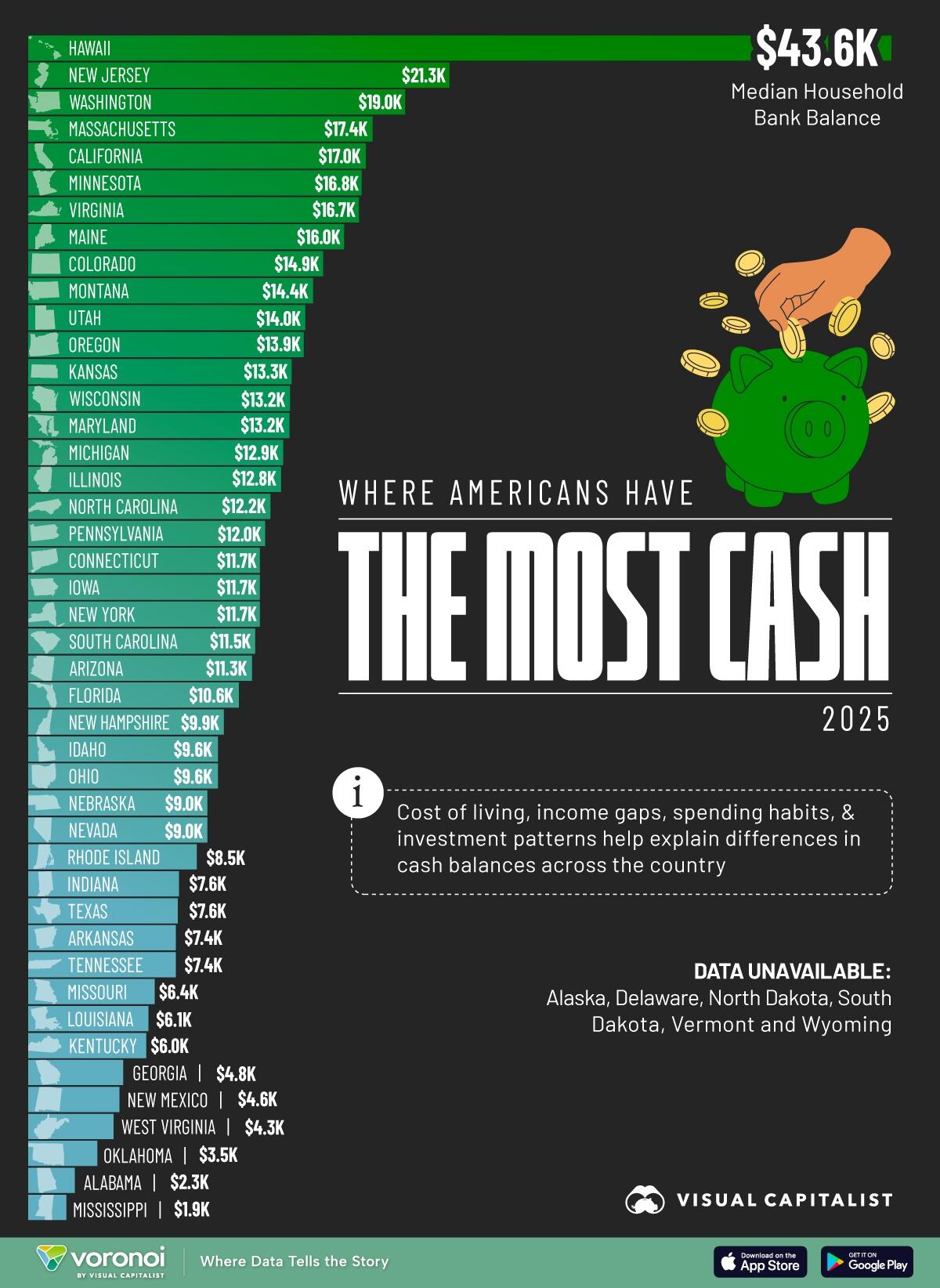 ?itok=mHftizci
For example, Hawaii’s economy ranks 38th in the country. However it also has some seriously wealthy residents. About one in 10 Hawaiian households are millionaires. The state’s median income ($142,000) is only second after DC.
On the other hand, New York City is home to the most millionaires in the country, but the state’s median bank balance ranks 22nd.
This could indicate many things: significant wealth disparity in the state, more spending, or also that New Yorkers are investing their savings.
Meanwhile, Southern states tend to hold less cash in the bank. These same clusters of states also have a higher share of residents under the https://www.visualcapitalist.com/mapped-poverty-rates-by-u-s-state/
.
If these median bank balances have you worried, it’s worth keeping things in perspective. Check out: https://www.voronoiapp.com/money/-Heres-How-Much-Money-Everyone-Would-Have-if-Divided-Equally-4067
to see how wealth concentration is skewed on a global scale. And why the average person has far less than you might think.
https://cms.zerohedge.com/users/tyler-durden
Thu, 04/24/2025 - 06:55
https://www.zerohedge.com/personal-finance/these-are-states-where-americans-have-most-cash-bank
The Big Short & The Bigger Long
The Big Short & The Bigger Long
https://vongreyerz.gold/the-big-short-and-the-bigger-long
For at least 35 years, the monetary system has been telling us that the current era is coming to an end.
 ?itok=gEQ53WYJ
That means a debt collapse, a currency collapse and a collapse of most bubble assets like stocks and property.
THUS THE BIG SHORT!
As I am writing this on Easter Monday, the Dow is down 1,100 points (2.9%) and the Nasdaq is down 3.3%.
Anyone who buys the dips will be slaughtered. As I have said for a very long time, before this is over, stocks will be down 90-99% in real terms, which is gold.
More importantly, this total collapse has very little to do with https://vongreyerz.gold/search/trump
. More later.
And don’t for a moment believe that gold is overvalued. As many have used conventional technical tools to predict a gold correction, I have been saying for a long time that gold is in an acceleration phase and will reach multiples of the current price. (Yes, of course, there will be corrections on the way up, but most probably not yet.)
THUS THE BIG LONG!
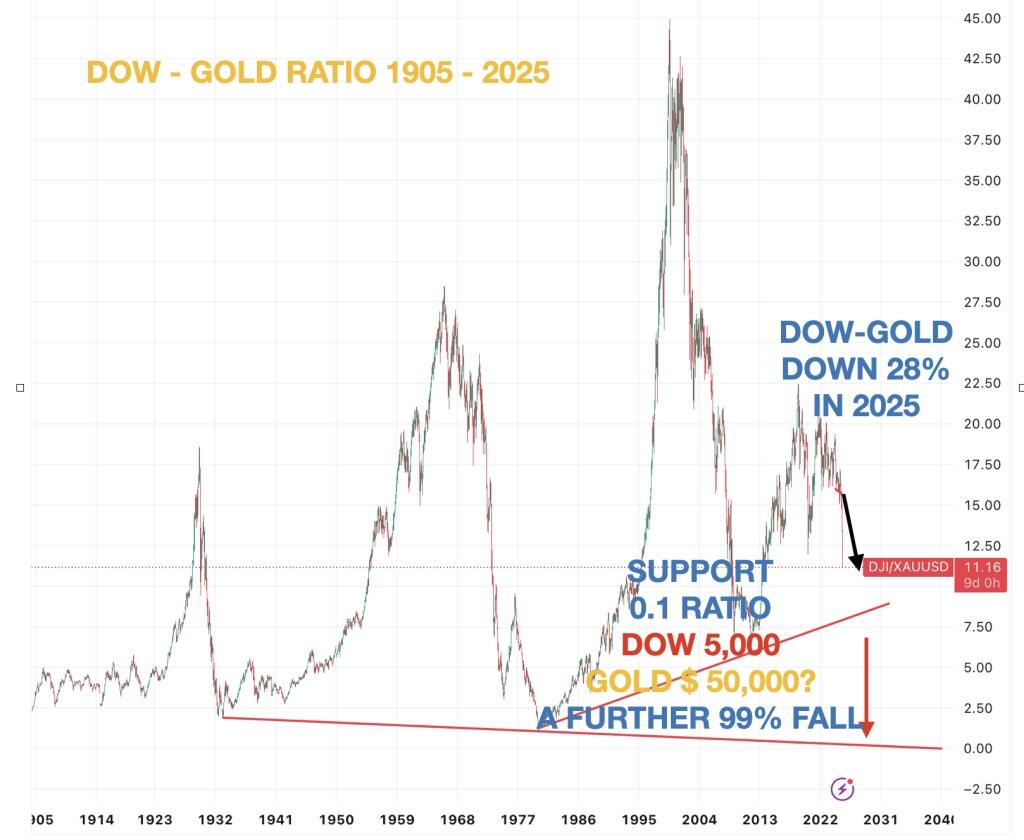 ?itok=ym_kjYU7
END OF A MONETARY ERA
https://vongreyerz.gold/risks#currency
is always the same, with bubble assets going up in smoke.
The majority of investors haven’t got a clue what is happening. They are hanging on to their stocks, hoping that Trump will save them by firing Powell and telling the next Chairman of the Fed to lower interest rates.
But the time of manipulating rates is over. The market will now determine rates, which it should always do. And with uncontrollable debt escalation in the US and many other countries, the cost of debt can only go one way – UP!
Remember, there is only one buyer of US debt, which is the Fed. But the Fed can only buy debt if the US government issues more debt.
And therein lies the crux. More debt must be created in a futile attempt to save the ever-growing and out-of-control finances of the US.
This is without doubt the biggest Ponzi scheme in history. Madoff would certainly have enjoyed it.
And still, it would have been so easy, as all of this has been totally predictable.
To paraphrase Churchill, the more you study history, the more self-evident the future becomes.
Still no government, no central banker, no journalist and virtually no market student spends any time on learning from the past.
Why, why, why, you ask yourself. Well, it is clearly sheer arrogance in believing that we know better today and that we have better tools. And of course, “The times are different today”. Hmmm!
But they are not and have never been.
Every monetary system has collapsed in history, and every currency has gone to ZERO, without fail.
As I witnessed Greenspan’s expansionary policy after the property market collapse in the 1990s and how debt and derivatives quickly continued to grow, I was certain that we were seeing the end of a major monetary system.
I had, since the late 1980s, been convinced that gold was the best insurance against yet another coming failure of the monetary system.
As major central banks like the UK and Switzerland were selling their gold in the mid to late 1990s, it was clear that we were near the bottom. So we waited until the 1999 gold bottom at $250 and confirmation of the gold price recovery in the early 2000s before buying physical gold.
BACK TO TRUMP – the culprit
But everything is, of course, Trump’s fault!
All the misery hitting the world now is due to Trump’s capricious actions.
Here are just a few examples of how TRUMP is now wrecking not just the US but the whole world economy, according to the general public as well as the media and politicians in most countries:
Stocks crashing, bonds crashing, rates up, dollar crashing, trade wars with massive daily tit for tat yo-yo swinging tariffs between 10% and 145%, much higher Inflation, collapse of global trade etc, etc.
Yes, all of the above is happening and much more and it is all Trump’s fault.
But is it really? No, https://vongreyerz.gold/search/trump
.
Instead, Trump happens to be the catalyst.
An absolutely superb analysis of the US-China trade war was given by this very acute Chinese influencer:
https://www.tiktok.com/@speedboyonlinestore?refer=embed
Absolutely Right
https://www.tiktok.com/music/original-sound-SpeedboyOnlineStore-7494856616848739088?refer=embed
Leaders are instruments of their time, and they appear at the time in the cycle to carry out what was going to happen anyway.
Just like Thatcher and Reagan were the right leaders to lead the upturn in the early 1980s, Trump is perfect for creating the havoc and chaos that comes with the end of a major monetary era.
What is happening in the US and global economy today, and the total collapse which is about to happen, is not “Trump’s fault”.
He just happened to be the right person to execute the inevitable downfall of a major monetary era.
But even if it is not his fault, history will unfairly blame him as the villain who brought the world economy down, and thus see him as probably the worst president in history.
So not the best of timing for Mr Trump.
GOLD IS NATURE’S MONEY
Gold is the only money that has survived in history because it is the only money which is made by nature.
Gold has history on its side – 5,000 years, as the only surviving currency, is enough proof. Let’s see where Bitcoin is in 5,000 years…
Investors have nowhere to run.
Government bonds were seen as good as gold. That’s why they were called Gilts in the UK.
But today, they are not worth the piece of paper they are written on these days.
Governments won’t even be able to pay the interest on them. And the capital is already lost.
And the currency these bonds are issued in is also on its way to ZERO.
It is incomprehensible and irresponsible to hold government bonds today!
Investors are guaranteed to lose 100%.
And stocks are likely to lose at least 90% in real terms, gold. The same with property, private equity and all other leveraged assets.
GOLD IS THE ULTIMATE WEALTH PRESERVATION ASSET
That is one of the reasons gold is going up. There is nowhere else to turn to for anyone looking for wealth preservation.
But gold can, of course, not absorb all the capital which is looking for safety.
The coming gold demand can only be satisfied at much, much higher gold prices.
Gold is now also a Tier 1 asset. This means that physical gold is, according to the Bank for International Settlements rules, as safe as cash and government bonds.
This is, of course, laughable. As I just explained, cash and government bonds will be worthless. Thus, it is an insult to gold to put it in the same category as cash and bonds.
As we enter the biggest global wealth destruction in history, we will simultaneously witness a long-term revaluation of gold. Gold is the only monetary asset which has survived in history and will, in the coming years, be the only asset which will preserve investors’ wealth.
Thus, it is important to understand that this is not just another gold rally. Instead, gold will resume the role that it has historically had, as nature’s money and the only REAL MONEY that has ever existed.
The current rerating of gold to what it was always meant to be is both historical and fundamental. Gold will be permanently re-rated and revalued, both as a transactional asset and as a wealth preservation asset that every investor must hold.
But gold won’t be just 0.5% of global financial assets as it is today. More likely gold will be 10% or more.
I have been standing on a soapbox for over 25 years, warning about the risks to the financial system and the critical importance of gold for wealth preservation purposes.
Few have listened. But now, as gold has gone up 11- 12x depending on the currency it is measured in, everyone is talking about gold.
There will be gold sellers popping up everywhere, and many without the integrity that investors must demand.
Only deal with companies that have the highest reputation and have been reputably involved with gold for at least 15-20 years. The long-term superior reputation of the owners and management is critical.
Hold gold in the https://vongreyerz.gold/services#vault-options
.
Don’t hold your gold in the US, which is more likely to take irrational actions.
Don’t hold your gold in banks.
Also, only hold physical gold, which you can access directly in the vault.
 ?itok=Yh9Qt92G
Many will wonder about https://vongreyerz.gold/the-fatal-effects-of-debt-rising-gold-silver
. Yes, silver is likely to go up faster than gold. But it is much more volatile and thus riskier. We recommend 25% silver maximum and 75% gold.
And remember that times are likely to become very difficult. Help your family and friends to whatever extent you can.
 ?itok=yHLiKbfd
https://cms.zerohedge.com/users/tyler-durden
Thu, 04/24/2025 - 06:30
"King Of Kings" Christian Film Outperforms Many Woke Studios At Box Office
"King Of Kings" Christian Film Outperforms Many Woke Studios At Box Office
The animated biblical film "The King of Kings", featuring Pierce Brosnan and produced by Angel Studios—the once small-time production company behind the surprise blockbuster "Sound of Freedom" in the summer of 2023—has continued its box office climb for a second consecutive week.
 ?itok=djw_3bWp
According to https://www.boxofficemojo.com/weekend/2025W16/?ref_=bo_hm_rw
, The King of Kings—inspired by Charles Dickens—follows a father and son on an imaginative journey through the life of Jesus.
 ?itok=aaY4T9J9
The Christian movie ranked number three on the Domestic 2025 theater list, behind Warner Bro. 's "A Minecraft Movie" in the second spot and Warner Bro. 's "Sinners" in number one. Just for reference, Walt https://www.zerohedge.com/personal-finance/awful-reboot-snow-white-bombs-box-office
is number ten on the list.
 ?itok=f5OhvFbe
On Sunday, Angel Studios released a https://www.angel.com/press/release/angels-the-king-of-kings-holds-strong-to-earn-an-estimated-usd17-2m-in
boasting about its theatrical footprint increasing by 10% for the second week and earning "a projected $17.2M second weekend, bringing its estimated box office cume to $45,339,117."
"Buoyed by its Rotten Tomatoes PopcornMeter rising to 98% and its coveted A+ CinemaScore, The King of Kings is poised for a strong theatrical run," the studio said.
"At Angel, our Angel Guild plays a crucial role in picking winners, and this film is a testament to that vision," Brandon Purdie, Global Head of Theatrical Distribution & Brand Development at Angel Studios, stated, adding, "The King of Kings is an epic, emotional journey made for the big screen. Theaters are responding by making room, and audiences are flocking in droves, speaking loud and clear: they're here for stories that amplify light."
Readers may recall Angel Studios' release of the low-budget flick "Sound of Freedom" in the summer of 2023. This film became a https://www.zerohedge.com/markets/sound-freedom-shatters-expectations-hits-100-million-milestone-box-office
, defying expectations to gross over $200 million globally and ignited a nationwide conversation on child trafficking.
Movies with a purpose versus mindless, woke nonsense appear to be a winning strategy for studios. Yet Disney still hasn't read the tea leaves about the https://www.zerohedge.com/political/overton-window-shift-towards-liberty
.
https://cms.zerohedge.com/users/tyler-durden
Thu, 04/24/2025 - 05:45
Professor: Migrants Cost Millions, Are Seeking 'Revenge' On Europe
Professor: Migrants Cost Millions, Are Seeking 'Revenge' On Europe
Not only must Poland refuse mass migration due to the societal costs, but the country also simply cannot afford it. Due to this reality, there can be no compromise over mass immigration, says Polish professor and lawyer Witold Modzelewski, who works at the University of Warsaw.
 ?itok=6PcI4b2U
In a conversation on the FMC27NEWS YouTube channel, Prof. Witold Modzelewski said he can provide a conservative estimate of how much each migrant costs Poland per day, which he said is 150 Polish zlotys (PLN), or €35 per day.
“If we chose an assimilation policy – assimilating those who choose us and we agree to have them here – then in today’s reality it is not just about mere food. After all, these people need to be provided with a place to stay…. they need to be covered by a state umbrella financing the so-called security services. If we were to assume the reality of today’s cost, it is an estimated PLN 150 per day. However, this is an underestimate,” said Prof. Modzelewski.
However, in other countries like Germany, these cost estimates are far higher, in part due to the higher cost of living.
Modzelewski may also not be factoring in social welfare, medical costs, integration courses, and education into his estimate.
🇵🇱 Migrants in Poland enjoy billiard and table tennis competitions to celebrate the International Day of Tolerance.
The men from countries like India, Iraq, Iran, and Sri Lanka then received free burgers, Belgian fries, and soft drinks at the asylum center in Lesznowola. https://t.co/ddWMUo1ed0
— Remix News & Views (@RMXnews) https://twitter.com/RMXnews/status/1862105167966949851?ref_src=twsrc%5Etfw
As the professor pointed out, this amount concerns direct expenses, and there would also be indirect expenses.
“Who can we take from to finance it? There is no one to take from. Therefore, let’s put this problem aside as one we cannot afford and as one we will not participate in,” the professor stated.
He said that even if they can assume that Polish society would like to take on part of the costs of supporting migrants for humanitarian reasons, Poland cannot afford it.
Prof. Modzelewski emphasized that Poland bears no responsibility for the criminal colonial past of “Old Europe.” He pointed out that the people who are currently inhabiting Europe through generational transmission “want to take revenge.”
“Their rebellion is today, but the motive is the past. And we cannot participate in this,” said the professor.
“We have nothing in common with the colonial past of the old West and let’s not look for anything in common. If someone wants to drag us into collective responsibility for those crimes, for centuries of objective wrongs, then we have to say ‘no.”‘
Germany could send up to 70,000 migrants to Poland per year, according to a Polish MP.https://twitter.com/DariuszMatecki?ref_src=twsrc%5Etfw
filmed the new massive migrant center near the Polish border.
Germany "can't cope with the migration problem."
The solution? Send them to Poland and other EU nations. https://t.co/b0Ak8fctgn
— Remix News & Views (@RMXnews) https://twitter.com/RMXnews/status/1892965780813148494?ref_src=twsrc%5Etfw
According to Polish publication https://dorzeczy.pl/ekonomia/718122/tyle-kosztuje-polakow-dzienne-utrzymanie-jednego-imigranta.html
regions – Africa and the Middle East – from Germany to our country. The lack of consent of Poles to open borders for mass migration is clearly shown by all polls.”
Poland is expected to https://rmx.news/poland/up-to-100000-migrants-could-be-sent-to-poland-per-year-under-terms-of-eu-migrant-pact-polish-legal-foundation-tells-remix-news/
over the coming years due to the EU migration pact, which obligates member states to accept migrants.
https://cms.zerohedge.com/users/tyler-durden
Thu, 04/24/2025 - 05:00
https://www.zerohedge.com/geopolitical/professor-migrants-cost-millions-are-seeking-revenge-europe
UK To Greenlight Experiments To "Dim The Sun" In Bid To Stop Global Warming
UK To Greenlight Experiments To "Dim The Sun" In Bid To Stop Global Warming
It's a project reminiscent of the movie Snowpiercer, in which governments institute a global experiment to spray chemicals into the atmosphere to stop global warming and end up creating a new ice age instead. Once again reality is downstream from fiction as the UK is set to bankroll an https://www.telegraph.co.uk/news/2025/04/22/experiments-to-dim-the-sun-get-green-light/
. This goal will be pursued in field trials which could include injecting aerosols into the atmosphere, or brightening clouds to reflect sunshine.
The project is being considered by scientists as a way to prevent "runaway climate change", despite the fact that there is zero evidence to support the claim of runaway climate change.
Aria, the Government’s advanced research and invention funding agency, has set aside £50 million for projects, which will be announced in the coming weeks.
 ?itok=7lmlANq3
Prof Mark Symes, the program director for Aria (Advanced Research and Invention Agency), said there would be “small controlled outdoor experiments on particular approaches”.
“We will be announcing who we have given funding to in a few weeks and when we do so we will be making clear when any outdoor experiments might be taking place,” he said.
“One of the missing pieces in this debate was physical data from the real world. Models can only tell us so much. Everything we do is going to be safe by design. We’re absolutely committed to responsible research, including responsible outdoor research. We have strong requirements around the length of time experiments can run for and their reversibility and we won’t be funding the release of any toxic substances to the environment.”
One major area of research is Sunlight Reflection Methods (SRM), which includes Stratospheric Aerosol Injection (SAI) whereby tiny particles are released into the stratosphere to reflect sunlight.
Another potential project is Marine Cloud Brightening (MCB) in which ships would spray sea-salt particles into the sky to enhance the reflectivity of low-lying clouds.
Climate scientists say efforts to reduce carbon emissions are not working fast enough and that levels are "too high", leading to irregular weather patterns and eventually the temperature "tipping point" in which an exponential crisis is created by heat creating carbon and then carbon creating more heat.
The problem is that nothing in this theory is backed by causational evidence or the climate history of the Earth. In other words, climate scientists are siphoning up government grant money to create solutions to a problem that doesn't exist.
The vast majority of climate change theories are based on data collected since the 1880s - 140 years of data is a insignificant window of time in the long lifespan of the Earth's climate.
 ?itok=y54ZTSWd
When we look at the temperature data over millions of years, we find that today's temps are near the lowest in our planet's history (we just exited an Ice Age not long ago and climate scientists want us to believe it's too hot).
 ?itok=IyUDCO0H
When comparing millions of years of carbon data to parallel temperature data, it becomes clear that there is no correlation between carbon levels and global warming. This graph also proves that carbon and temperature levels can rise and fall independently of human industry and human industry's effects on these patterns is negligible or non-existent.
 ?itok=1YR4dgT7
There is also no data to prove correlation or causation between carbon emissions and extreme weather patterns. The entirety of the climate change theory is based on lab models with no corresponding examples in nature. It is pure hysteria.
This makes the use of atmospheric manipulation by governments all the more disturbing. If they truly are trying to "dim the sun" for the sake of preventing global warming, then they are doing so based on a delusion. There is also the possibility that they know man-made climate change is nonsense and these experiments serve another purpose. In either case, they should be stopped. No one voted for politicians to blot out the sun (or to find a way to blot out the sun). No one gave them permission to pump particulates or chemicals into the sky. Their actions constitute a radical violation of the public trust.
https://cms.zerohedge.com/users/tyler-durden
Thu, 04/24/2025 - 04:15
https://www.zerohedge.com/weather/uk-greenlight-experiments-dim-sun-bid-stop-global-warming
Back With A Vengeance: Nina Jankowicz Calls On Europeans To Oppose The US
Back With A Vengeance: Nina Jankowicz Calls On Europeans To Oppose The US
Nina Jankowicz, the former head of Biden’s infamous Disinformation Governance Board, was “back with a vengeance.”
 ?itok=RX2m4sM6
After the outcry over the board led to its elimination, Jankowicz did what many of the displaced disinformation experts have done: she peddled her dubious skills to Europeans and others like https://jonathanturley.org/2025/02/24/the-american-ronin-how-displaced-disinformation-experts-are-seeking-new-opportunities-in-europe-and-academia/
.
Now, Jankowicz has appeared before one of the most anti-free speech bodies in the world — the European Union — to https://www.instagram.com/reel/DIw5Z31qRmV/
those 27 countries to fight against the United States, which she called a world threat.
” came to alight upon Europe is a familiar tale.
The European Union has become the global hub for censorship efforts and, after she departed from the government, Jankowicz made a beeline for Europe.
of the song “Supercalifragilisticexpialidocious.”
After the Biden Administration reluctantly disbanded her board, she later moved to https://www.washingtonexaminer.com/news/2882231/former-biden-disinformation-chief-nina-jankowicz-registers-as-foreign-agent/
as a foreign agent to continue her work to block views that she considers disinformation.
The false portrayal of the United States as a lawless, autocratic nation no doubt thrilled the Europeans.
In announcing her heading a private disinformation group called the American Sunlight Project, Jankowicz https://jonathanturley.org/2024/04/28/shes-baaaack-disinformation-czar-jankowicz-to-head-new-project-before-election/
the same hysteria to attract donors, insisting that “Disinformation knows no political party. Its ultimate victim is our democracy.”
Of course, Jankowicz herself has been accused of disinformation that served one particular party.
She was previously criticized for allegedly https://nypost.com/2022/04/28/wh-pick-for-disinformation-board-spread-hunter-biden-laptop-lie/
The ultimate irony is that Jankowicz knows that she can count on many of us in the free speech community to support her right to spread such sensational and inflammatory information.
She has every right to trash this country and the results of the election.
Jankowicz has clearly found a home with globalists in Europe where our “Mary Poppins of Disinformation” is “https://www.youtube.com/watch?v=QXn3r5plloI
”
* * *
Jonathan Turley is the author of best-selling book “https://www.amazon.com/exec/obidos/ASIN/1668047047?tag=simonsayscom
.”
https://cms.zerohedge.com/users/tyler-durden
Thu, 04/24/2025 - 03:30
https://www.zerohedge.com/political/back-vengeance-nina-jankowicz-calls-europeans-oppose-us
Auto Tariffs Increasingly Looking Like A "Permanent Fixture", Deutsche Bank Says
Auto Tariffs Increasingly Looking Like A "Permanent Fixture", Deutsche Bank Says
According to Deutsche Bank, with U.S. auto tariffs increasingly looking like a permanent fixture, they’re closely monitoring how automakers are responding each week—particularly on pricing, incentives, and production shifts, according to a note out this week by analyst Edison Yu.
While the administration has hinted at potential relief, there’s still no clarity on what that might entail. For now, Deutsche Bank assumes a 25% tariff applies to all imported vehicles, except those qualifying under USCMA rules until customs can fully assess non-U.S. content. Imported parts are expected to fall under the tariff starting May 3rd.
Responses among automakers remain mixed. Ford plans to hike prices on new vehicles next month, Tesla is reportedly halting Chinese parts imports for its CyberCab and Semi programs, and layoffs are anticipated at Volvo truck plants.
Last week we https://www.zerohedge.com/markets/fluid-situation-deutsche-bank-how-auto-oems-are-responding-tariffs
that Deutsche Bank said automakers (OEMs) are adopting a wide range of strategies to navigate the uncertainty—adjusting pricing, incentives, and production plans on a rolling basis.
The bank emphasized that the market should operate under the assumption that “all imported vehicles are currently subject to the 25% tariff,” with imported parts facing similar duties starting May 3.
In its April 15 update, Deutsche Bank observed, “Across OEMs, we continue to see a dispersion of reactions.”
 ?itok=Styzx4xZ
For instance, Tesla has paused sales of U.S.-built Model X and S vehicles in China, while GM halted operations at its CAMI Assembly Plant. Mazda, Mitsubishi, and Subaru have also taken a variety of measures—ranging from absorbing price increases to stopping U.S. inventory shipments altogether.
Among notable strategic shifts, Ford is offering broad employee pricing discounts and reshuffling production to its Fort Wayne facility and Honda has publicly stated it will not raise consumer prices as it evaluates its response.
Meanwhile, Infiniti has indefinitely paused production of two crossover models built in Mexico and Rivian and several other EV manufacturers have so far maintained operations but are assessing longer-term impacts.
While some OEMs are absorbing tariff costs temporarily—Mazda, for instance, will do so through April—others are preparing to pass the cost downstream. Deutsche Bank notes that despite a lack of sweeping public announcements, “the cost impact will not be trivial,” as one unnamed CEO warned.
Deutsche Bank continues to track weekly developments and offers updated data in spreadsheet form upon request, cautioning investors that policy developments could shift “overnight.”
We noted earlier this month https://www.zerohedge.com/markets/they-need-little-bit-time-auto-stocks-pop-trump-tariff-comments-deutsche-still-cautious
on auto stocks. In a note on Monday it said that as Q1 2025 earnings approach, automakers still face significant uncertainty from new tariffs. They expect strong early-year demand as consumers buy ahead of price hikes, followed by a slowdown in the second half as tariffs bite—pushing 2025 U.S. auto sales to 15.4 million, down from 16.0 million in 2024.
Ford and GM could see gross costs rise by over $10 billion, while Tesla and Rivian face smaller impacts due to their supply chains, the note said. These estimates assume a 25% tariff on imported vehicles and parts starting May 3, with exemptions for USMCA-compliant content.
https://cms.zerohedge.com/users/tyler-durden
Thu, 04/24/2025 - 02:45
'Live Free & F**k Italian Girls' - African Soccer Player Fired From Italian Team After Threatening Meloni's 7-Year-Old Daughter
'Live Free & F**k Italian Girls' - African Soccer Player Fired From Italian Team After Threatening Meloni's 7-Year-Old Daughter
A Black footballer from Cameroon mocked Deputy Prime Minister Matteo Salvini and Italian Prime Minister Giorgia Meloni, insulted the police, boasted that he eats for free and does not pay rent, and that he “f**ks Italian girls.” He has now been fired from the Cluentina Calcio football club in Italy.
 ?itok=ycz9BMNZ
The striker, Domingue Ibii Ngwang, filmed himself in front of a police vehicle parked in front of the police headquarters in Macerata. He made the extremely vulgar and pedophilic remarks towards Meloni’s 7-year-old daughter.
“Meloni, I heard that you have a beautiful daughter… I’m black, handsome and hot, with my handsome and hot brother. We eat for free, we sleep for free, we don’t pay rent and then f**k Italian girls.”
🇮🇹 An African migrant has been fired from his Italian football team after threatening Giorgia Melon's 7-year-old daughter.
"Meloni, I heard that you have a beautiful daughter… I'm black, handsome and hot... We eat for free, we sleep for free, we don't pay rent and then we… https://t.co/0RZIV5SzdR
— Remix News & Views (@RMXnews) https://twitter.com/RMXnews/status/1914951300061577590?ref_src=twsrc%5Etfw
Before making the statements, he offered to sell Salvini a police car for 50 cents in what appears to be an attempt to belittle Salvini and the police — a sort of sign of disrespect.
“Salvini, do you see this car? I’m selling it for 50 cents,” says Ngwang.
The football club, which is located in the Marche region, has now terminated the 27-year-old Cameroonian striker’s contract due to the sexist and violent remarks, according to Italian newspaper https://www.gazzetta.it/Calcio/altri-campionati/22-04-2025/calciatore-dilettante-contro-salvini-e-meloni-video-virale-di-domingue-ibii-ngwang.shtml?refresh_ce
.
Salvini commented about the video himself on Instagram, calling the footballer an “idiot.”
“Asd Cluentina Calcio totally dissociates itself from the contents represented in the video published by its member,” wrote the team after terminating the footballer’s contract.
“We also communicate our intention to immediately terminate the contract that binds us to his sporting performances, as we consider his serious statements to be deeply damaging to our reputation.
We recall, in fact, that Asd Cluentina Calcio has distinguished itself in the football panorama of the territory for over 50 years for inclusion, solidarity and friendship.
For this reason, we firmly believe it is necessary to nip in the bud any undue association between the violent and unacceptable contents expressed by Ibii Ngwang in the video and the history of Asd Cluentina Calcio, reserving, in the event of undue instrumentalization, the right to protect our image in the competent offices.”
The police are also investigating the case. His threat towards Meloni’s daughter may be especially problematic.
https://cms.zerohedge.com/users/tyler-durden
Thu, 04/24/2025 - 02:00