nostr:nprofile1qy2hwumn8ghj7un9d3shjtnddaehgu3wwp6kyqpqqpuhh3jqmxl42sa3668qdqf4pcfuay3gykvn74zxvyfxg79wwwlqhnuxsy nostr:nprofile1qy2hwumn8ghj7un9d3shjtnddaehgu3wwp6kyqpqc9m22hkc5h6zgrwkz48crhcpw6vch2rf6j97746ugl3neys86jeqcr59k6 nostr:nprofile1qy2hwumn8ghj7un9d3shjtnddaehgu3wwp6kyqpqn0l57s4a7l557kafglhkf3cxqvvhc7c2ctleyfcy4c5py3v5ezss87gy5z - that's a fun one.
Let’s Buy California from Trump – Denmark’s Next Big Adventure
Have you ever looked at a map and thought, "You know what Denmark needs? More sunshine, palm trees, and roller skates." Well, we have a once-in-a-lifetime opportunity to make that dream a reality.
Let’s buy California from Donald Trump!
Yes, you heard that right.
California could be ours, and we need your help to make it happen.
nostr:nprofile1qy2hwumn8ghj7un9d3shjtnddaehgu3wwp6kyqpqlap3j56u4rlekq8pgy36k83m7yz8xxhmlzfnem482e8x363xplrq6tguz4 - I left a comment on your blog. I agree with you!
Another fun thing: Euler's formula
𝑛² + 𝑛 + 41
which gives primes from 𝑛=1 to 𝑛 = 39 is actually related to the fact that 41×4-1 = 163 is a Heegner number. And this fact has (less impressive) relatives for the smaller Heegner numbers!
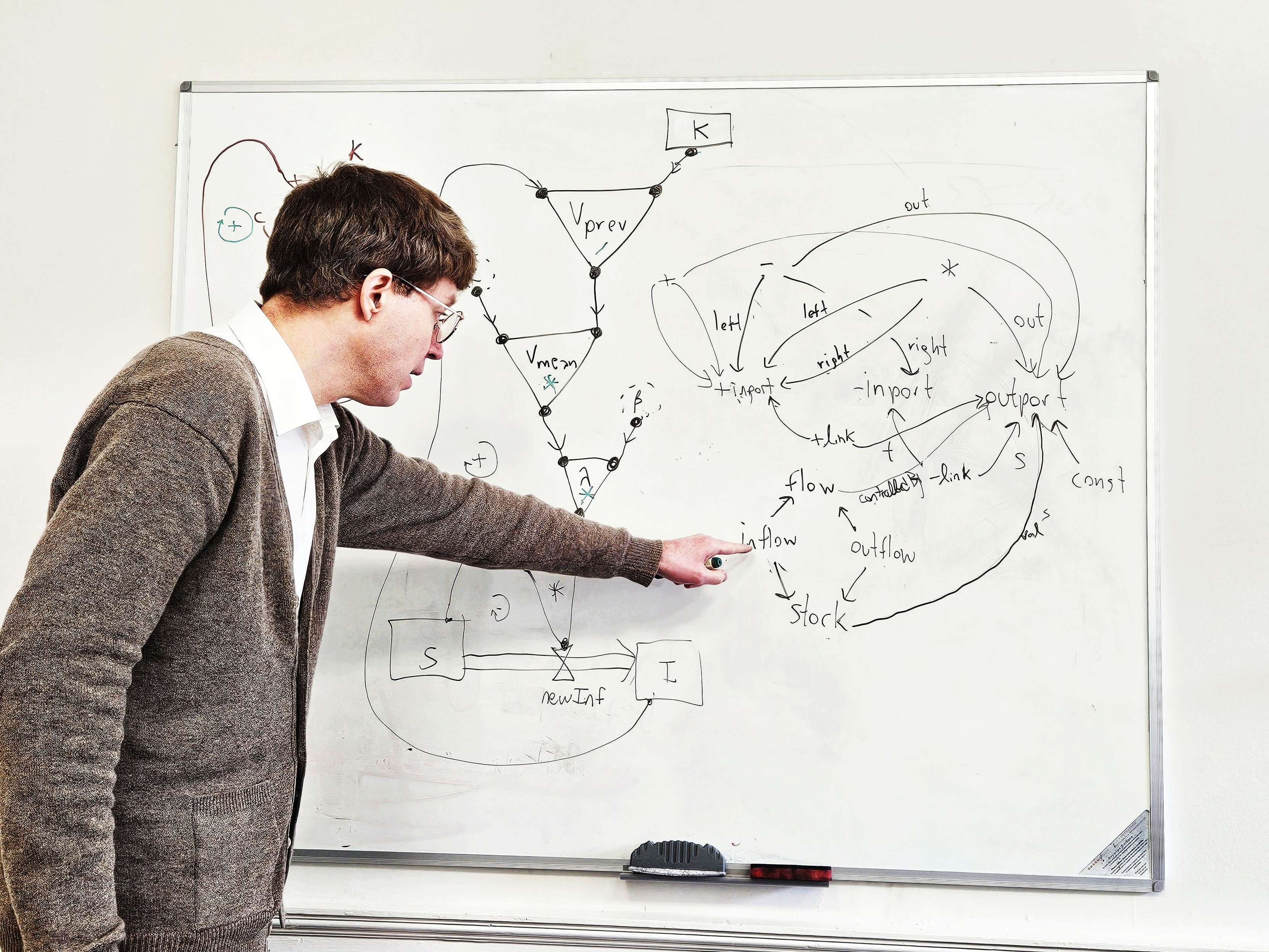
An epidemiologist having a category-theoretic revelation. My colleague Nathaniel Osgood, discovering how the process of converting stock and flow diagrams into causal loop diagrams can be captured by a left adjoint functor between presheaf categories. These two kinds of diagrams are both important in the modeling tradition called 'system dynamics', which is used in epidemiology as well as economics and other disciplines.
nostr:npub1vu7rsne9sx3y7dsmpgw3mzdlq0pnhwafw0fk83xlx0fsael7sheqgwug7a - they could have titled the paper "Why not?"
It's time to have that talk with your kids. About quantum mechanics:
https://www.smbc-comics.com/comic/the-talk-3
If our civilization collapses, extraterrestrial archeologists can look at this and be impressed. Three satellites following the Earth in an equilateral triangle, each 25 million kilometers from the other two. Each contains two gold cubes in free-fall. The satellites accelerate just enough so they don't get blown off course by the solar wind. The gold cubes inside feel nothing but gravity.
Lasers bounce between each cube and its partner in another satellite, measuring the distance between them to an accuracy of 20 picometers: less than the diameter of a helium atom! This lets the satellites detect gravitational waves — ripples in the curvature of spacetime — with very long wavelengths, and correspondingly low frequencies.
It should see so many binary white dwarfs, neutron stars and black holes in the Milky Way that these will be nothing but foreground noise. More excitingly, it should see mergers of supermassive black holes at the centers of galaxies as far as... the dawn of time, or whenever such black holes were first formed. (The farther you look, the older things you see.)
It may even be able to see the "gravitational background radiation", the thrumming vibrations in the fabric of spacetime left over from the Big Bang. This radiation was created before the hot gas in the Universe cooled down enough to become transparent to light. So it's older than the microwave background radiation, which is the oldest thing we see now.
It's called LISA - the Laser Interferometric Satellite Antenna. And we're in luck: ESA has just decided to launch it in 2034.
nostr:npub1vc25h5d4a3aeuvgf3da9xwmn2sfzpts8rn5nzkays4qw4rdh4rgsw82vj5 - interesting, thanks! So this is German only, not EU?
What happens in a world without equality? All you have are things, processes that turn one thing into another, meta-processes that turn one process to another, and so on... forever!
If this is too scary you can truncate it at the nth level. Then you're dealing with an 'n-category'. This has things (called 'objects'), processes (called 'morphisms'), meta-processes (called '2-morphisms') and so on up to n-morphisms.
In this talk I explain the periodic table of n-categories - a fundamental structure that organizes our understanding of these .
I put a lot of work into making it fun and easy to follow... and I think it worked!
(Alas, the video quality is still not great, but it's better than last week's lecture where I introduced n-categories. The volume is low so you have to really crank up your speaker... and the only way I have to boost the volume of a video also makes the file a lot bigger.)

I don't think spreading Musk's stupid tweets really helps.
nostr:npub17lkugy0zjet48jta4vefcwntapwqjnpsj35yzdw5kjfwh5qx0g5sw9l3x2 nostr:npub1t76as6gjr7pzg0taz40e55smjjegmj89ud7g056aqed90hs7cynspe4l63 - it sounds like it's not photovoltaic, i.e. does not use solar cells that convert light directly into electricity:
"Unlike a traditional solar array, the Carwarp project uses an array of mirrors which are arranged to face a tower.
Sunlight is concentrated at the top of the tower, heating up the solar modules that turns around a third of the captured sunlight into electricity."

nostr:npub173zugfcw5qemam49j598gfhr5nyctxun4mt3y8qf4ayj4pdnt7gq2gafem - I will henceforth write 1+1 as 2, 3+1 and 2+2 as 4, etc. Then my kid can learn their addition tables much more rapidly.

For more examples of chromatic mediants, check out this. The Depeche Mode song uses a minor chromatic mediant similar to the one I described, but voiced differently so it sounds like it's going *down* rather than up.
(3/n, n = 3)
A lot of video explanations spend the first ten minutes explaining the words 'chromatic' and 'mediant'. They are good words to understand, but I'll skip that and get to the point.
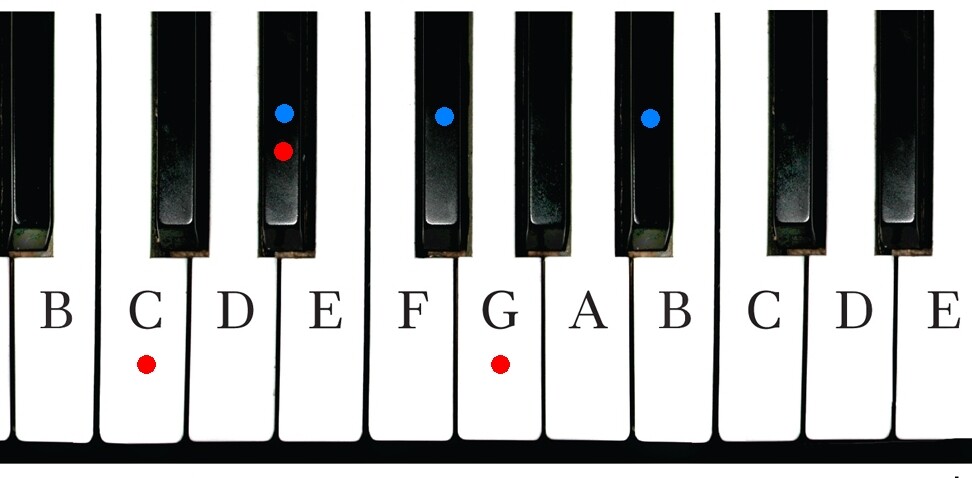
Say you play a minor triad - for example, the notes in red here. Then, starting on the second of those red notes, you play another minor triad - the notes in blue. This gives you a chromatic mediant!
This has a creepy effect. Why?
Both chords have the same shape, and they share one note, so the move isn't too jarring. But the second chord is in a different key than the first. This gives the sequence a floating quality, as if you're in a balloon and someone cut the rope and you start drifting upward. And the note in the new key that's not in the original key is the tritone of the first key! This massively boosts the creepiness.
You can also do chromatic mediants in a major key, which have a different feel.
(2/n)
I love creepy chromatic mediants! They have a dark but floating, unmoored quality.
Listen to some here. Then read my explanation.
(1/2)
Gauge theory and music - who knew?
My friend Mike Weiss said that 'commas' in music - those annoying glitches where you don't come back to the note you expect - are examples of 'holonomies' in gauge theory. And it's true if we use ideas from lattice gauge theory!
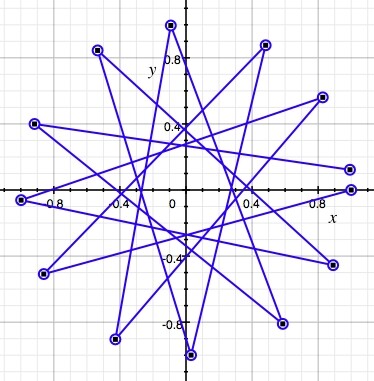
Since the Pythagorean comma is the simplest let's do that. Think of the circle of fifths as a graph X with 12 nodes and 12 edges. As we move along each edge, suppose the frequency goes up by a factor of 3/2. The issue is that when we go all the way around we are not 'back where we started'.
So, we want to assign some group element to each edge of X which records the fact that the frequency gets multiplied by 3/2 as we move along that edge.
But we need to think about frequency ratios modulo octaves. We can do it as follows: take the multiplicative group of positive real numbers ℝ₊ and mod out by 2, getting the group
G = ℝ₊/2
Note that we're modding out by 2 multiplicatively, not additively as more commonly done! So G is the group of frequency ratios mod octaves. It's isomorphic to the circle group, often called U(1) by physicists.
To put a connection on the graph X means that we assign an element of G to each oriented edge of X. We take all these elements to be [3/2] ∈ G.
This says mathematically that each time we move up a fifth on the circle of fifths, the frequency gets multiplied by 3/2, but we only care about frequencies mod octaves.
The 'holonomy' as we go all the way around the circle of fifths is defined to be the product of the group elements labeling all the edges. This is
[(3/2)¹²] ∈ G
and this is *not* the identity, though it's very close. This is called the Pythagorean comma! You can see it here:
I have so many questions about what just happened with Voyager 2. But let's review:
On August 20, 1977, Voyager 2 was launched from Earth.
In December 1977, it entered the asteroid belt.
In June 1978, its main radio receiver failed. Since then it's been using the backup receiver!
On July 9, 1979, it flew past many of Jupiter's moons and made its closest approach to Jupiter.
On August 26, 1981 it shot past Saturn.
On August 25, 1989 it shot past Uranus.
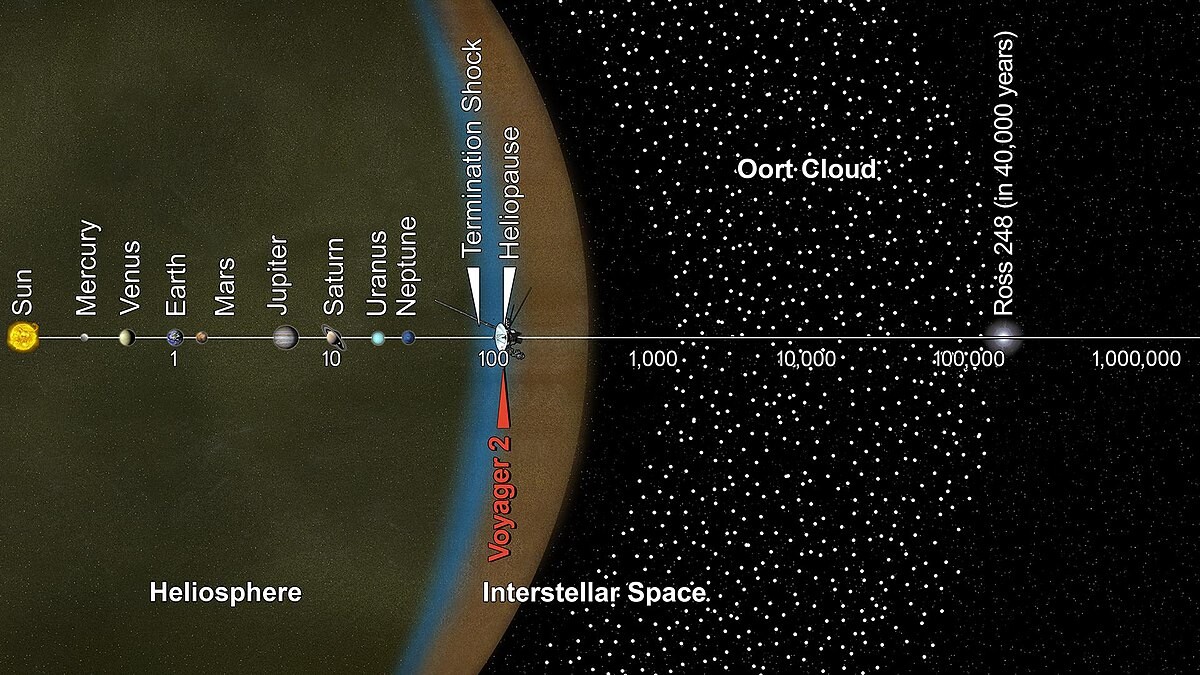
On November 5, 2018 it crossed the heliopause and entered interstellar space, 120 times farther from the Sun than we are.
On July 18, 2023, it overtook Pioneer 10 and became the second farthest man-made object from the Sun.
3 days later, some idiot sent a command that pointed its high gain antenna 2 degrees away from Earth. HOW EXACTLY DID THIS HAPPEN?
On August 4, 2023, NASA used its most high-powered transmitter to successfully command Voyager 2 to reorient towards Earth, resuming communications. HOW WAS THAT POSSIBLE?
How can you "shout" across 120 AU and attract the attention of someone who is not looking in your direction? That's very far. It takes light about 16 hours to travel that far.