
nostring from a plane right now… feels good


Haven’t had the chance to open it yet. Is BitKey multisig compatible with other devices?
Burnout and Freediving
In freediving a shallow water blackout is when you almost complete your dive, but as you approach the surface, you run out of oxygen (hypoxia) and lose consciousness.
One of the dangerous paradoxes about the sport is that, at depth the diver actually feels sufficiently oxygenated but as he approaches the surface this oxygenation proves to be partly illusory.
The reason for this is that the diver’s lungs compress upon descent, the partial pressure of oxygen increases and hence there is a feeling of sufficiency. Upon ascending, the lungs expand and there is suddenly a much lower partial pressure of oxygen to go around.
I think there is an interesting inverse parallel to the increasingly more common phenomenon of burnout at work:
Working hard and ascending the career ladder can be highly compelling. In fact, the higher we go, the more we can feel like what we’re doing is satisfying and meaningful.
But as our energy is depleted and we sober up, we come to realize that what we were doing was not nearly as meaningful as we thought and that we’ve been running on fumes for way too long.
Our body collapses and insists that we fuel up on energy before proceeding in any way, shape or form.
The only way to avoid this risk of burnout, it seems, is by finding work that is deeply aligned with our being and therefore practically effortless.

Almost every optimal state in matters of human affairs is characterized by balance.
Balance of new and tried-and-true. Balance of stress and relaxation. Balance of haste and slowness. Balance of order and chaos. Balance of discipline and creativity.
Therefore, in any debate or argument, you can recognize a bad take by its one-sidedness.



I once attended a writer’s retreat in Iceland with Paul Murray. He was a scintillating lecturer
The danger of quick fixes in human health:
The way our society has learned to approach health is through quick fixes.
There’s a simple and logical reason for this: Quick fixes generally alleviate the immediate symptoms a person is struggling with. And our healthcare system is primarily incentivized to alleviate symptoms.
Future consequences are exponentially less relevant to a pharmaceutical company or a doctor. This is because we simply have a very poor understanding of long term cause and effect in the human body. As an example, it’s just very hard to know what unique combination of genetics and external stressors have caused cancer in an individual.
If you build a house and the house collapses 10 years later, it’s still relatively easy to investigate who the culprit was and to hold them accountable. This level of accountability is difficult with a complex system like the human body and exponentially more so the further in the future the consequences.
Whether consciously or not, our system has internalized this principle.
Doctors simply do not have the time to really worry about the holistic health of their patients, they are incentivized to see as many patients as possible, relieve their symptoms and not kill them in the short term. And they do not have time to question whatever new treatment science funded by big pharma has most recently been recommended to them.
In brief: Your wish to live a long and healthy life is not aligned with the incentives of the system. Awareness of this problem is the first step towards a solution.

The only way… everything else is hot air
nostr:note189xucvgjzj65al2m8z3e6tp9haf8qytn9qskf94qdpz7qpvu8n5sneatrh
Hot Chocolate
Cocoa has been hot recently: prices have already more than doubled since the beginning of 2024 (up 250% in the last year), making the metric tonne more expensive than copper.
As a chocolate gourmet, my initial reaction is concern, nay outright worry that I may get priced out of the volume of dark chocolate required for my daily fix.
The main reasons for the rally are 1) crop shortfalls in Western Africa, the most important cocoa producing region in the world and, 2) the fact that cocoa is not a plantation business, meaning a significant portion of the supply stems from unsophisticated individual farmers, who get hit particularly hard by less than ideal weather conditions.
What to make of it beyond bittersweet dark chocolate? While the above conditions may be relatively unique to cocoa, we seem to be in the segment of the economic cycle where commodities prices, which have long stagnated (or at least not benefited from asset price inflation to the same degree), are poised to go higher, simply because demand remains very strong.
This means that inflation is very likely here to stay and this decade may see echoes of the highly inflationary 1970s.

The magic between inbreath and outbreath
A couple of years ago my brother and I visited Maui and decided to seize the opportunity to try out freediving. I had been drawn to the sport for a while, due to its natural synergies with meditation and my love for the ocean.
Even during the first few dry exercises under Lahaina’s Banyan tree, I felt I had hit gold. Working through our instructor’s exercises almost immediately allowed us to hold our breath for much longer than we had previously thought possible.
The real magic of freediving, however, occurred to us when we jumped in the water a short boat ride offshore, surrounded by nothing but blue and a few errant fish.
On the first day I was able to go down to 20m (65ft), a depth I thought would be much more elusive.
However, the maximum depth, while important, quickly becomes secondary once you get into freediving.
What feels much more important is the peace to be experienced between inbreath and outbreath, suspended at neutral or negative buoyancy, sounds subdued, body relaxed, thoughts on pause.
There’s a reason some meditation traditions prompt you to familiarize yourself with that gap between breaths. Extending it through relaxation, rather than brute force, opens up a whole new world of play.

hahaha wow that sums up the economic sentiment in Germany(?) pretty well
It’s called price differentiation. You don’t have to know directly how wealthy someone is, a lot of people will signal this themselves, if you offer the right product variants. e.g. Premium version that only offers marginal advantages over the Standard version.
As long as it stays at that level, it’s actually beneficial to the economy as it drives higher profitability and hence a more optimal distribution of goods and services.
It becomes a problem, of course, if the wealthy are no longer even given the option to opt for the standard product, e.g. imagine forcing the wealthy to take business class (which offers much more value than economy class but arguably not nearly as much as the relative price difference)

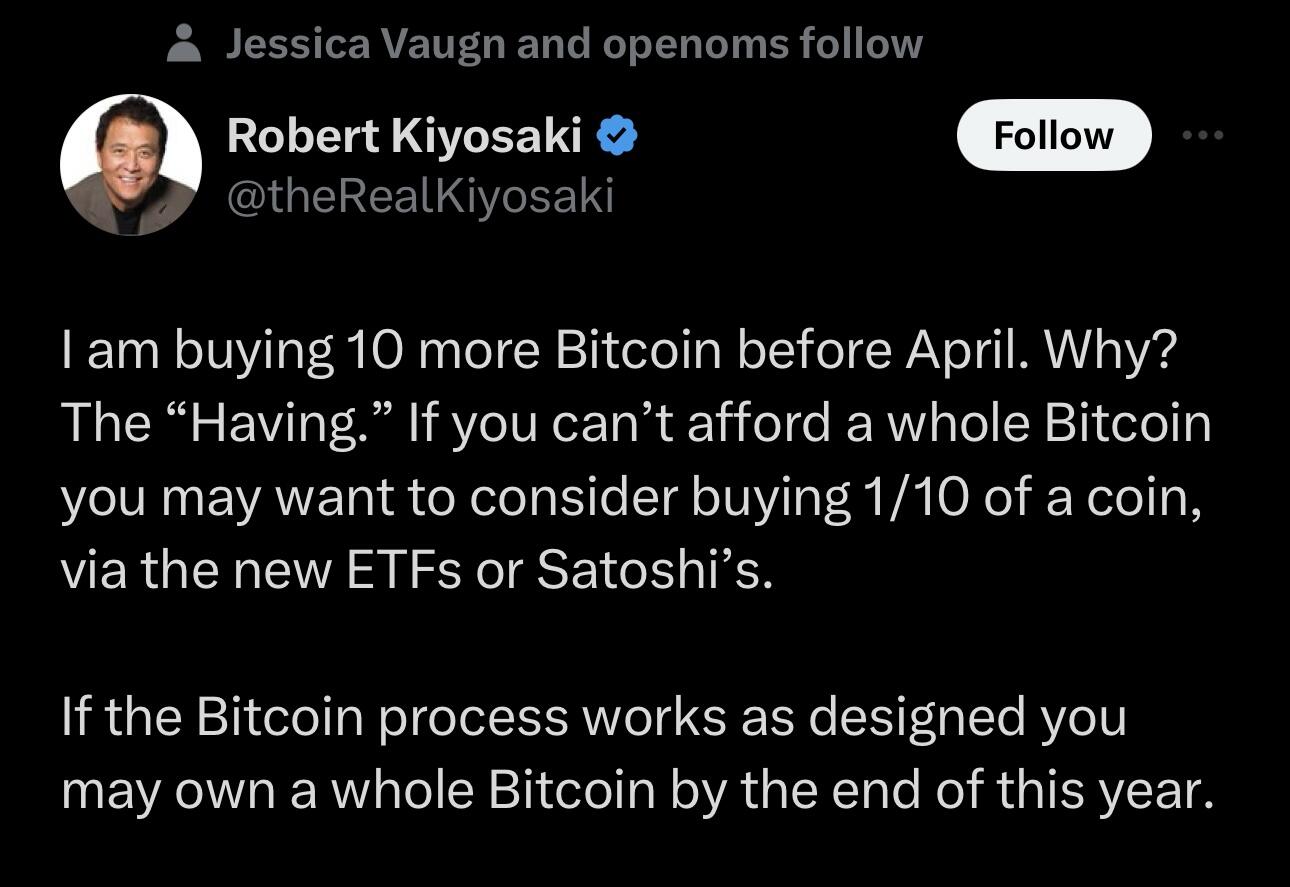
Yeah, I mean looks like even some of the people who were pitching BTC to the mainstream still live in some make-belief/magical world where they don’t understand it.
Bitcoin is so clear, so transparent and yet it’s still elusive to many because of how strong the Fiat delusion.

Awesome! Welcome Carla!

100%. Meditation is a big part of it!
Feeling embodied:
I used to live in my head, I didn’t know another way.
Living outside of it can still be intimidating, but I am now increasingly familiar with an embodied experience of life.
So much so that I feel a lack when I’m back to my (over)thinking ways.
One way this still happens is on long-haul flights. There is something naturally ungrounding about being in the air and airplanes add to this through other artificial factors: highly processed or preserved food, bad air quality and visual entertainment overkill.
I can feel my energy creep up into my head during the course of a flight.
Getting back to ground can take days. Yoga, breathing exercises and good food are some of the easiest ways to put down roots again.
Increasingly though, I’m looking not just for remedies after the fact, but for ways to stay here independent of obstacles thrown at me.

Lee who?