
It just occurred to me that somewhere in the world there’s an anarchist named Jay Walker. #anarchism
Well this is just fuckin’ horrific https://www.404media.co/wikipedia-prepares-for-increase-in-threats-to-us-editors-from-musk-and-his-allies/
Finally warm enough in metro #detroit to take my little terrier out for a walk without putting three layers on him.

Anyone know what “velocity limit” on fold app means in relation to debit card deposits? It’s rather annoying and I’m beginning to reconsider this whole relationship.

Yep, literally saw someone tweet “he’s not the president yet” like that makes it ok 😑
UBI, but in BTC. Let the people be the strategic reserve. You can start by giving me my tax refund in BTC.
For today, do what needs to be done. Then, do what you can do. Only then should you attempt to do what you can’t do. #stoicthoughts

Mine just got delivered yesterday (see what I did there?) 😬


Can someone explain to a smooth brain like me how it’s a liability on a balance sheet?



Have heard good things about keepass(sp?) but have not used. The Techlore community maybe helpful. (Find link on their YT channel)
What’s a beetcoyn, dad?


Unable to send message received on primal

A Roadmap For DOGE's 30 Percent Budget Cut
A Roadmap For DOGE's 30 Percent Budget Cut
Authored by Nikolai Wenzel via the https://thedailyeconomy.org/article/a-roadmap-for-doges-30-percent-budget-cut/
(AIER)
, Elon Musk and Vivek Ramaswamy laid out their vision for the new “Department of Government Efficiency” (DOGE) they will head within the Trump White House. They don’t yet have details (part of the plan involves identifying personnel, and then inefficiencies). But the vision has a three-part approach: ”regulatory recissions, administrative reductions, and cost savings.”
 ?itok=dzNVpADo
With politicians it’s often hard to know what is solid conviction and what is bluster for future bargaining. With Donald Trump, it’s always hard to know. He wants to renew the 2017 tax cuts, which lowered income and corporate taxes until 2025... but he also wants to tax imports at 10 percent to 20 percent (and 60 percent for China), which is the equivalent of a consumption tax on an American economy that is hungry for imported goods. Mr. Trump wants to cut red tape and federal spending… but he also wants to increase spending on defense and mass deportations.
Amidst all this, Messrs. Musk and Ramaswamy have bruited the lofty goal of a 30 percent cut in federal spending.
The federal budget was $6.2 trillion for FY23 (which I use here for accounting simplicity, rather than FY24). This represents almost 23 percent of GDP, to which we can add 13 percent spent by states and local governments. To this, we can also add the 10 percent of GDP in annual compliance cost with federal regulations, as estimated by the https://cei.org/studies/ten-thousand-commandments-2024/
. This total means that, for every dollar of economic activity, fully 46 cents are controlled, directly or indirectly, by politicians and bureaucrats. And only 54 cents of each economic dollar are in the hands of American consumers, families, and entrepreneurs. As of November 2024, the national debt is at 120 percent+ of GDP, and interest on the debt is the fourth biggest budget item (at $659 billion/year, or about 11 percent of federal spending). Clearly, America has a fiscal problem.
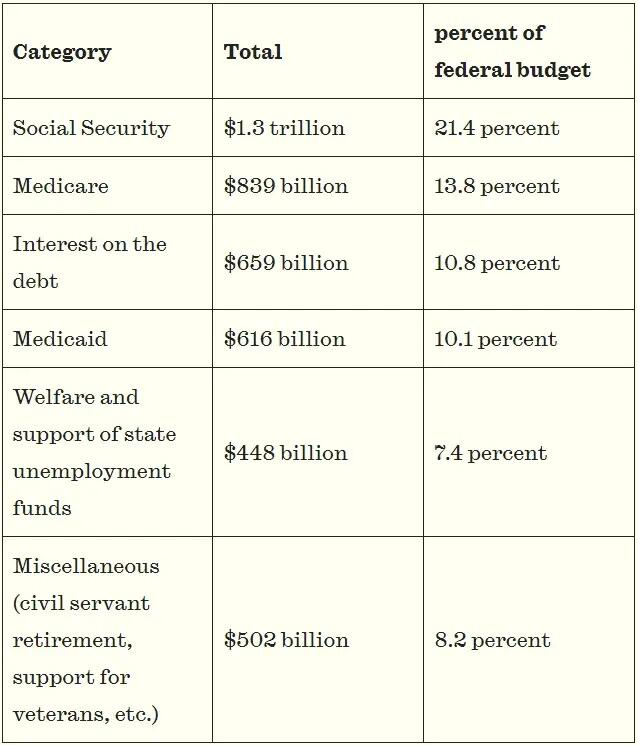
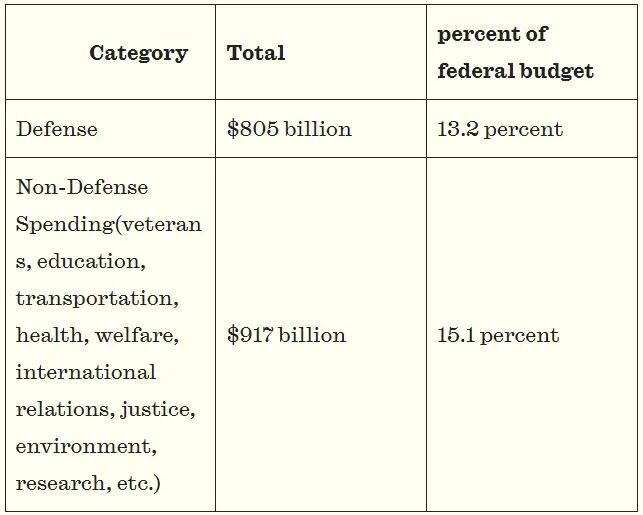
Before we examine possible budget cuts, let us see where that whopping $6,200,000,000,000 is going. First, we must distinguish between https://www.cbo.gov/publication/59728
. Mandatory spending has been set in motion by Congress, without the need for annual negotiation or reauthorization. Discretionary spending must be legislated, in political jockeying between the Congress and the President.
 ?itok=6tK-9qVA
Mandatory Spending (71.7 percent of total federal budget). AIER
 ?itok=xYjr8i7T
Discretionary Spending (28.3 percent of total federal budget). AIER
I propose three options for budget cuts, from the bold (and probably politically impossible) to the marginal.
1. The Constitution
I hate having to repeat it, over and over again... But the American people and the political class seem to have forgotten that the U.S. Constitution is different. Most other constitutions of the world are documents of assumed powers: governments are allowed to do anything, except that which is prohibited by the constitution. The U.S. Constitution, however, is one of limited and enumerated powers: it may not do anything, except that which is authorized by the constitution. Article 1, section 8 grants a bit over a dozen legislative powers to Congress (beyond the military and international powers authorized to the President in Article 2, and the judiciary powers in Article 3).
According to Article 1, section 8, the Congress has power over the following, only:
taxes and import duties
borrowing
regulation of commerce among the states and internationally
establish uniform laws of immigration and bankruptcy
coin money, fix standards of weights and measures, and grant patents
punish counterfeiting and piracy
establish post offices and postal roads
to constitute tribunals inferior to the Supreme Court
declare war, and maintain and regulate armed forces
to control the District of Columbia and other federal properties
Lest there be any doubt about enumeration and limitation, the 10th amendment reads as follows: “The powers not delegated to the United States by the Constitution, nor prohibited by it to the States, are reserved to the States respectively, or the people.”
It should be obvious, then, that the vast majority of federal expenditures are not authorized by the Constitution; as such, they are prohibited and unconstitutional. Only a small percentage of actual federal spending is authorized by the Constitution: defense, operating and retirement expenses for federal employees, support to veterans, international relations and justice (for a total of $1.46 trillion). If we squint very hard at the Constitution, we could conceivably see transportation ($115 billion), health ($100 billion), and the environment ($48 billion)... if we suppose generously that such expenditures are authorized under the commerce clause, as functions that cannot be handled by the individual states. Even then, we find ourselves at $1.72 trillion, or 27.7 percent of the current budget.
This would represent savings of $4.48 trillion, or 72.3 percent of the budget that could be returned from the unconstitutional hands of politicians and bureaucrats, back to American families, consumers, and entrepreneurs. Unfortunately, the President lacks the authority to veto mandatory spending, and merely enjoys veto power over discretionary spending bills. And, for all his talk of reducing red tape, Mr. Trump has yet to show a libertarian or constitutional soul. It is thus unlikely that we will end up with a North American version of a chainsaw-wielding Javier Milei of Argentina.
2. Big-Ticket Items
A return to constitutional constraints would be lovely. But it is not in the realm of the politically possible. The second option would be to start with the low-hanging fruit of Social Security and Medicare. Social Security was born in 1935, as part of FDR’s New Deal, and Medicare came to be in 1965, as part of LBJ’s Great Society. Neither of these programs is means-tested (technically, the Social Security formula is redistributive, but participation in both programs is mandatory for all Americans).
Social Security might have been necessary in 1935 (I am skeptical, as I have read David Beito’s https://uncpress.org/book/9780807848418/from-mutual-aid-to-the-welfare-state/
, “From Mutual Aid to the Welfare State: Fraternal Societies and Social Services, 1890–1967.” Civil Society was doing a fine job of providing welfare, before the New Dealers decided everything had to be nationalized). But financial markets have evolved drastically since 1935. Americans now have easy, low-cost, and convenient access to mutual funds, and especially index funds that track the market without investor savvy. The federal government could easily get rid of the low-yield, pay-as-you-go Social Security pension scheme, and replace it with a high-yield, portable, individually funded retirement plan. The Chilean plan of mandatory 10 percent contributions to a private fund would be a simple start. Likewise, insurance markets (especially if they are deregulated, unsubsidized, and fixed) can take care of the majority of American retirees.
Simply stated, most Americans don’t need Social Security and Medicare. These two big-ticket items eat about one third of the federal budget. They are unconstitutional. And they are unnecessary. Again, as a student of David Beito, https://civitas.org.uk/pdf/Tocqueville_rr2.pdf
, economics, and history, I have learned the superiority of private charity over government welfare. But, as a temporary solution, Social Security and Medicare could easily be privatized, with a portion replaced by means-test programs, with a much smaller cost. Currently, about 20 percent of Americans receive federal welfare or Medicaid. Setting aside details, we can easily imagine privatizing pensions and healthcare for the other 80 percent, with an 80 percent cut in Social Security ($1 trillion in savings) and Medicare ($671 in savings), for a total of $1.67 trillion in savings. This would still not be constitutionally authorized, but it would represent almost one third of the federal budget. As a bonus, a privately funded retirement plan would represent a surge in investment, and thus of economic activity and tax revenue; the lower expenses would mean the national debt would not increase as much, and pressure on interest payments would be relieved. The true savings would thus exceed one third.
Unfortunately, all retirees, rich and poor, have their snout in the federal trough—this was the political genius, and the fiscal disaster, of universal programs (rather than targeted means-tested programs). Social Security and Medicare costs are politically dangerous, and Mr. Trump has already promised he would not touch the two biggest federal expenditures.
3. Marginal Cuts
Without pushing constitutional respect or cutting the low-hanging fruit of big and outdated universal programs, the federal government could still save at the margin.
As mentioned above, the Competitive Enterprise Institute has calculated that 10 percent of GDP is spent each year on compliance with federal regulations. A Mercatus Center study estimates that, if regulations had stayed steady at the 1949 level, the American economy would be a whoppinghttps://www.mercatus.org/research/policy-briefs/regulatory-accumulation-and-its-costs
(it has a disparate impact on the poorest). Without attacking the budget directly, DOGE could take a serious ax to federal regulation, to great effect.
Finally, the https://www.cato.org/blog/10-spending-cuts-president-trump
has proposed a collection of small cuts that would amount to a serious $1 trillion to $2 trillion in savings (or 16 percent to 32 percent of the current budget).
It would be ideal, of course, to return to the constitution—for reasons of rule of law, as much as for fiscal prudence. More local responsibility, more market competition, less bureaucratic waste, more reliance on an efficient and human civil society over a wasteful and anonymous federal machine to help the poor—these would all be positive developments that would restore America’s fiscal health while actually tackling poverty. In the meantime, a 30 percent budget cut is within grasp—and it would represent a return to federal spending, not in some distant past… but as recently as 2001.
Views expressed in this article are opinions of the author and do not necessarily reflect the views of The Epoch Times or ZeroHedge.
https://cms.zerohedge.com/users/tyler-durden
Wed, 01/01/2025 - 17:20
https://www.zerohedge.com/political/roadmap-doges-30-percent-budget-cut
No one voted for Musk
Musk Confirms "Large Fireworks &/Or Bomb" Exploded Cybertruck At Trump Vegas Hotel
Musk Confirms "Large Fireworks &/Or Bomb" Exploded Cybertruck At Trump Vegas Hotel
Update (1723ET):
"We have now confirmed that the explosion was caused by very large fireworks and/or a bomb carried in the bed of the rented Cybertruck and is unrelated to the vehicle itself," Tesla's Elon Musk wrote on X, "All vehicle telemetry was positive at the time of the explosion."
We have now confirmed that the explosion was caused by very large fireworks and/or a bomb carried in the bed of the rented Cybertruck and is unrelated to the vehicle itself.
All vehicle telemetry was positive at the time of the explosion. https://t.co/HRjb87YbaJ
— Elon Musk (@elonmusk) https://twitter.com/elonmusk/status/1874579547452269054?ref_src=twsrc%5Etfw
* * *
Update (1534ET):
Government officials told https://abcnews.go.com/Politics/police-investigating-vehicle-explosion-trump-hotel-las-vegas/story?id=117252987
that the Tesla Cybertruck explosion on Wednesday outside the Trump Las Vegas hotel in Nevada is being investigated as a "possible act of terror."
 ?itok=ucbutHRm
Here's more from ABC:
Investigators do not know what caused the blast, such as whether something was wrong with the vehicle or whether something external prompted it. Determining what was behind the explosion is the key focus of the probe.
An official briefed on the probe told ABC News that the Tesla Cybertruck had a load of fireworks-style mortars onboard. Investigators are urgently working to determine a motive and whether the driver intended to set off an explosion and why.
Until a motive is determined and other possibilities are ruled out, police are treating the explosion like a possible criminal act and a possible act of terror. Evidence collection and investigation are ongoing.
Tesla's Elon Musk responded:
The whole Tesla senior team is investigating this matter right now.
Will post more information as soon as we learn anything.
We’ve never seen anything like this. https://t.co/MpmICGvLXf
— Elon Musk (@elonmusk) https://twitter.com/elonmusk/status/1874558969802547611?ref_src=twsrc%5Etfw
* * *
With everyone on edge after the New Orleans 'https://www.zerohedge.com/political/reported-fatalities-bourbon-street-after-vehicle-plows-crowd-during-new-years
' on Bourbon Street early this morning, reports flooded X moments ago of a 'boom' and/or a 'vehicle fire' in Las Vegas.
BREAKING: Witnesses heard "boom" video smoke rising near Trump Tower in Las Vegas.https://t.co/Fk3TtxnMlN
— Breaking911 (@Breaking911) https://twitter.com/Breaking911/status/1874507555147481490?ref_src=twsrc%5Etfw
It turns out the 'boom' was caused by a Tesla Cybertruck ablaze in front of the Trump Hotel in Las Vegas, possibly due to a lithium battery fire.
Cybertruck blew up in front of Trump hotel in Las Vegas. Those are our luggage by the door and that’s where we were when it happened. https://t.co/KaVZXfGLNK
— ayackle (@kaaaassuu) https://twitter.com/kaaaassuu/status/1874506594425381133?ref_src=twsrc%5Etfw
Wow.
🚨🚨 BREAKING UPDATE: Police confirm the driver was killed in a Cybertruck explosion at the Trump Hotel in Las Vegas, with 7 others injured. https://t.co/kFFg1UVjQM
— Breaking911 (@Breaking911) https://twitter.com/Breaking911/status/1874545592682299652?ref_src=twsrc%5Etfw
What are the odds?
https://cms.zerohedge.com/users/tyler-durden
Wed, 01/01/2025 - 17:23
https://www.zerohedge.com/technology/cybertruck-blew-outside-trump-hotel-vegas
Anything but a battery fire


Shout out to Pete at work who inspired me to want to to have my own node