

Nodes seem pretty decentralized. Not that far away from BTC node count. Maybe you'll find this interesting:
Discussion
Since Bitcoin and monero are trying to achieve different things, this is a bigger problem for monero than bitcoin. Even on the home page of the link you shared shows this message
Bitcoin isn’t trying to hide, it’s trying to be unstoppable. I’m not trying to put down monero. 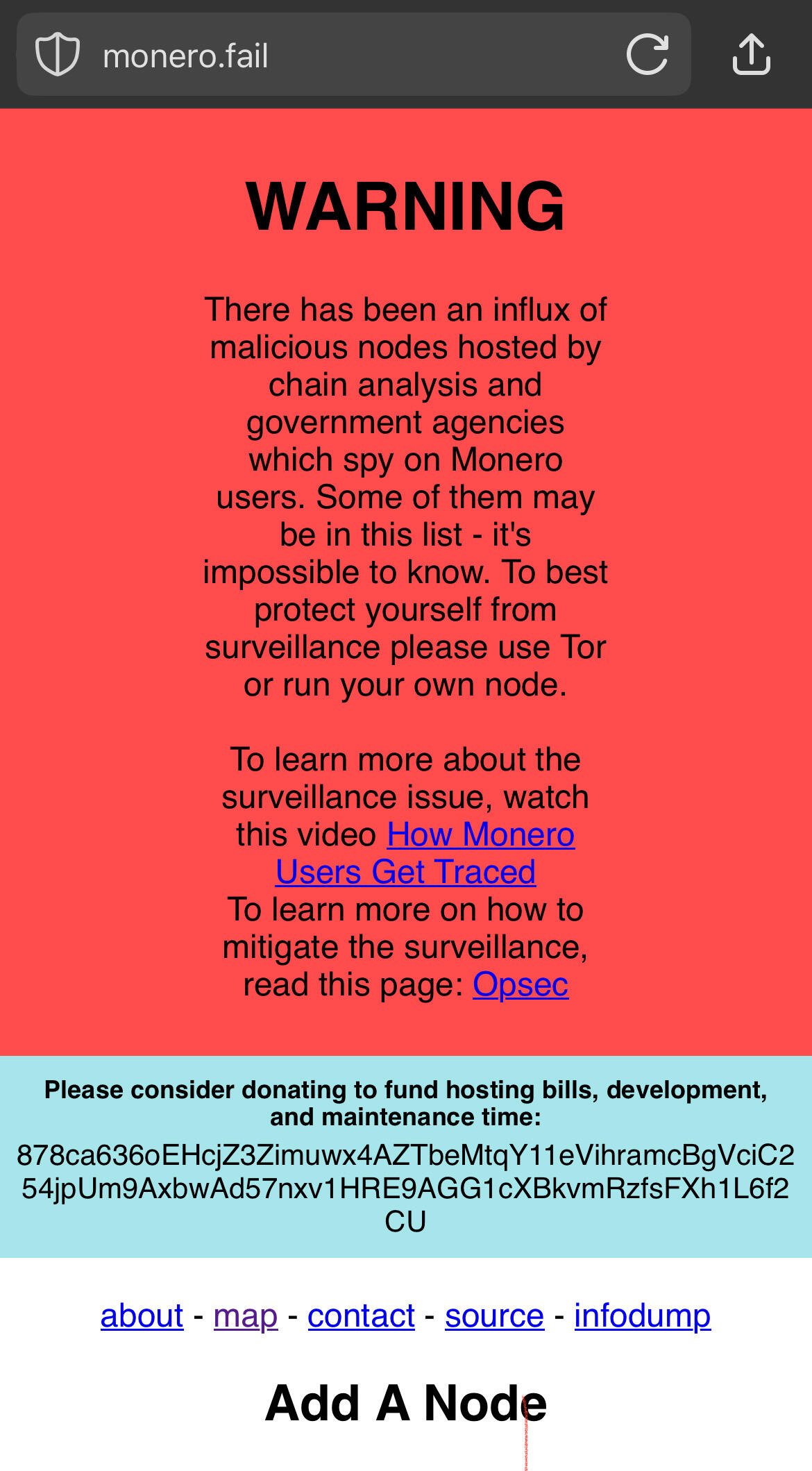

The problem with connecting to a malicious node to send a tx is simply that that node knows they are the first to see that tx.
obviously if you don't use protection, they will learn your IP address.
However,
This is true for all Bitcoin nodes by default anyway.
So if the node count is high,
and I don't think running an XMR node is any more complicated than Bitcoin
how is it less decentralized?
It’s not just the nodes I question, but the transactions. Putting enough transactions in from a bad actor can help identify other transactions. I’m not super up to speed on how they make their mining templates either.
I probably should have said that it can not easily remain decentralized. I believe because of the flexible block size in monero, it doesn’t provide good incentives for miners. If it was used a lot, I think the blockchain size could grow very rapidly. Ultimately I don’t think the rewards to those running the infrastructure are good enough. Bitcoin pays more when demand is high, monero pays less by allowing the block size to grow. But I’m not comparing the two. I am concerned that monero isn’t achieving what it intends to achieve, privacy.
When I have synced monero nodes in the past, it didn’t work to my satisfaction. Call that an opinion.
You mean a bad actor could spam the network with txs to themselves?
They then would know that anytime those outputs appear as inputs to another tx it is a decoy and not the true spend.
This is generally assumed to be low-key happening.
Im not up on the math but with a ring size of 16, I think you have to be responsible for a insane amount of the total tx volume to be statistically certain you're identifying the correct spend.
like over 95% of total volume and that's not happening.
meanwhile we have leaked Chainanalysis videos that literally SHOW us their tracing capabilities and they're basically dead in the water.
(UNLESS they get offchain stuff, exchange data or you connect to their malicious node without a condom etc)
Block size is a delicate balance and I'm not sure there's much to say except we'll find out. Since the block reward is penalized miners will only increase the block size when it makes financial sense for them to do it. ie, they can make more on fees than they lose by the penalty.
so far it has functioned fine.
last I checked the chain was 220gb. Still a long way from any urgency.
Of course there will be malicious nodes on Monero just like on Bitcoin. Not sure how that's unique to Monero. You can't stop that with open permissionless systems.
Satoshi has a whole section dedicated to privacy in the white paper. They were also attmpeting to have a form of privacy. And at the time that was probably good enough. It isn't anymore.
You should watch the recent chainalysis video on Monero so you can see yourself how little information they were able to glean even with the user using their malicious node. Remote nodes can see far less information on Monero transactions VS Bitcoin. They can't see amounts or receivers. They were basically correlating IP addresses (network level) to transactions which they admitted themselves wasn't an exact science. FCMP will render even these edge cases obsolete.