Replying to Avatar Greg Egan

Suppose we have a unit square, and we want to find the volumes of two 4-dimensional sets — call them “Opp” and “Adj” — consisting of pairs of points inside the square, such that the line containing both points intersects either two opposite sides of the square (Opp), or two adjacent sides (Adj).

I’ve posted previously about ways to compute these volumes by integration, but it turns out there’s another easy way: we can just map various subsets of these sets into each other.

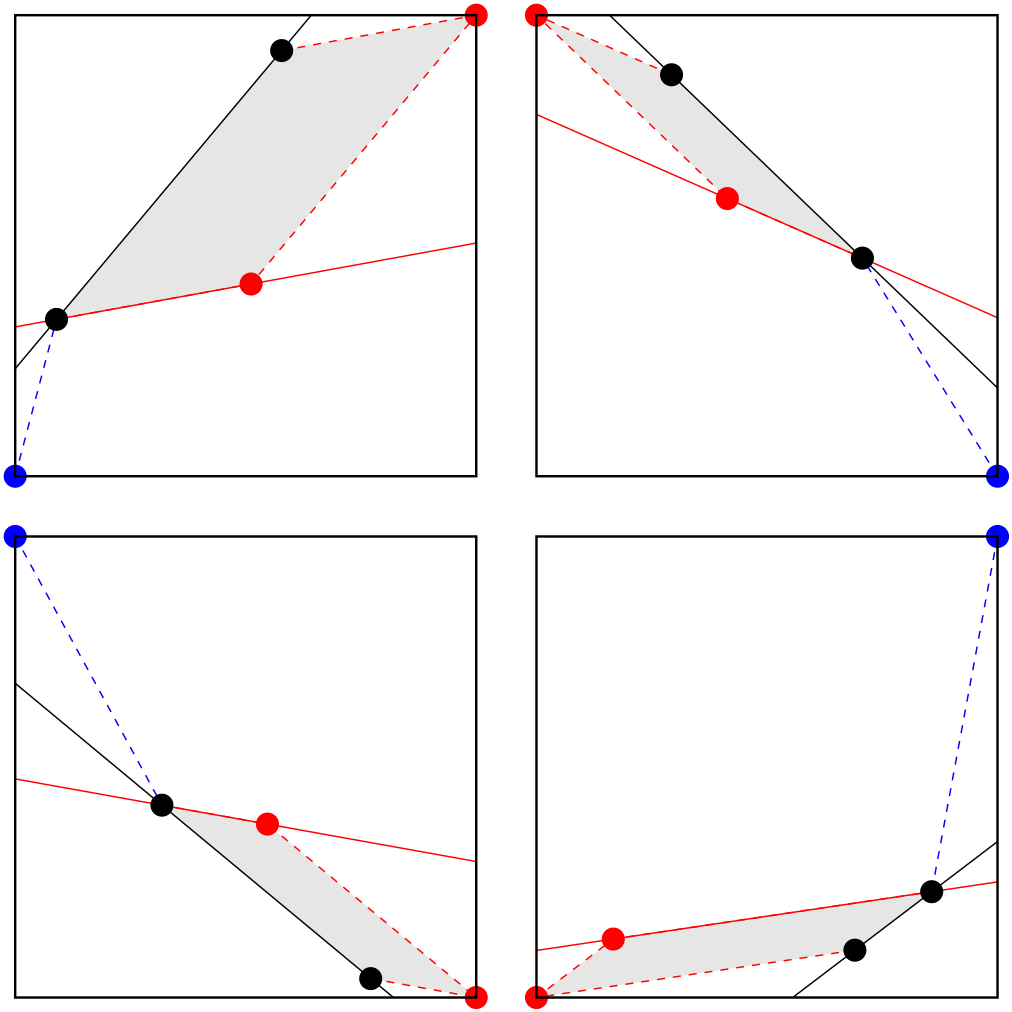
Suppose we have two points such that the line through them cuts across one of the corners of the square, like the two black dots in each panel in the image. These pairs of black dots belong to Adj, and these four cases cover all possible pairs of adjacent sides of the square.

If we place a red dot at the horizontally opposite corner of the square to the corner we cut across, there is a unique parallelogram (if we require it to be inside the square) whose vertices are the two black dots, the red corner dot, and a second red dot that completes the parallelogram.

The second red dot and the black dot with which it shares an edge of the parallelogram now comprise a new pair of points, such that the line containing them ALWAYS intersects the two opposite vertical sides of the square. So this new pair belongs to a subset of Opp: the half of it where the opposite sides are vertical rather than horizontal.

The four maps we have described, from four disjoint subsets of Adj to that half of Opp, all preserve volume: they take a 4-dimensional region in their part of Adj to another region of the same volume in Opp.

[2/2] What's more, they are all invertible; given a pair of points in that half of Opp, we can always locate the correct red corner, reconstruct the parallelogram, and find the two black dots in Adj. This might seem ambiguous at first; there is another potential corner to use, the blue dot in each panel. How do we know which one is correct? But depending on whether the line we get from our Opp points slopes up or down, we can compare the two candidate lines that join each corner to one of the points, and pick the correct one by its position at the start or end of the counterclockwise arc running between their directions.

So, these maps tells us that:

Vol(Adj) = ½ Vol(Opp)

because by symmetry we know that the two halves of Opp have equal volume.

But together, the two sets comprise the whole unit hypercube of all pairs of points in the square:

Vol(Adj) + Vol(Opp) = 1

It follows that:

Vol(Adj) = 1/3

Vol(Opp) = 2/3

Reply to this note

Please Login to reply.

Discussion

No replies yet.