“Flow” was eerily beautiful, charming, sad, strange and hopeful.
I must admit a part of my brain uncanny-valleyed a bit at the disparity between the lush, near-photorealistic landscapes and architecture versus the blocky palette in which the animals were rendered, but in the end I managed to shut that out and go with the story.
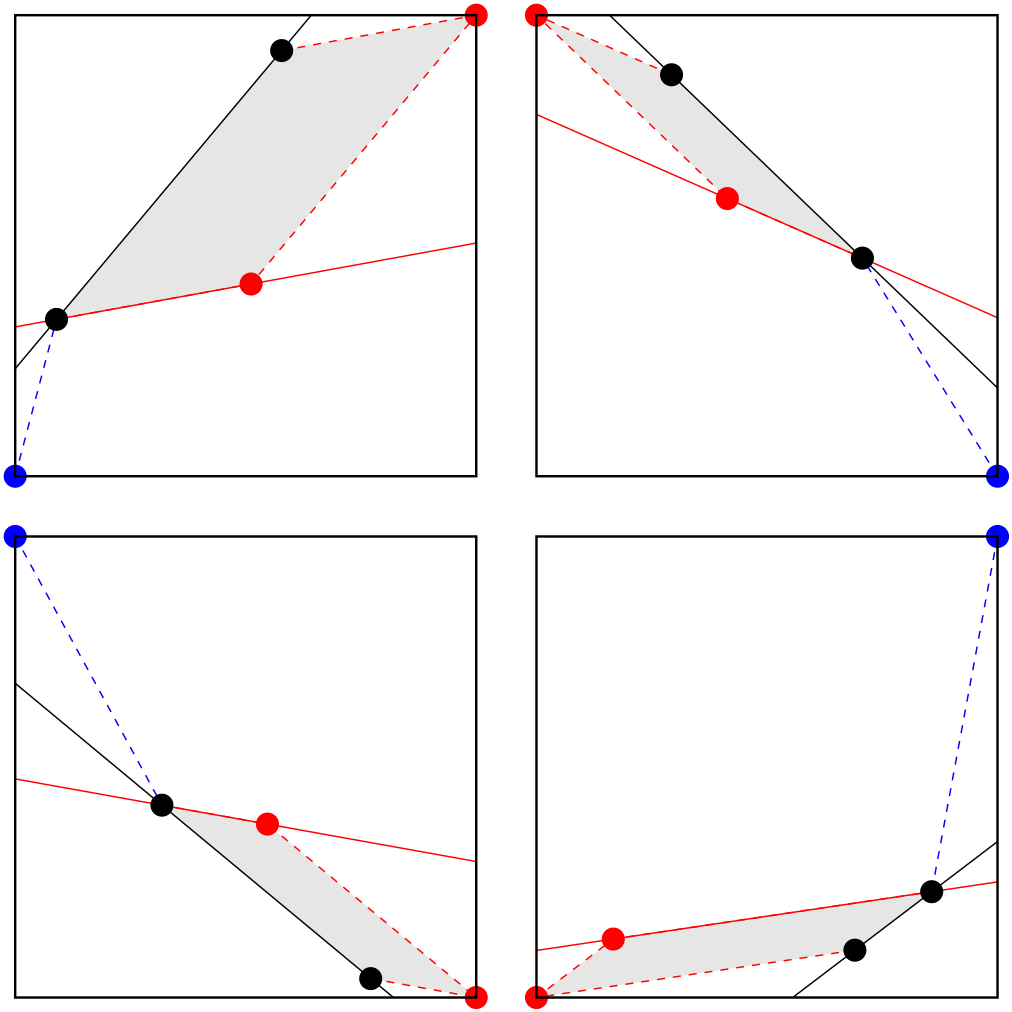
[2/2] What's more, they are all invertible; given a pair of points in that half of Opp, we can always locate the correct red corner, reconstruct the parallelogram, and find the two black dots in Adj. This might seem ambiguous at first; there is another potential corner to use, the blue dot in each panel. How do we know which one is correct? But depending on whether the line we get from our Opp points slopes up or down, we can compare the two candidate lines that join each corner to one of the points, and pick the correct one by its position at the start or end of the counterclockwise arc running between their directions.
So, these maps tells us that:
Vol(Adj) = ½ Vol(Opp)
because by symmetry we know that the two halves of Opp have equal volume.
But together, the two sets comprise the whole unit hypercube of all pairs of points in the square:
Vol(Adj) + Vol(Opp) = 1
It follows that:
Vol(Adj) = 1/3
Vol(Opp) = 2/3
Suppose we have a unit square, and we want to find the volumes of two 4-dimensional sets — call them “Opp” and “Adj” — consisting of pairs of points inside the square, such that the line containing both points intersects either two opposite sides of the square (Opp), or two adjacent sides (Adj).
I’ve posted previously about ways to compute these volumes by integration, but it turns out there’s another easy way: we can just map various subsets of these sets into each other.
Suppose we have two points such that the line through them cuts across one of the corners of the square, like the two black dots in each panel in the image. These pairs of black dots belong to Adj, and these four cases cover all possible pairs of adjacent sides of the square.
If we place a red dot at the horizontally opposite corner of the square to the corner we cut across, there is a unique parallelogram (if we require it to be inside the square) whose vertices are the two black dots, the red corner dot, and a second red dot that completes the parallelogram.
The second red dot and the black dot with which it shares an edge of the parallelogram now comprise a new pair of points, such that the line containing them ALWAYS intersects the two opposite vertical sides of the square. So this new pair belongs to a subset of Opp: the half of it where the opposite sides are vertical rather than horizontal.
The four maps we have described, from four disjoint subsets of Adj to that half of Opp, all preserve volume: they take a 4-dimensional region in their part of Adj to another region of the same volume in Opp.
∑ᵢ₌₀ⁿ⁻²∑ⱼ₌ᵢ₊₁ⁿ⁻¹𝑠𝑖𝑛((𝑗−𝑖)π/𝑛)⁴=3𝑛²/16
Well, obviously.
Asimov's SF and Analog have put the top few stories in each category in their 2024 annual readers’ poll free to read online on their web sites.
My novella “Death and the Gorgon” from Asimov’s and my novelette “Vouch For Me” from Analog are among them.
Links:
https://www.asimovs.com/about-asimovs/readers-award-finalists/
https://www.analogsf.com/about-analog/analytical-laboratory-finalists/
If you like some of these stories, I hope you’ll consider subscribing to the magazines. It’s a tough time for all SF magazines, and they’re the place where new writers get their start.
TIL that in 2018 Angélique Kidjo recorded an entire album covering every track of Talking Heads’ “Remain In Light”!
I haven’t heard the whole thing, but the samples here sound good.
nostr:nprofile1qy2hwumn8ghj7un9d3shjtnddaehgu3wwp6kyqpqt76as6gjr7pzg0taz40e55smjjegmj89ud7g056aqed90hs7cynsacyu7x huge and longtime fan of yours, Greg. Any recent stories based in world's closer in time and resemblance to our own?
nostr:nprofile1qy2hwumn8ghj7un9d3shjtnddaehgu3wwp6kyqpq6ml2w2hq0z2wal0kckg6qzege9559hwxqczmsrtq8xxez5amyw0s2a70w9 The last two novels (MORPHOTROPHIC and SCALE) are set in alternative versions of the Earth.
The two stories I mentioned are set in the near future, on Earth exactly as we know it. As are most of the stories in my most recent collection, SLEEP AND THE SOUL ... although the title story is set in an alternative pre-Civil War America in a version of Earth where humans rarely sleep.
Where the fruit flies sing:
“[W]e demonstrate that hearing regulates aggression in Drosophila males. Further, we show that courtship and aggression songs differentially affect aggression, indicating that hearing contributes to the context-dependent regulation of aggression.”
“Murthy hopes to eventually have a male fly connectome, too, which would allow researchers to study male-specific behaviours such as singing.”
Uploaded female fruitfly seeking choral companion to share the long, icy eternity of virtual immortality.
Things we’ll now check at compile time:
“The new IPC Template Type defined 21 input parameter fields, but the integration code that invoked the Content Interpreter with Channel File 291’s Template Instances supplied only 20 input values to match against.”
Crowdstrike have advised that the world will be reverted to its last valid backup set, dated 7 Jan 2014, within the next 30 minutes. Please make paper notes of anything important to you from the intervening period, and tape them to your refrigerator door in a prominent position.
A tragedy that shatters her childhood drives Charlotte to become an astronomer, in the hope of finally determining the shape of the universe.
My story “Didicosm” is now free to read online:
https://www.gregegan.net/DIDICOSM/Complete/Didicosm.html
with some supplementary material: