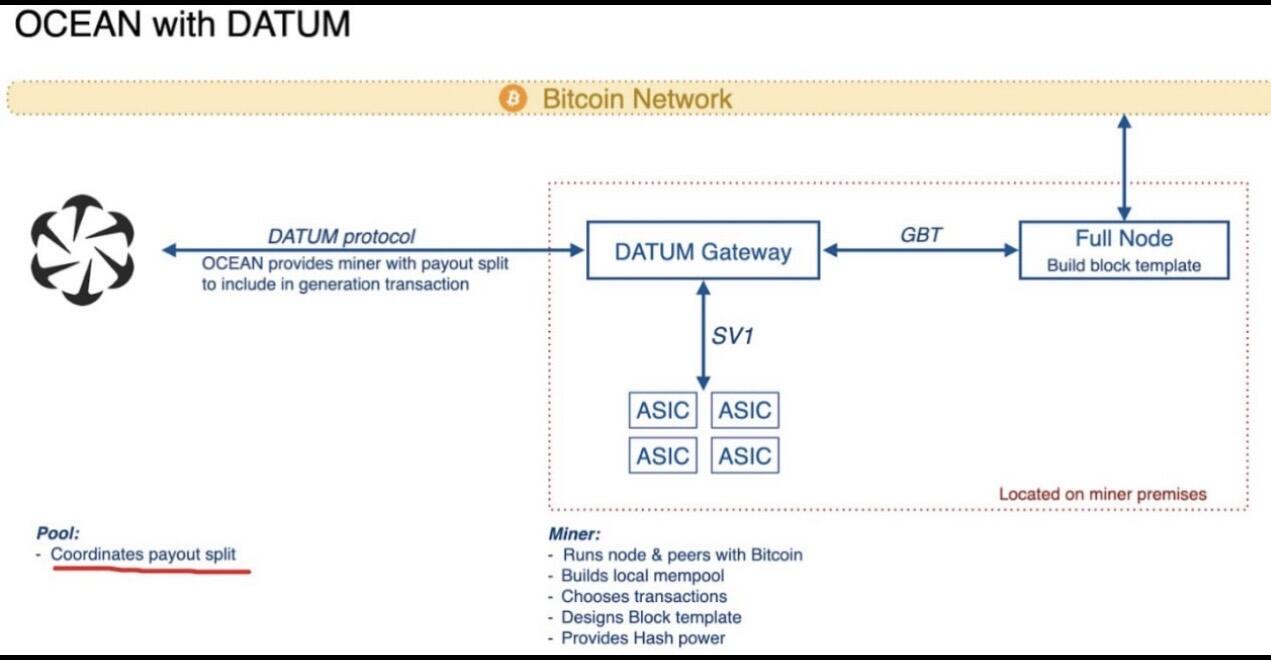

As you have shared in your photo, If you found a block and submit it to the bitcoin network through your node (independent from the template you are using), there is no possible way for that pool to stop that block from spreading through the bitcoin network. In this case OCEAN is just providing you the coinbase transaction but there is no way for them to invalid a found block published to the network.

Also if payouts are introduce in the coinbase transction changing them will invalidate the hole block, making it imposible for the pool to change the payouts after the found is found, so yes dezentralization can be possible with a pool.

Reply to this note

Please Login to reply.

Discussion

If the pool server is able to reject a miners template even if you created it yourself, how are we decentralizing mining or template creation at all?

1. StratumV2 pools custom miner template is sent to the pool server: https://github.com/stratum-mining/stratum/blob/904ac8efcedb4a7a8c92b49b252aa7cd170a4e2c/roles/jd-client/src/lib/upstream_sv2/upstream.rs#L252C41-L307C6

2. Rejection message the miner receives when the pool server rejects their template: https://github.com/stratum-mining/stratum/blob/main/protocols/v2/subprotocols/mining/src/set_custom_mining_job.rs

3. DATUM custom miner template is sent to the pool server: https://github.com/OCEAN-xyz/datum_gateway/blob/4fdcfad570d9120737e574395286dcabb4f8f748/src/datum_protocol.c#L451

4. Rejection message the miner receives when the pool server rejects their template: https://github.com/OCEAN-xyz/datum_gateway/blob/4fdcfad570d9120737e574395286dcabb4f8f748/src/datum_protocol.h#L146-L166

what's 'exactly decentralized there?

They have the power to do whatever they want with your template. Its a client-server relationship, the pool server has complete discretion over who mines in their pool. They can set any condition they want or they can be forced to set conditions by regulators. Decentralized?

I see that you send the block to the server and validate it but only to calculate and coordinate the payout for the next blocks, once you find a block you submit it directly to your own node (see submitblock function).

You need to run a personal node when running DATUM, if you found a valid block there is no possible way for anyone to stop the valid node from spreading to the hole network.

Ocean is the central server that coordinates the coinbase split and sends it to all the miners connected to their server. Without Ocean you are no longer pool mining because ocean is the server that every miner is relying on for the split.

Even if I run my own node

when you remove Ocean who coordinates and administers the split?

I dont understand the dilemma here, if miners are gathering their hashpower to homogenise payouts, it is going to be mandatory to have a central point of coordination. The fact that DATUM allows to only have coordination around the payments and not on the template is an upgrade. arouI suppose that if OCEAN makes all their code open source, the disappearance of OCEAN wont be a problem. Dont think that a central pool that coordinates payments is a risk to the network. The risk IMO is censored transactions.

Pools are very much needed and thanks to them the 51% attack is way more difficult. Mining conpanies may not be aligned with the philosophy but thanks to the network incentives they help to secure everything.

Pools do not decentralize mining period!

I already showed you with GitHub links what happens and what message miner will get - pool can reject your template no matter what

If a miner founds a block an sends it to a node that he is self hosting, no one can stop/cancel that block from spreading.

Don't care about the links they are not about block submittion to the network.

What you describing is not pool mining

but lottery mining

lol 😂 those links tell you what happens behind the seen it’s a code that runs both datum and stratum server.

Nothing is decentralized with stratum 2 or datum unless you hash towards your own node and your own stratum server

Again, you clearly don't know how DATUM works.

With DATUM you create your own block template using your OWN Bitcoin node. This means you decide which transactions are included in the block, not the pool. When your mining hardware finds a valid block, the DATUM Gateway—software running alongside your node—handles the submission process. The block is broadcast directly to the Bitcoin network by your node, ensuring it enters the network without relying on OCEAN to relay it.

The pool’s validation is a temporary coordination step for reward purposes, but it doesn’t gatekeep the block’s entry into the blockchain.