Wow, in an extremely rare case of an inflation bug you lost a few bucks in your wallet while gaining superior privacy, faster and cheaper txs. While your real saving is in Bitcoin... Big deal. The risk/reward for losing a few bucks it nothing.

No Bitcoin can't be private. It's a public ledger. Any form of coinjoin is obfuscation not privacy, all data is still completely available to save and parse in the future with new data and techniques. And anything built on L2 loses security garuntees of on chain plus othe trade offs.

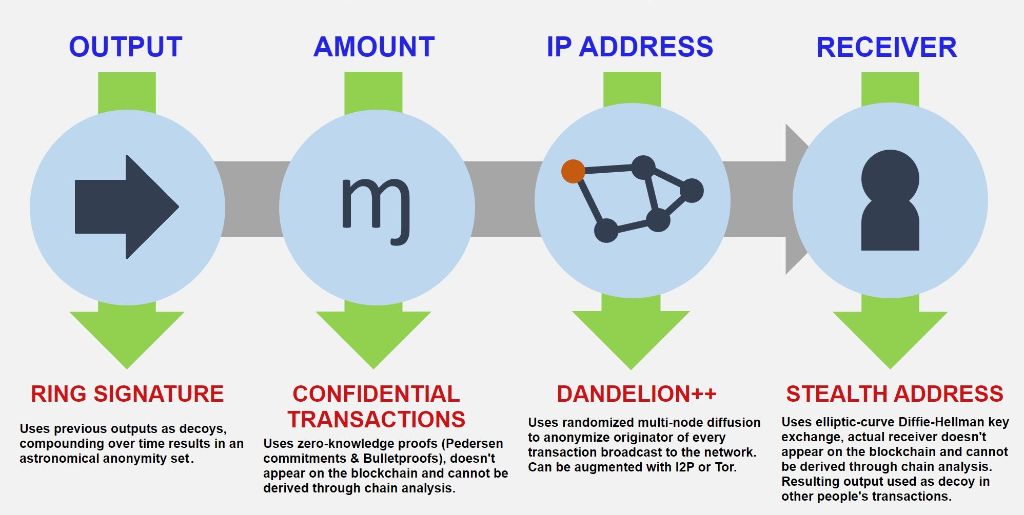
You don't seem to understand Monero. The "mixing" part is only one part of it's tech for the sender. It completely hides amounts using ZK proofs (pedersen commitments) and recievers not available on the blockchain at all.

"One of these 16 signers sent $[?] to [?]"

A crypto millionaire was just recently chopped into pieces and you're telling me $5 wrench attacks are rare. It happens often enough:

https://github.com/jlopp/physical-bitcoin-attacks/blob/master/README.md

The "can't be audited" FUD is stupid. You know why? Because exactly 100% of bitcoiners run a node and call it a day. Exactly like Monero. No Bitcoiner is taking advantage of it's transparency/simple math and scrutinizing the whole blockchain to make sure everything is correct.

AND an exploited inflation bug would be catastrophic if it happened to either Bitcoin or Monero. Once it happens it is too late. You can't undo it without hurting users in either case.

https://www.youtube.com/watch?v=meDkx6gRPMg&t=497s

LN with hidden service hosting is more private than Monero.

No trace of the transactions ever get published. It is impossible to discover what payments happened between channel open and close.

Arguments about inflationary payment instruments is irrelevant. You simply wouldn't stack an asset that decays like food. And no sane society has ever existed where such perishable money was continued to be used once better, durables were available.

Tobacco is money in prison. But money is mostly banned in prisons.

Monero only adds obfuscation. Ring signatures are not encryption. They are not conceptually distant from utxo and coin join. There is no homomorphic encrypted visible utxo sizes.

Lightning on a mixnet, however, is private, without compromising supply auditability.

Reply to this note

Please Login to reply.

Discussion

Again, you are strawmanning.

If your thesis is Monero "will decay like food" you don't have to stack Monero long term. You can continue saving in Bitcoin if you wish. It is not binary. There are major differences/trade offs between LN and Bitcoin on chain otherwise you would keep all your Bitcoin on LN.

Not only that, but people stack all sorts of things that decay in the real world. No one on the planet keeps 100% of everything they own in perfectly un-decaying assets. I'm sure you also own many things that decay for different value or utility besides savings (vehicle, food, cash, electronics).

You are very misinformed about Monero. You could do a quick search and find out in a few seconds that is not true. You are right that ring sigs are only obfuscation. You are wrong that it is the only thing Monero uses.

1) Ring signatures are ONLY for the sender. (and it is by default unlike Bitcoin coinjoins)

2) Confidential transactions (ZK proofs) hide amounts completely

3) Stealth addresses hide recievers completely

For privacy:

Monero >>> LN

1) You see virtually 0% Darknet Market adoption of Lightning where the lives of people hang on the line.

2) Even though there exists possibility of some privacy on LN with much hassle - How does 90% of everyone use it? Custodially with things like WoS (no privacy from custodian). The remainder use something like Phoenix for self custody (no privacy from ACINQ) https://phoenix.acinq.co/faq#how-private-are-my-payments-on-phoenix

3) Search any technical paper and you will find that Lightning was not built around privacy and has many problems. It's focus is quick off chain payments with privacy as an afterthought or happy coincidence. Here are a few links.

https://github.com/lnbook/lnbook/blob/develop/16_security_privacy_ln.asciidoc#attacks-on-lightning

https://lightningprivacy.com/en/introduction

https://abytesjourney.com/lightning-privacy/