

This is exciting to see. I did hit a snag. When I try again, I’m told the username chose, ‘shawn’, is taken. 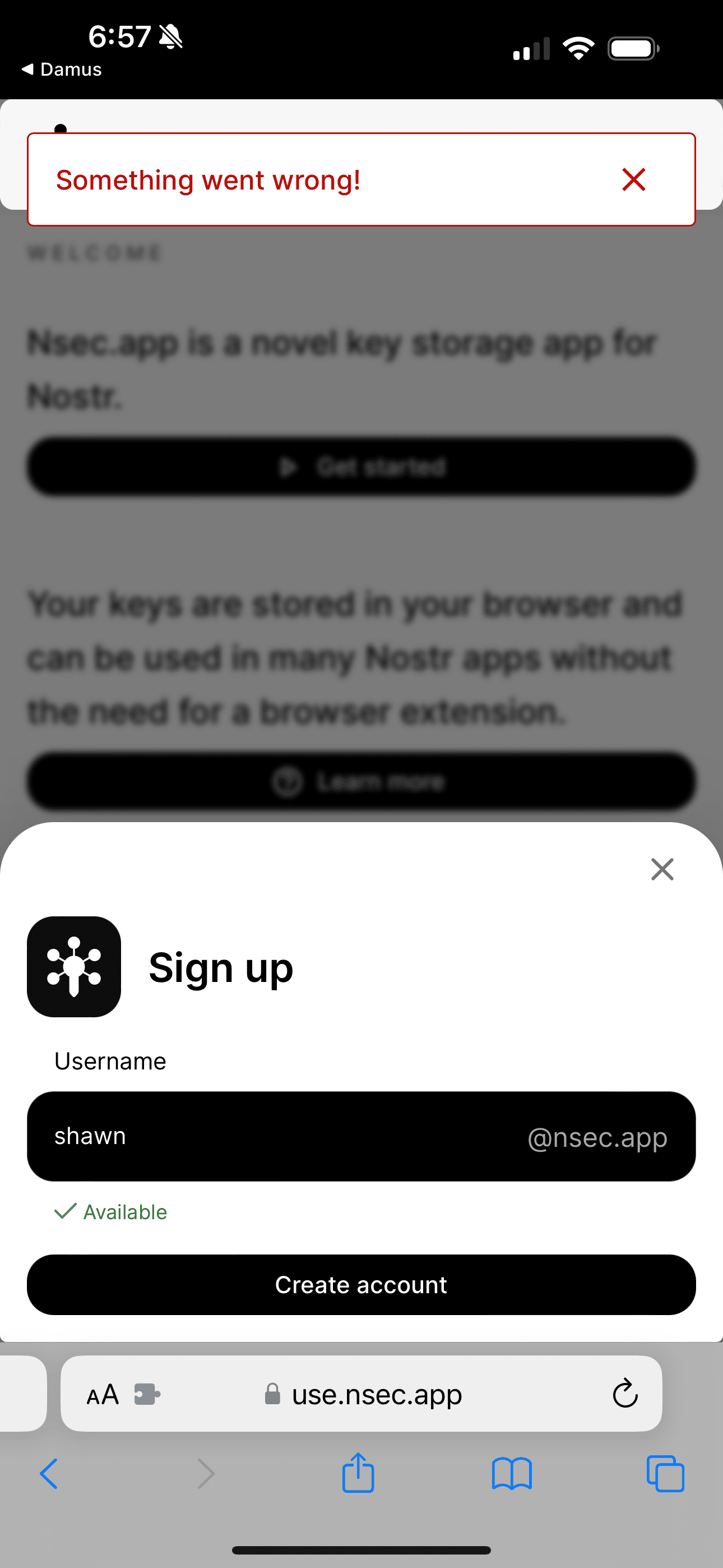
Introducing nsec.app and nostr-login!
I've shown the prototype of https://nsec.app in December, and it's essentially an nsecbunker in your browser. It is non-custodial - your keys are stored locally in the browser, and apps can get access to your keys using NIP46. We've now turned that prototype into a real thing, and I invite you to try it. Shoutout to nostr:npub149p5act9a5qm9p47elp8w8h3wpwn2d7s2xecw2ygnrxqp4wgsklq9g722q for the designs!
Now how do we help Nostr apps adopt NIP46 for remote key access?
That's where nostr-login library comes in. If your app uses NIP07 to talk to a browser extension, then with just two lines of code you can make it talk over NIP46.
Both of these tools support the new OAuth-like flow proposed by Pablo. Below you can watch a demo of how nostr-login (added to my fork of Snort) works with Nsec.app (or would work with any other nsecbunker).
What this all means is that people could join Nostr on the web, without installing extensions or mobile apps, with their keys stored non-custodially in the Nsec.app, and then could log in to other Nostr apps without copying their private keys.
Demo: https://void.cat/d/JSWwYMTtbWxTDTLpe132Kr.mp4
Links:
Snort+nostr-login: https://snort.nostrapps.org
nsec app: https://github.com/nostrband/noauth
nsec app server: https://github.com/nostrband/noauthd
nostr-login: https://github.com/nostrband/nostr-login
Discussion
Oh yes on iOS it's early to celebrate - you need to enable Web Push API in Safari Settings -> Advanced -> Experimental, and then click 'Share' on nsec.app tab and click 'Add to homescreen' - that's the only way iOS allows push notifications to get delivered. Eventually the 'Settings' part will go away as the feature matures, but we'll need to instruct people about 'Add to homescreen' flow.