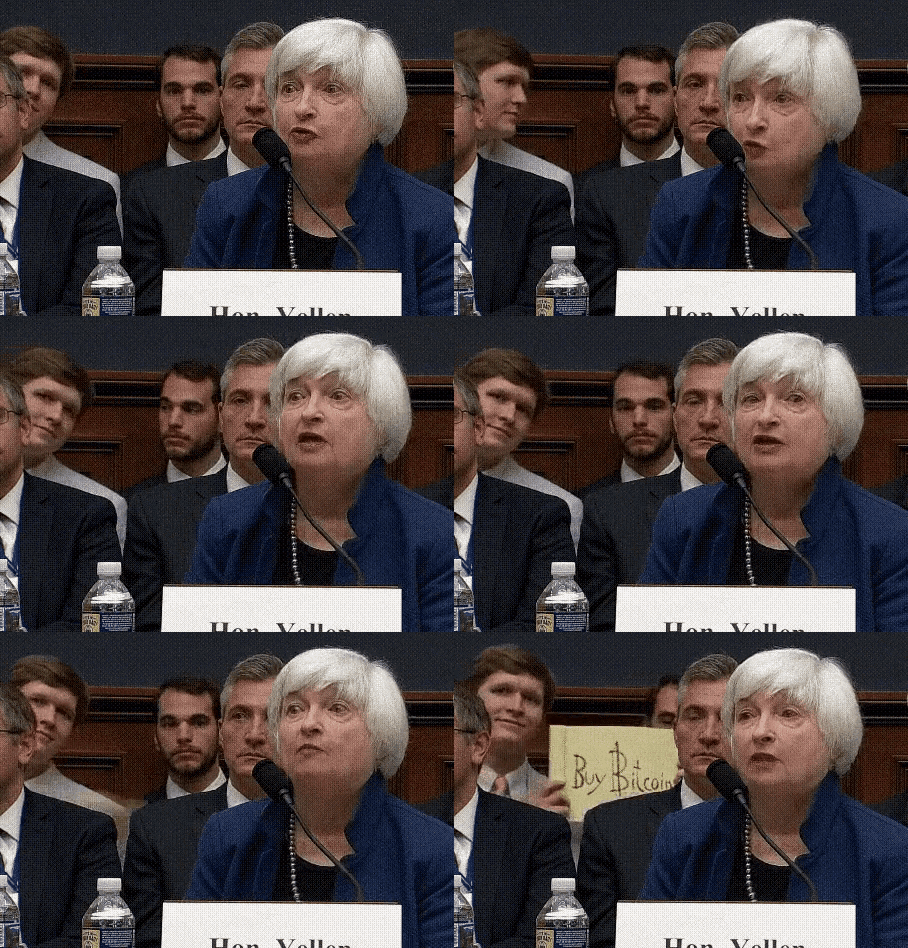
That's quite retarded claim. How exactly is #Bitcoin going to die if all the Fiat disappeared tomorrow?
Elaborate, please.
That's quite retarded claim. How exactly is #Bitcoin going to die if all the Fiat disappeared tomorrow?
Elaborate, please.
If the supplier of my business takes Bitcoin now, almost certainly they turn it into fiat (possibly collateralized stablecoins) in order to pay their suppliers. Or maybe their supplier does. When fiat collapses, I can't keep taking Bitcoin unless my supplier does, and he can't keep taking Bitcoin unless his supplier does. And so on. So only if you have self-sufficient systems in which everyone takes Bitcoin can it continue to circulate.
Instead, most people will turn to physical barter and we will rebuild a monetary system (likely) based on precious metals.
I love both gold and Bitcoin , but physical barter like you mentioned doesn't work anymore.
Same issue as just what you mentioned.
Your supplier loves fiat. Period.
If the supplier of my business takes precious metals now, almost certainly they turn it into fiat (possibly collateralized notes) in order to pay their suppliers. Or maybe their supplier does. When fiat collapses, I can't keep taking precious metals unless my supplier does, and he can't keep taking precious metals unless his supplier does. And so on. So only if you have self-sufficient systems in which everyone takes precious metals can it continue to circulate.
Instead, most people will turn to physical barter and we will rebuild a monetary system (likely) based on Bitcoin.
That should help.
The difference is if I am "stuck" with precious metals I can trade/sell them to a jeweler, or a dentist, or an electrician, or a scientist with a scanning electron microscope - who wants the metal not for trade but for practical use.
The possibility of non-trade use creates the certainty of trade use.
I want a pencil, paper, stamps and envelopes because I can do so much more with those things besides write letters so email is not going to catch on.
What's the money value of an email?
Infinitely cheap. But the value is in the information not the letter itself.
Money is information not the physical, note/coin itself. The only reason 1/10th oz of gold is worth less than 1 oz is because we have the information that one weighs more than the other. The only reason 1$ bill is worth less than 100$ bill is because of the information printed in it.
Money is energy density, bitcoin is by far the most dense. Money is representation of calories and watts. Bitcoin is a direct measure of calories and watts. Gold is an indirect measure of calories and watts. Fiat is an obfuscation of calories and warts.
If we could send calories globally with no transmission loss that would be the ultimate money. Btc is the closest thing we have to that.
Again, the energy theory of value. Like Marx's labor theory of value, this is incoherent.
Is it information or energy?
And no, the 1tz coin is worth 10x as much as the 1/10tz coin for the same reason 10 barrels of oil are worth 10x as much as 1 barrel of oil - namely you can do 10x as much with the material.
The $100 bill is worth the same post-fiat as the $1 bill because you can do exactly the same things with them. The $100 bill is worth more now only because the fiat credit system gives you more points for it. When that system collapses obviously the $1 and the $100 will have the same value - just as Zimbabwe $50trillion notes and Zimbabwe $50 notes (from the hyperinflated currency) already have the same value.
This problem applies to Bitcoin as well. There is no reason that 1 Bitcoin is worth more than 1 satoshi except that it counts for more fiat credit - unlike oil where it is very obvious that 1 barrel is worth more than 1 gallon.
Bitcoin does not have that problem because it can't be hyper inflated.
Already was - where did it come from?
#Bitcoin is still limited to 21 million coins, where is your hyperinflation?
How did it go from zero to 21 million?
how did gold go from 0 to unknown total amount
In quantity, supernova
In price, people wanted gold for jewelry or to fashion simple metal instruments (like lead, gold is malleable & makes good plumbing)
Then because it was durable people decided to save gold (later selling it to others for material uses).
But that can't happen with Bitcoin, there is no base case of jewelry or conducting electricity or whatever to bootstrap from. Instead it is a derivative of fiat which is a derivative of gold.
There was a monetization process of gold the same way there was with btc. It's not like humans were created wanting gold. In fact gold is in the demonetization process at the moment. The same way iron,bronze,silver (all were money at one point). have all mostly been demonetized gold will be too.
To the energy / information point. Money is energy dense because it's hard to create/find/ mine whatever. Then it's purely informational (transactional). Btc will surpass gold because it can store energy more efficiently and transmit its informational value more efficiently.
If you had a way to split gold down to the atom, and be able to physically move that atom anywhere in the world with no loss of information -no friction. Then gold would be competitive but its not.
How much energy does a Bitcoin store?
https://www.coinwarz.com/mining/bitcoin/hashrate-chart
Each T/h is approx 120w and getting more dense as hardware improves.
So the later bitcoins store more energy than the earlier ones? Are they worth more?
The energy storage is cumulative. The blockchain is like a battery for the humans to draw from. Money is like a civilizational battery where we store excess labor.
The longer we can defer consumption the better off we will be as humans. Savings is just deferred consumption so in a way the early bitcoins are worth a lot now because those people deferred consumption the longest. Even tho 1btc = 1btc
Is not at 21 million. Also, where is the hyperinflation, again. 👀😆
Money is the information.
Exactly. Good money can reflect that information (price) through time.
What about energy? Bitcoin is backed by the the ability to produce the energy need to mine a block, and or the ability to procure that energy. Why is that meaningless?
That's not backing.
When FRNs were backed by gold you could take them to the Federal Reserve (or the US Treasury) and demand gold.
The issuer who created the notes "backed" them by pledging a real asset - the notes were merely a stand-in for that real asset.
I don't have a particular right to go to the miner & demand any particular amount of energy for my Bitcoin.
Similarly, gold takes energy to find, recover & refine, but it is not backed by that energy. If you think it is, then we could ask what backs the energy. Hopefully you see why this leads quickly to absurdity.
I don't think that's an apt comparison.
The energy "backing" bitcoin is energy thay is immediately redirectable. There's objective of proof this in practice today.
Using mining as a "variable load" to increase reserve capacity for any given grid, again objectively provably happened today. Increase the available energy capacity at any give time. Leading to more stable grids. This also provides a tool that allows for what was previously cost prohibitive grid expansion.
This solves a problem that has existed since energy grids have existed. Nothing has solved this, to this extent before Bitcoin.
So is Bitcoin "backed" by energy, that's kind of subjective I'll give you that. But the real world, symbolic relationships between Bitcoin mining and energy production is not.
You use a certain amount of energy computing blocks. How do you get back or redirect that energy? Isn't it mostly lost as heat?
If your datacenter produces currency, that currency belongs to the datacenter owners and operators, not the electric grid operators. You could spend currency importing additional fuel but that was true regardless of what task the datacenter was doing to produce currency. You could be renting out cloud storage or crunching numbers for LLM chatbots.
Is Bitcoin mining the most efficient way to turn electricity back into some form of currency? I doubt it. One compelling alternative is turning air and water into ammonia, which can be used to fertilize crops or burned as a fuel for mechanical or electrical output. Or you could perform those other datacenter tasks.
Moreover, Bitcoin is convertible into electricity at variable rates, not a fixed rate. I can't buy Bitcoin now and have any confidence about how much or how little electricity it will buy in 5 years. Supposedly this is the great weakness of fiat - that my fiat dollars will buy an unknown amount of real goods.
I suspect this unknown is the chief appeal of Bitcoin. Bitcoiners seem to hope that Bitcoin will increase in trade value vs real goods, while they (and I) believe fiat will tend to decrease in trade value vs real goods.
If you think Bitcoin will continue to increase in trade value vs real goods forever, why? Whatever wonderful mathematical properties it has can be duplicated in other cryptocurrency. Do you think all cryptos matching or exceeding the current properties of Bitcoin will go up in value forever?
The consumed energy, of course has already been consumed. The supply that is aimed at that source of consumption is what can be redirected. This is supply that would otherwise be curtailed in one way or another. Rather then curtailing or ramping the supply, you throttle down the mining. There is no other industrial scale consumer of electricity that can be throttled up and down or completely shut off that quickly. You can’t just shut down a data center full of servers, or take cloud storage offline at moment’s notice.
Yes the bitcoin minted by the data center belongs to the data center, but some must be distributed to cover the coast of electricity. And so long as the data center is paying the bill, what does the producer care? They never need to interact with the bitcoin.
We know definitively, that the fiat dollar will buy less in five years, by definition as an inflationary currency. We know that for the entirety of its history, that there are no 2 points on a bitcoin price chart in which it has bought less five years later. Granted it has a short history; In which it has out competed that vast majority of other currencies in the world.
Why will it continue to go up in trade value vs real goods?(I’ll give that one it’s own separate answer, its kind of a big one.) As long as bitcoin continues to be useful and people want to use it. But why can’t any other cryptocurrency duplicate what bitcoin can offer? Firstly the security of the network. The network has more compute power than any other network in the world, more then all the supercomputers, or anything else, by orders of magnitude. You absolutely can not recreate that, on any realistic time frame, or port that over to another network. Same with the nodes, it is genuinely globally decentralized, and you can’t just port those nodes over to another network.
Why go up forever?
(I cheated in this one. I was struggling putting conceptual understandings into concise statements, so I used chatGPT. So, totally fair if you want to harange me for not being able to defend my arguments....🤷♂️)
From an economic standpoint, Bitcoin's potential for perpetual price appreciation can be attributed to fundamental principles of supply and demand, coupled with the network effect. Bitcoin's supply is capped at 21 million, creating a scarcity dynamic. As more individuals and institutions adopt Bitcoin, demand increases. Scarcity coupled with rising demand generally leads to price appreciation.
Furthermore, the network effect amplifies this dynamic. As the number of Bitcoin users grows, the utility and value of the network increase exponentially, attracting even more users and, consequently, more demand. This self-reinforcing loop has the potential to sustain long-term price growth, especially as Bitcoin continues to penetrate global financial markets and challenge traditional stores of value. Therefore, theoretically, Bitcoin's price could ascend indefinitely as long as these dynamics persist.
the energy dynamics of Bitcoin mining add another layer of complexity and potential for long-term value appreciation. The Proof-of-Work mechanism, which secures the Bitcoin network, requires miners to expend energy to validate
transactions and create new blocks. This energy expenditure effectively "backs" each Bitcoin, imbuing it with a tangible form of value akin to the labor and capital invested in extracting precious metals like gold.
The energy cost sets a kind of "floor" for the value of Bitcoin; as long as people are willing to expend energy to mine it, it will have intrinsic value. Moreover, as the network grows and more energy is expended, the security and robustness of the network increase, making it even more attractive to potential users and investors. This, in turn, feeds back into the supply and demand and network effect dynamics, creating a multifaceted system that could theoretically drive Bitcoin's value upward indefinitely.
Is that so absurd that you don't even find it worth responding to?