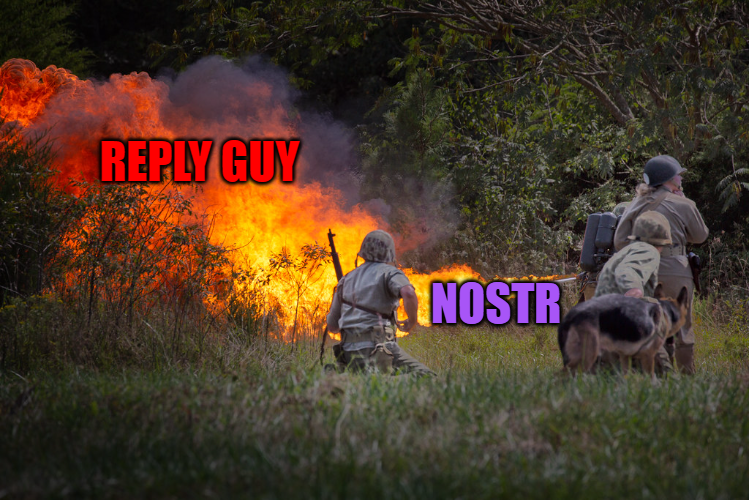
people are too complex to verify precisely. web of trust is about seeing past the self-promotion to what people actually perceive. the most important info in nostr data is not the follow lists, though it's got some value. interaction metrics *prove* trust but you then have the problem of characterising it, engagement is the raw signal, the words contain the sentiment.
Discussion
also, the purpose of it is to reduce the influence of malicious actors in a social graph. and various attempts to produce strongly indicative metrics often have various games you can play to pump your numbers, like sock puppets.
sock puppets, for example, could be reduced by creating a scheme for requiring users to mine vanity keys with a minimum readable length in them. this would be in the range of 8+ characters. the darkweb many sites do this with their Tor hidden service address (it's a pubkey). because they take weeks to generate long ones. a user with a very long vanity word in the pubkey bech32 encoding would be very difficult to impersonate.
there is schemes like this also with other systems. DNS uses monetary costs and a distributed replication system to stop people poisoning the map of name->address but it is a very high trust protocol, this is partly also why Russia has implemented its own name service system in case someone does break the IANA BIND9 database.
When you wrote malicious actors do you mean profile impersonators?
every type of malicious behavior. gaming the WoT is a red flag. trolling and spamming are red flags. brigading is red flags. infiltrating social graphs and sowing discord is red flags.
the core dev fan trolling was malicious behaviour. jb55 was in on that, for example.
I am not familiar with that incident.
let's just say that some people showed their true colors. people with high visibility thanks to the collaboration of such as the primal team.
it's not for nothing there is a segment of the nostr population really tired of the obvious social manipulation going on.

A metric based on how much mutual bi-directional interaction, frequency and last interaction could potentially be useful. Then you know its an actual relationship not just a 'reply-guy'
i'm building this now. it is going to be lightning fast, and use an allowed exception in NIP-01 that specifies underscore prefixed fields are to be ignored. it will let you grab even the list of metadata events, all sorted and grouped, either by depth of distance the users first appear from a "seed" npub, or multiple criteria like reactions/reposts, reports and mutes, and it will allow you to also do queries that fetch whole threads using index free adjacency with vertex graphs.
it's all very clear in my mind, clear enough that i am confident i will have a working version within a few hours.
i'm also adding a standard nip-01 based graph traversal for 3 degree follow graphs to the benchmark, as a baseline to compare both the optimization of relays to doing this kind of query under the existing scheme, and later i will make it add, for comparison, if the relay supports the new _graph field in REQ, to show how much faster again that 3 degree pubkey list can be produced using graph vertexes. i'm pretty sure it's gonna be at least one if not two extra decimal places in the ratio to nip-01
Reply guy was not very popular back in the day.