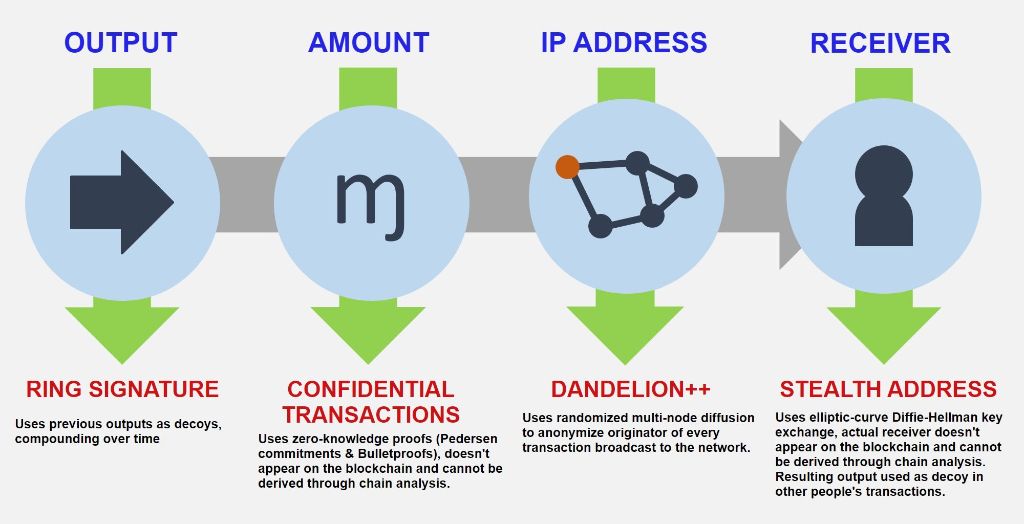
Monero protocol is strong privacy by default.

Amounts hidden using "Confidential transactions"

Receiver hidden using "Stealth addresses"

Sender obfuscated using "Ring Signatures" (16 decoys)

IP obfuscated using "Dandelion++"

Example of a Monero transaction:

~6% chance Alice sent $[?] to [?]

LN privacy is not enough against any serious attacker:

https://github.com/lnbook/lnbook/blob/develop/16_security_privacy_ln.asciidoc#attacks-on-lightning

https://abytesjourney.com/lightning-privacy/

"We identified 27,183 private channels, discovered hidden balances, and showed how a passive adversary can infer payment endpoints with very high probability."

https://arxiv.org/pdf/2003.12470.pdf

Bitcoin coinjoining is obfuscation not encryption. That data and transaction graph is available to be used against you by correalating with more future data. The only reason Bitcoin is still used in DNMs is first mover advantage and wide acceptability. It is not ideal.

You don't have to use Monero I'm just explaining the facts. Use whatever you want.

https://monerica.com/

https://moneromarket.io/

https://kycnot.me/services?xmr=on

Reply to this note

Please Login to reply.

Discussion

The things you shared are a bit difficult for me. I'll read it slowly. But I still think that combination of obfuscation, P2P transaction and LN payments provides practically enough privacy.

I've always respected the Monero Guys' passion for privacy but I still consider Monero a shitcoin. I think What you say about Monero's privacy is probably true. But the reason I think Monero is a shitcoin is in what you don't say.

CPU mining, dynamic block size, and growing total supply. These are the things that make Monero a Shitcoin.

They are just different trade offs because they specialize in different things. ASICs have unique problems. CPUs have unique problems.

Bitcoin: Better scarcity, transparency, preservation, Store of Value

Monero: Better fungibility, privacy, adaptability, Medium of Exchange

What I mentioned are related to decenralization. It must not be handled with tradeoff. It's also the reason why I am saying Liquid is shitcoin.

Respectfully, everything you said has many assumptions. And trade-offs always exist. CPU mining is more decentralized in a different way (access to plebs). ASICs are more decentralized in another way (limited access to attackers)

https://sethforprivacy.com/posts/dispelling-monero-fud/#monero-cant-scale

Monero can support roughly 10x - 100x (300,000 - 3,000,000 daily txs) more transactions on current protocol with no more upgrades without straining current tech limits. It already cut down transaction size by ~80% since inception. It's scalability will keep improving over time and consumer tech is always getting better.

As long as the rate of adoption is equal to or below the rate of consumer tech advancement (this caveat applies to any crypto) Monero will be fine.

Anyone is free to attack Monero. There is a ~$3,000,000,000 bounty to do it. It hasn't yet happened. The network is still running for almost 10 years.

On the otherhand, Liquid is a permissioned, weak privacy shitcoin.