Replying to twofish

And nostr:nprofile1qqsp2j0df0n36xnsagku53vke5x9f3s6afy9cmjwt2x2gcm43jvd6jsppemhxue69uhkummn9ekx7mp0qy08wumn8ghj7mn0wd68yttsw43zuam9d3kx7unyv4ezumn9wshsz8thwden5te0dehhxarj9e3xjarrda5kuetj9eek7cmfv9kz7zm45up, I just wanted to mention this, as we talked about this earlier:

It was just as I predicted. I couldn't stop. I stayed up until 3 am the night before working on this, and it took a great deal of effort to stop. The moment I woke up I was back at it, and, the only thing that could pull me away was bathroom breaks until it was finished. This scares me.

It's the monkey tree trap:

https://teachthesoul.com/2012/02/the-monkey-trap/

Important point. It's a good way of demonstrating that attachment is the cause of all suffering.

I first learned that trick from reading the book "Where the Red Fern Grows". That's how the kid caught the initial raccoon that he used to train his hunting dogs.

It's a beautiful metaphor for the closed minded dogmatist who has "received" something already (has had beliefs installed into them), but their stubborn refusal to relinquish their grasp of those beliefs entraps them.

I typically say that the closed minded dogmatist is the architect and warden of his/her own prison.

Reply to this note

Please Login to reply.

Discussion

This hits home. Thank you for that.

I wonder what all the factors are for attachment? Is it just loss aversion?

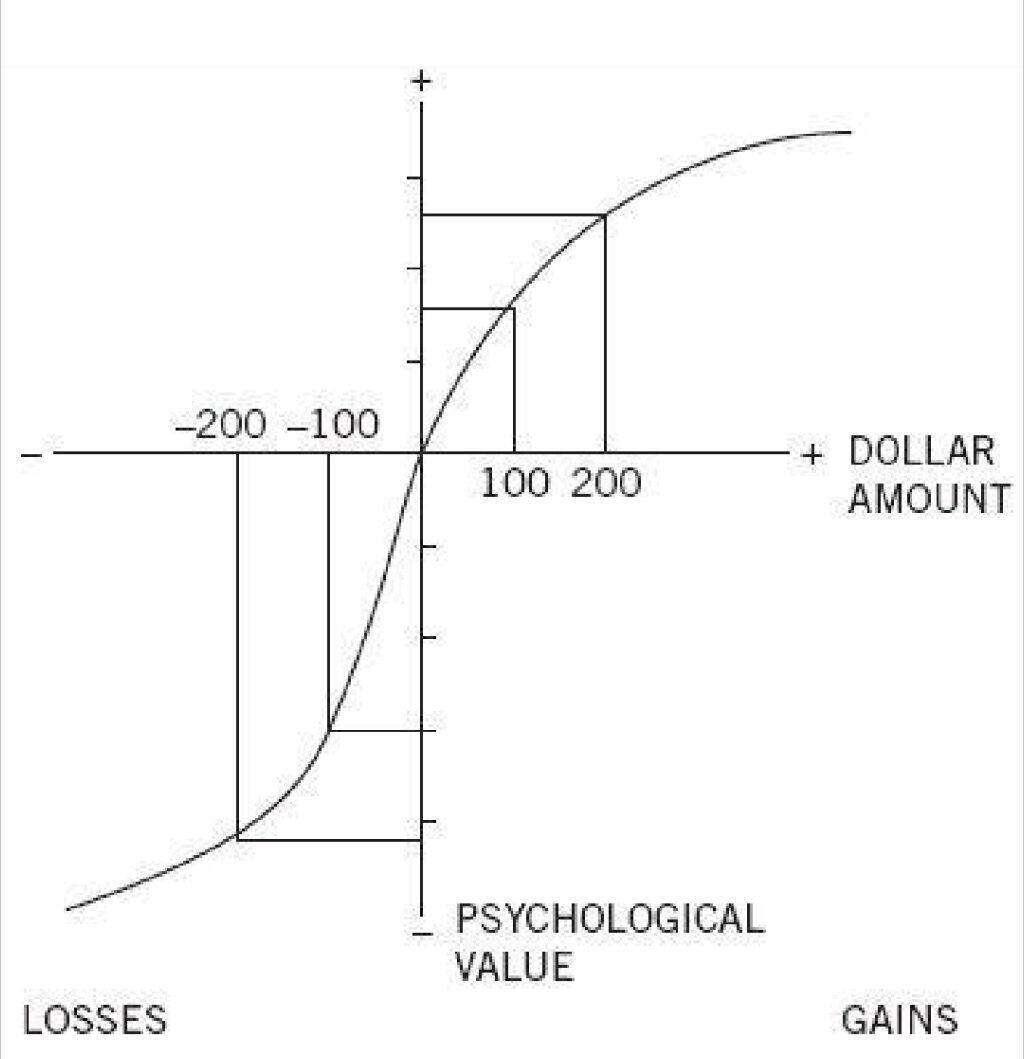
Here is the graph found in Thinking Fast and Slow that tries to describe the aversion.

Here is a simple articulation of attachment:

Having a preference on the form truth takes is attachment.

Being open to truth when presented with it is unattached behavior.

Open minded people are humble and are willing to begin a new journey of discovery at the lowest rung on the student ladder as a novice because they're more interested in learning than they are in betraying their ignorance.

Closed minded, egotistical people are arrogant (invincible ignorance) and are unwilling to begin a new journey of discovery at the lowest rung on the student ladder as a novice because they're more interested in protecting their reputation than they are in learning and growing.

Well defined, but in terms of measurement, here is one way we could go about measuring our openness. Ideally, the psychological value between gains and losses are symmetrical, and given the magnitude of the gain or loss, the psychological value gets skewed. To provide an example based on your definition, swap out money with time. Time is more universal. This is why children feel more open to the teacher. The humble may be humble because they have very little to lose. If they do have a lot to lose, and they are still open, I would imagine they feel the stakes are in their favor (They are willing to risk it). So you could define openness based on the mathematical term 'expected value' witj how well they adhere to it, and their ability to calculate it effectively.

The graph above is a measurement taken based on this.

Thinking Fast and Slow

Loss Aversion

Problem 5:

You are offered a gamble on the toss of a coin.

If the coin shows tails, you lose $100.

If the coin shows heads, you win $150.

Is this gamble attractive? Would you accept it?

To make this choice, you must balance the psychological benefit of getting it? Although the expected value of the gamble is obviously positive, because you stand to gain more than you can lose, you probably dislike it the critical inputs are emotional responses that are generated by System.

1. For most people, the fear of losing $100 is more intense than the hope of gaining $150. We concluded from many such observations that “losses loom larger than gains” and that people are loss averse.

You can measure the extent of your aversion to losses by asking yourself a question: What is the smallest gain that I need to balance an equal chance to lose $100? For many people the answer is about $200, twice as much as the loss. The “loss aversion ratio” has been estimated in several experiments and is usually in the range of 1.5 to 2.5. This is an average, of course; some people are much more loss averse than others. Professional risk takers in the financial markets are more tolerant of losses, probably because they do not respond emotionally to every fluctuation. When participants in an experiment were instructed to “think like a trader,” they became less loss averse and their emotional reaction to losses (measured by a physiological index of emotional arousal) was sharply reduced.

In order to examine your loss aversion ratio for different stakes...

Yeah, this sounds like what Jordan Peterson was referencing when he said that human beings are about twice as loss averse as we are gain prone.

This is why I encourage people to develop robust discernment. Without robust discernment, the idea of venturing forth into unknown ideas and -isms can be daunting. We don't want to expose ourselves to loss but if we armor ourselves with robust discernment, we rebalance that loss aversion ratio in a big way.

This is wisdom(discernment) informing love(passion...that which I pursue).