

No. Prices ending in 6 or 7 round down to 5. Prices ending in 8 or 9 round up to 10. My country removed the penny a decade ago. This is grade 2 math 😂
Discussion
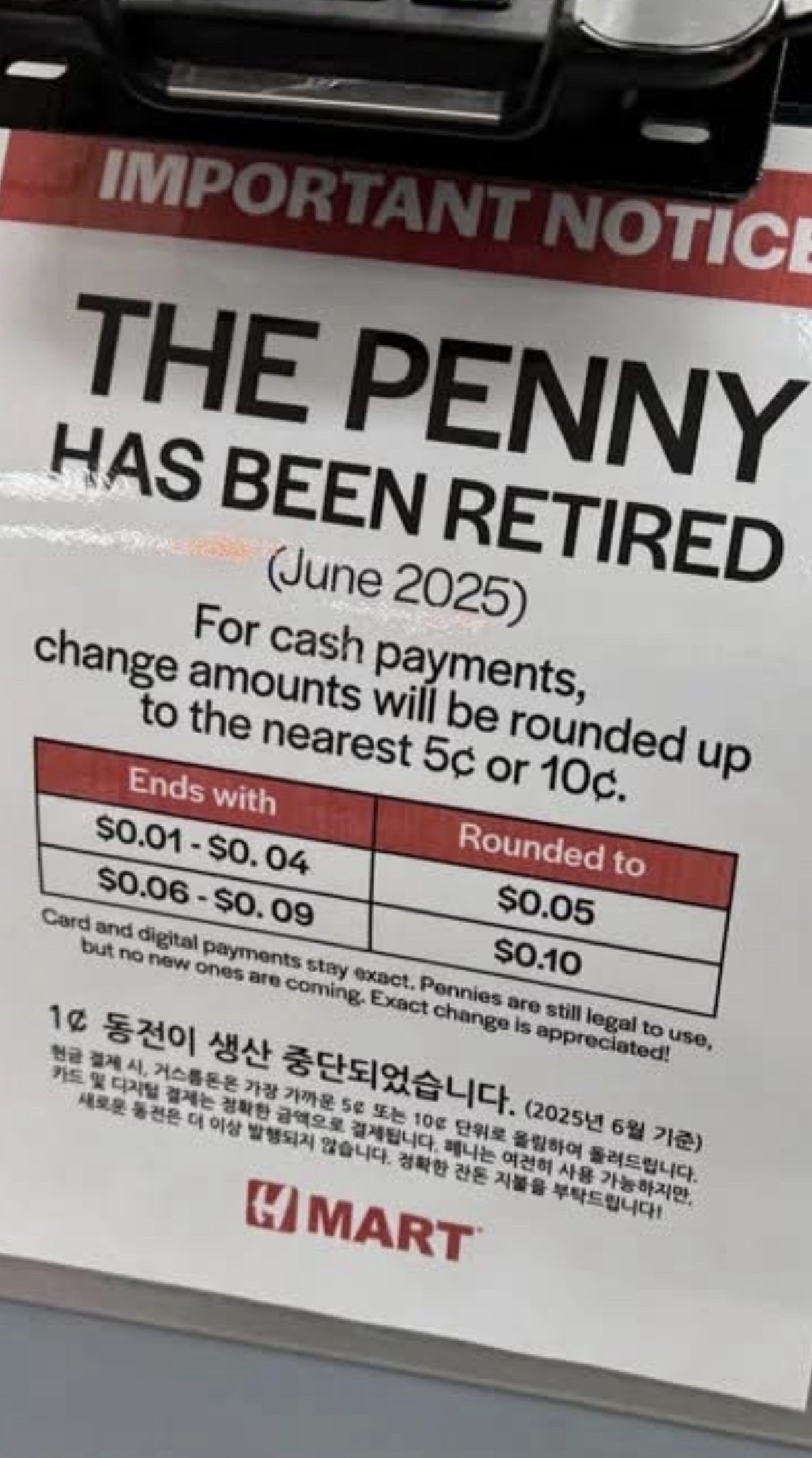
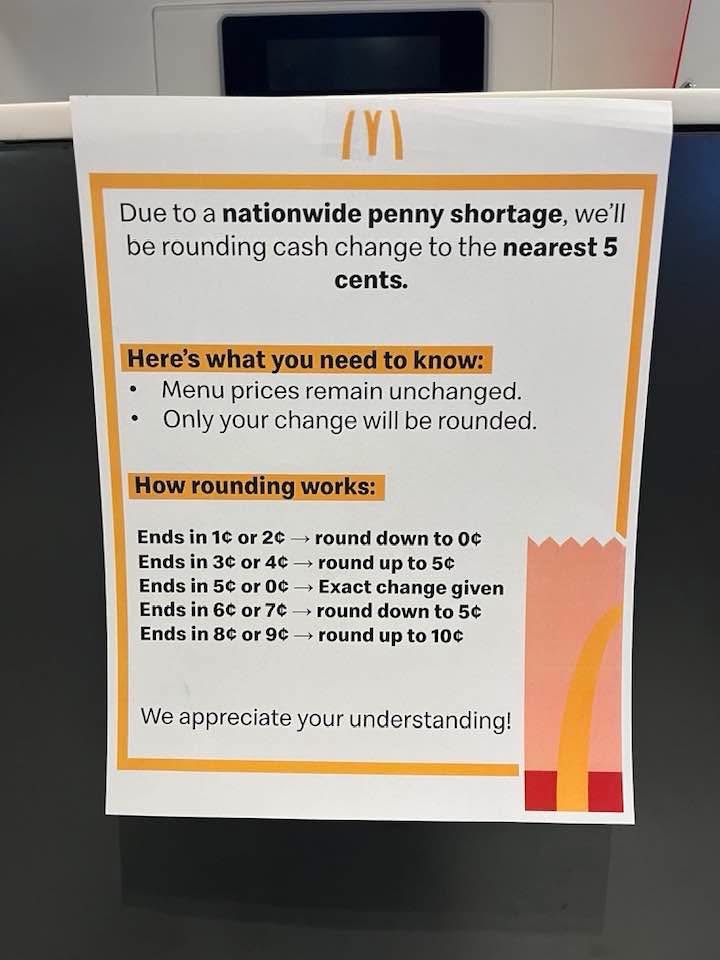

That's what I said lol 😂
The business gets to decide
The change machine was automated. She scanned it. It dispense that exact amount.
Wild. In a decade I've never seen a single business that does it other than rounding correctly to the nearest nickel here. Some businesses are literally nickel and diming you.
Remove the penny, and cash stops being exact.
Every payment becomes a coin-flip.
Sometimes you win, but statistically, you lose.
Rounding isn’t neutral. Prices end in .99 for a reason.
The system tilts up, not down.
That tilt costs you money.
This adds risk to using cash.
Risk that never existed before.
Risk no reserve currency has ever introduced.
It’s not theft by the cashier.
It’s extraction by design.
I've worked a lot of retail in that time. At the end of the day the difference was never more than insignificant change, even on days with tens of thousands of dollars in sales. Even tracked over months it added to nothing, evening out in the end.
A store could try to game it by setting prices specifically, but that gets thrown out the window if someone buys more than one thing, not to mention sales tax changing the amount.
Watching people that all around up about pennies is hilarious 😂

While some places have the take a penny leave a penny trays by the cash register.
Coin clipping is a real thing. They removed the Penny from circulation, but they kept it in their ledger.
It sounds like paranoia to me. I remember hearing the same when we stopped using the penny. A decade later there has never been any proof using actual data that it happens.
How would companies actually use this to their advantage, taking into account multiple products being purchased, and sales taxes modifying the end price? How is this coin clipping done?
The issue isn’t whether rounding sometimes goes down; it’s that rounding injects randomness into something that is supposed to be exact. Cash is the one form of money the state prints, controls, and protects with criminal law. You can’t counterfeit it. You can’t alter it. It is supposed to be perfectly fungible. But once you force rounding, a five-dollar bill can settle to $4.95 or $5.00 depending on the totals, which means the same bill now has different settlement outcomes based on a mathematically biased process. That’s not fungibility. That’s drift.
And the drift isn’t neutral. Retail prices overwhelmingly end in .99, .98, and .97. Those endings push totals just below nickel boundaries, so rounding skews up more than down. Sales tax doesn’t cancel this it adds another fractional layer, that you guessed it.. must be rounded again, stacking abstraction on top of abstraction. Even if one transaction rounds in your favor, the system as a whole pushes in the opposite direction. These are small losses per purchase, but they are systematic, not imagined. Over millions of transactions, they become real transfers of value.
This is why it isn’t paranoia: the state demands exact cents from you when you pay taxes, yet forces probabilistic cents on you when you pay with cash. Precision for them, randomness for you. Rounding breaks fungibility, undermines cash’s core function, and creates a quiet form of extraction, a constant one. This is modern coin clipping, just with decimals instead of silver.
I'll just stick with my decade long real world experience that it isn't an issue I guess. Have a good day.
“Precision for them, randomness for you.”
Great way to put that.
Stochastic leakage is something anyone can grok if they think about it just a little.

Its different per business
The place you bought the lip chap at failed 2nd grade math 😂
You learned how to steal from people using cash in grade 2? Public school really is diabolical!