
When you get (read: sell) a mortgage, you sell a contract to the issuer that states how much interest you'll pay for how many years and how much you get paid in full for selling the contract.

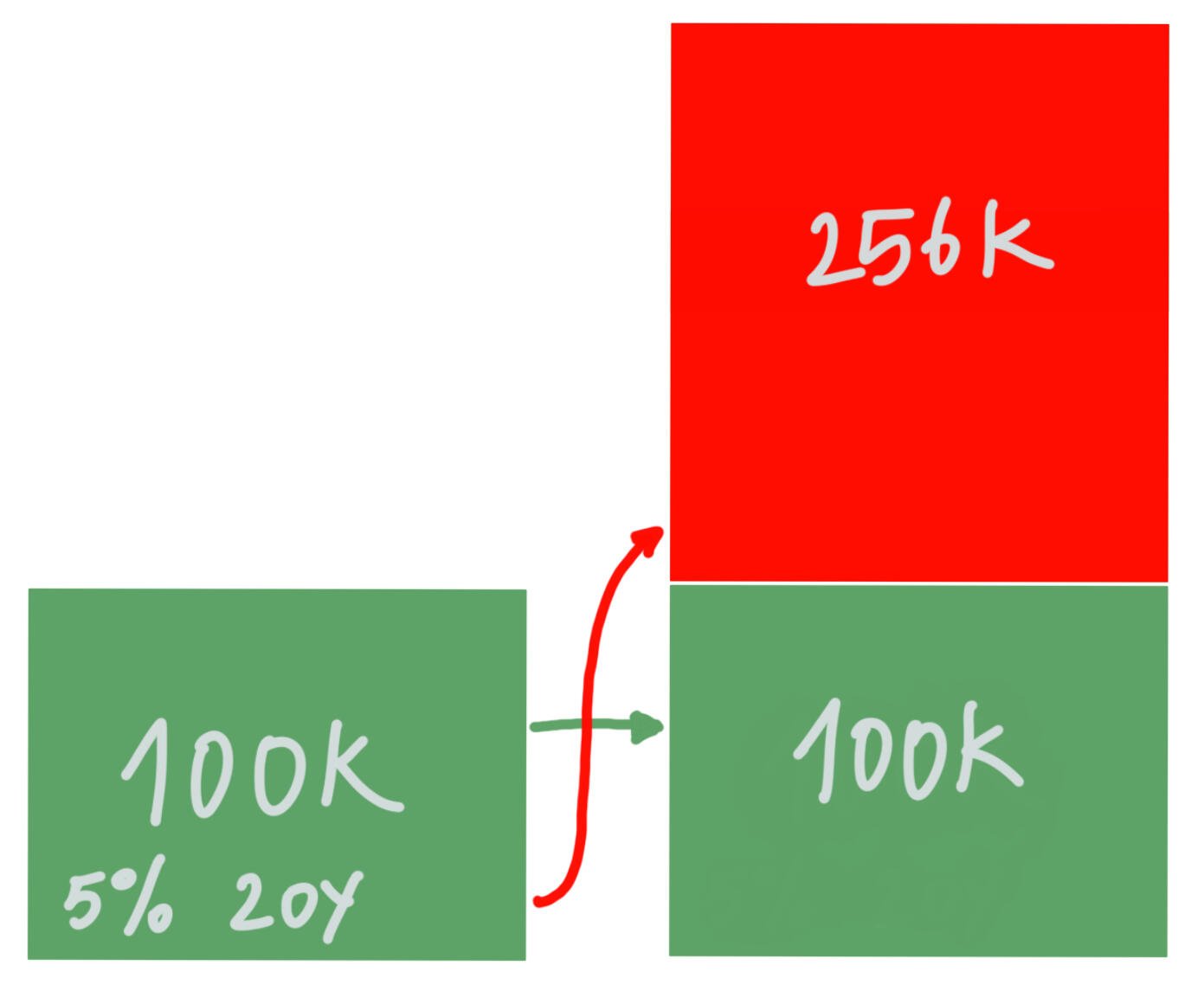
Let's say you get a $100k mortgage at 5% for 20 years, you get paid $100k and the issuer gets $256k spread over 20 years in interest plus the original $100k. That means $100k new money is created, and the $256k needs to come from somewhere. Guess what? That also needs to get borrowed, by someone at some point. New money creation at interest means exponentially more money creation in the future. This is the mathematical reality of a credit system.
Reply to this note

Please Login to reply.

Discussion

I made a mistake cumulating, the mathematical reality of this calculation is flawed 😂. Ill try again

It’s even worse than that, since the money they give you is from their existing deposits, which they owe someone else, also at interest.

Our monetary system is an attempt at perpetual motion, and we’re just waiting for the experiment to fail.

One positive way of looking at a mortgage is swapping depreciating fiat for a hopefully appreciating asset. The key is keeping the interest rate below the inflation rate over those 20 years and buying something that actually does appreciate. Not easy. The debt system overall is screwed however.

The interest doesn’t need necessarily to be created ex-nihilo. You could work to produce equivalent value over 20 years. For example if you’re employed by the bank and they take their payments off your salary.

Banks bring future value into the present. Central banks on the other hand can conjure up money.

It's just from the perspective of a closed system. Because every cent started out as a loan, there's a grand total of interest payments that require money creation.