

I completely agree. I have been and continue to be a long-time critic of Farcaster, Lens, and other similar efforts. The only place where blockchain is useful in this case is in a decentralized naming system such as ENS, or some kind of DID storage.
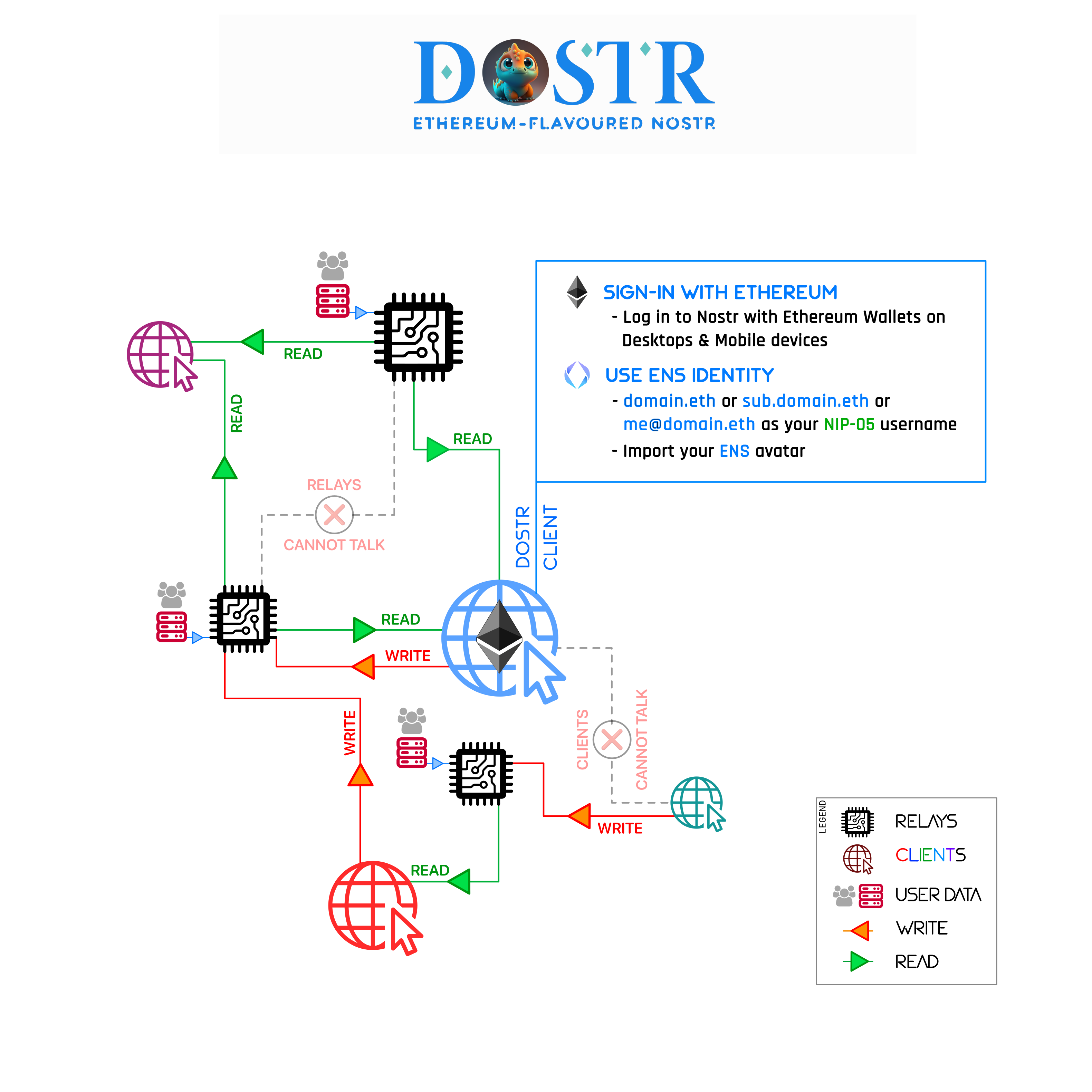
Someone tried to build an Ethereum-based Nostr client called Dostr.
Among the reasons it failed, IMHO, is why most Ethereum projects fail. It required that users already have an Ethereum wallet to connect in the first place. By tying your social graph to a blockchain, you immediately limit the potential size of your audience to only those who have already self-identified with that subgroup.
Nostr doesn’t use or need a blockchain to function. That’s an important point that the crypto people (I am using a much nicer word than I usually do) often overlook.
https://dostr-eth.github.io/homepage/
Discussion
I just wouldn't confuse this with it being the fate of all Ethereum projects. This clearly doesn't make sense—but there are many areas where it does make sense, such as lending, decentralized exchanges, decentralized stablecoins, prediction markets, and many other use cases.
What I meant to say was Ethereum social network projects. I mainly see them as places where people go to shill their NFTs and memecoins so they can dump them on other people. Their followers are just exit liquidity.
That's right, the social sphere is complex, with extreme pressure toward centralization. I believe that many projects were created honestly, but their authors were weak.
The incentives are all designed to give scammers the advantage. There’s no such thing as an honest token-based community. The insiders just want to cash out at the top.