
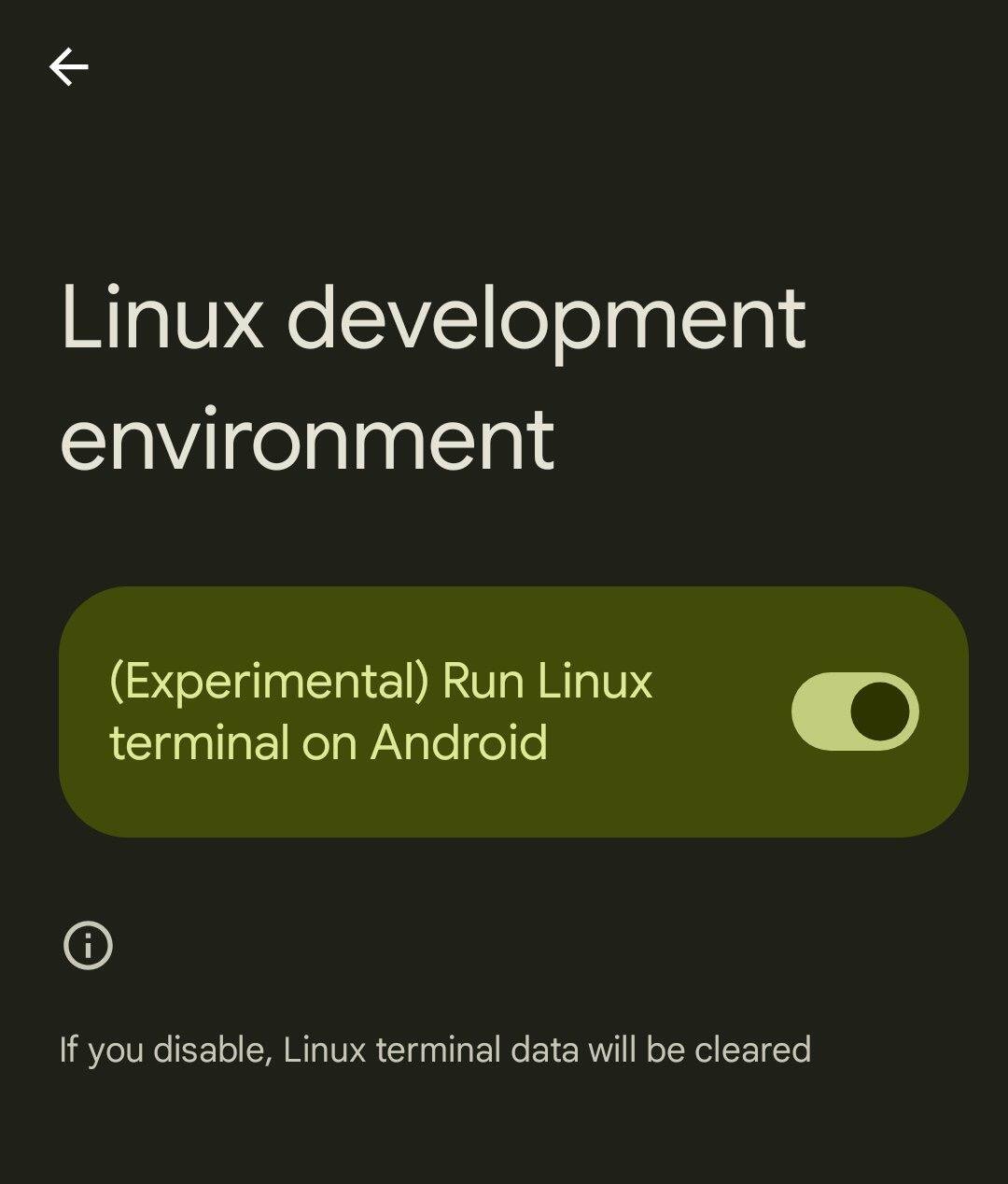
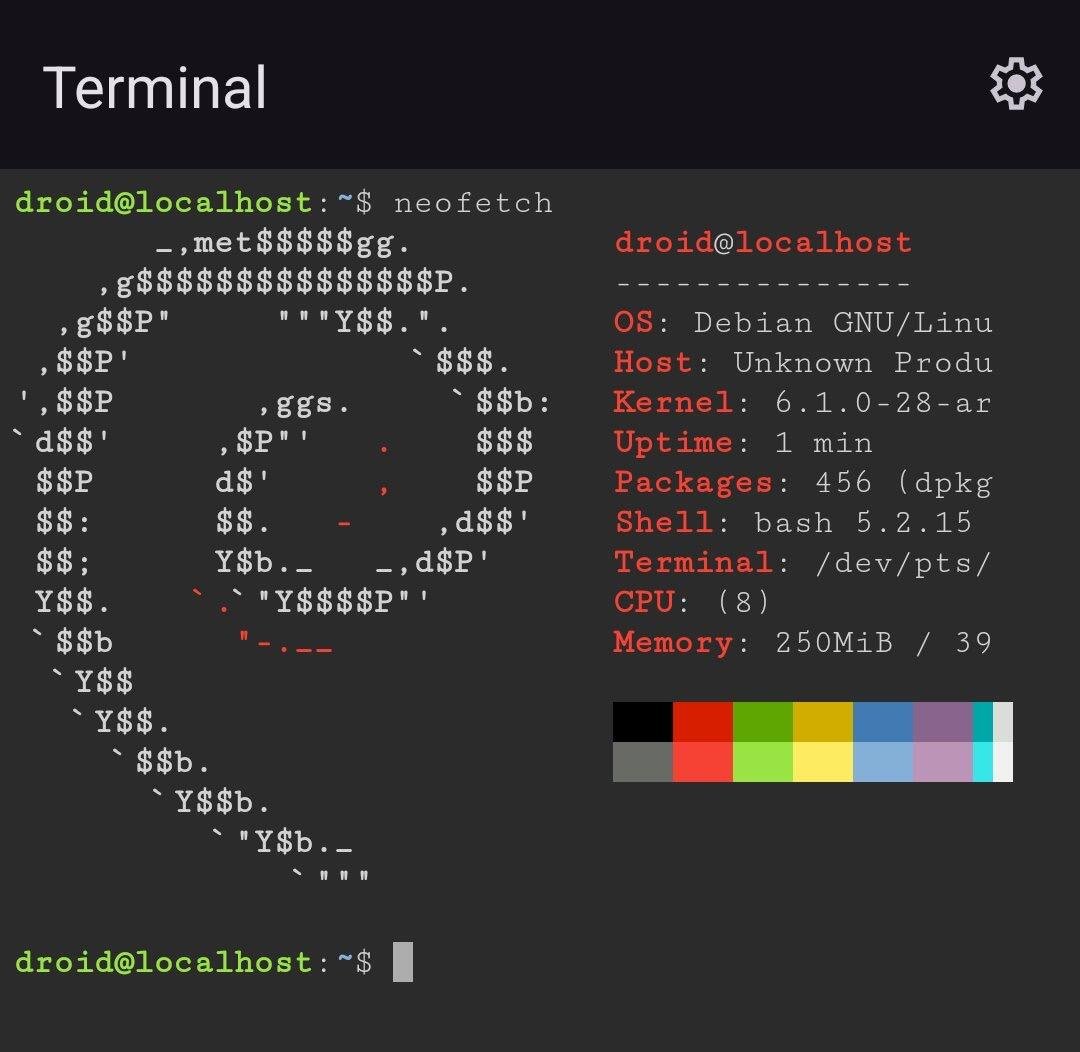

It's a whole VM subsystem. I hope projects like AnLinux can take advantage of this fur running custom builds. A tiny alpine Linux spin would be handy on mobile hardware.
Discussion
very interesting, better than i first thought.
Someday soon we'll be turning our old phones into nodes and relays 🚀
so if i’m getting this right, they’re basically giving us a hypervisor on an android device, letting us deploy any os virtually, just like on a server. in fact, all these cloud servers run on top of & are isolated using hypervisors.
so this isn’t just an app, it’s an entire development ecosystem for low-level system apps & os. it sounds almost too good to be true. really hoping it gets widely adopted & integrated.
It's going to be interesting to see where this goes. It is part of the open side, not the Google Play side of Android. It should be working on GrapheneOS shortly, there's still a bug that makes Linux crash on boot though.
Also GUI applications too
https://www.androidauthority.com/android-16-linux-terminal-doom-3521804/

👀

I really want to know what is the difference between this and a proot distro
From Gemini, it explains this better than I can.
When comparing Proot and hypervisors, it's essential to understand that they serve different purposes and operate at distinct levels of virtualization. Here's a breakdown:
Proot:
* Process-level virtualization:
* Proot (Process Root) is a user-space implementation of chroot, mount --bind, and binfmt_misc.
* It allows you to create a simulated root environment within an existing operating system.
* It doesn't create a separate virtual machine; instead, it tricks applications into thinking they're running in a different root directory.
* It's lightweight and efficient for running applications in isolated environments, especially on systems with limited resources, like Android devices.
* It shares the host operating system's kernel.
* Performance can be limited, as it's not true virtualization.
Hypervisors:
* Hardware-level virtualization:
* Hypervisors create and manage virtual machines (VMs).
* They allow you to run multiple operating systems simultaneously on a single physical machine.
* There are two main types:
* Type 1 (bare-metal): Runs directly on the hardware (e.g., VMware ESXi, Hyper-V).
* Type 2 (hosted): Runs as an application within an existing operating system (e.g., VirtualBox, VMware Workstation).
* VMs have their own virtual hardware, including CPU, memory, and storage.
* They provide strong isolation between VMs.
* They require more system resources than Proot.
* They offer better performance and compatibility for running different operating systems.
Key Differences Summarized:
* Isolation: Hypervisors provide strong isolation, while Proot offers limited isolation.
* Performance: Hypervisors generally offer better performance, especially for demanding workloads.
* Resource Usage: Proot is much more lightweight than hypervisors.
* Operating Systems: Hypervisors can run different operating systems, while Proot runs within an existing OS.
* Use Cases:
* Proot: Running Linux distributions within Android, creating isolated development environments.
* Hypervisors: Running multiple servers on a single physical machine, testing different operating systems.
In essence, Proot is a tool for creating isolated environments within a single operating system, while hypervisors are for running multiple, independent operating systems on a single hardware platform.
https://github.com/rootless-containers/PRoot/blob/rootlesscontainers/doc/proot/manual.txt?hl=en-US
https://cloud.google.com/learn/what-is-a-virtual-machine?hl=en-US
it’s pretty accurate, but specifics matter. here, we don’t know what kind of hypervisor we’re getting with our android device. traditionally, hypervisors are used in data centers, it’s bare-metal
I've been looking into running something other than Debian, but it looks like that will require root. I'm not keen to root my main device, and my secondary phone that is capable runs GrapheneOS, I don't think it is rootable. May have to switch it over to stock for some testing.
https://www.esper.io/blog/android-dessert-bites-13-virtualization-on-pixel-6-379185
not sure about the specifics, but in a traditional hypervisor, you get much lower-level control, hardware root access. you can create multiple isolations, each acting as its own server.
when you rent from amazon, you’re basically running on a hypervisor inside a large server. there are also security, performance, and file system access considerations.
btw, i like proot, pretty handy, lightweight method. haven’t used it in a while.

Wondering if you could just boot PostmarketOS (based on Alpine) this way. Being able to boot into a GUI would be pretty sweet. I've got a Pinephone that I used as a daily driver for a few years but switched to a a Pixel 8 because the hardware was lacking and I couldn't tolerate it any longer. PHOSH and now GNOME (KDE Plasma as well, if that's your thing) are available for mobile Linux and a growing amount of apps are already mobile friendly.
GUI is coming in 16. I may have to put my 6a on the beta to play with it. As of now I don't think there's is a way to use anything other than Debian, but I'm sure some tools will pop up once it's less experimental. Reading the docs it looks like you just need a kernel, initrd and a disk image to hand to the VM, but I didn't think there's a front end for that yet. It just came out in the March update, so it will take a bit maybe. 16 should be out by summer, will probably see more tools then.
Well if we get GUI with 16 then you could install PHOSH and have a mobile interface. Lots of apps in Debian's repo have been updated to work on mobile and flatpak has even more. Being able to pass audio and data connection would be awesome.
GrapheneOS may have GUI and audio as soon as today!

You can run alpine linux as a proot distro using termux. I do...