
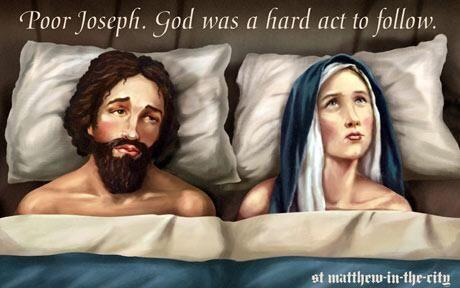
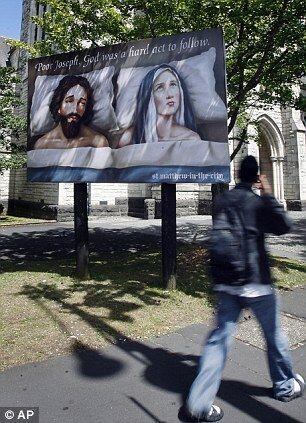

I guess thats what you can expect from a church that launched from a kings lusts. The fruit of an institution has quite a lot to do with the character of the person who decided their way was better and broke off communion.
Discussion

This billboard is an abomination but I think you've committed the genetic logical fallacy. I hope you're not implying that the entire Reformation was a mistake because the Reformers were flawed sinful men.
That's fair, i meant it as an observation of a sort of stereotype if you will, but I see how that could have come off as a truth claim. I cant imagine how difficult it would have been for people to believe they were leaving the "one true church", to break from it because Jesus "was wrong" about the gates of hell not prevailing against the church. So I understand why the reformation happened, and I understand that was their best option to their knowledge, but while much fruit has come from protestantism, there is (in my opinion) a lot of rot as well, stemming from its origins. Now, I'll say up front that I don't typically have fruitful debates with protestants, not because we cant have a calm and civil conversation, but because by definition protestants have no normative interpretational authority, and thus it is impossible to deal with it collectively and effectively. However, I have a healthy respect for the reformation while being neither protestant or papist.
I think our normative interpretational authority is the indwelling Holy Spirit interpreting the Holy Scripture that He authored. I don't need a member of an ecclesialogical hierarchy to do my thinking for me.
As noble and well meaning as that position is, the issue is when you run into 2 individuals who inevitably claim that they were guided by the Spirit and yet came to 2 incompatible conclusions. Because there isnt a normative authority, we have no way of determining who is truly interpreting correctly.
If we were to set a baseline as to what characterizes a Christian, most people would point to the Nicene Creed or Apostles Creed. This was the creed in which the early church came together and, believing as a united body that they were led by the Holy Spirit, came to a consensus on fundamental doctrines of the Trinity, on the two natures of Christ, on the procession of the Holy Spirit from the Father. I believe its a much more reasonable position to trust this church than a single individual who decided that all councils had erred and that scripture is simple enough to interpret at the subjective, individual level. 500 years and 30k denominations later, I believe we can agree that this isnt the case.
I don't have any argument with the Nicene or Apostles' Creed but I'm unclear what you mean by "this church". The persons who formulated those creeds aren't available for consultation at present. I am grateful that God gave me access to the Holy Scriptures and the ability to interpret them by the guidance of the Holy Spirit. It seems to me that I would effectively despise those gifts if I would attempt to offload my responsibility to discern God's word to some ecclesial functionary. According to 1 Peter 2:9, I am a member of a Royal Priesthood. I have a divine commission. I think it would be a sin for me to submit my conscience to governance by an earthly authority.
The 2 well meaning persons scenario that you posit is no problem for me. While I'm open to opposing arguments, after hearing such arguments, if I'm still convinced that I'm correct, I have no problem in saying I'm correct and the other person is incorrect. Truth is always true regardless of how many people understand it or agree with it.
Then the question is, is your perception of truth infallible? We both agree that there is absolute truth, the question is how do we determine that truth if 2 people believe that they hold the truth and come to opposing positions? Does my position become truth if I convince you that I'm right? What gives the Nicene creed the authority to bind our conscience to its standard, if you will? Arianism had a great, logical, biblically based argument, and convinced many that their position was orthodox. If you determine that my position is heterodox, is your opinion the objective standard, and does your interpretation have the power to excommunicate me from the body of Christ as a heretic? I think it's a slippery position.
The scriptures themselves are infallible. If you require infallibility in interpretation, there are 2 choices, yourself or someone else. I think it's most reasonable to choose myself because I know why I interpret as I do and I can change my interpretation at any time if I gain additional insight. Moreover, I can examine myself for bias or prejudice to a degree that I can't examine others.
Yes, we are in logical agreement, and yet come to 2 different conclusions. I would say that I am safer trusting in the church consensus and apostolic tradition to tell me what the church has believed from the beginning, while you find it safer to intellectually discern the truth yourself by your personal devotion and interpretation of the scripture.
Thanks for the discussion. Blessings.