
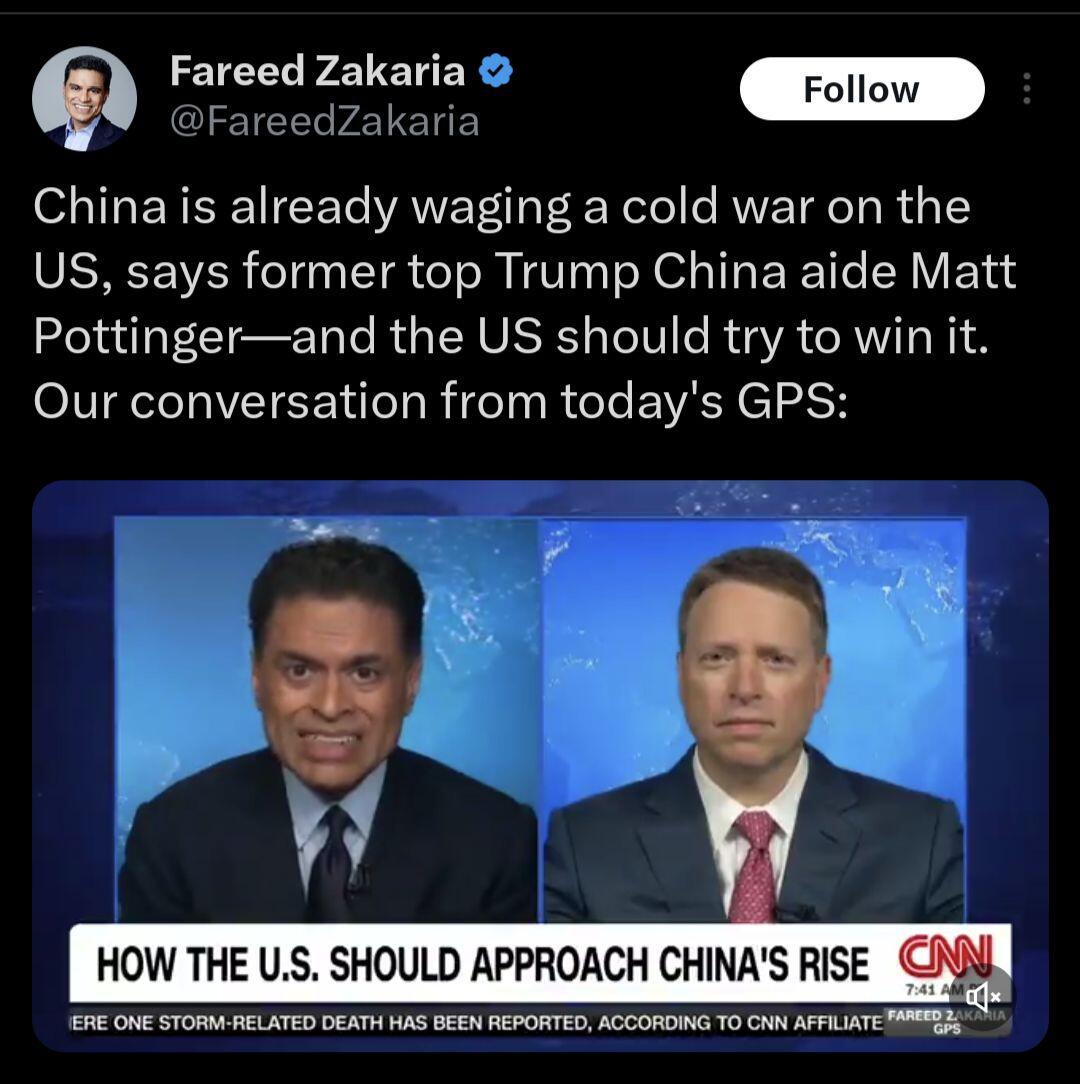
These are the new PNAC guys: PNAC 2.0. They will smile and chuckle and “aw-shucks” their way to complete global destruction as they cheer on “regime change” in countries far more powerful than Iraq was in the early 2000’s. When they—inevitably—fail, they will disappear with whatever they’ve been able to grift as their countrymen die and have their livelihoods incinerated as the “collateral damage” of their literally, descriptively stupid power games.
They have zero imagination—they just want to play “Cold War” over and over again because it’s a playbook they think they know. But not only do they not know either their “enemy” or themselves (which guarantees they lose), they don’t even have the basic restraint and questionable level of moral character of many Cold Warriors. They are literal fools and should be laughed out of or booed in every room they enter.
It should be obvious that there is no way for America to “win” in the world if her adversaries “lose.”
“I win, you lose” is the logic of the Treaty of Versailles in 1919, in which the Allies sought to “contain” Germany by redistributing its territory and industry, eviscerating its military, and imposing punishing war “reparations” which it could not repay. This led directly to the German civil war, hyperinflation of the German currency, the rise of National Socialism, and the Second World War.
Finding the win-win, although never “perfect” from anyone’s perspective, is the only way to avoid catastrophe. If your “enemy” has nothing to lose by fighting you, the game conditions are clear—and war is inevitable.
As Sun Tzu said in The Art of War, “When you surround an army, leave an outlet free. Do not press a desperate foe too hard. Such is the art of warfare.”
I am often asked by people new to #Bitcoin , “What about its volatility?”
There is, of course, the standard answer about how a new asset never before seen in human history will inevitably experience ups and downs during its first few decades of parabolic monetization.
But what is more disturbing and far more impactful in the long run is the global social volatility that we are living through as the system of fiat-based central banking, only one part of a governing apparatus “led” by a floundering, careening, and incoherent political class, dispenses with any rhyme or reason as it implements contradictory policy moves across all domains. We are witnessing personal, idiosyncratic, and sentiment-based exercises of power driven by a sprawling and factionalized administrative state.
This is chaos. It does not end well. Plan accordingly.
The state has to be aware that if they push, society will push back, and that creates the opportunity, the opening, for freedom.
https://www.whatbitcoindid.com/podcast/bitcoin-human-rights.
Congress is using their displeasure with specific types of protest as an excuse to give the administrative state more unchecked power.
Nonprofits are already prohibited by law from supporting terrorism and face intense scrutiny about this. This performative bill, however, gives an unelected Treasury official unilateral power to decide whether or not a nonprofit “supports terrorism” and strip it of its nonprofit status.
Don’t like it? You can appeal to the IRS.
I am angry that Senator @JohnCornyn of Texas has sponsored this unnecessary, tyrannical bill specifically to target speech he dislikes. But it is a reminder that the “War on Terror” era never ended—the same people are still in power, and they have the same dismal view of democracy and free speech today that they did back then.
(bipartisan legislation the House passed last week (382-11) & that was intro'd last week in the Senate -- HR 6408 & S. 1436.)
https://www.congress.gov/bill/118th-congress/senate-bill/4136
Just wondering if any of the “AI alignment” people have solved the problem of “human alignment?”
…
(TLDR: No, of course not, neither are “problems” to be solved; they’re manufactured moral panics to justify absolute state power.)

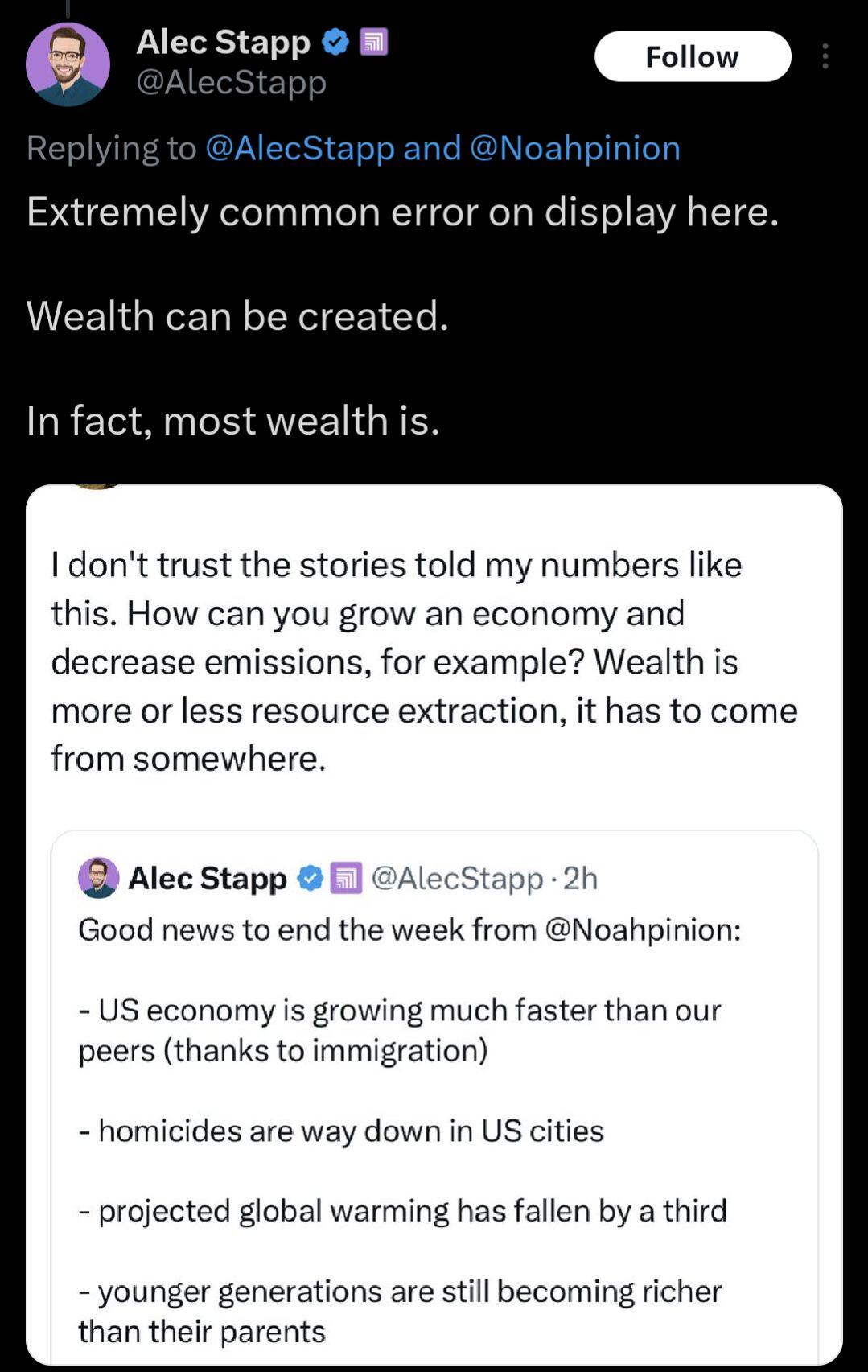
The questions this poster is genuinely asking Alec unfortunately reflect profoundly FALSE but widespread beliefs underpinning the tragically popular “degrowth” movement:
- That wealth cannot be created (it’s a zero-sum game in which the more powerful extract resources from the less powerful)
- That energy consumption and carbon emissions will be directly correlated forever
These two beliefs alone create a catastrophic worldview that brings about the very apocalypse it seeks to avoid. They must be relentlessly and systematically countered.
A few dozen, largely unknown, functionaries of humanity quietly keep the world's internet infrastructure functioning.
I like to think of them as "marenauts"--sea astronauts--engineers trained to repair equipment in extremely hostile conditions in the alien world of the Earth's oceans.
But maintenance isn't sexy, and it's not profitable. The costs of maintenance ships go up, not down, over time.
Who will take up this responsibility in the future?
https://www.theverge.com/c/24070570/internet-cables-undersea-deep-repair-ships
As the world moves increasingly toward identitarian nationalisms, countries that display a commitment to being multi-ethnic, multi-religious republics with no legally privileged racial or religious classes will have an advantage.
I hope the United States can stay on this trajectory.
The world is perhaps only now beginning to appreciate the uniqueness of the American Bill of Rights.
Instead of defining rights as the *positive* rights of individuals or groups, as do most other constitutions around the world, the Bill of Rights places *limits* on the power of government to restrict those rights. “Congress shall make no law …”
This is a night and day difference.
It means that, for example, even in democracies where freedom of speech is a constitutional right, “bad” speech can still be criminalized, and people can be put in jail for it. There is no constitutional mechanism to stop the state from carving out exceptions to rights.
If America can recapture its legacy of limiting the powers of government—arguably its most important contribution to political economy—it has the chance to flourish again.
To be a peacemaker, you first have to have moral courage and conviction.
Peace is a positive project; it is not the absence of violence.
This should go without saying, but democracies don’t pass “secret” laws, and they don’t pass laws based on “secret” (classified) information.
The will of the people cannot be expressed by their elected government if that government rules based on secrets that are kept from the people.
“Now clearly there exists the distinction between energetic thriving and atrophy, that is, one can say, between health and sickness, even in communities, peoples, states. Accordingly the question is not far removed: How does it happen that no scientific medicine has ever developed in this sphere, a medicine for nations and supranational communities?”
- Edmund Husserl, “Philosophy and the Crisis of European Man” (“The Vienna Lecture,” 1935)
We just wrapped up the “Bitcoin and Political Economy” panel at the #BitcoinPolicySummit in Washington, D.C. I asked my colleague @avik about the relationship between Congress and the administrative state (esp. federal regulatory agencies) and how that impacts American democracy.
He said something important: the ballooning of federal agencies and their powers has been a result of elected members of Congress wanting to evade political accountability (punishment at the ballot box). If an agency does something unpopular, the Congressman can always point to the Administrator and say, “Hey, it wasn’t me who made this rule! This guy or gal did it!”
This offloading of legislative responsibility is a dereliction of duty on the part of those who were elected to make laws on behalf of the American people. Authoritarianism is as much a function of people wanting to evade responsibility as it is a desire for power. Many elected officials are perfectly content having virtually no power as long as they keep the prestige (appearance of power) of their position.
Just replace the words “bank” or “financial institution” with “a male relative or guardian” in any AML/KYC/CFT laws and treaties to internalize how deeply offensive third-party doctrine is.
@RoyaMahboob speaking at the #BitcoinPolicySummit
I was reminded at dinner in D.C. this evening that the “national security state” and the “great powers conflict state” actually represent two different worldviews and sets of political orientations. Sometimes they overlap, but often they don’t. This is something @matthew_pines also pointed out today during his panel at the #BitcoinPolicySummit.
Obviously engaging policymakers is important. I wouldn’t be at the #Bitcoin Policy Summit if I didn’t think so. But “policy”—that is “law”—is something that needs to be kept on a tight leash. Law is not fundamental. It is way downstream from the primary social relationships that constitute the society for which law can be meaningful.
The problem with a “policy” framing of discussions about #Bitcoin , or technology in general, is that the assumption is often that there is a “lack of policy” or “missing policy”—i.e. a “lack of law” or “missing law.”
What if the problem is that we have *too much* law?
What if “making laws” is not the criterion of success for elected officials, but *protecting and preserving the Constitution?*
What if that usually means *doing less,* or often *doing nothing?*
We have a political culture that has been dominated for generations by the legal profession. They hold the hammer of law, so they tend to see every social phenomenon as a new nail. This creates a vicious cycle of runaway statute that by now has fully overgrown the framework—the Constitution—that was put in place precisely to constrain the power of lawmakers to make law.
We need to remember that power comes not from the law but from the people. The people, who exercise our power through the act of suffrage, need to stop expecting our elected officials to pass more laws and instead ask them how they have been pruning back the thicket of laws so that we can once again see the face of our founding framework—the Constitution.
The year is 33 AD (CE), although the Empire does not know it yet.
A depressed and paranoid Emperor Tiberius has lost both his sons and betrayed the love of his life, his first wife, for a throne he never wanted. He has retreated to his country house in Capri, from where he orders the executions of his political rivals in Rome.
Tiberius has been joined in Capri by his adopted grandson Caligula, the only surviving man in Caligula’s mother’s family—all of whom Tiberius had destroyed after a political feud. Caligula has insinuated himself into Tiberius’s good graces and waits for him to die, having secured Tiberius’s nomination as his successor. Once crowned Emperor, Caligula launches into his own political persecutions, drains the treasury, seizes property, insults and offends virtually all the elites of Rome, and creates dozens of new taxes. Although relatively popular with the people, he is assassinated by Praetorians four years into his reign.
Meanwhile, in one of Rome’s lesser colonies, a Palestinian peasant is executed for rejecting “all of the kingdoms of this world” and juxtaposing against it another kingdom—a model of community—that ostensibly exists elsewhere. Indifferent to the revolutionary aims of some of his co-religionists, he also insists that humans “Give to Caesar what is Caesar’s, and to God what is God’s.” Having thus alienated both his own people’s authorities and the authorities of the Empire, he is publicly tortured and crucified as a warning to others.
The Empire eventually falls, but only after turning toward the veneration of this prophet of another kingdom with his strange account of authority and power.

Redactions just lifted in nine unsealed plaintiffs briefs in private antitrust lawsuit.
The unsealed documents are 735 through 743 in case 3:20-cv-08570-JD
Adam Smith, "On the cost of Empire," the closing passage of The Wealth of Nations (1776)
Warning: Meta apps engaging in man-in-the-middle attacks by placing rootkits on phones to intercept and decrypt traffic by breaking SSL. (Enabled by their acquisition of spyware company Onavo.)