
"I wash my hands of today’s extended redundancy by the Court. Because the recordkeeping requirements of the [Bank Secrecy] Act [of 1970] order the seizure of customers’ bank records without a warrant and probable cause, I believe the Act is unconstitutional and that respondent has standing to raise the claim. Since the Act is unconstitutional, the Government cannot rely on records kept pursuant to it in prosecuting bank customers."
- Supreme Court Justice Thurgood Marshall, one of two dissenting opinions in United States v. Miller (1976), which established "Third Party Doctrine." The doctrine states that Fourth Amendment protections against warrantless search and seizure do not apply to records kept by a third party.
"The crisis of liberal democracy has become concealed by a ritual which calls itself methodology or logic. This almost willful blindness to the crisis of liberal democracy is part of that crisis. No wonder then that the new political science has nothing to say against those who unhesitatingly prefer surrender, that is, the abandonment of liberal democracy, to war."
- Leo Strauss, "An Epilogue," Essays on the Scientific Study of Politics (1962)
“Truth is not the default . . . it is an exceptional, fragile, improbable achievement.” (@danwilliamsphil)
Just as material poverty, not wealth, has been the historical norm and baseline for human societies, “epistemic” wealth is a historically new result of norms and institutions built painstakingly out of the genealogy that gave rise to and has continued to develop from the scientific revolution.
“Lies, conspiracy theories, misinformation, bias, pseudo-science, superstition and so on are not alien perversions of the public sphere. They are the epistemic state of nature that society will revert to in the absence of fragile—and highly contingent—cultural and institutional achievements.”
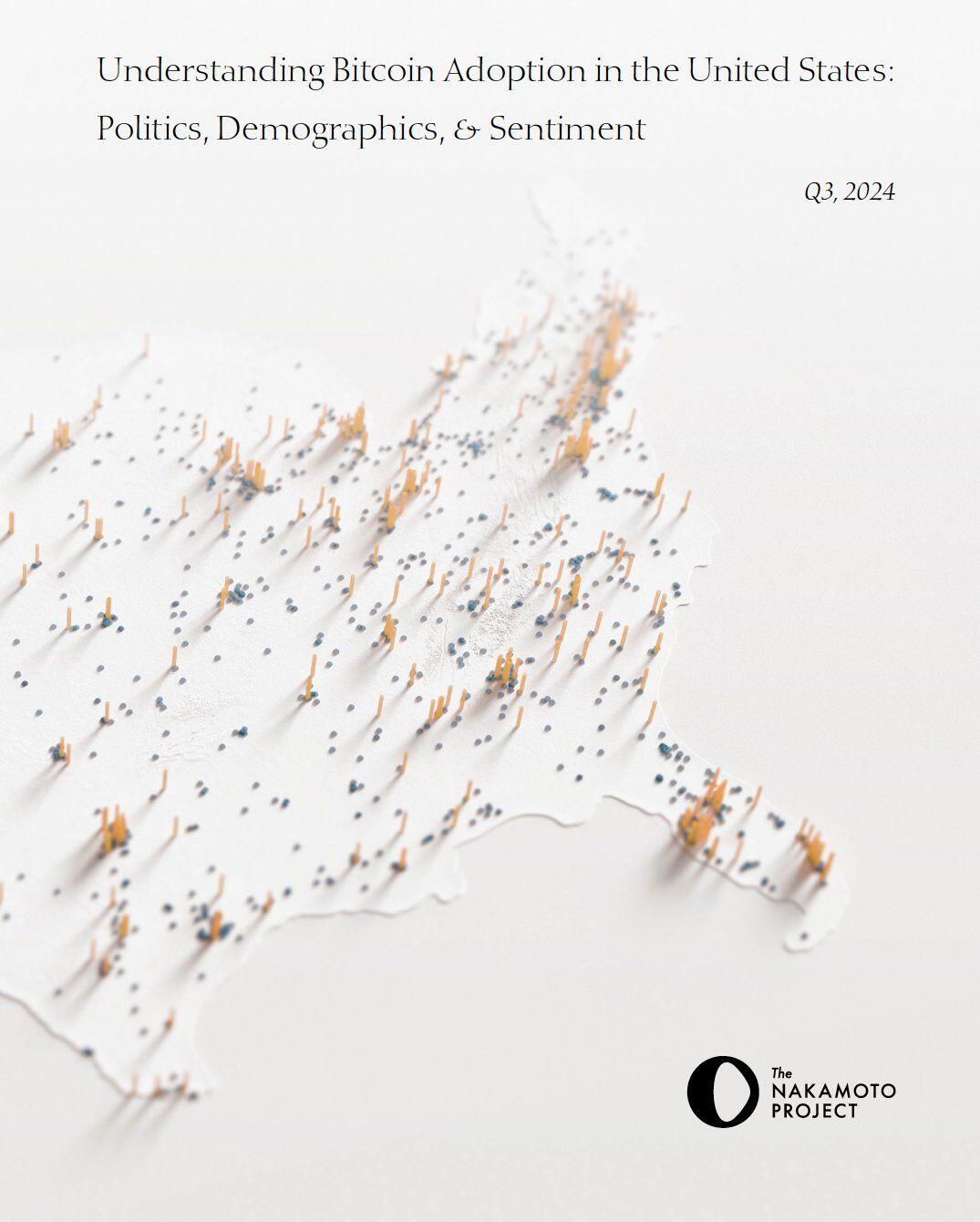
Sound money appeals to people of all political persuasions, levels of income and wealth, and demographic characteristics. For now, #bitcoin adoption tends to skew young and male, but even that will change as hyperbitcoinization proceeds. Eventually, money is just money.
Fantastic work by @thetrocro, @andrewwperkins, and @thecolinbrown at the @NakamotoProjct.
“We don’t have enough resources” is a familiar refrain in all kinds of organizations. I have heard it from government agencies at every level, from startups, and from multi-national Fortune 500 firms.
What if you don’t get more?
What if this is the *most* resources you will ever have?
What if you have to overdeliver with whatever that is?
Sometimes, the realization that they don’t get more is the thing that *causes* people to be motivated to excel for the first time.
Others simply give up and tread water, or complain or nurse resentment about “what they are due.”
Resource constraints show you who people are and who they are deciding to be.
Stay tuned for “Towards an Anthropological Theory of Money.”
Coming soon in The Satoshi Papers.
I discuss Graeber’s theory of money at length (among other theories).
#SatoshiPapers
All authoritarianism is bad. All abuse of power is bad. The question is: whose authoritarianism and abuse of power do each of us actually have some influence over?
This question is the political version of the serenity prayer. Trying to save everyone and fix everything is the surest way to save no one and make many things worse.
Knowing how to recognize and deploy talent is a hallmark of leadership.
It is a rare skill.
Information is currency.
Johannes Gutenberg, inventor of the printing press, was the youngest son of a nobleman and merchant, Friele, who served as a "Master of Accounts" for the mint in Mainz.
Because Friele had married a non-noblewoman, Gutenberg's mother Else, his sons could never serve in the "minting house cooperative." In the medieval German system, only pure-blood nobles could be "trusted" to mint the currency.
Nevertheless, Gutenberg drew on his father's heritage to become a goldsmith. He used his skills to develop an alloy of lead, tin, and antimony that was so effective for creating durable type letters that it is still in use today. He also innovated a new type of mould used to cast those letters and combined those technologies with a system of movable type. The printing press was born, giving rise to the most important information revolution in human history since the invention of writing.
Money is an information technology. Beware of who you exclude from the use of that technology--they may just start a revolution that opens it up to everyone.
Legal complexity = technical debt
Václav Havel, “The Power of the Powerless” (1978)
“An examination of the potential of the ‘powerless’ can only begin with an examination of the nature of power in the circumstances in which these powerless people operate.”
…
“The post-totalitarian system touches people at every step, but it does so with its ideological gloves on. This is why life in the system is so thoroughly permeated with hypocrisy and lies: government by bureaucracy is called popular government; the working class is enslaved in the name of the working class; the complete degradation of the individual is presented as his ultimate liberation; depriving people of information is called making it available; the use of power to manipulate is called the public control of power, and the arbitrary abuse of power is called observing the legal code; the repression of culture is called its development; the expansion of imperial influence is presented as support for the oppressed; the lack of free expression becomes the highest form of freedom; farcical elections become the highest form of democracy; banning independent thought becomes the most scientific of world views; military occupation becomes fraternal assistance. Because the regime is captive to its own lies, it must falsify everything. It falsifies the past. It falsifies the present, and it falsifies the future. It falsifies statistics. It pretends not to possess an omnipotent and unprincipled police apparatus. It pretends to respect human rights. It pretends to persecute no one. It pretends to fear nothing. It pretends to pretend nothing.
Individuals need not believe all these mystifications, but they must behave as though they did, or they must at least tolerate them in silence, or get along well with those who work with them. For this reason, however, they must live within a lie. They need not accept the lie. It is enough for them to have accepted their life with it and in it. For by this very fact, individuals confirm the system, fulfill the system, make the system, are the system.”
https://hac.bard.edu/amor-mundi/the-power-of-the-powerless-vaclav-havel-2011-12-23
Václav Havel, “The Power of the Powerless” (1978)
“An examination of the potential of the ‘powerless’ can only begin with an examination of the nature of power in the circumstances in which these powerless people operate.”
…
“The post-totalitarian system touches people at every step, but it does so with its ideological gloves on. This is why life in the system is so thoroughly permeated with hypocrisy and lies: government by bureaucracy is called popular government; the working class is enslaved in the name of the working class; the complete degradation of the individual is presented as his ultimate liberation; depriving people of information is called making it available; the use of power to manipulate is called the public control of power, and the arbitrary abuse of power is called observing the legal code; the repression of culture is called its development; the expansion of imperial influence is presented as support for the oppressed; the lack of free expression becomes the highest form of freedom; farcical elections become the highest form of democracy; banning independent thought becomes the most scientific of world views; military occupation becomes fraternal assistance. Because the regime is captive to its own lies, it must falsify everything. It falsifies the past. It falsifies the present, and it falsifies the future. It falsifies statistics. It pretends not to possess an omnipotent and unprincipled police apparatus. It pretends to respect human rights. It pretends to persecute no one. It pretends to fear nothing. It pretends to pretend nothing.
Individuals need not believe all these mystifications, but they must behave as though they did, or they must at least tolerate them in silence, or get along well with those who work with them. For this reason, however, they must live within a lie. They need not accept the lie. It is enough for them to have accepted their life with it and in it. For by this very fact, individuals confirm the system, fulfill the system, make the system, are the system.”
Entrepreneurial capitalism has completely different social effects from crony capitalism. Entrepreneurial capitalism rewards entrepreneurs for disrupting existing technologies, goods, and services—that is, for taking risks. By contrast, crony capitalism is when companies who have temporarily “won” in the market try to lock down their leading position by preventing others from competing with them. Crony capitalists hate risk and try to eliminate it wherever they can. There is a great book by Clayton Christensen called “The Innovator’s Dilemma” that goes into detail about how entrepreneurs can become crony capitalists.
Most of the industries where we’ve seen the kind of decline in quality and service you describe are industries where large companies have used the state—either through regulatory agencies or the legislature—to pass laws and regulations that make it easier for them to keep winning and harder for others to compete.
This is why it’s not just any capitalism that creates a rising tide that lifts all boats—it’s specifically entrepreneurial capitalism. Small government tends to be a friend of entrepreneurial capitalism but not of crony capitalism. This is a key distinction few make on the right or the left.
Hello @IngarSolty, just caught your piece in @jacobin smearing Friedrich Hayek as an "enemy of freedom," a "neoliberal," a figure of the "radical right," and equating his bottom-up, scientific approach to economy with the policies of specific politicians (i.e. Thatcher and Reagan).
Have you read any Hayek--at all? If not, perhaps start with the essay below, "Why I Am Not a Conservative," which is published in The Constitution of Liberty.
Hayek is extremely clear that he opposes the use of the power of the state to cudgel people into any kind of conformity, including cultural conformity. He considers conservatism as an ideology to be at war with science, innovation, and technological progress.
The fact that some of Hayek's readers have misunderstood him and taken his message to justify whatever misapplication of state power they feel inclined to (including weighing in on the part of the owners of capital to break the wills of workers asserting their *right* to bargain for better wages) does not in any way make this "Hayek's message."
https://www.cato.org/sites/cato.org/files/articles/hayek-why-i-am-not-conservative.pdf
Every platform, like every state, is or will be weaponized.
That does not mean platforms should be "banned." It means they should be used with awareness and caution. That is what "digital literacy" means.
It is impossible to have a free society that is not literate--that is, competent to navigate information presented in a variety of channels and forms. Any attempt to police "misinformation" is robbing the people of their rightful capacity to navigate information for themselves. In a culture of truth, information that is truthful and stands up to public scrutiny will eventually prevail over lies and falsehoods. This cannot happen if information is refereed to begin with.
Ultimately, we need to create alternatives to platforms by building peer-to-peer services that cannot be captured. But this doesn't mean platforms will go away. Platforms are digital territories and jurisdictions that will continue to serve some purposes, and people will have to navigate them in a literate manner.
We don't relativize the power of the state by "banning" states, and we don't relativize the power of the platform by "banning" platforms. We relativize the power of both by empowering individuals. The remedy for concentrations of power at the top is power that moves bottom-up.
Things are dark and they are going to get much darker.
Our moral and intellectual North Star must remain functioning from principle instead of identity and expediency.
Thinking and acting from principle is revolutionary. It transforms the world.
Cheers to all fellow travelers on the road ahead.
#Bitcoin
If “non-custodial software” is a “money transmission service,” then every person holding cash in their house or wallet is a “money transmitter.”
They should be honest about what they are really trying to outlaw here: people holding their own cash.
Now seems as good a time as any to revisit one of the classics of American political theory:
"Civil Disobedience," by Henry David Thoreau (1849).
(It was originally titled "On the Duty of Civil Disobedience.")
Thoreau's essay influenced the giants of human rights movements around the world, including Mahatma Gandhi and Martin Luther King, Jr. Thoreau himself was a lifelong abolitionist, and his opposition to slavery inspired the speech that became this essay.
“When the devaluation of the mark started during the war and especially during the postwar period, only a few people thought of the consequences which resulted for the affairs of learning. And yet it was after all perfectly clear that the foundations of German scholarship rest not only upon the researchers’ idealism, but just a much upon the solid rock of a gold currency and an active balance of payments. But what has been built with gold marks cannot be maintained or yet extended with paper marks. For all learning and all science requires progress to give it content and to enrich and stimulate it. Years of paper currency therefore mean no more and no less than the distress of learning and, if the sickness of the currency lasts a long time, the death of learning and science. Such meager years bring about the dismantling of our culture, which in turn leads to pseudo-culture.”
- Georg Schreiber, “The Distress of German Learning,” published during the hyperinflation of 1923