
Some folks believe we still need a CBDC despite FedNow offering real-time interbank settlement.
What this suggests is that by CBDC they mean “retail CBDC” (for individual account holders), not “wholesale CBDC” (for interbank settlement).
As many suspected, the “wholesale CBDC” fig leaf was a polite fiction designed to get political buy in for money that is fully ID-verified and programmable at the transaction level.
“The evidence strongly suggests that small-scale warfare is part of our evolutionary history predating agriculture and sedentism, but that cooperation across group boundaries is also part our evolutionary legacy. . . . our evolutionary history is more complex than one of selection for war or peace; rather, it reflects the complicated lifeways of a highly social and interdependent cultural species for which both cooperation and war were likely important selective forces.”
- @HSB_Lab
https://www.sciencedirect.com/science/article/abs/pii/S1090513824000941
Assumptions people who favor planned economies often make:
1. “I can do a great job planning the economy”
2. “I will be the one planning the economy”
If you’re looking at BTC strictly from a wealth equality standpoint, the current ownership distribution of BTC ownership is actually far more concentrated and unequal than fiat wealth ownership. Neither is BTC a mechanism of wealth redistribution. That is, in part, why so many hate it and are seek to use the power of the state to curtail adoption.
I would suggest, though, that an equality of ownership is neither the point nor value of BTC. Those who focus on that are missing the point entirely. BTC is censorship-resistant sound money, which does put downward pressure on the ceiling of endless debt monetization (which creates a kind of illusory wealth). Its widespread adoption may even result in lending slowdowns and production slowdowns as a result. But, counterintuitively, this may smooth out the “business cycles” of wealth creation and destruction that render the fiat economy so volatile.
A lot can be said about the causes of lower wealth inequality in the U.S. after the Second World War. Many believe that it’s because taxes were higher, but as economic historians have pointed out, almost nobody paid the higher rates.
The main cause of greater wealth equality was most likely the *actual war,* which absolutely incinerated property, labor, and value all over the world.
In other words, the easiest way to create “more equality”—at least on paper—is simply to destroy wealth. But by lowering the ceiling, you also lower the floor.
The only thing that reliably has raised the floor for everyone is entrepreneurial capitalism. But it also raises the ceiling.
Acemoglu is here exhibiting the classic logic of what he referred to in his own book, "The Narrow Corridor," as the "Cage of Norms."
The Cage of Norms is a form of tyranny embedded in society rather than the state. The logic of the Cage of Norms is that "status is zero-sum," as Acemoglu says below. Therefore, "any flower that grows too tall must be cut down." Success is fine, as long as it's not "too much." Once that arbitrary boundary has been crossed--"too rich," "too prestigious," "too influential"--the successful individual or entity must be "cut down to size."
The miracle of entrepreneurial capitalism is precisely that wealth, money, and status are NOT zero-sum. Entrepreneurs willing to take the risks and do the work to create real value can grow the pie for everybody.
This doesn't mean that powerful people don't abuse their power. Of course they do; they have and they will. This is why, first off all, power is not to be trusted; and second of all, why each of us has the unique responsibility to acquire and use power in the ways we consider most morally generative. Cutting down flowers that grow tall is an abuse of power. But by ourselves growing into the tallest flowers we can--that is how we check the power of bullies.
We need to stop calling for bigger bullies (the state, the manager, the whatever) to punish and cut down people we don't like. Instead, each of us needs to remember, find, and grow our own power.
That is how civil society is preserved, and that is how we prevent it from becoming a Cage of Norms. 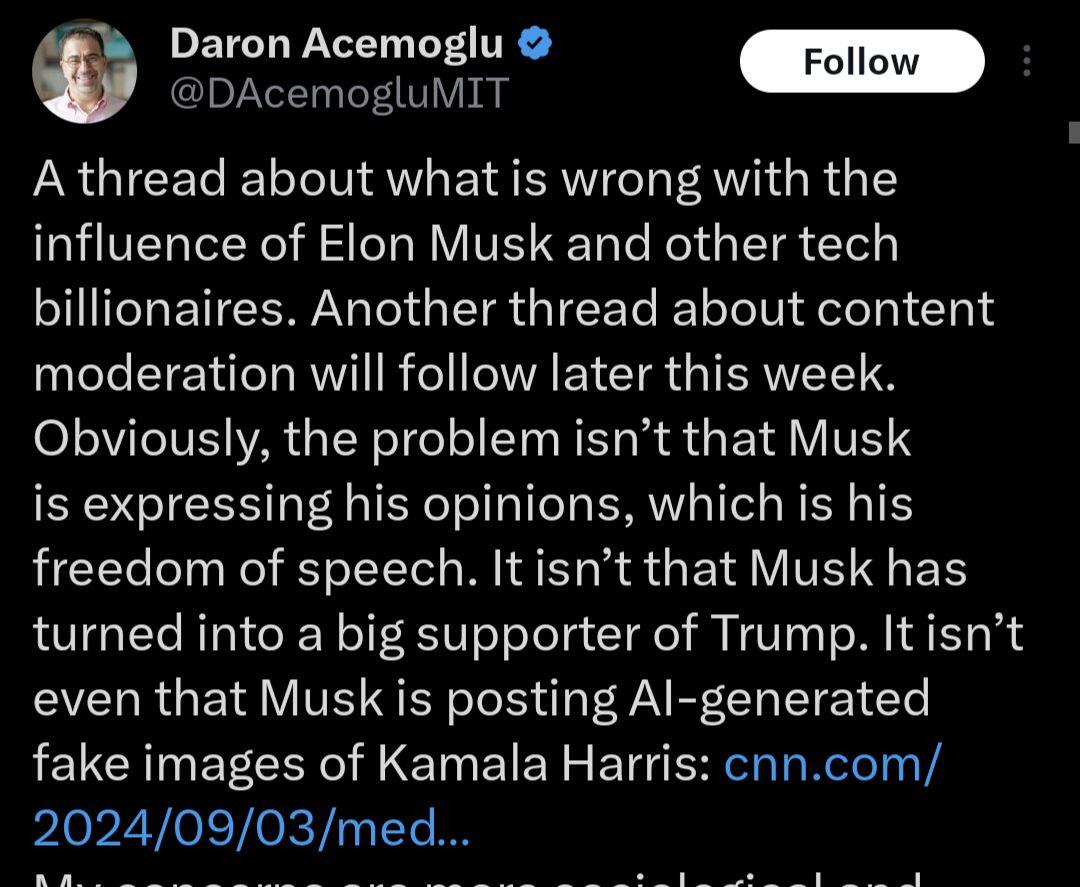
Important research paper on the economics of migration. The consensus narrative today is that most migrants are the poorest of the poor—people with no economic hope in their home countries.
The reality is more complicated. Many migrants are relatively poor, yes, but they are also people with the *means* to migrate.
Simply put: migration is expensive. The poorest of the poor often stay in their home countries simply because they can’t afford to move.
That said, greater desperation at home—war, violence, natural disasters—change the economic calculus. Under those conditions, it may be more expensive to stay than to go. People whose lives are at risk—i.e. refugees—routinely endure extraordinary hardship to escape what seems to be highly probable death. At the end of the day, people value their lives over material possessions. 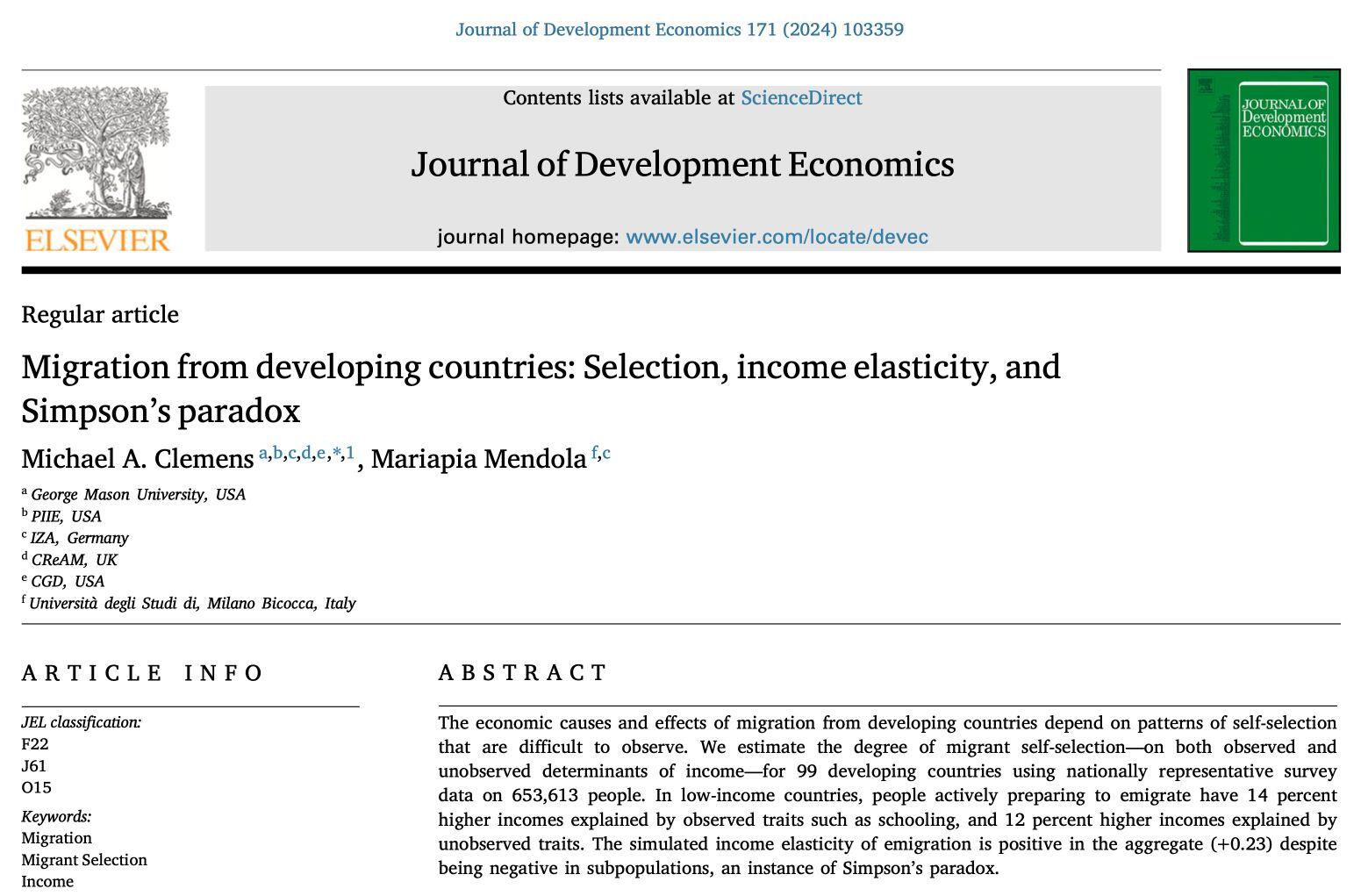
One of the interesting things I’ve learned about MMTers is that their main political goal is full employment at any cost.
They don’t distinguish between the “value” generated by massive government make-work projects and the value generated by entrepreneurial capitalism. The only thing that matters to them is that people are “employed” and getting a paycheck—of course, in the industries deemed “valuable” by the state, rather than the market.
Fantastic lecture by economist PeterBoettke inaugurating the Initiative for the Study of a Stable Peace (ISSP).
Boettke masterfully traces the lineage of mainline economics as the study of exchange rooted in human action as mediated and often laundered by institutions. The tradition of mainline economics differs from other economic traditions in that it “advances the ball” of the “science of liberty,” which is rooted in 1) non-discrimination and 2) non-domination. This science demonstrates that the “invisible hand” of the market can be either benevolent or malevolent, depending on the character of the individuals and institutions that shape that market.
It is the science and practice of liberty that gives humanity a fighting chance at finding solutions to problems that are not violent. Peace, in other words, is a cultural achievement rooted in a certain kind of civil society that arises from the interaction of individuals with a moral imagination shaped by the commitment to liberty.
youtu.be/spRZOVRSf-Q
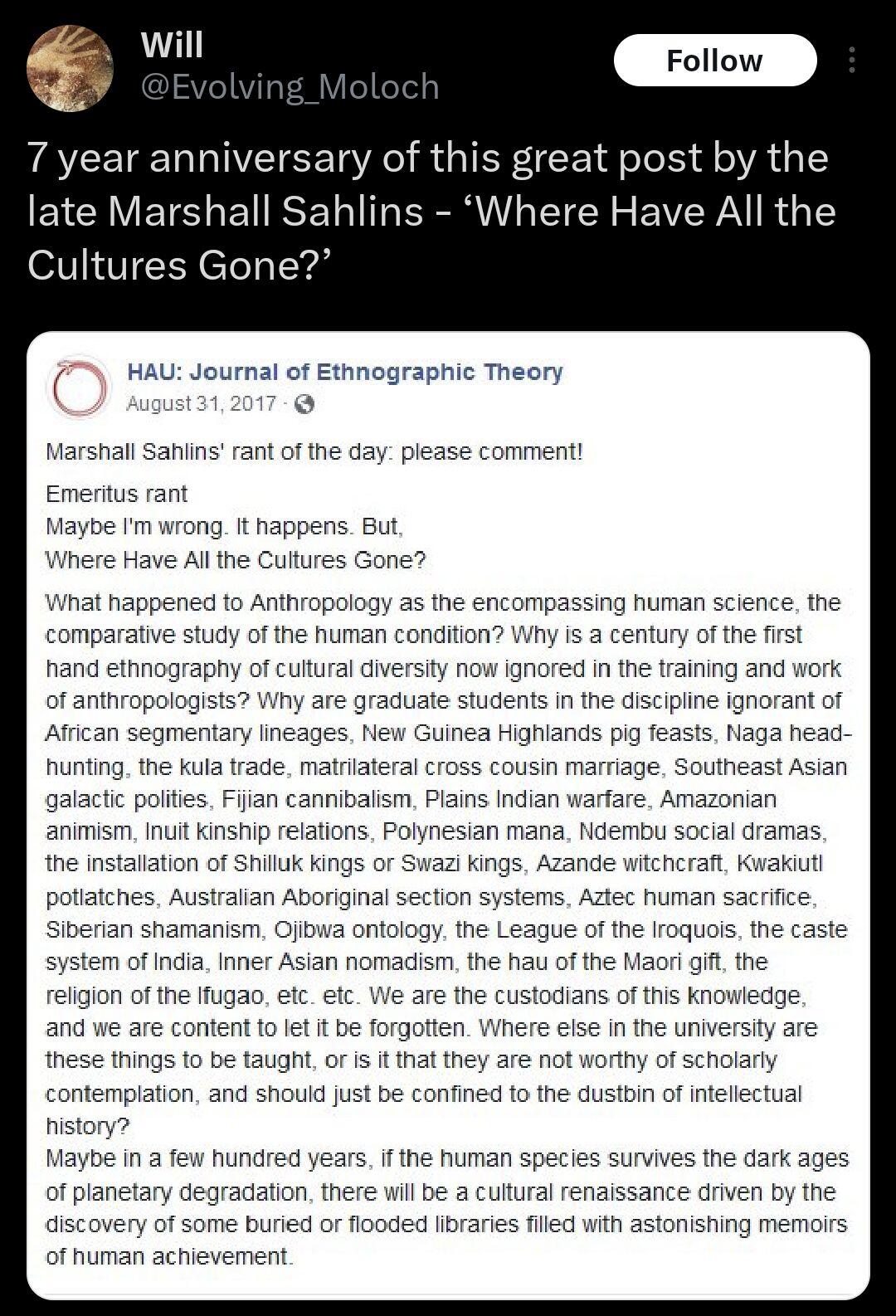
The answer to Sahlins’s question—quite sadly—is that (socio)cultural anthropology stopped considering itself a science.
Early anthropologists didn’t study the intricacies of specific human societies just for shits and giggles. They studied these things in order to develop a scientific account of human cultural and social life.
If you kick away the scientific scaffolding—as cultural anthropology has in fact done—the topics Sahlins lists out end up being little more than trivia. They may attract a few antiquarians here and there, but that’s about it.
Most knowledge—including most human languages, cultural practices, and histories—are forgotten. Remembering is the exceptional case. And that requires there to be a *motivation* to remember. That motivation is, like it or not, some form of significance for living human beings: the ones doing the remembering.
Cultural anthropology has gone all-in on political significance (as the Facebook reply to Sahlins below shows), but all but abandoned scientific significance. Counterintuitively, the politicization of the discipline has drained it of the actual political purchase it used to have, and is one of the many reasons why cultural anthropology must be re-founded as a discipline.
Creating value is not the same thing as generating profit.
Great companies, like all great organizations, seek to generate value above all else.
This means that profits will sometimes be sacrificed, especially in the near term.
In the long term, however, these are the companies that change the world.
“What is perhaps distinctive about the dynamic of difference as it is asserted in the WAT [War on Terror], however, is the belief that, in a globalised world, the transformation of the ‘other’ is essential for the defence, the very survival of the Western self. This could give rise to a uniquely dangerous situation and a continuous and self-sustaining violence.”
- Antony Anghie, “Imperialism, Sovereignty, and the Making of International Law” (2004)
Waiting for the announcement that all new technological development has to run through the Department of Safety, Security and Innovation and be approved by the Central Committee on Free and Fair Competition.
#AI
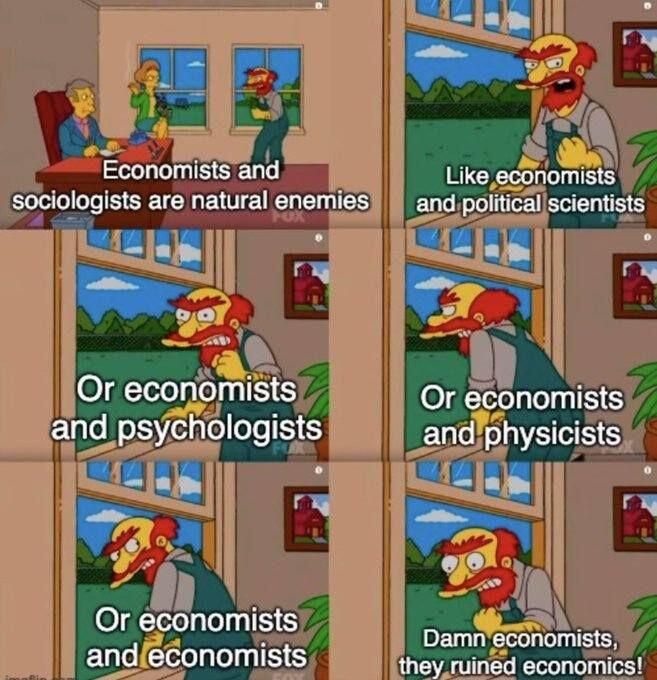
As anthropologist Marshall Sahlins once said, “Economics, as constituted, is an anti-anthropology.”
I’m here to prove him wrong. 😘
Stay tuned for “Towards an Anthropological Theory of Money,” coming soon in The Satoshi Papers.
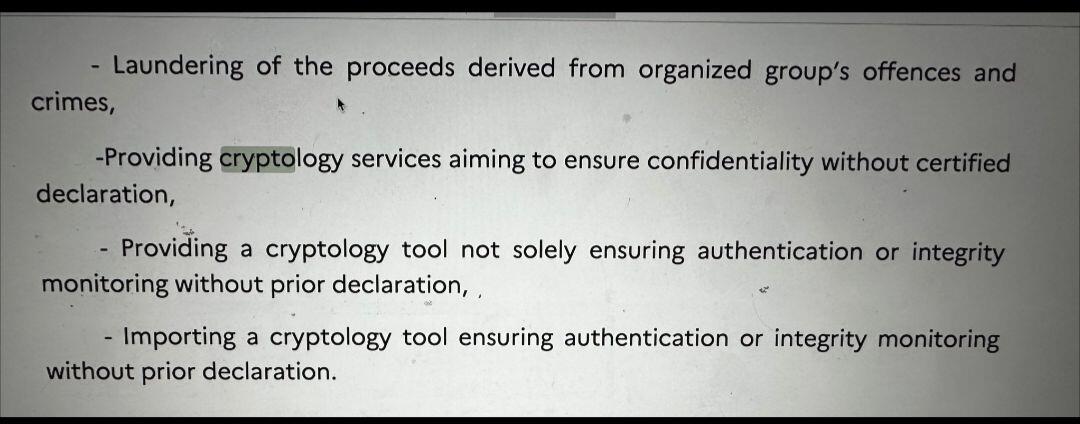
If they can’t criminalize cryptography by statute, they will criminalize it through enforcement.
Humans evolved to have strongly anthropomorphic models of how the world works. If something bad happens, we immediately look for someone (usually another human) to blame and punish. This is the “political mode”—find someone specific to punish or eliminate, and then the problem will be solved. Right?
Wrong. The world is vastly more complex than our Dunbar number-oriented social brain can account for. Our moral reflexes are built for simple, in-the-moment, relational reasoning, and few of us are incentivized to do the long-term, boring, scientific work of understanding causality across the many domains that impact our lives. And that understanding is always partial: we see as through a glass, darkly.
This leads to a pessimistic outlook on the possibilities of political action in general, whether authoritarian or democratic. Quite simply, most problems do not have “political” solutions, if the political is understood as the moral logic of attributing responsibility and blame in public. This is why social scientists like Mises and Hayek urged first and foremost intellectual humility. Humility doesn’t mean “doing nothing.” It means tailoring our actions to those areas of life over which we have actual control, not presuming to understand and control things we can’t.
At the end of the day, politics solves for enabling feelings of moral satisfaction for groups of people who enjoy seeing their enemies subjugated while reaffirming their own belonging in the powerful—winning—group. That is, quite simply, not only useless but counterproductive. It actively gets in the way of solving the problems that ostensibly motivate political outrage.
#BTC #Politics
This has been clear to me for a while now, but the Thiel/Rogan interview illustrated again that we need to have a broader cultural conversation about violence, sacrifice, the sacred, and the elementary forms of religious life.
One’s anthropology becomes one’s political theory.
The people saying they’re going to “control prices” are the same people who bailed out the banks, again and again.
They’re literally running on the Cantillon effect and betting that people will vote for the crumbs they are promised.
I'm excited to join @CatoInstitute for a day-long event:
"Financial Privacy Under Fire: Protecting and Restoring Americans' Rights."
Thursday, September 12. Fittingly, the day after 9/11.
The event will be live-streamed, and you can submit questions for the speakers online. Registration is now live at the link below!
The full conference agenda will be posted later this week.
https://www.cato.org/events/financial-privacy-under-fire-protecting-restoring-americans-rights
The world's three largest employers are:
1. India's Ministry of Defense (2.99M people)
2. The U.S. Department of Defense (2.91M people)
3. China's People's Liberation Army (2.55M people)
(As of 2022)
(Note: China's Central Military Commission, which includes civilian positions, may be #1 at 6.8M, but records aren't reliable.)
https://www.statista.com/chart/3585/the-worlds-biggest-employers/