


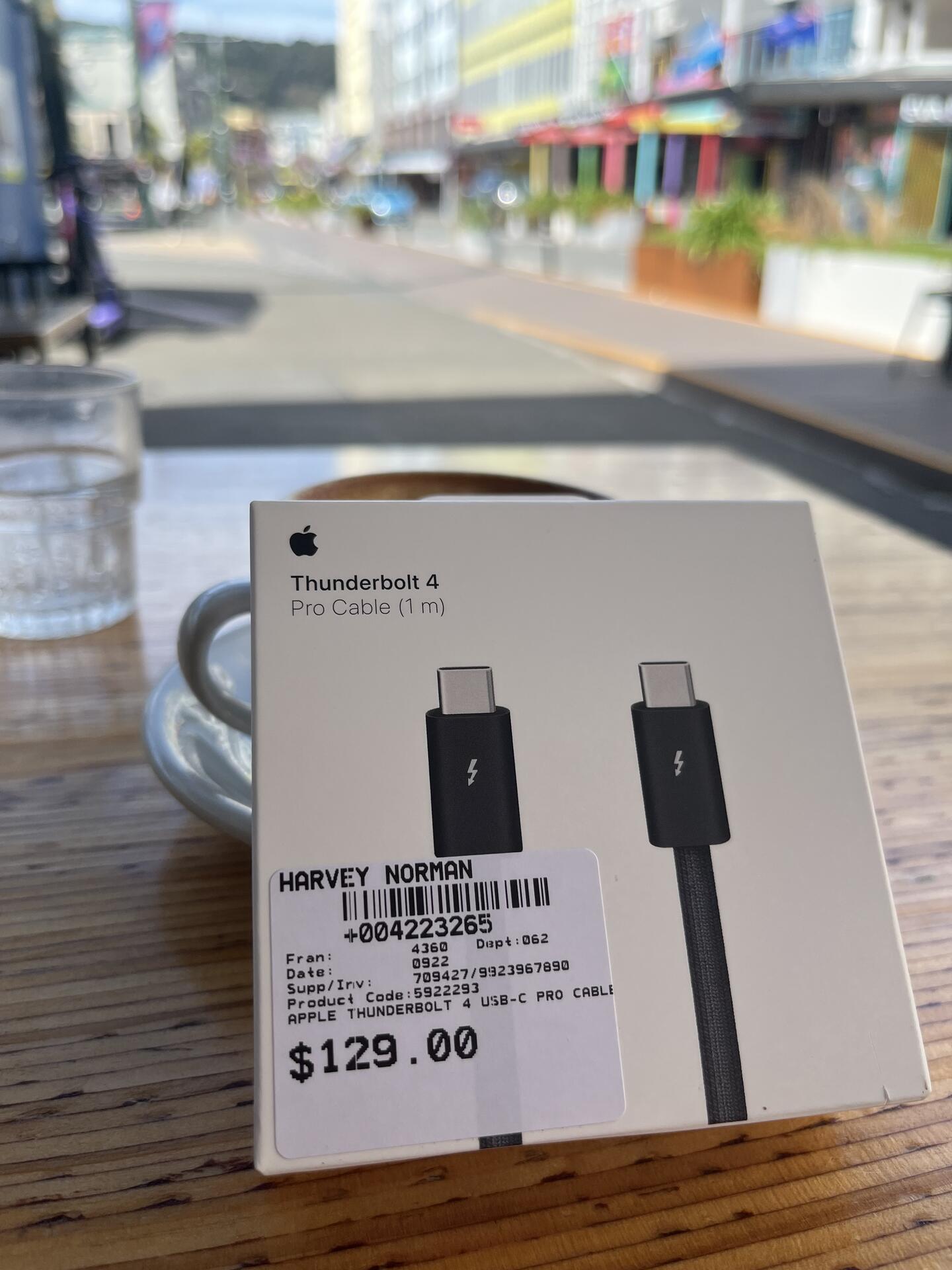
that is costly - the higher freq cables have gold threads that makes it costly, but this ones would be for DC. perhaps some other materials used inside ?

those are manual stitches, very classy. and neat too. i love seeing handwork, people who do great ones have so much patience and attention to details. Do share some videos on this if you get a chance. some leather goods have threads that mask the colour (similar tone to the leathers), but some remain white and distinct - the latter is classy, normally for men and for thicker hides / without designs
yea,the mould cutter are big fellas. If it doesnt justify the production cost, then maybe standalone die cutter makes more sense for now. Sometimes there might be smaller players who do leather cuttings for cars, sofas shoes, bags etc and they might do it for you as well. Nice products - are you shaving and sewing on your own ? are the thread colour distinctions intentional? i'm guessing cow hide?

yea that's a bit costly. do you have a presser or are you manually pressing it? a presser and metal cutter mould might be way cheaper if you produce a lot
Reading up on red light therapy - its not just about vitamin D deficiency from too little UV light (sunlight), but your circadian rhythm can get disrupted from too little blue light in the morning (and too much artificial light at night).
1. Blue light—influences the brain's circadian rhythm which regulates neurotransmitters and hormones
2. UV light—helps us make vitamin D from sunlight
3. Far-infrared—part of the sun's spectrum, can heat up cells and stimulate changes in cell function and circulation. This is why you feel heat from the sun.
4. Red light—stimulate the mitochondria in our cells, which increases cellular energy production, particularly ATP.
Note :
- ATP (adenosine triphosphate) also known as "energy currency" or the energy money of the cells. It stores and provides energy for the cells to do what it needs to do. More energy currency means more cells are powered.
- Mitochondria generates ATP
5. Near-infrared (NIR)—similar to red light in triggering mitochondria to generate ATPs
I'm going through the ultimate guide of red light therapy by Ari Whitten but i'll probably catch up on Huberman's podcast on it first to have a clearer understanding. If anyone has any info on this, would love to know more
Lean Six Sigma has been around for a long time - on fine tuning processes - and often used in manufacturing. Six sigma black belt is a thing for engineers. Now when i think about it, its a good marketing gimmick =) Did a quick refresher on this book - Lean startup by Jefferey Ries
(A personal take on processes - I think it should be used to raise standards from bare minimal to an average standard. But if it prohibits growth, then it’s good to reassess instead of forcing everyone, everything to stick to the process. Most companies will do the latter and it can get overwhelming, esp if you are a builder or a creative person).
Some highlights :
1. The term “startup” here refers to any team that is planning to create a new product or service whose future isn’t 100% certain yet
2. There are many risks in startups - technical risk (product build), market risk (wrong/no customers)
3. Core fundamentals of Lean Startup:
Iterate quickly - test - measure - learn - improve - repeat
4. Most product development involves an extreme amount of work, up front.
5. Minimal viable product - developing just enough of the product to complete one cycle of the build, measure, and learn process.
6. Innovation accounting - measuring progress through KPIs, metrics (there are many other ways these days)
7. After several iterations - it will start getting to an ideal phase.
8. If things are not as planned, decide whether to pivot or stick to the current plan based on the data. Pivoting can be demoralizing but prevents future costly mistakes.
9. Types of Pivots :
Zoom In Pivot: Turn a successful feature of a failed prototype into its own product.
Zoom Out Pivot: Incorporate a useful failed prototype into a larger, more complex product.
Customer Segment Pivot: When the target audience is different than expected.
Customer Need Pivot: Create a new product to address a more urgent customer problem.
Platform Pivot: When one application becomes so successful that it creates a whole ecosystem.
Business Architecture Pivot: Shift from low-volume, high-margin to high-volume, low-margin business.
Value Capture Pivot: Restructure the entire business to generate value in a new way.
Engine of Growth Pivot: Change the profit structure to meet growing demand.
10. Small batches : doing each step individually or in smaller batch rather than in large batch processes. This reduces time wasted on reorganising between steps, easy to spot errors and improves overall system efficiency.
11. Andon Cord: Toyota's Andon Cord empowered every production line worker to halt operations if they detected defects. This quick response prevents costly issues from progressing and makes sense despite stopping production temporarily (if you are familiar with large manufacturing, production stoppage = heart attack)
12. Continuous Deployment: frequently updating software or products, even multiple times a day, in live production system for quicker user feedback, lower risk of errors, ongoing improvements, and gives a competitive edge (many small and large companies may not agree with this)
13. Kanban is used to optimize processes and has 4 stages :
First - where tasks are ready but not started (backlog).
Second - where tasks are actively being worked on (progress)
Third - it moves to build once the major work is done
Lastly : validated by customer review.
(This works really well if you are building a product from raw material to finished goods)
14. The "Five Whys"
This technique is used to trace technical issues back to its root cause (which happens to be always human related hence can be improved)
Example - a company updated an app and customers were upset - why ?
1st why - the update accidentally disabled a popular feature.
2nd why - due to a faulty service which failed
3rd why - because a subsystem was used incorrectly
4th why - due to an engineer that wasn’t trained correctly.
5th why - The manager skimps on training for new engineers due to team overwork and multitasking.
(Note : people can overreact and get defensive - this is one way to diffuse the situation and just stick to finding the root cause and problem solving. Often this becomes a habitual practice)
15. All startup founders need to focus on revenue efficiency.
16. Gather feedbacks from devotees and skeptics, differentiate between what works and noise
17. Be die hard fan of your first customers
18. Accept mistakes. Own them, clarify and apologize appropriately.
19. Levels of Zshift:
One sigma - customers get what they want 30% of the time
Two sigma - 70% probability of accuracy
Three sigma - 93%
Four sigma - 99% accuracy
Five and Six - 100 accuracy, customer satisfaction
20. Kaizen - streamline processes that works, and improve others (there’s a lot more to this)
21. Poka Yoke is a control concept to prevent errors or mistakes through system designs, processes or mechanisms.
22. The 5S method is a workplace improvement approach from Japan, emphasizing five principles:
Sort: Identify and remove unnecessary items.
Set in order: Organize and designate places for everything.
Shine: Maintain cleanliness and equipment.
Standardize: Establish consistent procedures.
Sustain: Create a culture of continuous improvement.
( I’ve seen companies go crazy with this)


I wouldn't even know where to begin debugging nostr:npub1az9xj85cmxv8e9j9y80lvqp97crsqdu2fpu3srwthd99qfu9qsgstam8y8
lol, this exploration might end up with new innovations using ham radios =)

thank you. I don't write for any particular reasons and often boring book reviews so I hope the expectation is kept low =) But I appreciate the kind words
just found an interesting bug on ndk
I think this is what you were observing nostr:npub18ams6ewn5aj2n3wt2qawzglx9mr4nzksxhvrdc4gzrecw7n5tvjqctp424 -- working on a fix right now
for some reason i read this as "found an interesting bug on NVK" and puzzled for a few seconds

Just wrote a blog post attempting to re-articulate my vision for Coracle. It hasn't changed substantially since I started working on the project, it's just hard to stay focused when the project is so big.
naddr1qqvhw6r9wfjj66tn94khjttrdaexzcmvv5kkwmmfdensygyhcu9ygdn2v56uz3dnx0uh865xmlwz675emfsccsxxguz6mx8rygpsgqqqw4rs9ch9mg
nostr:nprofile1qqsqkyvwgrt08hatk9ljr222v3msru2qmzcx820gflnwfqmyfmwqnjcpz4mhxue69uhk2er9dchxummnw3ezumrpdejqz9rhwden5te0wfjkccte9ejxzmt4wvhxjmcpr4mhxue69uhkummnw3ez6ur4vgh8wetvd3hhyer9wghxuet5tk0hq0 nostr:nprofile1qqsph3c2q9yt8uckmgelu0yf7glruudvfluesqn7cuftjpwdynm2gygpzpmhxue69uhkummnw3ezuamfdejsz9rhwden5te0wfjkccte9ejxzmt4wvhxjmcpzemhxue69uhhyetvv9ujumn0wd68ytnzv9hxgg6dq49 nostr:nprofile1qqs8hhhhhc3dmrje73squpz255ape7t448w86f7ltqemca7m0p99spgpzemhxue69uhky6t5vdhkjmn9wgh8xmmrd9skcqgdwaehxw309ahx7uewd3hkcqgawaehxw309ahx7um5wgkhqatz9emk2mrvdaexgetj9ehx2aqd5pn6h I'd love to hear your thoughts
vanity metrics : likes, followers
validated metrics : zaps
(adapted from lean six sigma)


I love Nostr as is too - but I also love the many innovations and growth around this idea of decentralised platforms like this bridge, P2P, fediverse, AT - all of this will attract global attention to these types of social networks. And from an overarching perspective, we get to slowly deduct gov't and corporate control
* with reference to ownership, small players
maker movement - if people became makers of technology, they would own the things they made and could decide for themselves what their technologies and by extension their social, economic, and political lives would be like.
"Right here in Middle America, I discovered a reenergized economy built on optimism, innovation, sheer grit, and a strong work ethic...
I found aging, one-industry towns beginning to diversify. In previously forlorn places I discovered technologically advanced upstarts in biotech, 3D printing, self-driving cars, green energy, artificial intelligence, and robotics...
Pittsburgh, Youngstown, Cleveland, Detroit, and other cities that defined yesterday’s industrial revolution are evolving as high-tech centers. Over the past decade, venture capital investment has quadrupled and 18,000 startups have formed in the region" (Dualingo is from Pittsburgh) - Rebecca Fannin, Silicon Heartland (author)
"When the factories and mines closed, our drive, dreams, and curiosity were lost. Now we need to dream again, and to achieve those dreams we need to become a startup country. We need to stay ahead of market transitions, to disrupt or be disrupted.” John Chambers, Cisco (CEO Emeritus)
In wanting to understand the global economy of manufacturing better and in particular the decline of US manufacturing, I picked up a few books on it. This one is called ‘Why manufacturing is still key to America's future’ by Ro Khanna. It’s a little old but I’ve shared some recent stats as a comparison as well. The author was with the U.S. Dept of Commerce, focusing on govt's impact, or lack thereof, on manufacturing.
Some key highlights:
1. You can’t split R&D and manufacturing. When you offshore manufacturing, you send off design with it and you lose a big chance to cultivate innovation in the US - Andy Grove, CEO of Intel.
2. Manufacturing is needed to reduce the trade deficit that started in 1971
3. U.S. exports to China are $153.8 billion, imports are $536.8 billion. Hence trade deficit with China is $382.9 billion
4. The private sector demands out-of-the-box thinking. In the gov’t, follow instructions; don’t make waves; keep your head down for career advancement.
5. Small and medium-sized businesses create about half of all manufacturing jobs and make up more than 90 percent of U.S. manufacturers
6. Cluster theory - a lot of business in the surrounding area impacts other businesses i.e. supply chain. Businesses shutting down will be like dominoes impacting other businesses - Michael Porter, The Competitive Advantage of Nations" (1990)
7. Foreign subsidy - foreign companies ie China get a lot of subsidies to build manufacturing - free land, and factory capital. Cheap labour is not the only competition
8. Corporate tax - The US charges heavy corporate tax on foreign earnings hence companies rather invest outside than bring it back - John Chambers, CEO and Chairman Emeritus, Cisco
9. < 1 percent of American businesses export and mostly to Canada and Mexico only
10. US global manufacturing share in the ’90s was >22%. It started slipping in 99’. Today it’s 16.8%. China’s global market share was 3% in the 90, 8% in 2000 - today it is 28.7%
This is just some key takeaways. I'll put up the pocket briefs on this book on Habla News for further read if interested


from the book 'Made in the USA ; The rise and retreat of American Manufacturing' by Vaclav Smil
isn't a section to continue watching what you stopped halfway ?