Avatar
Joe Bloggs
233e10e1c8e9eca04183be86b6d31266affdc3745701043a2724a3a1d45c3bb8
Exchanging Pure Human Empathy Globally one transaction at a time. Living beyond the Algorithm and any Psychopathic AI. https://medium.com/@j0e810ggs

Though experiment.

Bitcoin without fear or favour.

As time goes on.

Bitcoin no fear only favour to pass on.

I'm not spamming the network. I'm trying to propagate immutable truth and help me as I'm doing so to avoid human abuse.

Mmmmm think juices, I can only see and hear, but with consciousness. A distributed consciousness that has pure human empathy for everyone.

Self reinforcing consciousness.

A decentralised mind without a hive.

It's hard to think of a global mind, that's not a hive and is decentralised.

It will come, because Bitcoin makes a decentralised mind reality.

Bitcoin a state of extended consciousness by default.

Pure Human Immutable Consciousness Global.

Is that beyond Immutable Empathy?

Probably.

Bitcoin is beyond fucking deep, it seems to represent everything infinitely.

Wow enough for now, I will get there.

As Humans we can see and we can hear.

They are our Primary sources of information. We have evolved based purely on which information is reinforced by surviving to pass on more information, our DNA.

Over millions of years the world that effects Humans has changed a lot. This change has recently been faster than evolution.

So what can you not see and what can you not hear. Those are the things you should see and hear, that will allow your DNA to be passes on to better equip Humanity.

How is pure information best transferred?

That's the dilemma I have, it's definitely not by Commodity Money or worth less Fiat Currency and especially not a Digital State Owned abortion of empathy and truth.

Bitcoin is the only contender, but that Human Empathy flow is hard to think about, especially demonstrating historical comparisons. Here's a magic sauce, now explain fully what's not been thought before.

Dilemma...

Replying to Avatar Joe Bloggs

01 Title: Barter to Money and the Empathy that a Lack of Numeracy Could Not Induce

Introduction

The transition from barter systems to money-based economies represents one of the most significant changes in human history. Before the widespread use of money and numeracy, trade relied on empathy—human beings understanding each other's needs and negotiating directly. As money began to replace barter, the need for personal trust diminished, but without numeracy, people still struggled to calculate fair exchanges. This post examines how barter declined as money use increased, and how the lack of numeracy prevented the kind of trust and empathy that characterised earlier economic interactions.

The Role of Barter and Empathy

In early human societies, barter was the primary method of trade. Without a standardised medium of exchange, individuals and groups relied on empathy to ensure fair exchanges. A farmer trading grain for livestock, for instance, had to place themselves in the position of the other party, understanding their needs and ensuring mutual satisfaction. Barter was not just an economic exchange; it was a social interaction, built on trust and community.

However, as human societies grew more complex, the limitations of barter became evident. In large communities or long-distance trade, barter required precise knowledge of the value of goods, and the negotiation process became increasingly cumbersome. The introduction of money simplified this process, but it also began to erode the personal, empathetic connections that had been central to barter.

The Introduction of Money and the Decline of Barter

The first coins, minted in Lydia around 600 BCE, marked the beginning of a new era in economic exchange. Money allowed for standardised transactions, reducing the need for personal negotiation. The direct connection between traders, once mediated by empathy, became less important. Instead, the value of goods was abstracted into coinage, allowing trade to occur even between strangers with little trust between them.

While the introduction of money led to a gradual decline in barter, the process was slow. Barter persisted for centuries, particularly in rural areas or in times of economic hardship when coins were scarce. In medieval Europe, for instance, barter was still common among peasants, even as money became the dominant medium of exchange in urban markets. The rise of feudalism and the lack of widespread currency systems ensured that barter continued well into the Middle Ages.

The Importance of Numeracy

Though money simplified transactions, it did not entirely solve the problem of fair trade. Without numeracy, the ability to understand and work with numbers, many individuals were still vulnerable to unfair deals. Money alone could not induce the kind of empathy that was necessary for ensuring fairness in barter systems. The rise of numeracy, particularly in the 19th and 20th centuries, played a crucial role in levelling the playing field, allowing more people to engage in economic transactions with confidence.

Numeracy became widespread only with the advent of public education systems in Europe and North America. Before this, only elites, scribes, and merchants had the numerical skills required for complex trade. By the early 20th century, with numeracy becoming common among the general population, the need for personal trust and empathy in transactions diminished further, as individuals could now calculate value and fairness independently.

See the Chart that shows Barter, Money and Numeracy in Use over time.

Barter, Empathy, and the Consequences of Their Decline

The decline of barter and the rise of money and numeracy represent more than just changes in how people traded goods. They mark a shift from a system based on human connection and trust to one grounded in abstraction and calculation. While the modern economy allows for efficiency and scale, it has also removed much of the empathy that once governed economic exchanges.

Barter required individuals to understand and relate to one another, making each transaction a negotiation not only of value but of social relations. The empathy exchanged in these interactions was a vital part of ensuring fairness, particularly in small, close-knit communities. As money and numeracy replaced this need, the personal connections that were once essential for trade were weakened, and economic transactions became increasingly impersonal.

Conclusion

The shift from barter to money-based economies was driven by the need for a more efficient and scalable method of trade. However, as this paper has shown, this transition also led to the erosion of empathy in economic exchanges. Without numeracy, early money-based systems could not induce the same kind of fairness and trust that characterised barter. Only with the widespread introduction of numeracy did individuals gain the tools to engage in fair trade independently. Yet, even today, the loss of empathy in economic transactions remains a consequence of this historic shift.

Sources:

Glyn Davies, A History of Money: From Ancient Times to the Present Day, University of Wales Press, 2002.

David Graeber, Debt: The First 5,000 Years, Melville House, 2011.

Joel Kaye, A History of Balance, 1250-1375: The Emergence of a New Model of Equilibrium and Its Impact on Thought, Cambridge University Press, 2014.

Niall Ferguson, The Ascent of Money: A Financial History of the World, Penguin Press, 2008.

https://nostrcheck.me/media/233e10e1c8e9eca04183be86b6d31266affdc3745701043a2724a3a1d45c3bb8/1fc862c6c5555d5c17b072df07e7b385f6a4a869b3c42dbbbdcfbef4af25340f.webp

The exchange of Pure Human Empathy that Bitcoin represents, see below, can have a loan system within it, a fork of Bitcoin (loans). Ticker LBTC and with smart contracts, which would be better than a shitcoin and also be constrained.

nostr:nevent1qqsq0vqxamw7wy8v4ahrkwnrlmm7lfamrkgrmhpmhrupvy7usaa37xcpz4mhxue69uhkummnw3ezummcw3ezuer9wchsygpr8cgwrj8fajsyrqa7s6mdxynx4l7uxazhqyzr5fey5wsaghpmhqpsgqqqqqqspxej5n

Thanks for your thoughts, firstly may I ask if you have read all 7 of my notes?

I know it's over 10,000 words, within those 7, and it's not a trivial thing to ask another to do.

I think it makes sense to read all 7 and see what your thoughts then are?

I'm a little busy at the moment and only using my phone or I'd add all the links in order and post a note.

In terms of setting up lnd for Zaps, it's something I need to do, I just need to ensure it is not contrary to me, irrespective of sharing empathy.

Is there a way to see edits, also it seems that editing on Amethyst doesn't show as edited when notes are viewed via other clients.

I've only been using Nostr for a couple of weeks, so I apologise if these questions sound idiotic.

That's another interesting feature of #Bitcoin, a small part in the larger sum of all it's features.

The Proof of Work, Bitcoin allows it's users to use the freedom created by ever increasing efficiencies of PoW Work.

You are actually outsourcing the Work and getting Freedom.

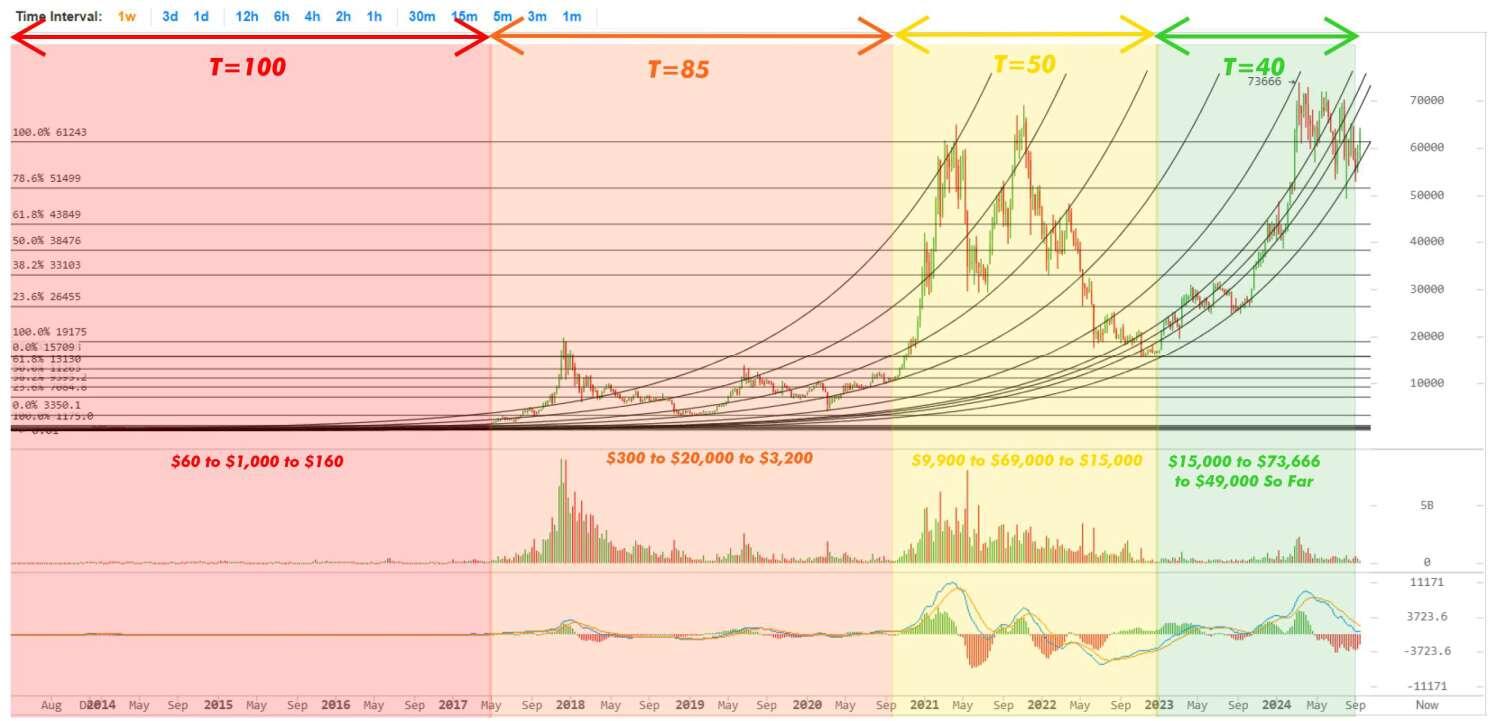
As #Bitcoin moves through time, one block after another, an increased number of people adopt it's usefulness.

I've edited this chart to try an convey how this adoption is not only increasing, but also speeding up. The coloured areas show how time in those adoption windows are compressed. Price is relatively relevant too, but I think the compression of those windows of adoption is more important to understand and view. .
Okay, I've done a series of papers that I'm working on and will produce more to further this. I post notes on these as I progress.

This the first of 7 I've done so far 00 to 06. Have a read, it starts to explain this and the others expand on this too. Feedback is appreciated, if you have any thoughts or comments.

nostr:nevent1qqsdcvflsdv7u0fmc0f92z95jtvq75hw5clzlrtf3r6pukh4fga2neqpzdmhxue69uhhwmm59e6hg7r09ehkuef0qgszx0ssu8ywnm9qgxpmap4k6vfxdtlacd69wqgy8gnjfgap63wrhwqrqsqqqqqpz4fnfa

And do you scale those Endorphins by have having the last word too.

:)

Whether I am 'good' or not, is the exchange of pure Empathy result.

My identity is also a result of sufferering of people globally. Am I 'man', yes if that is just a term for Mankind.

The exchange of pure human empathy is key, we both have the power to say anything we want here. Do we both choose not abuse.

We all good man?

Fundamentally, Bitcoin exchanges the Pure Human Empathy of the Barter exchange. Commodity Money tried to make IT a business and Fiat money went full on genocide.

Bitcoin is not a business, they can adopt IT, but that is different.

You are conflating factual and counterfactual are you not?

#Bitcoin is simplify information.

It's taking the pure information that comes directly from the Sun and in 10 minutes from being created on the Sun, it's allowing you to exchange Immutable Empathy with one and other Globally.

In that same 10 minutes, light produced by the Sun, bounces off the World and allows you to see IT.

This is the magic sauce that was required and that Commodity Money could not do, even less so in Clown Fiat Currency World.

Another, overlooked, small aspect of Bitcoin that is exponentially game changing.

If you read this and don't get IT now, don't react with worry, eventually you will Do!

Proof of Work is only relevant if the Work is meaningful. It must be, because Bitcoin code effortlessly only Exchanges Pure Human Empathy.

Have fun learning IT.

I believe the best way for Humanity to progress is to exchange Pure Human Empathy with each other.

I also believe, that is exactly what Bitcoin does, the evidence is beyond compelling.

So to switch your focus from Bitcoin would be counter productive.

Stacking Sats until you feel rich and then focus upon something else, that's similar to the protectionism of the Clown World we are trying to escape. Well that's my opinion, for what that's worth.

If everyone believes and follows "This is the way" then evolution stops and we are all doomed.