


"Oshis" are better.
Example: I am oshing, I oshied you
Being able to use it as a verb is a massive plus!
Hear me out, I've been a supporter of sats and on top of liking it, I've gotten used to it.
With an open mind, I propose we instead of Sats, we use "Oshis" (Oshi).
With calling Bitcoin denominations oshis, we can use it as a verb (for example: oshi me, I oshied you)
In Japanese it also means "push" or "press" which is fitting imo.
Interact with this post and let me know your thoughts! ⚡
From now on, every time I'm about to make a decent purchase, I'll first convert the amount into BTC/ sats
Most sobering to say the least
nostr:note1c3dvw3cmszhzahj5pdce8m584rq3wmszupt5t0wt8v0672dgdfpqenadq2

alright, fair
still want me to tey out the app?


Apps are built on protocols. Your app would fit perfectly for nostr, wouldn't it?.
Genuine question, can you build the 🟧💊 app as a nostr client?
To be honest, I am just looking for hypocrisy😅
I guess the company wants to maintain centralised control over its own IP
nostr:npub1ve8qwrlztemdmnh62jffcr0y9m9dpqgqjdg8ufx7gc3qw5wdk74qyv9ka6 Is your app build on nostr tho??

although i want to agree with you, I'll refrain from doing so as to prevent an echo chamber from occurring
So, no.

Expanding Bitcoin's Layer 1 uses beyond a peer-to-peer cash system undermines its security and risks transforming it into a less valuable asset.
Such proposals are either based on genuine maliciousness or driven by greed with no bad intentions.
Spam is anything other than the data required for Bitcoin to function as a peer-to-peer cash system.

what is the timeline for this project?

I am once again reminding you that bitcoin under a $1T market cap is just silly.
- nostr:npub1ylepraz59lvf6eeultg4kmvr3nza2ftpt2hgd90drh8tcwdjmtdss8xgy8
#BitcoinTwitter

yeah, because anything unser $10T makes sense🙄
I'd have to check out nostr's algorithm for content recommendation (if it even exists). Problem is I don't even know where to look😅
But most probably yes it is, at least partially.


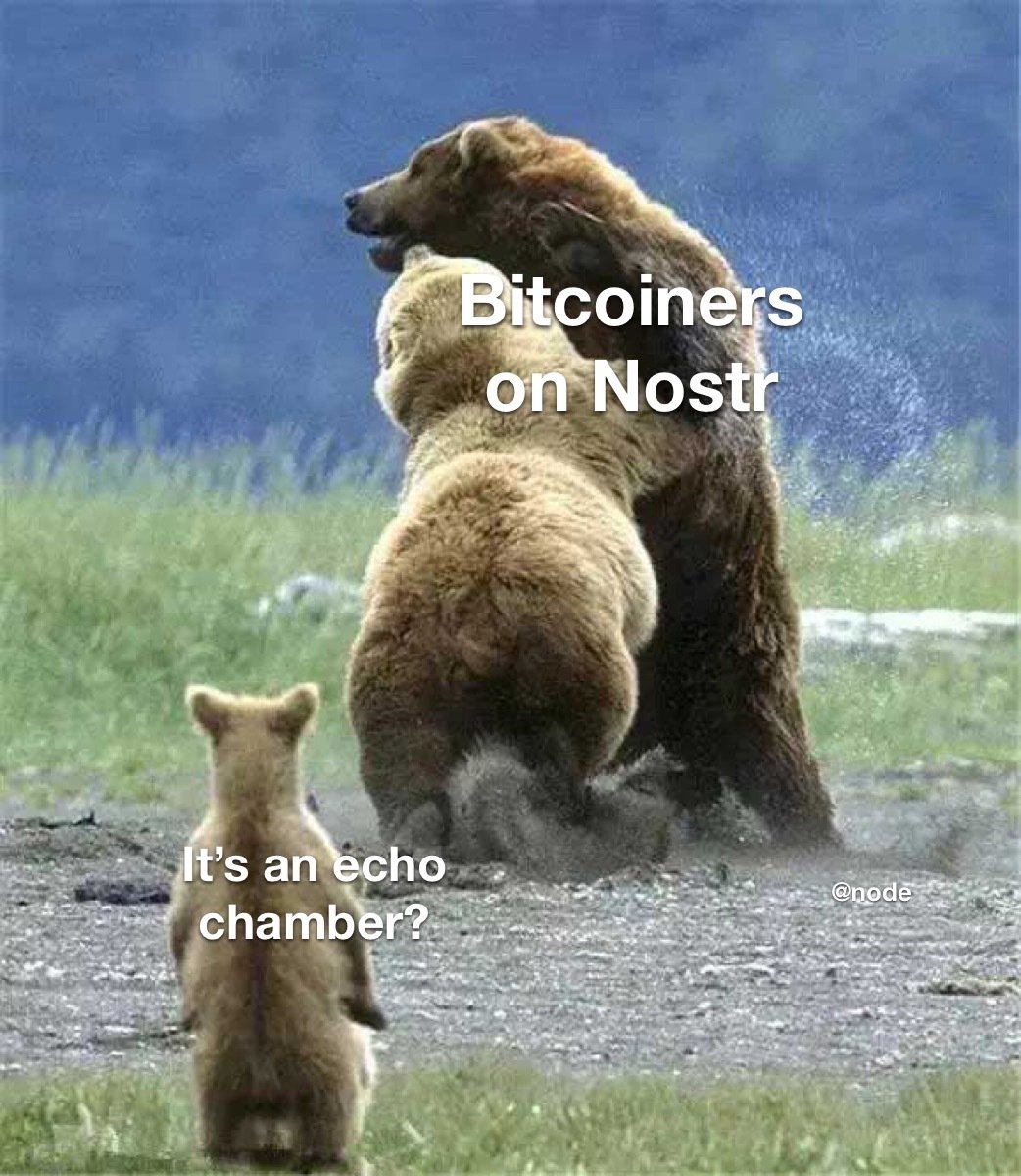
since I have to choose an echo chamber, might as well go with the Bitcoin one
smartest group of people alive


this is so they have some upside to go when BTC has it's leg up to 200k and then claim ETH outperformed BTC on the weekly 😂
and the illusion continues...

The latest speech from Milei. Powerful stuff. https://video.nostr.build/426f24d9b2667936a62ab50b1b1fc6c8c278b66db938b215f5c9dba68f68f324.mp4
Both sides of political alignment are not working in the interest of the People.
They merely are doing just enough to prevent mass revolution while interchangeably playing bad cop good cop with their political opposition. A choreographed act to perpetuate the status quo.
Stop believing in illusions and illusionists.
Attended a DLT meetup yesterday. My favourite thing to do at these events is to go around and try to #orangepill people
Safe to say I was the odd one out.


Breaking: You can now pay directly with your crypto on Revolut Visa
#Revolut is using horses to pull cars
They gradually introduce their costumers to crypto through intermediary steps...
Would you use this?

The Bitcoin Core OP_RETURN debate and the Blocksize Wars (2015–2017) share notable similarities, reflecting ongoing tensions within the Bitcoin community regarding its purpose, scalability, and governance. Let's go into a deep dive to understand their similarities but also where they differ!!
Drop a reaction if you you found this post helpful 💯🙏
Both highlight the struggle to balance Bitcoin's foundational principles—decentralization and financial sovereignty—with evolving demands.
1. Core Issue: Scaling vs. Purpose
- Blocksize Wars: Focused on scaling Bitcoin to handle increased transaction volumes. "Big blockers" sought larger block sizes to enhance throughput, while "small blockers" worried this would jeopardize decentralization, favoring off-chain solutions like the Lightning Network.
- OP_RETURN Debate: Centers on handling non-financial data. The NACK side argues for limiting OP_RETURN to preserve Bitcoin's monetary role, while the ACK side advocates for flexibility to accommodate broader use cases.
- Similarity: Both debates contrast a purist view (Bitcoin as money) with a pragmatist view (adapting to new demands), questioning whether Bitcoin should evolve or maintain its original constraints.
2. Spam and Efficiency Concerns
- Blocksize Wars: Small blockers feared larger blocks would increase resource demands, risking centralization and spam from low-value transactions.
- OP_RETURN Debate: NACK proponents worry that removing OP_RETURN limits would lead to spam from non-monetary data, complicating network efficiency.
- Similarity: Both discussions emphasize the risk of spam overwhelming the network, stressing the need for a lean and efficient blockchain.
3. Philosophical Divide: Bitcoin’s Purpose
- Blocksize Wars: Sparked a philosophical debate over Bitcoin's identity—payment system vs. store of value.
- OP_RETURN Debate: Reflects a similar divide, with the NACK side prioritizing Bitcoin as a monetary system and the ACK side accepting data storage as inevitable.
- Similarity: Both conflicts reveal a rift between those advocating for a rigid purpose and those supporting evolution to meet diverse needs.
4. Governance and Community Division
- Blocksize Wars: Exposed governance challenges within Bitcoin's decentralized structure, leading to forks like Bitcoin Cash.
- OP_RETURN Debate: Highlights similar governance tensions, with Bitcoin Core developers influencing outcomes amid community division.
- Similarity: Both debates illustrate the difficulties in decision-making within a decentralized system, resulting in fragmentation and prolonged discussions.
5. Inevitability of Use Cases vs. Resistance to Change
- Blocksize Wars: Big blockers argued for on-chain scaling to address high fees, while small blockers resisted immediate changes.
- OP_RETURN Debate: ACK proponents see data storage as inevitable, while NACK supporters resist changes that could compromise Bitcoin's core principles.
- Similarity: Both debates highlight the tension between adapting to user behavior and maintaining original design constraints.
6. Historical Precedents and Long-Term Impacts
- Blocksize Wars: Resulted in SegWit adoption and the emergence of Bitcoin Cash, influencing ongoing scalability debates.
- OP_RETURN Debate: Draws on past concerns about spam, with potential outcomes impacting future data-heavy applications.
- Similarity: Both conflicts serve as pivotal moments that challenge the Bitcoin community to confront technical and philosophical limits, shaping future developments.
The key takeaway is that the OP_RETURN debate and the Blocksize Wars illustrate a clash between Bitcoin's foundational vision and the pressures of evolving demands. Both reflect deep philosophical divides, governance challenges, and the struggle to balance efficiency with inclusivity in a decentralized network. The outcomes of these debates could significantly influence Bitcoin's trajectory, whether by accommodating new use cases or reaffirming its financial-first ethos.
Who.do you think will win?