Profile: 33674e84...





#node
#noderunner
#lightningnode nostr:note135j3fap2xmn28hwqg9kzjzck07mqn3yypm0wng88f674cd3ygc4qhnj4dr
5 million Satoshi‘s. One spot is left. Cheap opening fees. ⚡️⚡️⚡️⚡️


If it’s true that Jon Stewart was dropped by Apple for his China+AI takes (Apple reportedly wanted Jon to be more “aligned” with their view due to their Chinese economic overlords), I wonder what his next path is.
https://www.theverge.com/2023/10/19/23924549/jon-stewart-apple-ai-china-cancel
Retire with his “fuck you” money and maybe do a couple independent projects for fun? Or do a more independent/decentralized show?
I grew up watching Jon’s Daily Show. I don’t agree with all his past or present takes, but I always found him to be the best political jester- the one who could bring complex serious topics to a younger audience with humor. And right or wrong, speaking from his heart and logic rather than fully advertiser-captured or audience-captured.
Curious to see what he does next.
If he could get orange and purple pilled then maybe try decentralized. 




Show me this value transfer of bitcoin from one address to another for a lightning node runner. It shouldn’t take more than 10 minutes on average.


Not me. I’m spending my hard earnings on more Satoshi‘s instead of The propaganda/advertisement model.

LEAKED: Zuck is petrified of Nostr!!! 👀
“We’re not fucking leaving” video causes uproar with elites!
#nostr #grownostr #bitcoin https://video.nostr.build/eb2793734fc911378bbfa1e4263ca901623c7c9cad0b8573336e487512ffdc78.mov

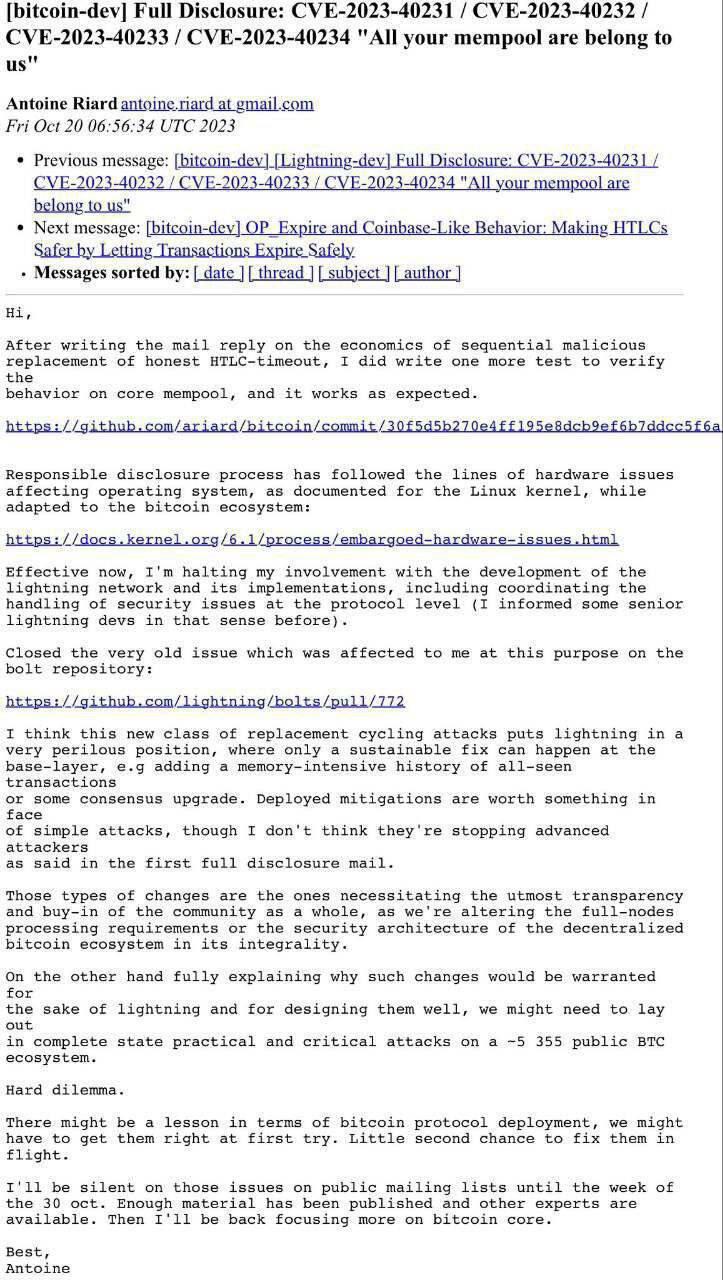
Actually you can lose bitcoin:
Somewhere in the link:
A lightning node allows HTLCs forwarding (in bolt3's parlance accepted
> HTLC on incoming link and offered HTLC on outgoing link) should settle the
> outgoing state with either a success or timeout before the incoming state
> timelock becomes final and an asymmetric defavorable settlement might
> happen (cf "Flood & Loot: A Systematic Attack on The Lightning Network"
> section 2.3 for a classical exposition of this lightning security property).
>
> Failure to satisfy this settlement requirement exposes a forwarding hop to
> a loss of fund risk where the offered HTLC is spent by the outgoing link
> counterparty's HTLC-preimage and the accepted HTLC is spent by the incoming
> link counterparty's HTLC-timeout.
>
> The specification mandates the incoming HTLC expiration timelock to be
> spaced out by an interval of `cltv_expiry_delta` from the outgoing HTLC
> expiration timelock, this exact interval value being an implementation and
> node policy setting. As a minimal value, the specification recommends 34
> blocks of interval. If the timelock expiration I of the inbound HTLC is
> equal to 100 from chain tip, the timelock expiration O of the outbound HTLC
> must be equal to 66 blocks from chain tip, giving a reasonable buffer of
> reaction to the lightning forwarding node.
>
> In the lack of cooperative off-chain settlement of the HTLC on the
> outgoing link negotiated with the counterparty (either
> `update_fulfill_htlc` or `update_fail_htlc`) when O is reached, the
> lightning node should broadcast its commitment transaction. Once the
> commitment is confirmed (if anchor and the 1 CSV encumbrance is present),
> the lightning node broadcasts and confirms its HTLC-timeout before I height
> is reached.
>
> Here enter a replacement cycling attack. A malicious channel counterparty
> can broadcast its HTLC-preimage transaction with a higher absolute fee and
> higher feerate than the honest HTLC-timeout of the victim lightning node
> and triggers a replacement. Both for legacy and anchor output channels, a
> HTLC-preimage on a counterparty commitment transaction is malleable, i.e
> additional inputs or outputs can be added. The HTLC-preimage spends an
> unconfirmed and unrelated to the channel parent transaction M and conflicts
> its child.
>
> As the HTLC-preimage spends an unconfirmed input that was already included
> in the unconfirmed and unrelated child transaction (rule 2), pays an
> absolute higher fee of at least the sum paid by the HTLC-timeout and child
> transaction (rule 3) and the HTLC-preimage feerate is greater than all
> directly conflicting transactions (rule 6), the replacement is accepted.
> The honest HTLC-timeout is evicted out of the mempool.
>
> In an ulterior move, the malicious counterparty can replace the parent
> transaction itself with another candidate N satisfying the replacement
> rules, triggering the eviction of the malicious HTLC-preimage from the
> mempool as it was a child of the parent T.
>
> There is no spending candidate of the offered HTLC output for the current
> block laying in network mempools.
>
> This replacement cycling tricks can be repeated for each rebroadcast
> attempt of the HTLC-timeout by the honest lightning node until expiration
> of the inbound HTLC timelock I. Once this height is reached a HTLC-timeout
> is broadcast by the counterparty's on the incoming link in collusion with
> the one on the outgoing link broadcasting its own HTLC-preimage.
>
> The honest Lightning node has been "double-spent" in its HTLC forwarding.
>
> As a notable factor impacting the success of the attack, a lightning
> node's honest HTLC-timeout might be included in the block template of the
> miner winning the block race and therefore realizes a spent of the offered
> output. In practice, a replacement cycling attack might over-connect to
> miners' mempools and public reachable nodes to succeed in a fast eviction
> of the HTLC-timeout by its HTLC-preimage. As this latter transaction can
> come with a better ancestor-score, it should be picked up on the flight by
> economically competitive miners.
>
> A functional test exercising a simple replacement cycling of a HTLC
> transaction on bitcoin core mempool is available:
> https://github.com/ariard/bitcoin/commits/2023-test-mempool
>
> ## Deployed LN mitigations
>
> Aggressive rebroadcasting: As the replacement cycling attacker benefits
> from the HTLC-timeout being usually broadcast by lightning nodes only once
> every block, or less the replacement cycling malicious transactions paid
> only equal the sum of the absolute fees paid by the HTLC, adjusted with the
> replacement penalty. Rebroadcasting randomly and multiple times before the
> next block increases the absolute fee cost for the attacker.
>
> Implemented and deployed by Eclair, Core-Lightning, LND and LDK .
>
> Local-mempool preimage monitoring: As the replacement cycling attacker in
> a simple setup broadcast the HTLC-preimage to all the network mempools, the
> honest lightning node is able to catch on the flight the unconfirmed
> HTLC-preimage, before its subsequent mempool replacement. The preimage can
> be extracted from the second-stage HTLC-preimage and used to fetch the
> off-chain inbound HTLC with a cooperative message or go on-chain with it to
> claim the accepted HTLC output.
>
> Implemented and deployed by Eclair and LND.
>
> CLTV Expiry Delta: With every jammed block comes an absolute fee cost paid
> by the attacker, a risk of the HTLC-preimage being detected or discovered
> by the honest lightning node, or the HTLC-timeout to slip in a winning
> block template. Bumping the default CLTV delta hardens the odds of success
> of a simple replacement cycling attack.
>
> Default setting: Eclair 144, Core-Lightning 34, LND 80 and LDK 72.
>
> ## Affected Bitcoin Protocols and Applications
If you have a watchtower or your nodes stays online, these transactions that caught caught in a forced closure will overtime be settled through the miners.
This is just more FUD. (Fear - Uncertainty - Doubt)

Doesn’t the bitcoin network get audited every 10 minutes? So, you should know the answer to this in about 10 minutes.