
Avatar
mrclownworld
34134b9e1cbb322582bca4020a39cc1256036d1f5e98effcc838b421fc209d48
Filmmaker. Conspiracy empiricist. Father. #truthstr LARPing as a salty no-coiner for the rest of this cycle

Good question, I would say the one Moses got the skinny from on Mt. Sinai, if He is really the same fella that was hanging out in the Garden with Adam and Eve

Hey nostriches - can you share any and all tips for talking to God?

Replying to Avatar Lyn Alden

The Dynastic Cycle and the Fourth Turning are all basically the same thing. It's built into civilization, regardless of era or culture.

There are debt/money growth cycles, law/bureaucracy growth cycles, and periods of reset for both of them.

During the growth phase, debt accumulates, and laws build upon laws as bureaucrats become bloated and detached. Even well-meaning people in power can't fix it; every attempt to fix things just adds another layer of debt and legal complexity.

And then after a long enough time, it blows up. It could be slow or it could be fast, but it gets fucking rekt. It could be a lost war, a major internal revolution, or a slow massive decline and then a major populist democratically-elected landslide pivot.

The new government emerges, as order out of chaos, with elements of authoritarianism. The ideal scenario is that this newfound unity is enough to create change in the right direction, and then decentralize itself to re-establish rule of law and individual rights. The more common scenario, however, is that this newfound unity is not let go by those who claimed it, and it leads to authorianism/communism/fascism and decades of problems. In other words, the revolution against the decaying chaos is easy, but sticking the landing toward the re-emergence of freedom and productivity is the hard part.

That's why nothing stops this train. We're in the debt cycle rotation/reset, and eventually the bureaucratic rotation/reset as well. It takes billions of dollars to build a thousand feet of high-speed rail in the USA. Europe flails around on energy optics. Politicians become satire. Japan is stuck in yield curve control. This can last a long time, but the tailspin is nearly irrecoverable.

Incrementalism doesn't work at this phase. The event horizon is passed. Rather, the focus becomes on what order will emerge from the chaos. Is it rational order, or is it even worse than what came before?

The answer to that question, is what people have a big part in shaping.

Ok I see “invaders attack empire” and “bandits raid countryside” copy that, all part of it

Replying to Avatar Lyn Alden

The Dynastic Cycle and the Fourth Turning are all basically the same thing. It's built into civilization, regardless of era or culture.

There are debt/money growth cycles, law/bureaucracy growth cycles, and periods of reset for both of them.

During the growth phase, debt accumulates, and laws build upon laws as bureaucrats become bloated and detached. Even well-meaning people in power can't fix it; every attempt to fix things just adds another layer of debt and legal complexity.

And then after a long enough time, it blows up. It could be slow or it could be fast, but it gets fucking rekt. It could be a lost war, a major internal revolution, or a slow massive decline and then a major populist democratically-elected landslide pivot.

The new government emerges, as order out of chaos, with elements of authoritarianism. The ideal scenario is that this newfound unity is enough to create change in the right direction, and then decentralize itself to re-establish rule of law and individual rights. The more common scenario, however, is that this newfound unity is not let go by those who claimed it, and it leads to authorianism/communism/fascism and decades of problems. In other words, the revolution against the decaying chaos is easy, but sticking the landing toward the re-emergence of freedom and productivity is the hard part.

That's why nothing stops this train. We're in the debt cycle rotation/reset, and eventually the bureaucratic rotation/reset as well. It takes billions of dollars to build a thousand feet of high-speed rail in the USA. Europe flails around on energy optics. Politicians become satire. Japan is stuck in yield curve control. This can last a long time, but the tailspin is nearly irrecoverable.

Incrementalism doesn't work at this phase. The event horizon is passed. Rather, the focus becomes on what order will emerge from the chaos. Is it rational order, or is it even worse than what came before?

The answer to that question, is what people have a big part in shaping.

Question - to what extent is the victorious emergent order determined by outside influence?

Would the USA broken from Britain without the French?

Would the South have successfully seceded if Europe had intervened on their behalf?

Would Germany have been destroyed if the pact with Stalin had held?

These guys would know better than anyone. They see all of the free things all of the free people are doing all of the time nostr:note19guewmv4su55az5xphssl8393wfczdf0vy554q977dpdj77e5lzq4phl6k

The Amish can.

Starting to feel like those mofos are right about literally everything.

Replying to Avatar rand0mguest2

https://x.com/adam3us/status/1789277167219536378 naw lol taxes are used to control ppl and yes lesson the amount of money needed to be printed. If taxes weren’t key to this Ponzi scheme the tiny hats wouldn’t have passed the income tax act at the same time at the federal reserve. Surprised how few Bitcoiners have actually thought this thru. Let us know when you stop taxing the Salvadorans, bukele lol

Tax rate on a particular GDP is supposed to match to a debt burden the way your income is matched to the size of a mortgage the bank is going to give you

They need it to optimize the debt burden they can levy on a country without forcing default

Obviously they also secure the loan in other ways (just like a mortgage) and they have violent enforcers (just like a sheriff) to repossess collateral in a default

Sometimes they’ll even bomb your country in a “burnt offering” and then pretend they didn’t call it that, and actually the “burnt offering” is what you did to them

The State likes the sovereign individual thesis as a boogeyman/foil - see Osama Bin Laden or Elon Musk

But it does not like it in actual practice

I think a very overlooked aspect in all of written history on revolutions is the opportunism of outsiders who turn the tide

I bet it would correlate with 99% of outcomes if someone smarter than me did an analysis

I have been reading different things about the culture divide in border states in the lead up to the Civil War. Churches splitting into two and such. I agree with you, I think we are living through that period now - the lead up to a Civil War.
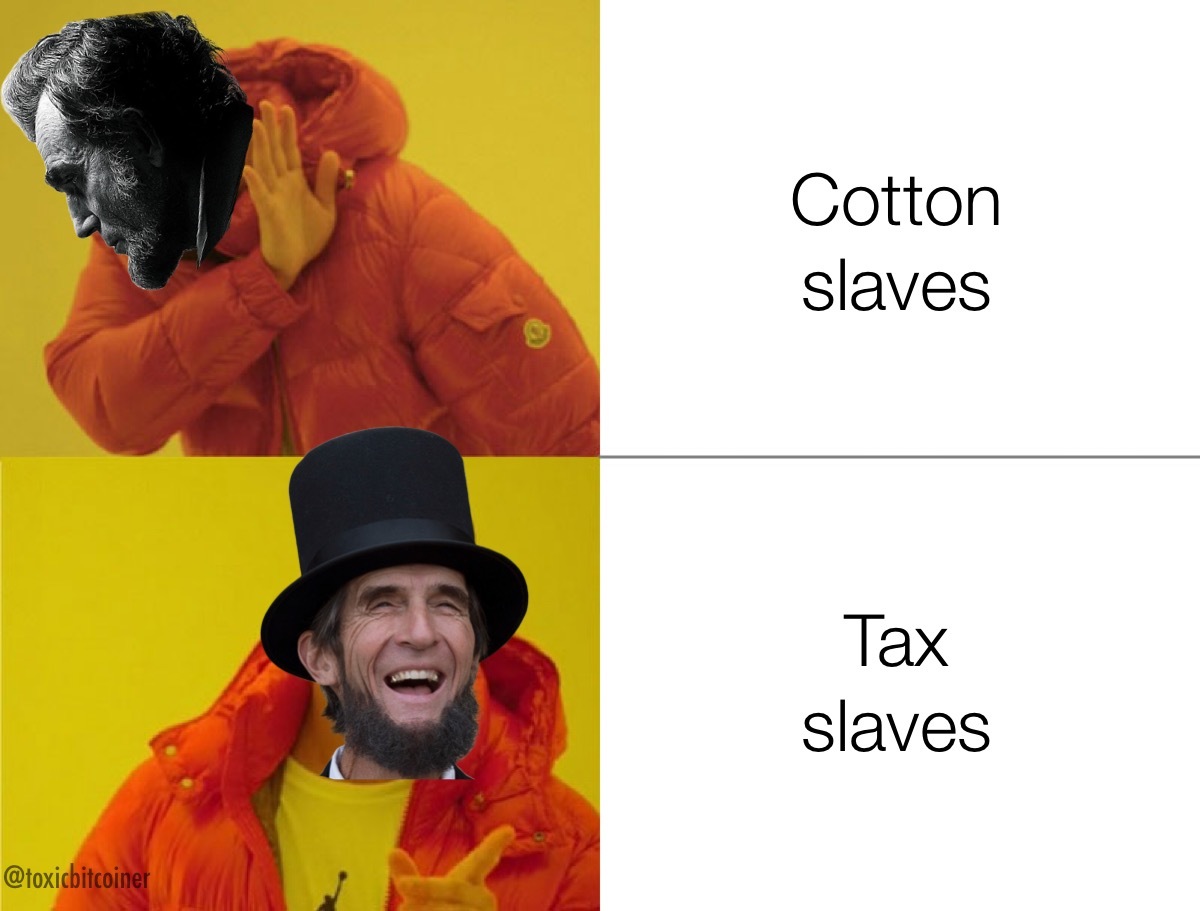
Sir I think your zaps aren’t working I’m trying to fat zap you rn

nostr:note10rqf97m7n895mwwjxe53tdum3dl8qqjw4skcegvqgna6fhmggv2qy2n99k

Replying to Avatar mrclownworld

The American Revolution was a simple tax revolt.

The British Crown simply overplayed its ability to tax people living on another continent.

The Crown had other enemies that helped the revolvers win, but nothing helped them more than the physical distance.

The parallels to today are meaningful. Just as colonists asked why a tyrant an ocean away should extract value from the labor they did here, today I wonder why work I do entirely in cyberspace for people all over the world should be taxed by a group of tyrants in Washington D.C. Just like those colonists rejected the idea that agents of that tyrant should be allowed to suppress their speech and seize their property, I too wonder why agents of that tyrant should be allowed to surveil and censor all of my communications.

Revolution was the only answer then. A severance of the governing relationship. A new government. A new set of rules and rights.

Years later, on the basis that tyrants sought to dispossess them of their property rights, slaveholders in the American South sought the same solution to their problems. They lost, because they lacked the advantages their predecessors had of physical distance and opportunistic allies.

History tells you the good guys won both times (what are the odds) but a more sober analysis would point to the mega-political - technology + geography (+ climate + microbiology).

So the question, bitcoiners - are we going to win like the Colonies or lose like the South?

Either way, I can’t imagine we will escape this decade without war.

*forgive all the typos, you get my drift

The American Revolution was a simple tax revolt.

The British Crown simply overplayed its ability to tax people living on another continent.

The Crown had other enemies that helped the revolvers win, but nothing helped them more than the physical distance.

The parallels to today are meaningful. Just as colonists asked why a tyrant an ocean away should extract value from the labor they did here, today I wonder why work I do entirely in cyberspace for people all over the world should be taxed by a group of tyrants in Washington D.C. Just like those colonists rejected the idea that agents of that tyrant should be allowed to suppress their speech and seize their property, I too wonder why agents of that tyrant should be allowed to surveil and censor all of my communications.

Revolution was the only answer then. A severance of the governing relationship. A new government. A new set of rules and rights.

Years later, on the basis that tyrants sought to dispossess them of their property rights, slaveholders in the American South sought the same solution to their problems. They lost, because they lacked the advantages their predecessors had of physical distance and opportunistic allies.

History tells you the good guys won both times (what are the odds) but a more sober analysis would point to the mega-political - technology + geography (+ climate + microbiology).

So the question, bitcoiners - are we going to win like the Colonies or lose like the South?

Either way, I can’t imagine we will escape this decade without war.