
i’m a maxi but “gargle Saylors balls” is a wonderful turn of phrase. Thank you sir!
I’m as anti-communist as anyone but I still want to know what part of this is not CIA cut-out National Endowment for Democracy organized and funded.
Bitcoiners swooning over promises of a strategic reserve should keep in mind that, to a politician, “acquiring” does not mean buying from a willing seller at the market clearing price.

It’s a mistake to judge Bitcoin culture by the behaviour of all the simps, scammers and generally stupid people who descend on to mega-conference cringe fests during the bull market. Look closely and you will see that the underground cyberpunks are still there, building, and they will be there when all the idiots wash out as the bear inevitably comes back.


How? Your own report lists 5 questions, all about left or right, liberal or conservative.


Fascinating study by nostr:npub1n3sjlzmhpu8rl56umtptc4lua6zkretq2p82yhytnmlcuq639vlqd0te5l
“Part of what shapes identity and behavior in America--surprise surprise--is political orientation. Our political divide seems not only to be deepening, but also becoming the most important fact about identity, the one that trumps all others. So we polled it 5 different ways: What we found was definitely our most shocking result. Like most everyone on this app, our critics in the media, academics who write about bitcoin, and almost all politicians, we thought #bitcoin ownership would skew towards the political right, and towards libertarianism.
Wrong!” 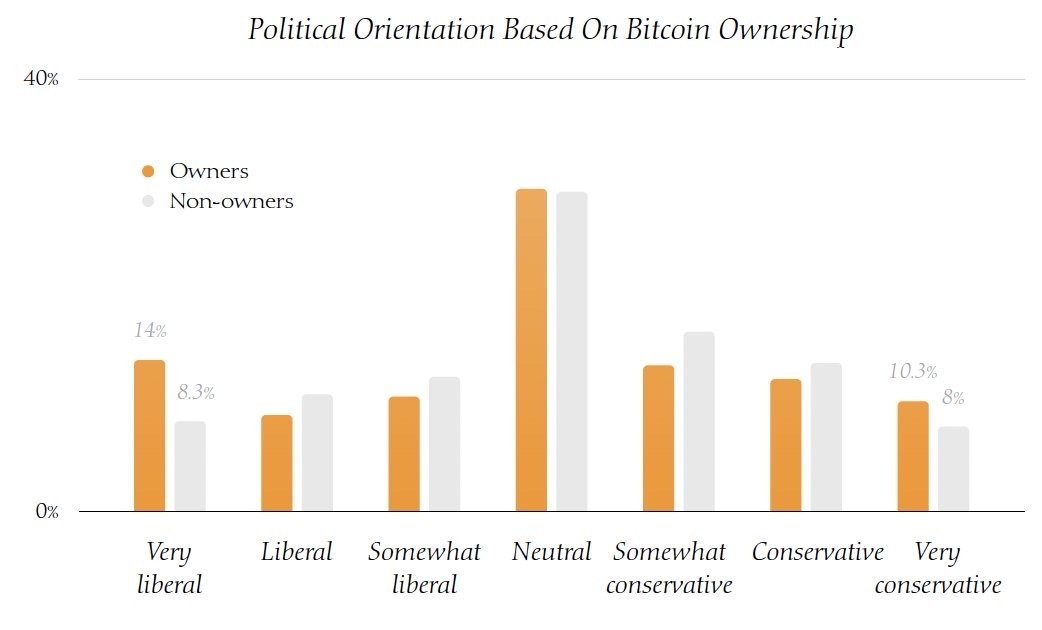
Someone who responds to a survey AND confirms he owns Bitcoin is a moron. There is zero chance that 14% of Americans own Bitcoin. The political orientation questions use the conventional left-right dichotomy that is completely inadequate to identify libertarians.

Lots of reasons:
(1) You don’t want to be an early adopter of new wallet software. Use well-established and widely used open source software for your savings.
(2) Web wallets have historically been terrible at security.
(3) Does not support Lightning, which makes it unsuitable as a spending wallet.
(4) It is a terrible idea to link your identity to your coins.
(5) They may be starting as Bitcoin-only, but their marketing materials talk about “digital assets” - big red flag.
(6) Third parties are security holes - there is no guarantee that they will not be co-opted and you have no control over them pushing a malicious update.

Shitcoins are fiat with a blockchain for regulatory arbitrage.

This week’s newsletter is out. Check your email or read it online.
https://newsletter.unlimitedhangout.com/2024-07-19-newsletter/


Nah, give back California to the Mexicans instead.

Neither one is retarded, it’s voters who are retarded. Biden may be a dementia patient now, but he has wielded the levers of power of the greatest empire on earth for at least three decades. He has been instrumental in every foreign policy debacle afflicting the world today, not least Ukraine and Gaza. He is a sociopath and so is Trump.


Your government hates you more than Hamas or the Russians and will be the cause of your own destruction if you continue to buy in to its propaganda about the Far Enemy.

The fact that the sheikhs hold their vast surpluses in Treasuries matters a lot more than them pricing their oil in dollars. Putting this out there as this aspect of the petrodollar system is often understated. (Not an original thought, heard it first from nostr:npub1gdu7w6l6w65qhrdeaf6eyywepwe7v7ezqtugsrxy7hl7ypjsvxksd76nak .)
Happy 4th of July to my American friends. Remember today that “taxation without representation” was a psyop.
https://mises.org/mises-wire/american-revolution-was-culture-war
BRÆKING: Greenpeace continues its SEXIST anti- #Bitcoin campaign, releasing new video about “Bitcoin BROS.”
NEWSFLASH to Greenpeace misogynists: there are WOMEN in Bitcoin, & Bitcoiners will not stand by while you ERASE them.
Please repost if you think Greenpeace is sexist. https://v.nostr.build/8G8mv.mp4
We will not win if we accept the enemy’s framing. We can only laugh in their face when they accuse us bitcoiners of any of the progressive deadly sins (sexist, racist, misogynist, etc. )

#introduction
Chomsky once said: “We shouldn't be looking for heroes, we should be looking for good ideas… All over the place, from the popular culture to the propaganda system, there is constant pressure to make people feel that they are helpless, that the only role they can have is to ratify decisions and to consume.”
We’ll be sharing Chomsky’s wisdom and related work, not to engage in hero-worship, but to support and inspire all of you here at nostr:npub1pu3vqm4vzqpxsnhuc684dp2qaq6z69sf65yte4p39spcucv5lzmqswtfch with ideas. Through participation in this project, we’re building revolution together. ✊
Brought to you by Noam’s friends at ZNetwork.org:
Noam is one of the most impactful educators of our time and has been an invaluable contributor to nostr:npub1xm0rvnpw52nh7tk59ntly55w74rmd2cqvt3kg5zxrzz3rlssvspsk0gs6s over the decades. We’re excited to learn about your work and to discuss some essential Chomsky. 
Chomsky should burn in hell for his insane Covid positions, despite his sometimes heroic anti-war stances.

To avoid single point of failure.

Yes but newbs need to be aware of the tradeoffs: (1) you need at least two more secure locations to store backups; (2) you need fatter utxos to make up for the added weight of transactions when you spend which means you have to spend a lot of time consolidating safely or you will compromise your privacy; (3) you need to keep a single-sig cold wallet as well for medium term savings or fees will bite and because you don’t want to access the multisig too often or you may compromise the security of your multisig and because you don’t want to let receivers think you have a big stack; (4) you need to step up your opsec when you spend from the multisig as the tx combined with an IP or any other personal info leak can lead to a wrench attack; and, (5) you need to store multiple backups of the wallet because you and your heirs cannot just rely on the seed words to access funds.
I can’t wait for FROST, which would take care of many, but not all, of these tradeoffs.