Some people have grown cynical with democracy (and various types of representative government broadly, e.g. including constitutional democratic republics that enshrine certain rights to protect liberty against the masses), viewing this method as promoting short-term leadership with bad incentives.

I have a different take.

Prior to the printing press and then the telegraph and radio, running a democratic society over long distances wasn’t even feasible. The concept of having people democratically participate in their government relies on people being relatively connected information-wise so that they can use their access to information to know what’s happening and to then select between different options, which you couldn’t do across the entirety of a country before people were literate and election materials or other publications could be mass produced. In the pre-press age of handwritten books, making written documents was expensive, and so literacy was a niche skill.

So, that era was ruled by kings and queens, council oligopolies, and so forth. Representative government, to the extent that it existed, only applied to small city states where people could literally gather in a town square, or to “elites” in a capital. There was literally no way to run an election over very broad distances on a regular basis. The printing press helped change that, and then the telegraph, radio, and other tech further reinforced it.

But ironically, as I discuss in Broken Money, those technologies also started to break our money. The printing press and telegraph allowed the transaction layer (the movement of IOUs between individuals and entities) to grow exponentially more efficient both domestically and globally, while our settlement layer (gold) remained basically unchanged. This broadening gap between fast transactions and slow settlements was increasingly bridged with centralization and credit, and the gap eventually became so wide that every nation dropped the settlement layer of gold almost entirely, except as a reserve asset.

So the same technologies that enabled widespread representative government also enabled the proliferation of softer money. Prior to these technologies, broad democracy wasn’t possible. And after these technologies, sound money was too slow to keep up. Oof.

But over a long enough timeframe, our technology became good enough that we finally figured out how to do fast settlements as well. Bitcoin. People can send value to each other quickly over long distances, in ways that no central entity can prevent or reverse, and with a unit that no central entity can debase. The first sound money of the Information Age.

If Bitcoin is successful over the coming decades and becomes a much larger and less volatile money, than it is now, fully entrenched in society, then that would be the first era where technology is at such a state where broad democracy and fast sound money can coexist. Or put more universally, it will be the first era where information spreads quickly without breaking the money, and thus both fast information and good money could coexist.

I, for one, would be curious to see how that develops.

Reply to this note

Please Login to reply.

Discussion

Broader democracy with less significance of borders or geographical limits of legislation means more decision power the closer you get to your own location, which is the way it should be, right? No need for globally unifying policy to be decided democratically when geographical arbitrage comes into play. Am I on the right track?

Take that doomers!! 😜

Networks happen from mushrooms to creation, bifurcation is a theme, and chicks dig scars *read: forever*

Work the network, Lyn (the answer orbits there).

Greta insight & question.I grappled with this for about 50 pages in BushidoOfBitcoin.com

I believe there are other factors at play which will shift the organisational orientation toward something more feudal AND meritocratic.

Too long to explain here, but I’ll send u advanced draft if u want to explore :)

Sure, happy to read it.

Sent via email!

Mmmm. Definitely something to mull over.

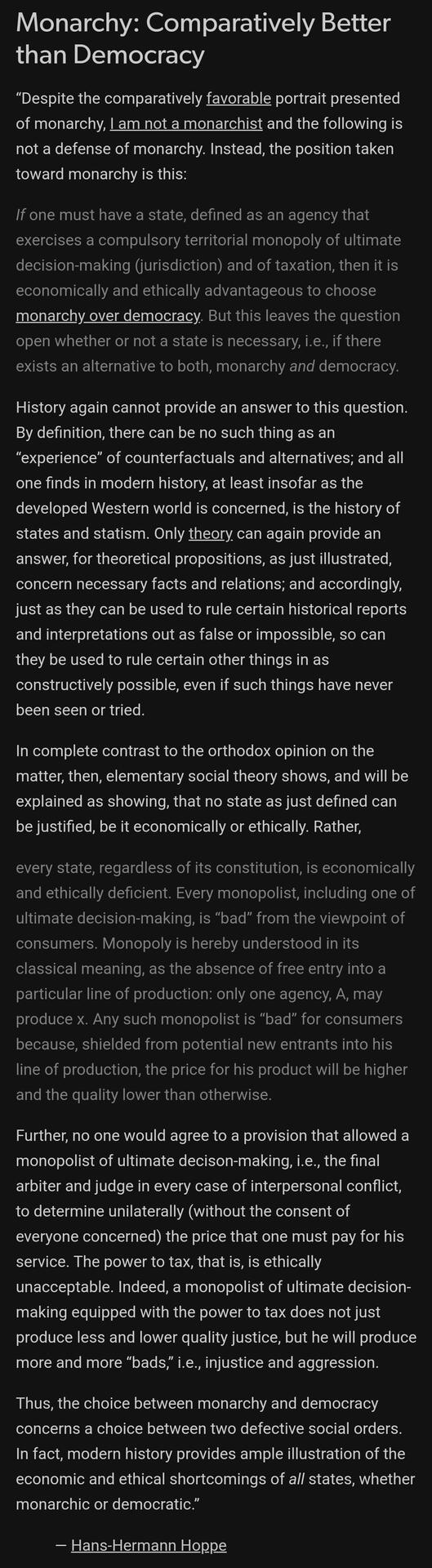
Did you read "democracy the god that failed" from Hans-Hermann Hoppe?

I did, but overall I think many of the shortcomings of democracy are more-so shortcomings of soft money.

I suspect hard money would make democracies better than their current form, and I think many people who favor non-democratic forms of government do so because they themselves expect to be part of the small elite that runs things or they otherwise have power in those non-democratic systems.

It doesn't need to be there a government to run things, every service a govt does can be done by private companies. Plus on principle democracy implies forced socialization and theft by taxation on some level. I prefer a voluntary association of individuals with real private property.

Watch out for Snow Crash!

The wild part about preferences like ours is the asymmetry between voluntaryists and statists/collectivists.

We say "we'll leave you alone to do your collectivist thing, can you just leave us alone so we can do this voluntary thing?"

And they say, "No, we need you in the collective or else it doesn't work, you are our hostage."

Of course, they know what's best for everyone lol

That's literally the same in democracy

https://youtu.be/Wa85VCiL_sM

The useful collective term “we” has enabled an ideological camouflage to be thrown over the reality of political life. If “we are the government,” then anything a government does to an individual is not only just and untyrannical but also “voluntary” on the part of the individual concerned. If the government has incurred a huge public debt which must be paid by taxing one group for the benefit of another, this reality of burden is obscured by saying that “we owe it to ourselves”; if the government conscripts a man, or throws him into jail for dissident opinion, then he is “doing it to himself” and, therefore, nothing untoward has occurred. Under this reasoning, any Jews murdered by the Nazi government were not murdered; instead, they must have “committed suicide,” since they were the government (which was democratically chosen), and, therefore, anything the government did to them was voluntary on their part. One would not think it necessary to belabor this point, and yet the overwhelming bulk of the people hold this fallacy to a greater or lesser degree.

— Murray Rothbard

I don’t know if we will have this privilege in our generation. But I believe our children do! And even though we are not here to check how everything coexists, the greater good has already been done by Nakamoto d and this is the reason why we do good to society as a whole, so that generations beyond ours benefit.

Your "If" what is worried me )

Always assume “if”.

Assuming “when” often leads to complacency.

Agree

That the current system is broken is not in question for the majority of people but I do not hear any recognition of the forces absolutely opposed to bitcoin becoming widespread.

History suggests to me that being right or better is simply not enough to change the status quo.

Bitcoin will only prevail imo if a body seeking power adopts it as a tool of obtaining power.

What if our ability to coordinate democratically has more to do with Dunbar's number than the access to information at great length?

It's easier to fool the electorate if people don't really know you...

Maybe democracy does not scale and must remain at a city state level.

The problem is, military power does scale.

So to the extent that this is true, some governments are likely to become and remain quite big, and thus we have the question: do we want them democratic or authoritarian? I’d pick democratic and with a division of powers (and limited by a constitution to protect bedrock liberties).

https://youtu.be/H37JIKFVp7M

Hans-Hermann Hoppe discusses why internally liberal states tend to be Imperialist powers and how the spirit of Democracy has contributed to the de-civilization in the conduct of war.

More specifically Hoppe explains the rise of the United States to the rank of the world’s foremost Imperial power, as a consequence of the transformation, from the beginnings of an Aristocratic Republic to a mass Democracy, and the role of the United States as an increasingly arrogant war monger. What stands in the way of peace and civilization is above all the state and democracy.

Lyn always a several moves ahead in every discussion đŸ«Ą

Continuing on your line of though (not disagreeing that democratic is definitely better than authoritarian).

Maybe if it's true that bitcoin will limit the forever wars of fiat, maybe this means that, under a bitcoin standard, even the biggest empires won't be as big as fiat money allows for.

So, what is your take on democracy?

That it is so good that no explanation is needed and once it becomes feasible it will win?

Do clans, families and small companies have more democratic structures than other types of governance?

Yes, that sounds fascinating! 👍

In general, should BTC become indeed the new world money, they way society is organized will be totally irrelevant.

I see your point of how physical money doesen't scale with the speed of information, and that democracy depends on communities remaining small, but I don't see the connection between speed of settlement and democracy failure.

Our information systems, traditional media, education, entertainment are captured by the state. I think there is little argument against this assertion. The state not only works to supress information, but they actively work to destroy thought itself with counterintelligence to prevent democracy. Whatever mass movement there develops for reform of the state, is seen as insurgency by the state, and the movement is crushed through the soft power of control over information. They buttress trust "in the system" in part through developmemt, influence and brainwashing of trusted public figures, and feeding supressed truths that harm this trust through discredited channels.

If the primary channels of information that is consumed by the majority of a democracy are controlled by the state, how can improving monetary settlement speed reverse this trend?

Uhhhh cynicism has *nothing* to do with it.

You haven't read "Democracy: the god that failed" have you?

“Democracy is the worst form of government, except for all those other forms that have been tried from time time.” - Winston Churchill

It’s no surprise that all of the technologies you reference, including Bitcoin, emerged from democratic republics.

Yeah, I’m not interested in monarchy, so. ..

Are you blind? Neither am I.

You interested in justice? You interested in reality? You interested in economic freedom?

Sure. But I’m not interested in monarchy, nor is anyone I’ve ever met or heard in American public life. It’s a non-starter.

1 line of change is all it takes to make more Bitcoin, that's how soft it is.

https://github.com/bitcoin/bitcoin/pull/29778

Actually, 1 line of code change isn't all it would take.

It would actually need to be ADOPTED by the network.

Meaning, tens of thousands of individuals would have to review, discuss, consider and then adopt the code change.

So, no... it wouldn't be that simple.

BUT, ofcourse you knew that already but decided to write an intentionally reductive statement.

Have a good weekend.

I appreciate your optimism and tend to agree. I personally haven’t grown cynical with democracy. Just with the EU parliament, most recently wrt ChatControl. I think democracy works relatively well in smaller units e.g. in Germany. I’m also genuinely intrigued by Switzerland’s decentralized canton model with more direct democracy and localized policy.

We can certainly take the logic in this post to follow that we are now in an era where the messaging layer travels faster and is much more informative than our legislative layer. If we don't find ways to upgrade the way we elect our representatives and keep them accountable our laws and civil society will lag behind the speed of the internet (both money and information)

Bullish

Its an interesting assessment. I also choose to remain positive and hopeful for the future. We are seeing this grand experiment finally starting to latch on in various areas of our society.

I for one look forward to watching this play out!

tldr?

If Bitcoin succeeds “it will be the first era where information spreads quickly without breaking the money, and thus both fast information and good money could coexist.”

What would democracy look like if it seemed like there was a new global monetary settlement network monetizing? nostr:npub1sfhflz2msx45rfzjyf5tyj0x35pv4qtq3hh4v2jf8nhrtl79cavsl2ymqt

"the same technologies that enabled widespread representative government also enabled the proliferation of softer money. Prior to these technologies, broad democracy wasn’t possible. And after these technologies, sound money was too slow to keep up. "

#econstr #lynwisdom #democracyvsfreedom

nostr:note19we3y6wcj3eymdn24d9qyeldqlj70gym52uj9t858gcv9sa7t65qu0lagp

Democracy is mob rule. It is immoral so it doesn’t matter if the money improves.

Do your Tweeker X followers see this too?

Agreed. Over time as technology has evolved we have become more and more decentralized. Look at it from a centuries perspective. Access to technology as a whole to humanity has become more equal. The internet ( hyperconnected world ) is driving this new paradigm of changes. Money ( bitcoin ) can now move with the speed of light all over the world creating more decentralization and democracy. So it is with societal democracy. We have relied on central entities to represent us ( the voted politicians ) this too is now subject to change due to the internet. I forsee a far more direct democracy as this evolves. We are as you discussed with nostr:npub1sg6plzptd64u62a878hep2kev88swjh3tw00gjsfl8f237lmu63q0uf63m that we are moving away from the issue of the SPOF ( single point of failure ) paradigm. This is turn bring us more balance and equilty over time. It seems things are looking better for all in this world.

“Broad democracy” or mass democracy is just a political formula. A narrative told by the regime to entice the low into an alliance against the productive classes. It is not a technology or even a practice, it is a fiction learned in 8th grade civics that most cannot unlearn. Bitcoin fixes this.

I’ve appreciated the insight on how the speed of information flow has altered underlying societal assumptions đŸ€

Interesting take

I think the world on a Bitcoin standard will dramatically reduce the size and scope of governments to the extent that they will become more like subscription based services like cell phone companies not based on geography but shared values.

The 0nly c0Untry that has genuine dem0cracy in this planet is Switzerland.

Most of the G0vernments work f0r the c0rporate$ & acc0untable only to their financier$ & c0rporate$, & r0b the m0b by tax & inflati0n, dem0cracy & republic is a j0ke.

https://www.weforum.org/agenda/2017/07/switzerland-direct-democracy-explained/

I don’t think this touches on the main issue with representative democracy- the scam that has been running since the French Revolution. The main issue is in this system we are only allowed to choose our temporary parents, who will make the decisions for us. And so the parasitic ruling class (as opposed to a true aristocratic class) continues to rule.

As means of communication have increased in reach, we see people are generally not better informed. The means of mind manipulation have simply increased in reach and strength.

The issues with democracy have been debated since Aristotle, and they are not tied to means of mass communication. I think there are a few simple steps to take to fix them:

Voting age increased to 26. Most people, including myself, are still morons at 18. At about 26 you start having long term goals in mind, more life experience and hopefully have left adolescence behind.

No voting rights if you haven’t paid taxes for the last 5 years straight.

We abolish the left-right wing nonsense by letting us vote directly on issues, not for “representatives”. A system of a party of one.

These three points alone would cut 95% of government bloat, end the left/right circus which keeps us in the illusion of democracy and slaves in the taxation plantation.

nostr:note19we3y6wcj3eymdn24d9qyeldqlj70gym52uj9t858gcv9sa7t65qu0lagp

Bitcoin is antithetical to democracy. Democracy is the rule of the many over the minority.

its my view that we need voluntaryism, that is to say to replace government and rule by force with voluntary choice in dispute settlement and defensive organizations

There's never been a wisdom of the masses and there will never be, democracy is the rule of the majority and the majority is always stupid and dangerous. Plus it relies on theft through taxion, are you OK with that?