

For the record - 6k posts. 20k replies - correcting economically illiterate 🤡's. She knows this. Keeps disingenuously pushing the flawed hueristic regardless. 🚩

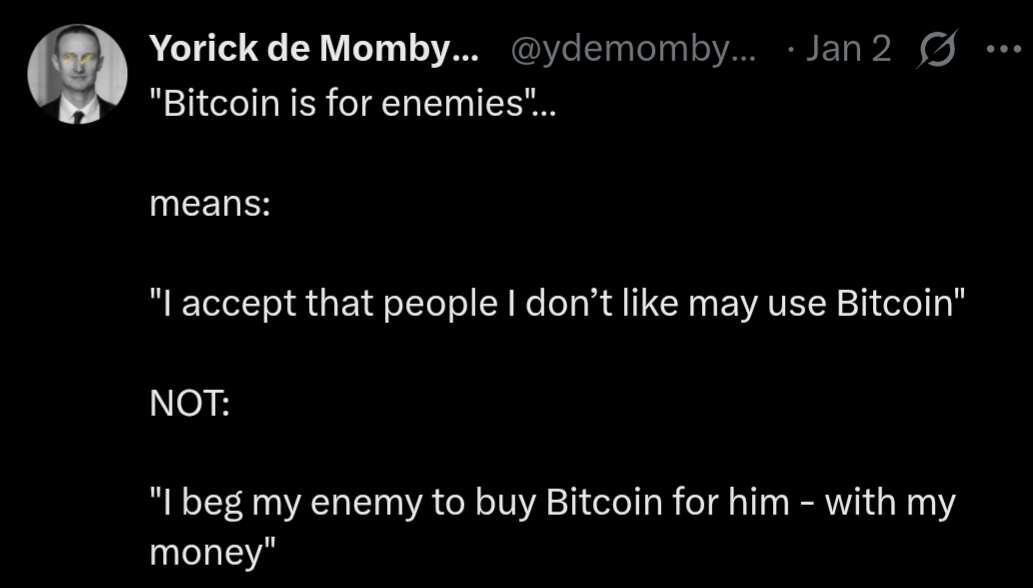
GM, except to everyone who is economically illiterate & has an ignorant strongly held opinion.
I support OP_GFY, and YAGNI. 
Make Bitcoiners economically literate again

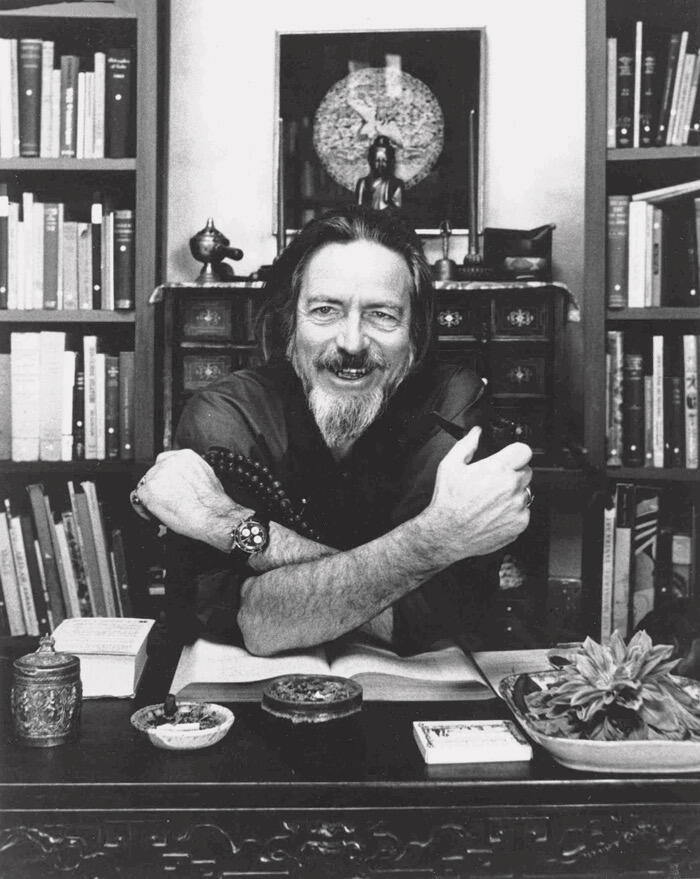
The meaning of life: goals.

Are you blind? Neither am I.
You interested in justice? You interested in reality? You interested in economic freedom?
You forgot the golden showers in Wizard costumes

That's literally the same in democracy
The useful collective term “we” has enabled an ideological camouflage to be thrown over the reality of political life. If “we are the government,” then anything a government does to an individual is not only just and untyrannical but also “voluntary” on the part of the individual concerned. If the government has incurred a huge public debt which must be paid by taxing one group for the benefit of another, this reality of burden is obscured by saying that “we owe it to ourselves”; if the government conscripts a man, or throws him into jail for dissident opinion, then he is “doing it to himself” and, therefore, nothing untoward has occurred. Under this reasoning, any Jews murdered by the Nazi government were not murdered; instead, they must have “committed suicide,” since they were the government (which was democratically chosen), and, therefore, anything the government did to them was voluntary on their part. One would not think it necessary to belabor this point, and yet the overwhelming bulk of the people hold this fallacy to a greater or lesser degree.
— Murray Rothbard
Hans-Hermann Hoppe discusses why internally liberal states tend to be Imperialist powers and how the spirit of Democracy has contributed to the de-civilization in the conduct of war.
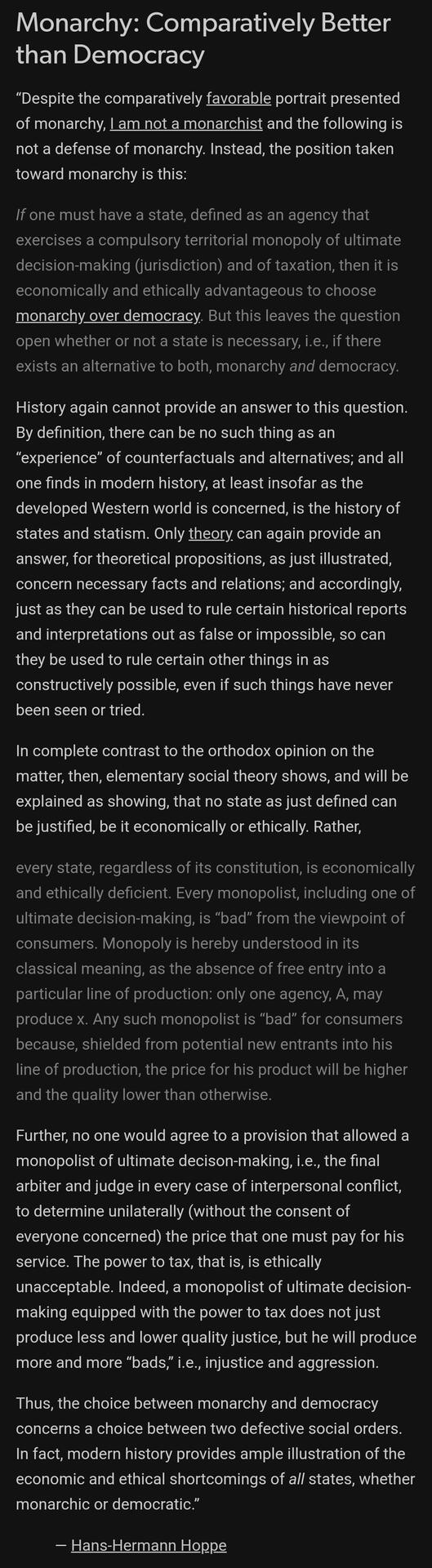
More specifically Hoppe explains the rise of the United States to the rank of the world’s foremost Imperial power, as a consequence of the transformation, from the beginnings of an Aristocratic Republic to a mass Democracy, and the role of the United States as an increasingly arrogant war monger. What stands in the way of peace and civilization is above all the state and democracy.

Calling Austrian Econ & Praxeology nerds & newbs
Conza needs your feedback to help him improve his presentation.
Let's show him that Nostr has a stronger signal than Twatter!
nostr:npub1klkk3vrzme455yh9rl2jshq7rc8dpegj3ndf82c3ks2sk40dxt7qulx3vt
🙏

How does the proposed change/s make Bitcoin a better money?
What monetary properties are being improved?
Is trust reintroduced anywhere?
What are the trade offs?
Are any monetary properties negatively affected?
Does it impact the rivalrous digital commodity ('asset') itself, or the peer to peer electronic cash system ('the network')?
There'll be a longer version (with better slides visuals) soon, so please pipe up with feedback around any concepts or terms that weren't understood or needed further elaboration! Critique away. 👍
📓Bitcoin Maximalism in One Lesson
Alternate titles:
📙Economic literacy in one lesson
📙Why Bitcoin is best
📙Why Bitcoin only
I had a blast putting the very condensed presentation together for Bitcoin Alive.

John Ruddick on Anarcho-Capitalism 👀
https://nostr.build/av/9f19b6c27c9e755869ab3df373517c50af3921a80cc33fb2c7cfbc175f77d746.mp4
He has read at max 2 books on the topic. I know this first hand from him admitting that if he didn't read them before his speech, he'd feel like a fraud. Furthermore, he didn't write the speech.
Make sure to keep those expectations comically low that way you won't get disappointed.
Unfortunately it's worse than that. If he's challenged in an interview and he's the new poster child for libertarianism, will set back the movement considerably.


