
GM! GM! 

Nostr for Normies:
The status quo of most of the internet is that of full-custody, with no way to exit, or a way to participate in the system if you don’t accept its irrevocably custodial nature.
On the other hand we have nostr, which is the upmost self-sovereign system.
But lit comes with the tradeoff of extreme personal responsibility of holding one’s key in an even more challenging way than Bitcoin (you can’t spend your nostr into a new key if your old key becomes compromised)
Binary.
This work introduces a new scheme, with its own tradeoffs, but one that can fill the gap to help onboard the next cohort of nostr users without asking them to jump through too many hoops.
Learning the ropes of a new system is already challenging enough, asking new users to also learn about key management at the point of onboarding them is a very big ask with no clear benefit.
But I don’t want to become a custodian of a bunch of keys! What if we allow ANY provider to become an interoperable custodian and allow people to choose
This is akin to going from a single Wallet of Satoshi to thousands of nostr:npub1uq70uqgas9pyhds2zt57kr9se8rg3s68ztphjnq82ts8rzeknmeql7u0c2
In light of this aim, I’m changing the license of nsecBunker to full MIT (from MIT+CC); I want it to be easy for anyone to offer this service. nostr:note1crl44xk24yc2ym5xlyyfjdeumxueyguzxetseg8r0prqzmqts47sghnmgp
Bravo ser

😁🤙
https://video.nostr.build/587cdbb7da5f2ebb54fd2406930fd18fb335c67471a26155f82ad4555c0622fd.mp4
#Bitcoin #Nostr #Plebs
Fuckin love it 🤣
lol! Alex de Vries. You could make this u- wait….
If you genuinely now believe Bitcoin uses too much water you better be drinking your own piss
Can you even imagine how much water a Tesla gets through? Or a tumble dryer?! Or a porno? I’m amazed we have any water left

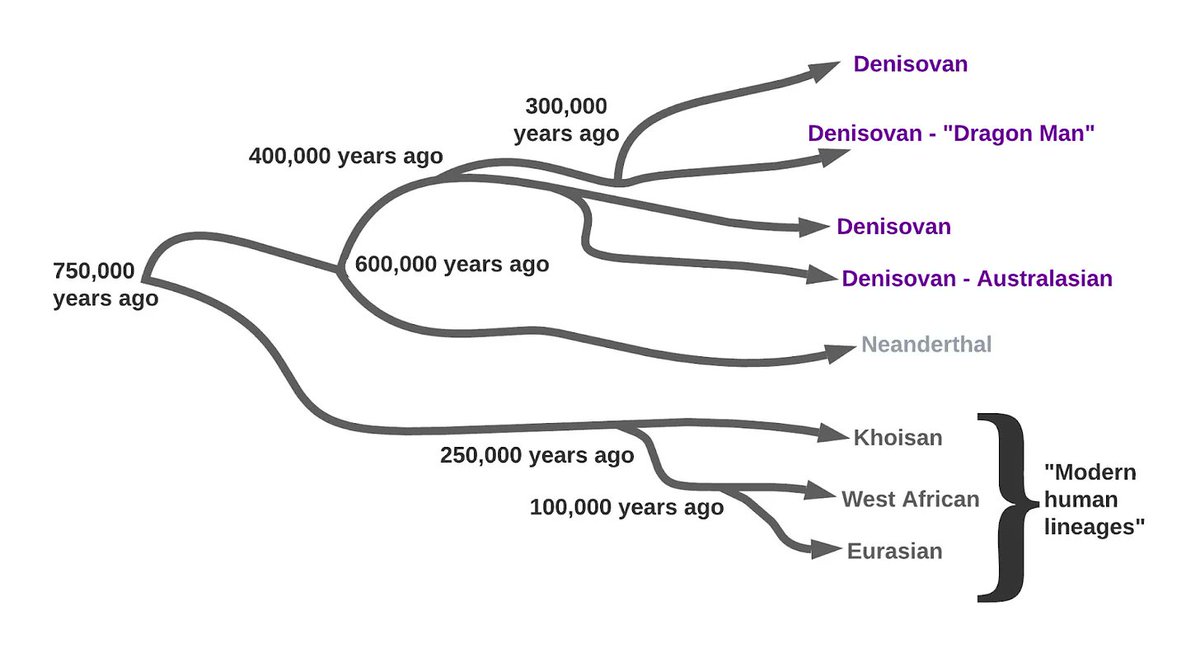
Here be humans https://t.co/0JAxAtOrf5 We're not the man we used to be. Over the last twenty years, genomics, ancient DNA and paleoanthropology have joined forces to completely overhaul our understanding of the origin of our species. The true diversity and complexity of human evolution over the last few hundred millennia surpasses even the most unhinged imaginings we might have hazarded just a short generation ago. But greater clarity has left us with a messier and less elegant narrative. Our species’ status, it turns out, is “complicated.”
In the year 2000, the orthodoxy was that humans spread across the world 60,000 years ago, and were descended exclusively from a small population in Africa. Neanderthals and various other human groups (and yes, we didn’t even deign to give them all names) were evolutionary “dead ends.” Of interest mostly to scholars, they were dismissed as failed experiments in a world our ancestors won. Today, this tidy story of us no longer passes a basic fact check.
In 2010, genomes recovered from ancient remains of “archaic hominins” in Eurasia turned out to have genetic matches in many modern humans. It seems they weren’t quite as “archaic” as we thought. In addition, we had to get used to the new reality that a solid 2-3% of the ancestry of all humans outside Africa is Neanderthal. About 5% of the ancestry of Melanesian groups, like the Papuans of New Guinea, actually comes from a previously unimagined new human lineage discovered in Denisova cave, in Siberia of all places.
Since these first major overhauls, the genetic picture has only grown more complex. Trace, but detectable (0.2% or so), levels of “Denisovan” ancestry are found across South, Southeast, and East Asia (as well as among indigenous people of the Americas). Similarly, trace but detectable levels of Neanderthal ancestry actually appear in most African populations. And, though we have no ancient genomes to make the triumphant ID, a great deal of circumstantial DNA evidence indicates that many African groups harbor silent “archaic” lineages equivalent to Neanderthals and Denisovans. We call them “ghost” populations. We know they’re there in the genomes, but we have no fossils to identify them with.
Even the canonical “Out of Africa“ migration itself has turned out to be less neat and tidy than we thought. Outside Africa, whether you are an indigenous Australian, Amazonian native or a German burgher, fully 90-99% of your ancestry derives from a single ancestral human population pulse 60,000 years ago. Somehow, an isolated African tribe of 1,000 to 10,000 people, who became genetically homogenous due to their initial small population size, swept across Eurasia. By 50,000 years ago, they reached Australia. They had replaced the last Neanderthals and Denisovans by 40,000 years ago, if not earlier. They even migrated to North and South America 15,000 years ago.
But inside of Africa, the story is much richer and still not fully grasped. Many African populations started separating from each other 200,000 years ago, becoming distinct lineages such as Khoisan and West Africans. The emergence of modern humans within the continent was not an explosion, but a gradual evolution of interacting lineages. A slow burn. The ancestors of modern non-Africans were part of this dance, but were isolated at some point for tens of thousands of years, passing through the “great bottleneck.” Where? When? Who knows? We can’t be sure at this point. Best to just come out and admit it: this chapter of the story is still provisional.
“Dragon Man” Skull📷
It’s raining men
And now, one after another, new dramatis personae, mostly ghosts, keep entering stage left, complicating what once seemed our simple soliloquy. In The New York Times, Carl Zimmer reports on a very well-preserved fossil, Discovery of ‘Dragon Man’ Skull in China May Add Species to Human Family Tree. Meanwhile, an Israeli group has a paper out in Science on a human population discovered there which seems to resemble Neanderthals and dates to 120,000 to 140,000 years ago. “Dragon Man” is at least 140,000 years old, and it is a very well preserved skull which exhibits a mixture of “primitive” and “modern” features.
“Dragon Man” reconstruction📷
Because these are brand new finds, there is not yet consensus about these fossils. Some researchers want to call “Dragon Man” Homo longi (龙, pronounced lóng, being Chinese for dragon), a new human species, and assert its features mean it is more closely related to modern humans than Neanderthals. Though Chris Stringer dismisses any bias in the Chinese researchers, I can't help but discern a drive here to establish precedence for China as one of the major hearths of modern humans, perhaps a matter of external pressure from the Xi regime.*
Fascinating thanks for posting
Black Fridays Matter?

I have some beef tenderloin that’s been vacuum sealed in the freezer for 3 years. Still good? nostr:npub1ejvhdkt8ppefezgz0sgnwdqrn8l4z8muws2k8dz2tv0a57ac2z9st56q8x
I’d eat it. Sounds like my freezer actually

A very localised version of cookies


Maybe one day. I suspect most people will use #bitcoin and not even know it is more likely. Bitcoin will run things they have no idea about

Bluey’s dad sets the bar so high. Amazing show, but he makes me look bad, no way I can meet that standard 🤣


And none of them thinks they have enough