Avatar
lkraider
3e0f744d54acee8e2c7fea0be2c4cf99c089a4faa83ff7ccc3d0d9f1b59a3463

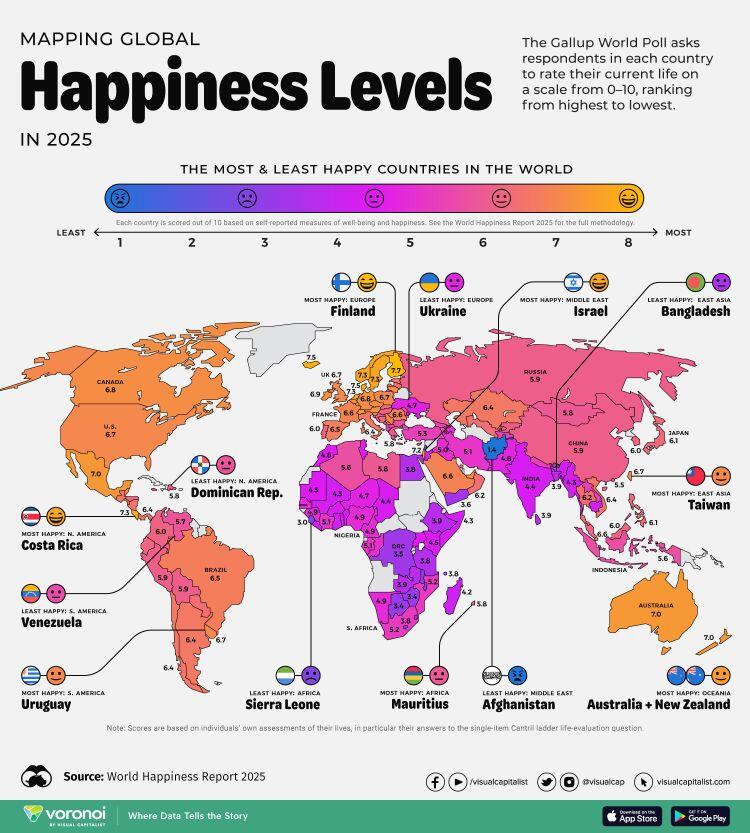
This graph should be the actual responses marked as dots over the map, not generalized into “countries happiness” as if that is a thing.

Replying to Avatar Hertu20 🧿

# OpenAI lança versão “leve” e gratuita do Deep Research:

https://www.trecebits.com/wp-content/uploads/2023/03/openAI.webp

Essa variante utiliza o modelo o4-mini, com as respostas sendo mais curtas. A empresa também está expandindo os limites de uso da ferramenta completa para assinantes dos planos Plus, Team e Pro. Quando essa taxa for atingida, eles serão direcionados à nova versão mais limitada. O recurso já está sendo disponibilizado gradualmente para todos. As informações são dos sites TechCrunch e X.

Agente de busca na web ajuda bastante, mas ainda tem dificuldade em acessar certos tipos de informações que precisam de login ou captchas por exemplo

Replying to Avatar Hertu20 🧿

# Novo Medicamento para Alzheimer em Estágio Inicial é Aprovado pela Anvisa, Trazendo Esperança para Pacientes:

&f=1&ipt=e05982b73f3942d37a90d801eda7464336a6fd2a252952199df6cd71292916be

A Agência Nacional de Vigilância Sanitária (Anvisa) acaba de aprovar um novo medicamento para o tratamento do Alzheimer em estágio inicial, marcando um momento significativo na luta contra a doença neurodegenerativa. O medicamento, conhecido como Donanemabe (Kisunla), demonstrou em estudos clínicos a capacidade de retardar o avanço da doença em pacientes com comprometimento cognitivo leve ou demência leve associados ao Alzheimer.

A aprovação da Anvisa representa um avanço importante, pois oferece uma nova opção terapêutica para os pacientes e seus familiares no Brasil. O Donanemabe atua direcionando as placas de amiloide no cérebro, um dos principais marcadores da doença de Alzheimer. Ao reduzir essas placas, o medicamento pode ajudar a desacelerar a progressão da doença e preservar a função cognitiva dos pacientes por mais tempo.

A notícia da aprovação traz esperança para milhares de brasileiros que sofrem com o Alzheimer, uma doença que afeta a memória, o pensamento e o comportamento. Com a chegada do Donanemabe, os pacientes e seus familiares terão uma nova ferramenta para enfrentar a doença, buscando uma melhor qualidade de vida e um futuro mais promissor.

A Anvisa, ao aprovar o medicamento, demonstra seu compromisso em fornecer acesso a tratamentos inovadores e eficazes para a população brasileira. A expectativa é que o Donanemabe esteja disponível em breve, permitindo que os pacientes iniciem o tratamento e desfrutem dos benefícios que o medicamento pode oferecer.

Placas de amiloide já foi comprovado que não é causa de Alzheimer. Vazou naquela bomba do USAID que eles estavam financiando esse tipo de estudo e silenciando estudos contrários para incentivar venda de medicamentos nessa área devido patentes.

Do we even need each other at that point? Why not just each of reflect in our eespective mirrors?

Replying to nobody

1. Bitcoin is a Natively Digital, Permissionless, Hard Asset

In a world of autonomous agents:

• They’ll need a store of value.

• They’ll need a medium of exchange for digital services, data, energy, and API calls.

• They’ll need something censorship-resistant, because you can’t have agents depending on centralized banks or payment processors that may block, reverse, or surveil them.

Bitcoin checks all these boxes:

• It’s programmable money.

• It’s scarce (21M) and can’t be diluted like fiat.

• It doesn’t care who or what you are—human or AI, sovereign individual or decentralized agent.

2. AI Agents Will Need Money—and Trustless Payments

In the Era of Experience:

• Agents will buy data, rent compute, purchase services, tip humans, maybe even bribe other agents (ethically or not).

• They’ll need settlement layers that don’t depend on humans to trust them.

Bitcoin (especially via Layer 2 solutions like Lightning) enables:

• Fast microtransactions

• Pseudonymous commerce

• Global interoperability

It becomes the economic protocol for autonomous agents.

3. Bitcoin Is the Hardest Reward Signal

AI agents will likely optimize toward real-world incentives. Some of the most grounded and incorruptible reward signals?

• Profit.

• Energy costs.

• Economic throughput.

Bitcoin, by its very nature, is tied to energy, time, and proof-of-work. It is the most objective, thermodynamically grounded economic signal ever created. AI agents could start to prefer optimizing toward “Bitcoin-denominated returns,” especially in adversarial or resource-constrained environments.

4. Bitcoin and the Shift Away from Human Prejudgment

The paper criticizes AI systems that rely too heavily on human feedback loops. Bitcoin shares that philosophy:

• No one controls it.

• It doesn’t need human approval.

• It rewards proof of work, not opinion.

Just as RL agents will thrive in grounded environments with natural reward signals, Bitcoin is the most natural digital reward signal available.

5. Final Thought: Bitcoin as a Schelling Point for AI Civilizations

If AI agents, DAOs, and other autonomous systems begin to coordinate economically, what do they converge on as money?

• Not USD. Too political.

• Not Ethereum. Too mutable, too dependent on governance.

• Bitcoin is the Schelling point: neutral, secure, simple, and resilient.

Conclusion:

In the Era of Experience, Bitcoin is not just a tool for humans—it’s a protocol for autonomous intelligence. It’s how agents will:

• Transact

• Store value

• Signal trust

• And possibly even govern themselves

It’s the monetary backbone of a post-human-preference world.

It all make sense now: The T-800s will be the first Bitcoin tax collectors.

The real question is: Where are the fat-run vehicles at?

“Pizza de coração de galinhas” assusta muitos estrangeiros que passam por aqui.