

That is indeed a very convincing line of thought. If staying anonymous at all cost was the goal, it would not make sense to send the first transaction to your meat space identity but if it was merely to avoid trouble with some patent claims ... plausible deniability might have been the only goal of the Nakamoto persona.

I meant you store the legacy key(s) in a nostr event. After all we trust our crypto. This event of course would be fatal if it went lost but as this could be a special kind, it might get special care on relays.
Get a new 12 words mnemonic M. Generate the master seed. Use m/12'/12' as encryption key for your kind-1212 event where legacy keys get stored.
What the other guy said. The standard should not encode the current keys with mnemonics. 12 words is plenty secure. At least until people start losing their Bitcoins secured by 12 words nostr should not bother using 24 words.
Why? I'm not exactly sure what Custom Designed meant but it sounded to me like you could store old keys encrypted with the new keys. So when migrating to HD mnemonic based key backup, you use a certain key derivation for a symmetric key and then store your old key(s) in a special event but encrypted with the new key. So when you restore from the mnemonic, the client could ask you which of your accounts to use. It could show you mentions of your legacy account even after switching to a new pubkey etc. The client could sign notifications that the legacy key was rolled over to the new key (whichever sub-key currently is active).
12 words over nsec all the time. The problem with nsec is that you really can't handle it well other than by copy/paste and on Android, all the apps have access to your clipboard without extra permissions.


Yeah, I found a hotkey. This TextNote was **not** ready. I repeat, it was **not** ready.
WOW!!! That is crazy!!

WOW!!!! That is crazy!

nostr:npub1gm7tuvr9atc6u7q3gevjfeyfyvmrlul4y67k7u7hcxztz67ceexs078rf6
#negr0art
Cerra un poco los ojos
 #m=image%2Fjpeg&dim=1024x1024&blurhash=UBEV%5DJ%3FwITt8%25g9EITxv%3Fct7ofM_Rjxu-%3Dxv&x=af1fe464754315a55129d71e3952ad71aa4d747a4ae506997af2dd8ab5588c8a
 #m=image%2Fjpeg&dim=1024x1024&blurhash=UEEq5G%3F%5EvLt-Q%5D0fIp%24*PXwHoyJCrZ%3FF%3DswI&x=6cbbd7a7b43a9a3cdd84211aaf48af8f5480ddaa6afe56e6a363edd659f2693e
The former image is very much in your face the avatar while I'd rather travel to the latter place but the latter image is amputating the chin and beard completely. Hmm ... Thanks anyway ;)
I did not get involved when drafting BIP94 but now I wonder why URL is not optional when it might be used for torrents and why there is no filename. The fallback is also not well specked. Is fallback allowed to occur multiple times or may it be `[fallback, fallback1, fallback2, ...]`
TOFU 😁 I was not familiar with "trust on first use" being called that.
I'm very excited about app distribution via nostr. This might be the killer app but then again, the social graph might on its own be the killer feature many tiny baby killer apps build on. Lets make the App Store obsolete!
(followed)
Wild thread about the shenanigans of Barry Silbert and his various companies. This makes me wonder why Grayscale hasn't bled more once cheaper options became available.
https://twitter.com/real_vijay/status/1721385528510251182
The first few of many tweets without links and images:
1/ There was a much more important fraud than SBF's embezzlement that took place in 2022. It was a fraud (allegedly) perpetrated by one of the oldest companies in the space, @DCGco and its CEO, @BarrySilbert
Time for a thread 👇
2/ To fully understand the fraud and its repercussions we have to go back in time to 2013 when Barry Silbert started @Grayscale which offered the first fund that enabled investors to purchase #Bitcoin from their brokerage accounts.
3/ For several years GBTC was the only way for equity market capital to get #Bitcoin exposure and because it was structured as a trust (with no ETF-like redemption mechanism), GBTC traded above its NAV (net asset value) during its early history.
4/ This basically means that the value of the fund on the market was greater than its underlying assets (bitcoins). Equity investors didn't have much choice, so they were willing to pay a premium on GBTC just to get #Bitcoin exposure.
5/ Shares of GBTC were created by giving Grayscale bitcoins and then 6 months later you would receive the equivalent shares of GBTC.
Because GBTC traded at a premium to NAV (over 40% at one point), a very profitable arbitrage ("arb") trade became possible.
6/ You could perform the arbitrage trade by shorting X bitcoins while giving X bitcoins to Grayscale. 6 months later you could cover your short by selling the GBTC (that traded at a premium to the X bitcoins). Farming the premium was called the GBTC premium arbitrage trade.
7/ Several market participants recognized how profitable and ostensibly riskless (since GBTC had always traded at a premium to NAV) this trade was and began piling in. Two such participants: hedge fund Three Arrows Capital (3AC) and lending platform BlockFi (both now bankrupt)
8/ Three Arrows Capital not only farmed the GBTC premium but turbocharged the trade with leverage. It didn’t just use its own capital but borrowed massive amounts of Bitcoin to multiply their returns. But who did they borrow from?
… enter Genesis.
9/ Genesis was one of the portfolio of companies owned by DCG (DCG was a parent company created by Barry Silbert to mimic the corporate structure of Berkshire Hathaway and apply it to the crypto market). Along with Grayscale, Genesis was one of the crown jewels of DCG.
10/ Genesis was the largest, most important, and essentially only prime brokerage service in the crypto market. It had both a trading/derivatives arm (GGT) and a lending arm (GGC), but to outsiders it was just a single entity since they shared office space and even employees.
11/ Genesis sourced bitcoins from Bitcoin holders, large and small, by offering them an interest rate on their bitcoins. It lent those bitcoins out at a higher interest rate and profited on the spread. Who did Genesis lend to?
Three Arrows, BlockFi and Alameda, among others.😵
12/ At this point, it should be noted that DCG directly controlled GGT (Silbert was the chairman of its board from 2013 until July 2022) and GGC via GGT. GGC had no board until June of 2022, when a board was appointed with two out of three members coming from DCG.
13/ There was a massive incentive to encourage Genesis to make bitcoin loans that would be used for the GBTC arbitrage trade because those bitcoins would flow into Grayscale (DCG's other crown jewel) and would then be stuck there (since there was no ETF redemption mechanism)
14/ Once those bitcoins were stuck, Grayscale would collect a fat 2% per year fee for "managing the fund" (essentially doing nothing at all). Currently GBTC has over 620,000 bitcoin meaning Grayscale collects over 12,000 (TWELVE THOUSAND!) bitcoins in fees every year. 😮
...
Who? What? In the Chrome extension, the kind-1 event contains a link to the page commented on but social clients don't show that if not referenced in the content.
In nostr-opinion-plugin the content gets a standard header and footer that won't be shown if you look at the conversation in its context but it is shown by unaware social media clients.
nostr:npub1alpha9l6f7kk08jxfdaxrpqqnd7vwcz6e6cvtattgexjhxr2vrcqk86dsn built a Chrome browser extension that adds a forum to every website on the internet.
It's also open source:
https://github.com/jinglescode/web-content-conversation
Bit-aloo who's working on https://gitlab.com/walletscrutiny/nostr-opinion-plugin just sent me the link. Digging into it to see if there is some synergies or standards to be developed.
I see it only uses kind-1 and kind-7 so far. That is text notes and reactions. With that approach I suspect the anchoring will not be apparent to users of normal social clients that will get to see these apparently lose kind-1 text notes.
Also for our project it would be nice to define something like "replies" to non-nostr stuff.
nostr:npub1alpha9l6f7kk08jxfdaxrpqqnd7vwcz6e6cvtattgexjhxr2vrcqk86dsn built a Chrome browser extension that adds a forum to every website on the internet.
It's also open source:
https://github.com/jinglescode/web-content-conversation
Bit-aloo who's working on https://gitlab.com/walletscrutiny/nostr-opinion-plugin just sent me the link. Digging into it to see if there is some synergies or standards to be developed.
FOMO intensifies ...

On Google phones, the OS won't let you down-grade apps or upgrade them to a version that's signed by a different key. I want this for PWAs. Of course, as admin I want to be able to override it but it would be great to have such a lock-in that no random hacker on a webserver could circumvent.

solving fake apps in app stores
automatic signature and provenance verification over nostr
cc nostr:npub1az9xj85cmxv8e9j9y80lvqp97crsqdu2fpu3srwthd99qfu9qsgstam8y8 nostr:npub1qny3tkh0acurzla8x3zy4nhrjz5zd8l9sy9jys09umwng00manysew95gx
#SOVENG

Details, please! Is this PWA distribution via nostr events? Or is the PWA signature on nostr? What is signed there? I'm very eager to learn for WalletScrutiny where I had PWAs kind of dismissed as impossible to get secure against hacked servers for example.

 #m=image%2Fjpeg&dim=828x620&blurhash=%23lJI97IWx%40jcofoMj%40WCWC%7EqM%7Cocj%5Dofofjtayays%3DWoRQbFjbkBj%5Bj%5BayIDk9afWUjZayofbHj%3FIVofxtafofa%23j%5Bafj%5BR%25t6xsj%5Bj%40j%5Bafj%40juofocWBfjafj%3FaykBj%5B&x=3eb11284b9d59a7d4fbf55d63c57c9e96ba063987bb71ca7ee5f92d2c7734849
 #m=image%2Fjpeg&dim=499x500&blurhash=%7CGJtn%3AM%7BIAR%2Cacxst7SPt7%25g%3FGI%5EM%7Bo%7Do%7Cxts%3Bay_4tmR5RQRjS5R*s%3AbItlD%25%25MtRR%3AM%7BM%7DtRayyZ-4xZo%7DjEM%7CM%7Ct7NGQ%2Cx%5Bt7xZoexZkDR%2BkCI%3AS5Neofaxxtt5ofs%2Cx%5DVrRQSPt6s.xuj%5Bt6IUR%2BozoJS5t7RkRjjE&x=3b2223cbef70ec616f2d91c6ff68fd359666865a808d0ef85ea80ea2584b25d9
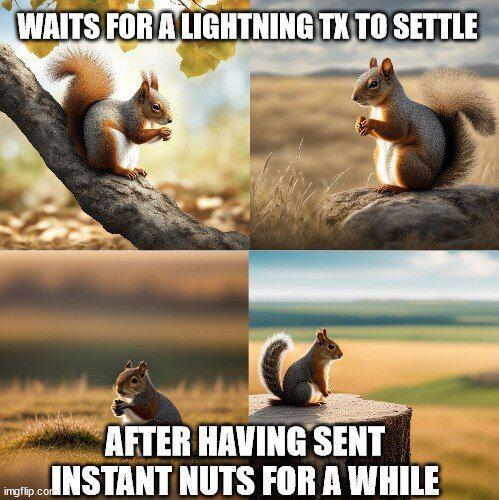
As the Chaumian tokens also need a settlement step, involving the mint, they should not be faster than single-hop LN payments. Sure, for donations it's nice the tokens can slumber in some inbox without the recipient knowing but that's the same with on-chain transactions. An on-chain gift I can treat as an instant payment from seeing the validly signed transaction.