

Give up the caffeine entirely and sleep like a baby. 71 days free of caff and I'm loving it. Coke Zero is poison, yuck.
Spurgeon's Faith's Checkbook (June 7th)
The Safest Place
And I give unto them eternal life; and they shall never perish, neither shall any man pluck them out of my hand. — John 10:28
We believe in the eternal security of the saints. First, because they are Christ's, and He will never lose the sheep which He has bought with His blood, and received of His Father.
Next, because He gives them eternal life, and if it be eternal, well then, it is eternal, and there can be no end to it, unless there can be an end to hell, and Heaven, and God. If spiritual life can die out, it is manifestly not eternal life, but temporary life. But the Lord speaks of eternal life, and that effectually shuts out the possibility of an end.
Observe, further, that the Lord expressly says, "They shall never perish." As long as words have a meaning, this secures believers from perishing. The most obstinate unbelief cannot force this meaning out of this sentence.
Then, to make the matter complete, He declares that His people are in His hand, and He defies all their enemies to pluck them out of it. Surely it is a thing impossible even for the fiend of hell. We must be safe in the grasp of an Almighty Saviour.
Be it ours to dismiss carnal fear as well as carnal confidence, and rest peacefully in the hollow of the Redeemer's hand.
Do not fret because of evildoers,
Nor be envious of the workers of iniquity.
For they shall soon be cut down like the grass,
And wither as the green herb.
Trust in the Lord & do good;
Dwell in the land & feed on His faithfulness (Ps. 37:1-3)
Thus says the Lord, “Let not a wise man boast of his wisdom, and let not the mighty man boast of his might, let not a rich man boast of his riches; but let him who boasts boast of this, that he understands and knows Me, that I am the Lord who exercises lovingkindness, justice and righteousness on earth; for I delight in these things,” declares the Lord.
— Jeremiah 9:23-24


“Sodomy was a criminal offense at common law and was forbidden by the laws of the original 13 States when they ratified the Bill of Rights. In 1868, when the Fourteenth Amendment was ratified, all but 5 of the 37 States in the Union had criminal sodomy laws. In fact, until 1961, all 50 States outlawed sodomy…”
-Justice Antonin Scalia, Lawrence v. Texas #pride
I was enjoying The Chosen, but not anymore. They are apparently all aboard the #pride train to hell. https://twitter.com/JonnyRoot_/status/1664300256803323904 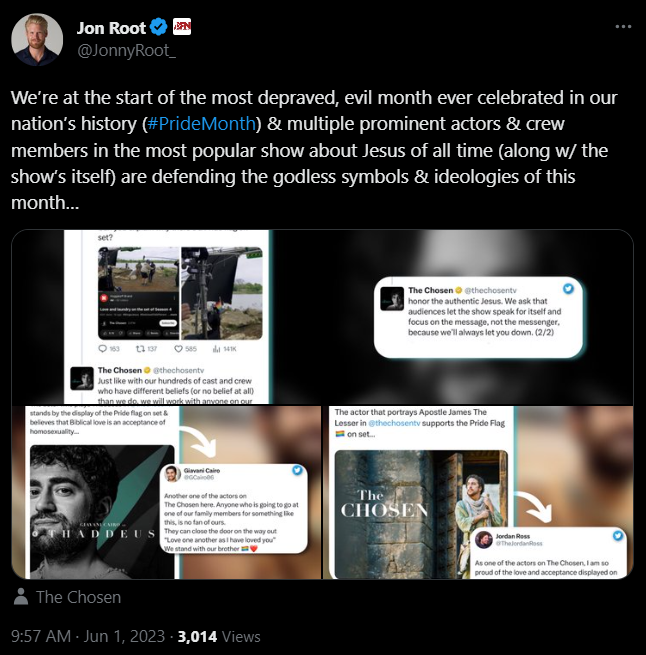
Happy first day of Romans 1 appreciation month!
"Therefore God gave them over in the lusts of their hearts to impurity, so that their bodies would be dishonored among them. For they exchanged the truth of God for a lie, and worshiped and served the creature rather than the Creator, who is blessed forever. Amen. For this reason God gave them over to dishonorable passions; for their females exchanged the natural function for that which is unnatural, and in the same way also the males abandoned the natural function of the female and burned in their desire toward one another, males with males committing indecent acts and receiving in their own persons the due penalty of their error." #pride
“Pride goes before destruction, and a haughty spirit before stumbling.” (Proverbs 16:18) #bible #pride
65 days caffeine free!
New article in the local paper by my pastor: Individual callings should be valued.
"Is there a calling on your life?
In my own denominational setting, that question is about two things specifically. Do you feel drawn in some way to pastoral ministry, or do you sense that God is calling you to be a foreign missionary? When Southern Baptists talk about being “called” that’s generally what we mean, and I wish we’d stop it.
I wish we’d expand our vision. Full time Gospel ministry is a thing that God calls people to. But that’s uncommon. What about all the rest of the folks? Has God not called them?
Of course. But here’s the rub, said plainly so that all the right people will know they should be offended: The reason we don’t focus on that wider calling is that it doesn’t tend to benefit our church organizations directly.
If a woman feels called to doctor animals as a veterinarian, that’s great. But we are more excited about the woman who feels called to tend the nursery on Sunday morning. We value the Bible study leader more than we do the carpenter, the lawyer, or the restaurant owner.
In the Declaration of Independence there is a famous list of Creator-given rights. The last one is “the pursuit of happiness.” I did some digging about that phrase years ago and found that it wasn’t original with Thomas Jefferson, but was an idea that was in current discussion, and it had a particular meaning.
We assume it refers to a right to do what we think will make us happy. But, to the writers who used it, the phrase had to do with individuals pursuing their callings under God without hindrance or interference. It meant doing what you were made to do, and the thinking was that if you’re pursuing this wholeheartedly, then everyone benefits. The community will be blessed with a great vet; a competent carpenter; or, a wonderful, new restaurant.
Raising children is a calling. Providing for your family is a calling. Moreover, they are noble pursuits, not to be despised. In fact, the encouragement of the New Testament is to see our everyday activities as service devoted, first, to the Lord.
We, the churchy people, tend to pressure young folks toward more religious work, service directly to the church. We do this with no regard to their individual gifts and talents. We do this without bothering to listen to them as they say what excites them, what they’re interested in pursuing. Then we sit back and wonder how the young ones conclude that church is irrelevant to their lives.
I’m at war with the idea that the church exists as a thing to be served. Christians should seek to out-do one another in service to their brethren and neighbors, sure. But when we see the organization itself as the beneficiary of all the labors of her people, we’ve completely reversed the New Testament order.
The church exists to train up her individual members, so that each one will do what God has called them to do, which benefits the whole community, whatever that individual calling may be. In the end, God is glorified. If this strikes you as a foreign concept, you might take a slow read through Ephesians 4.
Gordan Runyan is the pastor of Immanuel Baptist Church in Tucumcari." https://www.qcsunonline.com/story/2023/05/31/opinion/individual-callings-should-be-valued/24811.html

Please let me know what you think! Sproul died in 2017, the same year I was converted.
Have you ever heard any studies from R. C. Sproul? His Holiness of God series is fantastic https://www.youtube.com/playlist?list=PL30acyfm60fVpGc7Eo--3S6w1kdhXY9Cb
Do not love the world nor the things in the world. If anyone loves the world, the love of the Father is not in him.
— 1 John 2:15
For He rescued us from the domain of darkness, and transferred us to the kingdom of His beloved Son, in whom we have redemption, the forgiveness of sins.
— Colossians 1:13-14

Spurgeon's Faith's Checkbook (May 26th)
Commonest Things Blessed
Ye shall serve the Lord your God, and he shall bless thy bread, and thy water — Exodus 23:25
What a promise is this! To serve God is in itself a high delight. But what an added privilege to have the blessing of the Lord resting upon us in all things! Our commonest things become blessed when we ourselves are consecrated to the Lord. Our Lord Jesus took bread and blessed it; behold, we also eat of blessed bread. Jesus blessed water and made it wine: the water which we drink is far better to us than any of the wine with which men make merry; every drop has a benediction in it. The divine blessing is on the man of God in everything, and it shall abide with him at every time.
What if we have only bread and water! Yet it is blessed bread and water. Bread and water we shall have. That is implied, for it must be there for God to bless it. "Thy bread shall be given thee, and thy waters shall be sure." With God at our table, we not only ask a blessing, but we have one. It is not only at the altar but at the table that He blesses us. He serves those well who serve Him well. This table-blessing is not of debt, but of grace. Indeed, there is a troubled grace; He grants us grace to serve Him, by His grace feeds us with bread, and then in His grace blesses it.


VJL8G9m2Lgajw2hVFsXznqUFZRLTXsjsqd8vzSLFWrnN4qbE1GBwH9AqfYRvLZEHo76CCPEuKm7FDPUW
Now to the one who works, his wage is not credited as a favor, but as what is due. But to the one who does not work, but believes in Him who justifies the ungodly, his faith is credited as righteousness, just as David also speaks of the blessing on the man to whom God credits righteousness apart from works:
“Blessed are those whose lawless deeds have been forgiven,
And whose sins have been covered.
“Blessed is the man whose sin the Lord will not take into account.”
— Romans 4:4-8