

Any update on this? It's starting to become a real problem these day... One spam message even snuck by me and got approved already, and I need a way to spam it or delete it now!

That's perfect. Comedy gold!

It should be really easy to introduce yourself to Michael Buble... Just waltz up and say, "Pardon my intrusion, but I just haven't met you yet..."
We mined Bitcoin in space, how hard can mining on a seastead be?

In April 2018, some bitcoiners got together and sent up a solar-powered bitcoin miner onto a high-altitude weather balloon. Long story short: It worked, we've mined bitcoin in some of the toughest conditions imaginable already. Here's the deets on that fun part of Bitcoin history: https://www.inverse.com/article/44315-miner-one-bitcoin-space
What's more is that the year before, right in the middle of the Blocksize War, Core developer Peter Todd made a great series of tweets demonstrating that space mining would be inevitable: https://petertodd.org/2017/bitcoin-mining-space-hard-sci-fi
What's really eye-opening here is that in both space and on a Seastead, bitcoin solves the problem of teleporting stranded energy. A huge solar array would be useless in space if there was no power cable hanging down from it to the earth's surface... But mining bitcoin up there can simply beam down the 'digital energy,' as Michael Saylor would call it. The same would happen on a seastead. Any energy we generate out there wouldn't be stranded.
Don't get me wrong, I'm no huge fan of solar panels... They're expensive, not particularly cost-effective, impossible to recycle, made out of expensive rare-earth materials that keep kids in africa laboring around the clock, etc... But one solar advantage a seastead has is PLENTY of 'real estate' around it. Just put your 6 million or so panels on floaties and you can have all the room you want to deploy them out there, for free! Hard to beat free real estate.

I agree, but that's going to take some kind of event showcasing lightning that is so big that the MSM can't afford to ignore it. Hard to imagine what that would be, exactly... Maybe something like the Canadian trucker protests where the protestors win using lightning somehow.

One of the most unexpected things about living in Hawaii is the presence of feral chicken EVERYWHERE 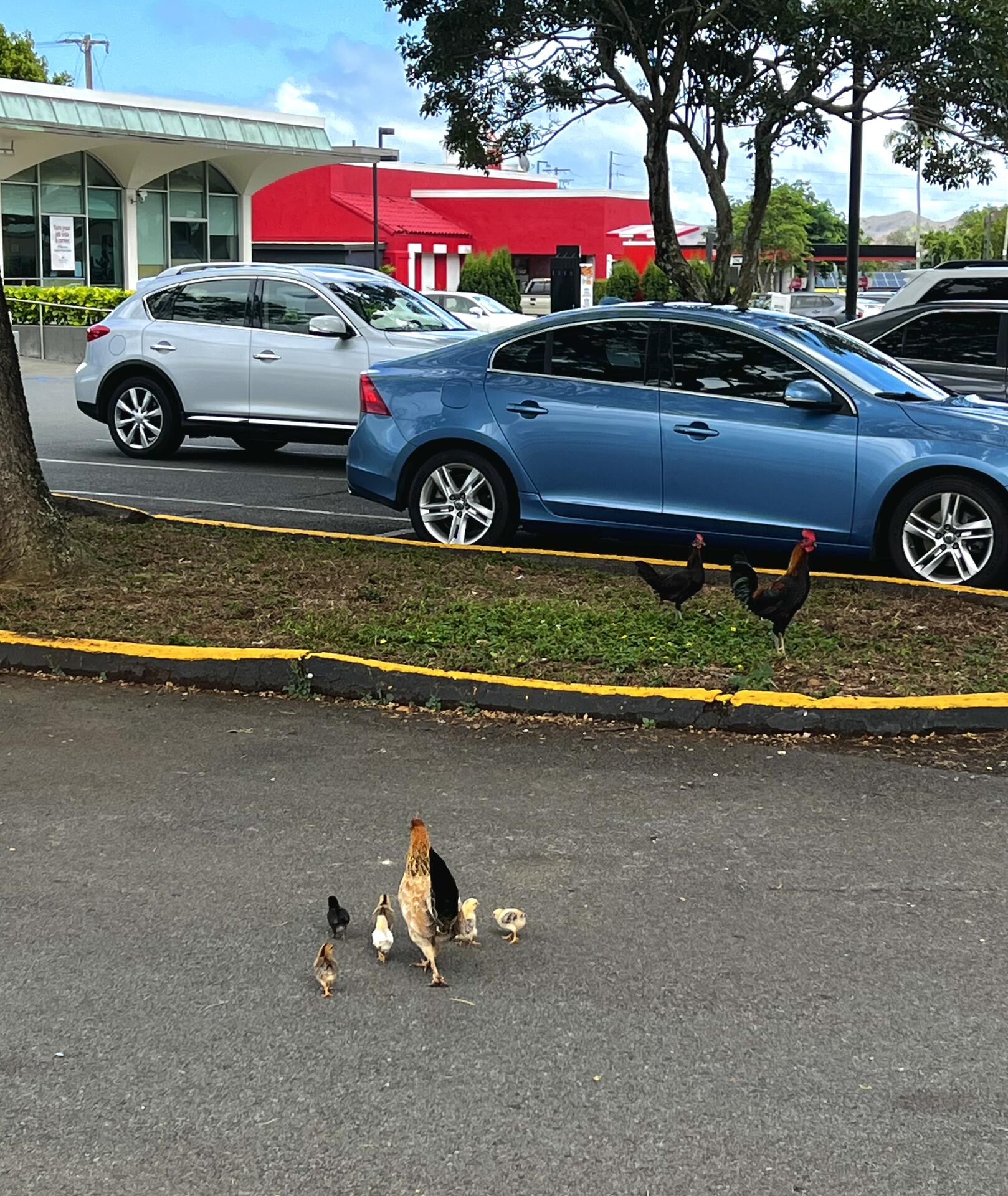
Good, Hawaiians will need the free food source soon the way that government is destroying the economy and infrastructure there. :(
ProTip: When deciding if you want to use any new client or online service, including Nostr clients, you'll be safest if you only use the ones with the most advanced features... Scammers don't have the time or expertise to make the best new software just to scam you with, they basically just copy existing code and change the output addresses at most.

As the universe's foremost expert on this subject, (ok, so we all have about the same level of knowledge on it) my professional opinion is that there are no such things as ghosts so no & N/A.
But if there were, then they'd definitely be haunting the place that they died. Who is born in haunted houses?



Waste management cycles on a Seastead
Seasteaders will be, by necessity, pioneers in the recycling space. You can't just throw everything overboard when you're done with it, and we'll need lots of raw materials to make stuff out of. Below are the major recycling efforts we'll need to incorporate in our quest for sustainable deep-water living.
Liquid waste -
Luxury yachts and cruise lines have long had to deal with the problem of liquid waste management, splitting the job into 3 subsystems. They typically set out with a full tank of fresh water, and empty tanks that are nearly as large for "grey water" and "black water" as well.
Some types of water usage, such as kitchen faucets, turns into grey water, and that goes to fill up or flush toilets, which then goes to black water. Ultimately, the black water is flushed in the deep sea and we let nature scrub it back into clean water again over millennia.
For more on that subject, check out the Seasteading Institute's "Where does the poop go" FAQ video:
https://www.youtube.com/watch?v=Gd2FCpU5wu8
This is established technology & wouldn't change much on a seastead, but we have other waste to consider than just what goes through our pipes.
Solid wastes -
All of our trash, down to every last banana peel, scrap of metal & plastic bottlecap, it all needs to be accounted for out in the deep because there is no junkyard. For decades seasteaders have been looking for an acceptable solution to deepsea trash recycling but it seems hopeless when we consider how bad the problem with trash & recycling is even on land today. Basically, just 9% of all the plastics you throw into a recycling big can be recycled at all!
https://www.youtube.com/watch?v=5-quksK76Rw
Plastic waste -
Thankfully, a couple of very interesting new developments are in testing these days. Chemically they do work, but the only question is if they are going to be practical to use at scale.
The first has already been highlighted in this short video by the seasteading institute: Recycle waste plastics into building materials for seasteaders:
https://www.youtube.com/watch?v=t02KFwHDeKs
There is much promise here for creating a concrete replacement, because the process isn't as energy intensive as a recycling plant typically is.
The second new development is even more useful; convert waste plastics into a hydrocarbon biofuel! Aduro Clean is one publicly-traded company that claims it can do exactly that: https://adurocleantech.com
If this process is perfected then such biofuel would naturally become a major source of energy generation on most seasteads.
However, now that 3D printers are common, I personally feel that the technology which most quickly takes us from an empty coke bottle to a printer filament spool will be the one we most need to pursue. Making biofuel out of our waste plastic wouldn't be an unwelcome use case, but creating just about every physical object we need would surely trump that usage by far.
Organic waste -
Most biological waste like banana peels, eggshells, paper & coffee grinds will have no trouble finding a home in compost bins, which then, with the help of a few worms, become soil for seasteaders to use in gardening. Naturally a lot of our solid waste from toilets can go in here too, but no one is going to want to live nearby that compost center! An air-tight system for composting stinky trash would be a great advancement we could make for a seastead.
Metal waste -
Finally, recycling metal waste would obviously need some kind of a smelting center. It would be great to see a seastead melt this stuff down and create new spars out of all waste metals out in the deep, but that process is extremely energy intensive, on par with all of the energy a large OTEC plant could produce!
Most likely, for the first 100 years or so, our metal waste would either get batched & sold to passing barges that recycle them on land, or simply dumped out in the deep. We've lost a few steel-hulled ships down there over the centuries already, so we're pretty sure the fallout is minimal from that choice.
How do we power a seastead?
Deep-sea colonies will need lots of power, & the more varied the sources of energy, the better. But some types aren't useful or even possible on such a colony, so I thought it'd be a good time to look at each of them and give them each a grade.
~~~
1. OTEC (Ocean Thermal Energy Conversion) ~ A ~ Creating electricity from the difference between deep-sea frozen water and surface water is as good as it gets. The benefits here are amazing, such as it being totally free and infinite in supply, but the problem is that there is still a lot of investment to be made in the technology before it is scaled up enough to become useful.
OTEC would be ideal for bitcoin miners at sea too, doing double-duty generating energy while cooling chips. Such a plant does require a large operation, so any OTEC plant would be on the municipal scale, providing lots of energy to the whole seastead 24/7.
~~~
2. Solar (Photovoltaic panels) ~ B ~ Sunlight is super-plentiful at any seastead's latitude, and PV panels are excellent for small-scale power generation on each home. Of course they can't provide much power at night, so its product should be thought of supplemental, decentralized energy. For some homes with a battery bank, they may indeed produce all the juice the owner needs... Assuming the up-front investment is affordable.
While it is notoriously hard to recycle a PV panel, they can eventually be manufactured at sea! They are made of a mix of both common & rare minerals. Making the glass at sea is a breeze, and the ocean floor is full of sand to do that with. The more rare elements are all hopefully found in Manganese Nodules, so large seasteads that mine the seafloor may very well be able to create PV panels eventually on the float!
~~~
3. Petro (oil refining) ~ B- ~ Despite the extreme advancements in oil refining and ginny technology, & the ease of purchase from pretty much any country worldwide, environmentalists will have a hissy fit & declare any seastead using oil a major source of pollution at sea. What's ironic is that most boats at sea still do use petro... And oil can be plentifully mined in many regions as well. This option would likely come with a hefty political price tag though.
~~~
4. Wind (Windmill generators) ~ C ~ Wind is less plentiful and less predictable than sunlight where seasteads reside, but windmills on each household could be useful as backup power. Larger windfarms probably won't be profitable down in the tropics so this could never be a full solution.
~~~
5. Wave motion bouy generators ~ D ~ Similarly, waves are just too small where we plan to park our houses. The better the location for a seastead, the smaller the waves, therefore the less useful this power generation source becomes. - But if anyone loves huge waves and wants to live in the north Atlantic, this is your go-to power source!
~~~
6. Nuclear Fission plant ~ F ~ Nukes are small enough now, but very expensive & full of problems for seasteaders... Not only does it give nations a reason to attack us, (because our power plant can be converted into a dirty bomb) but who is going to sell us the Uranium pellets? They aren't mined at sea, last I checked.
~~~
7. Hydro Dam power ~ F ~ You'd think with all that water we could move a turbine or two, but no one's figured out how to dam up the ocean yet. ;)
~~~
8. Geothermal plant ~ F ~ There are undersea volcanoes that we could tap into like a land geothermal plant, but the heat is so far away from us that it would take a very complex geo plant at the seafloor and then the seastead would have to be tethered to that with wires in order to bring the power up to us. This is simply not going to be viable.
~~~
9. Nuclear Fusion plant ~ F- ~ Oh come on now, this isn't even working well at CERN yet, I doubt we'll get it on a seastead in the next 150 years...
~~~
Seems obvious to me we'll be using a blend of OTEC & solar panels. Did I miss anything?

You mean kill the slavers? Killing the known slaves would not exactly be a voluntaryist thing to do.
Challenge for Seasteaders: What about the slavers?
Not every problem Seasteaders have to face will be adventuresome & optimistic. So far there has been very little talk about the depressing but unavoidable issue of slavery.
There are no less than 50 million people living as forced slaves around the world today.
https://www.youtube.com/watch?v=30PhwyPUVBQ
China has millions of actual cotton-picking slaves forced to work for their fashion industry. Human trafficking for various types of labor is rampant across the middle east. India & Southeast Asia have unknown millions of kidnapped, forced slaves doing "pig butchering" scams via social media. Many industries such as fishing see slaves in great numbers on the high seas, kidnapping tourists and never letting them see the shore again. Then let's not forget the sex slave trade these days, especially for children.
Overall, slavery as an industry is thriving. In the year 1800, less than 1 million people were enslaved in the USA. There were about 890,000 Africans at the height of that practice from best estimates. Today we're at literally 56 Times that... And don't even get me started about the similar crime of all governments enslaving their citizens in some lesser way.
Why is this an issue for Seasteaders?
All types of human traffickers survive by bribing officials to look the other way. A jurisdictional hunt for corruption. Without the help of the very regulators that are supposed to be busting them, they'd die out or be forced to move quickly.
Once some new type of land exists that doesn't even have regulators, that'll sound like paradise for slavers! The same lax libertarian rules that would allow drugs, casinos, and medical tourism could easily allow them to bring their slaves to us and build up the seastead on the backs of these slaves in the hopes that they can stop moving around now and run their slave empires happily ever after among us.
How are we, as a free, anarchic society, going to discourage or stop slavers from making our colonies their home? Slavery is, after all, the greatest possible violation of the Non Aggression Principle and is the opposite of everything that Voluntaryism stands for.
I am still looking for the best strategy here, but so far I see a 2-pronged approach to fighting slavery. The first is having an actual immigration policy for any new seastead. For the early years, the colony would need to exist on an invite-only residency basis to ensure that Voluntaryism thrives and becomes a bedrock of society. Nobody would be invited to join the seastead that doesn't consider themselves a Voluntaryist.
The second prong is our form of law. Yes, you can have a private law system and we already do, in many places.
https://www.youtube.com/watch?v=A8pcb4xyCic
No AnarchoCapitalist court could possibly recognize the slaver's claims of property, and any kind of Assurance service would drop a slavemaster as a customer automatically upon finding out their real business structure. So put simply, we make it so that slavers will find our colony useless because our laws & culture are both naturally opposed to their business model.
Do you guys have any more specific ideas/thoughts on the matter? It's important that we have this issue solved before launching a platform or our good reputation could be tarnished from the start.
Seastead Governance, or lack thereof
A seastead floating outside of all countries' sovereign waters is a platform to do something truly amazing on: To try out new forms of governance, which you obviously can't do in your home country.
There could be Anarchist seasteads, conservative seasteads, communists seasteads, techno-utopian seasteads, AI-run seasteads, whatever system the world would like to try, I truly do hope to see their ideas 'floated' one day... Just as long as the colonists are free to come and go as they please. May the best system win!
If this concept isn't obvious to you already, I suggest watching "How Seasteads improve government" from the seasteading institute:
https://www.youtube.com/watch?v=QUJmaFc6lIM
For 15 years I've been studying how a fully AnarchoCapitalist society would function, and especially on a seastead, where certain systems & decisions like pirate defense & city planning would obviously fall into 'the commons.' These things need to be paid for by most colonists, but only by privatizing every service mankind has ever included in government can a fully AnCap seastead have a chance to thrive. Paying for them has always created a challenge without taxation.
There is no way to know which recipe for society is the best approach without lots of trial and error, but I'd really like to see two particular anarchy-based approaches to these commons problems attempted:
1) The HOA approach - Have everyone on the seastead pay a monthly fee that funds the commons projects. Yes, Home Owners Associations can feel like a government with taxation, but at the core, they are very different because the contract to join a HOA is voluntary. Obviously, this is not so with governments. Your HOA contract can be very specific in how much you pay and exactly what you get for that. Don't pay your fee? Detach your home.
2) The Assurance approach - Assurance, a specific form (or reboot) of libertarian Insurance, is a financial product that everyone could buy to protect themselves, their property, and their credit record from anything bad happening to them. It assures individuals that if X happens to you, you get paid Y, & exactly how arbitration would be carried out during a dispute. These products can get very bulky, but would actually solve a lot more problems in society than a simple 'commons funding' device.
I imagine a great seastead could take both approaches, but neither side be so large as to be oppressive or absolutely required to live a healthy life there. A balance would have to be struck.
Some systems, such as a shared, large power generation system (OTEC or Nuke) would be fully privatized as most things are and they themselves would have a technician install the lines (in pipes underneath the streets?) to service customers directly. Others, like fire fighters or defense from external threats seem like they'd be easier to fund as a required service in a HOA, but in fact may work just fine as a totally voluntary service that every colonist can choose to subscribe to. Private firefighters have proven this model to work even in the USA already.
And as for city planning, I imagine that whomever funds the initial seastead will have some plans of their own that they'd like to try, like a billion dollar game of SimCity.
How would you design your seastead's governance plan?
The 2019 Seastead Launch - Bitcoiners Chad and Nadia versus the Thai Navy
Bitcoiners have long been avid seasteaders, but did you know that the first real attempt at a seastead was launched on the 10th anniversary of the bitcoin Genesis block?
Chad Elwartowski (@elwar) and Nadia Summergirl were outspoken bitcoiners that launched the first actual seastead (a house with a spar underneath) off the coast of Phuket, Thailand in January 2019. That year was a wild ride for seasteaders ending in the Thai Navy destroying their new home. Thankfully we learned a lot as the Seasteading Institute made the following great 7-part documentary series about it.
Part I: Facing the Storm
https://www.youtube.com/watch?v=tTXhgcXA1pM
Part II: Raising the Spar
https://www.youtube.com/watch?v=c83TiSJ6sfA
Part III: Lifting the Stead
https://www.youtube.com/watch?v=cFnrjbgLORI
Part IV: Living the Life
https://www.youtube.com/watch?v=8bceePdFruU
(They skipped episode #5 for some reason)
Part VI: Fleeing the Death Threat
https://www.youtube.com/watch?v=OovkeOuZsqU
Part VII: Spotted, Chased by Helicopter
https://www.youtube.com/watch?v=U8KVlk7uN0o
Part VIII: Today is D-Day for the Thai Navy
https://www.youtube.com/watch?v=WYgy88-HI8I
Despite talk of a penalty of death, today Chad & Nadia are alive and well in Panama, still working with Ocean Builders, last I heard. I'm hoping to get Chad in here to do an update soon.
So what have we learned from this attempt? Besides the obvious engineering elements that were tested to work, I believe that it mainly serves as a reminder how ruthless and belligerent governments often are. We should never take for granted that any sovereign state will be OK with our presence, even 1000 miles out at sea.
I'm thinking around a billion in today's dollars, but I've got pretty high standards for comfort. ;)
One of my posts is about fundraising, there's some more clues in there.
That sounds like a fun way to get some maritime experience, but keep in mind this has nothing to do with seasteading. Boats are not optimized for life at sea at all, they are optimized to move through it.
ArkPad making impressive progress
Unlike so many other Seasteading projects throughout the years that have vision but never get around to doing actual building, ArkPad, based in the Philippines, is publishing videos constantly of their many workers putting together a platform that they claim is built to 'Last 100 years.'
Today's video was them taking a completed Spar out of it's cast:
https://www.youtube.com/watch?v=BT000emsPnI
They've recently showed us a few other systems being constructed, including framework and cement work for the platform:
https://www.youtube.com/watch?v=0oCvHIDZpt4
Full of CGI models, the following video reveals a lot about their production plans, centering around a modular commercial product model called the ArkPad-C. (C for Coastal waters, on which they expect both homes and hotels to be built.)
https://www.youtube.com/watch?v=CGh09peGRJU
While new & as yet unproven, it is very encouraging to see a modular system being worked on. If these things prove sturdy and don't cost more than a small family home, we could indeed using a bunch of these ArkPad platforms together one day to link together to form the first community at sea.
Oh, they're not great dudes, I agree. They've got their hands in more pies than the public knows about, of course. But this thread started because you argued that Govt isn't our ultimate enemy. It absolutely is the top dog, but I'll grant you that the Fed would be a major hurdle in the way, one of it's toughest enforcers.
I'm trying to spell it out for you that the Fed has no power without the govt they leech off of. In our case congress could repeal the dollar and they'd be out of a job. And you know very well how the fed didn't even exist before congress passed that act in 1913. So of course the power flows from them; they could undo the act and use congressionally-issued money like we had before 1913 again.
When you get right down to it, all evil comes from exactly one source: The belief in Authority. The power everyone gives to authority by believing authority must exist. That's the only final boss we face on planet earth.
I agree the fed has too much power but they really only have that power thanks to the government that extends it to them. Do you think the fed could survive an Anarchy?