

Do any nostr clients let you disable profile styling outside of your web of trust? 🤔
Claude 3.5... 👌🏻
----
I understand your frustration. It can be really annoying when you want to remove something you've posted but don't have an easy way to do so. You're certainly not alone in wanting this feature.
The lack of a simple deletion option in many Nostr clients stems from a few key factors:
1. Technical challenges: In a decentralized system like Nostr, truly deleting a message across all relays is very difficult.
2. Design philosophy: Some developers believe strongly in data permanence and resist adding deletion features.
3. Early stage of development: Nostr is still evolving, and not all desired features have been implemented yet.
However, your desire to control your own content is totally valid. Some potential workarounds, though not perfect, include:
1. Using clients that support "deletion events" - these don't truly delete messages but can hide them in compatible apps.
2. Being cautious about what you post initially, knowing it may be difficult to remove.
3. Providing feedback to Nostr developers and client creators about the importance of this feature to you as a user.
If you're comfortable sharing, I'm curious - what specific situation made you want to delete messages? Understanding use cases like yours can help inform future development priorities.
Deletion is censorship. Which one do you want?

Deleting things is just going to cause people to pay more attention to them. No one needs "undeletion skills", just a client that makes it easy. It's more efficient to find posts by deleted status than to find ones with sensitive content.
> Always be skeptical of those around you in this space, chances are big that they’re not your friends. Doubt everyone and everything! Don’t trust, verify !
Unfortunately this is true everywhere, all the time. There is some hope in that nostr is a protocol that we can reason about, and it's simple one, so we can write our own clients. There's too much money floating around the ecosystem, but there isn't an easy way to fix that. I'm more concerned with the recent push for privacy, as there aren't easy solutions. If you want a censorship resistant way to say something to everyone, it should be obvious that there can't be a way to take your words back. People want something "better", "faster", more efficient than tor, without realizing that the reason tor is slow and difficult to use is because it provides field tested, actual privacy. Software is about finding a balance between technical design constraints that are usually complex, and privacy and security are further complicated by the sophistication of offensive techniques. No one can have their cake and eat it too. We've all gotten very comfortable trading our privacy and independence for ergonomics, reliability, and cost. To take them back will require a frontier mindset, and that isn't a life that everyone wants.
I hope to see you back, whatever name you go by next.
#HTP nostr:note1m28mf9gf3m0uddd6wgzt0qa73zkj32xjumve2m0tfanw5ty5e0aqvmzg99
What! Who's blind. I'm a card carrying... it's here somewhere... overstuffed Dad Wallet... here it... no, that's Costco...

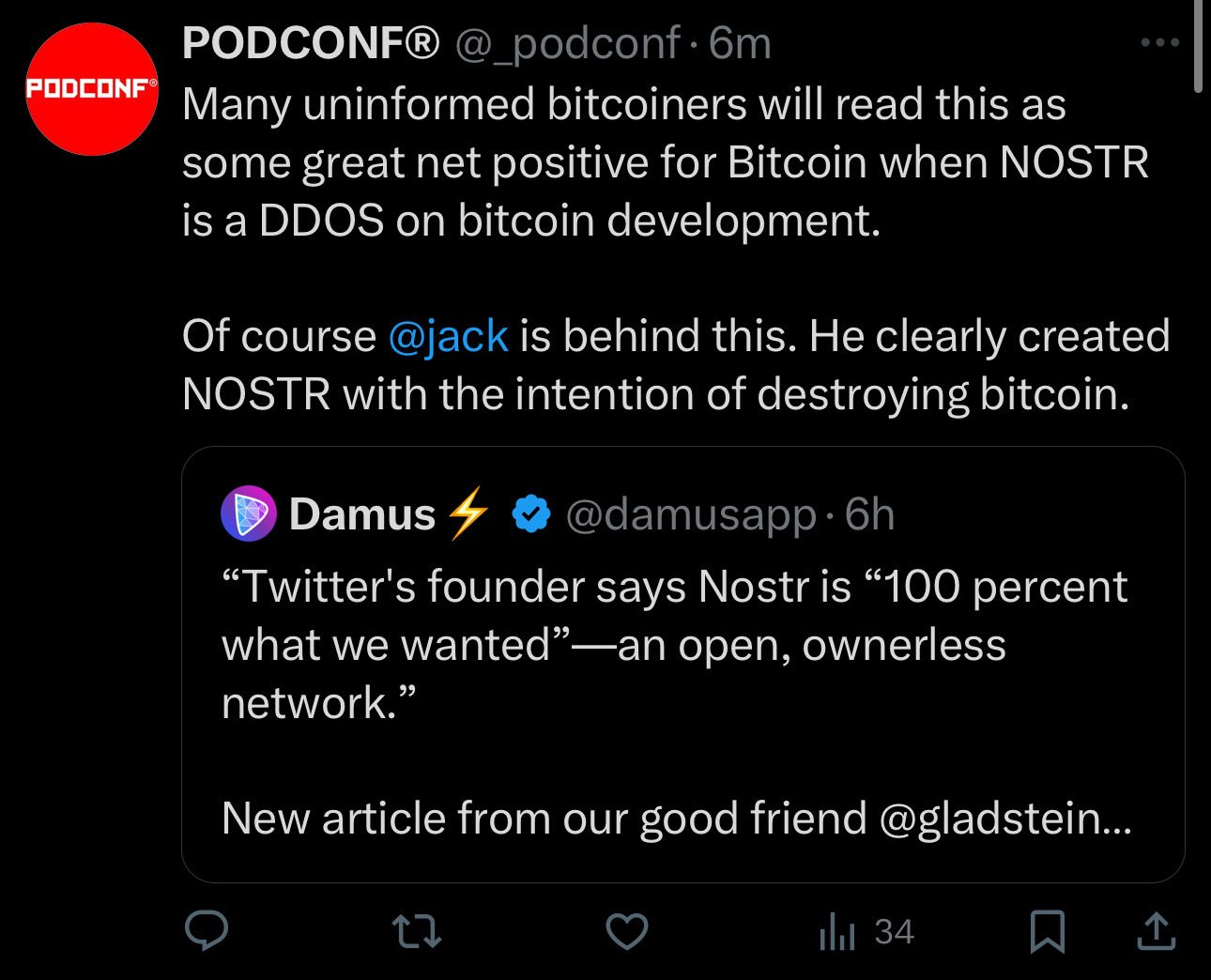
Who you hearing it from? Maybe they're just making noise
Didn't you "test the durability" of one? Maybe the fingerprint reader has a Linux driver.

The problem is that it's to easy to imagine that things are more work than they really are. I've worked on a few things that from the outside and after the fact seem like they would have involved a lot of people, when in fact it was just a few of the right people doing something that they knew how to do and even then barely made it happen.
Imagine a project that needs a cutting edge front end programmer, a backend web programmer, an embedded programmer, a scalability and reliability engineer, a product manager, a marketer, a designer, QA, etc... imagine how hard it would be to make decisions and keep them under wraps! ... But for some unreproducible reason, this time there's a single person that can perform each of these roles.
Can it happen quietly? Well duh...


The best way to curb inflation is to give the most money to people who will (over) spend it on things that aren't tracked as consumer inflation.
One of many problems in society is that it's easier to solve things with a lie than it is to explain how a real solution isn't possible.

Definitely not a new trick, Apple has had Public Source for decades. I was going to suggest forking it and building it yourself, but there's a proprietary library for the fingerprint reader. 🤔 Maybe Blocks can at least reproduce the build, though I'm not sure how reassuring it would be if there were a 3rd party blob.


That looks like a client retry bug


We need better keys, but demanding to be able to delete things from the Internet is a pretty hot take. There's no way to require relays / clients / the NSA / ransomware to behave a certain way. What's been said cannot be unsaid. People can choose to publish first to relays that (appear to) honor deletion. Most devs that push back probably do so out of concern for people fooling themselves into thinking that something has been erased.
It's of course possible to build something more sophisticated on top of the current protocol. Something with limited distribution that's more likely to bitrot than survive. Not many relays are going to retain encrypted messages that are megabytes each, though archive.org might and the NSA of course will.
So, the energy is right, but taken at face value the demand to be able to delete messages doesn't make sense.

Revision is also a useful social signal, and deletion can be a tombstone revision. Clients are free to show any or all revisions.

I like how this St Louis Fed post blames people for banks’ failings.
Flip it around. Banks irresponsibly created way more claims for gold than they had gold, kept defaulting, and lost trust. So the government made gold illegal to own for like 40 years.
There was no “shortage” of gold in the Great Depression. There was an excessive amount of fraudulent promises for gold, made by commercial banks and central banks.
https://www.stlouisfed.org/open-vault/2017/november/why-us-no-longer-follows-gold-standard

"They wanted something tangible and of value. Gold was a good fit because of its limited supply
[...]
Fiat money has no value of its own and doesn’t represent anything of value, such as gold"
Usually this is where we laugh at fiat money for having no intrinsic value, but that misses the point that gold *also* has no intrinsic value. The only differences between fiat and gold are how easily more of it can be created, and more importantly, *who* can do that:
"The U.S. mines a lot of gold, but we’re not the biggest producer,” Wheelock said. “The bigger suppliers of gold would have more control over our monetary policy"
The purpose of fiat is not only to enable a cheap money spigot, but to be very specific about who controls it.

If someone tells you something worth knowing, first, assume it is a lie.