

Avatar
a_priori
6313d3f5b6a58f36a769339b789a5df6cda177e86ebef495bf1202d17744d789
Friendly psychopath who loves freedom and sound money

Whether or not to mix or coin join your Bitcoin depends on your individual circumstances and #privacy needs. Here are some factors to consider:

* **The amount of Bitcoin you are #mixing.** If you are only mixing a small amount of Bitcoin, it may not be worth the hassle or the fees charged by mixing services.

* **The purpose of mixing your Bitcoin.** Are you mixing your Bitcoin to protect your privacy from prying eyes, or are you trying to #obfuscate the source of your Bitcoin for illegal activity?

* **The laws in your jurisdiction.** Some #jurisdictions have laws that restrict or prohibit the use of mixing services.

* **The reputation of the mixing service.** Not all mixing services are created equal. Some are more reputable than others. Do your research before choosing a mixing service.

Here are some of the reasons why people might choose to mix or coin join their Bitcoin:

* **To protect their privacy.** Bitcoin is a #pseudonymous currency, which means that it is not possible to track the identity of the sender or recipient of a transaction. However, it is possible to track the movement of Bitcoin through the #blockchain. Mixing or coin joining can help to obfuscate the movement of Bitcoin, making it more difficult to track.

* **To avoid taxes.** In some jurisdictions, it is illegal to mix or coin join Bitcoin in order to avoid paying taxes. However, in other jurisdictions, mixing or coin joining is not considered tax evasion.

* **To buy #illegal goods or services.** Some people use mixing or coin joining to buy illegal goods or services. However, it is important to note that this is a risky activity, and you could be prosecuted if you are caught.

Ultimately, the decision of whether or not to mix or coin join your Bitcoin is a personal one. There is no right or wrong answer. You should weigh the risks and benefits carefully before making a decision.

Here are some of the risks of mixing or coin joining your Bitcoin:

* **The mixing service could be hacked.** If a mixing service is hacked, your Bitcoin could be stolen.

* **The mixing service could be a scam.** There are some unscrupulous mixing services that will simply take your Bitcoin and run.

* **The mixing service could be illegal in your jurisdiction.** If you use a mixing service that is illegal in your jurisdiction, you could be prosecuted.

It is important to do your research before using a mixing service. Read reviews and compare fees. And, most importantly, only use a mixing service that you trust.

Whirlpool is a non-custodial coinjoin implementation (you are always in control of your own Bitcoin) implemented in Samourai Wallet and Sparrow Wallet. Privacy should be an option for everyone; the fact that you are trying to obtain privacy does not mean that you are a criminal.

Replying to Avatar PABLOF7z

📱 NDK 1.0 is out!

Codename: Outbox ✅

When I set out to write NDK my main goal was implementing the gossip protocol, now known as *outbox model*. I wanted nostr applications to have decentralizing tendencies by *default*; transparent to the developer.

After a few failed attempts, it's finally here, which, paired with a bunch of non-backward compatible changes, prompts me to do a major version bump.

# What is outbox model?

In short, the outbox model allows nostr to fragment, instead of everybody coalescing around a few popular relay and using things like Blastr. Nostr simply doesn't work without the outbox model.

# Main changes:

* Outbox model support, obviously.

* `fetchEvent(s)` is now faster, (particularly with queries using exclusively `ids` filters).

* Fixed unstable relay back-off code (credit goes to nostr:npub1az9xj85cmxv8e9j9y80lvqp97crsqdu2fpu3srwthd99qfu9qsgstam8y8 for the valuable testing infrastructure)

* Defaults to blacklisting wss://brb.io #censorship (credit goes to nostr:npub1az9xj85cmxv8e9j9y80lvqp97crsqdu2fpu3srwthd99qfu9qsgstam8y8 for the widely hinted-at dead relay)

* Subscription aggregation now works when multiple filters run at the same time

* Subscriptions that should close when EOSEd are now closed when each individual relay EOSEs instead of waiting for all of them to EOSE.

* A better algorithm on when to signal a subscription's EOSE. The margin that NDK now gives to relays to EOSE is now a function of how many of the connected relays in the relay set have EOSEd (accounting for relays that are still sending events).

* There are *many* more changes that I needed to do to accommodate for this that I don't remember now.

Some of the most glaring breaking changes:

* `ndk.subscribe` now defaults to keeping the subscription alive; the default of closing subscriptions on EOSE was bothering me

* NDKUser changes the `hexpubkey` from a function to a getter, so wherever you were using `user.hexpubkey()` needs to change to `user.hexpubkey`.

# Enabling outbox model

Outbox model comes disabled by default *for now*, as soon as I test it more throughogly it will be the default.

To enable it you need to instantiate NDK with:

```

const ndk = new NDK({

explicitRelayUrls: [...],

outboxRelayUrls: ["wss://purplepag.es"],

enableOutboxModel: true,

})

```

The outbox model will largely be transparent to you and will work on the background once you enable it.

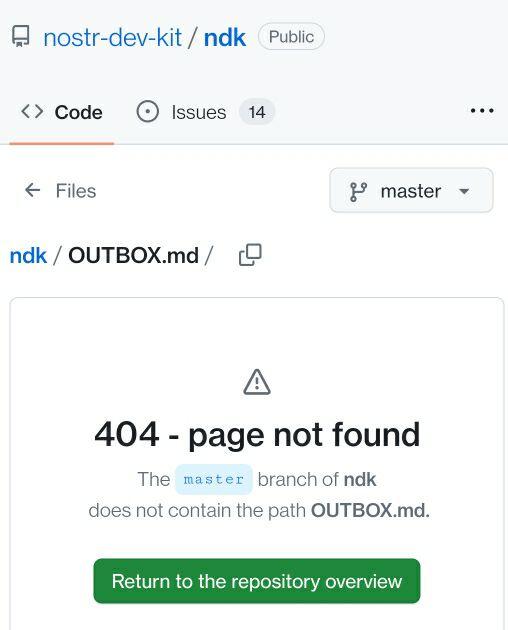
Was trying to read more about it and stumbled on this. Is there meant to be a readme?
Not enough people are saying this! đŸ€™

Need a garlic necklace and some holy water to keep the D Vampires away

Replying to Avatar miljan

Dust has finally settled on the “Primal censorship” drama. That’s good to see, but I don’t want to sweep this episode under the rug. It is probably appropriate to do a post mortem, assess what has happened and see what we can learn. Let’s make sure that Nostr is a better place after this episode.

Two weeks ago, Primal’s trending algorithm was attacked by bots. The attacker generated hundreds of thousands of reactions, propping his note to the top of our trending feed. At the time, our only defence was a simple “can’t trend” list, so we put the attacker on it. He immediately posted on Nostr, accusing us of censorship, but his note never took off. The attacker then selected a few well liked Nostr accounts and started stuffing the ballot box for them. We saw a bunch of bogus notes with massive bot engagement, so we resorted to the only blunt tool we had. The attacker jumped on the opportunity to publicize the fact that some well liked accounts were being suppressed on Primal and accused us of “shadowbanning”. The whole thing exploded on Nostr.

What followed was a pretty tough week for Primal. Many of our users turned against us. They took the idea of shadowbanning seriously, as they should. Most feedback was in good spirits, people making fun of Primal via memes. But we also got a fair bit of hate from complete strangers, which was super-weird. All in all, Nostr users were clear about what they think of censorship. This was the Nostr immune system reacting. Being on the receiving end of it really sucked, but still it’s beautiful to see!

The crazy part is that those “shadowbanned” accounts were actually perfectly visible throughout the entire Primal site. They had *exactly* the same level of visibility as they do on Damus, Snort, Coracle, and other Nostr clients. They just couldn’t show up in our trending bar. I tried to explain, but there was little room for nuance with the drama in full swing.

So we decided to disengage temporarily, focus on building, and let our product do the talking. We made our trending algorithm more resistant to bots and removed everyone from the “can’t trend” list. We also built a new content moderation system for Nostr, giving complete control to the user. This is our best take on how to do content moderation on such a radically open network. I cover the features and our reasoning in my blog post below.

So Primal is strictly a better product after this episode. But what about Nostr itself?

Attacks can be useful. While they disrupt our systems and really suck for us and our users, they do force us to improve and become more competent at operating in an adversarial environment. However, we should be careful about making it socially acceptable for Nostr devs to attack other projects in broad daylight. That’s not the most productive way to collaborate. It also creates weird vibes which I think we don’t want here. Nostr is in its infancy and the way we act will set the tone for things to come. There is so much to build and we are all working as fast as we can. At Primal we build open source software and run services for Nostr. If you don’t like the way something works, fork it and do your own thing. If you want to contribute, we accept PRs. If you have found a vulnerability, there are multiple good ways to disclose it.

As for Nostr users, I think you all reacted perfectly. Push back hard at any whiff of censorship. When in doubt, mercilessly create memes, point out things that are wrong, and don’t let up. Even if the target is Primal.

If Primal is real, it can stand the pressure. đŸ€™đŸ’œ

https://habla.news/u/miljan@primal.net/1693416828339

How can you not love this guy?

Replying to Avatar Lyn Alden

“We should change Bitcoin now in a contentious way to fix the security budget” is basically the same tinkering mentality that central bankers have.

It begins with an overconfident assumption that they know fees won’t be sufficient in the future and that a certain “fix” is going to generate more fees. But some “fixes” could even backfire and create less fees, or introduce bugs, or damage the incentive structure.

The Bitcoin fee market a couple decades out will primarily be a function of adoption or lack thereof. In a world of eight billion people, only a couple hundred million can do an on chain transaction per year, or a bit more with maximal batching. The number of people who could do a monthly transaction is 1/12th of that number. In order to be concerned that bitcoin fees will be too low to prevent censorship in the future, we have to start with the assumption that not many people use bitcoin decades out.

Fedwire has about 100x the gross volume that Bitcoin currently does, with a similar number of transactions. What will Bitcoin’s fee market be if volumes go up 5x or 10x, let alone 50x or 100x? Who wants to raise their hand with a confident model of what bitcoin volumes will be in 2040?

What will someone pay to send a ten million dollar equivalent on chain settlement internationally? $100 in fees per million dollar settlement transaction would be .01%. $300 to get it in a quicker block would be 0.03%. That type of environment can generate tens of billions of dollars of fees annually. The fees that people pay to ship millions of dollars of gold long distances, or to perform a real estate transaction worth millions of dollars, are extremely high. Even if bitcoin is a fraction of that, it would be high by today’s standards. And in a world of billions of people, if nobody wants to pay $100 to send a million dollar settlement bearer asset transaction, then that’s a world where not many people use bitcoin period.

In some months the “security budget” concern trends. In other months, the “fees will be so high that only rich people can transact on chain” concern trends. These are so wildly contradictory and the fact that both are common concerns shows how little we know about the long term future.

I don’t think the fee market can be fixed by gimmicks. Either the network is desirable to use in a couple decades or it’s not. If 3 or 4 decades into bitcoin’s life it can’t generate significant settlement volumes, and gets easily censored due to low fees, then it’s just not a very desirable network at that point for one reason or another.

Some soft forks like covenants can be thoughtfully considered for scaling and fee density, and it’s good for smart developers to always be thinking about low risk improvements to the network that the node network and miners might have a high consensus positive view toward over time. But trying to rush VC-backed softforks, and using security budget FUD to push them, is pretty disingenuous imo.

Anyway, good morning.

Can one of these Central Bitcoiners accurately predict what transaction fees will be tomorrow, much less in 2040?

Replying to nobody

Truth.

Was looking for this but you beat me to it đŸ€™