
nostr:npub1g7ec7nfhyyus6kmtaaud4clnuwygandlrpz0hvem3pep6dndtjyqumtp42 I can not give you a great salary at all but I am indeed looking for help in a paid way. Depending on your skills, motivation and financial needs, if you are interested in https://blowater.app, let’s talk.
Just recovered from my illness. A small PR to get started https://github.com/BlowaterNostr/blowater/pull/344
https://blowater.app used to freeze a bit if you send messages immediately after the app loads. No more.


Yes, I totally see your points and I agree that needs to more softwares.
We should take game industry as an inspiration. Many games have mods and modular design. Minecraft is the best example. Without coding, players can create interesting new things from existing rules.
However, functionality software is not like this at large. To extend a functionality software, one has to code. Examples are:
Small nostr clients, VS code extensions
Worse, centralized platform software does not even allow you to extend with code.
Therefore, to address this problem, having more programmers is not the key. To have more no-code, extendable software is the key.
When users find composing with existing modules (minecraft building blocks) not enough, they will have a reason to learn the code.

Fun should be the consequence of good work. Fun should be built in to the process. It should not be a dopamine impulse introduced only by external factors. That’s the difference between deep joys and shallow fun.
In another works, if your work is truly amazing, it will produce fun eventually. But the process will have difficulties.
It’s very hard to find dedicated people to work on new & challenging things. Most people are one of either lazy, greedy, lack of skills, easy to give up or insecure.
I used to make much more than 10K USD per month and I quitted my job to work on Nostr full-time many months before nostr:npub1sg6plzptd64u62a878hep2kev88swjh3tw00gjsfl8f237lmu63q0uf63m donated to OpenSats.
If not for OpenSats, I won’t even make a living. Even with the grant, I am willing to only make a fraction of what I used to make. This is my commitment.
I can’t guarantee that I can continue it forever. But, I will carry on at least til the end of the grant and many months afterwards.
My point is, to find the right person to work on Nostr and Blowater in particular, they have to be so damn dedicated that they will do it for free because they believe in it so much. So that they will continue to work on it even it’s a bad day. They will continue to work on it even it doesn’t provide emotional joy & excitement anymore. They carry on, they hold their professionalism even more than they hold their bitcoins, if needed.
I am not here to just have fun. Having fun is part of my life. But it’s shallow. I am here to have deep thoughts and do deep work. Having fun is just the side effects, not my goal. Fun is fundamentally dopamine impulse and can’t last very long.
This is the difference between a developer and a user.
Only good developers can attract good users. Not the other way around.

Open source projects community can really benefit from Nostr. This is https://godotengine.org/community/

Meaning, scams will eventually become mainstream. Like "fake it to make it"?
Or do you mean that "scams density" is an indicator for nostr popularity?

Am I the only one feeling they became more stylistic when getting older?

Where is the video?
What happened today to the market?


nostr:npub1dww6jgxykmkt7tqjqx985tg58dxlm7v83sa743578xa4j7zpe3hql6pdnf as per your request here is a first step of the restyling proposal for Blowater.
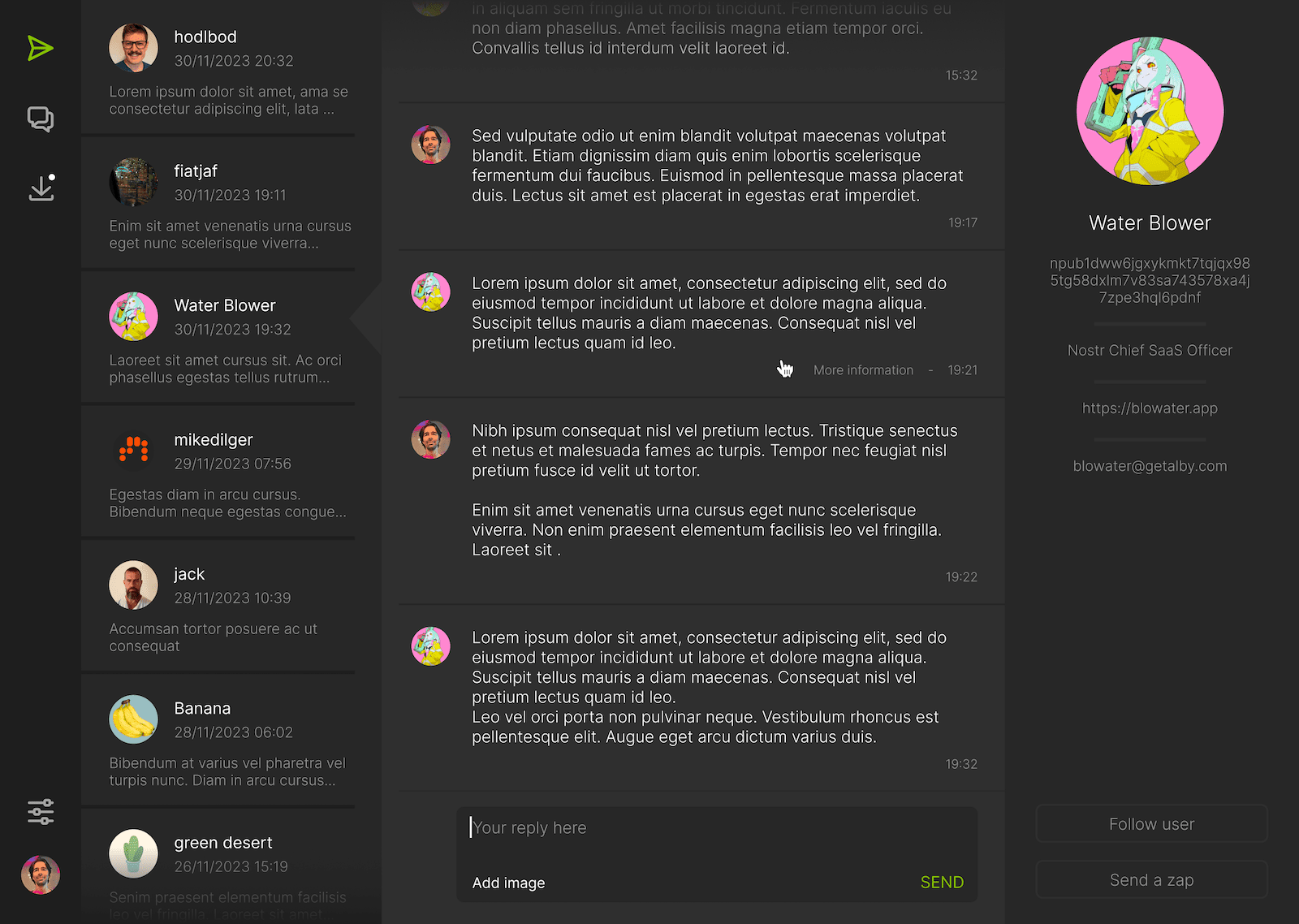
More info in the Github issue:
https://github.com/BlowaterNostr/blowater/issues/343
#nostrdesign
https://github.com/BlowaterNostr/blowater/issues/343 Just commented.
learned helplessness and victim mentality is absolutely toxic. Growth mindset is the only way out.
P.S. The new UI of Damus is nice.
Some people have this distinguishing between fiat world and Nostr world. The concept by itself is fine but misleading as if they are separate. Before any of these concepts, there is the real, physical world.
Do you want to escape from real world to Nostr as a refugee? Or do you want to make the real world actually more comfortable and better for you and other people to live in, by leveraging Nostr?
Big difference.
Nobody can escape the real world and people who hallucinates about escaping seriously need therapists and I just can’t stand with this pessimistic and pathetic mentality.
But if you run away, how can you even have a conversation?