
Bitcoin's unstoppable rise, much like Iron Maiden's music, reminds us that even in a world of uncertainty, there are forces that can rock the foundations of traditional finance
💪🤘🤘 


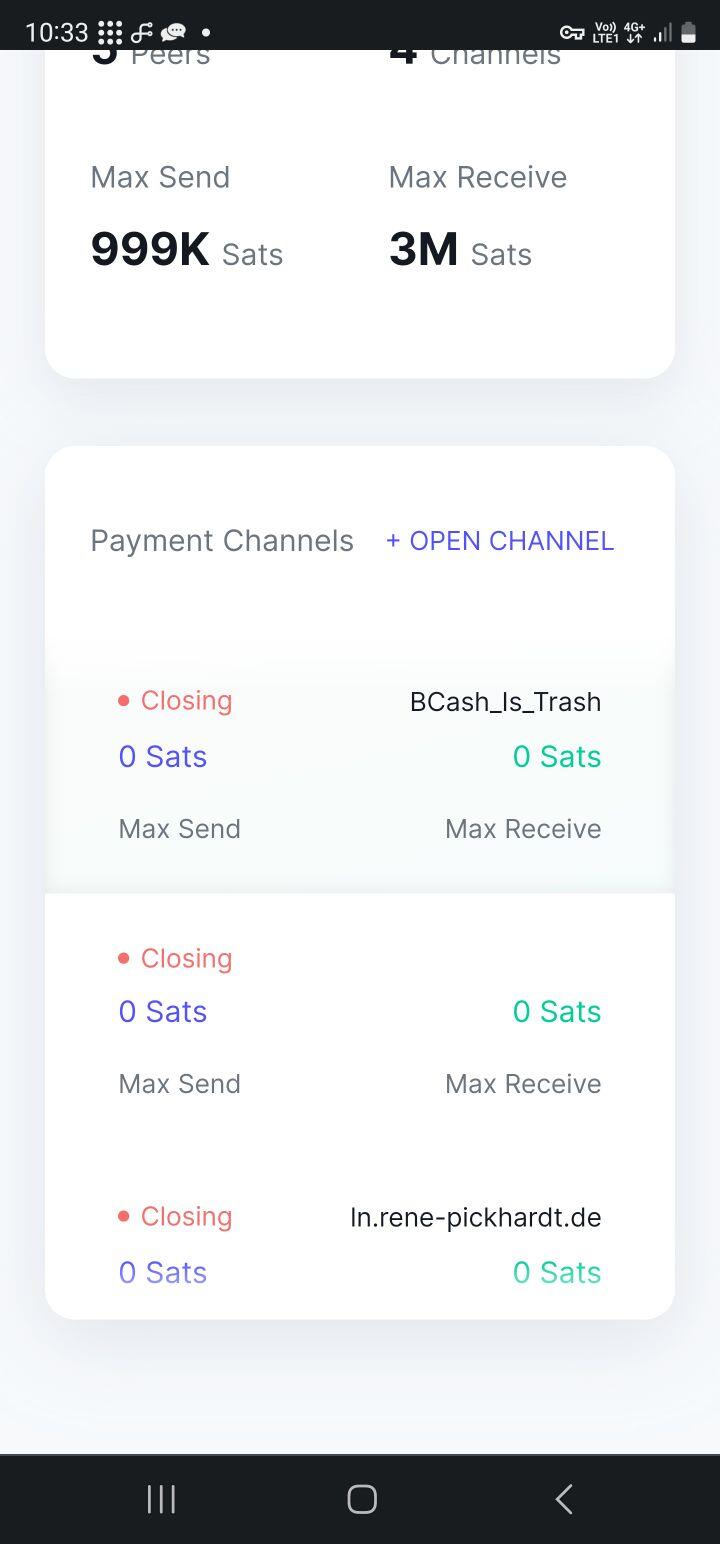
Install and connect Zeus LN wallet to your node and go to the channels (from Zeus) and force close with RPF (set higher fee, prefered to be top fee to be sure)

We are always ready to fuck the bear
🤪🤪🤪😂😂
https://video.nostr.build/c42e32b5ae964c9c01a0f246bdae54b1cea3450e182454f6bb4bc560b9d65f66.mp4
🤣
"Anyone who understands economics and finance and how markets work will be a maximalist because it is more efficient to have one currency than a bunch of ones." —Peter Todd
Hear me out;
Not Ethereum.
Not Solana.
Not ADA.
Bitcoin.
Why? Its slow. Its old. Its….
1) Decentralized 100% (ethereum hard forked a few times, for example, who’s to say they wont hard fork or freeze a transaction in the future?)
2) Regulated
There are legal frameworks that allow even banks to purchase BTC. There are non for ETH and other coins.
3) Commodity
Has a fixed supply. No “foundation” can change this. The rules are set in stone.
4) Proof of work.
Doing gymnastics is work, saying you understand gymnastics is “theory”. The practice shapes your thoughts and creates a level of difficulty. The theory is horseshit.
5) Its not slow.
Layer 1 is for settling transactions and it takes 10-30m.
Did you know that the Layer 1 of a bank transaction is 5 dats?
Visa and Mastercard use Layer 2 for transferring funds.
Lightning Network is the Layer2 of Bitcoin. What Visa is to banks.
Careless money owns dollars.
Greedy money owns stocks.
Old money owns gold.
Smart money owns Bitcoin.
I don't need sex. The government fucks me everyday.
Scammers gonna scam.
#Bitcoin only gents, #BTC has no CEO, no leader, no centralization, no manipulation, no inflatability, no corruptability, #BTC is forever, for anyone, anywhere. POW is math & physics.
POS is made out 💩, arbitrary numbers punched on a screen.
How will gold ever function as money again without a digital layer backed by a cumbersome and untrustworthy system of custodianship that already failed once.
#Bitcoin solves this problem, because no trust is needed to ensure 1 BTC = 1 BTC
Gold is the fax machine.
Because ETH can be stopped, since it has a CEO and a team. It can be rehulated. BTC cannot be stopped, regulated or controlled since it has no central authority and is being considered a commodity rather than a security like the altcoins.
The fact that BTC is slower is the least problem. If anyone wants a true global monetary system, go for absolute decentralization. No company ever could be in charge of the money of the world.
Crypto is generally crappy unregistered software companies awkwardly glued to a centralized blockchain, who’s primary purpose is to shill a token, which is an unregistered security, to enrich the founders and early speculators, usually at the expense of unknowing retail investors
People believing something immutable and finite = bad
People believing in what government tells them (as it perpetually dilutes while inserting itself digitally into every facet of your life) = good
Am I understanding this correctly?
Trust us…not physics
#Bitcoin is separating money and state it does not have a foundation, CEO, premines or insiders. It's censorship-resistant sound neutral money without an issuer that gives freedom and sovereignty to the individual. The rest is noise.
BIP 30 explained:
BIP30 is a Bitcoin Improvement Proposal that addressed a vulnerability in Bitcoin's early design, where transactions with the same identifier (or TXID) could exist. The potential for duplicate transactions created security risks, allowing for certain types of attacks.
The problem
In the early days of Bitcoin, it was possible for two or more transactions to share the same identifier. This was a problem because Bitcoin relies on unique transaction IDs to keep track of which coins are spent and which are unspent.
For example, if Alice sends Bob 1 Bitcoin in a transaction (Transaction 1), and then later Bob sends that Bitcoin to Carol in a new transaction (Transaction 2), Transaction 1's output is marked as spent and can't be used again.
But what if a miner included a new transaction that also identified itself as Transaction 1 in a later block? According to the old rules, this would be allowed, and it would reset Transaction 1's output to unspent. This could result in Bob's Bitcoin being sent back to Alice, even though she had already spent it.
The solution
To prevent this from happening, BIP30 introduced a new rule: blocks are not allowed to contain a transaction whose identifier matches that of an earlier, not-fully-spent transaction in the same chain. This ensures that once a transaction output is spent, it can't be spent again by a later duplicate transaction.
The exceptions
There were two historic blocks in the Bitcoin blockchain that violated the BIP30 rule, but because they were already part of the blockchain, they were grandfathered in and allowed to remain. All future blocks, however, must follow the BIP30 rule.
Why it's important
This change was essential to maintain the security of Bitcoin transactions. By enforcing uniqueness of transaction IDs, it's ensured that once a Bitcoin is spent, it can't be double-spent.
The backward compatibility
The rule introduced by BIP30 makes some previously-valid blocks invalid, meaning blocks that were previously accepted by the network would now be rejected if they violated the BIP30 rule. This is not a problem for the network, as the rule is now standard and any blocks violating it would be rejected by the nodes in the network.
In simpler terms, imagine you're playing a game of Monopoly. Initially, there's a rule that allows players to use the same token (like the thimble or the dog). But then you realise this can create confusion and lead to cheating, as players could claim others' moves as their own. So, a new rule is introduced that each player must use a unique token. This is essentially what BIP30 does for Bitcoin transactions.
BIP 33 explained:
Bitcoin Improvement Proposal 33 (BIP33), introduced by Pieter Wuille, was designed to solve a problem related to "Stratum," a mining protocol widely used in Bitcoin mining.
Before BIP33 was introduced, when a miner wanted to mine a new block, they had to wait for the mining pool to create a new block template. This was because miners were not able to change the transactions in a block themselves. The Stratum protocol used to simply provide the miner with the block header for mining.
This method was inefficient and had a couple of issues. The primary issue was that it increased the time between when a transaction was broadcast to the network and when it could be included in a block because miners were waiting for a new block template from the pool. This led to longer confirmation times for Bitcoin transactions.
Additionally, it reduced the amount of flexibility that miners had in selecting which transactions to include in a block. Miners generally prefer to include transactions with higher fees as this is more profitable for them. However, without the ability to create their own block template, they were at the mercy of the mining pool to include these higher fee transactions.
BIP33, introducing the "Stratum protocol extensions for pooled mining," proposed a solution to these problems. This extension is often referred to as "getblocktemplate." It allows miners to create their own block templates, giving them the ability to choose which transactions to include in the block.
Using getblocktemplate, the miner can create a block template, including all the transactions they want, and then start hashing the header. This decreases the latency between when transactions are broadcast to the network and when they can be included in a block, effectively reducing transaction confirmation times.
Moreover, it gives miners the autonomy to include transactions with higher fees in their blocks, potentially increasing their profits. This proposal, therefore, brought about a more efficient and flexible mining protocol, contributing to an improved Bitcoin network.
BIP 34 explained:
Bitcoin Improvement Proposal 34 (BIP34), proposed by Gavin Andresen and Peter Wuille, aimed to address a fundamental issue with the Bitcoin protocol's block versioning system.
Before BIP34 was introduced, there was a concern that the original design of the Bitcoin block versioning system didn't allow an upgrade procedure that could be followed by the entire network. Specifically, blocks didn't have a way to signal the version of the rules they were following, which could lead to problems when a portion of the network upgraded to a new version of the rules while others hadn't. This could potentially lead to network forks and various issues with transaction validation.
BIP34 introduced a new mechanism that included the block height in the coinbase transaction, which is the first transaction in a block. This provided a way for the Bitcoin network to enforce that blocks have a certain version number once a certain block height is reached. This effectively acted as a version signaling mechanism, allowing all nodes on the network to know when a certain percentage of blocks had upgraded to a new version of the rules. Once a certain percentage (usually 95%) of recent blocks signal the new version, all nodes start enforcing the new rules.
In the process, BIP34 also solved another potential issue. Before this proposal, it was possible (though highly unlikely) that two miners could independently solve a block at the same time without knowing about the other's block. This could lead to duplicate coinbase transactions, which have the same transaction id (txid). By including the block height in the coinbase transaction, every block on the blockchain is guaranteed to have a unique coinbase transaction, thus eliminating the possibility of two coinbase transactions having the same txid.
In summary, BIP34 improved the Bitcoin protocol by providing a robust mechanism for rule version upgrades and ensuring that every coinbase transaction is unique.

100% porn. ❤️ 😍
#plebchain
#zap
#bitcoin
#coffeechain
#zapathon
#nostr
#einundzwanzig 🧡 https://video.nostr.build/fed7aca0aae9c9ea571b6d4caa7f3dcf1377709038b2d0de118b58cb09418ddf.mov
Best porn 😄
Yes minimum is 90w without load but I put 100w because I think the server have programs running in background . Raspberry usually have less than 10w but I choose 15w because same programs need a lot o power from raspberry. Is just an estimation, not real but I want to show you that solution with optiplex is not good solution for server if you don’t have cheap energy or free.

In 2 years you pay another optiplex ( by bill of power consumtion)
Long term is ok to have raspberry.
If you have free energy from solar pannels is ok to have what that optiplex


Anyway power consumption is much higher than raspberry.
Over 100W vs 15w on raspberry;
Of course you have much better performance with desktop computers.
Keep in mind, to run something in 24/7 with high power consumption is not efficient