

How about this: I find bitcoin to be a commonly held intellectual property that we all possess and can control collectively.
I think the co-mingling of the idea of individual control being necessary and being property is the problem here.
Charles Schultz has a large vested interest in keeping the integrity of the Peanuts universe; with it he makes books, movies, merchandise, ect.
If I start producing a Peanuts comic and I portray Charlie Brown as a meth head that starts kicking Snoopy and pimping out Lucy, it will degrade the intellectual property that he has built and will cost him in lost revenue from missing ticket sales on movies, lower book sales, ect.
Just because I can easily do this does not make it right (it will cause monetary harm to Mr. Schultz), it also does not negate Peanuts being an intellectual property.
I find this argument pedantic. The property is the UTXO on the bitcoin blockchain not the piece of paper your key is written on...
If they steal your key words and move the utxo to a wallet under their control, they have deprived you of access to your property; commonly known as theft.
I think the co-mingling of the idea of individual control being necessary and being property is the problem here.
Charles Schultz created Peanuts and all the characters in that universe ( Charlie Brown, Snoopy, Lucy, ect.) This is an intellectual property.
If I make a bastardized Peanuts of this I am stealing and degrading his intellectually work, especially if I claim to be the creator of Peanuts.
TLDR: Just because something is easy to steal does not make it yours and does not make it stop being a property.
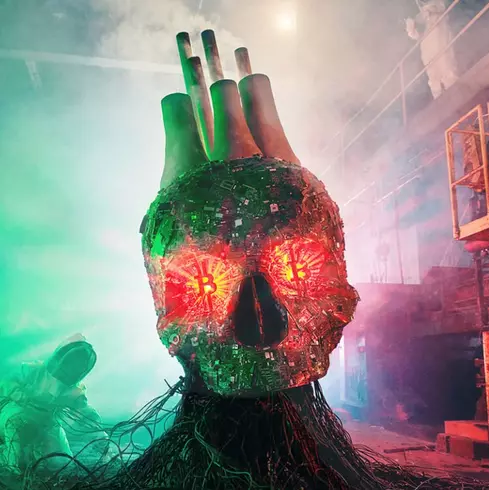
IP are inventions: I agree. They are the works and property of their creator. These works are highly susceptible to theft. An unnatural monopoly is created to defend it. I agree with all of these points.
Also by your own logic, if the secret of your bitcoin keys becomes known by a malicious entity, in that moment bitcoin ceases to be an intellectual property and transforms into ??? (nature?)

Property does not cease being a property if you fail to defend it... The British didn't lose control of their colonies and then say, " Don't worry it's not a property anymore... it's just nature now"
Hey nostr:npub1v9qy0ry6uyh36z65pe790qrxfye84ydsgzc877armmwr2l9tpkjsdx9q3h. You offered the challenge... I accepted. Defend your position
No reply nostr:npub1v9qy0ry6uyh36z65pe790qrxfye84ydsgzc877armmwr2l9tpkjsdx9q3h? I get it... it's a ridiculous statement and completely indefensible.
Hey nostr:npub1v9qy0ry6uyh36z65pe790qrxfye84ydsgzc877armmwr2l9tpkjsdx9q3h. You offered the challenge... I accepted. Defend your position
You know... books, movies, branding, trademarks...
You live in a world where these things don't exist?
Intellectual property (IP) is a category of property that includes intangible creations of the human intellect.
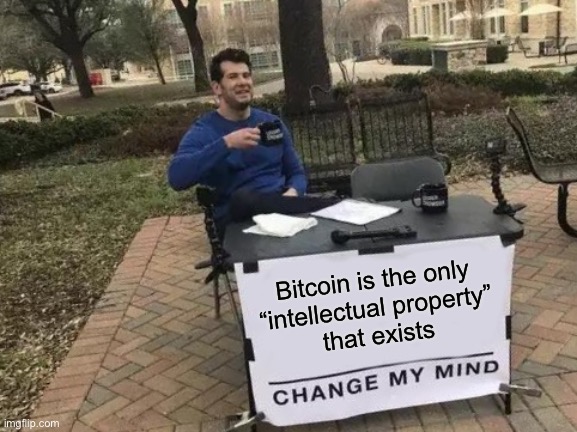
Disagree. There are an unbelievable amount of intellectual works produced by mankind. Bitcoin just happens to be one of the only ones that is defensible by a distributed group of enforcers (miners) that we all collectively pay tax to.

“The whole aim of practical politics is to keep the populace alarmed (and hence clamorous to be led to safety) by an endless series of hobgoblins, most of them imaginary.”
― H.L. Mencken
They have been doing it since forever... I'll always remember my dad telling me about "duck & cover" drills for elementary school kids to hide under desks incase of a nuclear bomb!

The academics don't like bitcoin because it cuts off their funding. The inflation in the cost of higher education is egregious, and is because the Feds issue the loans that blew the bubble. Those academics don't want to give up their spot next to the money spigot.

Again, I don't know what you're on about? You must be arguing against some imaginary statement in your mind...
Habanero: "All of those things you listed (electricity, microwaves, nuclear) have incredible risks and have killed many people who did not take caution"
You are saying this statement is wrong?
Again, your argument has zero to do with my original statement. Whatever random tangent you choose to go off on does not invalidate what I said.
Just to be clear; I could give two squirts of piss about AI being regulated by a government body... move fast and break as much shit as possible. I DO care about a government body regulating nuclear power, electrical generation, and radio/microwave frequencies... as you can kill alot of people if you don't set standards. I find Jimmy analogy to be dumb and misguided.