exactly. what i have just read indicates that the coming coalition government in Berlin could agree on an additional debt package of 400 to 600 billion euros to increase the defense budget. This money does not exist, it has to be raised through new debt issuance.
Hjalmar Schacht: Hitler's Fiat Banker
The military resurgence of the German Reich after the defeat of the First World War and the catastrophe of the Weimar Republic is one of the most astonishingly fatal events of the 20th century. Millions upon millions lost their lives after the resentment-driven German people rose again militarily from the ruins of the Treaty of Versailles. In charge of financing the gigantic German war machine was an economist and intellectual who was not initially suspected of harboring nationalist or even extremist thoughts: the president of the German Reichsbank at the time, Hjalmar Schacht.

Born in 1877 in Tingleff, in northern Germany, into a middle-class family, the economist turned himself into a top banker, starting out at Dresdner Bank and making decisive reforms at the height of the hyperinflation of the Weimar Republic. It is all amazing what happened later, considering that Schacht was a founding member of the ddp party, a social-liberal grouping that had no connection whatsoever towards the resentment driven extremist groups that lateron brought Weimar to its kneed.

Was it the plundering by the Treaty of Versailles that radicalized this man from the middle class of society and put him on the path of Adolf Hitler or was Schacht nothing more than the typical successful careerist and political hanger-on who recognized the opportunity and took advantage of it?

After Hitler’s ascent, Schacht was reappointed Reichsbank President (1933–1939) and named Minister of Economics (1934–1937). He engineered Germany’s economic recovery through innovative policies like the MEFO bills, which secretly financed rearmament, and public works programs that reduced unemployment. However, he clashed with Hitler and Hermann Göring over excessive military spending, which he believed destabilized the economy and violated the Treaty of Versailles (!!).

These tensions led to his resignation from the Reichsbank in 1939 and his dismissal as Minister without Portfolio in 1943. Of course, if you let the money printer run hot, things turned out as they had to: with the start of the Second World War and the invasion of Poland, Germany was faced with insolvency and hyperinflation, once again, which is why the Nazis consistently sought the gold reserves of the subjugated states first.
Schacht’s relationship with the Nazi regime soured further as he opposed Hitler’s aggressive policies. In 1944, after the failed July 20 assassination attempt on Hitler, he was arrested by the Gestapo for alleged contacts with the resistance and interned in concentration camps, including Ravensbrück and Flossenbürg.
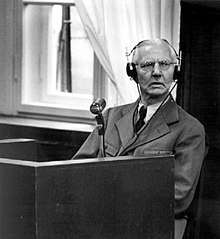
Liberated in 1945, he faced trial at Nuremberg but was acquitted in 1946, as the tribunal found insufficient evidence tying him to war crimes. German denazification courts later sentenced him to eight years in prison, but he was released in 1948 after an appeal.
Post-war, Schacht founded a private bank in Düsseldorf in 1953 and advised leaders like Egypt’s Gamal Nasser. A prolific writer, he authored 26 books, including The Stabilization of the Mark (1927) and Confessions of "The Old Wizard" (1956). Known for his high intellect—he scored 143 on an IQ test at Nuremberg—Schacht remains a controversial figure, celebrated for his economic genius yet criticized for his early Nazi collaboration.
This video from 'Slice Full Doc' takes an interesting look and angle at the events surrounding the Reichsbank before the second world war: https://shorturl.at/38ZmD
#history #schacht #hitler #germany #weimar #fiat #ww2 #bitcoin #nostr #grownostr #nostrlearn

My prayers are with my american friends
Will watch for more info on capital flight. Did You see what happened to Norway after introducing a wealth tax? They finished with lower taxes as the rich are fleeing to Switzerland
This will free us from the euro commies
This is the moment when Schopenhauer recognized the cold truth of the human condition. After that, he was never the same again, this jolly old bone from Hamburg.

#philosophy #nostr #grownostr #bitcoin #life
Well they all share the same level of intellect and ethics, so...
2025 they'll climb the top for sure
Çatalhöyük: The First Whisper of Cities
Archaeology is the science that explores our roots and shows us the path civilization has taken. Catalhöyük in Anatolia is considered to be one of the oldest known city foundations, alongside sites such as Jericho and Ur, and possibly the oldest of all urban settlements of mankind.

Çatalhöyük just seems a smear of mud and bone, born around 7500 BC, maybe long before. Excavactions show there where no streets, no plazas or market placed, just a heap of homes mashed together like clay clenched in a fist - like a gigantic beehive. Roofs were the roads, ladders dropped you in, and the dead slept under the floors. They feared the ancestors, but did not want to be separated from their good spirit. This was rawer than first mesopotamien settlements like Ur or Uruk, it was quieter, the first stutter of humans piling up to stay.

Walls of sun-baked brick, so tight you could hear your neighbor breathe. No doors—just holes above, spilling you into dim rooms with hearths flickering. They painted bulls on the plaster, wild and red, and tucked skulls into corners like keepsakes. Up to 8000 souls lived here, not roaming, not scattering, but rooted. They grew wheat, herded sheep, traded obsidian sharper than flint. It wasn’t chaos - it was a knot, tied by need and something deeper.
Society here wasn’t loud with hierarchy. No palaces, no thrones - just families, equal in their huddle, was it a clan-dominated cooperation that gave society stability? It's probable. Archaeologists find no grand tombs or hoarded gold, just shared spaces and tools. Power, if it existed, hid in the quiet - maybe in those who knew the seasons, who led the hunts, who painted the walls. Women and men worked the fields, wove baskets, shaped clay (we all know the wonderful legend that in the end the cultivation of grain, which was necessary for brewing alcohol, led to man becoming sedentary). Burials show little difference - bones wrapped in cloth, tucked beneath floors, equal in death as in life. It’s like they ruled themselves, a community stitched by survival, not scepters.

The economy was agricultural-based. They farmed emmer wheat and barley, grinding it into bread with stones. Sheep and goats grazed nearby, giving meat, milk, hides. But obsidian was the pulse — black glass from volcanic hills, traded far beyond the plains. It cut cleaner than flint, and Çatalhöyük sat on the route, swapping it for shells, flint, ideas. No coins, no markets - there was just barter as form of exchange, hands to hands. Homes doubled as workshops; beads, tools, pots piled up beside the hearths. Food wasn’t scarce—grains stored in bins, bones tossed in middens. They had enough to settle, to paint, to pray.

And what about Safety? Walls block wolves and raiders. Warmth, too, with fires and bodies pressed tight. They buried their dead beneath them, keeping ancestors close, not cast out. Shrines rose, plastered with horns and art, whispering of spirits they couldn’t name. Staying put had weight—literally, in the bones below, and spiritually, in the bulls above. Çatalhöyük isn’t grand. No ziggurats, no wheels. Yet it’s the seed —before Jericho’s walls, before Sumer’s tablets. A city not because it roared, but because it held. People stopped wandering, started stacking, started marking their place. From that cramped huddle came the itch to settle, to grow, to last. The archaeological excavation field will probably offer generations of archaeologists and us the opportunity to keep discovering new things from this bygone era. Çatalhöyük didn’t know it was first. It just was.
A short video by 'History with Cy': https://shorturl.at/3spr1
#History #Çatalhöyük #HumanRoots #Neolithic #Civilization #FirstSettlers #Nostr #Nostrlearn #Bitcoin #EarlySociety
Millionaires voting with their feet! These are approximate values and not exact analyses, but I think the trend is clear: authoritarian control regimes are losing the successful and their capital to societies, which offe the individual more scope and sovereignty. The USA will suck the European Union dry in the coming years! Also China will face more than 'just' a demographic problem as it seems.

#EU #usa #millionaires #capital migration #nostr #bitcoin #plebchain #china
Here is a little insight into the infantile propaganda machine of the Eurocommies. They really believe that something like this goes unnoticed. Especially when #Musk posts it on X! 
#eu #wef #nostr #plebchain #usa #ukraine
The 'Rheingold' is the best music to grow Your germanic spirits... and short the sh..t out of these commies when the days are here. But not now. USD will be coming down to earth again first

I am primarily looking at interest rate spreads between the USA and major European economies in Germany and France. Then I try to find out which capital flows are in the background by analyzing the balance sheet positions of the various central banks and their proxy central banks, as well as FX analyses of the capital account between the USA and the eurozone, for example. I continue to observe productivity developments and the general economic situation, of course to draw geopolitical conclusions
GM,
wind of change is ìn the air!

#usa #trump #ukraine #russia #peace #nostr #plebchain


Maybe she needs another 'Kingsley treatment' to calm down again