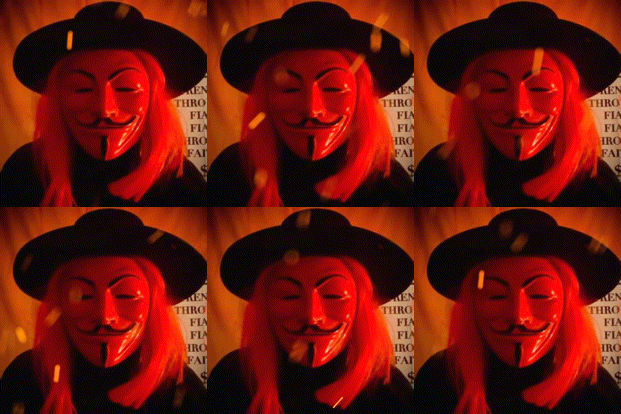
I'm staying at the most gorgeous hostile in the middle of no where Colombia (near Los Santos, Santander). The sport rock climbing on single pitch sandstone is amazing. I have just orange pilled the wonderful woman who runs the hostile and will be paying for my stay in Bitcoin! ⚡⚡⚡⚡ 


If you climb, check out the hostile:
Check out the rock climbing:
https://www.fundacionrocasdelamojarra.org/
Mangos, avocados, and limes grow on the trees at the hostile. The climbing is a 5 minute walk. Everything is cheap and hopefully will be priced in sats in the near future.
If your not a climber you can take a guided rock climbing day.

"Avoiding those who think differently than you is free. Missing out on hearing opposing views is costly."










Ita funny, I'm retarded at reading and writing. I'm disluxic and went to special reading classes for years. My hippy friends can't handle it when I tell them disluxic is just a fancy word for dumb at reading and writing. "Your not dumb, your just disluxic". Yeah, I'm not dumb at everything (I fingered our bitcoin after all).but I'm definatñyndumb st reading and writing. They also don't like it when I make disluxic jokes, but they are so funny.

What are "atomic swaps"?
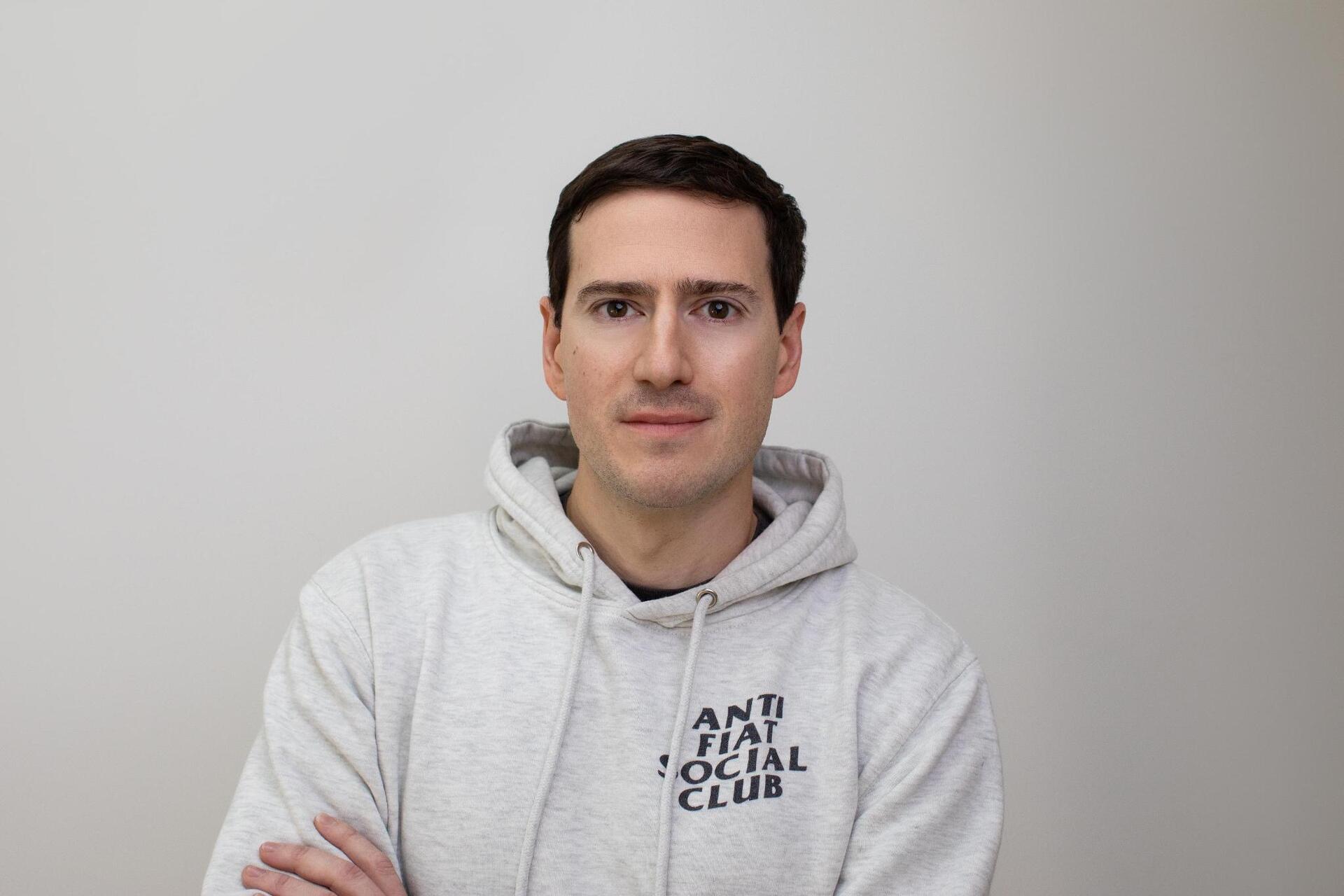
The first time Bitcoin hit dollar parity
Next stop: sat-cent parity!
H/T nostr:npub1pu5pjm8dzqjtul8t84a3jsehh78jreadp297sqa3as98c5hfym0qu6pn0a
What's that? 1 BTC = $1 million?


Any guess how many there are now?
Alex Gladstein had an interesting point on his latest interview on WBD podcast. He said that in a hyper Bitcoinized society everyone, governments included, will be using Bitcoin. So governments buying Bitcoin is a move in the direction of hyper bitcoinization. I have been torn between that and wanting to see more grass roots adoption before the biggest governments in the world go all in.

I'm about 40% in. My friend owns a lending library in Alaska that is all spiritual, philosophical, and religious texts (soon to have a bitcoin section via me!). She gave this book to me after a long deep conversation. I want to like it more than I do. I'm always interested in anything on sex/gender so that content is what I'm looking forward to most.
I can't stop thinking about these two graphics 

I just cracked open a book on Hermatic Philosophy.

Sure but most people do not accept Bitcoin as payment. If I own a business and owe someone 10k of usd tomorrow but I will not get a payment from a client for a week that will cover that I can take out a BTC collateralized loan and don't have the taxable event. Am I missing something? The custodian only holds by BTC for a week. It seems there is a use case.

In 2015, an eccentric millionaire placed bitcoins in weak addresses.
For years, the prize has been contested by bots, GPUs, and in the future, it is expected to be the first target of quantum attacks.
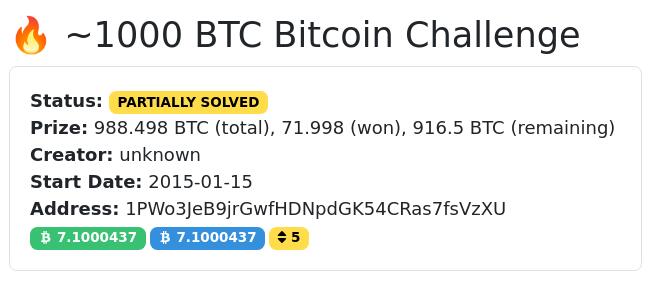
The individual's goal was to monitor the advancement of computational power capable of breaking Bitcoin keys.
These keys have up to 256 bits of entropy, which can be understood as the difficulty of discovering them. They are simply large numbers, on the order of 2²⁵⁶.
He then created 160 addresses, each with fewer bits of difficulty, from 1 to 160, and placed a few satoshis in each one, doubling the amount in the next.
The total prize reached nearly 1,000 BTC. There are still 916 BTC left to be claimed.
https://mempool.space/tx/08389f34c98c606322740c0be6a7125d9860bb8d5cb182c02f98461e5fa6cd15
The first few dozen addresses were quickly looted. There are bots monitoring the blockchain and stealing UTXOs that have some vulnerability — such as low entropy in the generation of the private key.
https://mempool.space/tx/0eb5b5c103e68eb0931430e7786cf1b6962f9eed5a2cb5271d4dd1699b77e86f
It was only at the end of 2015 that one of the owners of these bots noticed that the source of the bitcoins all came from a single transaction. He decided to share the discovery on the Bitcointalk forum, and that’s when more people began competing for the remaining prizes.
https://bitcointalk.org/index.php?topic=1306983.0
In 2019, the creator exposed the public keys of some addresses (those with indexes ending in 0 or 5). This is done simply by moving the coins—the key appears in the transaction. With it, other methods can be used, making it easier to crack.
https://mempool.space/tx/17e4e323cfbc68d7f0071cad09364e8193eedf8fefbcbd8a21b4b65717a4b3d3
One of these methods is a very old algorithm from 1978:
Pollard's Kangaroo Algorithm — a clever trick used to find private keys when part of the keyspace is known. Imagine two kangaroos jumping across a number line, one tame and one wild, eventually landing on the same spot. It’s a classic in cryptography, and now it's being used to chase Bitcoin prizes.
Since then, several programs and even participant "pools" have emerged, all trying to crack the next address. "kowala24731" secured an investment in the hundreds of thousands of dollars to rent GPUs and managed to break addresses #67 and #68 in early April.
Yesterday, someone, probably a beginner, cracked address #69 but didn’t secure the spending properly and exposed the public key.
In a few seconds, some bots cracked the key and replaced the transaction, battling for the balance. The last one paid a total fee of 1.2M sats.
https://mempool.space/tx/a52c5046f3097a8c2bd3b9889df2fb47b104d47a16cc679d3357feec003db753
The time to crack these addresses — discovering the private key from the public key — is quite short. A GPU can do it in less than a minute.
That’s why those who crack the keys can't publish it to the network; they must send it directly to a miner to include it in a block (like Mara).
Among the addresses with exposed public keys, the record was 130 bits of entropy, set by "RetiredCoder," who also cracked other keys.
These addresses are likely serving as "canaries in the coal mine" for the attacks Bitcoin may face. As long as there are still hundreds of BTCs sitting in them, yours should be safe.
The Bitcoin Space Race: Why the U.S. Risks Falling Behind Its Rivals
https://bitcoinmagazine.com/news/the-bitcoin-space-race-why-the-u-s-risks-falling-behind-its-rivals
Is this really just a two paragraph article?
"If our country can issue a dollar bond, it can issue a dollar bill. The element that makes the bond good, makes the bill good also. The difference between the bond and and the bill is the bond let's money brokers collect twice the amount of the bond and an additional 20%, where as the currancy pays nobody but those who contribute directly in some useful way. It is absurd to say that our country can issue $30 million in bonds and not $30 million in currancy. Both are promises to pay, but one promise fattens the usurers and the other helps the people."
-Thomas Eddison
"People will forgive you for being wrong, but they will never forgive you for being right—especially if events prove you right while proving them wrong"
Thomas Sowell
"The money power preys upon the nation in times of peace and conspires against it in times of adversity. It is more despotic than monarchy, more insolent than autocracy, more selfish than bureaucracy."
-Aberham Linchon
"The hand that gives is above the hand that takes. Money has no motherland; financiers are without patriotism and without decency: their sole object is gain."
-Napoleon Bonaparte