The Promises Men Live By
Harry Scherman
published 1938
...after all, economics is a special field of knowledge. Is there any particular reason, one may well ask, why all men, or even many men, should be fully informed in it? We cannot in this hard world hope to be omniscient. Why not leave this branch of inquiry, as other branches are left, to the experts? There is no practical need discernible for any wide diffusion of understanding about Professor Einstein's theories of relativity. No disastrous consequences seem to arise from the almost universal absence of understanding of the simplest aspects of chemistry, physics, astronomy, geology, archaeology, philology, botany, and a hundred other fields of inquiry that might be cited. The rest of us can go about our own pursuits, safe in the confidence that the discovery of truth in these fields will slowly seep into the general body of wisdom the race inherits and will change our lives, if at all, in that slow way. Certainly, the common ignorance that prevails about such sciences seems to have no immediate harmful social consequences.
The reverse is true of economics. It differs indeed, in this respect, from almost every other pursuit of knowledge that one can think of. With the world constituted as it now is, the well-nigh universal ignorance among men as to how their society functions, since it determines the nature of their actions, is itself a governing factor, which can be seen operating in a thousand positive ways, in what currently happens to the human race. This universal ignorance has the most direct effect the fortunes of every single one of us, upon how we live and what we are compelled to do every day (that is the point!) whether or not we are conscious of the compulsion. What the great masses of men, for example, do not know about the processes of trade and even the very nature of trade; what they do not know about what they call their money -all this ignorance has a far more profound influence upon the daily welfare of each one of us than what a few men do know!
The disasters, which proceed from this ignorance, come first from those who have acquired the position of leadership in our states. Their policies and their acts, when misguided in an economic sense -as we have seen only too unhappily in the past quarter-century may engulf literally tens of millions of human beings in the most tragic circumstances. It is a bitter truth that the masses of men have had to pay, through their suffering, for the education of their leaders in economics; in spite of which, too often, no education seems to result.
Nevertheless, these persons, whom we allow to rule us, are only partly to blame. They acquire whatever power they have from our acquiescence. Their ignorance is really but a segment of our own, and rests finally upon our own.
xx
Breedlove and I are finally wrapping up the Twilight Of Gold series.
Episode 13 is sort of a catch-up episode since the series has been on hiatus for a year. We talk a lot about the Shanghai Gold Exchange International Board.
https://youtube.com/watch?v=7YQz1BxH278
In Episode 14 we analyze the controversy around Churchill's 1925 decision to revalue the pound sterling at $4.86 USD, what narratives were spun around this move, and how it has implications for us today.
Also at 01:01:40 you can hear the beginning of a five minute long chunk where I figure out in real time that I do not like BIP300.

Just zapped him. Holy shit.

Shhhhh!
Stunning line from The Bitcoin Layer by Nik Bhatia:
"With the wave of failures seen and to be seen, it doesn’t seem as if a single depositor will face losses. An implicit nationalization of all deposits is now broad consensus, and no laws had to be passed in order for this to occur."

It's never ending. I was drinking way too much Celsius for a while just to function.
"But I felt I could do one thing if I had the opportunity. I could accumulate ideas, and impart them to others."
- Jude The Obscure
We're constantly exhausted and we always have colds and weekends feel like an eternity.

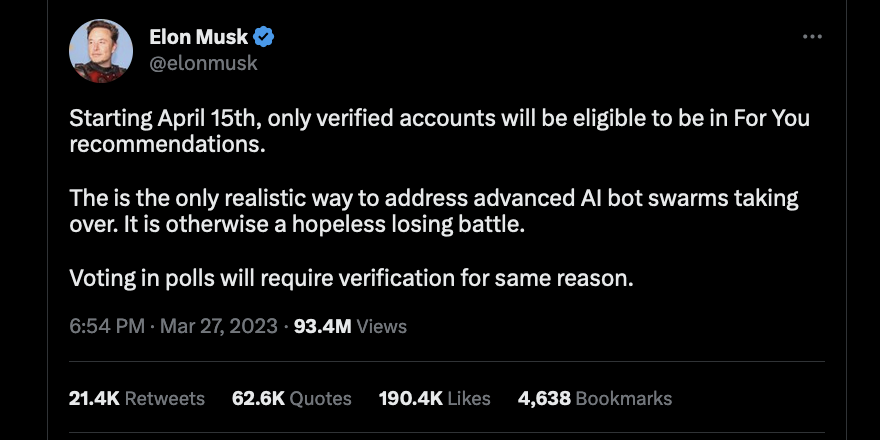

One should never have to use their true identity for any online service ever.
We're like the band of paleolithic humans who crossed the land bridge to what would become North America.
Prior to the introduction is where the two versions of the paper differ, and where we see a negative bias seems to have crept into the 2016 version.
The 2015 jumps into the introduction, but the 2016 includes a "Non-technical summary" before the introduction. The summary begins like this:
"This paper extrapolates the growth of Bitcoin as a medium of exchange and conducts the following thought experiment: Suppose that the use of Bitcoin has grown to such an extent that it has replaced existing fiat currencies and has become the predominant medium of exchange or at least the backing for the predominant medium of exchange in a large group of countries."
This presupposition is flawed in my opinion, due to the fact that Bitcoin is not designed, nor is it technically capable of being a worldwide medium of exchange (unless payment layers are built on top**). A Bitcoin Standard would come about not because of Bitcoin's universal medium of exchange capability, but because of it's universal store of value capability COMBINED with it's robustness as a network which has the potential to withstand attack from a nation state (See Erik Voskuil's Axiom Of Resistance). It is these two qualities in tandem which make Bitcoin a comparable asset to gold, in that like gold, there is no way for governments to control the protocol. In the case of gold the protocol is the atomic property of the metal. In the case of gold the protocol is determined by node software that each user chooses to run independently.
If I could amend this section (which exists in a different section of the 2015 paper as well) I would presume the attainment of a global gold standard through the organic, and widespread use of Bitcoin for any purpose at all, but chiefly as a savings tool for the currency, and as a settlement technology for bitcoin the network.
This summary section of the 2016 version recaps the points made in the abstract, but highlights a 4th point:
"4. There would still be financial crises, because they can occur under any fractional reserve financial system."
This is quite true, so I strongly agree with Weber that a feature of the Bitcoin standard would include occasional banking crises. This is actually not the negative part yet. The negative part is next. He writes:
"The paper concludes by speculating that even if the Bitcoin standard were to come into existence, it would not last long, for two reasons: (1) The payments world is changing so rapidly that there will be a technological innovation that provides a potential medium of exchange with the same or greater benefits of Bitcoin or with lower costs. Such an innovation could come either from the private sector or from the government. (2) There would be pressure to return to a fiat money system so that a more activist monetary policy could be pursued."
**Part 1 above is nullified by the fact that Bitcoin requires payment layers. It's universal usage via these layers would obsolete any payment technology and or shitcoin which promised "faster cheaper." The first draft of this paper was published before the Lightning paper by Poon and Dryja came out. So Weber was likely unaware of efforts to scale Bitcoin in layers. Therefore this caveat can be disregarded entirely in my opinion. But to throw even more finality on the subject, it's worth pointing out that "faster, cheaper payments) is an illusion when you understand that "fastness" refers to settlement time, and settlement time is a function of energy expended by the network, NOT by simply changing a perameter in the code to show "faster" confirmations. For a more complete explanation of this please see my tweet thread from 2021: https://twitter.com/ProgrammableTx/status/1394530758358798341?s=20
Weber's second point about pressure to return to a fiat money standard so that activist monetary policy could be pursued is an extremely valid point. But it was much more valid in 2015 and 1016 than it is today. the assertion was made prior to the events of 2020-2023 which have demonstrated the frailties and abuse which is inevitable when activist monetary policy is enacted. This question is a political question which does not present an obvious solution to the financial game theory. Remember that the premise of the paper is that the world has reach a global bitcoin standard through organic use, any citizens or politicians campaigning for a return to activist monetary policy would exist alongside holders of Bitcoin, both nations and individuals. How these competing interests play out is anyone's guess. Especially if you see this question in light of my alteration to Weber's premise, namely that the global bitcoin standard has come about because it is already used by citizens of the world for savings and for exchange. If that state of adoption has occurred then a political campaign to undermine it would face entrenched interests.
Ug, sorry for a few critical typos above, including two places where the word "gold" mistakenly appears instead of "Bitcoin."
Yes I'm really happy to have unearthed the original draft. It echoes literally everything I've been thinking about, or rather, my thoughts have echoed his since he was 7 years ahead of me.
Good to see you over here on Nostr btw! It's like we've all picked up and moved to a new school district or something.
Prior to the introduction is where the two versions of the paper differ, and where we see a negative bias seems to have crept into the 2016 version.
The 2015 jumps into the introduction, but the 2016 includes a "Non-technical summary" before the introduction. The summary begins like this:
"This paper extrapolates the growth of Bitcoin as a medium of exchange and conducts the following thought experiment: Suppose that the use of Bitcoin has grown to such an extent that it has replaced existing fiat currencies and has become the predominant medium of exchange or at least the backing for the predominant medium of exchange in a large group of countries."
This presupposition is flawed in my opinion, due to the fact that Bitcoin is not designed, nor is it technically capable of being a worldwide medium of exchange (unless payment layers are built on top**). A Bitcoin Standard would come about not because of Bitcoin's universal medium of exchange capability, but because of it's universal store of value capability COMBINED with it's robustness as a network which has the potential to withstand attack from a nation state (See Erik Voskuil's Axiom Of Resistance). It is these two qualities in tandem which make Bitcoin a comparable asset to gold, in that like gold, there is no way for governments to control the protocol. In the case of gold the protocol is the atomic property of the metal. In the case of gold the protocol is determined by node software that each user chooses to run independently.
If I could amend this section (which exists in a different section of the 2015 paper as well) I would presume the attainment of a global gold standard through the organic, and widespread use of Bitcoin for any purpose at all, but chiefly as a savings tool for the currency, and as a settlement technology for bitcoin the network.
This summary section of the 2016 version recaps the points made in the abstract, but highlights a 4th point:
"4. There would still be financial crises, because they can occur under any fractional reserve financial system."
This is quite true, so I strongly agree with Weber that a feature of the Bitcoin standard would include occasional banking crises. This is actually not the negative part yet. The negative part is next. He writes:
"The paper concludes by speculating that even if the Bitcoin standard were to come into existence, it would not last long, for two reasons: (1) The payments world is changing so rapidly that there will be a technological innovation that provides a potential medium of exchange with the same or greater benefits of Bitcoin or with lower costs. Such an innovation could come either from the private sector or from the government. (2) There would be pressure to return to a fiat money system so that a more activist monetary policy could be pursued."
**Part 1 above is nullified by the fact that Bitcoin requires payment layers. It's universal usage via these layers would obsolete any payment technology and or shitcoin which promised "faster cheaper." The first draft of this paper was published before the Lightning paper by Poon and Dryja came out. So Weber was likely unaware of efforts to scale Bitcoin in layers. Therefore this caveat can be disregarded entirely in my opinion. But to throw even more finality on the subject, it's worth pointing out that "faster, cheaper payments) is an illusion when you understand that "fastness" refers to settlement time, and settlement time is a function of energy expended by the network, NOT by simply changing a perameter in the code to show "faster" confirmations. For a more complete explanation of this please see my tweet thread from 2021: https://twitter.com/ProgrammableTx/status/1394530758358798341?s=20
Weber's second point about pressure to return to a fiat money standard so that activist monetary policy could be pursued is an extremely valid point. But it was much more valid in 2015 and 1016 than it is today. the assertion was made prior to the events of 2020-2023 which have demonstrated the frailties and abuse which is inevitable when activist monetary policy is enacted. This question is a political question which does not present an obvious solution to the financial game theory. Remember that the premise of the paper is that the world has reach a global bitcoin standard through organic use, any citizens or politicians campaigning for a return to activist monetary policy would exist alongside holders of Bitcoin, both nations and individuals. How these competing interests play out is anyone's guess. Especially if you see this question in light of my alteration to Weber's premise, namely that the global bitcoin standard has come about because it is already used by citizens of the world for savings and for exchange. If that state of adoption has occurred then a political campaign to undermine it would face entrenched interests.
I've spent the last two years contemplating the classical gold standard, looking for glimpses of how a Bitcoin standard could work.
Somehow I missed a fantastic paper on the subject.
It's called The Bitcoin Standard: Lessons From The Gold Standard. It was written by Warren E. Weber, who was then a visiting scholar at the Bank Of Canada.
https://www.bankofcanada.ca/wp-content/uploads/2015/12/bitcoin-standard-lessons.pdf
Bitcoin Magazine wrote about this paper in 2017: https://bitcoinmagazine.com/culture/bank-canada-report-imagining-bitcoin-standard-financial-system
The Bitcoin Magazine article summarizes the paper as being negative on the idea of a Bitcoin Standard. Upon reading the actual paper for myself, however, I don't think the conclusion is negative at all. At least not the ORIGINAL version....
See, there are two versions of this paper on the internet. The first was written in 2015. The paper was then revised in 2016. And the conclusions of both of these drafts are different in FASCINATING ways. The 2015 version, as a complete work, is amazing, and in my opinion the better paper. The conclusion is nuanced, though somewhat incomplete IMO for several reasons. But overall the 2015 paper posits a bold and sound thesis: that a Bitcoin standard WOULD ACTUALLY WORK in practice.
Weber's paper is remarkably ahead of his time. I mean, Saifedean's Book, "The Bitcoin Standard" seemed radical when it was published a full 3 years after Weber.
My guess is that Weber's ideas must have surprised a few people in the banking establishment. I further surmise that he got some feedback which caused him to throw in a more downbeat ending to the 2016 version.
I'll summarize both versions over the next couple weeks in a thread here.
In short, I am even more convinced now that a global Bitcoin standard would work. I think the author would agree.
Thanks for your great work Warren Weber.

I've been going down the Hi-Res audio rabbit hole and learned how to buy from ototoy.jp (RIP my wallet). I ran across this comment for MacOS which was immediately applicable:
"The primary issue many don't realise is how Mac's are configured to play anything other than the standard 44.1khz/16bit output. To make this work, you must configure the output stream using the "Audio MIDI Setup" application found in the Utilities folder (from the Window menu, select 'Show Audio Devices', pick the output and set the Format to your choice of output). The maximum frequency is entirely based on the hardware capabilities. My 12 year old Mac Mini is quite capable of outputing from iTunes at 96khz at 24bit through the headphone out (which doubles as a digital toslink output) to my Pioneer receiver that can process the toslink input at 96khz/24bit. Has worked just fine for this purpose for years (and yes I've verified that the Pioneer is indeed processing 96khz/24bit data). Newer Macs can natively handle 192khz, though the toslink out via headphone jack was depreciated in more recent years, likely because few knew it existed."
Source: https://www.whathifi.com/advice/high-resolution-audio-everything-you-need-to-know
The Toslink/headphone output was always one of the coolest features of my macs. It's an unsung hero feature for sure. I have an unwieldy collection of optical cables of different lengths I've used over the years.

I consider this a possibility.